

1.6 Phylogenetic status, characteristics and geographical distribution of the following: (A) Prepleistocence fossil primates- Oreopithecus. (B) South and East African hominids-Plesianthropus/Australopithecus Africau Paranthropus, Australopithecus. (C) Paranthropus, Australopithecus. .Paranthropus-Homo erectus-Homo erectus javanicus, Homo erectus pekinensis. (D) Homo Heidelbergensis. (E) Neanderthal man-La-chapelle-aus-saints (Classical type), Mt.Carmelites types (Progressive type). (F) Rhodesian man. (G) Homo sapiens-Cromognon, Grimaldi, Chancelede.
Official Syllabus: Paper I, Unit 1.6
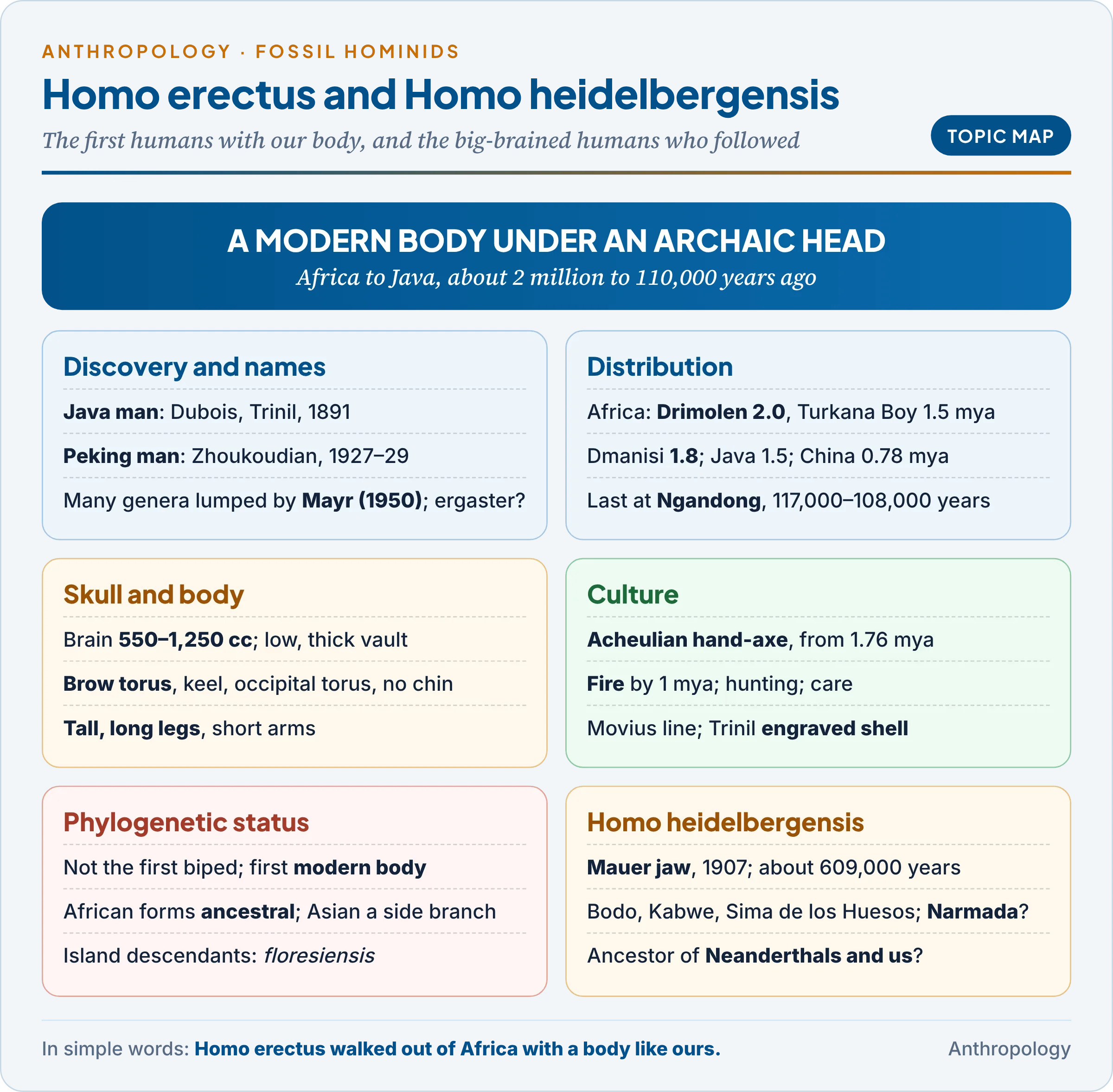
This article covers Homo erectus, including the Asian forms H. erectus javanicus (Java man) and H. erectus pekinensis (Peking man), and Homo heidelbergensis. The forms that came before are in Unit 1.6a: in brief, the small-brained, bipedal australopithecines lived in Africa from 4.2 to 1 million years ago, and early Homo (H. habilis, about 2.3–1.4 million years ago) added a slightly larger brain and Oldowan stone tools. Neanderthals, Rhodesian man and the early Homo sapiens follow in Unit 1.6c.
1. Homo erectus: Discovery, Names and Status
In simple words
Homo erectus, “upright man”, is the first human species with a body like ours: tall, long-legged and fully built for walking and running. It appeared in Africa about 2 million years ago, was the first hominin to leave Africa, and survived in Java until about 110,000 years ago. Its fossils were found under many different names before scientists recognised them as one species.
1.1 Java man: the first find
In 1887 a young Dutch army doctor, Eugène Dubois, sailed to the Dutch East Indies to look for the “missing link” that the German biologist Ernst Haeckel had predicted in Asia. At Trinil, on the Solo River in Java, his team found a molar and a skullcap (1891) and, nearby, a thigh bone (1892). The skullcap was low and thick with a heavy brow ridge, but held a brain of about 900 cc, twice an ape’s; the femur was straight and human. Dubois first called it Anthropopithecus erectus, then (1894) Pithecanthropus erectus, “upright ape-man”. The case shows why the species matters: here, for the first time, was a creature with an upright human body and a primitive head.
- Dubois’s critics called it a giant gibbon or a deformed modern man; he hid the fossils for years. Later studies showed that the femur may be younger than the skullcap, but the skullcap itself is an early human.
1.2 Many names, one species
| Old name | Find | Region | Now |
|---|---|---|---|
| Pithecanthropus erectus (Dubois, 1894) | Trinil skullcap | Java | H. erectus (Java man) |
| Sinanthropus pekinensis (Davidson Black, 1927) | Zhoukoudian teeth and skulls | China | H. erectus (Peking man) |
| Meganthropus palaeojavanicus | Massive Sangiran jaws (1941) | Java | H. erectus or an ape |
| Telanthropus capensis (Broom and Robinson, 1949) | Swartkrans jaw | South Africa | H. erectus |
| Atlanthropus mauritanicus (Camille Arambourg, 1954) | Ternifine (Tighenif) jaws | Algeria | H. erectus |
| Homo ergaster (Colin Groves and Vratislav Mazák, 1975) | Koobi Fora jaw | Kenya | African H. erectus (see box) |
| Homo georgicus (2002) | Dmanisi skulls | Georgia | Early H. erectus |
- Why it belongs in Homo. The australopithecines grade into early Homo and early Homo into H. erectus, so any boundary is partly arbitrary. H. erectus is placed firmly in our genus because it combines human body size and proportions, a brain that overlaps the lower end of the modern range, a planned tool culture and a wide, human-like range across continents. From the neck down it is almost indistinguishable from us; only the head is archaic.
- In 1950 the German-American evolutionary biologist Ernst Mayr, applying the biological species concept of the synthetic theory (Unit 1.4b), argued that so many genera for one grade of human made no sense and placed them all in Homo erectus. This is why the syllabus uses subspecies names, H. erectus javanicus and H. erectus pekinensis: Java and Peking man are regional populations of one species.
Common confusion
Is Homo ergaster a different species from Homo erectus? It depends on whether you are a lumper or a splitter. Splitters call the early African fossils (about 1.9–1.4 million years, such as Turkana Boy) H. ergaster, “workman”, because their skulls are thinner-walled and lack some Asian specialisations; they reserve H. erectus for the Asian forms. Lumpers call all of them H. erectus, with African and Asian populations. The Dmanisi skulls, which show the range of both within one site, favour lumping, and this note follows that usage (“African H. erectus“).
2. Geographical Distribution
In simple words
Homo erectus lived across a huge area: from South and East Africa through Georgia and India to China and Java. It spread out of Africa quickly, reaching Georgia by 1.8 million years ago and Java by about 1.5 million years ago, and its last members lived in Java until about 110,000 years ago. Few species of mammal have ever had such a wide range.
The table lists the key specimens region by region; read the date column with the dating method, because the dates carry the argument about where and when H. erectus arose.
| Specimen | Site | Date (method) | Traits | Significance |
|---|---|---|---|---|
| DNH 134 (child’s braincase) | Drimolen, South Africa | 2.04–1.95 mya (uranium–lead, palaeomagnetism, ESR) | Small braincase, erectus shape | Oldest H. erectus; beside Paranthropus |
| KNM-ER 3733 | Koobi Fora, Kenya | 1.78 mya (argon dating) | Brain about 850 cc; thin vault | Classic early African skull |
| Turkana Boy (KNM-WT 15000) | Nariokotome, West Turkana; found by Kamoya Kimeu, 1984 | About 1.5 mya (argon dating) | Nearly complete skeleton; tall, slender; brain about 880 cc | The body of H. erectus |
| OH 9 | Olduvai, Tanzania (Louis Leakey, 1960) | About 1.4 mya (argon dating) | Brain about 1,060 cc; huge brow | Large-brained African form |
| Daka | Bouri, Ethiopia (2002) | About 1.0 mya (argon dating) | Brain about 995 cc | Links African and Asian forms |
| Tighenif (Ternifine) jaws | Algeria | About 0.7 mya (fauna) | Robust jaws | North Africa |
| Dmanisi skulls 1–5 | Georgia | 1.85–1.77 mya (argon dating, palaeomagnetism) | Brains 546–775 cc; short bodies | Earliest outside Africa |
| Trinil 2; Sangiran 17; Mojokerto child | Java, Indonesia | About 1.5–0.5 mya (argon dating, palaeomagnetism) | Thick vault, keel, 800–1,000 cc | Java man |
| Ngandong (Solo man) crania | Solo River, Java | 117,000–108,000 years (uranium-series, luminescence, 2020) | Brains up to about 1,250 cc | Last H. erectus |
| Peking man (about 40 individuals) | Zhoukoudian, near Beijing | About 780,000–400,000 years (cosmogenic burial dating, uranium-series) | Brain 850–1,225 cc; shovel incisors | Peking man |
| Gongwangling (Lantian) | Shaanxi, China | About 1.63 mya (palaeomagnetism) | Small, thick skull | Early East Asia |
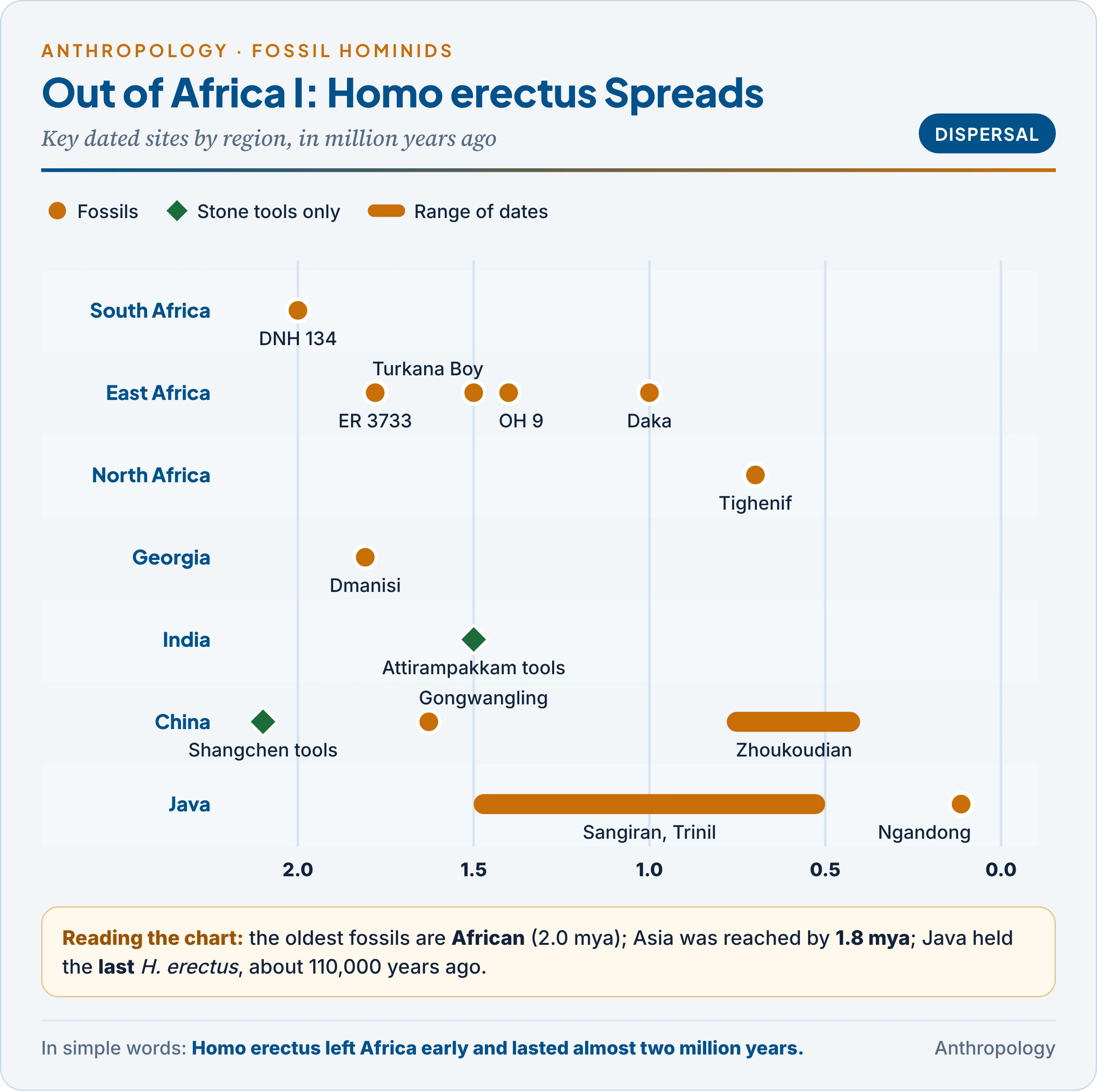
Two points stand out. First, the oldest dates are African (Drimolen, Koobi Fora), so H. erectus most likely arose in Africa and spread out: “Out of Africa I“, about 1.8 million years ago. Second, stone tools at Shangchen, China (about 2.1 million years, 2018) are older than any erectus fossil outside Africa, which suggests that some earlier hominin, or an even earlier erectus, left Africa first.
- India: no undisputed H. erectus fossil, but Acheulian hand-axes at Attirampakkam, Tamil Nadu, about 1.5 million years old (Shanti Pappu and colleagues, 2011), and at Isampur in the Hunsgi valley, Karnataka (K. Paddayya), show that toolmakers of the erectus grade lived in South Asia. The Narmada skull is discussed in §8.
- Europe: H. erectus in the strict sense is doubtful. The earliest Europeans, at Atapuerca, Spain (Sima del Elefante, about 1.2–1.1 million years; Gran Dolina, about 850,000 years, Homo antecessor), are erectus-like early Homo; older books, like the syllabus, call the later European forms “Homo erectus heidelbergensis” (§7).
- Why did it leave Africa? Nothing suggests a planned migration. Grassland expanded across Africa and southern Asia about 2 million years ago, and a meat-eating predator follows its prey: a population that moved only a few kilometres a generation could cross from Africa to Java in well under 100,000 years. The Levant (Ubeidiya, Israel, about 1.4 million years) and the Caucasus (Dmanisi) were the corridors.
- Why so widespread? A long-legged body able to travel far, a varied diet with meat, tools and, later, fire let H. erectus live in tropical, temperate and seasonal environments; it adapted chiefly by culture, not by splitting into many biological forms.
3. Physical Characteristics
In simple words
Below the neck, Homo erectus looked almost like us: tall, with long legs and short arms. Its head was different: a long, low, thick-walled skull with a heavy bony brow, no chin, and a brain about two-thirds the size of ours. Most of its “primitive” features are in the skull.
3.1 The skull
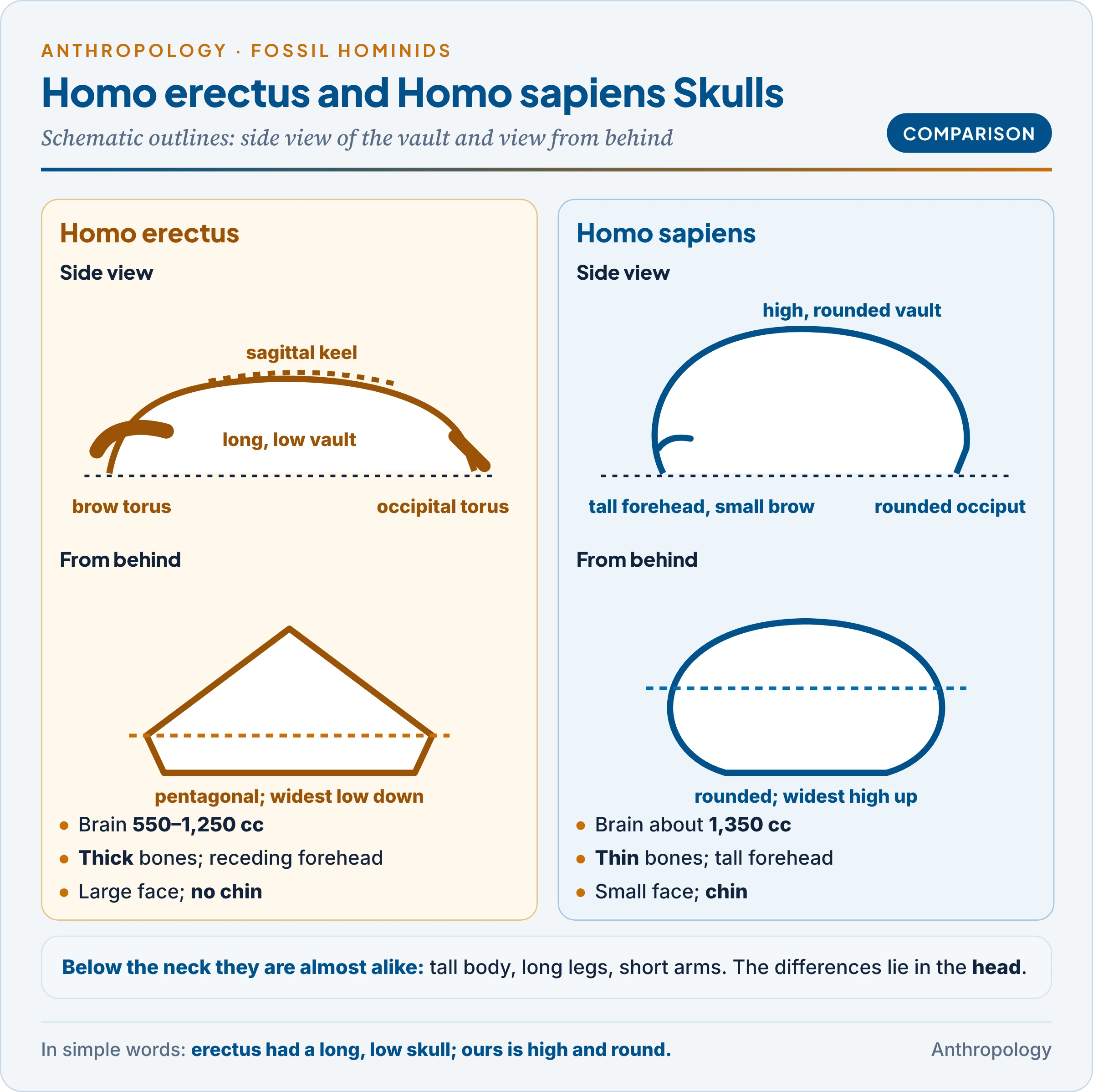
- Brain about 550–1,250 cc, average near 900–1,000 cc (modern about 1,350 cc). Small at Dmanisi and in early Africa, larger in later Java and China: brain size rose within the species over a million years.
- Platycephaly: a long, low, flat vault, with the widest point low down, near the ears, so the skull seen from behind is pentagonal (tent-shaped). In H. sapiens the widest point is high on the parietals and the outline is rounded.
- Supraorbital torus: a continuous bar of bone over both eyes, with a groove behind it (post-orbital sulcus) and a receding forehead; postorbital constriction (narrowing behind the eye sockets).
- Sagittal keel: a low ridge along the midline of the vault (not a chewing crest like Paranthropus‘s).
- Occipital torus: a bony bar across the back of the skull, which is sharply angled where the neck muscles attached.
- Thick cranial bones, about twice the thickness of ours.
- Face and teeth: a large, projecting face with a broad nose; no chin; teeth smaller than H. habilis‘s but larger than ours; shovel-shaped incisors (hollowed on the tongue side) in Peking man; enlarged pulp chambers (taurodontism) reported in some molars.
- Foramen magnum fully under the skull: a habitual biped.
- Why such a skull? The thick vault and heavy tori are best explained as a robust build throughout the skeleton combined with a still projecting face: the brow bar braces the face against chewing forces where there is no tall forehead to do so. The pentagonal rear view arises because the brain had grown longer and wider at the base but not yet upward at the parietals, the region that expanded only in H. sapiens.
3.2 Java man and Peking man compared
The two Asian populations differ in degree, Peking man being later and slightly more advanced.
| Trait | H. erectus javanicus (Java man) | H. erectus pekinensis (Peking man) |
|---|---|---|
| Main sites | Trinil, Sangiran, Ngandong (Java) | Zhoukoudian Locality 1 (China) |
| Discoverers | Eugène Dubois (1891); Ralph von Koenigswald (1936–41) | Otto Zdansky (teeth, 1921–23); Davidson Black (named 1927); Pei Wenzhong (first skullcap, 2 December 1929); Franz Weidenreich (described 1935–41) |
| Date | About 1.5–0.5 mya (Ngandong 117,000–108,000 years) | About 780,000–400,000 years |
| Brain | About 800–1,000 cc (Trinil about 900) | About 850–1,225 cc (mean about 1,040) |
| Vault | Extreme platycephaly; strong keel | Less flat; keel reduced; slightly higher forehead |
| Brow | Massive continuous torus | Torus still heavy but more arched |
| Jaw and teeth | Large jaw; occasional diastema; some projecting canines | Smaller jaw; no diastema; shovel incisors; trace of a chin region |
| Culture | Few tools; Trinil engraved shell (§5) | Quartz choppers and flakes; burnt bones |
The differences are of degree, not kind: both share the long, low, thick-walled erectus skull. Peking man is younger and has a somewhat larger brain, higher forehead and smaller jaw, which fits the gradual brain increase seen within the species.
- The lost fossils. The Zhoukoudian originals vanished in December 1941, while being shipped to the United States during the Japanese occupation. Our knowledge rests on Weidenreich’s casts and descriptions, which is why he matters so much in this topic.
3.3 The body
- Turkana Boy (about 8 years old at death by dental age) was about 1.5–1.6 m tall; as an adult he might have reached about 1.6–1.8 m. H. erectus was the first hominin with modern body proportions: long legs, short arms, a narrow pelvis and a barrel-shaped chest.
- A body for heat and distance. Its tall, slender, linear build gives a large skin surface for its volume, so it shed heat in the hot, open tropics (Allen’s and Bergmann’s rules, Unit 9.7). Long legs, a strong heel and arched feet, and an enlarged gluteus maximus fitted it for long-distance walking and running.
- Robust bones: thick-walled limb bones, a flattened femur shaft (platymeria) and a low femoral neck, signs of heavy daily activity.
- Dmanisi people were shorter (about 1.45–1.66 m) with small brains, showing the species’ range at its start.
- Growth: tooth-growth lines show that Turkana Boy matured faster than a modern child but slower than an ape, an intermediate life history.
4. Homo erectus Compared with Homo habilis and Homo sapiens
The table answers two common questions at once: what is new in H. erectus compared with its predecessor, and what still separates it from us.
| Feature | Homo habilis | Homo erectus | Homo sapiens |
|---|---|---|---|
| Brain | 510–800 cc | 550–1,250 cc | About 1,350 cc |
| Vault | Small, rounded | Long, low, thick; pentagonal from behind | High, rounded, thin |
| Forehead and brow | Small brow | Continuous torus; receding forehead | Vertical forehead; small brow |
| Occiput | Rounded | Angled, with a torus | Rounded |
| Face | Projecting | Large, projecting; broad nose | Small, tucked under the brain |
| Chin | Absent | Absent | Present |
| Teeth | Large | Smaller | Smallest |
| Body | Small, long arms | Tall, long legs, short arms | Tall, long legs, short arms |
| Pelvis | Australopith-like | Narrow, thick-boned | Narrow; wider birth canal |
| Tools | Oldowan | Acheulian | Blade and symbolic cultures |
- Similarities with H. sapiens: a fully modern upright skeleton (foramen magnum, S-shaped spine, bowl pelvis, valgus knee, arched foot), human body proportions and size, a reduced face and teeth compared with earlier hominins.
- Differences: almost all lie in the skull: brain size, vault shape and thickness, brow and occipital tori, keel, chin and face.
The comparison shows a step pattern: the body became modern with H. erectus about 2 million years ago, while the head became modern only with H. sapiens (larger, rounder brain, smaller face). This is mosaic evolution in its later phase (Unit 1.4b).
5. The Culture of Homo erectus
In simple words
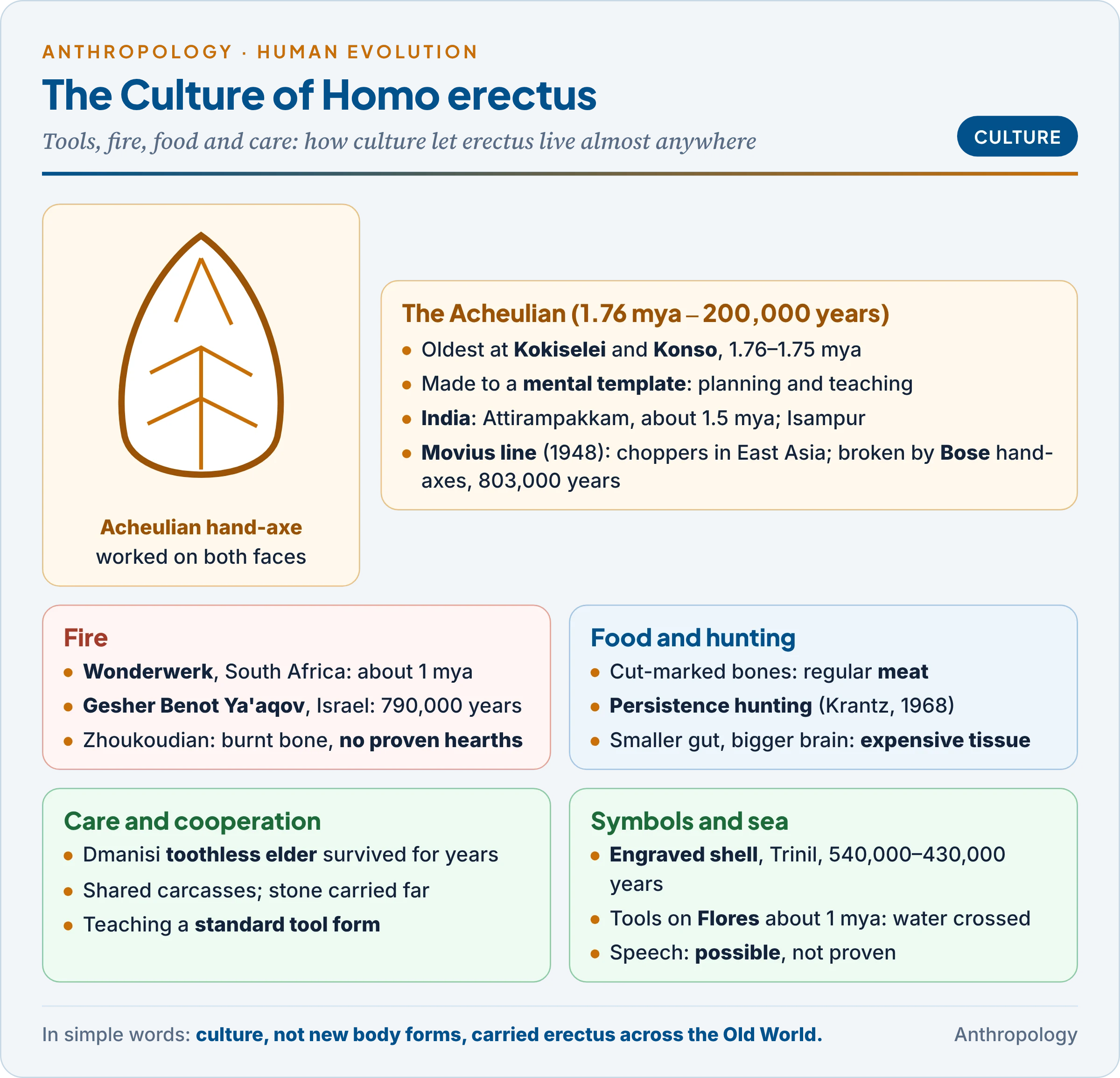
Homo erectus made the first planned, symmetrical stone tool, the Acheulian hand-axe, and used it for over a million years. It probably learned to control fire, hunted and butchered large animals, cared for its weak and travelled across water. These skills let it live in places no earlier hominin could.
5.1 The Acheulian hand-axe
- What it is: a biface, a stone worked on both faces into a pear or teardrop shape with a sharp edge all round, plus cleavers (a straight cutting edge) and picks. Named after Saint-Acheul, France.
- When: the oldest are at Kokiselei, West Turkana, about 1.76 million years (Christopher Lepre and colleagues, 2011) and at Konso, Ethiopia (about 1.75 million years); the tradition lasted until about 200,000 years ago.
- Why it matters: an Oldowan chopper needs a few blows; a hand-axe needs a mental template of the final shape, planning and many controlled strikes, and is made to a standard across continents. It is therefore evidence of planning, teaching and imitation, the bases of culture.
- The Movius line. The American archaeologist Hallam Movius (1948) observed that hand-axes were common in Africa, Europe, West Asia and India but rare east of a line through north-east India, where chopper-chopping tools prevailed (Choukoutienian of Zhoukoudian, Patjitanian of Java, Soan of the Siwaliks).
- Explanations offered: bamboo used instead of stone in East Asia; poor raw materials; an early dispersal before the Acheulian.
- Challenge: hand-axes about 803,000 years old in the Bose Basin, China (Hou Yamei and colleagues, 2000), and the early Indian Acheulian show the line is a difference of frequency, not an absolute boundary.
The table sets the Acheulian against the Oldowan of H. habilis (Unit 1.6a), and its lead point is the change from opportunistic flakes to a designed form.
| Feature | Oldowan | Acheulian |
|---|---|---|
| Makers | Early Homo, perhaps Paranthropus | H. erectus, H. heidelbergensis |
| Time | About 2.6–1.7 mya | About 1.76 mya – 200,000 years |
| Typical tools | Choppers, scrapers, sharp flakes | Hand-axes, cleavers, picks |
| Working | One face, a few blows, hard hammer | Both faces, many blows; later a soft hammer |
| Design | Shape follows the stone | Shape follows a mental template |
| Indian sites | Rare | Attirampakkam, Isampur, Hunsgi, Didwana, Bhimbetka |
The Acheulian lasted with little change for about 1.5 million years, which shows both a learned tradition passed between generations and a slow pace of innovation compared with later humans. India’s long Acheulian record, first noticed when the British geologist Robert Bruce Foote found a hand-axe at Pallavaram, near Chennai, in 1863, is examined in Unit 1.8b.
5.2 Fire, hunting and home bases
- Fire: the strongest early evidence is burnt bone and plant ash in Wonderwerk Cave, South Africa, about 1 million years ago (Francesco Berna and colleagues, 2012), and hearths at Gesher Benot Ya’aqov, Israel, about 790,000 years ago (Naama Goren-Inbar, 2004). The Zhoukoudian “hearth” layers were re-examined in 1998 (Steve Weiner and colleagues): they contain burnt bone but no true ash hearths, so Peking man’s fire use is probable but not proven. Fire gave warmth (enabling life in cold Asia and Europe), protection from predators, light that lengthened the day, and cooked food (Richard Wrangham’s cooking hypothesis, Unit 1.4a). Whether erectus could make fire, rather than keep natural fire, is unknown.
- Hunting or scavenging: cut-marked bones of antelope, horse and elephant show regular meat-eating. The American anthropologist Grover Krantz (1968) argued that erectus practised persistence hunting, running animals down over hours, which needed memory and planning and so selected for a larger brain. Dennis Bramble and Daniel Lieberman (2004) linked its long legs, sweat cooling and spring-like feet to endurance running. Others see scavenging of carnivore kills as just as important.
- Diet and the brain: the British anthropologists Leslie Aiello and Peter Wheeler (1995) argued in the “expensive tissue hypothesis” that a large brain is energetically costly, so it could grow only if another costly organ shrank. H. erectus had a smaller gut (its narrow pelvis and barrel chest leave less room than an australopith’s funnel-shaped trunk), possible only on high-quality food: meat, marrow and, perhaps, cooked food. Diet, tools and brain thus formed a feedback loop (Unit 1.4a).
- Home bases and division of labour: older books describe erectus groups sharing food at a home base, women gathering and men hunting. The archaeology shows repeated use of places and food carried to them; the exact division of labour is inference.
- Clothing, shelter and social life: cave and open-air camps; skins were probably used in cold regions, but direct evidence is lacking. Claims that erectus began rituals or the nuclear family are speculation; what the evidence does show is cooperation: sharing carcasses, carrying stone over kilometres and teaching a standard tool form.
5.3 Care, symbols, sea crossings and speech
- Care for the weak: a toothless old individual from Dmanisi (D3444; David Lordkipanidze and colleagues, 2005) lived for years after losing his teeth, perhaps with help from others.
- Symbols: a freshwater shell engraved with a zigzag from Trinil, about 540,000–430,000 years old (Josephine Joordens and colleagues, 2015), is the oldest known geometric engraving.
- Sea crossing: stone tools on Flores, Indonesia, about 1 million years old, lie beyond a sea gap never bridged by land, implying the ability to cross water, perhaps by accident on rafts.
- Speech: the standardised Acheulian suggests teaching and possibly some language. The narrow spinal canal of Turkana Boy (Ann MacLarnon, 1993) was read as limited breath control for speech, but Dmanisi vertebrae (2006) are modern, so the boy’s may have been abnormal.
6. Phylogenetic Status of Homo erectus
In simple words
Is Homo erectus our ancestor? Most scientists think that African Homo erectus gave rise, through Homo heidelbergensis, to both Neanderthals and modern humans. The Asian populations of Java and China, though, are usually seen as cousins who died out, not as our direct ancestors.
6.1 Was it the earliest erect man? (1983 question)
No. Habitual bipedalism is much older: the Laetoli footprints (3.66 million years), Lucy’s pelvis and knee (3.2 million years), and the femur of Orrorin (about 6 million years) all show upright walking (Unit 1.6a). The name erectus was given in 1894, when the Trinil femur was the oldest upright human bone known. What H. erectus first shows is the fully modern striding body without climbing adaptations.
6.2 Ancestor or side branch?
| View | Proposed by | Argument | Problem |
|---|---|---|---|
| Direct ancestor of H. sapiens everywhere (multiregional) | Franz Weidenreich (1943); later Milford Wolpoff, Alan Thorne | Regional continuity: shovel incisors and flat faces link Peking man to living East Asians, Java to Australians; gene flow kept one species | Genetics shows modern humans came out of Africa recently (Unit 1.6c) |
| African erectus ancestral, Asian erectus a side branch | Christopher Stringer, Peter Andrews and others | Asian forms have specialised traits (very thick vault, keel, angled occiput) absent in H. sapiens | Wide variation blurs the line |
| H. ergaster ancestral; H. erectus (Asian) a separate species | Bernard Wood and other splitters | Thin-walled African skulls are less specialised | Dmanisi variation suggests one species |
| Separate lineage | Louis Leakey (1960s) | H. sapiens descends directly from H. habilis; erectus a cousin | Little support today |
- “Too specialised to be our ancestor” (1981 question). The thick vault, heavy tori and keel of Asian erectus are derived traits, peculiar to that line. A specialised population is unlikely to reverse these traits, so it is better placed as a side branch. This argument does not apply to the less specialised African forms, which most see as the source of later Homo.
- A long, successful species. H. erectus lasted from about 2 million to about 110,000 years ago, nearly ten times as long as H. sapiens so far, with long periods of little change, a case of stasis (long stability) (Unit 1.4b, punctuated equilibrium).
- Descendants in island Asia? Homo floresiensis (Flores, 2004; about 100,000–50,000 years; about 1.1 m tall, brain about 420 cc) and Homo luzonensis (Luzon, Philippines, 2019) may be dwarfed descendants of an erectus population isolated on islands (insular dwarfism), though some see a smaller, earlier ancestor.
- A racist misuse. The American anthropologist Carleton Coon (The Origin of Races, 1962) claimed that five races crossed the sapiens threshold separately from regional erectus populations, at different times; the claim was racist and unsupported and is rejected.
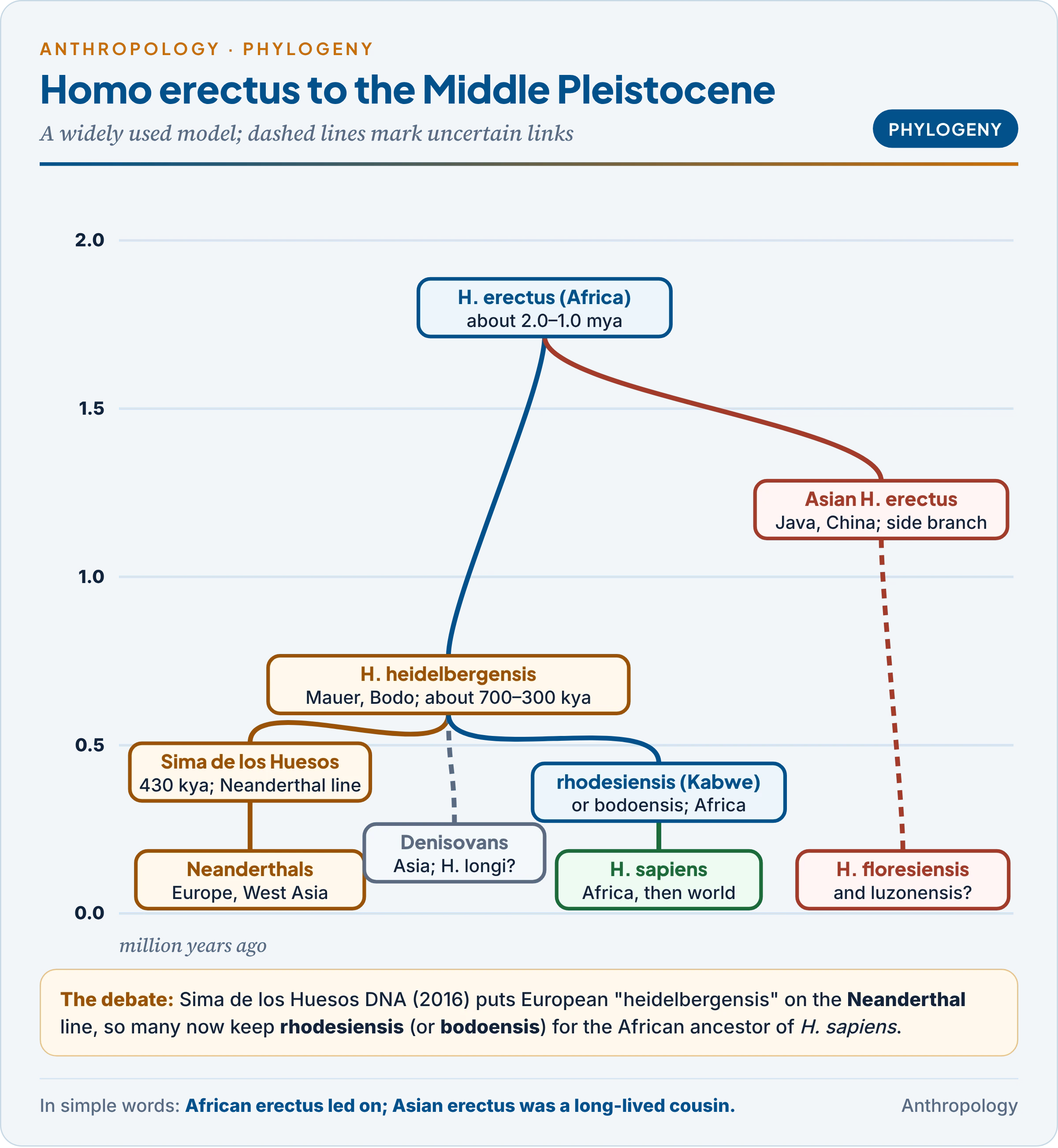
Evaluation. H. erectus is the pivotal grade between early Homo and later humans: the first with our body, our travels and a planned tool culture. Its African populations most probably led, through H. heidelbergensis, to Neanderthals and modern humans, while its East and South-East Asian populations were long-lived cousins that died out about 110,000 years ago.
7. Homo heidelbergensis
In simple words
Homo heidelbergensis is named after a heavy lower jaw found near Heidelberg, Germany, in 1907. It is used for big-brained humans who lived in Africa and Europe about 700,000 to 200,000 years ago, between Homo erectus and the later Neanderthals and modern humans. Scientists argue about which fossils belong to it, and whether it should be split.
7.1 The Mauer jaw
- Discovery: on 21 October 1907 a workman, Daniel Hartmann, found a lower jaw in the Grafenrain sand pit at Mauer, about 10 km south-east of Heidelberg. The German anthropologist Otto Schoetensack named it Homo heidelbergensis in 1908.
- Date: about 609,000 years (± 40,000) by combined luminescence and ESR/uranium-series dating of the sands (Günther Wagner and colleagues, 2010); older books give 450,000 or 0.35–0.45 million years.
- Associated fauna: elephant, rhinoceros, bison, horse, deer and lion, a warm-period Middle Pleistocene community.
- Characteristics:
- Massive, broad and chinless, with a very wide ascending ramus (the upright rear part of the jaw).
- Thick body where the two halves meet; a rounded, high condyle; a parabolic tooth row with no diastema.
- Teeth of modern human size; small canines that do not project.
- The jaw is primitive, the teeth are modern: a mosaic that made the fossil hard to place.
7.2 Other fossils and the African and European record
The fossils most often grouped as H. heidelbergensis (in the broad sense) are listed below.
| Specimen | Site | Date (method) | Traits | Significance |
|---|---|---|---|---|
| Bodo cranium | Middle Awash, Ethiopia (1976) | About 600,000 years (argon dating) | Brain about 1,250 cc; huge face; cut marks | Earliest evidence of defleshing a dead person (Tim White, 1986) |
| Kabwe (Broken Hill) | Zambia (1921) | About 299,000 years (2020) | Brain about 1,300 cc; massive brow | “Rhodesian man” (Unit 1.6c) |
| Arago XXI | Tautavel, France (1971) | About 450,000 years | Broad face; projecting brow | European Middle Pleistocene |
| Boxgrove tibia and teeth | England (1993) | About 500,000 years | Robust tibia of a tall body | Butchered horse; a spear-damaged horse shoulder blade |
| Petralona cranium | Greece (1960) | Middle Pleistocene (date debated) | Brain about 1,230 cc | Mixed archaic features |
| Sima de los Huesos (28 or more individuals) | Atapuerca, Spain; Juan Luis Arsuaga | About 430,000 years (uranium-series, luminescence) | Brain about 1,230 cc; Neanderthal-like face and teeth | Nuclear DNA (2016) places them on the Neanderthal line |
| Dali and Jinniushan | China | About 260,000 years | Large brains, flat faces | East Asian Middle Pleistocene |
- Characteristics in general: brain about 1,100–1,400 cc, overlapping the modern range; a thick, double-arched brow ridge; a broader, higher vault than H. erectus, with the widest point moving up; a large, projecting face; no chin; tall, heavily built bodies (about 1.7 m).
7.3 Culture
- Refined Acheulian: thinner, symmetrical hand-axes made with a soft hammer (bone or antler), and by about 500,000–300,000 years the first Levallois (prepared-core) flakes, ancestral to Middle Palaeolithic technology (Unit 1.8b). A red quartzite hand-axe (“Excalibur“) lies with the Sima de los Huesos bones, which may have been deliberately placed in the pit.
- Hunting: at Boxgrove (about 500,000 years), horses were butchered where they fell; a horse shoulder blade bears a round wound probably made by a spear. Stone points from Kathu Pan, South Africa (about 500,000 years), show wear from being hafted (fixed to handles). The famous Schöningen spears of Germany, once dated to about 300,000–400,000 years and credited to H. heidelbergensis, were re-dated in 2025 to about 200,000 years, the time of early Neanderthals.
- Shelter and fire: Terra Amata, Nice, France (Henry de Lumley, 1966), was claimed to have huts and hearths about 400,000 years old, a claim many now doubt; fire becomes more frequent in this period (Beeches Pit, England, about 400,000 years).
7.4 Phylogenetic status
- The classic view: the American palaeoanthropologist Philip Rightmire (1998) and others made H. heidelbergensis the last common ancestor of Neanderthals (in Europe) and modern humans (in Africa), descended from African H. erectus about 700,000–600,000 years ago. Older texts call it “Homo erectus heidelbergensis“, a transition from erectus to Neanderthal.
- The genetic problem. Ancient DNA from Sima de los Huesos (Matthias Meyer and colleagues, 2016) shows that these 430,000-year-old Europeans were already on the Neanderthal line, so the Neanderthal–modern split happened earlier, perhaps 550,000–765,000 years ago. Many European “heidelbergensis” fossils are therefore early Neanderthals, and the Mauer jaw itself may belong near that line.
- Rival proposals:
- Keep H. heidelbergensis for Mauer and closely related European fossils, and call the African ones Homo rhodesiensis (Arthur Smith Woodward’s 1921 name for Kabwe).
- Homo bodoensis (Mirjana Roksandic and colleagues, 2021): a new name for the African Middle Pleistocene ancestor of H. sapiens, based on Bodo; critics argue the rules of naming do not support it.
- Homo antecessor (Gran Dolina, about 850,000 years): enamel proteins (Frido Welker and colleagues, 2020) place it as a sister of the common ancestor of Neanderthals, Denisovans and modern humans, not their direct ancestor.
- Why the name matters. Under the international rules of zoological naming, the oldest available name for a group has priority. If Mauer belongs to the Neanderthal line, H. heidelbergensis cannot also name the African ancestor of modern humans; the next oldest African name is H. rhodesiensis (1921). This is why the 2021 proposal of a new name drew objections.
- Evaluation: “H. heidelbergensis” is best read as a grade of large-brained Middle Pleistocene humans in Africa and Europe, between H. erectus and the later species. Its African members are the likeliest ancestors of H. sapiens, its European members of Neanderthals; this period is often called the “muddle in the middle” because so many fossils resist neat classification.
Common confusion
Is Homo heidelbergensis the same as Rhodesian man? Partly. Rhodesian man (Kabwe, Zambia) is one fossil, an African Middle Pleistocene skull named Homo rhodesiensis in 1921. Homo heidelbergensis is a species named for a European jaw (Mauer). Lumpers place Kabwe inside H. heidelbergensis; splitters keep H. rhodesiensis (or H. bodoensis) for the African branch. Rhodesian man is treated in Unit 1.6c.
8. Narmada Man: India’s Middle Pleistocene Hominin
In simple words
The only early human skull from India was found on the bank of the Narmada river in Madhya Pradesh in 1982. It was first called Homo erectus, but it has a larger brain and some more modern features, so most scientists now place it with the later, large-brained humans of the Middle Pleistocene.
- Discovery: on 5 December 1982 Arun Sonakia of the Geological Survey of India found a partial calvarium (skullcap) in the basal gravels at Hathnora, Hoshangabad (now Narmadapuram) district, Madhya Pradesh.
- First reading: Sonakia and the French palaeoanthropologist Marie-Antoinette de Lumley (1984–85) named it Homo erectus narmadensis for its thick vault and strong brow.
- Reassessment: the American anthropologist Kenneth Kennedy and colleagues (1991) found a brain of about 1,150–1,420 cc, a higher vault and a rounded rear, and called it archaic Homo sapiens. Sheela Athreya (2007) placed it among Middle Pleistocene Homo (heidelbergensis-like). Anek Ram Sankhyan (Anthropological Survey of India) added two clavicles and a rib (1997–2005) from a short, stocky individual.
- Date: Middle to Late Pleistocene; proposed ages range from about 500,000 years (Sonakia) to under 160,000 years (later studies), so its age is still uncertain.
- Context: the gravels also yielded Acheulian hand-axes and cleavers and a Middle Pleistocene fauna (elephant, hippopotamus, wild cattle), linking the skull to the Indian Lower Palaeolithic.
- Why it is excluded from H. erectus: the brain size is above the erectus range, the vault is higher and the rear lacks the sharp erectus angle. Its mixture of erectus-like thickness and brow with a larger, rounder vault matches the Middle Pleistocene grade of §7, which is why most specialists now group it with H. heidelbergensis-like humans. For India it is significant as the only hominin skull of its age in South Asia, filling a gap between Africa and East Asia. The debate is treated in Paper II (Unit 1.2).
Key Terms
| Term | Meaning in simple words |
|---|---|
| Homo erectus | “Upright man”, the first human species with a fully modern body |
| Homo ergaster | A name some use for early African H. erectus |
| Sensu lato / sensu stricto | In the broad sense / in the narrow sense (for a species name) |
| Platycephaly | A flat, low skull vault |
| Supraorbital torus | A continuous bar of bone over the eyes |
| Sagittal keel | A low ridge along the midline of the skull top |
| Occipital torus | A bony bar across the back of the skull |
| Shovel-shaped incisors | Front teeth hollowed on the inner side |
| Taurodontism | Molars with enlarged pulp chambers and short roots |
| Acheulian | The hand-axe tool tradition, about 1.76 million to 200,000 years ago |
| Biface | A stone tool worked on both faces |
| Movius line | The old boundary between hand-axe and chopper-tool regions of Asia |
| Levallois technique | Shaping a core first so that a flake of planned shape can be struck off |
| Out of Africa I | The first spread of Homo out of Africa, about 1.8 million years ago |
| Persistence hunting | Running prey to exhaustion over long distances |
| Insular dwarfism | Shrinking of a large species isolated on an island |
| Last common ancestor | The latest species from which two lines both descend |
| Calvarium | A skull without the face and lower jaw |
Contemporary Developments
- The oldest face in western Europe (March 2025): a partial face (ATE7-1, “Pink“) from Sima del Elefante, Atapuerca, Spain, about 1.4–1.1 million years old, was provisionally assigned to Homo affinis erectus, showing that an erectus-like human reached western Europe before H. antecessor (Rosa Huguet and colleagues, Nature).
- Schöningen spears re-dated (May 2025): amino-acid and other dating put the world’s oldest complete wooden spears at about 200,000 years, 100,000 years younger than thought, so they belong to the age of early Neanderthals, not H. heidelbergensis (Jarod Hutson and colleagues, Science Advances).
- Yunxian reconsidered (September 2025): a digital reconstruction of the crushed Yunxian 2 skull from Hubei, China, long classed as H. erectus, placed it at the root of the Homo longi (Denisovan) clade, sister to H. sapiens, at about 1 million years (Xiaobo Feng and colleagues, Science); its date and status remain debated.
- The last Homo erectus (January 2020): the Ngandong crania of Java were dated to 117,000–108,000 years, the youngest known H. erectus (Yan Rizal and colleagues, Nature).
- The oldest Homo erectus (April 2020): the DNH 134 braincase from Drimolen, South Africa, dated to 2.04–1.95 million years, lived alongside Paranthropus robustus and Australopithecus, placing the origin of H. erectus around 2 million years ago (Andy Herries and colleagues, Science).
Diagrams to Master
- Topic map: discovery and names; distribution; skull and body; culture; phylogeny; H. heidelbergensis; Narmada.
- Dispersal chart: Africa (Drimolen 2.04, Koobi Fora 1.78, Turkana Boy 1.5), Dmanisi 1.85–1.77, Gongwangling 1.63, Java 1.5–0.117, Zhoukoudian 0.78–0.4, Attirampakkam tools 1.5.
- Skull comparison: H. erectus and H. sapiens in side and rear view; label torus, sulcus, keel, occipital torus, pentagonal outline, chin.
- Culture panel: hand-axe outline, the Movius line across Asia, fire sites, hunting, care and the Trinil shell.
- Phylogeny: African erectus → heidelbergensis (or rhodesiensis/bodoensis) → sapiens; European branch → Neanderthals; Asian erectus, floresiensis and luzonensis as side branches.
Revision Grid
| Scholar | Work (year) | Key idea |
|---|---|---|
| Dubois | 1891–94 | Pithecanthropus erectus from Trinil, Java |
| Schoetensack | 1908 | Homo heidelbergensis (Mauer jaw) |
| Davidson Black | 1927 | Sinanthropus pekinensis |
| Pei Wenzhong | 1929 | First Peking man skullcap |
| Weidenreich | 1935–43 | Described Peking man; multiregional “trellis” |
| Movius | 1948 | Movius line: hand-axe and chopper-tool zones |
| Mayr | 1950 | Lumped the Asian and African forms into H. erectus |
| Coon | The Origin of Races (1962) | Separate racial origins (rejected) |
| Krantz | 1968 | Persistence hunting and brain growth |
| Groves and Mazák | 1975 | Homo ergaster |
| Kimeu, Walker and Leakey | 1984 | Turkana Boy |
| Sonakia | 1982–84 | Narmada skull; H. erectus narmadensis |
| Kennedy and colleagues | 1991 | Narmada as archaic H. sapiens |
| Rightmire | 1998 | H. heidelbergensis as common ancestor of Neanderthals and moderns |
| Bramble and Lieberman | 2004 | Endurance running |
| Lordkipanidze and colleagues | 2005; 2013 | Dmanisi toothless individual; Skull 5 |
| Meyer and colleagues | 2016 | Sima de los Huesos on the Neanderthal line |
| Roksandic and colleagues | 2021 | Homo bodoensis |
Previous Year Questions
Unit 1.6: Homo erectus and Homo heidelbergensis
- 2024Discuss the geographical distribution of Homo erectus. Taking into account its physical features, where does it fit in human evolutionary line?
- 2021What are the physical and cultural characteristics of Homo erectus ? Discuss its phylogenetic status.
- 2018Describe the culture related to Homo erectus.
- 2015Describe the salient characteristics and geographical distribution of Homo erectus.
- 2014Write a note in 150 words on Asian Homo erectus.
- 2011Describe major skeletal similarities and differences between Homo erectus and Homo sapiens.
- 2010Write a note in 150 words on Culture of Homo erectus.
- 2007Write a note on Homo erectus.
- 2003Write a note on Homo Erectus.
- 1998Write a note on Pithecanthropus erectus.
- 1995Write a note on Homo erectus finds from Africa.
- 1989Write a note on Morphological Character of Homo erectus.
- 1988Discuss the different types of evidence of the Pithecanthropines, and give a critical appraisal of their place in human evolution in the light of latest discoveries in Africa.
- 1984Determine the phylogenetic position of Homo-erectus.
- 1983Homo erectus was not the earliest erect man of prehistoric times. Justify.
- 1981“Homo Erectus was too specialized to have been the direct ancestor of Homo Sapiens.” Discuss.
Related questions from other units and Paper II
- 2026Unit 1.2: Write notes on: Debate regarding the phylogenetic position of Narmada Man.
- 2024Unit 1.8: Discuss the Acheulian and Oldowan traditions of Indian Paleolithic cultures with suitable illustrations.
- 2022Unit 1.2: What are the arguments for excluding Narmada Man from Homo erectus category?
- 2020Unit 1.2: Write short note on the ‘Narmada’ Man In about 150 words.
- 2016Unit 1.2: Delineate the salient characteristics of ‘Narmada Man’ and examine itsphylogenetic significance.
- 2014Unit 1.2: Describe the evolutionary significance of the fossil finds of the Narmada Basin.
- 2012Unit 1.2: Write a note in 150 words on Narmada Man.
- 2010Unit 1.4: What are the major craniofacial changes that occurred during Hominid evolution ? Discuss.
- 2008Unit 1.2: Write a note on Paleoanthropological significance of Narmada Man.
- 1993Unit 1.2: Write a note on Homo erectus narmadenis.