

Soul: Immortality; Rebirth and Liberation.
Official Syllabus: Paper II, Section B, Unit 4
If something of a person survives death, in what form does it continue? The religions of the world give three main answers. In rebirth or reincarnation, held by the Indian religions and by Pythagoras and Plato, the self (or a stream of experience) is born again in another body, life after life. In resurrection, held by Judaism, Christianity and Islam, the person lives once on earth and is raised by God in a renewed body at the end of time. In disembodied survival, the soul lives on without any body. This article explains each model, the arguments for and against rebirth, the subtle body that is said to carry the self from life to life, John Hick’s replica theory of resurrection and its critics, disembodied survival, and the old puzzle: what makes a birth a re-birth of someone rather than a new beginning?
In simple words
Think of a novel in many volumes. Rebirth says your life is one volume of a long series: the same story continues in the next book, with a new cover, new setting and often no memory of the earlier volumes. Resurrection says your life is one complete book; after it ends, the Author will publish a new edition of the same book in a better binding. Disembodied survival says the story goes on without any book at all. The puzzle in every case is the same: what makes the next volume or edition your story?
Context & Problem
Rebirth, Reincarnation and Resurrection — What the Words Mean
- Rebirth (punarjanma): being born again after death — the broadest term, used for Hindu, Jaina and Buddhist teaching alike.
- Transmigration (saṃsaraṇa; Greek metempsychosis): the passage of a soul from one body to another.
- Reincarnation: entering flesh again — a new physical (human or animal) body.
- Saṃsāra: the cycle of births and deaths itself, driven by karma and ignorance.
- Resurrection (Greek anastasis, “standing up again”): the raising of the dead by God, usually in a transformed body, once and for all.
- Disembodied survival: continued existence of the soul without a body.
Why the Form of Survival Matters
- Each model gives a different answer to the problem of personal identity: what links the person before death with the one after?
- Rebirth: an eternal soul, a subtle body, or a causal stream.
- Resurrection: God’s re-creation of the whole person.
- Disembodied survival: the soul itself, with its memories.
- The models also shape ethics: rebirth makes this life one of many and karma the moral law; resurrection makes this one life decisive, followed by judgement.
Core Doctrine
Rebirth and Transmigration
The idea
- The soul is immortal. After the death of the present body, it takes a new body. This presupposes a soul that can exist even when the gross material body is dead, until it enters the next.
- Rebirth is closely linked with the doctrine of karma: the kind of birth one takes depends on the quality of one’s past actions (Article 6).
- It is accepted by Hindu, Jaina, Buddhist and Sikh traditions, and in the West by the Orphics, Pythagoras, Empedocles and Plato.
In Greece
- Pythagoras taught that souls pass into human and animal bodies; the story goes that he stopped a man beating a puppy, saying he recognised the voice of a dead friend in its cries.
- Plato’s Myth of Er (end of the Republic): a soldier named Er, killed in battle, revives on his funeral pyre and describes the other world — souls are judged, then choose their next lives (a tyrant, an animal, a quiet private man), and drink from the river of forgetfulness before rebirth, which is why we do not remember.
In India
- The Upaniṣads first state the doctrine clearly: after death, those who have done only ritual and good works go by the path of the fathers and return to earth; those who have knowledge go by the path of the gods to Brahman and do not return. “Those whose conduct here has been good will quickly attain a good birth; those whose conduct has been evil, an evil birth.”
- The Bṛhadāraṇyaka image: as a caterpillar reaching the tip of a blade of grass draws itself onto the next, so the self leaves one body and takes hold of another.
- The Gītā: as a person changes worn-out clothes, so the self changes worn-out bodies (Article 3).
Arguments for Rebirth
- The inequalities of birth: one child is born healthy into a wealthy, loving family, another sickly into poverty and cruelty. If a just and loving God creates each new soul at birth, such inequality seems unjust. If instead each is reaping the fruit of past lives, there is “no arbitrariness, no randomness, no injustice … only cause and effect”.
- The Englishman John Bradford, seeing a criminal led to the gallows, said: “But for the grace of God there goes John Bradford.” Edifying — but what about God’s grace to the criminal?
- Karma and justice: good deeds are not always rewarded within one life; a further life is needed for every deed to bear its fruit — “as you sow, so shall you reap“.
- Innate talents and child prodigies: a child who composes music at five or calculates like a mathematician seems to bring skills from before.
- The newborn’s instincts (Nyāya): a newborn’s joy, fear and grief, and its seeking the breast untaught, imply memories of past experience.
- Memories of past lives (jātismara): some children describe a previous life with details later verified. In the famous case of Shanti Devi (born in Delhi in 1926), the girl claimed to remember the life of Lugdi, a woman of Mathura who had died shortly before Shanti Devi was born; investigators reported that many of her statements were confirmed. The psychiatrist Ian Stevenson (University of Virginia) collected hundreds of such cases, including birthmarks said to correspond to wounds of the remembered person.
- Yogic and enlightened memory: the Buddha is said to have recalled countless former lives on the night of his enlightenment (the Jātaka stories); Indian tradition holds that the liberated yogi remembers all past existences, seeing the karmic thread that joins them.
- Revelation: rebirth is taught in the Vedas, Upaniṣads and Gītā.
- Moral hope: rebirth gives every being another chance to grow towards perfection — no soul is lost for ever on the basis of one short life.
Objections to Rebirth
- No memory: the vast majority of people — perhaps 99 per cent — remember no previous life. If I remember nothing of a past person, in what sense was it I?
- Character is too broad a link: once memory and bodily continuity are removed, only similarity of character remains to make A and B the same person. But many thousands of people in every generation have similar traits; a twelfth-century Tibetan peasant and a twentieth-century American graduate may share selfishness or an artistic bent. On this criterion I could be the reincarnation of any of thousands — it proves too much.
- Duplication: if two living people both sincerely “remember” being the same dead person, they cannot both be that person (the reduplication argument). So memory alone cannot establish identity.
- Inequality is only postponed: if there is no first life (a beginningless series), the explanation of inequality is pushed back for ever, never given; if there is a first life, the inequality arises there, at creation.
- Population: there are far more humans now than in the past — where do the extra souls come from? (Replies: souls also pass between animal and other forms, and other worlds.)
- Genetics and environment explain inherited traits and talents without past lives.
- Unverifiable: past-life claims may come from suggestion, fantasy or forgotten reading (cryptomnesia); a theory that fits every outcome can be tested by none.
- Moral hazard: if all suffering is deserved, compassion may weaken and social inequality (including caste) may be justified (Article 6).
- Cārvāka: if the soul went to another body or world, why does it never return out of love for its weeping family?
In simple words
If your friend’s handwriting, accent and favourite food were exactly copied by a stranger, you would not say the stranger is your friend. Hick’s point about rebirth is the same: when there is no memory and no body in common, a similar character is all that is left — and similar characters are far too common to tell us who is who.
The Subtle Body — What Carries the Self from Life to Life
Three bodies (Vedānta)
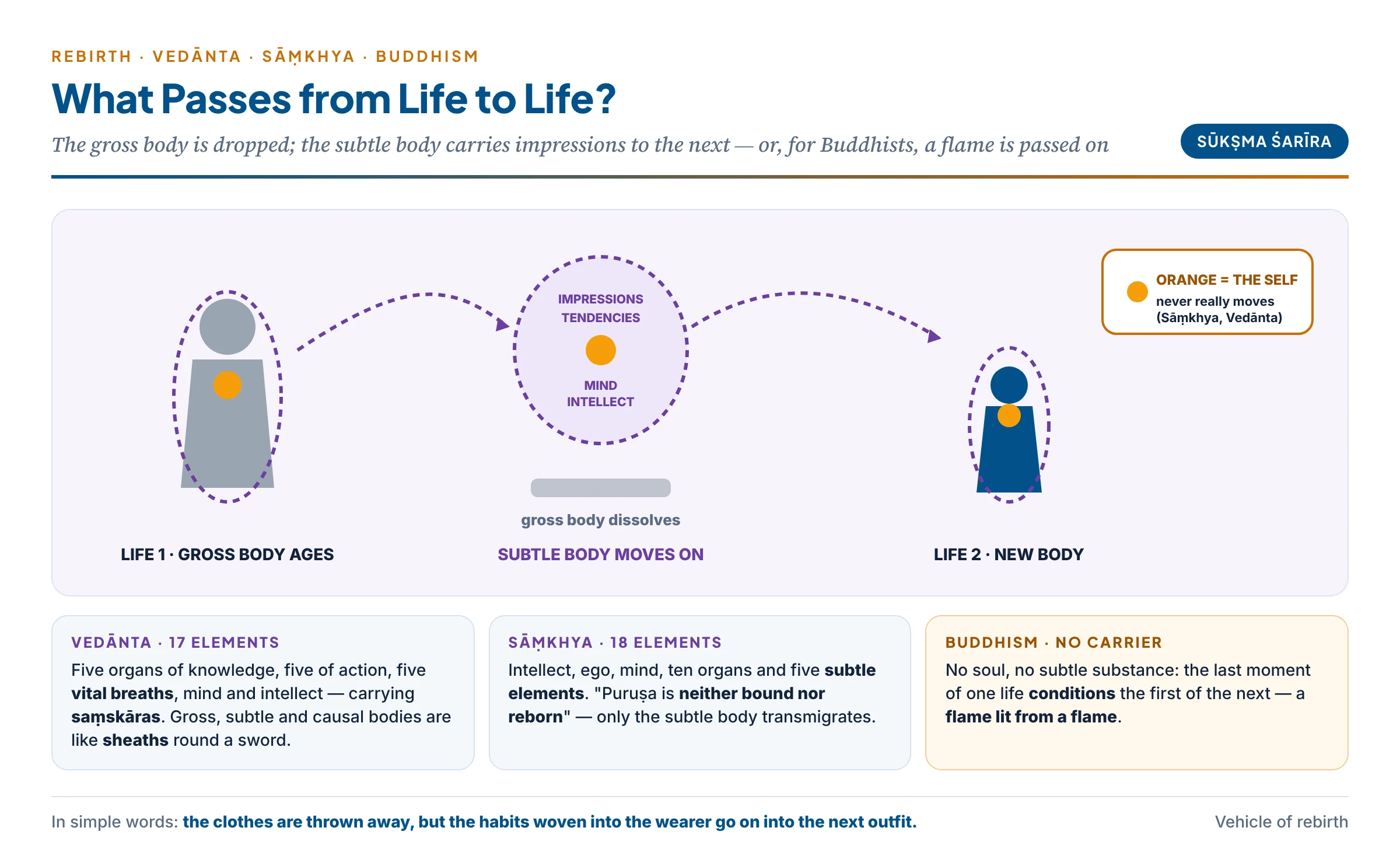
- Gross body (sthūla śarīra): the physical organism, formed at conception, dissolved at death.
- Subtle body (sūkṣma or liṅga śarīra): survives death and shapes the next body.
- Causal body (kāraṇa śarīra): the root ignorance, the seed of the other two.
- These are like sheaths enclosing the blade of a sword: all must be discarded before the self is free.
What the subtle body is made of
- Vedānta: seventeen elements — the five organs of knowledge, the five organs of action, the five vital breaths (prāṇas), mind (manas) and intellect (buddhi).
- Sāṃkhya: eighteen elements — intellect, ego, mind, the ten organs, and the five subtle elements (tanmātras).
- It carries the impressions (saṃskāras) and tendencies (vāsanās) built up by our actions.
What the subtle body is not
- It is not a material body in the Western sense — it has no shape, size or place.
- In the Indian division between consciousness (puruṣa/ātman) and everything unconscious (prakṛti), it falls on the side of prakṛti: finite, changing and unconscious — so it is called a “body”.
- In modern terms it is best described as a structure of mental dispositions — moral, aesthetic, intellectual and spiritual — built up over many lives, which joins a new embryo and influences its growth alongside its genetic inheritance.
- Sāṃkhya’s striking claim: the puruṣa is neither bound nor reborn; it is the subtle body that transmigrates, and the self only appears to move.
Parallels
- The philosopher C.D. Broad suggested a “psychic factor” — a cluster of a dead person’s memories and dispositions that might persist and attach to a medium in trance; reincarnation would be its fusion with a developing embryo instead.
- Jainism: the soul is accompanied by a karmic body (kārmaṇa śarīra) of subtle karmic matter, which leads it to its next birth.
- Buddhism: no soul and no subtle body-substance; the last moment of consciousness of one life conditions the first moment of the next (the rebirth-linking consciousness) — like a flame lit from a flame, or a seal pressed into wax.
A Demythologised Reading of Rebirth
- Some interpreters read rebirth ethically: all our actions affect others who come after us; “instead of individual threads of karmic history there is the universal network of the karma of humanity“.
- On this view rebirth is a myth expressing a moral truth — the unity of humankind and our responsibility for the world future generations will inherit (pollution, war, population, racial conflict).
- Criticism: whatever its value, this is not what the Indian traditions have meant by rebirth for thousands of years.
Resurrection
In Judaism
- The early Hebrew Bible focuses on God’s covenant with the nation; the dead go to a shadowy Sheol. Belief in individual resurrection arose late, when the nation’s political collapse threw the individual’s destiny into prominence.
- In Jesus’ time the Pharisees affirmed resurrection; the Sadducees denied it.
In Christianity
- The resurrection of Jesus is the centre of the faith; the creed affirms “the resurrection of the body“.
- Not resuscitation of corpses: Paul teaches that the dead are raised not as the organism that died but as a “spiritual body” (sōma pneumatikon) suited to a new world — as different from the earthly body as a full grain of wheat is from the seed that was sown.
- Death is real: unlike Plato’s soul walking calmly from one room to another, the biblical person really dies — “passing out from the lighted circle of life into death’s dateless night”. New life comes only through God’s creative love. Hence a sense of utter dependence on God in the hour of death.
- After resurrection comes the Last Judgement, and then heaven (communion with God) or hell; Catholic teaching adds purgatory.
In Islam
- On the Day of Resurrection (Yawm al-Qiyāmah) God will raise all the dead in their bodies and judge them; the righteous enter Paradise (Jannah), the wicked Hell (Jahannam).
- Between death and resurrection the soul waits in an intermediate state (barzakh).
In simple words
Plant a mango seed and a tree grows. The tree is not the seed — it is far bigger and more glorious — yet it is that seed’s tree, not some other. Paul uses the same picture for resurrection: the earthly body is “sown” like a seed, and what is raised is a transformed, spiritual body — continuous with the old person, yet utterly new.
Problems of resurrection
- The same atoms? A body’s particles are scattered, absorbed by plants and animals, even shared with other people. If resurrection needs the same matter, whose body gets the shared atoms? (An old puzzle — the “cannibal” objection.)
- Lodge’s view: the idea that the same atoms will be re-collected is “a superstition”; the body is in constant flux anyway. What Christianity rightly keeps is that a real person has a double aspect — spiritual and bodily — so survival needs some vehicle, not the old particles.
- Identity: if God re-creates me after a gap, is the new person me or a copy? This is the problem Hick’s replica theory addresses.
John Hick’s Replica Theory
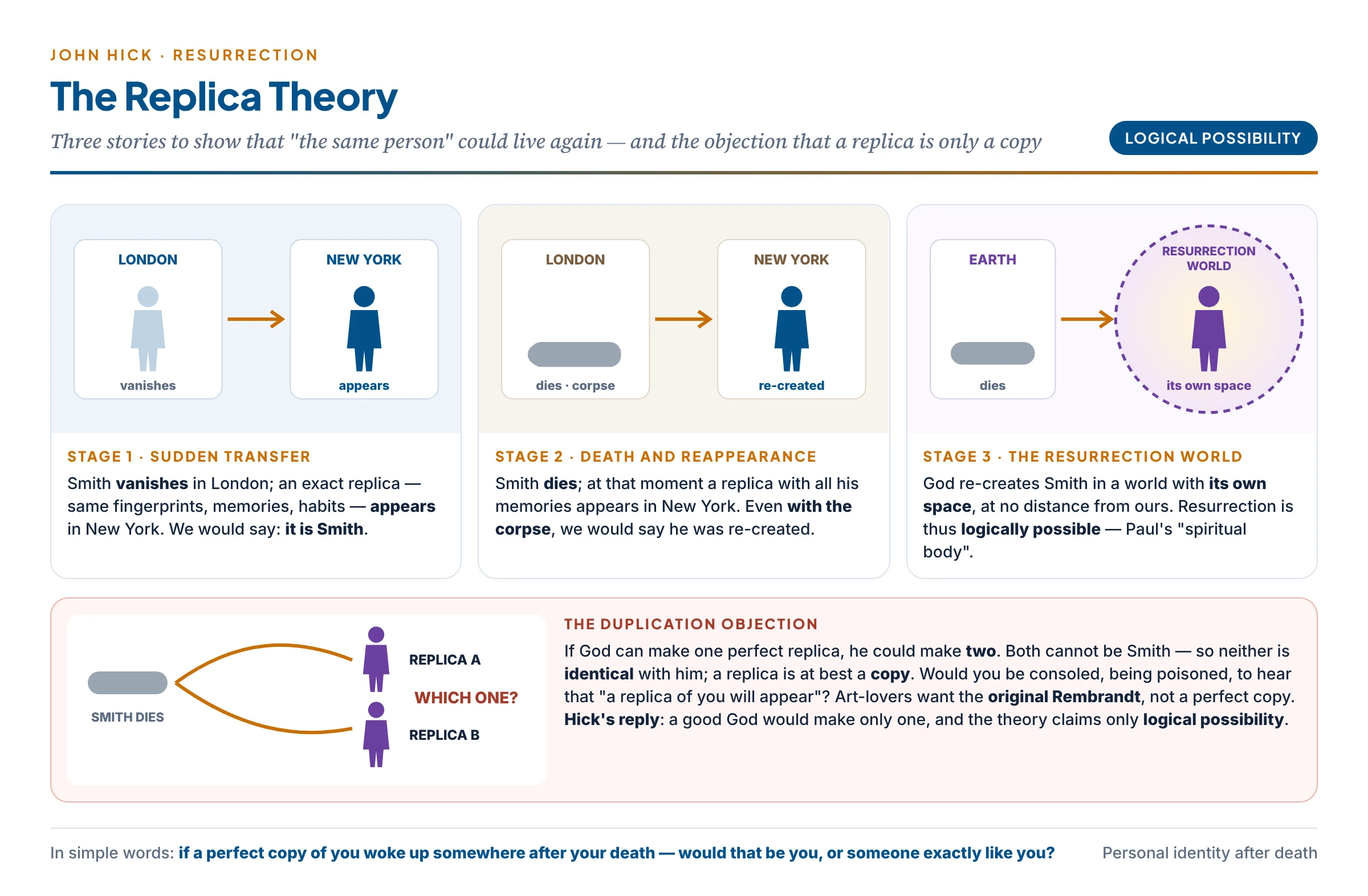
Hick does not try to prove resurrection; he tries to show that it is logically possible — that “the same person” could meaningfully apply to someone who dies and is re-created.
- Stage one — sudden disappearance: John Smith, at a meeting in London (or the United States), suddenly vanishes, and at the same instant an exact replica appears at a meeting in New York (or India) — same fingerprints, hair, eye colour, even stomach contents, same memories, beliefs, habits and emotions. He is as baffled as everyone else. After all tests, his friends would surely say: this is John Smith, mysteriously transferred.
- Stage two — death and reappearance: John Smith dies in London, and at that moment a replica, with memories up to the moment of death, appears in New York. Even with the corpse on our hands, we would have to say he has been miraculously re-created elsewhere — “an extension of ‘same person’ required and warranted by the facts”.
- Stage three — the resurrection world: John Smith dies, and the replica appears not on earth but in a resurrection world — a world with its own space, not at any distance or direction from ours, inhabited only by resurrected persons. God thus re-creates the psychophysical person.
- Why it matters: the model avoids disembodied existence (which many find unintelligible) and gives resurrection a clear criterion of identity — complete physical and psychological similarity and continuity of memory.
- Hick’s grounds for the belief: the authority of the New Testament, and above all faith in the sovereign purpose and love of God, which “is not restricted by death”.
Criticisms of the replica theory
- The duplication problem: if God can create one replica, an omnipotent God could create two or three at once. Which is the “real” John Smith? Two different people cannot both be identical with the original — so the replica is at best a copy, not the person. (The objection develops Bernard Williams‘s reduplication argument: if one man, Charles, sincerely “remembered” the life of Guy Fawkes, we might be tempted to say he is Guy Fawkes — but if his brother had exactly the same memories, both could not be.)
- Broken spatio-temporal continuity: personal identity normally needs an unbroken path through space and time; a rotting corpse on earth and a person in another space have no such link.
- Would I care? Suppose someone poisons me and says: “Don’t worry, a perfect replica of you will appear.” Knowing that a replica will be wining and dining somewhere is not knowing that I will be. More is required than replication — as art-lovers want the original Rembrandt, not a perfect copy.
- Memory cannot settle identity: as Butler said against Locke, memory presupposes identity and cannot by itself make it. And Reid’s brave officer: flogged as a boy, he later remembers the flogging when he captures a standard; as a general he remembers capturing the standard but not the flogging — on Locke’s view the general both is and is not the boy who was flogged.
- Hick’s replies: a good God would not create duplicates, and in the resurrection world there is only one; the theory needs only logical possibility; and “same person” is a concept we would reasonably extend to such cases. Some philosophers add that what matters to us may be psychological continuity rather than strict identity.
Common confusion
Does Hick’s replica theory prove that there is a resurrection? No. Hick claims only that resurrection is logically conceivable — that it is not self-contradictory to say the same person died and lives again. Whether it actually happens depends, for Hick, on faith in God’s purpose, not on the replica argument. Critics who show that replicas might be duplicated attack the conceivability claim, not any proof.
Disembodied Survival
The case for it
- Plato and Descartes: the person is the soul; the body is not essential.
- Richard Swinburne: a person has a body if there is one chunk of matter through which he must act and learn. Suppose he could know and move objects in a room without using any particular chunk of matter, and could shift his focus at will to the next room — he would be disembodied. Since this is coherent, I am not my body.
- H.D. Lewis: no recent discussion has shown that we can dispense with an absolute distinction between mind and body; each of us has a private access to his own experiences.
- H.H. Price’s “mental world”: survival might be a dream-like world of mental images, built from memories and desires, in which minds communicate telepathically. Those with similar desires and memories might share a common image-world — each would, in a sense, get the world he desires.
- Indian parallel: the subtle body gives the surviving self a vehicle without a gross body.
The case against it
- Persons are bodily: much of what we mean by “person” — seeing, speaking, acting — involves bodies and physical contexts. Our concept of seeing, for example, is woven with phrases like “I can’t see, it’s too far”, “I caught his eye”; break enough of these threads and the concept collapses.
- Individuation: how would one disembodied person be told apart from another, or re-identified over time, without bodies? (Flew.)
- Arguments for dualism are weak: that we speak of “having” a body does not show we are distinct from it (we say a chair has legs); privacy of thought shows only that we can sometimes keep thoughts secret.
- From “conceivable” to “actual”: even if disembodiment is logically possible, it does not follow that we can actually exist without bodies.
- A bleak prospect: an existence of dream-images or “thoughts alone” seems a thin, impoverished life (Article 4).
- Geach: “Apart from the possibility of resurrection, it seems a mere illusion to have any hope for life after death.“
Rebirth and Resurrection Compared
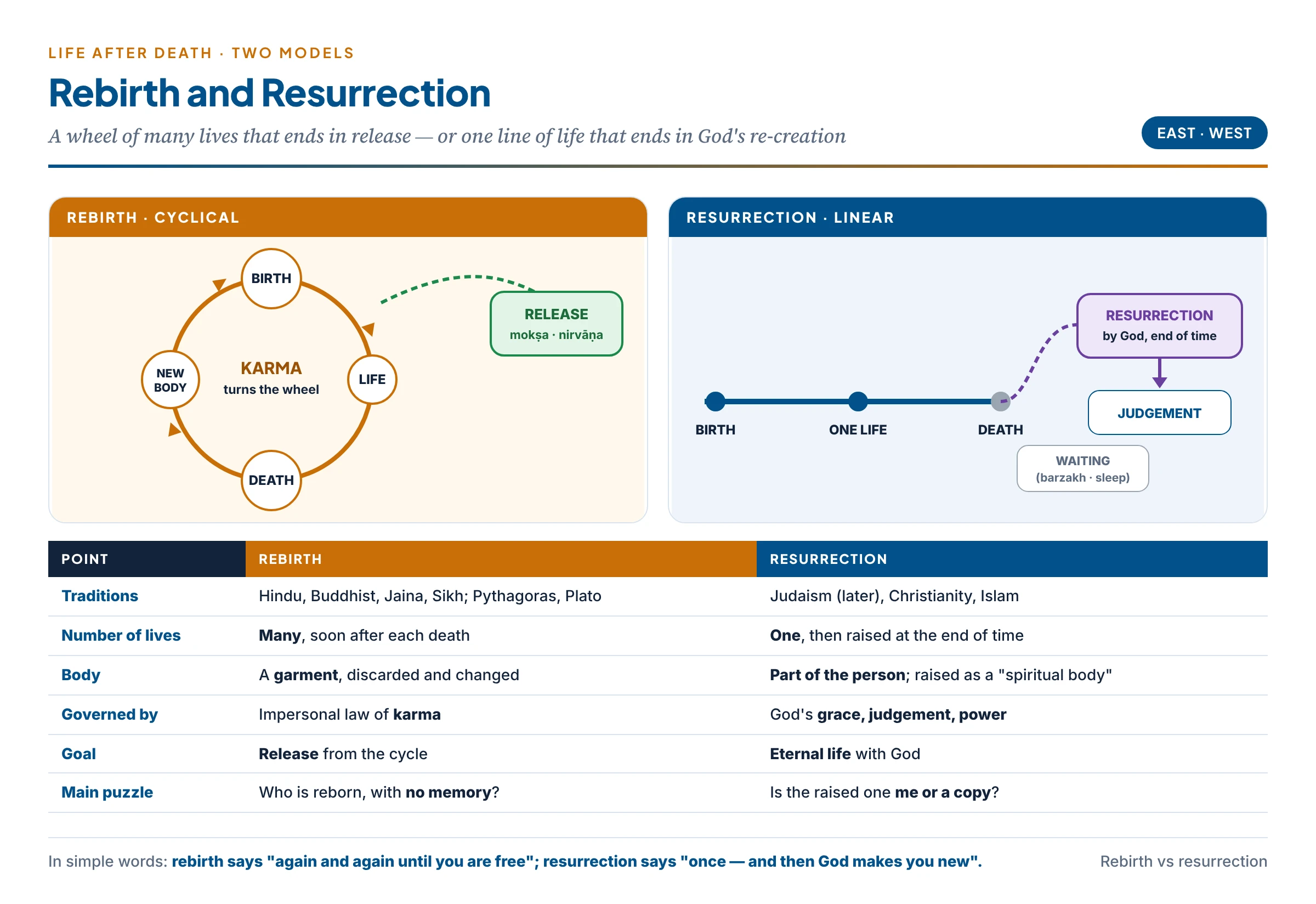
| Point | Rebirth / Reincarnation | Resurrection |
|---|---|---|
| Traditions | Hinduism, Buddhism, Jainism, Sikhism; Orphics, Pythagoras, Plato | Judaism (later), Christianity, Islam |
| How it works | Soul (or subtle body, or causal stream) passes through many successive bodies | God raises or re-creates the whole person in a transformed body |
| Number of lives | Many — cyclical (saṃsāra) | One earthly life, then judgement and an eternal state |
| Role of the body | A garment, discarded and changed | Part of the person; the soul alone is incomplete |
| Governing principle | Impersonal law of karma | God’s grace, judgement and creative power |
| Timing | Soon after death, repeatedly | At the end of time, once for all |
| Attitude to death | A transition, one of many | A real ending, overcome only by God |
| Final goal | Release from the cycle (mokṣa, nirvāṇa) | Eternal embodied life with God in the new creation |
| Main problem | Identity without memory or body | Identity across a gap — copy or original? |
Indian Connect — Indian Connect — rebirth or resurrection: two answers to one need
- Both doctrines answer the same human need: that justice be done and that a person’s growth not be cut off by death.
- Rebirth answers it with time: many lives under the law of karma, until release.
- Resurrection answers it with grace: one life, then God’s re-creation and judgement.
- Hick proposed a bridge: many lives, but in other worlds rather than this one, leading to a final union with God — showing that the two need not be wholly opposed.
What Makes a Birth a Re-birth?
Every birth is the coming into existence of a new organism. What could make this birth the rebirth of some earlier person, rather than a fresh beginning? Several criteria have been proposed:
| Criterion | What it says | Strength | Weakness |
|---|---|---|---|
| Memory (jātismara) | The new person remembers the old life, with details unknown by normal means | The strongest ordinary mark of identity; can be checked (Shanti Devi, Stevenson) | Rare; may be suggestion, fraud or cryptomnesia; could be duplicated |
| Bodily marks | Birthmarks or defects match wounds of the remembered person | Physical, checkable | Few cases; coincidence; no clear mechanism |
| Character and skills | Same dispositions, talents, fears; child prodigies; speaking an unlearned language | Explains innate differences | Far too broad — thousands share the same traits |
| Karmic fit | Present circumstances match the past life’s deeds | Central to the doctrine | Unverifiable — we do not know past deeds |
| Same subtle body | The same structure of impressions links the two lives | Gives a bearer of identity | Not observable; we cannot track it |
| Causal continuity (Buddhist) | The new life arises dependent on the old, like flame from flame | Needs no soul; “neither the same nor another“ | Gives continuity, not strict identity |
| Enlightened memory | A liberated person sees all his past lives | Claimed direct knowledge | Available only to the few; logically odd — “remembering” what one did not experience |
| Scripture | Śruti teaches it | Decisive for believers | Not a test for others |
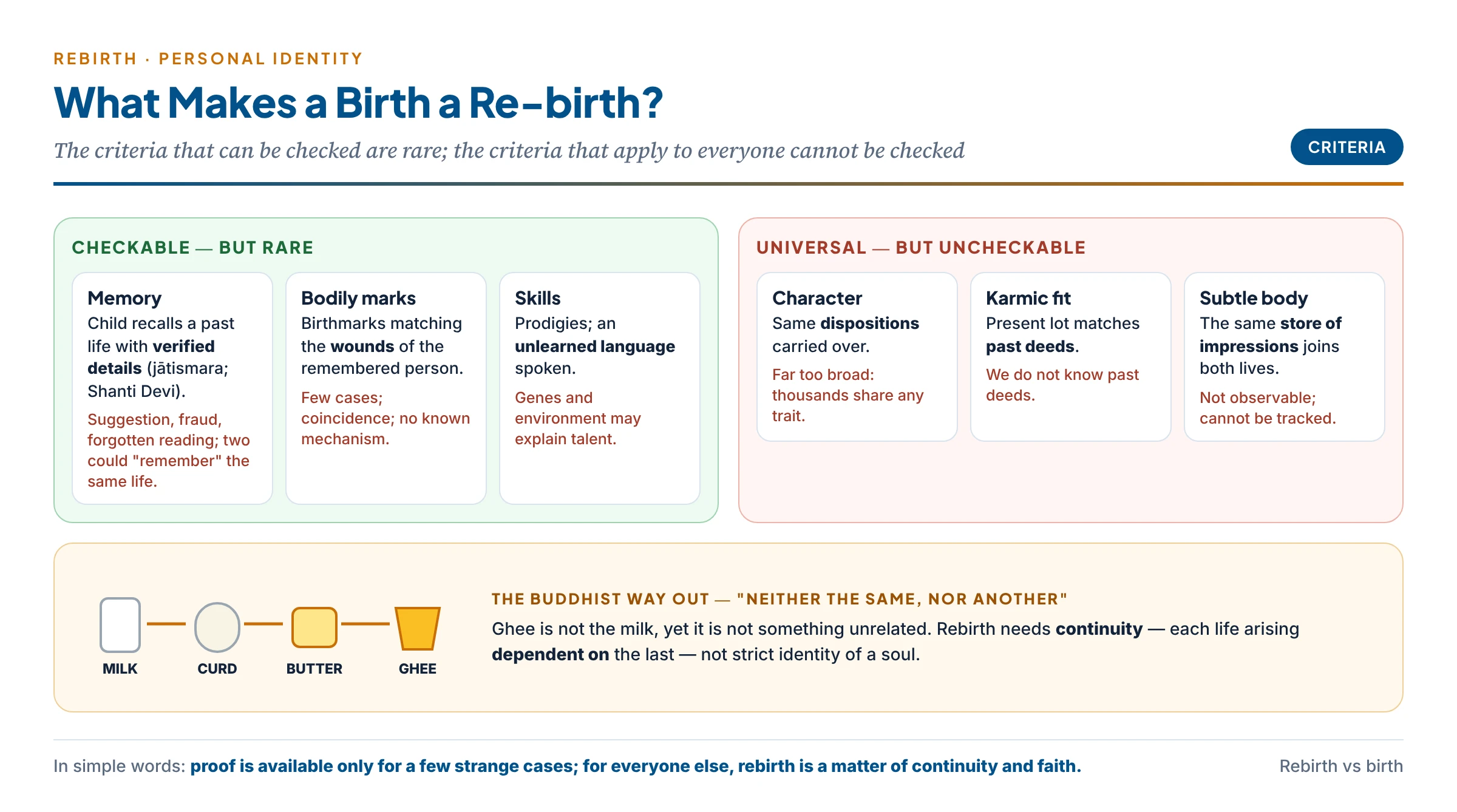
- The dilemma: the criteria that are checkable (memory, birthmarks) apply only to rare cases; the criteria that apply to everyone (subtle body, karmic fit, causal continuity) are not checkable.
- The Buddhist way out: asked whether the one reborn is the same as the one who died, Nāgasena answers: “Neither the same, nor another.” As milk becomes curd, then butter, then ghee — we cannot say the ghee is the milk, nor that it is something unrelated. Rebirth needs continuity, not strict identity.
- Conclusion: rebirth is best understood as a relation of continuity in degrees (of memory, disposition and causal dependence), not as the numerical sameness of an observable thing. This is why the doctrine is coherent but hard to verify.
In simple words
Is a river after a hundred kilometres “the same river”? There is no single drop that has travelled all the way, yet the flow is continuous. The Buddhist says rebirth is like that: no fixed thing passes from life to life, but each life flows out of the one before. Ask for a single drop that went the whole way and you will find none; ask whether the flow is continuous, and the answer is yes.
The Significance of Rebirth in Indian Religious Thought
- Moral order: rebirth makes the universe morally lawful — no deed is lost, no suffering is random.
- Theodicy: it explains inequality and suffering without blaming God (Article 6).
- Hope: every being gets further chances; no one is damned for ever.
- Unity of life: since one may be born as an animal, all life is kin — the root of ahiṃsā and vegetarianism in Jaina, Buddhist and Hindu ethics.
- Urgency of liberation: endless rebirth is suffering; it gives the motive for seeking mokṣa and nirvāṇa.
- Discipline of action: it underlies the Gītā’s karma-yoga — act without attachment, so as to bind no new karma.
- Social misuse: it has also been used to justify caste and inequality as “deserved” — a charge reformers from the Buddha to Ambedkar pressed.
Critical Evaluation
Weighing the Three Models
- Rebirth is morally attractive (justice, hope, unity of life) and has some puzzling evidence (past-life cases), but faces serious identity problems once memory and body are gone.
- Resurrection keeps the whole embodied person and avoids disembodiment, but depends wholly on God’s power, and the replica model meets the duplication objection.
- Disembodied survival is the model most often attacked as unintelligible: persons seem to be essentially bodily.
- In all three, the decisive issue is the criterion of personal identity — memory, body, character, causal continuity, or God’s will.
Critics and Defenders
Criticism — The critics
- Hick on rebirth: without memory or body, only character remains — far too broad to fix identity.
- Duplication (Williams): memory claims can be shared, so they cannot make identity; God could make two replicas.
- Davies: a replica is a copy, like a reproduction of a Rembrandt; I would not be consoled.
- Flew and Geach: disembodied persons cannot be identified; outside resurrection, hope of survival is an illusion.
- Sceptics: past-life cases arise from suggestion and cryptomnesia; rebirth is unfalsifiable.
Defence — The defenders
- Rebirth: explains inequality without an unjust God; supported by jātismara cases and the newborn’s instincts.
- Buddhists: identity is not needed — “neither the same nor another“; causal continuity suffices.
- Hick: the replica model shows resurrection is logically possible; God would not duplicate.
- Swinburne and Price: disembodied existence is coherent — a mind could know and act without one particular body.
- Vedānta and Sāṃkhya: the subtle body carries impressions; the true self never moves at all.
Cross-Tradition Comparison
| Theme | Western | Indian |
|---|---|---|
| Many lives | Pythagoras, Plato’s Myth of Er | Upaniṣads, Gītā, Jainism, Buddhism |
| Forgetting past lives | River of forgetfulness (Lethe) | Trauma of death and birth; ignorance |
| Vehicle of survival | Paul’s spiritual body; Lodge’s “ethereal” vehicle | Subtle body (liṅga śarīra); Jaina karmic body |
| Identity criterion | Locke’s memory; bodily continuity; Hick’s replica | Same self or subtle body; Buddhist causal continuity |
| Final state | Resurrection to eternal life | Release from rebirth |
Synthesis (Siddhānta)
- Life after death is conceived as rebirth (many lives under karma), resurrection (one life, then re-creation by God) or disembodied survival (the soul alone).
- Rebirth is supported by the inequality of birth, karma, innate talents, the newborn’s instincts and past-life memories; it is opposed by the absence of memory, the breadth of the character criterion, duplication, the postponement of the inequality problem, and unverifiability. The subtle body (Vedānta, Sāṃkhya) or the causal stream (Buddhism) is offered as its vehicle.
- Hick’s replica theory shows how resurrection might be logically possible, but faces duplication and the “copy, not me” objection.
- Disembodied survival faces the deepest charge of unintelligibility.
- The criteria for telling rebirth from birth split into the checkable but rare and the universal but uncheckable; the Buddhist answer — continuity, not identity — is the most coherent.
- Contemporary relevance:
- Research on children who report past lives continues in several universities and remains controversial.
- Teleportation and mind-uploading thought experiments in science fiction and philosophy are modern versions of Hick’s replica puzzle.
- Belief in rebirth shapes Indian attitudes to death, animals, ecology and social duty even today.
- Balanced view: none of the models can be proved; each is coherent under its own assumptions, and each reveals that the real question of the afterlife is the question of personal identity.
“Neither the same, nor another.” — Nāgasena, on the one who is reborn
Previous Year Questions
- 2010What sort of criteria can one provide for identifying rebirth as opposed to birth? Discuss.
- 2005Is Christian doctrine of the immortality of soul compatible with the Gita’s doctrine of atman? Discuss.
- 1998Explain the significance of the doctrine of reincarnation in the Indian religious thought. Examine the chief arguments given in support of the doctrine.