

Soul: Immortality; Rebirth and Liberation.
Official Syllabus: Paper II, Section B, Unit 4
The law of karma — “as you sow, so shall you reap” — is the moral backbone of the religions of Indian origin, and rebirth is its partner: since the fruits of our deeds are not all reaped within one life, life must continue until they are. This article explains what karma means, its kinds, how each school thinks it works (with or without God), the causes of rebirth and the means to end it, rebirth in Hinduism and the Gītā, the puzzle of rebirth without a soul in Buddhism, the stand of the non-theistic religions, the classic problem of karma and free will, and whether finite actions can decide the destiny of an eternal self.
In simple words
A farmer who sows mango seeds does not get mangoes the next morning; some trees fruit in three years, some in ten, and some seeds wait in the soil for the right rain. Karma is like that: every intentional act is a seed that will ripen into an experience of the same kind — good for good, bad for bad — sooner or later. If a seed has not ripened when the farmer dies, Indian thought says the harvest simply waits for the next life. That is why karma and rebirth go together.
Context & Problem
Meaning of Karma
- Literal meaning: karma (from kṛ, “to do”) means action.
- Three senses:
- Action itself — physical, verbal or mental.
- The after-effect of action — the trace or potency it leaves.
- The law connecting action and result — the moral law of cause and effect.
- From ritual to morality: in the early Vedas karma meant mainly ritual action (sacrifice), within the cosmic order (ṛta). The Upaniṣads made it a moral law: “as one acts, as one conducts oneself, so one becomes — the doer of good becomes good, the doer of evil becomes evil.”
- The law of karma is often called the law of the conservation of moral energy: as physical energy is never lost, so the moral value of an act is never lost.
The Problem
- If karma governs our lives, three questions arise:
- How does it work? — what carries the effect of a deed into a future life, and who, if anyone, administers it?
- Who is reborn? — an eternal soul, a subtle body, or (in Buddhism) only a causal stream?
- Are we free? — if our present is the fruit of our past, what room is left for choice?
Core Doctrine
The Law of Karma — Its Main Features
- Moral causation: every voluntary action produces a result of the same moral quality — good for good, evil for evil.
- No deed is lost and no fruit is undeserved: the law avoids two “fallacies” — the loss of the fruit of what one has done (kṛtapraṇāśa) and receiving the fruit of what one has not done (akṛtābhyāgama).
- Intention matters: the Buddha said, “It is intention (cetanā) that I call karma” — an accidental act binds less than a deliberate one.
- Across lives: fruits not reaped in this life are reaped in a future birth; present circumstances reflect past lives.
- Impersonal and universal: it applies to all beings, high or low — even the gods.
- Not fatalism: karma fixes the situation from which we act, not our response to it (see below).
- Self-made destiny: we are the authors of our own fortune; no outside power punishes or rewards arbitrarily.
The Kinds of Karma
By time of fruition (Vedānta)
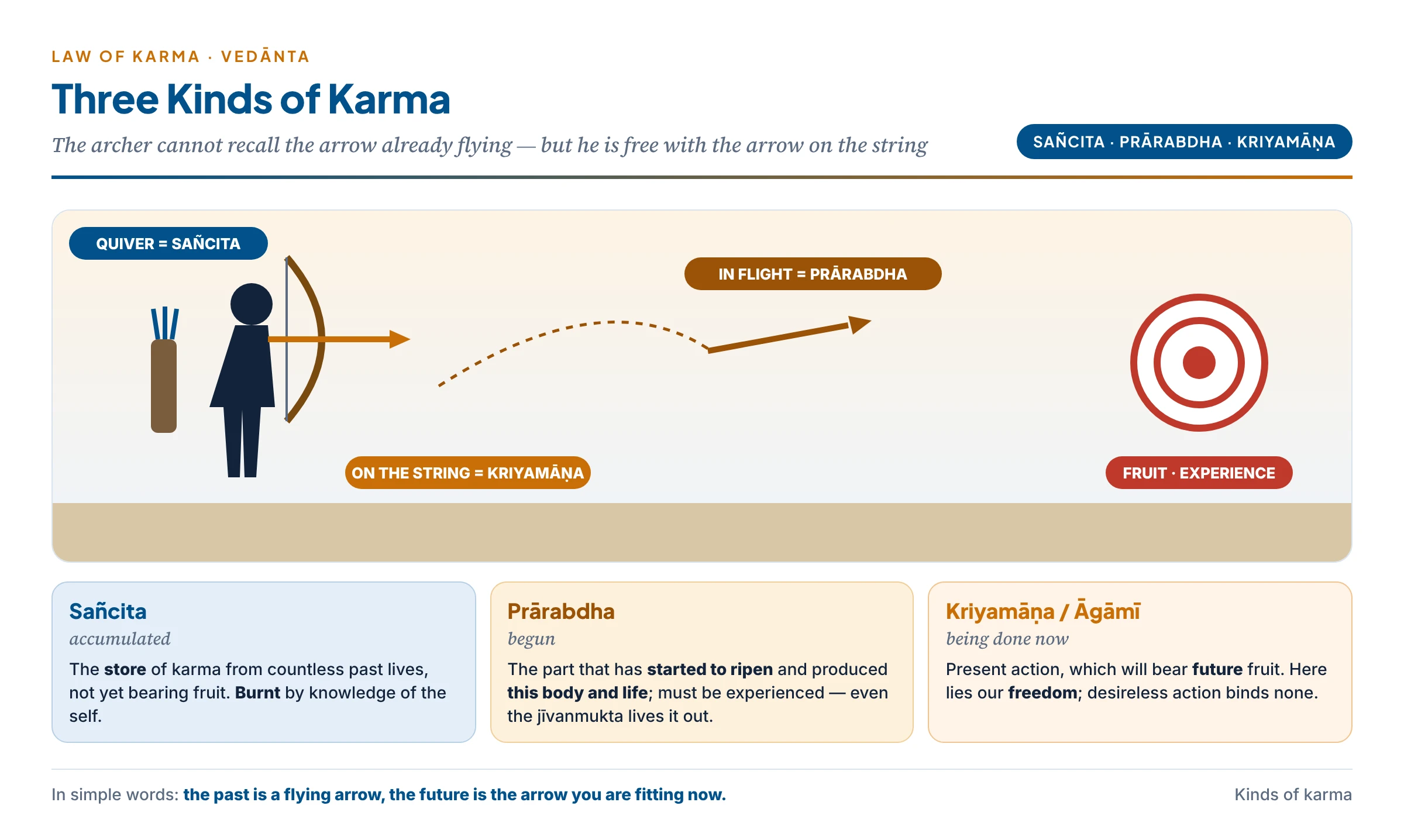
- Sañcita karma — accumulated karma from countless past lives, not yet bearing fruit (the granary of seeds).
- Prārabdha karma — the part of sañcita that has begun to bear fruit and has produced this present body and life; it must be experienced and exhausted.
- Kriyamāṇa (or āgāmī) karma — karma being done now, which will bear fruit in future.
- The archer’s analogy: the arrow already shot cannot be called back — it is prārabdha; the arrows still in the quiver are sañcita; the arrow being fitted to the bow now is kriyamāṇa. The archer is free about the last two, not the first.
- Effect of knowledge: for Advaita, knowledge of Brahman burns sañcita “like fire burns fuel”, and the knower binds no new karma; but prārabdha continues until the body falls — which is why the jīvanmukta still lives (Article 7).
By moral quality (Yoga)
- Black (evil), white (good), black-and-white (mixed — most ordinary action), and the yogi’s action, which is neither white nor black because it is done without desire — it binds no fruit.
By kind of act (Mīmāṃsā)
- Obligatory (nitya, e.g. daily rites), occasional (naimittika, on special occasions), desire-prompted (kāmya, for some reward) and forbidden (niṣiddha). One who seeks release performs the first two, avoids the last two.
By motive (the Gītā)
- Desire-driven action (sakāma karma) binds; desireless action (niṣkāma karma) — doing one’s duty without attachment to its fruit — does not bind. “Your right is to action alone, never to its fruits.“
How Does Karma Work? — The Mechanism in Each School
A deed is over in a moment; its fruit may come lives later. Something must carry the effect, and something must direct it to the right person at the right time. The schools answer differently.
| School | What carries the effect | Is God needed? | Key image |
|---|---|---|---|
| Nyāya–Vaiśeṣika | Adṛṣṭa (“the unseen”) — merit and demerit inhering in the soul | Yes — adṛṣṭa is unconscious, so Īśvara must guide it; this is one of Nyāya’s proofs of God | God as the dispenser of the fruits of karma |
| Mīmāṃsā | Apūrva — an unseen potency produced by ritual, which yields the fruit later | No — the Vedic law works by itself | The sacrifice today, heaven later |
| Jainism | Karmic matter (karma-pudgala) attracted by the passions and sticking to the soul | No | Dust on an oiled body; eight kinds of karma veil the soul |
| Buddhism | Intention and its traces; in Yogācāra, seeds (bīja) stored in the storehouse consciousness | No — karma works by dependent origination | Seeds ripening; natural consequences |
| Sāṃkhya–Yoga | Impressions (saṃskāras) and tendencies (vāsanās) in the mind | No (Sāṃkhya); Yoga’s Īśvara is a teacher, not the dispenser | Afflictions → mental states → action → impressions → rebirth |
| Advaita Vedānta | Karma in the subtle body at the level of appearance | Īśvara (Brahman with māyā) dispenses fruits | God is like rain: differences in crops come from the seeds |
| Viśiṣṭādvaita, Dvaita | Karma as recorded in the Lord’s will | Yes — the Lord is the inner controller | The Lord rewards according to karma, and grace can override it |
- The Nyāya argument: adṛṣṭa is unconscious; an unconscious thing cannot by itself bring the right fruit to the right soul at the right time — as an axe needs a woodcutter. So an intelligent being must direct it: God.
- The Buddhist reply (as in Aśvaghoṣa): an omnipotent God cannot be bound by the law of karma — and if karma works, there is no need for God, because karma works autonomously through dependent origination. In Buddhism, “all ethically significant actions have their consequences — not because of an externally imposed law, but just because actions have their natural consequences“: what you do today shapes the person you become tomorrow.
- The Yoga cycle: the five afflictions (kleśas — ignorance, ego-sense, attachment, aversion, clinging to life) produce mental states (vṛttis) → actions (karma) → impressions (saṃskāras) → fresh mental states → rebirth. Break the afflictions and the cycle stops.
- Śaṅkara on God’s fairness: God is not partial or cruel in giving unequal births, because he acts according to the karma of beings — as rain falls equally on all fields, but rice grows as rice and barley as barley, according to the seed.
In simple words
Think of a bank account. Every good act is a deposit, every bad act a withdrawal; the balance is carried forward from year to year — and, in karma theory, from life to life. The schools disagree about the bank: for Nyāya there must be a manager (God) who keeps the accounts; for Jainas the deposits are physical particles stuck to the soul; for Buddhists there is no bank at all — the habits you build simply are your future.
Why Must Rebirth Be Stopped? — Causes and Cures
Why rebirth is bondage
- The world is full of suffering (duḥkha). Because of desire, we tend to be born again and again into it.
- Because of ignorance, the burden of karma gets attached to the soul; the soul takes birth again and again according to its record of karma. This is bondage — hence rebirth must be stopped.
- Stopping rebirth is possible only through liberation; every means to liberation is a means to stop rebirth.
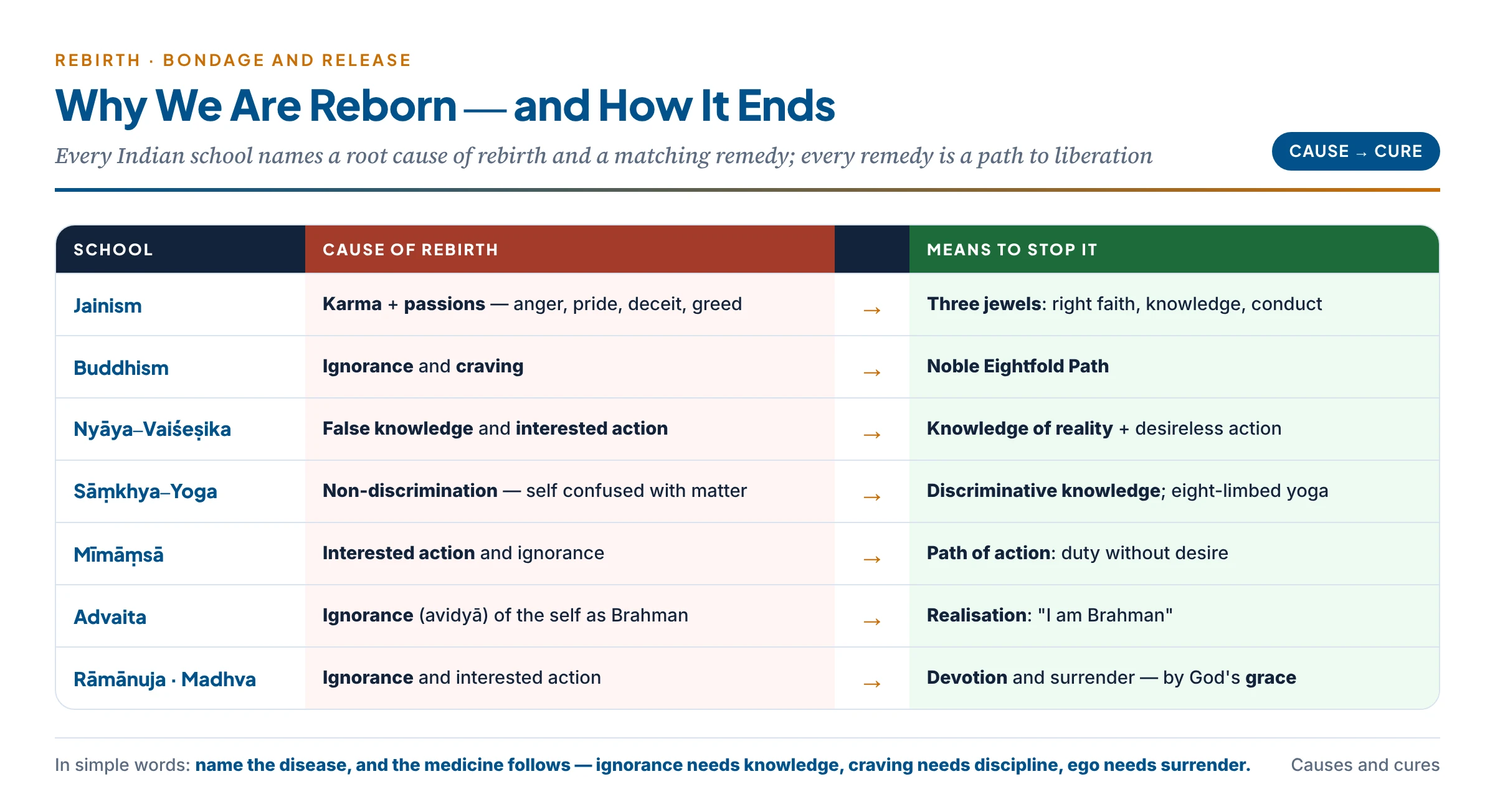
Causes of rebirth and means to stop it
| School | Cause of rebirth | Means to stop rebirth |
|---|---|---|
| Jainism | Karma and the passions (kaṣāya: anger, pride, deceit, greed) | Three jewels (triratna): right faith, right knowledge, right conduct |
| Buddhism | Ignorance (avidyā) and craving (tṛṣṇā) | Noble Eightfold Path |
| Nyāya–Vaiśeṣika | Ignorance (false knowledge) and interested action | Knowledge of reality (tattvajñāna) and desireless action |
| Sāṃkhya–Yoga | Non-discrimination (aviveka) — puruṣa fails to distinguish itself from prakṛti | Discriminative knowledge (vivekajñāna); eight-limbed yoga |
| Mīmāṃsā | Interested action and ignorance | Path of action (karma-mārga): duties without desire |
| Advaita (Śaṅkara) | Ignorance (avidyā) | Realisation of the self as Brahman |
| Rāmānuja and Madhva | Ignorance and interested action | Devotion (bhakti) and surrender, with God’s grace |
The Significance of Rebirth in the Theory of Karma
- Time for fruition: many deeds cannot bear fruit within one life — a murderer who dies unpunished, a saint who dies in poverty. Rebirth provides the field (bhoga-bhūmi) where every fruit is reaped.
- Completeness of the moral law: without rebirth, the law of karma would have exceptions — deeds lost, fruits undeserved; rebirth makes it exceptionless.
- Explaining inequality at birth: why is one child born healthy and rich, another sick and poor? Only past karma can explain this without blaming God (Article 5).
- Explaining innate character: talents, tendencies and fears present from childhood are impressions carried from earlier lives.
- Defining the goal: rebirth turns karma into bondage and so makes liberation — the end of karma and rebirth — the highest goal.
- Logical partner: take away rebirth, and karma shrinks to ordinary this-worldly cause and effect — the Cārvāka position. Rebirth is what gives karma its religious and cosmic scope.
Common confusion
Is karma the same as fate? No. Fate (daiva in the popular sense) means that what happens to you is fixed by an outside power, whatever you do. Karma means that what happens to you is the result of your own past choices, and that your present choices shape your future. The archer cannot recall the arrow already shot (prārabdha), but he is free about the arrow now on the string. Karma is therefore a doctrine of responsibility, not resignation.
Karma as an Essential Postulate of Hinduism
Why it is essential
- It runs through the whole tradition — Upaniṣads, epics, Purāṇas, Gītā, Dharmaśāstras — and every orthodox school except Cārvāka accepts it.
- It grounds the four goals of life (puruṣārthas): dharma (right action) is meaningful because actions have lasting results; mokṣa is release from karma itself.
- It supplies Hinduism’s theodicy: suffering is not God’s cruelty but the fruit of one’s own deeds.
- It underlies the Gītā’s ethics of desireless action, and the ideal of ahiṃsā, since all beings are fellow travellers in saṃsāra.
- Max Weber called the karma doctrine “the most consistent theodicy ever produced by history” — it turns the world into a “strictly rational, ethically determined cosmos”.
Its merits
- It answers the problem of evil without a theodicy of divine purposes — there is no undeserved suffering.
- It makes the moral order as lawful and objective as the physical order.
- It puts liberation within reach of human effort.
- It explains the inequality of native endowment and circumstance without making God arbitrary.
- It is a doctrine of hope: the present life is one of many, and the future remains to be made.
Its difficulties
- Unverifiable: there is no independent access to a past life; a theory that fits every outcome is tested by none.
- Identity: the reaper must be the sower — but what links them across lives, without memory or body?
- Mechanism: how an unconscious residue allots exactly proportionate fruits is never explained — which is why Nyāya brings in God and Yogācāra the storehouse consciousness.
- Moral hazard: if every condition is deserved, compassion may be blunted and inequality rationalised — the charge, pressed by Ambedkar and others, that karma lent legitimacy to caste.
- Infinite regress: each birth is explained by an earlier one, but the series as a whole is never explained; a beginningless series only postpones the problem.
- Collective suffering: earthquakes, epidemics and genocide strike thousands at once — can each victim’s suffering be individually deserved?
- Morality from fear? Responsible moral choice depends on freedom and reason; if people avoid evil only for fear of a lower rebirth (or of hell), are they acting morally or merely prudently? (The Gītā’s reply: the highest action is desireless — done for its own sake, not for reward or fear of punishment.)
Replies
- Explaining suffering is not excusing it: the Gītā’s karma-yoga and the Buddhist elevation of compassion make relieving suffering a duty whatever its cause.
- A beginningless series needs no first term.
- Unverifiable is not refuted; karma functions like Kant’s postulates — a presupposition of moral life.
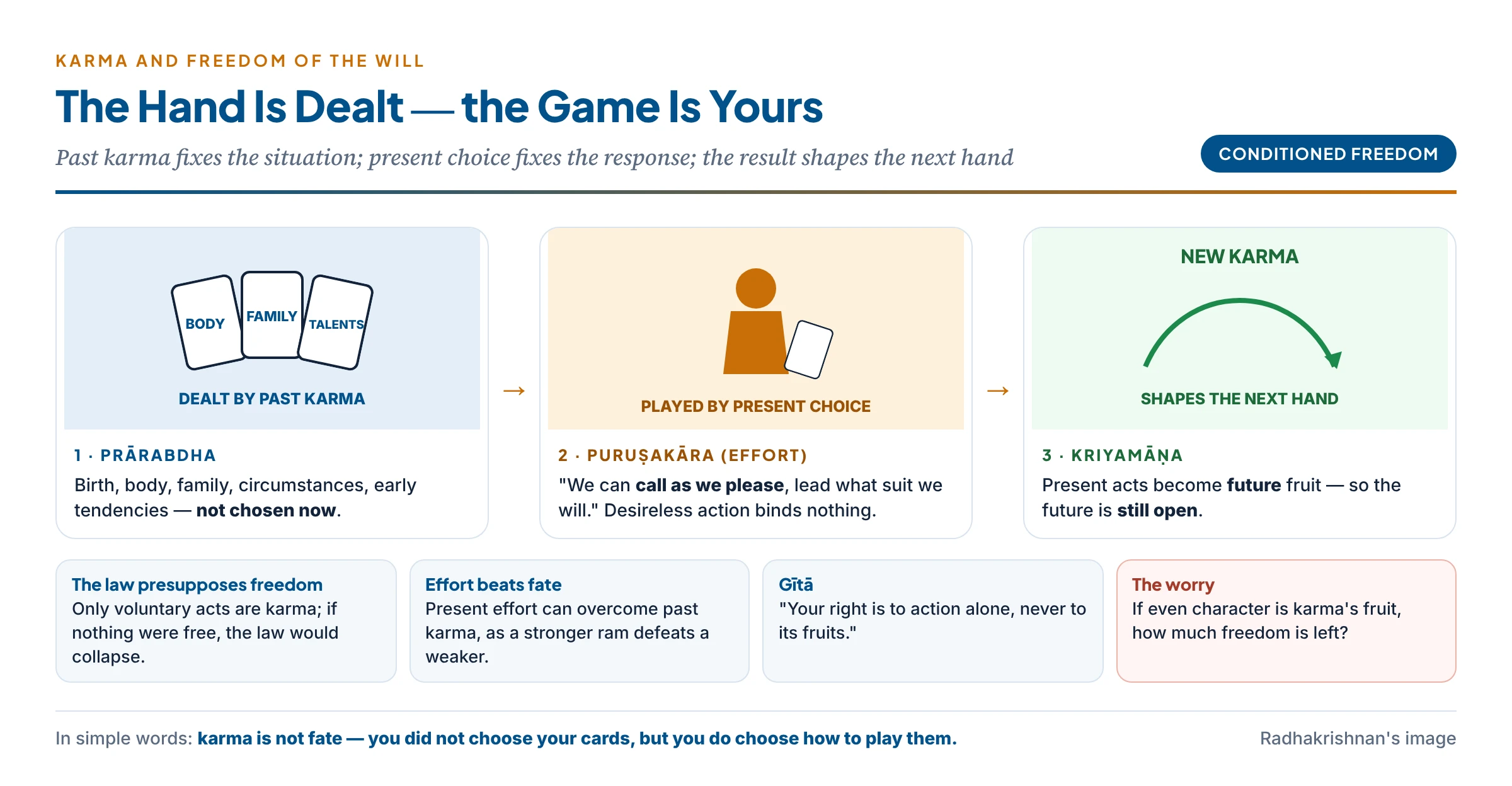
- Radhakrishnan’s image: “The cards in the game of life are given to us; we do not select them. They are traced to our past karma, but we can call as we please, lead what suit we will, and as we play we gain or lose. And there is freedom.” Karma is “a law of continuity, not of fatalism”.
Karma, Rebirth and Reincarnation in Hinduism
- Karma: the moral law of action and result (above).
- Rebirth (punarjanma): the jīva, enclosed in its subtle body, passes after death to a new birth fixed by its karma — human, animal, divine or infernal. The Upaniṣads speak of the path of the fathers (return) and the path of the gods (no return).
- Reincarnation: the self “puts on new bodies as a man puts on new clothes“; the Gītā adds a beautiful image — “as the wind carries scents from their places, so the lord of the body, when he takes a body and when he leaves it, carries with him the mind and the senses“.
- What decides the next birth: one’s karma and one’s last thought — “whatever state of being one remembers when one leaves the body, to that one goes”.
- Continuity of spiritual effort: a seeker who dies before completing the path (the “fallen yogi”) is reborn in a pure and prosperous family or a family of yogis, and regains the understanding of the previous life, striving onward — “no doer of good ever comes to grief“.
- Divine incarnation (avatāra): distinct from the reincarnation of souls. God descends freely, not by karma: “Whenever righteousness declines and unrighteousness rises, I manifest myself.” Kṛṣṇa tells Arjuna: “Many births of mine and of yours have passed; I know them all, you do not.“
- Hindu schools: Advaita (rebirth real at the level of appearance, ended by knowledge), Viśiṣṭādvaita and Dvaita (rebirth real, ended by devotion and grace); Nyāya, Sāṃkhya, Mīmāṃsā each with its own mechanism (table above).
The Gītā: Is Immortality a Necessary Condition for Rebirth?
In the Gītā’s framework — yes
- Rebirth in the Gītā is the passage of the embodied self (dehin) from body to body; the self that passes is unborn, eternal and indestructible. Without an enduring self there would be no one to “cast off worn-out bodies”.
- Kṛṣṇa’s knowledge of “many births of mine and of yours” presupposes an enduring subject across lives.
- The fallen yogi regains past understanding — continuity of the same seeker.
But a subtlety
- The Gītā also says the true self does not act: “the one who is deluded by egoism thinks ‘I am the doer‘”; actions are done by the guṇas of prakṛti. What actually carries karma from life to life is the self together with mind and senses — the subtle body, carried “as the wind carries scents”.
- So in the Gītā, immortality of the self is the ground of rebirth, while the subtle body is its vehicle.
In simple words
A breeze passing through a garden of jasmine carries the fragrance to the next street, though not a single flower travels. The Gītā uses this picture: when the self leaves one body and enters another, it carries along the mind and senses — the “fragrance” of the life just lived — into the new body. The flowers (the old body) stay behind; the scent (the impressions) moves on.
Is it a necessary condition in general?
- Buddhism shows that rebirth can be conceived without an immortal soul — as a causal continuity of momentary states.
- Verdict: immortality of the soul is necessary for rebirth as the Gītā conceives it (a person who passes on), but not logically necessary for every concept of rebirth; whether the Buddhist alternative preserves moral responsibility is the real dispute (below).
Rebirth without a Soul — Buddhism
The puzzle
- Buddhism denies a permanent soul (anātman) and holds that everything is momentary (kṣaṇika) — yet it accepts rebirth and karma. If there is no soul, who is reborn, and who reaps the fruit of karma?
The Buddhist answer
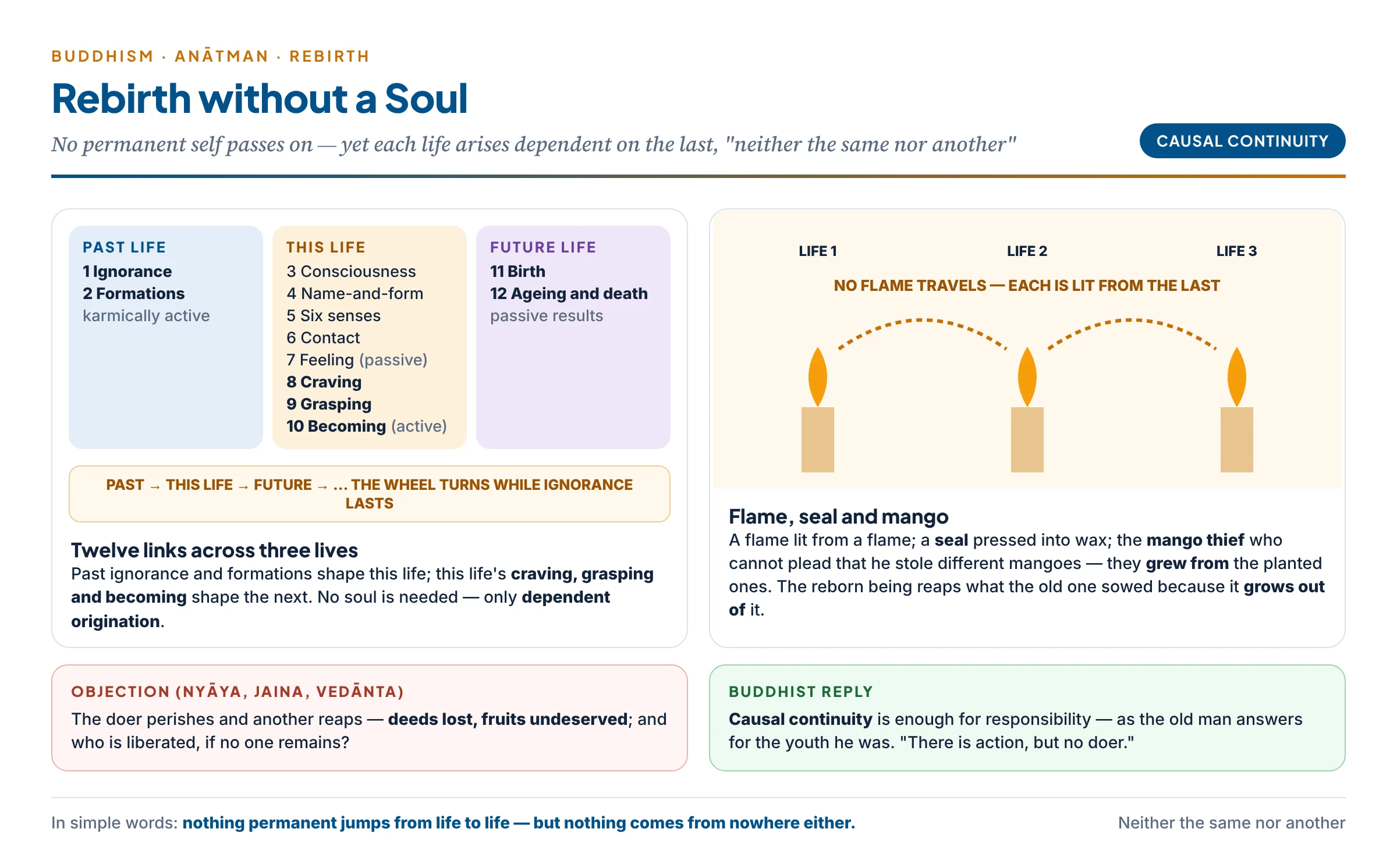
- A stream, not a substance: the person is a continuous series (santāna) of physical and mental events — the five aggregates — each arising dependent on the previous one. At death the series does not stop; the last moment of consciousness conditions the first moment of a new life (the rebirth-linking consciousness).
- Neither the same nor another: the new being is “neither identical with the former, nor completely different“; there is a causal connection, for they belong to the same causal continuum.
- The twelve links (nidānas) across three lives: ignorance and formations (saṃskāra) are the karmically active states of the past life; they produce the karmically passive states of this life — consciousness, name-and-form, the six sense-bases, contact and feeling; in response, the active states of craving, grasping and becoming arise, which determine the future life — birth, and ageing and death. Ignorance and formations are present in this life too, so the wheel keeps turning.
- Karma is intention: what passes on is not a soul but the force of intentional action, like a transmission of energy.
The analogies
- Flame lit from a flame: the flame of the second lamp is not the flame of the first, yet it would not exist without it.
- Seal in wax: the seal’s pattern passes to the wax, though nothing of the seal moves into it.
- Echo, reflection in a mirror, a verse learned from a teacher — something passes, but no substance travels.
- Milk to curd to butter to ghee: different, yet continuous.
- The mango thief (Nāgasena): a man who steals mangoes cannot plead that the mangoes he took were not the ones the owner planted — they grew from them; he is punishable. So the new being reaps the fruit of the old being’s deeds because it grows out of them.
- The Buddhist verse: “There is suffering, but none who suffers; there is action, but no doer; there is nirvāṇa, but no one who enters it; there is the path, but no one who travels it.”
Objections from the soul-schools (Nyāya, Jaina, Vedānta)
- Moral injustice: if the doer of a deed perishes in a moment and another being reaps the fruit, the law commits both fallacies — the doer’s deed is lost and the reaper gets what he did not do.
- Memory and recognition: “I who saw this yesterday now see it again” — recognition needs a persisting subject; momentary states cannot remember.
- Who is liberated? If there is no self, who attains nirvāṇa — and why should anyone strive for a liberation that will not be his?
- The unity of the stream: what makes a series one series rather than a heap of unrelated moments? Something must hold it together — a self.
- “Immortality of the soul is a necessary postulate for rebirth”: without an enduring self, “rebirth” becomes mere re-arising — not the rebirth of someone.
Buddhist replies
- Causal continuity is enough for responsibility: the old man is punished for the crimes of the youth he was, though every cell has changed — not because a soul persisted, but because he grew out of that youth.
- Memory belongs to the stream: each moment inherits the traces of earlier ones.
- Liberation is precisely the end of the illusion of self — striving for it is not selfish but selfless.
- Some early Buddhists (the Personalists, Pudgalavāda) went further and accepted a “person” that is neither the same as nor different from the aggregates — showing the difficulty was felt within Buddhism itself.
In simple words
The person you were at five years old shares no cells, no memories of most days, and very few opinions with the person you are now — yet you would rightly be called to account for a promise made at fifteen. Buddhism says rebirth works like growing up, only across a death: no fixed “thing” passes on, but each stage grows out of the last, and that is enough for responsibility.
Is a Belief in Rebirth Possible without Immortality? — Ways to Justify Rebirth With or Without the Soul
With a soul (Hindu and Jaina view)
- The eternal self is the bearer of karma and the one reborn; the subtle body or karmic body is its vehicle.
- Strength: preserves identity and responsibility in the strict sense; explains memory of past lives and the newborn’s instincts.
- Weakness: the soul itself is unproved; and on Sāṃkhya–Advaita views the true self does not really move or act, so the burden falls on the subtle body anyway.
Without a soul (Buddhist view)
- Causal continuity of the five aggregates; karma as intentional energy.
- Strength: needs no metaphysical substance; fits the observable flux of mind and body; shows that rebirth is about continuity of character and consequence.
- Weakness: struggles to explain identity, memory and desert; may reduce rebirth to re-arising.
Verdict: rebirth can be conceived without an immortal soul, but the soul-schools have a stronger claim to explain why the reborn being is the same responsible agent. The real issue is what personal identity requires — strict sameness of a substance, or continuity of a causal stream.
The Non-theistic Religions and Rebirth — Is Their Stand Philosophically Significant?
- Jainism and Buddhism (and the atheistic forms of Sāṃkhya and Mīmāṃsā) reject a creator God but accept karma and rebirth. They are sometimes called “anti-theistic” religions.
- Why their stand is significant:
- Ethics without theism: they show that a moral order can be conceived without a divine lawgiver or judge — karma works by itself, like a natural law.
- A theodicy without God: since no God created the world, there is no problem of evil in the Western sense; suffering is the fruit of one’s own deeds.
- Self-reliance: liberation is won by one’s own effort — “be a lamp unto yourselves” — not by grace.
- Rebirth without a soul (Buddhism) shows rebirth can be a psychological and causal doctrine, not only a metaphysical one.
- Naturalistic moral physics (Jainism): karmic matter makes the mechanism of karma almost physical — a bold attempt to explain how deeds bind.
- Ahiṃsā and universal kinship: all living beings are in the same cycle — the root of the most thorough non-violence in world religions.
- Criticisms:
- Nyāya: an unconscious law cannot distribute fruits with perfect justice — an intelligent guide is needed.
- Without God or (for Buddhism) without a soul, karma’s mechanism and bearer become obscure.
- Verdict: their stand is philosophically significant because it separates morality and the afterlife from belief in God — an idea of great relevance to modern discussions of “religion without God”.
Karma and Freedom of the Will
The problem
- If my present body, family, character and circumstances are the fruit of past karma, and my present choices flow from that character, then all my actions seem determined — and if they are determined, how can I be responsible, and how can new karma be fairly imposed?
Why karma is compatible with freedom
- The law presupposes freedom: karma rewards and punishes voluntary action. If actions were not free, they would not be karma in the moral sense at all — the law would destroy itself.
- Determinism of situation, not of response: prārabdha fixes the situation — the cards we are dealt — but not how we play them (Radhakrishnan). The archer is free with the arrow on the string.
- Human effort and fate: Indian thought sets human effort (puruṣakāra) beside past karma (daiva); the Yoga Vāsiṣṭha holds that present effort can overcome the force of past karma, as a stronger ram defeats a weaker. Past karma is simply past effort.
- Character can be changed: tendencies (vāsanās) are strengthened or weakened by present choices; spiritual discipline can reshape them.
- The Gītā’s solution: one is free to act without attachment to fruits (niṣkāma karma); such action binds no new karma and leads to freedom from karma itself.
- God and freedom: for Rāmānuja, God as the inner controller permits (anumati) the soul’s free initiative and then gives the fruit; the first movement is the soul’s own.
- Buddhism: karma is intention — the very seat of choice; the Buddha rejected both strict determinism and chance.
- Western parallel: like the compatibilists (who hold that freedom is acting from one’s own character without external compulsion), karma theory sees freedom not as uncaused choice but as self-determination.
Remaining difficulties
- If character itself is the fruit of karma, the self that chooses is already shaped — freedom seems to shrink to very little.
- Madhva’s doctrine that souls have an inborn nature (some fit for liberation, some never) seems to reduce freedom drastically.
- If God’s grace decides liberation (theistic schools), what is left for human effort? (Article 8).
- Verdict: karma is not fatalism; it is a theory of conditioned freedom — we are bound by what we have done, and free in what we do now.
Can Finite Karma Determine the Nature of the Immortal Self?
The puzzle
- Karma is the result of finite actions; the ātman is eternal and infinite. How can something finite decide the nature or destiny of what is eternal? And how could finite actions deserve infinite consequences?
Answers of the schools
- Advaita: karma does not touch the ātman at all — the self is unattached (asaṅga), like space unaffected by smoke. Karma belongs to the jīva (the self limited by mind and body) and to the subtle body. Bondage is apparent; and liberation is not produced by karma — anything produced by action is perishable, so mokṣa must be eternal and unproduced: it is knowledge of what one already is.
- Sāṃkhya: puruṣa is neither bound nor freed; karma and rebirth belong to prakṛti (the subtle body). The puruṣa only seems affected, as a crystal seems red beside a red flower.
- Jainism: karma does not change the soul’s nature but veils it — like clouds hiding the sun. Remove the clouds and infinite knowledge and bliss shine out.
- Nyāya–Vaiśeṣika: merit and demerit (adṛṣṭa) are qualities in the soul; they decide its experiences, not its essence.
- Dvaita: each soul has an intrinsic nature (svarūpa); karma only brings out what the soul essentially is.
- On infinite punishment: Indian systems generally hold that finite karma yields finite results — even heaven and hell are temporary; this avoids Hume’s charge against eternal punishment for temporary offences. Only liberation is eternal — and it is not a reward of karma but the end of karma.
- Conclusion: finite karma determines the circumstances and experiences of the embodied self, not the nature of the eternal self — which is why liberation is possible at all.
Critical Evaluation
Strengths of the Karma–Rebirth Doctrine
- Moral seriousness: no act is insignificant; everyone is responsible for his own destiny.
- Rational theodicy: explains suffering and inequality without an arbitrary God.
- Hope and freedom: the future is not fixed; effort and wisdom can change it.
- Ecological and universal ethics: all beings share the cycle — the root of ahiṃsā.
Weaknesses
- Unverifiable and possibly unfalsifiable.
- Identity problem, especially in Buddhism.
- Obscure mechanism without God; arbitrary God with him.
- Social misuse to justify caste and indifference.
- Collective calamities strain the idea of individually deserved suffering.
Critics and Defenders
Criticism — The critics
- Hick: a beginningless regress only postpones the explanation of inequality; without memory, rebirth identity is too thin.
- Nyāya (against Jainas and Buddhists): unconscious karma cannot dispense fruits — God is needed.
- Soul-schools (against Buddhism): momentary beings make deeds lost and fruits undeserved.
- Social critics (Ambedkar): karma has been used to call caste and suffering deserved.
- Determinists: if character itself is karma’s fruit, freedom is illusory.
Defence — The defenders
- Weber: karma is “the most consistent theodicy ever produced”.
- Radhakrishnan: the cards are dealt, but we play them freely — karma is continuity, not fatalism.
- Buddhists: causal continuity suffices for responsibility — the mango thief cannot escape.
- Gītā: desireless action frees us from karma; explaining suffering is no excuse for not relieving it.
- Śaṅkara: God is like rain; differences come from the seeds of karma, so God is neither partial nor cruel.
Cross-Tradition Comparison
| Theme | Indian karma theory | Western parallels |
|---|---|---|
| Moral causation | “As you sow, so shall you reap” | “Whatsoever a man soweth, that shall he also reap” (Paul) |
| Justice beyond death | Rebirth carries fruits forward | Kant’s justice postulate; heaven and hell |
| Without God | Jaina, Buddhist, Sāṃkhya, Mīmāṃsā karma | Kant’s autonomous moral law; Stoic nature |
| Freedom | Conditioned freedom; effort vs past karma | Compatibilism (Hume, modern philosophers) |
| Theodicy | Suffering is self-earned | Augustine: evil as sin or punishment for sin |
| No soul, yet continuity | Buddhist santāna | Hume’s bundle; modern psychological-continuity views |
Indian Connect — Indian Connect — Augustine and karma
- Augustine held that all evil is either sin or the punishment of sin — suffering is deserved because of the Fall.
- Karma theory says suffering is deserved because of one’s own past deeds — in this or earlier lives.
- Karma avoids the injustice of inherited guilt (everyone punished for Adam’s sin), but at the price of positing countless unremembered lives.
Synthesis (Siddhānta)
- Karma is the moral law of action and result — sañcita, prārabdha and kriyamāṇa; it is carried by adṛṣṭa (guided by God in Nyāya), apūrva (Mīmāṃsā), karmic matter (Jainism), seeds and intentions (Buddhism) or impressions (Sāṃkhya–Yoga).
- Rebirth is karma’s necessary partner: it gives the time for fruits, explains inequality and innate character, and turns karma into the bondage from which liberation is sought. Each school names a cause of rebirth (ignorance, craving, passions, non-discrimination, interested action) and a remedy.
- Hinduism treats karma as an essential postulate; the Gītā makes the immortal self the ground of rebirth and the subtle body its vehicle, while teaching desireless action as the way out.
- Buddhism shows that rebirth can be conceived without a soul, through causal continuity — at the cost of hard questions about identity and desert.
- The non-theistic religions show that a moral order can exist without God — a philosophically significant result.
- Karma is compatible with freedom as a law of conditioned freedom; finite karma shapes the experiences of the embodied self, not the nature of the eternal self.
- Contemporary relevance:
- Collective karma: our actions shape the world future generations inherit — climate change and pollution are karma on a global scale.
- Habit and neuroplasticity: modern psychology confirms that repeated choices reshape character — the core of the karma idea within a single life.
- Social justice: the old misuse of karma to justify caste is rejected by the Constitution’s equality guarantees and by reformers.
- Balanced view: karma and rebirth form a coherent and morally powerful worldview, not provable but deeply rational as a postulate of moral life — provided it inspires responsibility and compassion, not resignation.
“As one acts, as one conducts oneself, so one becomes.” — Bṛhadāraṇyaka Upaniṣad
Previous Year Questions
- 2025Is the concept of immortality of soul a necessary condition for Rebirth? Discuss with reference to the Bhagavad Gītā.
- 2023Examine the significance of the concept of rebirth in the theory of Karma.
- 2022“Immortality of Soul is a necessary postulate for rebirth.” Critically examine with reference to Buddhism.
- 2021Discuss and evaluate the doctrine of Karma as an essential postulate of Hinduism.
- 2019State and explain the doctrines of Karma, Rebirth and Rebirth and Reincarnation in Hinduism.
- 2018How far is it plausible to argue that the anti-theistic religions’ stand on the concept of rebirth is philosophically significant?
- 2016Buddhism disbelieves in the immortality of soul, but accepts the phenomenon of rebirth. Examine.
- 2014How do you justify rebirth with or without the soul?
- 2011Is a belief in rebirth and reincarnation possible without a belief in the immortality of the soul? Discuss.
- 2007Explain the doctrine of the law of karma. Is it compatible with the freedom of will? Discuss.
- 2006Explain the doctrine of the law of karma. Is it compatible with the freedom of will? Discuss.
- 2003Can the results of a finite action of an individual (karma) determine the nature of the immortal soul (atman)? Critical notes.