

Individual and State: Rights; Duties and Accountability.
Official Syllabus: Paper II, Section A, Unit 3
Rights began as claims of the individual against the state. But individuals are born into groups — a language, a religion, a tribe, a caste, a nation — and some goods, such as a living language or a sacred tradition, can only be enjoyed together. Should groups have rights of their own? What happens when a group’s rights clash with the rights of its own members — a woman, a dissenter, a lower-caste member? And does a society shaped by dharma, family and caste, like India’s, welcome individual rights or resist them? This article covers group rights and multiculturalism (Kymlicka, Parekh, Taylor, Iris Young), the challenges of balancing group and individual rights and the ways democracies reconcile them, the debate on whether Indian tradition is antagonistic to individual rights, and whether rights can be sustained in a caste society — with the Indian Constitution as the running example.
In simple words
Think of a joint family. Each member has personal wishes — whom to marry, what to study, where to work. The family as a whole also has interests — its home, its traditions, its reputation. Usually the two fit together; sometimes they clash, as when a daughter wants to marry outside the community. A good family protects the members and keeps the family alive. A good multicultural democracy faces the same balancing act on a national scale.
Context & Problem
Individual Rights and Group Rights
- Individual rights are held by persons as persons — speech, liberty, equality before law.
- Group rights are held by a group as a group, or by individuals because they belong to a group — the right of a linguistic minority to run its schools, of a tribe to its land and customs, of a religious community to its personal law, of a disadvantaged caste to reserved seats.
- Why groups claim rights.
- Culture shapes the self — a person’s choices, language and sense of worth are formed in a culture; if the culture dies, the person is impoverished.
- Majority rule can swamp minorities — “one person, one vote” alone can leave a small group permanently outvoted.
- Historical injustice — colonised, enslaved or caste-oppressed groups need remedies as groups.
Multiculturalism
- Meaning. The state should recognise the existence of various cultures in its policies; cultural plurality should be part of policy formation.
- Two aspects.
- Descriptive — accepts cultural plurality as a fact.
- Normative — plurality must be recognised and respected.
- Action at two levels.
- The dominant group practises toleration and accommodation of other cultural groups.
- The state secures equal rights of citizenship and due representation of groups in decision-making bodies.
- Why it emerged. Largely as a response to immigration into Western societies. Unlike earlier immigrants to Europe, new arrivals wanted to keep their cultural identities intact. It also responded to the demands of indigenous peoples, national minorities (Quebec, Catalonia) and racial minorities.
Core Doctrine
Bhikhu Parekh: Culture, Plurality and Dialogue
- Three features of multiculturalism.
- Culture shapes human nature — human beings are culturally embedded.
- Cultural plurality does not mean that some cultures are inherently inferior or superior; each embodies a vision of the good life.
- Cultures interact with each other and get enriched; no culture is closed.
- Against moral monism. Traditional and contemporary Western philosophy stood for moral monism — one true way of life. Parekh proposes intercultural dialogue between groups to find shared values.
- Recognition needs power. No cultural recognition will succeed without a just share of economic and political power for the groups concerned.
- India as a model. Parekh saw Indian “unity in diversity” — linguistic states, minority rights, plural personal laws — as an older form of multiculturalism.
Will Kymlicka: Liberal Group Rights
- Liberal multiculturalism. Kymlicka (Multicultural Citizenship, 1995) argues that liberals should support group rights because individuals need a secure cultural context to make meaningful choices — culture is the “context of choice”.
- Three kinds of group-differentiated rights.
- Self-government rights — for national minorities and indigenous peoples (Quebec, Native Americans, India’s Sixth Schedule tribal areas).
- Polyethnic rights — for immigrant groups: exemptions and support so that they can express their culture without disadvantage — a Sikh’s exemption from motorcycle-helmet laws to wear a turban.
- Special representation rights — guaranteed seats for disadvantaged groups in legislatures.
- Mirror representation. Different cultural and ethnic groups should be represented in the legislature by members of their own groups; other legislators must also be accountable for representing these groups.
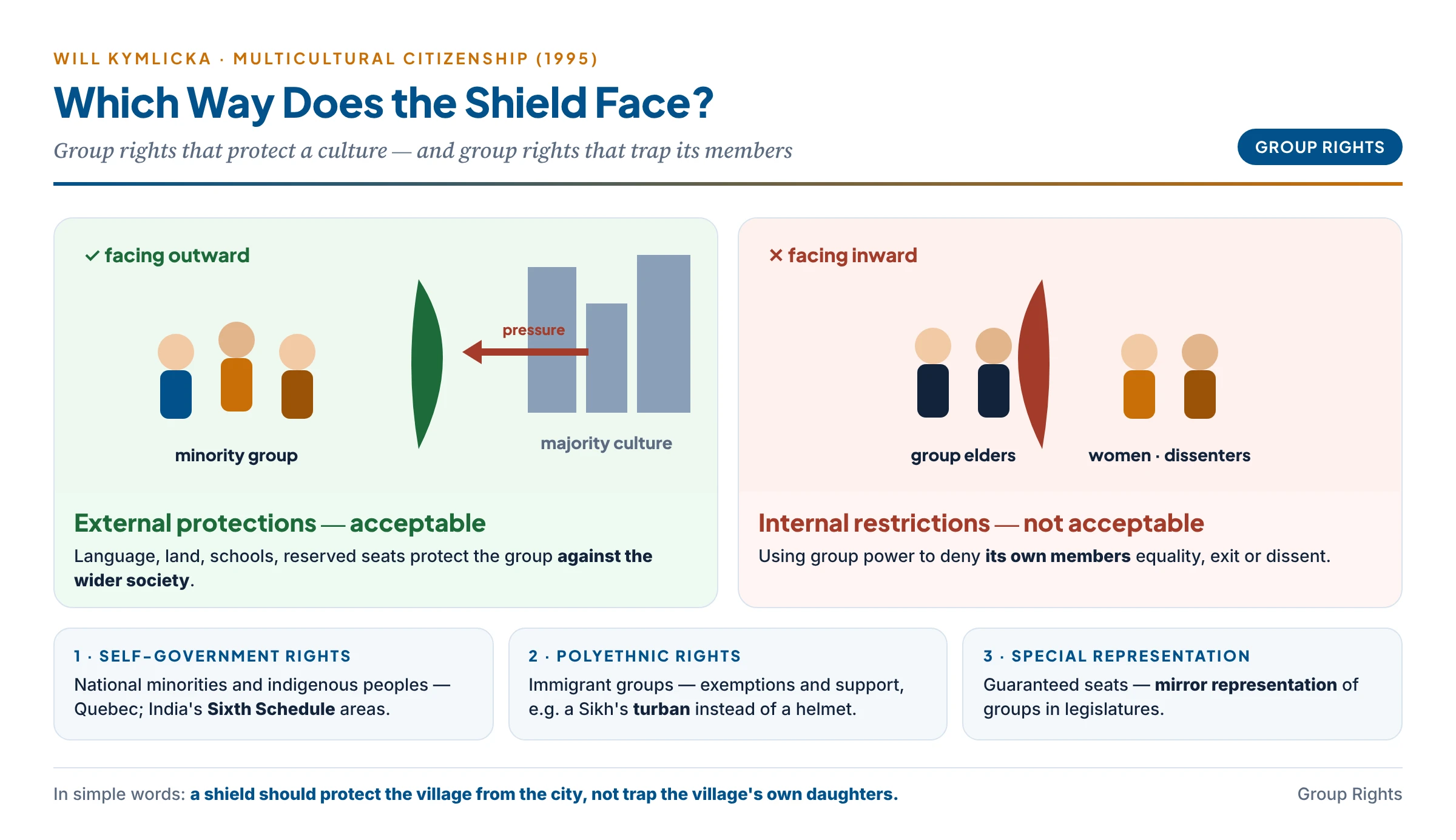
- The key distinction.
- External protections — protect a group against the wider society (language rights, land rights, reserved seats). Kymlicka supports these.
- Internal restrictions — let a group restrict its own members (punish dissent, deny women equal rights). Kymlicka rejects these.
In simple words
A shield can be held two ways. Turned outward, it protects a small village from being swallowed by a big city — its language, its land, its festivals. Turned inward, the same shield can trap the village’s own daughters and dissenters. Kymlicka says: give minorities shields that face outward, never shields that face inward.
Charles Taylor and Iris Marion Young
- Charles Taylor (“The Politics of Recognition”, 1992) — identity is formed through recognition by others; misrecognition (contempt, stereotyping) is a real harm. Equal dignity alone (treating everyone the same) can hide a bias towards the majority culture, so a “politics of difference” is also needed.
- Iris Marion Young (Justice and the Politics of Difference, 1990):
- Assimilationist models falsely project the norms of one group as universal standards; others are treated as deviants.
- Disadvantaged groups want to preserve their identity to maintain their difference.
- The politics of difference implies liberation and emancipation; it promotes democratic cultural pluralism and group solidarity (Black Americans calling one another “brothers” and “sisters”).
- Movements of the oppressed expose the faults of the dominant culture and point to new values — for example, Native American cultures tied to nature challenge a self-centred industrial culture.
Liberal and Feminist Objections to Group Rights
- Brian Barry (Culture and Equality, 2001) — group rights undermine equal citizenship and divert attention from economic inequality.
- Chandran Kukathas — the state should tolerate groups but guarantee individuals a right of exit.
- Susan Moller Okin (“Is Multiculturalism Bad for Women?”, 1999) — many cultural practices control women’s bodies and lives; group rights can entrench patriarchy within the group.
- Essentialism — treating a “culture” as fixed and uniform ignores internal debate and change; who speaks for the group — often its conservative male elite?
- Minorities within minorities — a group right can oppress smaller groups inside it (lower castes within a religious minority).
Challenges in Balancing Group and Individual Rights in a Multicultural Society
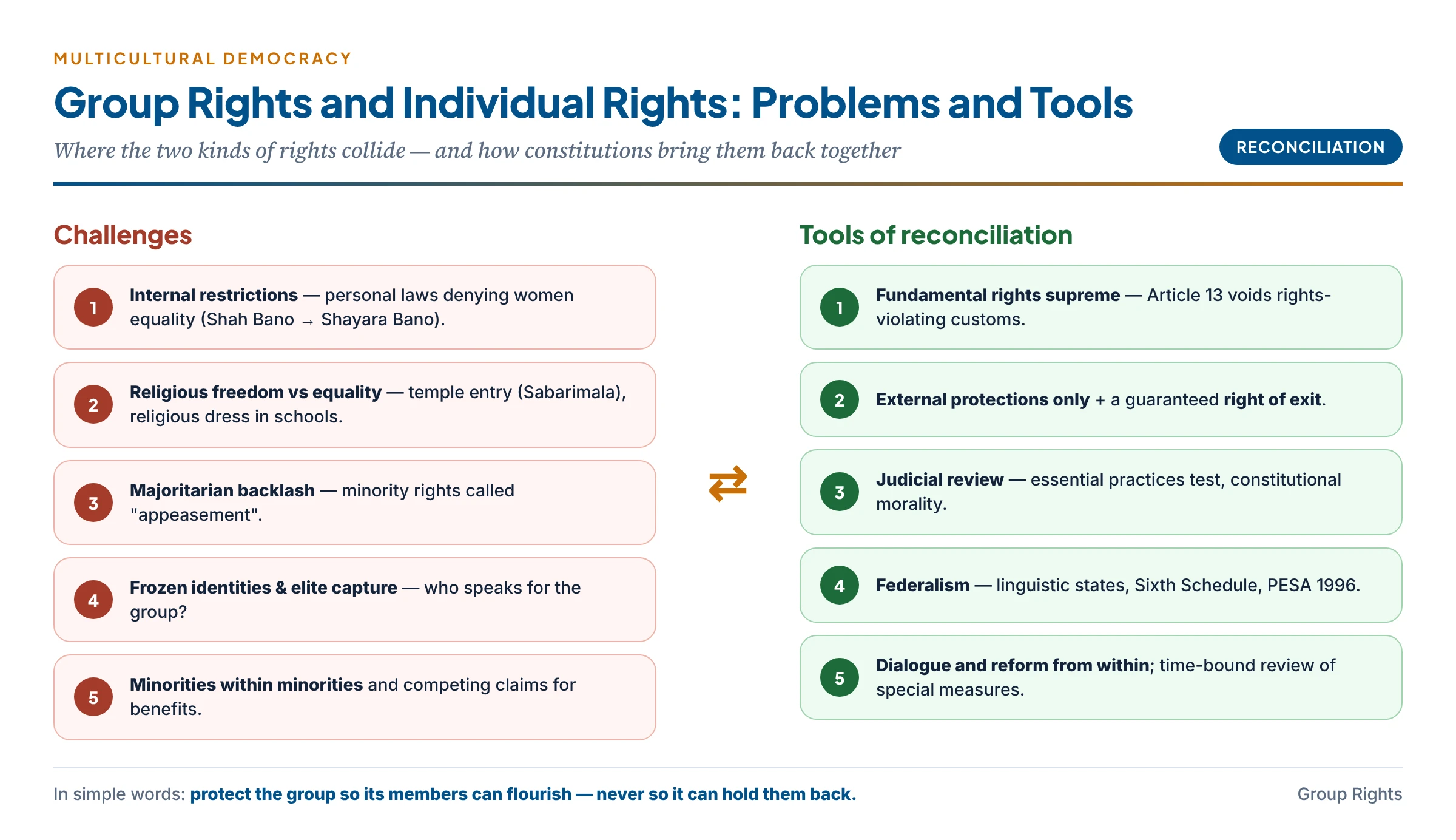
- Internal restrictions on women and dissenters — personal laws on marriage, divorce and inheritance may deny women equality (the debates from Shah Bano, 1985, to Shayara Bano, 2017, on instant triple talaq).
- Religious freedom versus equality — entry of women into a temple (Sabarimala, 2018) or religious dress in schools (the 2022 hijab case, decided by a split verdict) set group practice against individual equality.
- Majoritarian backlash — minority rights are attacked as “appeasement“; group claims harden into identity politics.
- Fragmentation of national identity — too much stress on difference can weaken shared citizenship and solidarity.
- Freezing identities — group rights may lock people into categories (caste, tribe, religion) they wish to leave.
- Distributive conflicts — reservations versus claims of merit; competing claims among groups for limited benefits.
- Who decides what the group wants — community leaders may not represent women, youth or the poor.
- Neutrality of the state — accommodating every group can make the state look partial to some.
How Democracies Reconcile Individual and Group Rights
- Constitutional supremacy of individual rights — group rights operate within fundamental rights; Article 13 makes laws, customs and usages inconsistent with Part III void.
- External protections, not internal restrictions (Kymlicka) — groups may defend themselves against the majority but not oppress their members.
- Right of exit — no one can be compelled to remain in a group or follow its rules.
- Judicial review — courts test group practices against equality and dignity; Indian courts use the “essential religious practices” test and the idea of constitutional morality.
- Differentiated but common citizenship — special rights for specific needs, alongside the same basic rights for all.
- Federalism and decentralisation — linguistic states (1956), autonomous district councils under the Sixth Schedule, Panchayats (Extension to Scheduled Areas) Act, 1996.
- Representation and dialogue — reserved seats, consultation and Parekh’s intercultural dialogue.
- Gradual, internal reform — reforms are more lasting when they come from within communities (Hindu law reform bills of the 1950s, the Muslim Women (Protection of Rights on Marriage) Act, 2019, debates on a uniform civil code (UCC) under Article 44).
- Time-bound review of special measures, so that group rights remain remedies, not permanent privileges.
Common confusion
Does recognising group rights mean the Indian Constitution puts the community above the individual? No. The Constitution protects groups mainly through external protections — minority schools (Article 30), cultural and linguistic rights (Article 29), reservations, tribal autonomy. But all of them operate under Part III: Article 25 makes religious freedom subject to public order, morality, health and the other fundamental rights, and Article 13 voids customs that violate them. Ambedkar insisted that the individual is the unit of the Constitution; group rights are tools for individual dignity, not a licence for groups to override it.
Is Indian Tradition Antagonistic to Individual Rights?
Arguments that it is
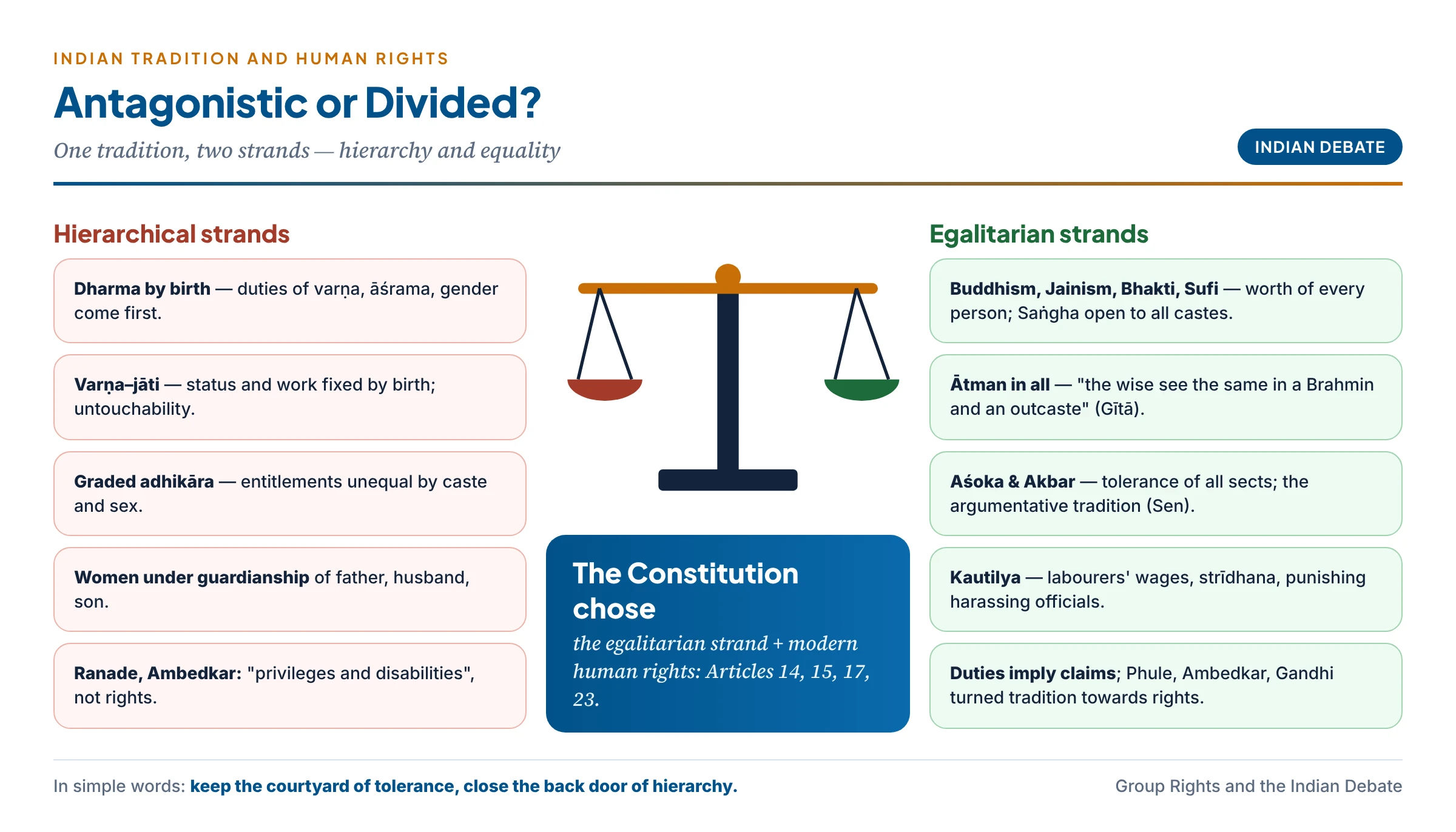
- Duty-centred ethics. Classical Indian ethics is dharma-centric: one’s duties according to varṇa, āśrama, gender and family come first; the language of individual claims is largely absent.
- Hierarchy by birth. The varṇa–jāti order assigned status, occupation and rights by birth; adhikāra (entitlement) was graded, not equal.
- Subordination of women. Texts such as the Manusmṛti placed women under the guardianship of father, husband and son.
- Individual absorbed in the group. Family, caste and village councils decided marriage, work and conduct.
- Ranade’s verdict, endorsed by Ambedkar: there were “no rights in the Hindu society which the moral sense of man could recognise. There were privileges and disabilities, privileges for a few and disabilities for a vast majority.”
Arguments that it is not
- A plural tradition. Indian tradition includes Buddhism, Jainism, Cārvāka, Bhakti and Sufi movements that rejected birth-based hierarchy and affirmed the worth of every person; the Buddha admitted all castes to the Saṅgha.
- Equality of the self. The Upaniṣadic teaching that the same ātman dwells in all, and the Gītā’s “the wise see the same in a Brahmin, a cow, an elephant, a dog and an outcaste”, supply a ground of equal dignity.
- Tolerance and free debate. Aśoka’s edicts on respect for all sects, Akbar’s policy of peace with all, and the śāstrārtha culture of debate — Amartya Sen’s “argumentative Indian” — show deep respect for freedom of belief and expression.
- Protection of subjects. Kautilya fixed wages for labourers, protected strīdhana (women’s property), punished officials who harassed subjects and made the king’s happiness depend on theirs.
- Duties imply rights. If the king has a duty to protect the weak, the weak have, in effect, a claim to protection — rights exist as the other side of duties.
- Modern Indian thinkers used tradition for rights — Ram Mohan Roy against sati, Phule and Ambedkar against caste, Gandhi’s sarvodaya and ahiṃsā; India’s freedom struggle demanded rights, and the Constitution embraced them.
In simple words
An old family house may have a beautiful courtyard where everyone gathers — and also a back door through which the servants were made to enter. Inheriting the house does not mean keeping the back-door rule. Indian tradition is like that house: one can keep its courtyard of tolerance and compassion while abolishing its rules of hierarchy.
Assessment in the light of human-rights doctrine
- Human-rights doctrine holds that rights belong to every human being equally by virtue of dignity. Judged by this, the hierarchical strands of Indian tradition — caste, untouchability, subordination of women — were indeed antagonistic to individual rights.
- But the tradition also contains egalitarian, tolerant and compassionate strands that support human rights from within; Sen argues that the claim of a uniquely “Western” origin of liberty is false.
- Balanced view. Indian tradition is not antagonistic as a whole; it is internally divided. The Constitution, drawing on its egalitarian strands and on modern human-rights thought, chose individual rights and outlawed the hierarchical practices (Articles 14, 15, 17, 23).
Can Rights Be Sustained in a Caste Society?
- The problem. Rights rest on equal dignity; caste rests on graded inequality by birth. Ambedkar described caste as an order of “graded inequality“, in which each caste looks down on those below and up to those above, so that the oppressed are divided and cannot unite.
- How caste denies rights.
- Equality — untouchability, exclusion from temples, wells and schools.
- Liberty — restrictions on occupation, residence and marriage; “honour” killings for inter-caste marriage.
- Dignity — degrading work such as manual scavenging imposed by birth.
- Fraternity — Ambedkar: caste is “anti-social”; it prevents a sense of common citizenship.
- Ambedkar’s warning on the limits of law. “Rights are protected not by law but by the social and moral conscience of society. If social conscience is such that it is prepared to recognise the rights which law chooses to enact, rights will be safe and secure. But if the fundamental rights are opposed by the community, no Law, no Parliament, no Judiciary can guarantee them in the real sense of the word.” (Ranade, Gandhi and Jinnah, 1943)
- The “life of contradictions”. On 25 November 1949 Ambedkar warned the Constituent Assembly: “In politics we will be recognising the principle of one man one vote and one vote one value. In our social and economic life, we shall … continue to deny the principle of one man one value.”
In simple words
Imagine a staircase where each step looks down on the one below and is looked down upon by the one above. No one wants to break the staircase, because everyone has someone beneath them. That is Ambedkar’s “graded inequality” — and why a law declaring “all steps equal” is not enough unless people stop thinking in steps.
- Constitutional and legal remedies.
- Article 17 abolishes untouchability; Article 15 bars discrimination and permits special provisions; Article 16(4) and later clauses allow reservations; Article 46 directs the state to promote the interests of weaker sections.
- Protection of Civil Rights Act, 1955; SC/ST (Prevention of Atrocities) Act, 1989; Prohibition of Employment as Manual Scavengers and their Rehabilitation Act, 2013.
- Political representation — reserved seats in legislatures and panchayats.
- Can rights be sustained?
- Pessimistic view: formal rights cannot overcome a social order backed by religion, custom and economic power; atrocities and social boycotts continue.
- Optimistic view: rights have changed Indian society — Dalit political assertion, education, urbanisation and inter-caste marriage show caste weakening; rights give the oppressed a language and a tool of struggle.
- Balanced view: rights can be sustained in a caste society only if law is joined by social reform, economic empowerment, education and fraternity. This is why Ambedkar called for the annihilation of caste, not merely its regulation.
Critical Evaluation
Group Rights Weighed
- For: they protect vulnerable cultures and correct historical injustice; they make equal citizenship real rather than formal.
- Against: they can trap individuals in groups, empower conservative elites and divide citizens.
- Test: a group right is justified when it enlarges the freedom and dignity of the group’s members, and unjustified when it restricts them.
Critics and Defenders
Criticism — Critics
- Brian Barry: group rights betray equal citizenship.
- Okin: multiculturalism can be bad for women.
- Kukathas: the state should not fund cultures, only protect the right of exit.
- Majoritarians: minority rights are “appeasement” that divides the nation.
- Ranade and Ambedkar: traditional Indian society knew privileges and disabilities, not rights.
Defence — Defenders and strengths
- Kymlicka: culture is the context of choice; external protections serve liberty.
- Parekh: dialogue between cultures, with a just share of power, enriches all.
- Taylor: misrecognition harms; recognition is a vital human need.
- Iris Young: the politics of difference liberates oppressed groups.
- Sen: Indian traditions contain rich resources for tolerance and freedom.
Cross-Tradition Comparison
| Theme | Western debate | Indian experience |
|---|---|---|
| Group rights | Kymlicka’s three kinds; Quebec, indigenous peoples | Articles 29–30; Fifth and Sixth Schedules; reservations |
| Culture and the self | Taylor’s politics of recognition | Ambedkar’s demand for self-respect for Dalits |
| Liberal limits | External protections, not internal restrictions | Personal laws subject to Part III; Shayara Bano (2017) |
| Dialogue | Parekh’s intercultural dialogue | Gandhi’s sarva-dharma-samabhāva (equal respect for all religions) |
| Tradition and rights | Sen: freedom is not uniquely Western | Aśoka, Akbar, Bhakti saints; Phule and Ambedkar against hierarchy |
Indian Connect — Indian Connect
- India’s model of multiculturalism. India combines individual rights (Part III) with group protections — minority education, linguistic states, tribal self-government, reservations — and a principled distance secularism that lets the state reform religious practices that violate rights.
- Gandhi and Ambedkar. Gandhi sought to reform caste from within Hinduism through moral persuasion and an idealised varṇa of duties without hierarchy; Ambedkar held that caste cannot be reformed, only annihilated, and that rights need a society of liberty, equality and fraternity.
- Social endosmosis. Ambedkar’s ideal society has many channels through which groups share experiences and interests, so that changes in one part spread to others — the opposite of the closed, non-communicating compartments of caste.
Synthesis (Siddhānta)
- Individuals need groups; groups must serve individuals. Group rights are justified as means to individual dignity and freedom, never as ends that override them.
- The liberal–multicultural balance — external protections, a right of exit, constitutional supremacy of fundamental rights, judicial review and intercultural dialogue — is the best available way to reconcile individual and group rights in a democracy.
- Indian tradition is plural — it carries both hierarchy and equality; the Constitution chose its egalitarian strands and modern human rights.
- Caste is the hardest test — rights survive in a caste society only when backed by social conscience, economic empowerment and fraternity; law is necessary but not sufficient.
- Contemporary relevance.
- Uniform civil code (UCC) debates (including Uttarakhand’s 2024 law) revive the question of group personal law versus individual equality.
- Caste census and sub-categorisation of reservations raise questions of minorities within minorities.
- Global migration keeps multiculturalism at the centre of politics in Europe and North America.
- Conclusion. A democracy is judged not only by how it treats individuals in general, but by how it treats the woman within the minority and the Dalit within the village. Reconciling individual and group rights is therefore the everyday work of constitutional democracy.
“Rights are protected not by law but by the social and moral conscience of society.” — B. R. Ambedkar
Previous Year Questions
- 2026Examine the challenges faced by a multicultural society in creating a harmonious balance between group rights and individual rights.
- 2020Is Indian tradition antagonistic to Individual Rights? Consider it by taking recourse to the doctrine of Human Rights.
- 2015How are individual and group rights reconciled in democracy? Explain.
- 2014“All human rights are centered on individual rights.” Discuss.
- 2011Can the conception of ‘rights’ of citizens be sustained in a society characterized by caste discrimination? Discuss.