

Individual and State: Rights; Duties and Accountability.
Official Syllabus: Paper II, Section A, Unit 3
Human rights are the rights a person has simply because he or she is a human being — not because of citizenship, caste, religion, gender, wealth or the favour of a ruler. They rest on one idea: every human being has equal and inherent dignity. After the horrors of the Second World War, when “legal” governments carried out genocide, the world decided that some rights must stand above every state. This article explains the meaning and features of human rights, their historical evolution to the Universal Declaration of Human Rights (1948) and after, Karel Vasak’s three generations, the philosophical justifications (natural law, Kant, Rawls’s Law of Peoples, capabilities), the great debate between universalism and cultural relativism, whether social contract theory can account for human rights, whether all human rights are individual rights, and the main critiques — with the Indian experience throughout.
In simple words
Imagine a traveller who loses his passport in a foreign country. He is no longer a citizen anywhere that can protect him. Does he still have a right not to be tortured, not to be enslaved, to be given food and a fair hearing? Most people feel at once that he does — not because any state gave him these rights, but because he is a human being. That feeling is the core of human rights.
Context & Problem
Meaning of Human Rights
- Definition. Human rights are rights available to all humans by virtue of being human, based on the idea that every person is entitled to a dignified existence.
- Moral foundation of all rights. They provide the moral foundation for every system of legal rights — the standard by which laws themselves are judged.
- The secular form of natural rights. They continue the natural-rights tradition of Locke, but ground it in human dignity rather than in God or a state of nature, so that people of all faiths and none can accept them.
- Why the idea was needed. Ordinary legal rights proved unable to protect individuals when the state itself turned criminal — under dictatorships, fascist regimes and colonial rule. The Holocaust was carried out under laws. Human rights were meant to be rights against the state, valid even when the state’s own law denies them.
Features of Human Rights
- Universal — for every human being, everywhere.
- Inherent — not granted by the state; they flow from human dignity.
- Inalienable — cannot be taken away or given up, except in specific, lawful situations (for example, liberty after a fair trial).
- Equal and non-discriminatory — no distinction of race, sex, language, religion, caste or status.
- Indivisible and interdependent — civil, political, economic, social and cultural rights support each other; the right to vote means little to a starving person.
- Claimable against states — states bear the primary duty to respect, protect and fulfil them.
Core Doctrine
Evolution of Human Rights
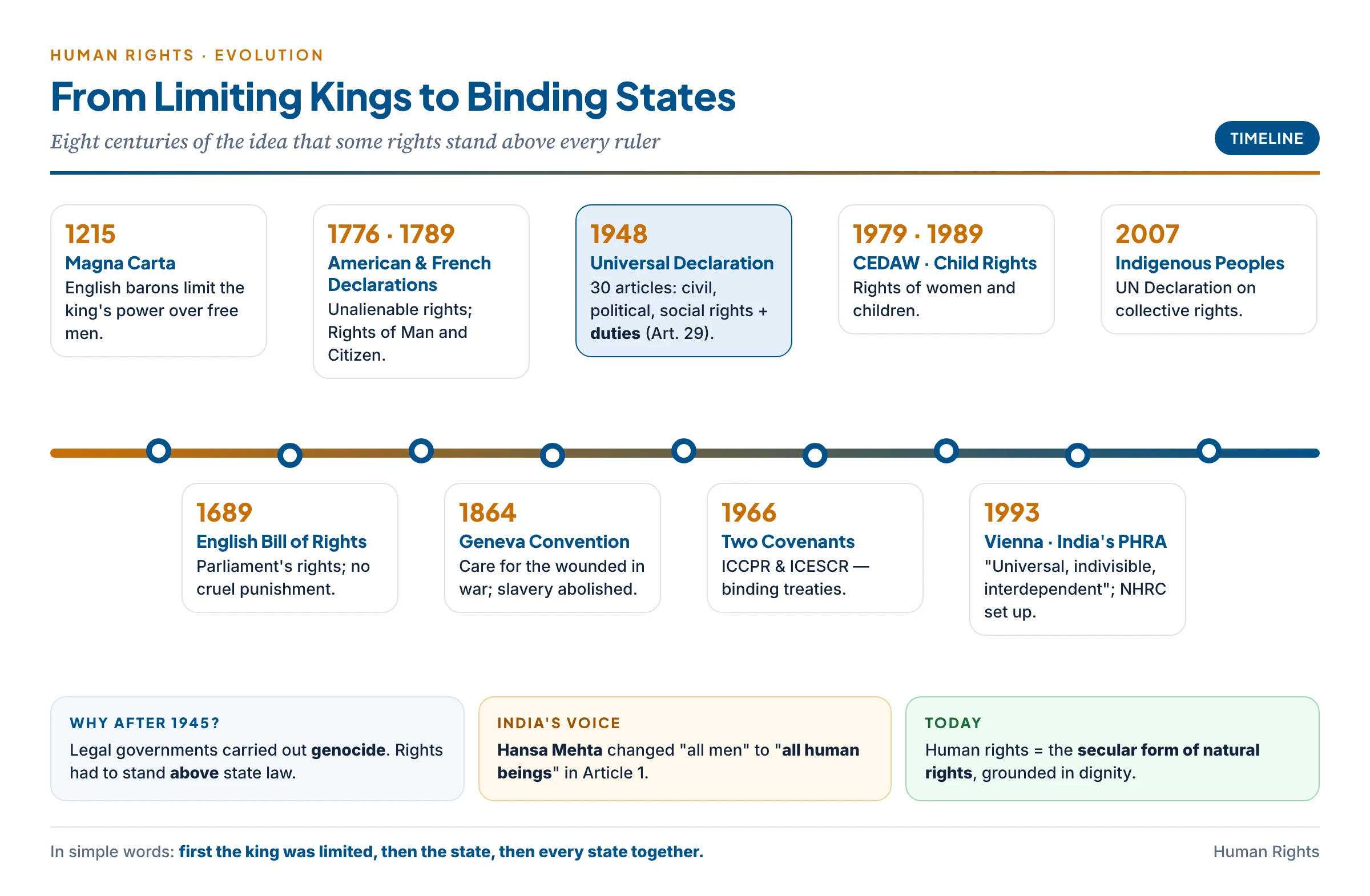
- Ancient and medieval roots — the Cyrus Cylinder (sixth century BCE) is often cited for religious tolerance; Aśoka’s edicts urged humane treatment of all, including animals and prisoners; the Magna Carta (1215) limited the English king’s power over free men.
- Age of revolutions.
- English Bill of Rights (1689).
- American Declaration of Independence (1776) — unalienable rights to life, liberty and the pursuit of happiness.
- French Declaration of the Rights of Man and of the Citizen (1789).
- Nineteenth century — abolition of the slave trade and slavery; the first Geneva Convention (1864) for the wounded in war.
- After the World Wars.
- UN Charter (1945) commits members to “promote … universal respect for … human rights”.
- Universal Declaration of Human Rights (10 December 1948, now Human Rights Day).
- Genocide Convention (1948).
- The binding covenants — the International Covenant on Civil and Political Rights (ICCPR) and the International Covenant on Economic, Social and Cultural Rights (ICESCR), both 1966; with the UDHR they form the International Bill of Human Rights.
- Later instruments — conventions on racial discrimination (1965), discrimination against women (CEDAW, 1979), torture (1984), the rights of the child (1989), persons with disabilities (2006); the Declaration on the Right to Development (1986); the Vienna Declaration (1993); the Declaration on the Rights of Indigenous Peoples (2007).
- Regional charters — European Convention on Human Rights (1950); African (Banjul) Charter on Human and Peoples’ Rights (1981), which lists duties as well as rights; Cairo Declaration on Human Rights in Islam (1990).
The Universal Declaration of Human Rights (1948)
- Drafting. A UN commission chaired by Eleanor Roosevelt, with members from many traditions — René Cassin (France), P. C. Chang (China), Charles Malik (Lebanon) and Hansa Mehta (India), who successfully urged that Article 1 say “all human beings are born free and equal”, not “all men”.
- Structure (30 articles).
- Article 1 — “All human beings are born free and equal in dignity and rights.”
- Articles 3–21 — civil and political rights: life, liberty, security; no slavery or torture; equality before law; fair trial; privacy; movement; asylum; nationality; marriage; property; thought, conscience and religion; expression; assembly; participation in government.
- Articles 22–27 — economic, social and cultural rights: social security, work, rest, an adequate standard of living, education, cultural life.
- Article 29 — duties: “Everyone has duties to the community in which alone the free and full development of his personality is possible.”
- Status. A declaration, not a treaty — but much of it is now treated as customary international law, and it inspired more than a hundred national constitutions, including India’s.
- Balance. It gives due importance to civil, political and socio-economic rights alike, and also enumerates the duty of individuals towards the community.
Common confusion
Is the Universal Declaration a binding treaty that states can be taken to court under? No. The UDHR (1948) is a declaration adopted by the UN General Assembly, not a treaty. Binding obligations came with the two Covenants of 1966 (ICCPR and ICESCR), which states ratify. Over time, however, many UDHR principles — the bans on slavery, torture and genocide, for example — have come to be treated as customary international law, binding on all states.
Vasak’s Three Generations of Human Rights
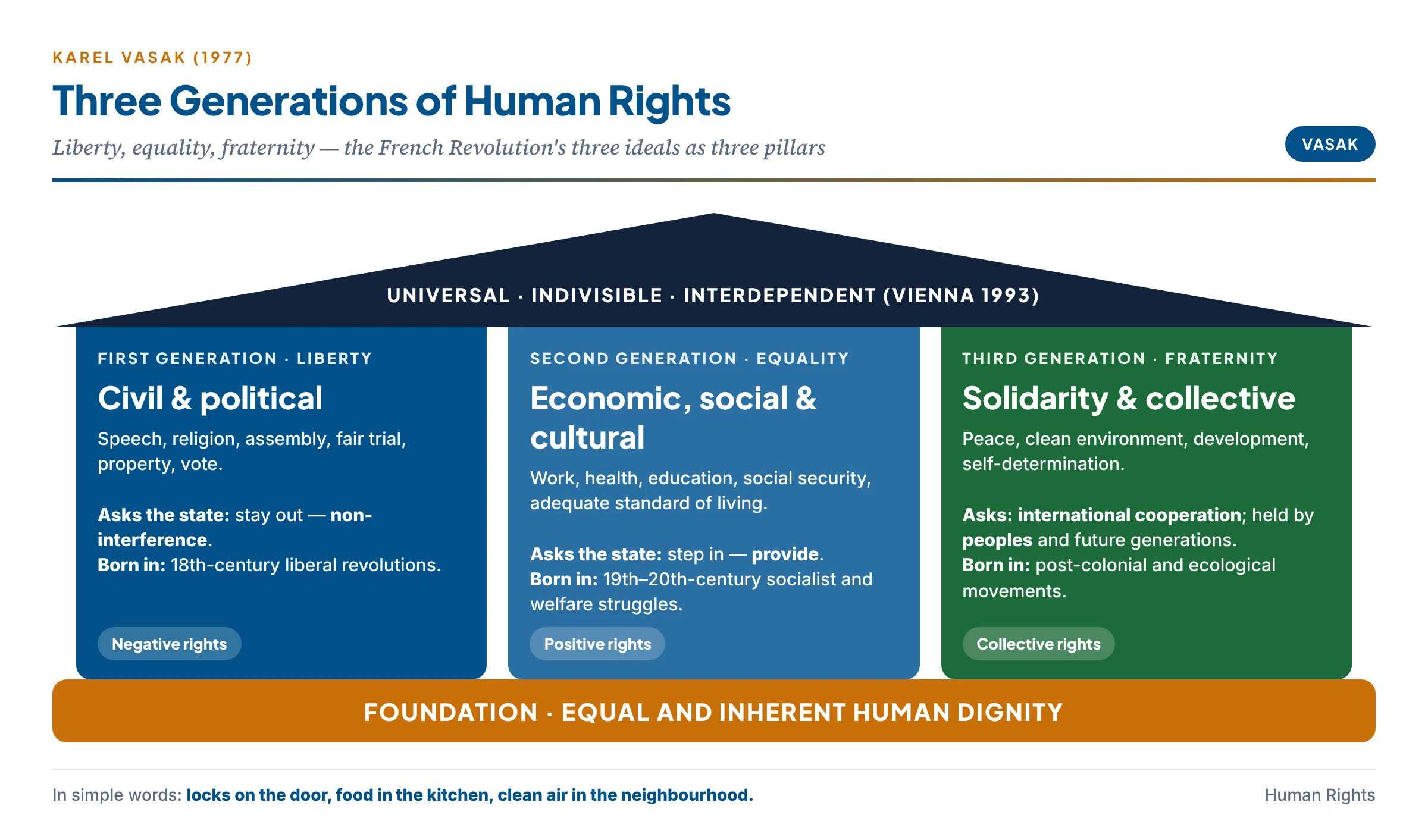
The Czech-French jurist Karel Vasak (1977) grouped human rights into three “generations”, matching the three ideals of the French Revolution.
| Generation | Ideal | Rights | Demand on the state | Origin |
|---|---|---|---|---|
| First — civil and political | Liberty (liberté) | Speech, religion, assembly, fair trial, property, vote | Non-interference — negative rights | Eighteenth-century liberal revolutions |
| Second — economic, social and cultural | Equality (égalité) | Work, health, education, social security, adequate standard of living | Provision of resources — positive rights | Nineteenth–twentieth-century socialist and welfare struggles |
| Third — solidarity or collective | Fraternity (fraternité) | Peace, clean environment, development, self-determination, common heritage | International cooperation | Late twentieth-century post-colonial and ecological movements |
- Third-generation rights belong not to atomised individuals but to peoples and future generations.
- A “fourth generation” is sometimes proposed — rights relating to digital life, genetic technology and future generations.
- Limits of the metaphor. “Generations” can suggest that older rights are more important or that later ones replace earlier ones. The Vienna Declaration (1993) insisted that all human rights are “universal, indivisible and interdependent and interrelated“.
In simple words
Think of a person’s life as a house. First-generation rights are the walls and locks — no one may break in. Second-generation rights are the kitchen and the schoolbag — food, health and education to live and grow. Third-generation rights are the neighbourhood — clean air, peace and development that no household can secure alone.
Justifying Human Rights
- Natural law and natural rights — human rights are rights of nature or God (Locke, the Declarations). Critics say this ties them to one religious or metaphysical view.
- Kantian dignity — every person is an end in himself, never merely a means; human rights protect this dignity. This is the dominant justification in modern documents.
- Capabilities (Amartya Sen, Martha Nussbaum) — human rights protect people’s real freedoms to do and be what they value — to be healthy, educated, safe, to take part in public life.
- Rawls’s The Law of Peoples (1999) — a political, not metaphysical, account:
- Human rights are “a special class of urgent rights” — such as freedom from slavery and serfdom, liberty of conscience, and security of ethnic groups from mass murder and genocide.
- They are not peculiarly liberal or Western; they do not depend on any one religious or philosophical doctrine of human nature, and can be accepted by both liberal peoples and “decent hierarchical peoples“.
- Their role: respecting them is a condition of a society’s decency; grave violations can justify outside intervention; and they set the limit to the pluralism that peoples must tolerate.
- Rawls’s “human rights proper” are a short list (roughly UDHR Articles 3–18), not the full catalogue.
- Agreement without full agreement — Jacques Maritain, a drafter of the UDHR, observed that people agreed on the rights “on condition that no one asks us why“; different cultures can reach the same list from different reasons (an overlapping consensus).
Universalism versus Cultural Relativism
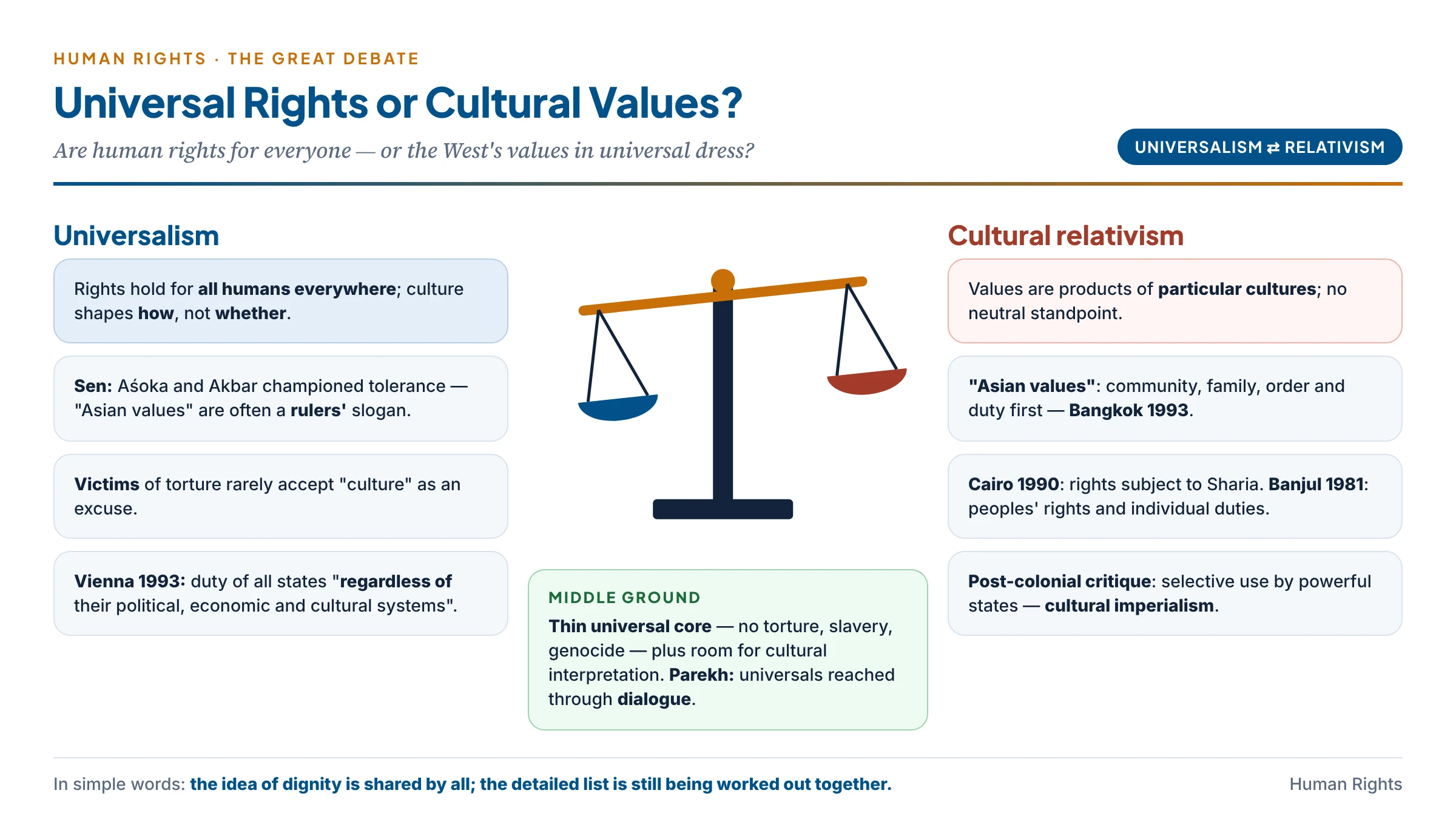
- Universalism. Human rights hold for all people everywhere; culture can shape how rights are realised but cannot cancel them. Torture, slavery and genocide are wrong in every culture.
- Cultural relativism. Values are products of particular cultures; there is no neutral, culture-free standpoint; human rights reflect Western liberal individualism and are imposed on others.
- Forms of the relativist challenge.
- “Asian values” — leaders such as Lee Kuan Yew (Singapore) and Mahathir Mohamad (Malaysia) argued that Asian societies prize community, family, order and duty over individual rights; the Bangkok Declaration (1993) asked that “national and regional particularities” be kept in mind.
- Islamic perspectives — the Cairo Declaration (1990) affirms rights subject to the Sharia.
- African communal ethics — the Banjul Charter speaks of peoples’ rights and individual duties to family and community.
- Post-colonial critique — “human rights” have been used selectively by powerful states to justify intervention while ignoring their allies’ abuses — a form of cultural imperialism.
- Universalist replies.
- Amartya Sen (“Human Rights and Asian Values”) — Asian traditions are not uniformly authoritarian; Aśoka and Akbar championed tolerance and freedom of belief; the claim of “Asian values” is often made by rulers to silence their own citizens.
- The victims’ voice — those who suffer torture or discrimination rarely accept “culture” as a justification; many anti-colonial movements (including India’s) themselves appealed to rights.
- Relativism undermines itself — if all values are local, then the value of respecting other cultures is also local.
- Vienna compromise (1993) — “the significance of national and regional particularities … must be borne in mind”, but “it is the duty of States, regardless of their political, economic and cultural systems, to promote and protect all human rights”.
- Middle positions.
- Bhikhu Parekh’s dialogical universalism — universal values are reached through intercultural dialogue, not imposed from one culture.
- Thin universalism — a small core of rights (life, no torture, no slavery) is universal; the wider list allows cultural variation in interpretation.
Human Dignity as a Common Human Aspiration
- The claim. Human rights and human dignity are no longer the product of one culture but a common aspiration of humanity for an ideal world.
- Arguments for.
- Every great tradition values dignity — the Upaniṣadic idea of the same ātman in all, the Buddhist and Jaina ahiṃsā and compassion, the Christian idea of persons made in God’s image, the Islamic idea of human beings as God’s trustees (khalīfa), the Confucian ren (humaneness), the African Ubuntu (“I am because we are”).
- Global ratification — almost every state has ratified at least one of the major human-rights treaties; the language of rights is used by movements in every continent.
- Shared vulnerability — all humans can suffer pain, humiliation and fear; protection from these is a cross-cultural need.
- Arguments against.
- The formulation of rights (individual claims, the nation-state, courts) is historically European.
- Agreement on words hides disagreement on meaning — on religion, gender, family and free speech.
- Balanced view. The idea of dignity is universal; the detailed list of rights is still being negotiated across cultures. Human rights are best seen as a common project, not the property of any one civilisation.
Can Social Contract Theory Account for Human Rights?
- What contract theory contributes.
- Rights prior to the state — in Locke, people bring natural rights into civil society; government exists to protect them. This is the direct ancestor of human rights.
- Limited government and consent — authority depends on the governed; a government that violates rights loses legitimacy.
- Equality — every contracting party is equal; no one is born to rule.
- Rawls’s original position — behind a veil of ignorance, people would choose equal basic liberties for all, a powerful argument for civil and political rights.
- Where it falls short.
- Hobbes keeps only the right of self-preservation — almost no human rights against the sovereign.
- Rousseau’s total alienation to the community leaves the individual few rights against the general will.
- Members only. A contract binds those who make it — citizens. It struggles to explain the rights of refugees, stateless persons and foreigners. Hannah Arendt observed that the stateless discovered they had lost not particular rights but “the right to have rights” — human rights failed exactly when people lost their citizenship.
- Who was left out. Carole Pateman (The Sexual Contract, 1988) argued the classical contract silently excluded women; Charles Mills (The Racial Contract, 1997) argued it excluded non-white peoples; Martha Nussbaum (Frontiers of Justice) shows it ignores people with disabilities, animals and other nations, since only rough equals who can bargain are parties.
- Future generations and the environment — third-generation rights do not fit an agreement among people alive now.
- Socio-economic rights — Locke’s contract protects property but says little about food, health or education.
- Hypothetical consent — a contract no one signed cannot bind (Hume).
- Conclusion. Contract theory explains why governments must respect rights and supplies the idea of legitimacy by consent, but it cannot by itself ground rights that hold for every human being as such — that needs dignity (Kant), capabilities (Sen, Nussbaum) or an overlapping consensus (Rawls’s later work).

In simple words
A housing society’s rules protect its members — the right to use the park, the lift and the water supply. But what about the guard who sleeps in the basement, the maid who works there or a lost child who wanders in? The society’s contract says nothing about them. Human rights are the rules that protect people whether or not they are members of any particular society.
Are All Human Rights Centred on Individual Rights?
- Yes — the individualist view (Jack Donnelly and many liberals).
- The UDHR speaks of “everyone” and “no one“; the bearer of rights is the individual.
- Groups can oppress their own members; only individual rights protect dissenters, women and minorities within groups.
- Even collective rights are justified by their value to individual lives.
- No — the collective view.
- Self-determination is the first article of both 1966 Covenants — a right of peoples.
- Development (1986), peace, environment, and the rights of indigenous peoples and minorities are held collectively.
- Some goods are essentially shared — a language, a culture, a sacred landscape — and cannot be enjoyed by one person alone.
In simple words
A person’s right to speak her language is hers — but she cannot speak it alone. If her whole community is forced to stop using it, her individual right becomes useless. That is why some rights, like language and culture, need protection for the group so that each individual can enjoy them.
- Balanced view. Most human rights are held by individuals, but many are exercised in community, and some belong to groups. Will Kymlicka’s test: group rights are justified as “external protections” of a group against the wider society, not as “internal restrictions” that let a group oppress its own members (developed in the next article).
Critical Evaluation
Critiques of Human Rights
- Bentham — rights without law are “nonsense upon stilts”.
- Burke — abstract rights ignore history and lead to terror.
- Marx — the rights of man are the rights of egoistic man; formal rights mask economic exploitation.
- Alasdair MacIntyre — “there are no such rights, and belief in them is one with belief in witches and in unicorns” — no argument for them has ever succeeded.
- Feminist critique — early human-rights law treated violence in the home as private; the slogan “women’s rights are human rights” (Vienna, 1993; Beijing, 1995) corrected this.
- Selectivity and hypocrisy — powerful states condemn rivals and protect allies; humanitarian intervention can hide strategic aims.
- Enforcement gap — there is no world government; treaty bodies can only report and recommend.
Critics and Defenders
Criticism — Critics
- Relativists: human rights are Western values in universal dress.
- Marx: rights of egoistic, bourgeois man.
- MacIntyre: belief in human rights is like belief in unicorns.
- Realists: without enforcement, human rights are words on paper.
- Arendt: in practice human rights vanish when citizenship is lost.
Defence — Defenders and strengths
- Sen: Asian and other traditions contain resources for freedom and tolerance.
- Rawls: a short list of urgent rights can be shared by liberal and decent peoples.
- Nussbaum: capabilities give a cross-cultural basis for rights.
- Victims and movements — from anti-colonial struggles to Dalit and women’s movements — use rights to win dignity.
- Human-rights law has ended apartheid, exposed torture and inspired constitutions worldwide.
Cross-Tradition Comparison
Human Rights and Indian Thought
| Theme | Western human-rights idea | Indian parallel |
|---|---|---|
| Equal dignity | Kant: persons as ends in themselves | Upaniṣadic ātman present in all beings; Īśa Upaniṣad: see all beings in the self |
| Non-violence and humane treatment | Freedom from torture and cruelty | Ahiṃsā (Jaina, Buddhist, Gandhian); Aśoka’s edicts on prisoners and animals |
| Tolerance of belief | Freedom of religion | Aśoka’s Rock Edict XII on honouring other sects; Akbar’s sulh-i-kul (peace with all) |
| Duties with rights | UDHR Article 29 | Dharma; Gandhi’s view that rights flow from duties well done |
| Welfare | Second-generation rights | Yogakṣema — the king’s duty of welfare and security (Kautilya) |
Indian Connect — Indian Connect
- India’s constitutional bridge. Part III (Fundamental Rights) mirrors UDHR civil and political rights; Part IV (Directive Principles) mirrors its economic and social rights; Part IVA adds duties, echoing Article 29.
- Institutions. The Protection of Human Rights Act, 1993 set up the National Human Rights Commission and state commissions.
- Courts as human-rights forums. Using public-interest litigation, the Supreme Court has drawn on international norms: Vishaka (1997) used CEDAW to frame guidelines against sexual harassment at work; D. K. Basu (1997) laid down safeguards against custodial violence; NALSA (2014) recognised transgender persons; Puttaswamy (2017) recognised privacy as a fundamental right; Navtej Singh Johar (2018) decriminalised consensual same-sex relations.
- Continuing concerns. Custodial deaths and fake encounters, long detention of undertrials without trial, and denial of the right to life before birth through female foeticide are serious human-rights violations; punishment must follow a fair trial by a judicial authority, and no inhumane act can be justified as punishment.
Synthesis (Siddhānta)
- Human rights are the moral minimum of a decent world — rights every person holds as human, against every state.
- Their foundations are plural — natural law, Kantian dignity, capabilities and political agreement converge on the same core, which is why people of many faiths accept them.
- Universal core, cultural interpretation — torture, slavery and genocide are wrong everywhere; how rights to family, religion or speech are realised may vary within limits set by dignity.
- Beyond the contract — rights must protect those outside every contract: refugees, the stateless, future generations; Arendt’s “right to have rights” is the deepest human right.
- Individual and collective — most rights belong to individuals, but solidarity rights and minority rights show that dignity is also lived in community.
- Contemporary relevance.
- Climate change turns third-generation rights into urgent questions of survival.
- Digital surveillance and artificial intelligence raise new questions of privacy and freedom of thought.
- Refugee crises test whether human rights hold for those without a state.
- Conclusion. Human rights began as a European declaration and have become a global language of dignity. Their future depends less on proving their metaphysics than on building the institutions — and the social conscience — that make them real.
“All human beings are born free and equal in dignity and rights.” — Universal Declaration of Human Rights, Article 1
Previous Year Questions
- 2021Evaluate whether the social contract theory adequately addresses the different issues of human rights.
- 2018“Human rights and human dignity would no longer be the product of a particular culture, rather a common human aspiration for an ideal world.” Discuss.
- 2016Evaluate the statement that all human beings have certain unalienable rights.
- 2014“All human rights are centered on individual rights.” Discuss.