What a coaching class actually gives a History Optional aspirant, broken into three parts, and how to replace each one yourself with the standard books, 42 years of previous year questions, model answers and a 10-point self-evaluation rubric.
Quick Answer
Yes, you can prepare History Optional without coaching. It is one of the most self-study-friendly optionals UPSC offers. The syllabus is closed and the standard books are excellent. The past papers (1985–2026) are free and cover every clause. Most people fail at self-study because nobody replaced what the coach did, not because they lacked a teacher.
A coaching class gives you three things:
- A sequence: what to read, in what order, how deep.
- A standard: what a full-marks answer looks like.
- Feedback: where your answer falls short of that standard.
Books give you content, which is none of the three. Here is how to replace each:
| What coaching gives | How to replace it yourself |
|---|---|
| Sequence | A clause-wise reading order weighted by PYQ frequency (Section 3) |
| Standard | Solved PYQs: model answers to real questions, read after you attempt them (Section 4) |
| Feedback | A 10-point self-evaluation rubric applied within 24 hours of writing (Section 5) |
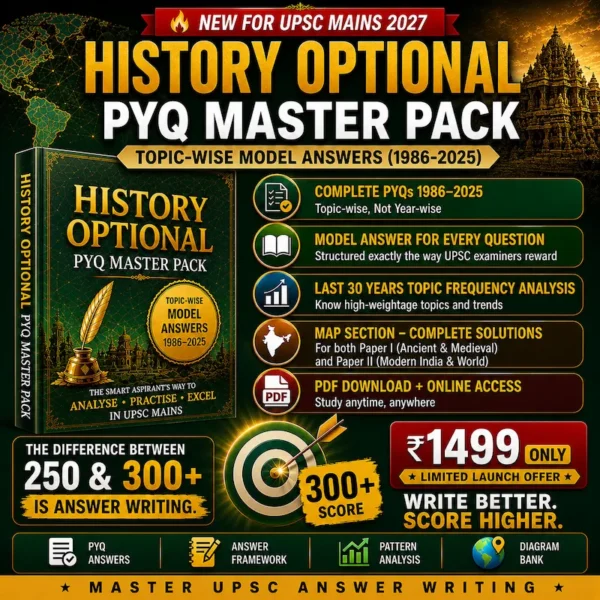
The weekly routine that ties them together is read → extract → write → compare → revise (Section 6). The History Optional PYQ Master Pack supplies the standard, with topic-wise model answers from 1985 to 2025, so the plan works without a classroom.
Should you self-study History Optional?

History is better suited to self-study than most optionals, for four reasons:
- The syllabus is closed. Nothing after 1991 in world history, and very little after the early decades of independent India. You are not relying on anyone to keep you updated.
- The books are written for self-learners. The Tier 1 texts (Upinder Singh for ancient India, Satish Chandra for medieval India, India’s Struggle for Independence for the national movement, Norman Lowe for world history) are readable narratives, not lecture notes.
- The past papers are unusually complete. The archive runs from 1985 to 2026, is organised clause by clause, and is free on the topic-wise PYQ page. About 1,437 topic-tagged questions show you exactly what the examiner does with each clause.
- Questions repeat. Our scan found 33 near-identical pairs (17 effectively verbatim) from 1985 to 2025, and the 2026 paper reprinted questions from 2018 and 2019. A self-studier who works the archive thoroughly is not at a disadvantage against a classroom.
Self-study is hard if you cannot keep a schedule without external deadlines, or if you have never written a long-form argumentative answer. Both can be fixed, and the plan below is built for them.
What coaching really provides, and what it doesn’t
Separate what coaching sells from what it actually does:
| What a coaching class does | Is it essential? | Self-study replacement |
|---|---|---|
| Decides the order of topics and the depth for each | Yes | PYQ-weighted reading order |
| Condenses books into lecture notes | Helpful, not essential | Your own clause sheets, or a consolidated note set used after the book |
| Shows model answers | Yes, the single most important thing | Solved PYQs |
| Evaluates your answers | Useful, but only if the feedback is specific | Rubric-based self-evaluation, plus occasional peer review |
| Imposes deadlines and routine | Yes, for most people | A fixed weekly routine and a public commitment (a study partner) |
| Makes you read the books | No, you still have to read them | Nothing replaces reading |
| Predicts questions | No: the prediction is the PYQ pattern, which you can read yourself | The topic-wise archive |
Look at the last two rows. No classroom does the reading for you, and every “important topics” list is a reading of the same free PYQ archive. What you cannot easily produce alone is the standard: a clear picture of what a 15/20 answer to a real question looks like. That is where a self-studier should put their money, if anywhere.
Replacing the sequence: the 51-clause reading order
The syllabus is printed in chronological order. Chronological order is not the best learning order. Early chapters (Sources, Pre-history) are thin in PYQs and hard to enjoy on day one. Some of the heaviest clauses sit in the middle of Paper I and the start of Paper II.
The order below groups the syllabus into eight phases, and within each phase places the clauses with the most questions since 2013 first. Question counts are topic-tagged PYQs from 2013 to 2026 (a question spanning two clauses counts in both).
Phase 1: The national movement (weeks 1–3)
Why first: it is the most familiar material, the heaviest clause in Paper II, and it overlaps directly with GS I. It builds momentum and confidence.
| Clause | Qs 2013–26 |
|---|---|
| Nationalism under Gandhi’s leadership | 27 |
| Early Indian Nationalism | 18 |
| Indian Response to British Rule | 18 |
| Other Strands in the National Movement | 12 |
| Constitutional Developments, 1858–1935 | 10 |
| Politics of Separatism | 5 |
Anchor: Bipan Chandra et al., India’s Struggle for Independence.
Phase 2: The colonial economy and society (weeks 4–6)
| Clause | Qs 2013–26 |
|---|---|
| Economic Impact of British Colonial Rule | 19 |
| British Expansion in India | 15 |
| Social and Religious Reform Movements | 14 |
| European Penetration into India | 12 |
| Social and Cultural Developments | 11 |
| Early Structure of the British Raj | 9 |
Anchor: Shekhar Bandyopadhyay, From Plassey to Partition and After.
Phase 3: World history, 1750–1919 (weeks 7–10)
| Clause | Qs 2013–26 |
|---|---|
| Origins of Modern Politics | 33 |
| Revolution and Counter-Revolution | 23 |
| Enlightenment and Modern Ideas | 22 |
| Imperialism and Colonialism | 15 |
| Industrialization | 14 |
| Nation-State System | 13 |
Anchor: Norman Lowe, Mastering Modern World History, plus a European-history text for the French Revolution and 1815–1871.
Phase 4: World history, 1914–1991 (weeks 11–13)
| Clause | Qs 2013–26 |
|---|---|
| World Wars | 18 |
| Liberation from Colonial Rule | 17 |
| The World after World War II | 16 |
| Disintegration of the Soviet Union | 10 |
| Unification of Europe | 9 |
| Decolonization and Underdevelopment | 6 |
Phase 5: The Delhi Sultanate and the 15th–16th centuries (weeks 14–17)
| Clause | Qs 2013–26 |
|---|---|
| 15th and early 16th c.: Political Developments and Economy | 28 |
| Society, Culture and Economy, 13th–14th c. | 25 |
| The Fourteenth Century | 18 |
| The Thirteenth Century | 10 |
| 15th and early 16th c.: Society and Culture | 6 |
Anchor: Satish Chandra, Medieval India, Part I.
Phase 6: Mughals and the 18th century (weeks 18–21)
| Clause | Qs 2013–26 |
|---|---|
| The Eighteenth Century | 22 |
| Culture during the Mughal Empire | 20 |
| Economy and Society, 16th–17th c. | 19 |
| Mughal Empire in the Seventeenth Century | 13 |
| Akbar | 10 |
Anchor: Satish Chandra, Medieval India, Part II.
Phase 7: Ancient India (weeks 22–27)
| Clause | Qs 2013–26 |
|---|---|
| Period of Mahajanapadas | 15 |
| Aryans and Vedic Period | 14 |
| Sources | 12 |
| Indus Valley Civilization | 12 |
| Mauryan Empire | 12 |
| Regional States during the Gupta Era | 12 |
| Guptas, Vakatakas and Vardhanas | 11 |
| Post-Mauryan Period | 10 |
| Early State and Society in Eastern India, Deccan and South India | 7 |
| Pre-history and Proto-history | 6 |
| Themes in Early Indian Cultural History | 6 |
| Megalithic Cultures | 3 |
Anchor: Upinder Singh, A History of Ancient and Early Medieval India.
Phase 8: Early medieval India and post-1947 India (weeks 28–30)
| Clause | Qs 2013–26 |
|---|---|
| Cultural Traditions in India, 750–1200 | 18 |
| Early Medieval India, 750–1200 | 16 |
| Consolidation as a Nation | 11 |
| Economic Development and Political Change | 10 |
| Caste and Ethnicity after 1947 | 6 |
Running through all eight phases: the map. Start a site bank in week 1 at ten sites a week, so it passes 150 by the end of Phase 5 and about 300 by the end of the first pass. The 50-mark map question cannot be crammed. See the map section guide.
Why ancient India comes seventh: it is about 37% of Paper I’s written questions and is compulsory territory (Paper I Section A is essentially ancient India plus the map). But its reading is dense, and it goes faster once you have learned how History answers are built. Many self-studiers begin with the Harappans and are still in the Guptas in month four. Don’t.
The full booklist, with Tier 2 and Tier 3 options for each block, is in the History Optional Booklist. One book per block is enough for the first pass.
Replacing the standard: learning from model answers without copying them
This is the part of self-study that fails most often, in one of two ways.
- Failure 1: never seeing a standard. You write answers for months, compare them with nothing and score 10–12 in the exam without knowing why.
- Failure 2: reading model answers too early. You read the model answer first, it feels obvious, and you think you have learned it. You haven’t. Recognising an answer is not the same as producing one.
The rule: attempt first, then compare
Use every model answer in this order:
- Read the question. Plan for three minutes. Write your intro line, three to five sub-headings and the historians or evidence you would use.
- Write the answer under time: 7 minutes for a 10-marker (150 words), 11 minutes for a 15-marker (200–250 words), 14 minutes for a 20-marker (250–300 words).
- Only now open the model answer. Compare it with yours against the rubric in Section 5.
- Write down one change you will make next time, in one line, in a running “error log”.
What to copy from a model answer, and what not to
| Copy | Don’t copy |
|---|---|
| The structure: how the introduction frames the claim, how sections divide | The sentences |
| The evidence types used: inscriptions, chronicles, statistics, a named historian’s reading | The exact wording of a historian’s argument (paraphrase it and attribute it) |
| How the answer reaches a verdict on a quotation question | Its length (yours must fit your handwriting speed) |
| The maps, flowcharts or timelines it uses | Facts you cannot verify in your own source |
A worked example
Question (2018; asked again, almost word for word, in 2026): Was the Moplah Rebellion in Malabar an expression of anti-landlord and anti-foreign discontent? Discuss. (20 marks)
A typical self-studier’s first attempt narrates events: August 1921, the Khilafat link, the leaders, the Wagon Tragedy, suppression. It scores around 10–11. It is accurate, but it never answers the question, which asks you to judge between two characterisations.
A model answer is built differently:
Frame (2–3 lines): The 1921 rising in Ernad and Walluvanad taluks has been read as agrarian revolt, as religious uprising and as anti-colonial struggle; the question asks whether “anti-landlord” and “anti-foreign” together capture it.
Anti-landlord (evidence): a tenancy structure of janmi landlords over kanamdar and verumpattamdar tenants; insecurity of tenure and rack-renting; a chain of Mappila outbreaks going back to 1836 aimed largely at landlords; William Logan’s inquiry of the 1880s identifying agrarian grievance. Historian: K.N. Panikkar, Against Lord and State, which reads the outbreaks as peasant protest expressed in a religious idiom.
Anti-foreign (evidence): the Khilafat and Non-Cooperation mobilisation of 1920–21; attacks on police stations, courts and government offices; the proclamation of “Khilafat kingdoms”; the scale of British military suppression.
The complication: violence against Hindu landlords, and in places against Hindu tenants, which communal readings emphasise; Conrad Wood, The Moplah Rebellion and its Genesis, and Stephen Dale on the Mappila frontier society as counterpoints.
Verdict: Both descriptions fit, because in Malabar “lord” and “state” were fused: the colonial courts enforced janmi rights. The communal turn was a consequence of how the revolt was fought and suppressed, not its root cause. Aftermath: the Malabar Tenancy Act of 1929.
Compare the two. The model does not know many more facts. It uses them to decide between the two readings, it names the historians whose readings it weighs, and it ends on a verdict. That standard does not come from any textbook. You learn it by seeing it applied to real questions dozens of times, which is why solved PYQs replace the classroom.
Replacing feedback: the 10-point self-evaluation rubric
Score every answer you write against these ten criteria within 24 hours. Each scores 0 (absent), 1 (partial) or 2 (fully met). The total is out of 20.
| # | Criterion | What “2” looks like |
|---|---|---|
| 1 | Answers the demand | The directive (examine, evaluate, “how far”) is addressed explicitly, not just the topic |
| 2 | Framed introduction | 2–3 lines that state the claim, its context and your line of argument; no background paragraph |
| 3 | Structure visible | Sub-headings or numbered points a tired examiner can scan in ten seconds |
| 4 | Specific evidence | At least four precise items: dates, inscriptions, texts, figures, places, acts |
| 5 | Historians named | At least one named reading, correctly attributed; two for a debate question |
| 6 | Both sides | The counter-view is stated and weighed, not just mentioned |
| 7 | Verdict | The conclusion takes a position on the claim (“largely”, “only partly”, “in the short run”) |
| 8 | Visual aid where it helps | A map, flowchart, timeline or table if the question has spatial, causal or sequential logic |
| 9 | Within length and time | 150/250/300 words ±15%, finished inside the time box |
| 10 | Clean presentation | Legible, underlined key terms, no crossed-out paragraphs, margins kept |
Reading your score
| Rubric total | Likely examiner band (per 20-mark question) | What to fix first |
|---|---|---|
| 0–8 | 6–8 | Criteria 1, 2, 7: you are describing, not answering |
| 9–13 | 9–11 | Criteria 4, 5: add specifics and named historians |
| 14–17 | 12–13 | Criteria 6, 8: weigh counter-views; add one visual |
| 18–20 | 14+ | Speed: hold this standard across five questions in three hours |
The bands are guides, not guarantees. The point is to see which criterion keeps scoring zero. Most self-studiers find it is always the same one or two. Fixing one recurring zero is worth more than twenty more answers written the same way.
The error log
Keep a single page. Every time the rubric exposes a defect, add one line: “Moplah 2018: no historian named. Next time Panikkar vs Wood.” Read the log before every writing session. In three months it becomes a personalised list of your weaknesses, which is what a good mentor would have given you.
The weekly routine
Six days, about 3 hours a day on the optional during the first pass (more if you are full-time and not also covering GS). Adjust the hours; keep the shape.
| Day | Read (new clause) | Extract | Write | Compare and log |
|---|---|---|---|---|
| Mon | Clause A: book chapter, syllabus open | Pull clause A’s PYQs; mark the 5 most recent and any repeat families | — | — |
| Tue | Clause A: finish; make a one-page clause sheet | Tag each PYQ to the part of your sheet it tests | 2 answers from clause A | Rubric + model answer; 2 log lines |
| Wed | Clause B: book chapter | Pull clause B’s PYQs | 1 answer (clause A, different directive) | Rubric |
| Thu | Clause B: finish; clause sheet | Tag PYQs | 2 answers from clause B | Rubric + model answer; log |
| Fri | Revise clause sheets A and B | Map: 10 new sites | 1 answer mixing A and B, timed | Rubric |
| Sat | Catch-up / weakest clause | Map: revise last 30 sites | 1 “cold” answer from an earlier week | Re-read error log |
| Sun | Off, or light reading (historiography, one Tier 3 chapter) |
Output per week: 2 clauses read, 7 answers written and evaluated, 10 map sites added. Over a 30-week first pass that is about 200 evaluated answers and 300 sites, well beyond what most classroom programmes demand, and every answer compared against a real standard.
From first pass to Mains
After the first pass, switch to the revision and testing cycle in the History Optional Strategy: a second reading from your own sheets, full-length papers from recent years under exam conditions, and three revision rounds in the last 100 days.
Seven self-study mistakes that cost a year
- Reading everything before writing anything. The routine above has you writing from week 1. Writing is how you find out what you haven’t understood.
- Starting with the Harappans. Chronological order puts the densest reading first. Use the phase order.
- Collecting sources. Three books per block, none finished. One Tier 1 book per block, then PYQs, then model answers.
- Reading model answers first. Recognition feels like learning, but it isn’t. Attempt first, always.
- Evaluating by feel. “That felt okay” is not feedback. Score against the rubric, every time.
- Leaving the map for the end. Ten sites a week from week one, or fifty marks at risk.
- Skipping world history until late. It is half of Paper II. Phases 3 and 4 put it early on purpose.
What you still need from other people
Self-study does not mean studying in isolation. Three things are worth finding:
- A study partner with the same optional. Exchange one answer a week and score each other’s against the rubric. A second pair of eyes catches what you can’t, especially criteria 1 and 7.
- Timed full papers. In the last three months, write full three-hour papers from recent years under strict conditions. Recent years’ papers work as a test series and cost nothing.
- A standard to calibrate against. Topper answer copies and model answers keep your sense of “good” honest. Read them for structure, not content.
Where the History Optional PYQ Master Pack fits
The plan above needs one thing you can’t produce yourself: a trustworthy standard for real questions, clause by clause. That is what the History Optional PYQ Master Pack provides:
- Topic-wise model answers to History Optional PYQs from 1985 to 2025, arranged in the same clause order as the syllabus, so each week’s “compare” step is ready when you need it
- Map-section solutions for the 50-mark Paper I question
- PDF and online access, so the answers sit beside your clause sheets
It replaces the one part of coaching that matters most, the model answer, at a fraction of the cost of a classroom programme. It fits a plan in which you still do the reading and the writing.
Resources
| Resource | Use it for | Link |
|---|---|---|
| Topic-wise PYQs (free) | The “extract” step: every question by clause | Open |
| History Optional Booklist | Choosing one Tier 1 book per block | Open |
| History Optional Strategy | Revision cycles and full-length testing after the first pass | Open |
| How to Cite Historians | Criterion 5 of the rubric | Open |
| Why Answers Score 10–13, Not 16–18 | Diagnosing the gap your rubric exposes | Open |
| Map Section Guide | The weekly 10-site drill | Open |
| History Optional PYQ Master Pack | The “compare” step: topic-wise model answers | Open |
Frequently Asked Questions
In one paragraph
Coaching gives a History Optional aspirant three things: a sequence, a standard and feedback. You can replace all three. Read the syllabus in a PYQ-weighted order, starting with the national movement rather than the Harappans. Learn the standard from model answers to real past questions, read only after you have attempted them. Get feedback from a 10-point rubric and an error log that shows which weakness keeps recurring. Do that for 30 weeks and you’ll have written and evaluated about 200 answers, more than most classrooms ask for, each one checked against a real standard.