

Anthropology Optional › Paper II › Unit 06: Tribal Situation in India
6.3 Developmental projects and their impact on tribal displacement and problems of rehabilitation. Development of forest policy and tribals. Impact of urbanization and industrialization on tribal population
Official Syllabus: Paper II, Unit 6.3
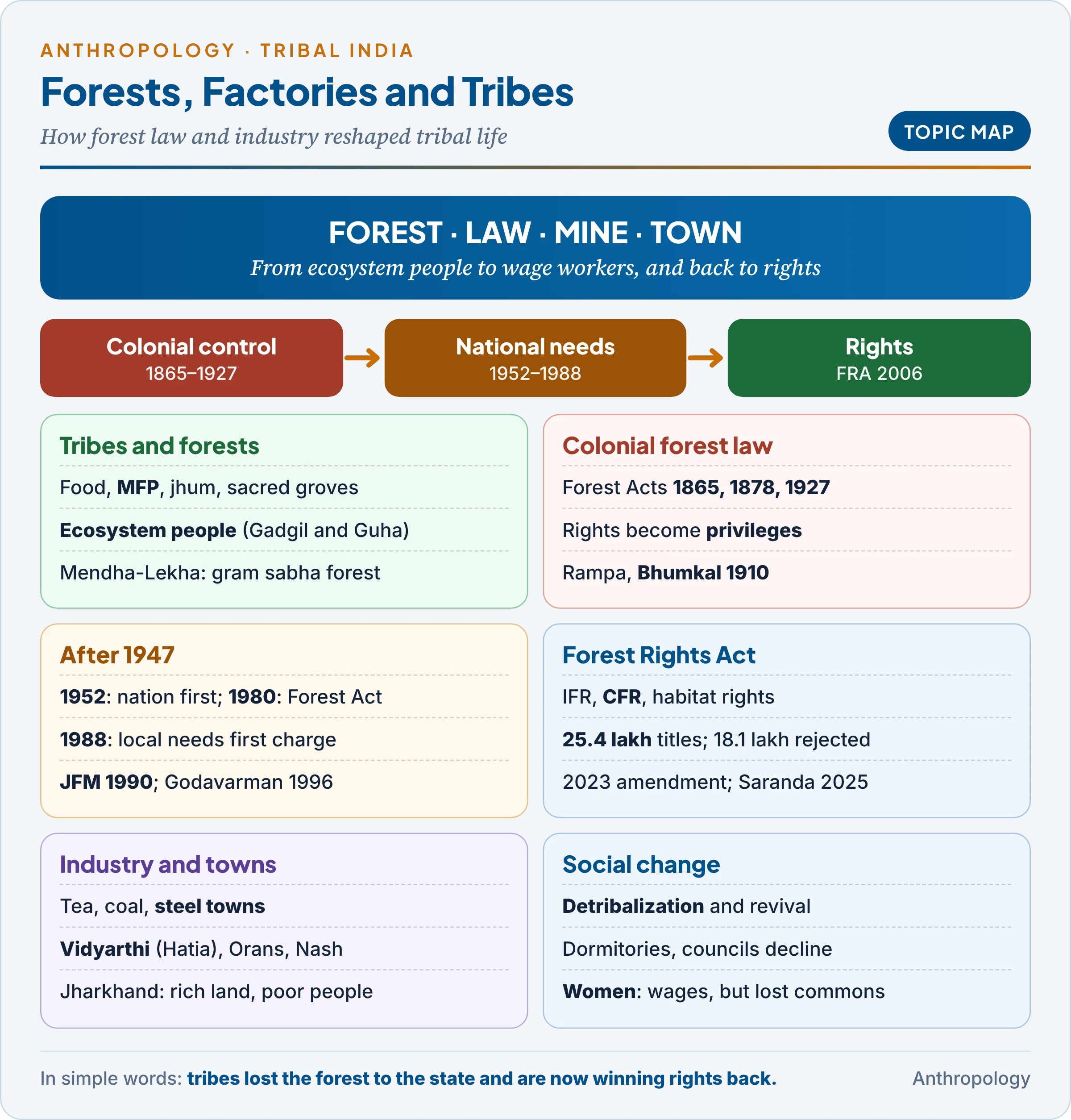
This article covers the second and third parts of the syllabus line: how forest policy developed from colonial control to the Forest Rights Act, 2006, and how urbanization and industrialization have changed tribal life. Development projects, displacement and the land acquisition laws are in 6.3a. Land alienation, the Samatha judgment and labour migration are in 6.2; PESA and the gram sabha in 5.3b; tribal movements in 7.4.
1. Tribes and Forests
In simple words
For most tribal communities the forest is not scenery but home, kitchen, pharmacy, bank and temple. Forest policy therefore decides how tribal people eat, earn and worship. The history of that policy is a story of the state taking the forest away from the people who lived in it, and only recently beginning to give some of it back.
1.1 Mendha-Lekha: the example
Mendha-Lekha is a Gond village of about ninety households in Gadchiroli district, eastern Maharashtra. From the late 1980s its gram sabha (village assembly) decided every matter by consensus, after debate in village study circles (abhyas gat), and protected the forest around the village from outside felling. In 2009 Mendha-Lekha and neighbouring Marda became the first villages in India to receive community forest rights under the Forest Rights Act. The forest department still refused transit passes to move bamboo out of the village, until in April 2011 the gram sabha itself was given the passbook; its open tenders then earned the village far more than the department used to pay. The village leader Devaji Tofa preferred to call his people Koitur (“human beings”), the Gonds’ own name. The example sums up this article: the forest was taken by the state for over a century, and its return to the community is recent, partial and contested.
1.2 How tribes depend on the forest
- Food: tubers, greens, fruit, mushrooms, honey, fish and game, which balance diets in the lean season.
- Livelihood: minor forest produce (MFP) such as tendu (kendu) leaves for bidis, mahua flowers and seeds, sal seeds, lac, tamarind, chironji and bamboo bring cash; wage work in forestry.
- Agriculture and animals: shifting cultivation (jhum, podu, bewar), grazing, leaf manure, wood for ploughs.
- Housing, fuel and medicine: timber, thatch, fuelwood and medicinal plants.
- Religion and identity: sacred groves (sarna of the Munda and Oraon, jaher of the Santal), tree spirits and hill gods; L.P. Vidyarthi’s nature-man-spirit complex among the Maler (3.3) shows nature, people and spirits as one interlocked world.
Ecosystem people. The ecologist Madhav Gadgil and the historian Ramachandra Guha (Ecology and Equity, 1995) divided Indians into ecosystem people (who live off the resources of their own locality, such as forest tribes), omnivores (urban and rich groups who draw resources from everywhere) and ecological refugees (ecosystem people uprooted by the omnivores’ demands). Forest policy is in large part the story of how ecosystem people lost control of their locality.
1.3 Protectors or destroyers?
Tribes are both praised as forest guardians and blamed for deforestation. The table weighs the two sides.
| Benevolent actions | Malevolent (or harmful) actions |
|---|---|
| Sacred groves left untouched for generations | Shortened jhum cycles under population pressure degrade soil |
| Customary rules on felling, hunting seasons and harvest | Illegal felling, often as labour for timber contractors |
| Community protection (Mendha-Lekha; Odisha’s forest protection committees) | Forest fires set to clear undergrowth or for mahua collection |
| Knowledge of medicinal plants and sustainable harvest | Sale of forest produce under debt to traders |
The balance of evidence is that most large-scale deforestation came from commercial logging, plantations, mining and dams, often with official connivance, while tribal harm grew mainly when communities lost control of the forest and were reduced to wage labourers for outsiders.
2. Colonial Forest Policy: The State Takes the Forest
In simple words
Under British rule, forests became government property managed for timber and revenue. Tribal people, who had used them freely, were turned into trespassers whose old rights became mere “privileges” that the state could grant or withdraw. This caused deep hardship and several tribal rebellions.
2.1 Why the British took the forests
- Timber for an empire: teak for ships, and from the 1850s sal and deodar for railway sleepers.
- Revenue: forests became a source of income for the colonial state.
- Scientific forestry: the German forester Dietrich Brandis became the first Inspector General of Forests (1864), and the Imperial Forest Department organised forests for sustained timber yield.
2.2 The forest laws
- Indian Forest Act, 1865: the first law; it let the government declare forests as government property.
- Indian Forest Act, 1878: classified forests as reserved (almost all use forbidden unless recorded and allowed), protected (use allowed but restricted) and village forests. Customary use became a privilege granted by the state, not a right; a forest settlement officer recorded or extinguished claims, and unrecorded tribal claims were lost.
- Forest Policy, 1894: the first national forest policy. Forests were to be managed for the “public benefit”, which meant commercial timber and revenue; land needed for permanent cultivation could be released from forests, but local use was to be regulated and shifting cultivation discouraged.
- Indian Forest Act, 1927: consolidated the earlier laws and is still in force: reserved forests, village forests and protected forests, with transit rules, duties on timber and penalties.
2.3 Impact and resistance
- Rights to concessions: grazing, collection, shifting cultivation and hunting became offences or paid privileges; whole communities became encroachers on their own land.
- Forced labour and contractors: forest villages were set up to supply labour to the forest department; contractors bought produce cheaply and paid low wages.
- Rebellions: the Rampa rebellions of the Koya hills (1879, and 1922–24 under Alluri Sitarama Raju) and the Bhumkal of Bastar (1910) were driven largely by forest reservation and restrictions. The sociologist Nandini Sundar (Subalterns and Sovereigns, 1997) showed how forest reservation reshaped power in Bastar.
- Critique: the anthropologist Verrier Elwin repeatedly argued that forest rules were impoverishing tribes such as the Baiga, whose shifting cultivation (bewar) was banned; Guha (The Unquiet Woods, 1989) showed how forest control provoked peasant resistance in the Himalaya that later fed Chipko (1973).
3. Forest Policy after Independence
In simple words
Independent India first kept the colonial idea that forests serve the nation, not the people living in them. Over time, protests and evidence of failure pushed policy towards conservation and then towards people’s participation. Each step changed how much say tribal people had over their forests.
3.1 National Forest Policy, 1952
- National needs first: the policy held that a village lying close to a forest gave it no claim over a national asset; local needs were subordinate to defence, industry and communications.
- Target: one-third of the land area under forest (60% in hills, 20% in plains).
- Functional classification: protection forests, national forests, village forests and tree-lands.
- Tribal impact: release of forest land for cultivation was stopped, grazing fees were introduced, private forests came under state control and tribes were to be weaned away from shifting cultivation. Rights shrank further into concessions, and treeless land was often recorded as forest, making cultivators into encroachers.
3.2 Production forestry and social forestry (1970s)
- National Commission on Agriculture (1976): favoured production forestry (fast-growing plantations for industry) and social forestry (planting on village, roadside and farm land) to meet local fuel and fodder needs outside forests.
- Concurrent List: the 42nd Amendment (1976) moved forests from the State List to the Concurrent List, giving the Centre a larger role.
- Social forestry in practice: much of it became eucalyptus monoculture on farms and commons for pulp and poles; it supplied markets more than the poor and took common grazing land.
3.3 Wildlife Protection Act, 1972 and protected areas
- The Act created sanctuaries (where some rights may continue) and national parks (where no rights are allowed); rights inside had to be settled by the Collector; Project Tiger began in 1973.
- Impact on tribes: loss of access to forest produce and grazing, restrictions on cultivation, harassment, and relocation of villages. From Kuno (Madhya Pradesh), 24 villages (about 1,550 families, mostly Sahariya) were moved between 1996 and 2001 to prepare a home for Asiatic lions that never came; the economist Asmita Kabra (2009) found the relocated Sahariya poorer and more dependent on wage labour.
- Voluntary relocation: the 2006 amendment created the National Tiger Conservation Authority, critical tiger habitats and voluntary relocation with consent; the package was raised to Rs 15 lakh per family in 2021, when about 18,500 families from 215 villages had been relocated from tiger reserves.
- Coexistence: the Soliga of the Biligiri Rangaswamy Temple tiger reserve (Karnataka) won community forest rights in 2011, the first such recognition inside a tiger reserve, showing that conservation and rights can go together.
3.4 Forest (Conservation) Act, 1980
- Central approval became compulsory for using forest land for any non-forest purpose; it slowed deforestation sharply.
- Tribal impact: it froze the regularisation of old cultivation on forest land and treated schools, roads, wells and electricity in forest villages as “non-forest” uses needing clearance; communities without recorded rights became permanent encroachers. In 1990 the Environment Ministry issued circulars to regularise pre-1980 occupation and settle disputed claims, but few states acted.
3.5 National Forest Policy, 1988
Adopted on 7 December 1988, it reversed the commercial emphasis.
- Ecological security and environmental stability became the main aims; the one-third forest cover goal was kept.
- The domestic needs of tribal and other forest dwellers for fuelwood, fodder, MFP and small timber became the first charge on forest produce.
- It recognised the symbiotic relationship between tribes and forests, asked that tribal people be associated with protection, regeneration and development of forests, that contractors be replaced by tribal cooperatives, and that forest villages be developed on par with revenue villages.
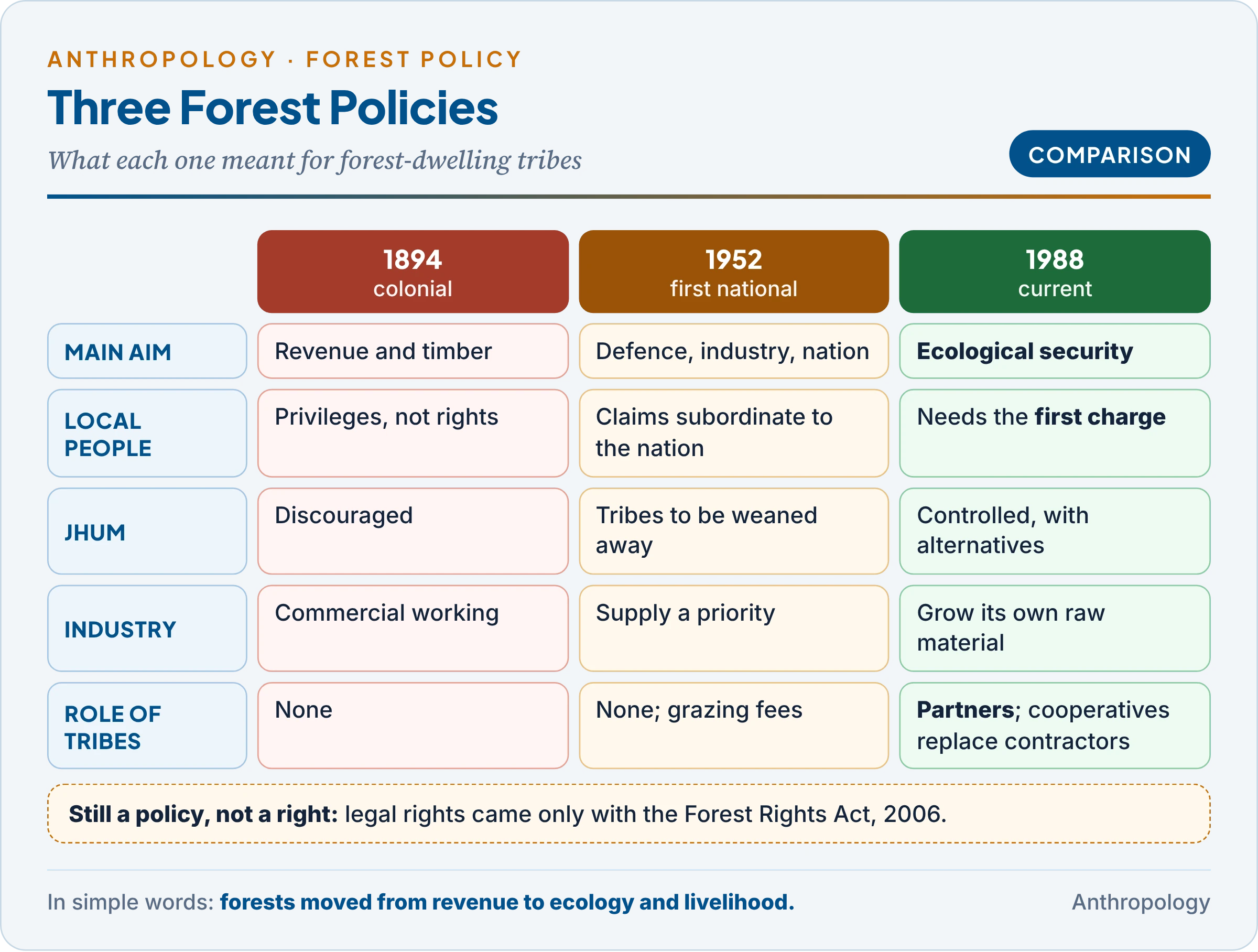
The table compares the three national policies.
| Point | Policy of 1894 | Policy of 1952 | Policy of 1988 |
|---|---|---|---|
| Main aim | Revenue and timber for the “public benefit” | National needs: defence, industry | Ecological security |
| Local people | Use regulated; privileges, not rights | Local claims subordinate to the nation | Their needs the first charge |
| Shifting cultivation | Discouraged | Tribes to be weaned away | To be controlled with alternatives |
| Industry | Commercial working of forests | Industrial supply a priority | Industry to grow its own raw material |
| Participation | None | None | People’s involvement in protection |
The shift from 1894 to 1988 is a shift from forest as revenue to forest as ecology and livelihood. But it remained a policy, not a law; legal rights came only in 2006.
3.6 Joint Forest Management (JFM), 1990
- Origins: an experiment at Arabari (West Bengal) from the early 1970s showed that villagers given a share of produce would protect degraded sal forests.
- Circular of 1 June 1990: the Environment Ministry asked states to involve village communities in protecting and regenerating degraded forests through forest protection committees, in return for usufruct (the right to use forest produce) and a share of timber.
- Achievements: regeneration of degraded forests; income for villages; a shift in forester attitudes.
- Limits: committees were created and controlled by the forest department; communities had no legal rights; benefit shares were small and delayed; and women were poorly represented, as the economist Bina Agarwal (Gender and Green Governance, 2010) found.
3.7 Godavarman and the courts
- T.N. Godavarman Thirumulpad v. Union of India (order of 12 December 1996): “forest” must be understood in its dictionary meaning, covering all forests whatever their ownership or legal category; this extended the 1980 Act to many unrecorded forests and began years of court supervision of forests.
- 2002 eviction drive: an Environment Ministry letter of May 2002, citing the court, led states to evict “encroachers” across India, displacing many forest-dwelling families and triggering the campaign that produced the Forest Rights Act.
- Compensatory afforestation: the court also required project developers to pay for compensatory afforestation and the net present value of forests lost, the origin of the CAMPA fund (§5).
- Samatha (1997): leases of tribal land in Scheduled Areas to private miners are void (detail in 6.2).
3.8 Shifting cultivation: livelihood or degradation?
- What it is: a patch of forest is cut, burnt and cropped for one to three years, then left fallow to regrow; it is practised mainly in the North-East and in parts of Odisha, Andhra Pradesh and central India.
- Why it was opposed: foresters saw it as wasteful and a cause of soil erosion and floods.
- Why it is defended: the ecologist P.S. Ramakrishnan (Shifting Agriculture and Sustainable Development, 1992) found jhum sustainable when the fallow cycle is long (about ten years or more); it supports mixed crops and rich biodiversity. It degrades land when the cycle shortens under population pressure and loss of land.
- A balance: lengthen fallows by securing land; improve fallows with nitrogen-fixing trees (the alder-based jhum of Nagaland’s Angami); add horticulture and agroforestry on slopes; recognise jhum land as community land rather than forcing settled farming; and pay for the ecological services of fallows.
4. The Forest Rights Act, 2006
In simple words
The Forest Rights Act finally gave tribal and other forest dwellers legal rights to the land they farm and the forests they use. It calls their earlier treatment a “historical injustice”. It also makes the village assembly the body that decides claims and protects the forest.
4.1 Why the Act came
The Scheduled Tribes and Other Traditional Forest Dwellers (Recognition of Forest Rights) Act, 2006 (in force 31 December 2007; Rules 1 January 2008, amended 2012) states in its preamble that forest rights were not recognised during the consolidation of state forests, causing a historical injustice to forest dwellers who are integral to the survival and sustainability of the forest ecosystem. The 2002 evictions, a national Campaign for Survival and Dignity, and evidence that forest boundaries had never been properly surveyed pushed Parliament to act.
4.2 What the Act provides
Who is eligible: forest dwelling Scheduled Tribes in areas where they are scheduled, and other traditional forest dwellers (OTFDs) who have lived in and depended on forests for three generations (75 years); the occupation must date from before 13 December 2005.
Rights (section 3):
- Individual forest rights (IFR): title to forest land held for habitation or self-cultivation, up to 4 hectares (section 4(6)), heritable but not alienable, and issued jointly to husband and wife (section 4(4)).
- Community rights: ownership of and access to MFP (including bamboo and tendu), grazing, fishing, nistar (customary use), and seasonal access for pastoralists and nomads.
- Habitat rights for Particularly Vulnerable Tribal Groups (PVTGs).
- Conversion of forest villages and unrecorded settlements into revenue villages.
- Community forest resource (CFR) rights: the right to protect, regenerate, conserve and manage any community forest resource (section 3(1)(i)).
- In situ rehabilitation for those illegally evicted or displaced without entitlements (section 3(1)(m)).
- Development facilities: forest land of up to 1 hectare each for schools, dispensaries, roads, water and similar public needs (section 3(2)).
Institutions and safeguards:
- The gram sabha initiates the process and verifies claims through its Forest Rights Committee; Sub-Divisional and District Level Committees decide; a State Level Monitoring Committee oversees.
- No eviction until recognition and verification are complete (section 4(5)).
- Rights in critical wildlife habitats may be modified or people resettled only with their free informed consent and after rights are recognised (section 4(2)).
- Right holders and gram sabhas have a duty to protect wildlife, forests, biodiversity and water sources (section 5).
Common confusion
What is the difference between IFR, CFR and CFR resource rights? Individual forest rights are titles to a family’s own cultivated or homestead land (up to 4 hectares). Community forest rights are a village’s shared rights of use: grazing, MFP, fishing, nistar. Community forest resource rights go further: they let the gram sabha manage and protect a defined forest area, deciding rules of use and stopping harmful activities. Most titles so far are individual; the resource rights that give real control are the fewest.
4.3 Implementation: the numbers
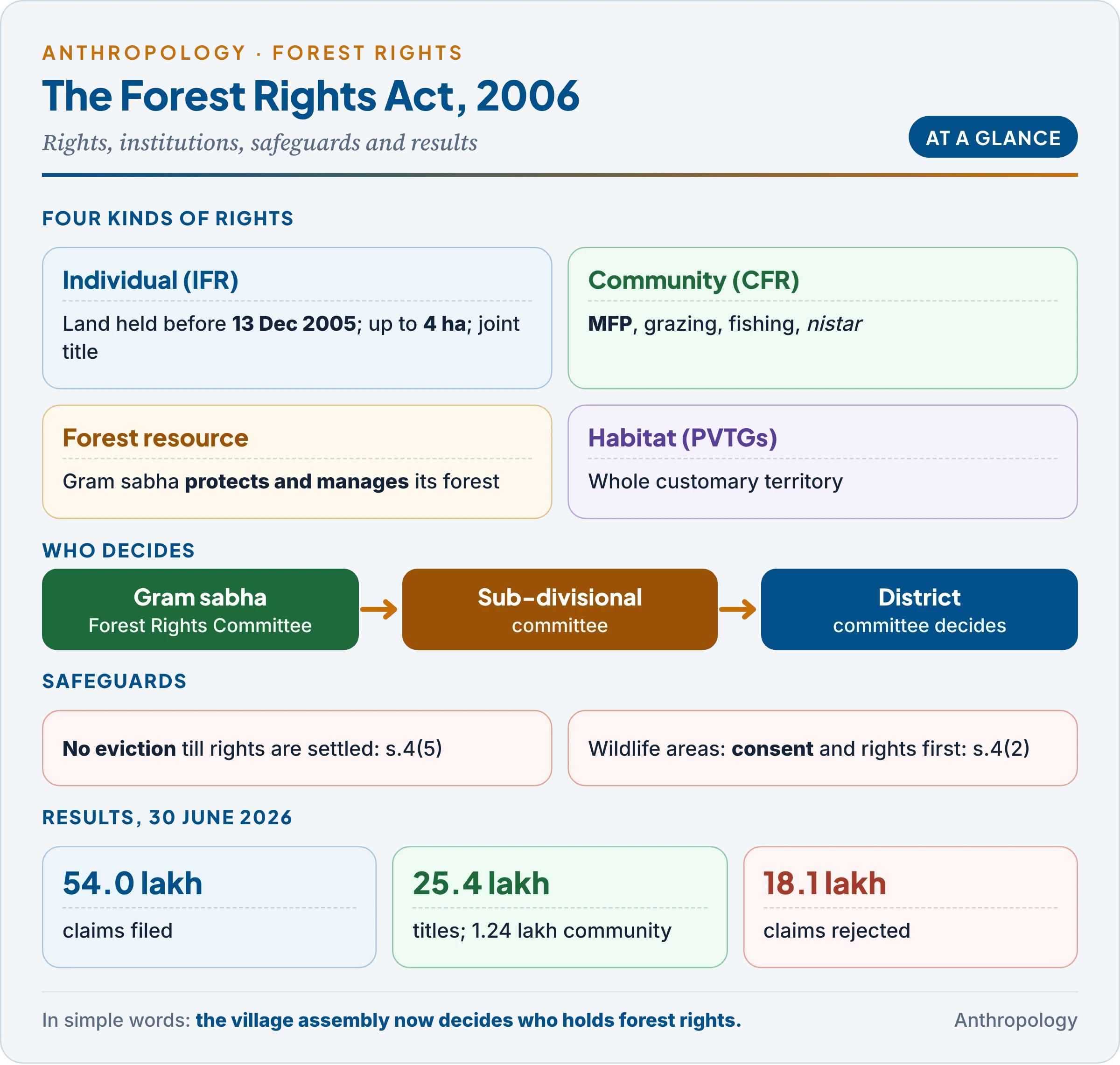
As reported to Parliament for 30 June 2026:
- 54,01,561 claims filed; 25,42,359 titles distributed (24,18,197 individual and 1,24,162 community); 18,13,232 claims rejected; over 10 lakh still pending.
- Titles cover about 238 lakh acres (about 96 lakh hectares).
- Chhattisgarh (about 5.3 lakh titles) and Odisha (about 4.7 lakh) lead; some states with large forest populations, such as Karnataka, have rejected most claims.
- Habitat rights have been recognised for only 11 of the 75 PVTGs (August 2026).
4.4 Difficulties in implementation
- High rejection: about one claim in three has been rejected, often without reasons communicated, for want of a particular document, on the basis of satellite images alone, or because OTFDs could not prove 75 years.
- Forest department resistance: officials treat the Act as a threat to their control; CFR claims are discouraged in favour of JFM committees.
- Gram sabha problems: early gram sabhas were held at the panchayat level, excluding small hamlets, until the 2012 Rules allowed hamlet-level sabhas.
- MFP and tendu monopolies: state corporations kept their monopoly over high-value produce; transit permits were denied (Mendha-Lekha).
- Eviction threat: on 13 February 2019 the Supreme Court ordered states to evict those whose claims were rejected; after protests it stayed the order on 28 February 2019 and asked states to review rejections.
- Diversion without consent: forest diversion for mines and projects has bypassed or manufactured gram sabha consent (Hasdeo Arand and Great Nicobar, 6.3a); the Forest Conservation Rules, 2022 shifted settlement of FRA rights to after Central approval, which the National Commission for Scheduled Tribes opposed as violating the Act.
- Records: recognised rights are often not entered in revenue and forest records, so titles do not bring access to credit or schemes.
4.5 Impact on livelihood and culture
- Security of tenure: an individual title ends the fear of eviction and lets families invest in land, wells and trees and get bank credit and farm schemes.
- Income from the forest: in Gadchiroli, Mendha-Lekha and other villages sold bamboo and tendu through their gram sabhas, earning many times what they got as labourers; gram sabha federations now negotiate prices.
- Community governance: CFR rights revived customary institutions and gave gram sabhas a legal role in forest management; the Niyamgiri gram sabhas used the Act to protect a sacred landscape (6.3a).
- Women: joint titles and gram sabha membership give women a legal claim to land for the first time, though men still dominate claim-making.
- Culture: recognition of sacred groves, burial grounds and habitat rights protects ritual life and identity.
- Limits: most titles are small individual plots; CFR coverage is patchy; and without markets, irrigation and credit, rights alone do not raise incomes much.
5. Forest Governance since 2016
In simple words
Recent laws have tried to balance development, conservation and rights. A fund now pays for planting trees where forests are cut, and a 2023 amendment narrowed the forest law’s reach for some projects. Courts and tribal bodies are watching whether these changes weaken the rights won in 2006.
- Compensatory Afforestation Fund Act, 2016 (CAMPA; Rules 2018): money paid by project developers for compensatory afforestation and net present value is placed in national and state funds. Critics say plantations are often raised on community grazing and forest lands used by tribes, without gram sabha consent, so that loss of forest in one place causes dispossession in another.
- Van (Sanrakshan Evam Samvardhan) Adhiniyam (the renamed Forest (Conservation) Act after its 2023 amendment; Rules in force 1 December 2023): applies to notified forests and land recorded as forest on or after 25 October 1980; exempts forest land within 100 km of international borders and lines of control for strategic linear projects, up to 10 hectares for security infrastructure, and up to 5 hectares in Left Wing Extremism areas for defence, paramilitary or public utility projects; and allows zoos, safaris and eco-tourism as forestry activities. The 2023 Rules leave FRA settlement to the state before the final diversion order.
- Supreme Court on the amendment: on 19 February 2024 the Court ordered that the Godavarman dictionary meaning of forest must continue until states complete records of “forest-like” areas; on 3 February 2025 it barred any reduction of forest land without compensatory land; and on 4 March 2025 it ordered states to form expert committees and prepare consolidated forest records within six months.
- Saranda (West Singhbhum, Jharkhand): on 13 November 2025 the Supreme Court directed Jharkhand to notify the Saranda sal forests (126 compartments of the 1968 game sanctuary, minus six mining compartments) as a wildlife sanctuary, barred mining within 1 km of national parks and sanctuaries across India, and ordered wide publicity that the individual and community rights of tribals under the FRA remain protected.
- CFR and working plans: a joint communication of the Ministries of Tribal Affairs and Environment (27 July 2026) allows CFR management plans prepared by gram sabhas to be integrated with forest department working plans.
6. Urbanization, Industrialization and Tribes
In simple words
Mines, factories and towns have come into the heart of tribal India, especially the Chotanagpur plateau. They brought roads, wages, schools and new ideas, but also loss of land, migration, slums, pollution and a crisis of identity. Tribal people have adapted in many ways, from becoming factory workers to reviving their festivals in cities.
6.1 Hatia: the example
In 1958 the anthropologist L.P. Vidyarthi and his Ranchi University team began studying the villages near Ranchi where the Heavy Engineering Corporation (HEC) was building a giant factory and township at Hatia and Dhurwa. Dhurwa had narrow lanes, mud houses, an akhra (dancing ground) and, as late as 1960, a dhumkuria (Oraon youth dormitory). In Socio-cultural Implications of Industrialisation in India: A Case Study of Tribal Bihar (1970) Vidyarthi followed the uprooted villagers to resettlement colonies, the slum labourers who built the plant, the quarry workers of nearby villages and villages 3 to 20 miles away. He found that change was greatest close to the factory and faded with distance; that the displaced gained least from the jobs; and that tribal workers adjusted by keeping kin ties and festivals while taking on wage work. The study founded industrial anthropology in India.
6.2 Concepts
- Industrialization: the shift of production to factories, mines and plantations using machines and wage labour; in a wider sense it also includes a society’s growing use of industrial products, wherever they are made.
- Urbanization: the growth of towns and the spread of urban ways of life (urbanism); in tribal India it comes through industrial and mining towns, administrative headquarters and migration.
- M.N. Srinivas noted that industrialization and urbanization require social and economic relationships that conflict with the traditional order, so they change society even where the machines are few.
- Push and pull factors: push factors (landlessness, debt, displacement, forest restrictions, drought) drive people out of villages; pull factors (wages, towns, schools, glamour of city life) draw them to towns. For tribes, push usually dominates.
- Detribalization: the loss of a tribe’s distinctive features (language, customary law, communal land, dormitories, religion) through contact, wage work and urban life, until members merge with the general peasantry or working class. The opposite trend, retribalization, is the conscious revival of tribal identity, language and religion, often by the urban educated.
Common confusion
Does urbanization simply detribalize? No. Studies find both processes at once. Urban Oraon of Rourkela stopped using their mother tongue and crafts, yet the most urbanized were the most active in religious and linguistic revival. Detribalization of everyday habits often goes with retribalization of identity, because people in mixed cities need a clear identity to organise and claim rights.
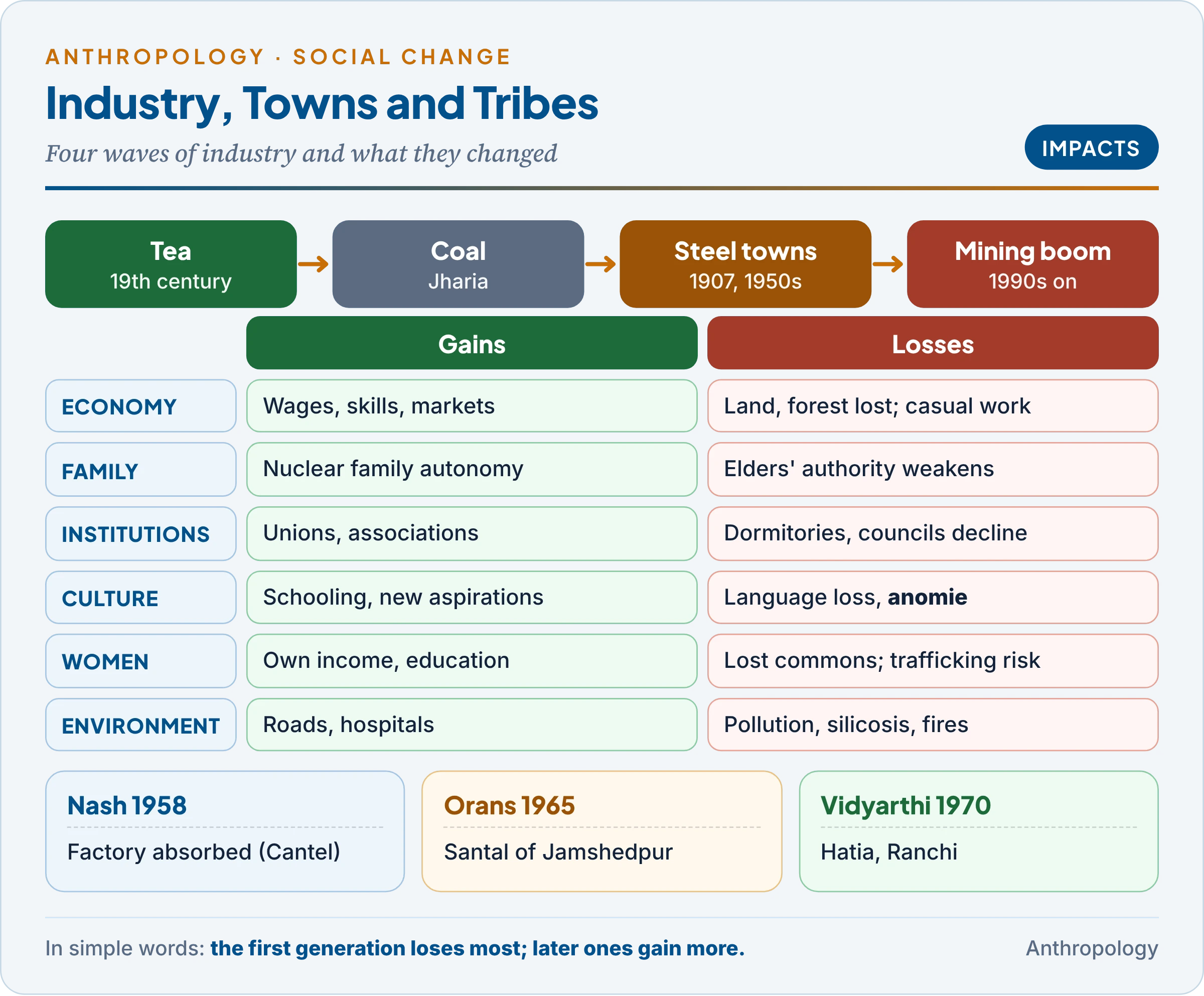
6.3 How industry reached tribal areas
- Plantations (from the 19th century): Assam and north Bengal tea gardens recruited labour from Chotanagpur and the Santal Parganas; the descendants (Santal, Munda, Oraon, Kharia and others), known as “tea tribes” or Adivasis of Assam, are not Scheduled Tribes in Assam.
- Mining: the Jharia and Raniganj coalfields from the late 19th century, later iron ore (Saranda, Bailadila), bauxite and uranium, all drawing tribal labour.
- Manufacturing: the Tata steel works at Jamshedpur (1907), and after Independence the public sector steel towns of Rourkela, Bhilai and Bokaro and the HEC at Ranchi, all in tribal belts.
- Liberalisation (from the 1990s): private mining, power and steel projects, often through state agreements with companies (6.3a).
6.4 Anthropological studies
- Manning Nash, Machine Age Maya (1958): in Cantel, Guatemala, a textile factory opened in 1876 had not destroyed Maya community life; the factory was absorbed into existing kinship and religious structures. He questioned the assumption that industry must disorganise traditional society.
- Martin Orans, The Santal: A Tribe in Search of a Great Tradition (1965): Santal workers in the Jamshedpur industrial area competed for rank by adopting Hindu practices and, at the same time, built Santal solidarity and political organisation.
- Vidyarthi (1970) on Hatia (§6.1).
- Rourkela: for India’s first public-sector steel plant and its Mandira dam, the state acquired land from 33 and 31 villages in the 1950s; the Ministry of Steel reported in 2026 that 4,094 families had been displaced and 6,707 local displaced persons employed. Studies record that about two-thirds of those displaced at the plant site were tribal, that promised jobs came late, and that the displaced lived in resettlement colonies and slums at the edge of a planned township built for outsiders.
6.5 Impacts: the balance sheet
The table sets out the favourable and harmful effects of industrialization and urbanization on tribal life.
| Sphere | Favourable effects | Harmful effects |
|---|---|---|
| Economy | Cash wages, new skills, shops, roads, markets | Loss of land and forest; casual and contract work; first generation unable to compete for skilled jobs |
| Family | Nuclear families gain independence | Joint family weakens; elders lose authority; migration splits families |
| Social structure | Class and occupation begin to count more than descent | Outsiders (dikus) dominate towns; slums; alcoholism, crime, prostitution |
| Institutions | Unions, associations, new leaders | Dormitories, village councils and clan rules decline |
| Culture | Education, media, new aspirations | Loss of language, crafts, songs; culture shock and anomie |
| Religion | Tolerance through contact | Pressure to abandon tribal religion; conversion conflicts |
| Health and environment | Hospitals, schools | Pollution, silicosis, mine fires, loss of water sources |
The first generation pays the heaviest price; later generations, with schooling, gain more. The psychological frustration of rapid industrialization comes from the sudden gap between new wants and the means to meet them, the loss of familiar social controls and the humiliation of being unskilled outsiders in one’s own homeland.
6.6 Jharkhand: industrialization and the Scheduled Tribes
- The paradox: Jharkhand holds much of India’s coal, iron ore, copper, uranium and mica, and has old industrial towns (Jamshedpur, Bokaro, Dhanbad, Ranchi), yet its tribal districts remain among the poorest. Scheduled Tribes were 26.2% of its population in 2011.
- Land and in-migration: mines, steel plants, dams and townships took tribal land, while skilled migrants from outside took most new jobs; tribal people became a minority in industrial towns.
- Jharia: underground coal fires and subsidence have burned for over a century; the revised Jharia Master Plan (25 June 2025, Rs 5,940.47 crore) provides resettlement, a Rs 1 lakh livelihood grant and credit for both title-holding and non-title-holding families.
- Saranda: the iron ore hills of the Ho country, where the Supreme Court ordered a sanctuary in 2025 (§5).
- Politics of land: the long Jharkhand movement won statehood in 2000 (7.4). Amendments to the Chotanagpur and Santhal Parganas Tenancy Acts in 2016, to ease use of tribal land for industry, met mass protest and were returned by the Governor in 2017.
- Out-migration: landless and under-employed tribal families migrate to brick kilns, farms and cities (6.2).
6.7 Mining and tribal communities
- Economic: royalties and a few jobs, mostly contract and unskilled; loss of farmland, forest and water; benefit-sharing through the District Mineral Foundation (6.3a); local inflation and dependence on cash.
- Social: displacement, in-migration of outsiders, alcohol, sex work and trafficking, and conflicts over land and jobs; women lose forest work and often end up as head-loaders or domestic workers.
- Developmental: the “resource curse”: mineral-rich tribal districts such as Keonjhar, West Singhbhum and Dantewada combine high output with poor health and education; conflict and Left Wing Extremism thrive where the state is seen as serving companies.
- Environmental and health: dust, polluted streams, silicosis and tuberculosis, falling water tables.
- Responses: Niyamgiri and Hasdeo resistance (6.3a), the Samatha principle (6.2), FRA rights, and the 1 km no-mining belt around protected areas (2025).
6.8 Urbanization and tribal institutions
About one Scheduled Tribe person in ten lived in towns in 2011. Urban life reshapes tribal institutions in several ways.
- Youth dormitories (dhumkuria, ghotul) decline as schooling and wage work replace their training functions.
- Village councils (the Oraon parha, the Munda manki-munda) lose authority over urban members, who turn to courts and police.
- Kinship and marriage: clan exogamy weakens, inter-tribal and some inter-caste marriages occur, bride-price is monetised, and choice of spouse becomes more individual.
- Religion and festivals: urban associations organise large Sarhul and Karma processions in Ranchi; the demand for a separate Sarna religion code is led by urban educated groups.
- Language: a shift to Hindi or Sadri as a common language, alongside revival efforts through literature and media.
- New institutions: students’ unions, tribal welfare associations, cooperatives and political parties replace or reinterpret traditional ones; a small tribal middle class emerges, as Virginius Xaxa has noted, sometimes distant from the village majority.
6.9 Urbanization, industrialization and tribal women
- Gains: education and wage work give some women independent income, mobility and a voice; urban Oraon women at Rourkela were better educated than their mothers.
- Losses: loss of land and forest ends women’s role as producers; at Rourkela, women’s participation in income-earning fell with urbanization; work offered is often the lowest-paid (head-loading, construction, domestic work in distant cities).
- Vulnerability: young women migrating from Jharkhand and Chhattisgarh as domestic workers face trafficking, unpaid wages and abuse; tea garden women carry heavy work for low pay.
- Status: the relatively higher status tribal women had in the family and economy can decline as they adopt the norms of caste society (seclusion, dowry) in towns.
6.10 Making industrialization fair
Studies since Vidyarthi suggest that the tide of industrialization cannot be stopped, but its rigours can be softened:
- Anthropological study and SIA of every project before it begins (6.3a);
- training local people before the plant opens, so that the first generation is not shut out;
- jobs, shares and royalties for the displaced and the district;
- planned townships that include tribal hamlets with services, not slums at the edge;
- PESA and FRA powers to let gram sabhas decide on land and forests;
- support for language, festivals and cultural centres so that change does not mean loss of identity.
Key Terms
| Term | Meaning in simple words |
|---|---|
| Reserved forest | Forest where almost all use is banned unless the state allows it |
| Protected forest | Forest where use is allowed but restricted |
| Privilege (concession) | A use the state may grant or withdraw, unlike a right |
| Minor forest produce | Non-timber forest products such as tendu leaves, mahua, bamboo, honey |
| Nistar | Customary right of villagers to take forest produce for household use |
| Shifting cultivation (jhum) | Clearing and burning a forest patch, cropping it, then leaving it fallow |
| Joint Forest Management | Villagers protecting degraded forests in return for a share of produce |
| Usufruct | The right to use and benefit from something owned by another |
| Historical injustice | The FRA’s term for the denial of forest dwellers’ rights in the past |
| Other traditional forest dwellers | Non-tribals who have depended on forests for 75 years |
| Community forest resource | A village’s customary forest that its gram sabha may manage |
| Habitat rights | Rights of PVTGs over their whole customary territory |
| Compensatory afforestation | Planting forest to make up for forest land diverted to projects |
| Ecosystem people | People who live off the resources of their own locality |
| Detribalization | Loss of distinctive tribal features through contact and change |
| Retribalization | Conscious revival of tribal identity, often in towns |
| Industrial anthropology | The study of how factories and mines change communities |
| Push and pull factors | Reasons that drive people out of villages and draw them to towns |
Contemporary Developments
- FRA status (30 June 2026): 54.02 lakh claims, 25.42 lakh titles (1,24,162 community), 18.13 lakh rejected; habitat rights for only 11 of 75 PVTGs (August 2026); regional review conferences in 2026 asked states to review rejections and record rights in land records.
- CFR and working plans (27 July 2026): a joint Tribal Affairs–Environment communication allows gram sabha CFR management plans to be integrated with forest department working plans.
- Forest law in court (2024–25): the Supreme Court kept the Godavarman meaning of forest pending state records (February 2024), barred loss of forest land without compensatory land (February 2025) and set deadlines for consolidated forest records (March 2025).
- Saranda (13 November 2025): the Supreme Court ordered a wildlife sanctuary in Jharkhand’s Saranda forest, banned mining within 1 km of protected areas nationwide and directed publicity that tribal FRA rights remain protected.
- Jharia (25 June 2025): the revised Jharia Master Plan (Rs 5,940.47 crore) adds livelihood grants and credit for families resettled from coal-fire and subsidence zones, including those without legal title.
Diagrams to Master
- Topic map: forests (dependence, colonial laws, post-1947 policies, FRA, recent changes) and industry and towns (phases, studies, impacts, women, institutions).
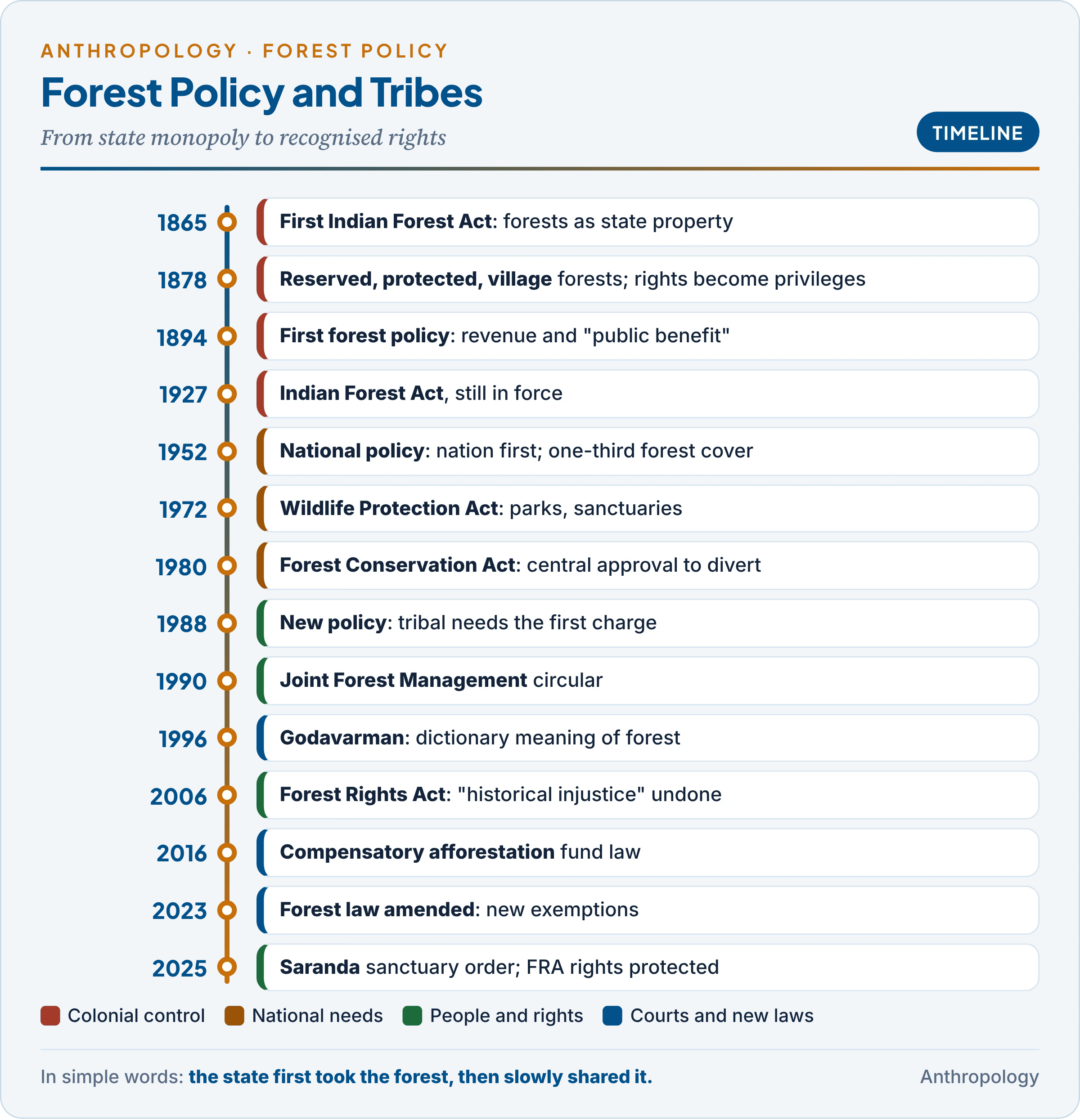
- Forest policy timeline: 1865, 1878, 1894, 1927, 1952, 1972, 1980, 1988, 1990, 1996, 2006, 2016, 2023, with a “rights” arrow turning from loss to recognition at 2006.
- Three policies compared: 1894, 1952, 1988 on aim, local people, shifting cultivation and participation.
- FRA structure: four kinds of rights, three levels of committees, key safeguards, latest numbers.
- Industrialization impacts: four phases of industry and a sphere-by-sphere balance sheet.
Revision Grid
| Scholar | Work (year) | Key idea |
|---|---|---|
| Dietrich Brandis | First Inspector General of Forests (1864) | Scientific forestry for state timber |
| Gadgil and Guha | Ecology and Equity (1995) | Ecosystem people, omnivores, ecological refugees |
| Ramachandra Guha | The Unquiet Woods (1989) | Forest control and peasant resistance; roots of Chipko |
| Nandini Sundar | Subalterns and Sovereigns (1997) | Forest reservation and the 1910 Bastar rebellion |
| P.S. Ramakrishnan | Shifting Agriculture and Sustainable Development (1992) | Jhum sustainable with long fallows |
| Bina Agarwal | Gender and Green Governance (2010) | Women in community forest groups |
| Asmita Kabra | Conservation-induced displacement (2009) | Kuno Sahariya impoverished by relocation |
| L.P. Vidyarthi | Socio-cultural Implications of Industrialisation in India (1970) | Hatia: industrial anthropology in tribal Bihar |
| Martin Orans | The Santal (1965) | Santal workers seek rank and solidarity |
| Manning Nash | Machine Age Maya (1958) | Factory absorbed into community life |
| M.N. Srinivas | Social change in modern India | Industry needs relations that conflict with tradition |
| Virginius Xaxa | Studies of tribal society and the state | Emerging tribal middle class |
Previous Year Questions
Development of forest policy and tribals; impact of urbanization and industrialization on tribal population
- 2025Write notes on: Impact of urbanization and industrialization on tribal communities of India.
- 2024Examine the impact of Forest Policies from 1878 to 2006 on land alienation and deprivation of rights of tribal communities in India.
- 2024Discuss the economic, social, and developmental impacts on tribal communities with special reference to mining.
- 2022How can a balance be struck between livelihood concern and environmental degradation in the context of shifting cultivation?
- 2021Write short notes on “Urbanization and tribal institutions” in about 150 words.
- 2021Discuss the impact of the Forest Rights Act on the livelihood and culture of tribal people in India.
- 2018Discuss the significance and implementation of ‘Recognition of Forest Right’s Act 2006’
- 2016Write a note in 150 words on Impact of industrialization on scheduled tribe population of Jharkhand.
- 2016Explain the difficulties experienced by scheduled tribes with regard to implementation of the ‘Recognition of Forest Rights Act, 2006’
- 2014Write a note in 150 words on Forest policy and tribes.
- 2014Discuss the impact of Globalization on the livelihood of the tribal populations.
- 2013Write a note in 150 words on Impacts of sanctuaries and national park on tribal populations.
- 2011Write a note in 150 words on Forest Rights Act – 2006.
- 2011Discuss the impact of Urbanization and Industrialization on tribal women.
- 2009Critically examine the evolution of Forest policy in India since the British period. Discuss its impact on tribals of India.
- 2007Write a note on Impact of Industrialization on Tribals.
- 2006Write a note on Joint Forest Management.
- 2005Examine the impact of urbanization and industrialisation on tribal economy in India.
- 2004Write a note on Detribalization.
- 2003Discuss how forest is related to the tribal life. Critically examine how a change in forest policy and forest degradation have affected tribal economy.
- 2001Write a note on Detribalization.
- 2000Give an account of Joint Forest Management programmes. What is the role of NGOs in such programmes ?
- 1999Critically examine the forest policy in India right since the British period. Discuss its impact on tribal people.
- 1998Write a note on Social Forestry.
- 1996Bring out the impact of industrialization on rural population in India. Illustrate your answer with suitable examples. Suggest appropriate measures for the solution of the problems encountered with.
- 1996Write a note on Involvement of local communities in forest management.
- 1995Write a note on Genesis of urbanization in India.
- 1993How are the tribes in India dependent on forest? Make a comparative evaluation on malevolent and benevolent actions of the tribes on forest.
- 1993Point out the favourable and detrimental impacts of industrialization on rural population, living in the vicinity areas. What are your proposals for achieving a balance without harmful effects?
- 1992Write a note on ‘Land and forest’ are basic needs of tribals.
- 1992Describe the traditional economy of the Indian tribal communities and show how changes have come in it due to impact of Industrialization.
- 1991Write a note on Effects of governmental policy regarding forests on Indian tribes.
- 1991Write a note on ‘Push’ and ‘Puli’ factors in rural-urban migration.
- 1990Write a note on Impact of urbanization on the tribal societies.
- 1988Discuss the world view of tribal people in forest regions of India.
- 1987Write a note on Forests and the tribal peoples.
- 1987Write a note on ‘Rapid industrialisations may lead to psychological frustrations.’Discuss.
- 1986The impact of Industrialization of the tribes of India created for them many problems. Discuss with suitable Examples.
- 1982Write a note on (200 words) : Forest policy and tribal interests.
- 1981Write a note on Influence of environment on the culture of any Indian tribe. (200 words).
Related questions from other units
- 2024Unit 6.2: Custodians of natural resources are the tribals, but they are the most deprived. Critically examine how climate change will impact their survival in future.
- 2024Unit 2.4: Define urbanization and discuss its impact on family in India with examples.
- 2021Unit 5.1: Examine how structural transformation in economy is affecting traditional social relationships in agrarian society.
- 2019Unit 5.1: Describe the impact of industrialization on the economic and social aspects of India’s villages.
- 2013Unit 3.3: Examine Nature – man – spirit complex as an ecological concept. (250 words).
- 2010Unit 6.2: “Land and forest are the twin problems of the tribes.” Explain.
- 1994Unit 6.2: Write a note on Factors responsible for tribal migration and its consequences.
- 1991Unit 5.1: Write a note on Problem of shifting cultivation in Indian tribes.
- 1982Unit 5.1: Write a note on (200 words) : Impact of industrialization on simple societies.
More from Tribal Situation in India: all notes of this unit · every PYQ of this unit · Anthropology Optional hub