

Anthropology Optional › Paper II › Unit 06: Tribal Situation in India
6.3 Developmental projects and their impact on tribal displacement and problems of rehabilitation. Development of forest policy and tribals. Impact of urbanization and industrialization on tribal population
Official Syllabus: Paper II, Unit 6.3
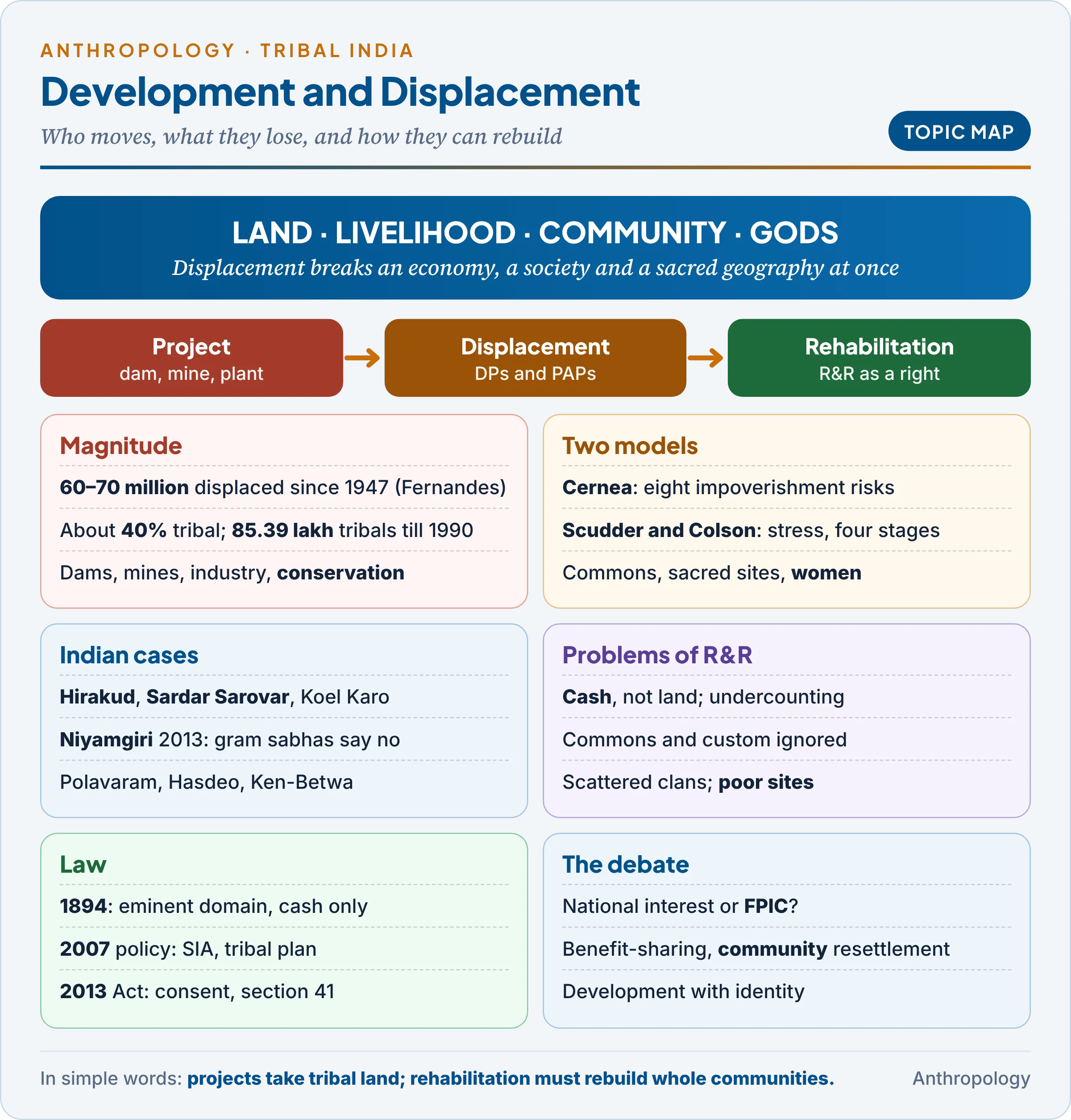
This article covers the first part of the syllabus line: how development projects (dams, mines, industries, conservation areas and infrastructure) displace tribal people, and why rehabilitation has so often failed. The history of forest policy and the impact of urbanization and industrialization are in 6.3b. Land alienation through moneylenders, traders and fraud is in 6.2; PESA and the gram sabha are in 5.3b; tribal movements as a whole are in 7.4.
1. Development and Displacement: Meaning and Magnitude
In simple words
When the state builds a dam, a mine or a factory, it needs land, and the people living on that land must move. Tribal people have had to move far more often than others, because the rivers, forests and minerals that projects need lie in their homelands. For them losing land means losing not only a livelihood but a whole way of life.
1.1 The Bhilala of the Narmada valley: the example
In the late 1980s the Indian sociologist Amita Baviskar lived among the Bhilala (a Bhil-related adivasi community) of Alirajpur in the then Jhabua district of Madhya Pradesh, in villages such as Anjanvara that the Sardar Sarovar reservoir was to submerge. In In the Belly of the River (1995) she showed that for the Bhilala the river, the forest and the village gods formed one landscape: their creation song (gayana), clan shrines and fields all lay in the valley. Cash for a field could not replace the shrine, the kin nearby or the forest that gave fuel and food. Baviskar also refused to romanticise them: the Bhilala cut trees and wanted roads and schools; what they resisted was losing control over their land to a distant state. The example states the core argument of this article: displacement breaks an economy, a society and a sacred geography at once.
1.2 Key concepts
- Development-induced displacement (DID): the forced movement of people to make way for a project. It is involuntary: the state acquires land through eminent domain (the sovereign power to take private property for public use, with compensation).
- Displaced persons (DPs) are physically uprooted; project-affected persons (PAPs) lose land, forest, grazing or fishing without being moved. The Indian displacement scholar Walter Fernandes (Indian Social Institute, Delhi; later the North Eastern Social Research Centre, Guwahati) counted both as DP-PAPs, because official figures counted only the first.
- Resettlement is physical relocation to a new site; rehabilitation is restoring or improving livelihood, income and social life. A family can be resettled in a new house and still not be rehabilitated.
Common confusion
Are resettlement and rehabilitation the same thing? No. Resettlement is moving people and giving them a house plot. Rehabilitation is the harder task of rebuilding their livelihood, community and status so that they are at least as well off as before. India’s early projects often resettled people, or merely paid cash, without rehabilitating them; that is why the law now speaks of “R&R” as two linked duties.
1.3 How many people, and why so many tribals?
India has never kept an official national count of the displaced, so scholars built their own estimates.
- Fernandes’s estimates: about 21.3 million DP-PAPs for 1951–90 (1998); more than 60 million for 1947–2000 (2007); about 70 million for 1947–2010 (2023).
- Who they are: about 40% are tribal, though tribals are under a tenth of India’s population; about 20% are Dalits; Fernandes found tribals to be about 90% of those displaced by wildlife sanctuaries.
- Official figure: the Ministry of Tribal Affairs’ draft National Policy on Tribals stated that 85.39 lakh tribals had been displaced until 1990, at least 55.16% of all displaced persons.
- Few rehabilitated: a Planning Commission expert group (2008) cited Fernandes’s finding that only about one-third of the displaced had been resettled.
Why the tribal share is so high. Tribal regions hold most of India’s coal, bauxite and iron ore, its large forests and the upper reaches of rivers that suit dams. Much tribal land is held under community or customary tenure, which land law treated as state land, so it was cheap to acquire, often without compensation. Tribal communities also had the least political voice.
The table sorts the main causes of displacement.
| Type of project | Indian examples | How it displaces |
|---|---|---|
| Dams and irrigation | Hirakud, Sardar Sarovar, Polavaram, Ken-Betwa | Submergence of whole villages; the largest single cause |
| Mining | Niyamgiri (proposed), Hasdeo Arand, Singrauli | Opencast pits, dumps, loss of forest and water |
| Industry | Rourkela, Kalinganagar, POSCO site | Plants, townships and ports |
| Conservation | Tiger reserves, sanctuaries | Relocation of forest villages from core areas (6.3b) |
| Infrastructure and defence | Highways, firing ranges, Great Nicobar | Corridors, airports, ports, security zones |
Water projects displace the most people and conservation the highest proportion of tribals; because projects cluster in the same mineral and river belts, many families are displaced more than once.
2. Why Displacement Hurts Tribals More: The Anthropology of Impoverishment
In simple words
Losing land hurts everyone, but it hurts tribal communities in more ways at once. Their land is shared, their gods live in particular hills and groves, and their families depend on each other nearby. Anthropologists have built models that list these losses so that planners can see and prevent them.
2.1 Land, commons and sacred geography
- Land held by the community: among many tribes land belongs to the clan or village; the khuntkatti lands of the Munda, held by the founding lineage, are a classic case. Individual title (patta) is often missing.
- Commons invisible to the law: under the Land Acquisition Act, 1894, only individually owned land earned compensation; common property resources (CPRs) such as forest, grazing land and streams counted as state land. Fernandes found that over 40% of land taken for projects was common land, most of it tribal.
- Sacred geography: hills, groves (sarna, jaher) and memorial stones hold a tribe’s ancestors; for the Dongria Kondh, the Niyamgiri hills are the abode of Niyam Raja (§3.6).
- Identity: scattering a tribe among non-tribal villages weakens its language, festivals and councils.
Why this matters: a cash award can price a field, but not a grove, a kin network or a forest commons; that is why compensation alone has never restored tribal livelihoods.
2.2 Cernea’s Impoverishment Risks and Reconstruction model
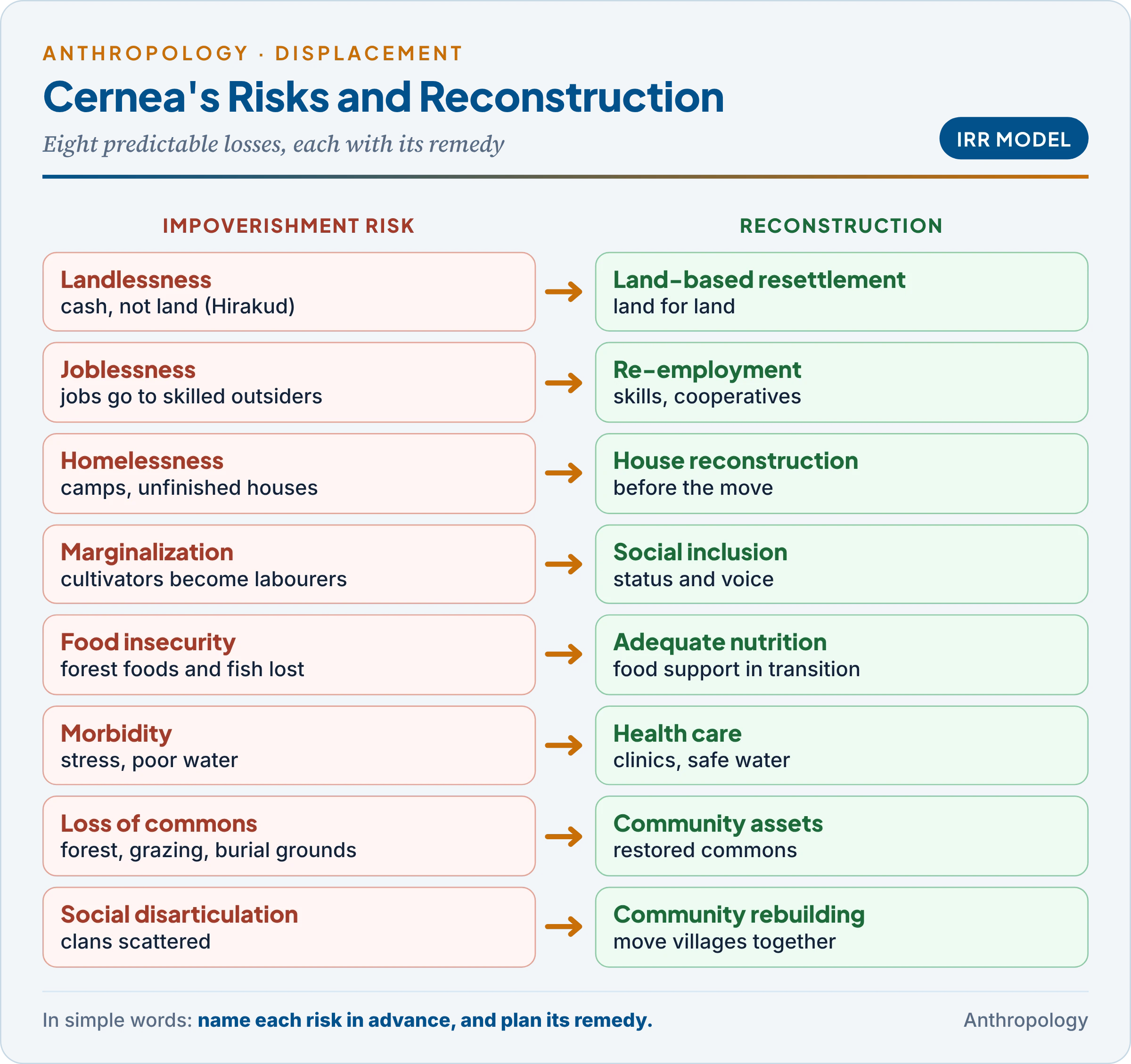
Michael Cernea, a Romanian-born sociologist who was the World Bank’s senior adviser on sociology and resettlement, built the Impoverishment Risks and Reconstruction (IRR) model (“The Risks and Reconstruction Model for Resettling Displaced Populations”, World Development, 1997). Forced displacement carries eight predictable risks, each reversible by a matching strategy.
| Risk | What happens | Tribal example | Reconstruction strategy |
|---|---|---|---|
| Landlessness | Productive land lost | Cash, not land, at Hirakud | Land-based resettlement |
| Joblessness | Wage, craft and forest work lost | Project jobs go to skilled outsiders | Re-employment, training |
| Homelessness | Shelter lost or replaced by camps | Unfinished houses in Polavaram colonies | House reconstruction |
| Marginalization | Downward mobility, loss of status | Cultivators become casual labourers | Social inclusion |
| Food insecurity | Less food and income | Loss of forest foods and fish | Adequate nutrition |
| Morbidity and mortality | Stress, disease, poor water | Illness in crowded new sites | Improved health care |
| Loss of common property | Forest, grazing, water, burial grounds | CPRs taken as state land | Restoring community assets |
| Social disarticulation | Kin groups scattered | Clans split among colonies | Community rebuilding |
The model is predictive: if planners know the risks, they can budget against them. Cernea later added loss of access to education (2002). Critics say it treats displacement as a technical problem to be managed rather than a question of rights and power; it never asks whether the project should be built at all.
2.3 Scudder and Colson: stress and stages
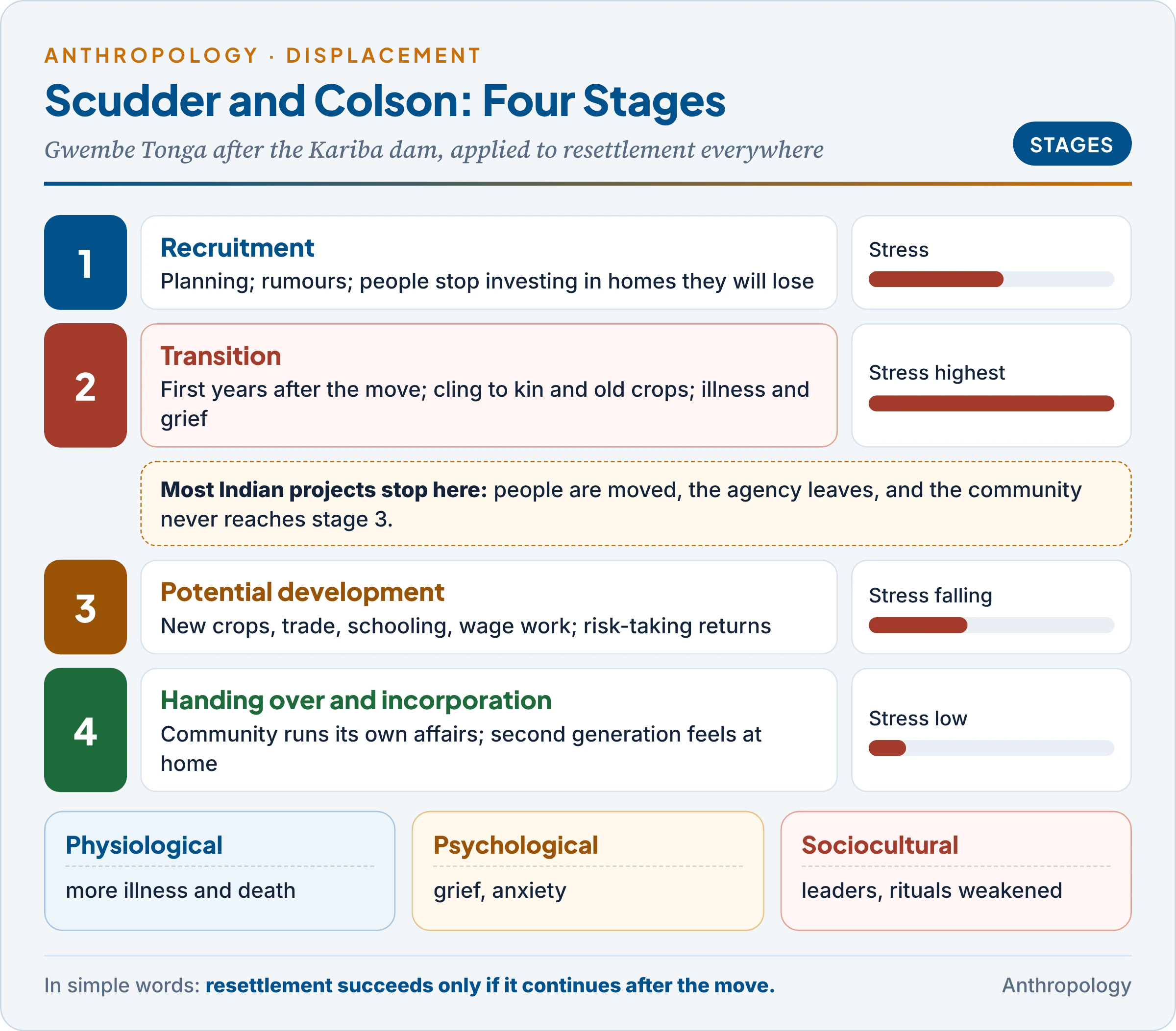
Thayer Scudder and Elizabeth Colson, American anthropologists who followed the Gwembe Tonga of Zambia for decades after the Kariba dam (1958) flooded their valley, showed that relocation causes multidimensional stress: physiological (more illness and death), psychological (grief for the lost home, anxiety) and sociocultural (leaders lose authority, rituals lose their places). In 1982 they described four stages of a successful resettlement:
- Recruitment (planning): officials plan; people hear rumours and stop investing in homes they expect to lose.
- Transition: the first years after the move; people cling to kin and old crops, and stress is highest.
- Potential development: people take risks again: new crops, trade, schooling, wage work.
- Handing over and incorporation: the new community runs its own affairs and its second generation feels at home.
Their key point is that most projects stop at stage two: they move people and leave. Cernea drew the lesson that resettlement must itself be a development project, with its own budget and goals.
2.4 The many impacts of displacement
- Economic: loss of land, forest produce, fishing and grazing; landlessness, wage labour and migration; cash compensation spent on consumption, debts and liquor, often to traders who gather around compensation offices.
- Social: scattering of clans; conflict with host communities who must now share land and water; family disputes over who gets the money.
- Cultural: loss of sacred sites and burial grounds; decline of language and festivals.
- Political: village councils lose authority; resettlement colonies may fall outside PESA and any panchayat (Polavaram, §3.4).
- Health: stress, loss of forest foods, unsafe water and crowding raise morbidity, worst for the young and old.
Multiple displacement sharpens every impact. In Singrauli (Madhya Pradesh–Uttar Pradesh border), families uprooted by the Rihand dam around 1960 were uprooted again by coal mines and NTPC power plants; a 1991 assessment for the World Bank and NTPC found about 90% of local people displaced at least once and 34% more than once, and a complaint to the World Bank’s Inspection Panel followed in 1997.
2.5 Women and displacement
- Loss of the women’s economy: tribal women collect fuel, fodder, forest foods and minor forest produce, fish and farm; these commons are not compensated. Fernandes argued that tribal women enjoy a higher status (not equality) because they are economic assets, and that displacement destroys its basis.
- Compensation and jobs go to men: titles, cash and project jobs went to the male head of household; the Narmada Water Disputes Tribunal award (1979) treated every major son, but not a major daughter, as a separate family entitled to land.
- Downward slide: no longer producers, women are confined to the house, lose a say in decisions and face alcohol-related violence, distress migration and trafficking.
- Burdens and voice: women carry water and fuel farther at new sites and nurse the sick, and they have often led protests (Narmada valley, Niyamgiri, Dhinkia) because they feel the loss of commons first.
The 2013 Act answers part of this bias: an adult of either gender counts as a separate family, as do widows, divorcees and deserted women (§5.3).
3. Indian Cases: Dams, Mines and Industries
In simple words
India’s experience of displacement is best understood through a few famous projects. Each shows a different side of the problem: poor planning, legal battles, violent clashes, or tribal communities saying “no”. Together they show how law and people’s responses changed over seventy years.
3.1 Hirakud: the first big dam and the first lessons
- India’s first major multipurpose river valley project, on the Mahanadi near Sambalpur (Odisha), inaugurated on 13 January 1957.
- Underestimation: the feasibility report expected 168 villages to be submerged; the dam submerged 325 (291 in Odisha, 34 in the then Madhya Pradesh), displacing about 26,501 families (roughly 1 lakh people).
- Rehabilitation: only 2,243 families (about 8.5%) were settled in government camps; compensation of about Rs 200–600 an acre was below market value, and no land was given for land. Oustees’ groups still claimed dues in 2022.
Lesson: engineering estimates, cash compensation and remote camps without livelihoods set a pattern repeated for decades.
3.2 Sardar Sarovar and the Narmada Bachao Andolan
- Award: the Narmada Water Disputes Tribunal (7 December 1979) fixed the full reservoir level at 455 feet (about 138.68 m) and ruled that no area be submerged until oustees were rehabilitated.
- Affected area: 245 villages: 193 in Madhya Pradesh, 33 in Maharashtra, 19 in Gujarat; those of Maharashtra and Gujarat are almost wholly tribal (Bhil, Bhilala, Tadvi, Vasava and others).
- Resistance: local groups united by 1989 as the Narmada Bachao Andolan (NBA), led by Medha Patkar with Baba Amte‘s support. The World Bank, which had lent US$450 million (1985), commissioned the Morse Report (June 1992), which found resettlement and environmental planning deficient; the remaining loan was cancelled in 1993.
- Narmada Bachao Andolan v. Union of India (18 October 2000): by 2:1 (Kirpal J. and Chief Justice A.S. Anand; Bharucha J. dissenting) the Supreme Court let construction continue, up to 90 m at once and higher only pari passu (step by step) with certified rehabilitation. Displacing tribals does not by itself violate Article 21 if oustees end up better off. The dissent called the 1987 environmental clearance “no clearance”.
- Completion: dedicated on 17 September 2017. The government told Parliament (August 2017) that 32,684 families had been resettled; the NBA maintained that tens of thousands, mainly in Madhya Pradesh, lacked land or full entitlements.
What it proves: a project can be legally upheld and still leave a contested rehabilitation record. It also made Indian displacement an international issue and pushed the World Bank to tighten its rules (§4.3).
3.3 Koel Karo: a project that was stopped
- Two hydroelectric dams on the Koel and Karo rivers (now Jharkhand), planned from 1955, would have affected about 250 villages, most of them Munda.
- The Koel Karo Jan Sangathan raised barricades in 1985; on 2 February 2001 police fired on a crowd at Tapkara, killing at least eight.
- The dams were never built: clan land (khuntkatti), sacred groves and memorial stones (sasandiri) gave Munda resistance its moral force.
3.4 Polavaram: the largest current displacement
- A dam on the Godavari (Andhra Pradesh), a national project under the Andhra Pradesh Reorganisation Act, 2014; seven Telangana mandals were transferred to Andhra Pradesh to keep the reservoir in one state.
- Scale: the CAG audit (2025) recorded 1,06,006 displaced families, 56,495 of them tribal, and only 11% rehabilitated by March 2023. The state reported (September 2025) 96,660 families from 373 habitations, 38,060 in Phase I.
- Communities: the Koya, the Konda Reddi (a PVTG) and the Konda Kammara, whose life centred on the river and the dugout boat (dhone).
- Problems: colonies 40–50 km from old villages; unirrigated land-for-land; no fishing until the reservoir fills; and colonies not notified as revenue villages or panchayats, so the displaced lose even their PESA gram sabha powers.
3.5 Ken-Betwa: river-linking and a tiger reserve
- The first river-link of the National Perspective Plan (Ken to Betwa, Bundelkhand), approved at Rs 44,605 crore (2021); Daudhan dam foundation laid on 25 December 2024; completion targeted for 2030.
- The reservoir will submerge about 9,000 ha, including 4,141 ha of the Panna Tiger Reserve core, and 10 villages (about 1,913 families per the EIA), mostly Gond and Kol. Villagers protested over low valuations in 2025; Madhya Pradesh’s special package (2023) offers Rs 12.5 lakh lump sum or a plot grant.
- Double displacement: villages elsewhere are being relocated to give the tiger reserve new habitat, so conservation and development displace together.
3.6 Niyamgiri: the Dongria Kondh and the first environmental referendum
Context. The Niyamgiri hills (Rayagada and Kalahandi districts, Odisha) hold bauxite and are home to the Dongria Kondh, a PVTG of horticulturists who worship Niyam Raja, the lawgiver-king of the hills. A joint venture of the Odisha Mining Corporation and Vedanta planned to mine the hills to feed Vedanta’s alumina refinery at Lanjigarh in the foothills.
- 24 August 2010: after the N.C. Saxena committee documented violations of forest, environment and forest rights laws, the Environment Ministry rejected Stage II forest clearance.
- Orissa Mining Corporation v. Ministry of Environment and Forests (18 April 2013; Aftab Alam, K.S. Radhakrishnan and Ranjan Gogoi JJ.): the gram sabhas, under the Forest Rights Act and PESA, must decide whether mining affects the religious, cultural and community rights of the Dongria Kondh and other forest dwellers.
- 18 July–19 August 2013: all 12 palli sabhas (village councils) chosen by the state (seven in Rayagada, five in Kalahandi) unanimously rejected mining, with a district judge as observer.
- 8 January 2014: the Environment Ministry finally rejected the mine’s forest clearance.
Critical appraisal.
- Achievements: India’s first environmental referendum; recognition that religious and cultural rights over a landscape are forest rights; the gram sabha as decision-maker; a small PVTG, organised through the Niyamgiri Suraksha Samiti and backed by national and global solidarity, stopping a multinational project by law.
- Limits: only 12 of more than 100 villages in the range were consulted; the court asked about the mine, not the refinery already built; one hill was protected, not the wider bauxite belt; and activists have faced policing and arrests.
- Debate: mining’s supporters saw lost jobs and revenue for a very poor region; its critics saw a vindication of consent. Consent works when communities are organised and courts insist on process, but it depends on who is asked and what question is put.
3.7 Kalinganagar, POSCO and Hasdeo Arand
- Kalinganagar (Jajpur, Odisha): on 2 January 2006 adivasis protesting the boundary wall of a Tata Steel plant on land acquired cheaply years earlier were fired on; 12 adivasis (including three women and a boy) and one policeman died. Odisha then adopted its Resettlement and Rehabilitation Policy (14 May 2006).
- POSCO (Jagatsinghpur, Odisha): an MoU of 22 June 2005 for a 12-million-tonne, Rs 51,000 crore steel plant met twelve years of resistance by the POSCO Pratirodh Sangram Samiti, centred on Dhinkia, defending betel vines, fishing and paddy. POSCO withdrew in March 2017; the land went to JSW Utkal Steel, and police and villagers clashed again in January 2022. The affected were mostly non-tribal cultivators claiming rights as other traditional forest dwellers: displacement struggles in forest areas are not tribal alone.
- Hasdeo Arand (Surguja, Surajpur and Korba, Chhattisgarh): a dense sal forest of Gond and other adivasi villages near the proposed Lemru Elephant Reserve. The Parsa East and Kete Basan coal block, allotted to the Rajasthan Rajya Vidyut Utpadan Nigam with an Adani group company as mine operator, was cleared in 2012 against the Forest Advisory Committee’s advice. A Wildlife Institute of India study (2021) warned of unmanageable human-elephant conflict; the Assembly unanimously asked the Centre to cancel the Hasdeo blocks (July 2022); the State ST Commission found the Parsa block’s gram sabha consent forged (November 2024).
The table brings the cases together.
| Case | State | Main communities | Key issue | Outcome |
|---|---|---|---|---|
| Hirakud (1957) | Odisha | Peasant and tribal villages | Underestimation; cash only | Dues still claimed |
| Sardar Sarovar | Gujarat, MP, Maharashtra | Bhil, Bhilala, Tadvi, Vasava | R&R pari passu; NBA | Upheld 2000; completed 2017 |
| Koel Karo | Jharkhand | Munda | Clan land, sacred groves | Stopped |
| Kalinganagar (2006) | Odisha | Adivasis of Jajpur | Low compensation | Firing; state R&R policy |
| Niyamgiri (2013) | Odisha | Dongria Kondh (PVTG) | Religious and forest rights | Gram sabhas said no |
| Hasdeo Arand | Chhattisgarh | Gond and others | Coal; forged consent | Contested |
| Polavaram | Andhra Pradesh | Koya, Konda Reddi | Scale; colonies outside PESA | Rehabilitation lagging |
| Ken-Betwa | Madhya Pradesh | Gond, Kol | River-link in a tiger reserve | Under construction |
4. Problems of Rehabilitation
In simple words
Rehabilitation has failed far more often than it has succeeded. People were undercounted, shared land was ignored, cash was paid instead of land, new sites had no livelihoods, and nobody stayed to see whether families recovered. Each failure has a matching remedy.
4.1 Why rehabilitation failed
- No law, only compensation: until 2013 the general law gave cash for property; rehabilitation depended on project orders or state policies.
- Undercounting: estimates were guesswork (Hirakud: 168 villages expected, 325 submerged); PAPs, labourers, artisans, tenants and forest users were left out.
- Customary rights ignored: families without patta were treated as encroachers; CPRs were taken as state land.
- Cash instead of land: land-for-land was promised but “not available”; cash, delayed and arbitrarily valued (stone houses rated below brick ones), drained away to traders and middlemen.
- Poor sites and host conflict: colonies far from forest, river and market, without irrigation or schools; a sudden rise in numbers strains the man-land ratio of host villages.
- Jobs to outsiders: skilled jobs go to migrants; locals get casual or contract labour.
- Fragmented community: families split among colonies; council, priest and clan structure break up.
- Institutional weakness and coercion: authorities saw resettlement as a cost, not a goal; monitoring ended at the move; protest was met with policing (Kalinganagar, Dhinkia).
Underlying cause: displaced people were treated as obstacles to a project, not its stakeholders. Engineering and finance were planned in detail; people were planned for last.
4.2 The thrust of anthropological studies
- Making the invisible visible: ethnographies counted PAPs, commons, women’s work and sacred sites that surveys left out (Fernandes’s state studies; Enakshi Ganguly Thukral (ed.), Big Dams, Displaced People, 1992; Baviskar on the Bhilala).
- Building theory: Scudder and Colson’s stress and stages; Cernea’s IRR model; the Indian sociologist Hari Mohan Mathur (Displacement and Resettlement in India: The Human Cost of Development, 2013) on resettlement as a development programme.
- Critiquing the development model: the anthropologist Felix Padel and the writer Samarendra Das (Out of This Earth, 2010) traced how bauxite mining tied Odisha’s Kondh hills to the global aluminium industry; Fernandes argued that the poor pay the price of development for the middle and upper classes.
- Shaping policy: these findings fed the World Bank‘s resettlement rules, the 2007 policy and the 2013 Act‘s Social Impact Assessment.
The Austrian anthropologist Christoph von Fürer-Haimendorf, restudying Deccan tribes decades after his 1940s fieldwork, recorded in Tribes of India: The Struggle for Survival (1982) how self-reliant communities had become dependent on the state after losing land and forest.
4.3 International standards
- World Bank: the first involuntary resettlement policy of any development agency (1980), revised in 1990 and 2001, now Environmental and Social Standard 5 (from October 2018): avoid, minimise, restore or improve livelihoods, cost resettlement into the project, and compensate customary rights too.
- World Commission on Dams (Dams and Development, 2000): projects need the demonstrable acceptance of affected people.
- ILO Convention 107 (1957), ratified by India in 1958, allows removal of indigenous populations only exceptionally, with land of equal quality; ILO 169 (1989) is not ratified by India.
- UN Declaration on the Rights of Indigenous Peoples (2007), Article 10: no relocation without free, prior and informed consent (FPIC).
4.4 A rehabilitation package that keeps community belonging
Anthropological findings point to a package built around the community, not the household. The table contrasts old practice with a people-centred one.
| Element | Old practice | People-centred rehabilitation |
|---|---|---|
| Planning | Engineers decide; people told late | Social Impact Assessment; gram sabha consent; anthropologists in the team |
| Who counts | Title holders only | All DP-PAPs, including landless, forest users and adult women |
| Compensation | Cash for property | Land for land, cash and benefit-sharing |
| Site | Wherever land is free | Near the old habitat, same Scheduled Area, compact block |
| Community | Families scattered | Village and clan moved together; council, priest and festivals kept |
| Commons | Ignored | Forest, grazing, water and fishing rights; land for sacred groves and burial grounds |
| Livelihood | A promised job | Skills, cooperatives, forest produce, share in revenue |
| Monitoring | Ends with the move | Independent, until families are better off |
Why the community matters: keeping clans, councils and shrines together preserves the social capital that carries people through the transition stress and keeps their identity; scattered families are absorbed as labourers. Benefit-sharing makes the displaced partners: the District Mineral Foundation created by the 2015 amendment of the mining law collects a share of royalty (30% for leases granted before 12 January 2015, 10% after) for mining-affected people.
4.5 People’s response and NGOs
- Response spectrum: communities have accepted projects (often on promises), negotiated better packages, or resisted (NBA, Koel Karo, Niyamgiri, Dhinkia). Participation in planning was usually minimal, so protest became the only voice.
- NGOs: surveys of the displaced, legal aid and public interest litigation, rights awareness under PESA, the Forest Rights Act and the 2013 Act, and monitoring of sites.
- Limits: NGOs can speak for tribals rather than with them, as Baviskar noted in the Narmada movement; some become resettlement contractors; activists face legal harassment.
Common confusion
Is compensation the same as rehabilitation? No. Compensation is a one-time payment for property taken. Rehabilitation is a process that restores livelihood, community and status through land, jobs, skills, amenities and long-term support. A family can receive full compensation and still end up poorer, exactly as Cernea’s model predicts when compensation is the only remedy.
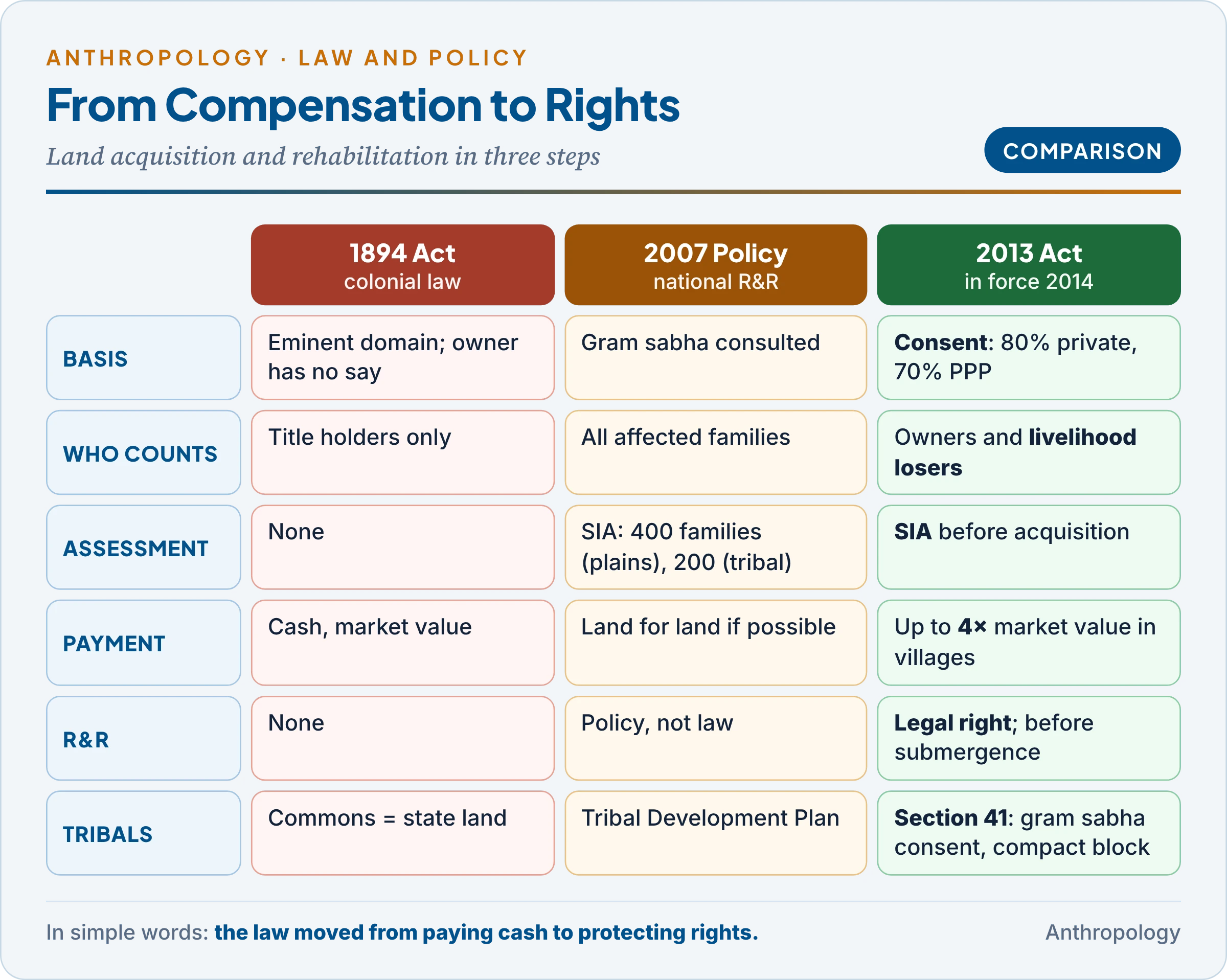
5. Law and Policy: From 1894 to 2013
In simple words
For over a century India acquired land under an 1894 colonial law that gave owners cash and nothing else. National rehabilitation policies came only in 2004 and 2007, and a 2013 law finally made consent, social impact studies and rehabilitation compulsory. Laws for tribal areas, such as PESA and the Forest Rights Act, added further protections.
5.1 The Land Acquisition Act, 1894
- Eminent domain for a “public purpose” (section 3(f)), defined so broadly that it covered housing, roads, industry and, after 1984, companies.
- Procedure: notification (section 4); objections within 30 days (section 5A), limited to the purpose and the land’s suitability; declaration (section 6); award (section 11). The urgency clause (section 17) skipped objections and was widely misused.
- No rehabilitation, no recognition of CPRs, landless people or customary rights; community land became state land.
5.2 Towards a rehabilitation policy
- From the 1980s some states (Maharashtra, Madhya Pradesh, Karnataka) framed rules for irrigation oustees; NTPC and Coal India adopted their own policies in the 1990s.
- National Policy on Resettlement and Rehabilitation for Project Affected Families, 2003 (published February 2004): applied only to projects displacing 500+ families in the plains or 250+ in hilly and Scheduled Areas; widely criticised as weak.
- National Rehabilitation and Resettlement Policy, 2007 (gazetted 31 October 2007): Social Impact Assessment where 400+ families (plains) or 200+ (tribal, hilly, Scheduled Areas) are displaced; gram sabha consultation; rehabilitation before displacement; land for land where possible; a Tribal Development Plan; an ombudsman.
5.3 The Act of 2013
The Right to Fair Compensation and Transparency in Land Acquisition, Rehabilitation and Resettlement Act, 2013 (in force 1 January 2014) replaced the 1894 Act and joined acquisition and R&R in one law.
| Provision | Section | Content |
|---|---|---|
| Consent | 2(2) | 80% of affected families for private projects; 70% for public-private partnerships |
| Social Impact Assessment | 4–9 | Independent SIA with public hearings before acquisition |
| Food security | 10 | Irrigated multi-cropped land only as a last resort |
| Family | 3(m) | An adult of either gender is a separate family; so are widows, divorcees and deserted women |
| Compensation | 26–30 | Market value × factor (up to 2 in rural areas) + 100% solatium: up to about four times market value |
| R&R | Second Schedule | House; job, Rs 5 lakh or an annuity; subsistence grant; one acre in the command area in irrigation projects; extra Rs 50,000 for STs displaced from Scheduled Areas |
| Before submergence | 38 | R&R completed six months before submergence in irrigation and hydel projects |
| Scheduled Areas | 41 | Acquisition only as a last resort; prior gram sabha consent; a Development Plan to settle and restore tribal land rights; one-third of compensation first; resettlement in the same Scheduled Area in a compact block; free land for community gatherings; fishing rights; 25% extra benefits if moved outside the district |
| Unused land | 101 | Returned after five years |
| Exempted laws | 105 | Thirteen laws (railways, highways, coal-bearing areas and others), though compensation and R&R were extended to them from 2015 |
5.4 How 2013 advances on 1894
| Point | Act of 1894 | Act of 2013 |
|---|---|---|
| Basis | Eminent domain; owner has no say | Consent for private and PPP projects; gram sabha consent in Scheduled Areas |
| Who is affected | Title holders | Owners and livelihood losers |
| Assessment | None | Social Impact Assessment |
| Compensation | Market value + 30% solatium | Up to about four times market value in villages |
| R&R | None | Legal entitlement |
| Urgency | Section 17, misused | Defence, security and disasters only |
| Tribals | No special provision | Section 41 safeguards |
Limits: the Act covers only acquisition; projects that buy land privately or take forest land by diversion largely escape it. Several states passed amendments (from 2016) exempting categories such as industrial corridors and infrastructure from consent and SIA. And no law can by itself create the land that land-for-land needs.
5.5 Successive land laws and tribal social organisation
- 1894 Act: recognised only individual property, so clan and village territories became state land; compensation paid to individual, usually male, title holders turned land from a lineage trust into a commodity, weakened headmen and councils, and set compensated against uncompensated families.
- State tenancy laws (the Chotanagpur Tenancy Act, 1908; the Santhal Parganas Tenancy Act, 1949) barred transfer of tribal land to non-tribals but allowed acquisition by the state, so alienation shifted from moneylenders to projects.
- PESA, 1996: the gram sabha or panchayat must be consulted before acquisition and resettlement in Scheduled Areas (section 4(i)) (5.3b).
- Forest Rights Act, 2006: no eviction until rights are recognised (section 4(5)); a right to in situ rehabilitation for those displaced without entitlements (section 3(1)(m)); and, since an Environment Ministry letter of 30 July 2009, forest diversion needs proof that FRA rights are settled and gram sabhas consent (6.3b).
- Act of 2013: consent and resettlement as a community in the same Scheduled Area (section 41) aim to keep clan, language and council together.
Net effect: displacement has individualised property, monetised relations and weakened customary councils and women’s standing; laws since 1996 try to reverse this by making the gram sabha, not the individual title holder, the deciding unit.
5.6 Courts
- Samatha v. State of Andhra Pradesh (11 July 1997): leasing tribal land in Scheduled Areas to private mining companies is void (6.3b).
- Narmada Bachao Andolan (2000): displacement is not unconstitutional if rehabilitation leaves people better off (§3.2).
- Orissa Mining Corporation v. MoEF (2013): gram sabhas decide on religious and cultural rights (§3.6).
- Indore Development Authority v. Manoharlal (6 March 2020): a Constitution Bench narrowed when old acquisitions lapse under section 24(2) of the 2013 Act.
6. Development, Displacement and the Debate on Balance
In simple words
Should the country stop building dams and mines because people are displaced? Most people answer neither “always build” nor “never build”. The real question is how to reduce displacement, share the benefits and give affected communities a real say.
The debate runs between four positions.
| Position | Argument | Weakness |
|---|---|---|
| Developmentalist | Dams, mines and industries feed, power and employ millions; some cost serves the national interest | Costs fall on the poorest; “national interest” hides who gains |
| Managerial (Cernea, World Bank) | Acceptable if risks are planned against and people end better off | Treats a political question as a technical one |
| Rights-based | Indigenous peoples must give FPIC; displacement violates the Fifth Schedule and Article 21 | Consent can be manufactured (Hasdeo) |
| Alternative development (Baviskar, Padel and Das, NBA) | Question the model: smaller dams, local water harvesting, less resource-hungry growth | Hard to scale; may underplay tribal aspirations |
- The dilemma: the British economist John Toye (Dilemmas of Development, 1987) saw development policy as balancing the gains of some against the losses of others. India’s answer since the 1990s has been to make losers visible (SIA), give them a voice (consent) and a share (benefit-sharing).
- Sustainable development: the Brundtland Report (Our Common Future, 1987) defined it as development that meets the needs of the present without compromising the ability of future generations to meet their own needs. Tribal critics add the needs of the people on the spot.
- Development with identity: tribes too want roads, schools and income; the issue is who decides. Nehru’s Tribal Panchsheel asked that tribes develop “along the lines of their own genius” (9.1), which displacement without consent contradicts.
Overall: India moved from cash compensation (1894) through policy (2004, 2007) to rights (PESA 1996, FRA 2006, the 2013 Act), yet the gap between law on paper and rehabilitation on the ground remains the central problem.
Key Terms
| Term | Meaning in simple words |
|---|---|
| Development-induced displacement | Forced movement of people to make way for a project |
| Eminent domain | The state’s power to take private land for public use, with compensation |
| Displaced person (DP) | Someone physically moved from home |
| Project-affected person (PAP) | Someone who loses land or livelihood without being moved |
| Resettlement | Physical relocation to a new site |
| Rehabilitation | Restoring livelihood, community and status after displacement |
| Common property resources | Forest, grazing land and water used by a whole community |
| IRR model | Cernea’s eight risks of displacement and their remedies |
| Social disarticulation | Breaking up of kin groups and community life |
| Multidimensional stress | Physical, mental and social strain caused by relocation |
| Social Impact Assessment | A study of a project’s effects on people before approval |
| Solatium | Extra payment for the compulsory nature of acquisition |
| Pari passu | Step by step (dam height rising only with rehabilitation) |
| FPIC | Free, prior and informed consent of indigenous peoples |
| Benefit-sharing | Giving affected people a share of a project’s income |
Contemporary Developments
- Great Nicobar (2026): the Tribal Council of Little and Great Nicobar told the Tribal Affairs Minister (30 June 2026) that an August 2022 certificate of forest rights settled before about 130 sq km of forest was diverted for the Rs 81,000 crore project was “false”; in October 2026 council leaders sought to join a case in the Calcutta High Court (Port Blair bench), saying no Nicobarese gram sabha was held. Shompen (PVTG) consent was given through a government body.
- Polavaram: by October 2025, 14,371 of 38,060 Phase I families had moved to 26 colonies; commissioning is targeted for 2027.
- Ken-Betwa: the Daudhan dam in the Panna Tiger Reserve is under construction; Gond and Kol villagers protested over valuations in 2025.
- Hasdeo Arand (2025): diversion of about 1,742 ha was recommended for the Kente Extension block, and the High Court upheld cancellation of Ghatbarra village’s community forest rights.
Diagrams to Master
- Topic map: magnitude and causes; Cernea and Scudder–Colson; Indian cases; problems of rehabilitation; law from 1894 to 2013.
- Cernea’s IRR model: eight risks opposite eight reconstruction strategies, with a tribal example each.
- Scudder and Colson’s four stages: stress in each stage; most Indian projects stop at transition.
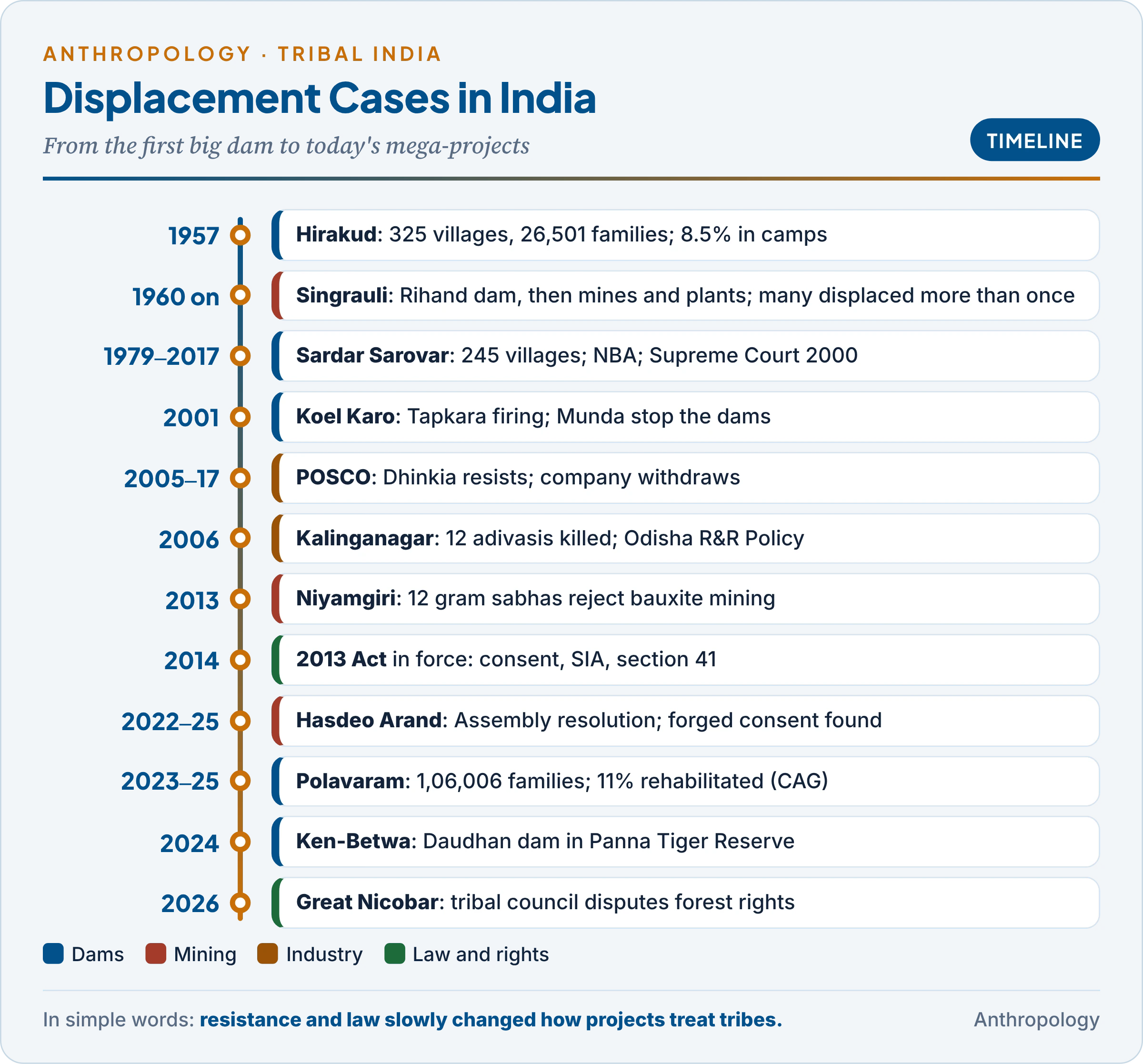
- Timeline of Indian cases: Hirakud 1957 to Great Nicobar 2026.
- Law from 1894 to 2013: three columns with consent, SIA, R&R and tribal safeguards.
Revision Grid
| Scholar | Work (year) | Key idea |
|---|---|---|
| Walter Fernandes | DP-PAP estimates (1998, 2007, 2023) | 60–70 million displaced since 1947; about 40% tribal |
| Michael Cernea | “The Risks and Reconstruction Model” (1997) | Eight impoverishment risks; resettlement as development |
| Scudder and Colson | Four-stage framework (1982) | Multidimensional stress; recruitment to incorporation |
| Amita Baviskar | In the Belly of the River (1995) | Bhilala of the Narmada valley; land, gods and resistance |
| Enakshi Ganguly Thukral (ed.) | Big Dams, Displaced People (1992) | Human costs of Indian dams |
| Hari Mohan Mathur | Displacement and Resettlement in India (2013) | Human cost of development |
| Padel and Das | Out of This Earth (2010) | Bauxite mining and the Kondh hills |
| Fürer-Haimendorf | Tribes of India: The Struggle for Survival (1982) | Self-reliant tribes made dependent |
| John Toye | Dilemmas of Development (1987) | Balancing gains and losses |
| Brundtland Commission | Our Common Future (1987) | Sustainable development |
Previous Year Questions
Developmental projects, tribal displacement and problems of rehabilitation
- 2026Make a critical appraisal of Niyamgiri movement against mining-induced displacement.
- 2023Critically examine how the displacement of tribal communities due to hydroelectric river dam projects has affected the women in local context. Illustrate with suitable ethnographic examples.
- 2021Explain the impact of successive Land Acquisition Acts on tribal social organization.
- 2021Discuss the problems involved in rehabilitation and resettlement of tribals displaced due to development projects in India.
- 2020Explain the impact of developmentinduced displacement among the tribal people in India with suitable examples.
- 2019What has been the impact of development projects on the environment and livelihood of forestdwelling tribes ?
- 2018Examine the advancement made in the land acquisition and rehabilitation Act of 2013 over the Land acquisition Act of 1894.
- 2012Critically examine the National Policy on Rehabilitation and Resettlement substantiating it with experiences from different parts of India.
- 2011Discuss the problem of displaced tribal communities with the help of recent examples.
- 2010Write a note in 150 words on Tribal displacement.
- 2007Illustrate, with suitable examples, the impact of development programmes on tribal and weaker sections.
- 2004Discuss the context, process and consequences of involuntary displacement among tribal communities in India and analyze the problems of rehabilitation.
- 2001Indicate the main thrust of anthropological studies on development induced displacement and rehabilitation. Suggest a worthwhile rehabilitation package for displaced tribals to retain their sense of community-belonging.
- 1999Discuss the problem of tribal displacement in India. To what extent, are development policies responsible for such displacement ? Also explain the role of NGOs in providing the remedial measures to the affected people.
- 1999Write a note on Sustainable development.
- 1988Write a note on Large scale development and distress in tribal regions.
- 1988Discuss the people’s response and participation in development programmes in tribal areas.
Related questions from other units
- 2020Unit 6.2: Elucidate the problems of land alienation among the tribals of India.
- 2018Unit 9.2: Examine the strengths and weaknesses of anthropology in the context of its role in tribal and rural development.
- 2017Unit 6.2: Describe the impact of displacement on the health and nutritional status of tribal communities.
- 2015Unit 9.2: Examine in detail the role of anthropology in planning for tribal development.
- 2015Unit 6.2: Discuss how constitutional provisions in India have built-in mechanisms for dealing with the problem of land alienation in tribal areas.
- 2014Unit 6.2: Discuss the impact of land alienation on the tribes of Central India.
- 2012Unit 8.2: Critically examine the relationship between tribal communities and the Nation-State on issues of governance.
More from Tribal Situation in India: all notes of this unit · every PYQ of this unit · Anthropology Optional hub