

Official syllabusPaper II · Unit 2 · Psychological Well Being and Mental Disorders
Factors influencing positive health, well being, life style and quality of life.
Definition
“Quality of life was defined … as individuals’ perception of their position in life in the context of the culture and value systems in which they live and in relation to their goals, expectations, standards and concerns. It is a broad ranging concept, incorporating in a complex way individuals’ physical health, psychological state, level of independence, social relationships, personal beliefs and their relationships to salient features of the environment.”
WHOQOL Group (1995)
Positive health, well-being and quality of life are outcomes; personality, relationships, daily habits, material conditions and surroundings are the factors that produce them, most of them changeable. Because the evidence is largely correlational, the applications — prevention, schools, workplaces, ageing — are where it is tested. The concepts are in Health, Ill-Health, Positive Health and Well-Being.
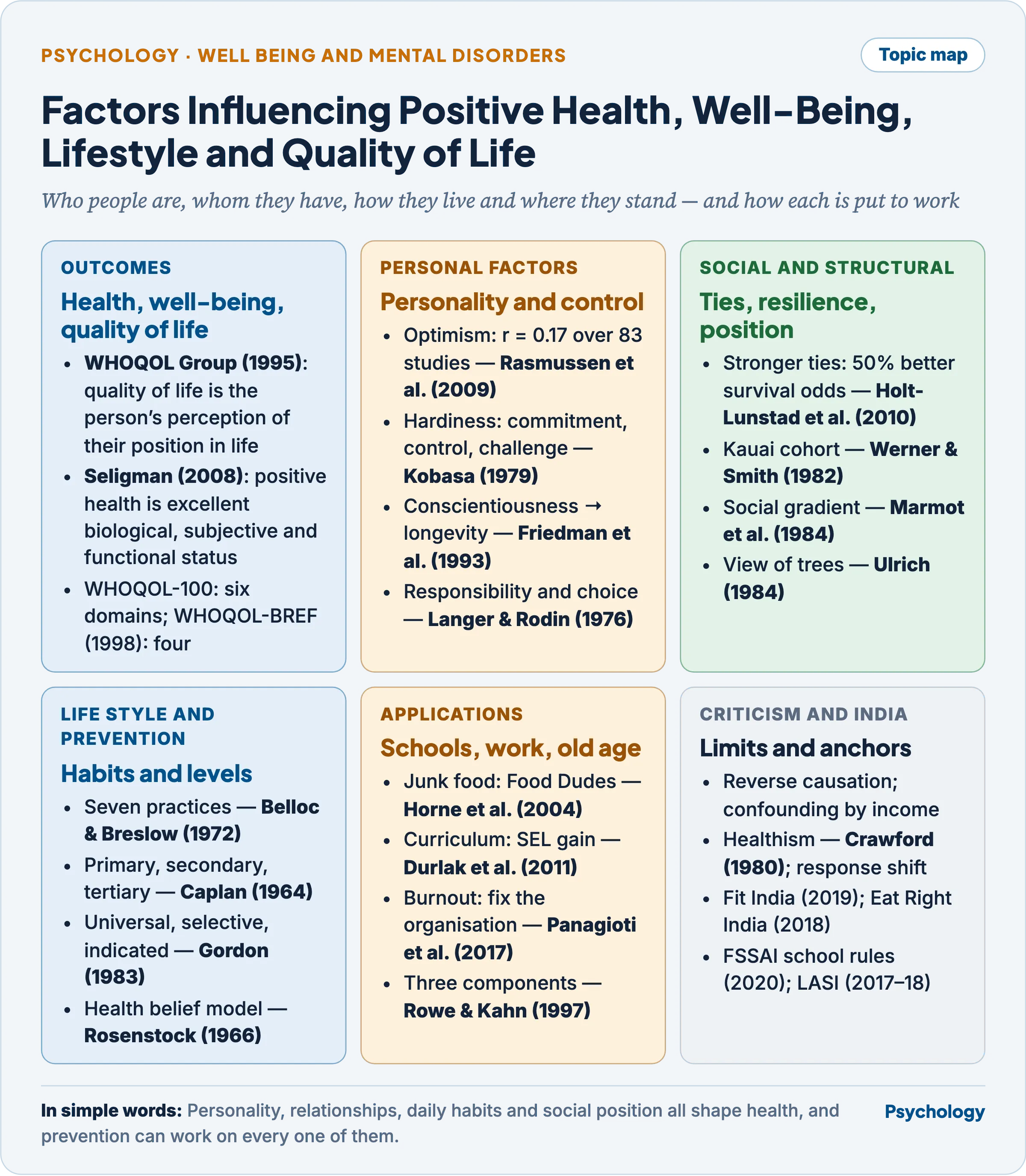
The top row names the factors and their evidence; the bottom row, where each is applied and where it falls short.
Factors influencing positive health and well-being
- Positive health, in Seligman’s (2008) sense, is excellent status on biological, subjective and functional measures, not merely the absence of disease. Its factors act at four levels: personality, relationships, habits and social position.
Personality: optimism, hardiness and conscientiousness
- Dispositional optimism is a generalised expectancy that good rather than bad outcomes will occur, measured by the Life Orientation Test (Scheier and Carver, 1985). Optimists favour problem-focused coping and persist with health behaviour.
- Rasmussen, Scheier and Greenhouse (2009) pooled 83 studies: a mean effect of 0.17 for optimism and physical health, 0.21 for subjective but 0.11 for objective outcomes.
- Kobasa (1979) studied executives of a public utility with comparably high life-event scores over three years: 86 stayed well, 75 fell ill.
- Those who stayed well scored higher on commitment, control and challenge, the three components of hardiness.
- Limitation: all-male, retrospective, and illness may have lowered hardiness rather than the reverse.
- Friedman and colleagues (1993) ran survival analyses on 1,178 members of Terman’s gifted-children cohort, begun in 1921.
- Childhood conscientiousness predicted longevity: a child at the 75th percentile carried 77 per cent of the yearly death risk of one at the 25th (Friedman and colleagues, 1993).
- Childhood cheerfulness predicted a shorter life, so optimism’s benefit does not generalise across the lifespan. Limitation: a bright, white sample.
Personal control and social support
- Langer and Rodin (1976) told residents of one nursing-home floor that their lives were their responsibility and gave them choices and a plant; a comparison floor heard that staff would care for them.
- Within three weeks the responsibility group was happier, more alert and active; at 18 months its death rate was 15 per cent against 30 (Rodin and Langer, 1977).
- Limitation: one home, floors rather than individuals assigned.
- Cohen and Wills (1985) separated a main effect, in which social integration benefits everyone, from a buffering effect, in which support protects only under stress.
- Holt-Lunstad, Smith and Layton (2010) meta-analysed 148 prospective studies of 308,849 people followed for 7.5 years on average.
- Stronger relationships gave 50 per cent higher odds of survival, 91 per cent for complex measures of integration — comparable with quitting smoking (Holt-Lunstad and colleagues, 2010).
- Limitation: observational; healthier people may keep more relationships.
Resilience, meaning and coping
- Resilience is positive adaptation despite significant adversity. Masten (2001) called it ordinary magic: it arises from common protective systems — attachment, cognitive ability, self-regulation — rather than rare traits.
- Werner and Smith (1982, 1992) followed all 698 children born on Kauai in 1955. About 30 per cent were high-risk — poverty, perinatal stress, discord — and one in three of these became competent, caring adults.
- Protective factors sat in the child (easy temperament, problem-solving, self-belief), the family (a bond with one stable caregiver) and the community (a teacher, elders, a faith group). Limitation: one island cohort.
- Purpose in life predicts lower mortality independently of mood (Hill and Turiano, 2014); coping is in Stress, Psychosomatic Disorders and Stress Management.
Socio-economic and environmental factors
- Marmot, Shipley and Rose (1984) followed 17,530 male Whitehall civil servants for ten years: the lowest grade had three times the mortality of administrators, only partly explained by smoking and other risk factors — the social gradient in health.
- Ulrich (1984): 23 surgical patients whose windows faced trees had shorter stays and took fewer strong analgesics than 23 matched patients facing a brick wall. Limitation: archival records, non-random rooms.
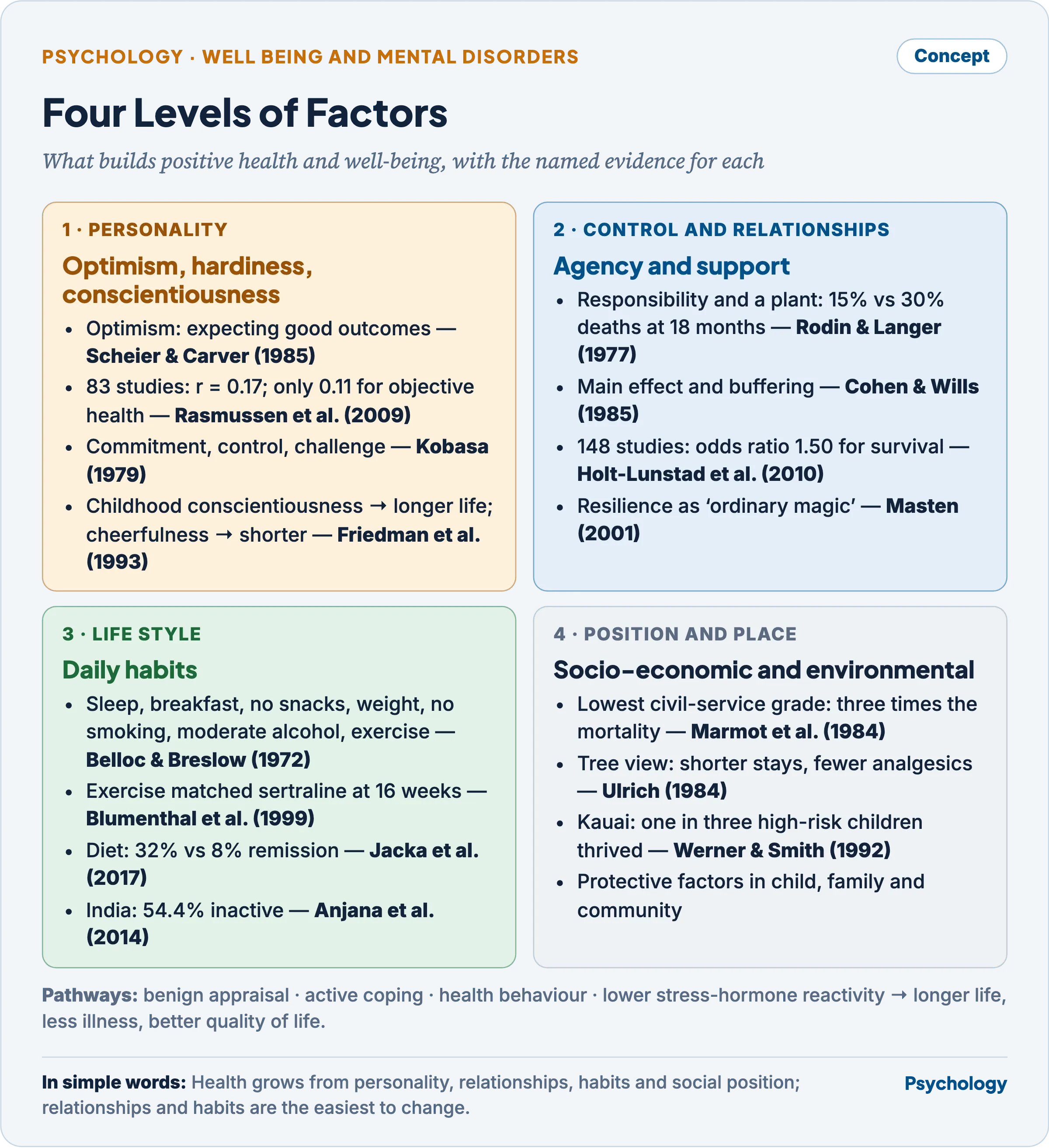
Personality changes slowly, relationships and habits readily, social position only through policy.
Life style and quality of life
- Life style is the habitual pattern of health behaviours. Belloc and Breslow (1972), surveying 6,928 Alameda County adults from 1965, identified seven practices: seven to eight hours’ sleep, breakfast, no snacking, desirable weight, no smoking, moderate alcohol, exercise.
- Physical health rose with the number of practices kept, and later disability was about half as common among those with good practices (Breslow and Breslow, 1993). Limitation: self-reported habits, partly confounded with income.
- The WHOQOL-100 scores six domains — physical, psychological, level of independence, social relationships, environment, and spirituality, religion and personal beliefs — across 24 facets (WHOQOL Group, 1995). The 26-item WHOQOL-BREF keeps four: physical, psychological, social and environmental (WHOQOL Group, 1998).
How life-style variables influence quality of life in different life domains
| Life-style variable | Domains it reaches | Mechanism | Evidence |
|---|---|---|---|
| Physical activity | Physical, psychological, independence | Fitness and mobility; mastery; mood | Blumenthal and colleagues (1999): 16 weeks of aerobic exercise matched sertraline in 156 depressed adults aged 50 and over |
| Diet | Physical, psychological | Weight and disease risk; mood | Jacka and colleagues (2017): dietary counselling, 32.3 per cent remission against 8.0 with social support, 67 depressed adults |
| Tobacco, alcohol, drugs | All, including social | Dependence narrows life to one reinforcer | Set out in Substance Abuse Disorders |
| Social and leisure engagement, nature | Social, environmental, spiritual | Belonging, meaning, restoration | Holt-Lunstad and colleagues (2010); Ulrich (1984) |
- Domains are linked, so habits spread: inactivity raises weight and pain (physical), which lowers mood (psychological), which shrinks social contact (social).
- Anjana and colleagues (2014), in the ICMR-INDIAB survey of 14,227 Indian adults, found 54.4 per cent inactive (65 urban, 50 rural) and over 88 per cent in every region without recreational activity.
Prevention against cure: the models and the role of quality of life
- Albee (1959) argued that the United States could never train enough clinicians to treat everyone in need. Caplan (1964): primary prevention lowers incidence before onset, secondary lowers prevalence by early detection, tertiary limits disability once a disorder exists.
- Gordon (1983), adopted for mental disorders by the Institute of Medicine (Mrazek and Haggerty, 1994), classifies by risk instead: universal, selective (high-risk groups) and indicated (individuals with early signs).
- The biopsychosocial model (Engel, 1977) traces illness to interacting biological, psychological and social causes, so prevention acts on all three at every level:
| Level | Biological action | Psychological action | Social action |
|---|---|---|---|
| Primary | Immunisation, nutrition, exercise, sleep | Life-skills and resilience training | Income security, sanitation, safe schools and workplaces |
| Secondary | Screening for hypertension, diabetes, cancers | Depression screening; brief intervention | Cheaper, less stigmatised help-seeking (Tele-MANAS) |
| Tertiary | Medication adherence, physiotherapy | Rehabilitation, relapse prevention | Supported employment, family care |
- The health belief model, consolidated by Rosenstock (1966), grew from the US Public Health Service’s 1950s puzzle over unused free tuberculosis screening.
- Action follows perceived susceptibility and perceived severity (together, threat), weighed as perceived benefits against perceived barriers and triggered by a cue to action; Rosenstock, Strecher and Becker (1988) added self-efficacy.
- Janz and Becker (1984) reviewed 46 studies: barriers were the most powerful dimension. Limitation: a rational-actor model that ignores habit, emotion and social norms.
- Quality of life is the goal of tertiary prevention where cure is unavailable and the outcome by which promotion is judged; building the strengths that sustain it buffers against disorder — positive prevention (Seligman, 2002).
- Limits: Rose’s (1981) prevention paradox — a measure that greatly benefits a population offers little to each individual, which depresses uptake — and the stigma of labelling people “at risk”.
- Verdict: mental health depends more on prevention, since the factors act before illness and treatment cannot reach everyone; cure remains necessary for the ill. See also Prevention and Rehabilitation of the Mentally Ill (Unit 3).
Enhancing psychological well-being
- Psychological well-being is essential to health because it predicts lower mortality in initially healthy people, independently of negative affect (Chida and Steptoe, 2008).
- Seligman, Steen, Park and Peterson (2005) randomly assigned 577 adult web visitors to five week-long exercises or a placebo (recalling early memories); 411 completed six months.
- Three good things and using signature strengths in a new way raised happiness and reduced depressive symptoms for six months; the gratitude visit gave large gains that faded within a month.
- Limitation: a self-selected, educated, mostly white sample.
- Sin and Lyubomirsky (2009) reported effects of r = .29 on well-being and .31 on depression; White, Uttl and Holder (2019), correcting for small-study bias, found about .10 for well-being and no reliable effect on depression.
- Other routes: exercise, social connection, purpose and mindfulness (Indigenous Therapies: Yoga and Meditation, Unit 3); well-being therapy is in Fostering Mental Health (Unit 3).
Changing children’s junk-food behaviour with psychological knowledge
- Analyse the behaviour. Record antecedents (advertising, snacks at the gate, peers, screens) and consequences (taste, social reward); target one behaviour, such as packaged snacks at break.
- Repeat exposure to healthy foods. Wardle, Herrera, Cooke and Gibson (2003) gave 49 children eight daily tastes of red pepper: liking and intake rose against controls; a sticker reward was intermediate and not significant.
- Peer modelling with reward. Horne and colleagues (2004) ran the Food Dudes programme with 749 children aged 5–11 in two London schools: 16 days of videos of heroic peers who enjoy fruit and vegetables, plus small rewards.
- At four months fruit eaten at lunch had risen from 36 to 61 per cent of that offered while the control school declined (Horne and colleagues, 2004).
- Limitation: Upton, Upton and Taylor (2013), with 2,433 children in 15 English schools, found gains at three months not sustained at twelve.
- Never reward with junk food, nor simply forbid it. Foods given as rewards become more preferred (Birch, Zimmerman and Hind, 1980); restricting a palatable food raised children’s selection and intake of it (Fisher and Birch, 1999).
- Re-design the setting. Choice architecture (Thaler and Sunstein, 2008) — fruit at eye level, water instead of soft drinks, smaller portions — removes cues without coercion.
- Involve parents and teachers as models, with home records of what is eaten.
- Build self-regulation in older children: advertising literacy, self-monitoring and goal-setting raise self-efficacy (Bandura, 1977); knowledge alone changes little.
- Evaluate consumption, not knowledge, at twelve months — where Food Dudes faded.
- FSSAI school regulations, 2020 — the Food Safety and Standards (Safe Food and Balanced Diets for Children in School) Regulations (notified 4 September 2020) bar selling or advertising foods high in fat, salt and sugar on campus and within 50 metres of the gate.
- Principle: stimulus control. Compliance began on 1 July 2021, but the sale ban and 50-metre rule awaited a commencement notice; Maharashtra ordered their enforcement in July 2026, which the Bombay High Court left standing (August 2026).
Designing a well-being curriculum for school children
- Seligman, Ernst, Gillham, Reivich and Linkins (2009): “Positive education is defined as education for both traditional skills and for happiness” — because youth depression is widespread and positive emotion aids learning.
- Durlak and colleagues (2011) meta-analysed 213 universal social and emotional learning programmes with 270,034 students: mean effects of 0.22–0.57 across six outcomes, 0.27 for achievement (11 percentile points), largest with all four SAFE practices — sequenced, active, focused, explicit.
- Brunwasser, Gillham and Kim (2009) pooled 17 evaluations of the Penn Resiliency Program (2,498 youths): fewer depressive symptoms up to twelve months (effect sizes 0.11–0.21), but no better than active controls.
- Kuyken and colleagues (2022), in the MYRIAD trial across 84 schools and 8,376 pupils, found ten mindfulness lessons no better than usual social-emotional teaching at one year.
- Focus: universal and whole-school; skills practised, not lectured; sequenced by age; culturally rooted; assessed without marks.
- Components:
- Emotional awareness and regulation — a short daily practice of breathing or mindful attention.
- Thinking skills — the Penn programme’s link between thoughts and feelings; problem-solving.
- Relationships — cooperation through the jigsaw classroom (Aronson and Patnoe, 1997); anti-bullying norms.
- Strengths and meaning — gratitude, kindness, service.
- Physical well-being — play, sleep and food, tied to Fit India School and Eat Right School.
- Teacher well-being and training, since teachers’ competence shapes classroom climate (Jennings and Greenberg, 2009).
- Parents, a counsellor, a referral route, and evaluation against comparison schools.
- Delhi Happiness Curriculum (Government of Delhi, 2 July 2018) — a daily 45-minute period, nursery to class VIII, in over 1,000 government schools: mindfulness, stories, activities and expression, without examinations. Principle: universal primary prevention through practised skills.
- With no Delhi control group, evidence comes from a randomised Tripura trial in 100 schools: maths rose 0.27 SD in two years; anxiety and depression barely changed (Carney and Moorthy, 2026, working paper).
- Discontinued in March 2025, it was replaced on 18 September 2025 by Science of Living (classes 1–12: yoga, meditation, emotional intelligence, digital detox).
- Value-education components are in Personality Development and Value Education (Unit 5).
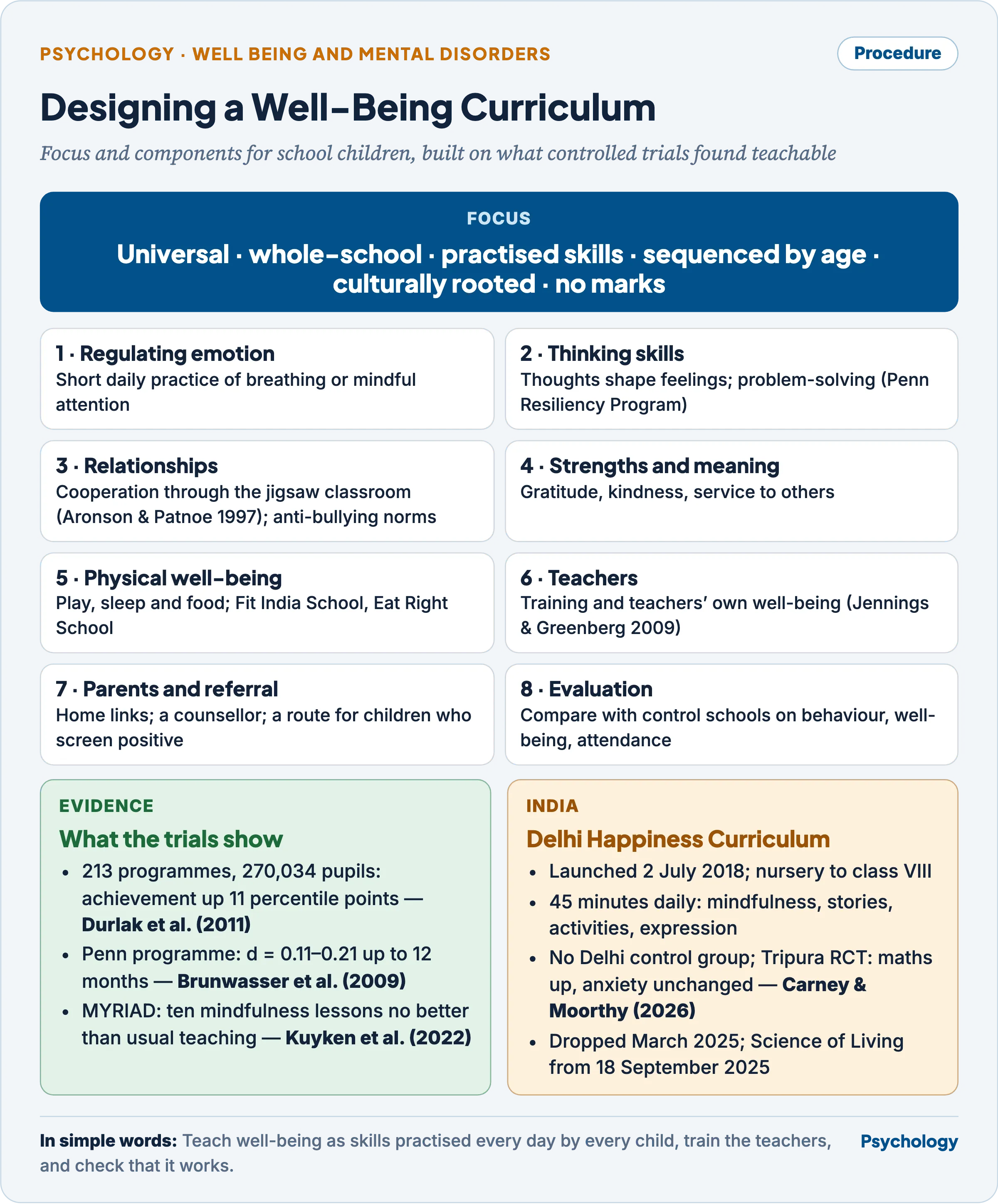
The components are the skills trials found teachable; MYRIAD warns against relying on one practice.
Promoting the well-being of service professionals
- Doctors, nurses, teachers and police perform emotional labour (Hochschild, 1983). Burnout — emotional exhaustion, depersonalisation, reduced accomplishment (Maslach and Jackson, 1981) — follows when demands outrun resources (Demerouti and colleagues, 2001), as set out in Occupational Stress and Its Management (Unit 4).
- Panagioti and colleagues (2017) pooled 19 studies of 1,550 physicians: interventions cut burnout modestly (standardised difference −0.29), organisation-directed ones (−0.45) more than individual ones (−0.18).
- Organisational measures: workload and duty-hour limits, staffing, autonomy, supervision and peer support, fairness and recognition.
- Individual measures: stress-management and cognitive skills, exercise and sleep, boundaries between work and home, and psychological capital — hope, efficacy, resilience, optimism (Luthans, Youssef and Avolio, 2007).
- NMC Task Force — the National Medical Commission’s National Task Force on Mental Health and Well-being of Medical Students (2024) surveyed 5,337 postgraduates: 45 per cent worked over 60 hours a week; 64 per cent said workload harmed their mental health.
- It recommended at most 74 hours a week with one day off, and Tele-MANAS access. Principle: resources must match demands.
Successful ageing
- Rowe and Kahn (1987) separated usual ageing, in which extrinsic factors such as diet, exercise and habits worsen ageing, from successful ageing, in which they are neutral or positive.
- Rowe and Kahn (1997) gave three components: low probability of disease and disease-related disability, high cognitive and physical functional capacity, and active engagement with life — relationships and productive activity.
- Baltes and Baltes (1990): selective optimisation with compensation — select fewer goals, optimise resources for them, compensate for losses. Older adults using these strategies reported higher well-being (Freund and Baltes, 1998).
- Vaillant and Mukamal (2001), following 237 Harvard and 332 inner-city men for 60 years, found seven controllable factors before 50 that predicted ageing well at 70–80: no smoking, mature coping, no alcohol abuse, healthy weight, stable marriage, exercise, education.
- Levy, Slade, Kunkel and Kasl (2002) followed 660 people aged 50 and over: those with positive self-perceptions of ageing, measured up to 23 years earlier, lived 7.5 years longer, partly through a stronger will to live.
- Strawbridge, Wallhagen and Cohen (2002): of 867 adults aged 65–99, 50.3 per cent rated themselves as ageing successfully but 18.8 per cent met Rowe and Kahn’s criteria; no one with a chronic condition qualified, yet self-ratings tracked well-being better.
- Hariprasad and colleagues (2013) block-randomised 120 residents of nine Bengaluru elderly homes to yoga or waitlist: over six months yoga improved memory, attention and executive function. Limitation: no active control, heavy dropout.
- Theories of ageing are in Ageing – Physical, Cognitive and Psychosocial Change (Paper I).
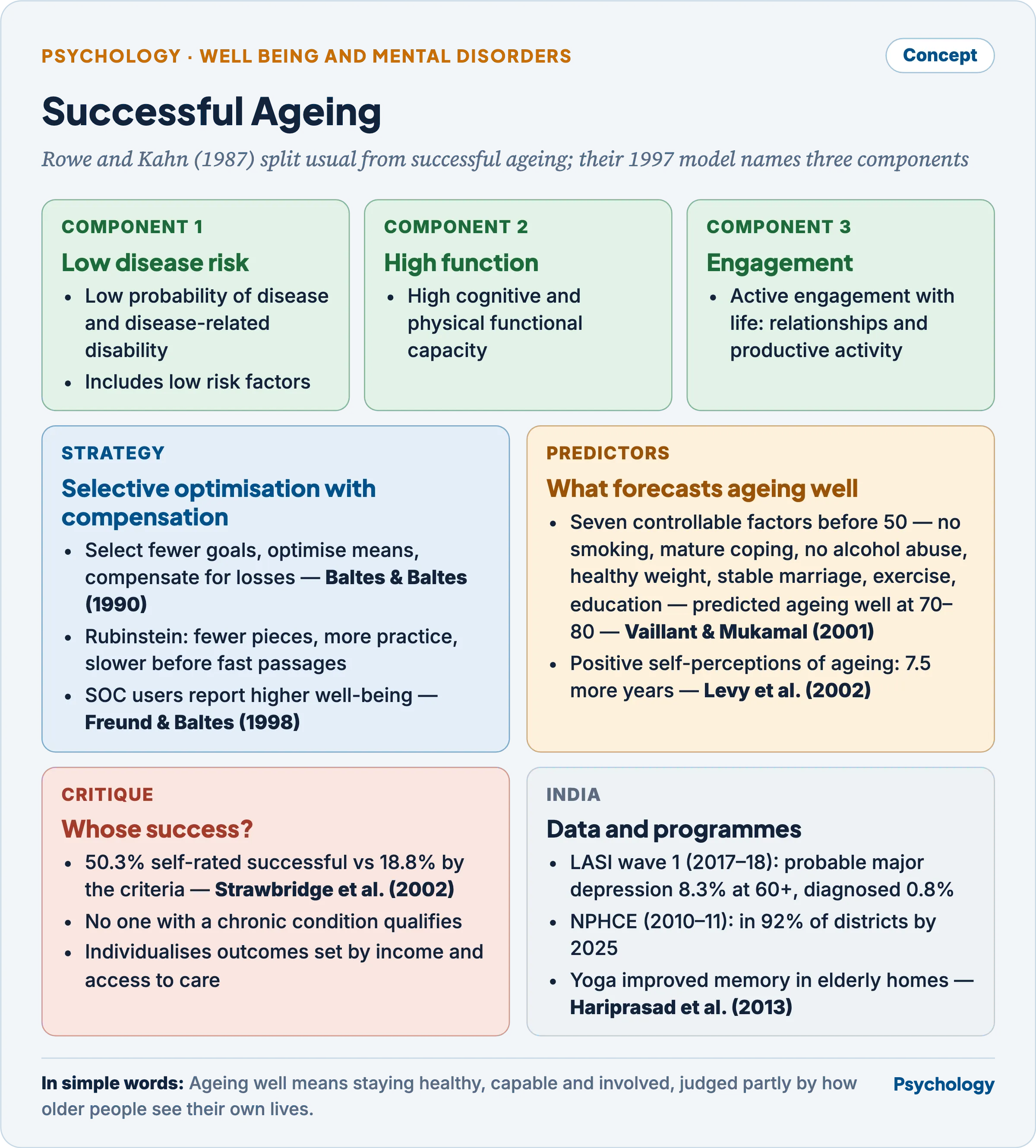
Objective criteria and older people’s own verdicts disagree sharply — the core of the critique.
Criticisms and limitations
- Reverse causation. Illness lowers optimism, activity and social contact; prospective designs shrink the optimism–health effect to 0.12 from 0.22 in cross-sectional ones, a non-significant gap (Rasmussen and colleagues, 2009).
- Confounding with social position. Personal factors partly stand in for income and status, whose gradient is steep (Marmot and colleagues, 1984).
- Healthism (Crawford, 1980). Framing health as individual choice blames people for illness that poverty and work produce.
- Measuring quality of life. It is self-rated, and response shift (Sprangers and Schwartz, 1999) — patients recalibrating their standards after illness — can hold scores level while health declines.
- Small intervention effects. Positive-psychology exercises shrink once small-study bias is corrected (White and colleagues, 2019); Held (2004) faulted the movement’s dismissal of negative emotion.
- Narrow samples. Executives, gifted children and web volunteers dominate; Indian prospective evidence is thin beyond the Longitudinal Ageing Study in India.
Indian context
- Fit India Movement (Ministry of Youth Affairs and Sports, 29 August 2019) — the daily target “Fitness Ka Dose Aadha Ghanta Roz” (2020) and Fit India School certification. Principle: a concrete goal plus social norms.
- Eat Right India (FSSAI, 10 July 2018) — its campaign Aaj Se Thoda Kam asks for gradually less salt, sugar and fat while nudging industry to reformulate. Principle: shaping through small steps.
- Ayushman Arogya Mandirs (Ministry of Health and Family Welfare; formerly health and wellness centres, 2018) — 1,86,298 centres with twelve service packages (June 2026) and 6.54 crore yoga and wellness sessions (November 2025). Principle: lowering perceived barriers.
- NPHCE — the National Programme for Health Care of the Elderly (Ministry of Health and Family Welfare, 2010–11): geriatric clinics, home visits and rehabilitation, now in 92 per cent of districts (PIB, October 2025). Principle: tertiary prevention aimed at independence.
- LASI — the Longitudinal Ageing Study in India, wave 1 (2017–18), covered 72,250 adults aged 45 and above and their spouses: probable major depression was 8.3 per cent among those 60 and above, but self-reported diagnosed depression 0.8 per cent (IIPS, 2020).
Previous Year Questions
- 2023Discuss the biopsychosocial model of health. Suggest relevant actions to prevent illness.
- 2019What is successful aging? What are the components of successful aging?
- 2019Why is psychological wellbeing considered as an essential factor of health? What are the different ways it can be enhanced?
- 2019There is a strong need for a wellbeing curriculum for children in schools. You are asked to develop such a curriculum. What would be the focus and essential components of such a curriculum?
- 2016How can psychological well-being of service professionals be promoted? Discuss.
- 2016How do lifestyle variables influence quality of life of an individual in different life domains?
- 2015How can psychological knowledge be put to use in changing the behaviour of children inclined to consume ‘junk food’?
- 2005What do you mean by positive health? Suggest some of the important factors responsible for positive health, well being, life style and quality of life.
- 2004Write a short note on: Factors influencing positive health and well-being.
- 2003Sustaining positive and effective mental health is more dependent on prevention than cure. Do you agree with this statement? Answer with the help of a relevant model and highlight the role of quality of life.