

Emergence of Nation State System

The emergence of the nation-state system is a foundational theme in UPSC History Optional (World History), explaining how the modern international order — built on sovereignty, territorial boundaries, and non-interference — replaced the multi-ethnic empires and feudal structures of pre-modern Europe. This article traces the origins of the Westphalian system, the evolution of the nation-state from the age of empires, the causes behind its emergence, and its lasting impact on nationalism and world history.
Background: The Peace of Westphalia
- Before the emergence of nation-states, the Feudal System prevailed. As this form of government was gradually phased out, nation-states emerged and took its place.
- After the Thirty Years’ War in Europe (1618–1648), the Peace of Westphalia was established in 1648.
- The treaty recognised the sovereignty of individual states and established the principle of non-interference in the domestic affairs of other states — a principle that came to be known as the Westphalian system.
- The Westphalian system established the nation-state as the dominant form of political organisation in Europe and provided the foundation for the modern international system.
- The balance of power that characterised this system depended, for its effectiveness, upon clearly defined, centrally controlled, independent entities — whether empires or nation-states — that recognised each other’s sovereignty and territory.
- The Westphalian system did not itself create the nation-state, but the nation-state meets the criteria required for its component states, assuming there is no disputed territory.
- Nation-states still exist today and are partially responsible for the way we view ourselves as citizens of our countries.
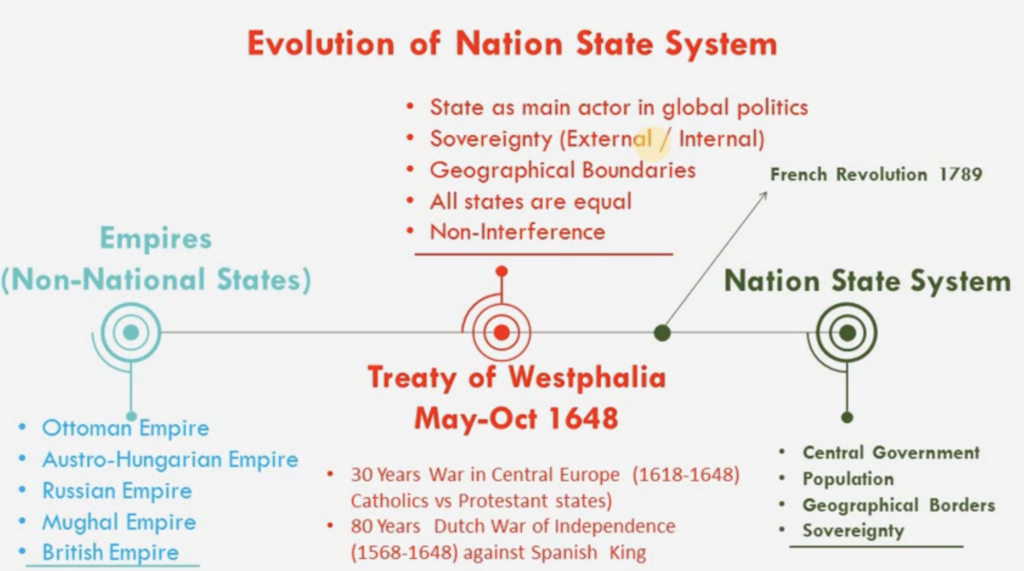
Evolution of the Nation-State System — Key Markers
- Empires (Non-National States): Ottoman Empire, Austro-Hungarian Empire, Russian Empire, Mughal Empire, British Empire, and others, organised without the defining features of a nation-state.
- Treaty of Westphalia (May–October 1648): Ended the Thirty Years’ War in Central Europe (Catholics vs Protestant states, 1618–1648) and the Eighty Years’ War for Dutch independence (1568–1648) against Spanish rule.
- Nation-State System — defining features: state as the main actor in global politics; sovereignty (external and internal); defined geographical boundaries; all states equal in status; and the principle of non-interference.
- French Revolution (1789) further advanced these ideas, reinforcing the nation-state model built around a central government, a defined population, geographical borders, and sovereignty.
Evolution of the Nation-State System
Before the Nation-State
- In 18th-century Europe, the classic non-national states were the multi-ethnic empires — the Austrian Empire, the Kingdom of France (and its empire), the Kingdom of Hungary, the Russian Empire, the Portuguese Empire, the Spanish Empire, the Ottoman Empire, the British Empire, the Dutch Empire, and smaller polities at what would now be called sub-state level.
- The multi-ethnic empire was typically an absolute monarchy ruled by a king, emperor, or sultan, with a population belonging to many ethnic groups speaking many languages.
- The empire was usually dominated by one ethnic group, whose language served as the language of public administration, and the ruling dynasty was usually — though not always — drawn from that group.
- This type of state was not exclusively European: similar empires existed across Asia, Africa, and the Americas.
- Chinese dynasties such as the Tang, Yuan, and Qing dynasties were all multi-ethnic regimes governed by a ruling ethnic group — the Han Chinese, Mongols, and Manchus, respectively.
- In the Muslim world, Caliphates were established immediately after the death of Muhammad in 632 — Islamic states under the leadership of a political-religious successor to the Prophet. These polities developed into multi-ethnic, trans-national empires.
- The Ottoman sultan Selim I (1512–1520) reclaimed the title of caliph, which had been disputed and asserted by various rulers and “shadow caliphs” during the centuries of the Abbasid-Mamluk Caliphate, following the Mongols’ sacking of Baghdad and the killing of the last Abbasid Caliph there in 1258.
- The Ottoman Caliphate, as an office of the Ottoman Empire, was abolished under Mustafa Kemal Atatürk in 1924 as part of Atatürk’s Reforms.
- The Holy Roman Empire was a limited elective monarchy composed of hundreds of state-like entities.
- The multi-ethnic empire was typically an absolute monarchy ruled by a king, emperor, or sultan, with a population belonging to many ethnic groups speaking many languages.
- Some smaller European states were less ethnically diverse but were nonetheless dynastic states ruled by a royal house, whose territory could expand through royal intermarriage or merge with another state when dynasties merged.
- In parts of Europe, notably Germany, minimal territorial units existed that were recognised by their neighbours as independent, each with its own government and laws.
- Some were ruled by princes or other hereditary rulers, others by bishops or abbots. Because these units were so small, however, they had no separate language or culture of their own — inhabitants shared the language of the surrounding region.
- Several of these states were overthrown by nationalist uprisings in the 19th century.
- Liberal ideas of free trade played a role in German unification, which was preceded by a customs union, the Zollverein; however, the Austro-Prussian War and German alliances in the Franco-Prussian War proved decisive in achieving unification.
- The Austro-Hungarian Empire and the Ottoman Empire broke up after the First World War, and the Russian Empire became the Soviet Union after the Russian Civil War.
- A few smaller states survived, including the independent principalities of Liechtenstein, Andorra, Monaco, and the Republic of San Marino.
- Vatican City is a special case: all of the larger Papal States, apart from the Vatican itself, were occupied and absorbed by Italy by 1870. The resulting Roman Question was resolved with the rise of the modern state under the 1929 Lateran Treaties between Italy and the Holy See.
Causes of the Emergence of Nation-States
- Two significant contributors to the emergence of the nation-state were the Thirty Years’ War and the Peace of Westphalia.
- The Thirty Years’ War began in 1618 and ended in 1648, making it the bloodiest war in world history until World War I.
- Historians remain unsure of the exact death toll, but estimates range between eight and twelve million, with deaths resulting not only from combat but also from famine and plague.
- The war originated in religious conflict: the Holy Roman Emperor decreed that everyone within the empire must be Catholic, even though the northern territories had been permitted to practise their own religion since 1555, under the Peace of Augsburg.
- These northern territories were Protestant and refused to convert to Catholicism, and it was this new imperial decree that sparked the Thirty Years’ War.
- The war began over religion but soon merged into a broader political dispute, as kingdoms sought to prevent rivals from gaining more power than themselves — leading traditionally Catholic kingdoms to join forces with Protestants, and vice versa.
- The war was finally settled through the Peace of Westphalia (1648), a name that comprises a series of treaties.
According to These Treaties
- Every kingdom in attendance stood in equal standing with the others.
- No kingdom, during the negotiations, was treated as more or less important than any other.
- Each country was recognised as independent of the others, meaning that it was not ruled by any other kingdom, but governed itself.
- Lastly, the sovereign of a kingdom could choose the religion of their kingdom, and other kingdoms could not interfere in that choice.
- Here we see the emergence of the very concepts required for a nation-state to function: kingdoms that were equal and independent, each entitled to govern as it saw fit without interference from others, with no country permitted to interfere in how another sovereign ruled.
Impact of the Emergence of the Nation-State
- Nation-states changed the course of human history. Borders were established, and people living within a nation came to share a sense of kinship — a development that led to the rise of nationalism.
- Nationalism is a concept in which individuals identify with and support their country, while excluding those who do not fit the accepted idea of what a citizen of that country should be.
- Nation-states and nationalism are considered partial causes of the World Wars.
- The way we understand our own citizenship today derives directly from the modern model of the nation-state.





 Geography Optional 300+ Score Pack with PYQ Solutions | UPSC Mains 2027
It really helped me alot, Thank you so much🥰
helpful