

Definition and concept of personality.
Official Syllabus: Paper I · Unit 11 Personality
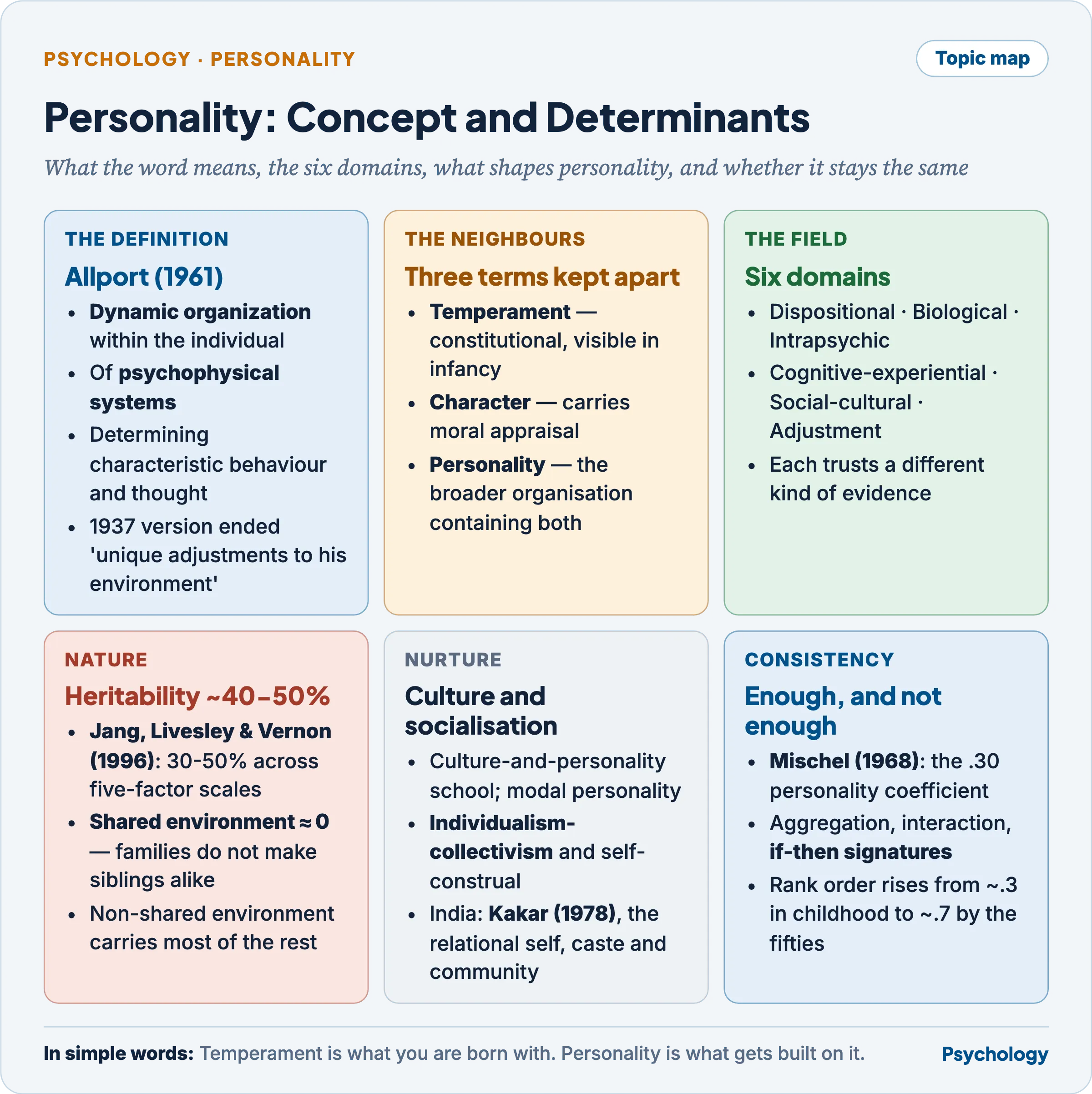
“Personality is the dynamic organization within the individual of those psychophysical systems that determine his characteristic behaviour and thought.”
— Allport (1961)
The word descends from persona, the mask worn by an actor on the Roman stage — which already contains the field’s central ambiguity. Is personality the mask, the impression a person makes on others? Or is it what lies behind the mask, the organisation that produces the impression? Every definition since has had to choose, and most of the discipline’s disagreements can be traced to that choice.
What personality means
- Allport’s definition above is the one the field converged on, and each phrase in it is doing work.
- Dynamic — personality is active and changing, not a fixed inventory of attributes.
- Organization — it is a structured system, not a list of traits lying side by side.
- Within the individual — it is located inside the person, which is a deliberate rejection of the mask reading.
- Psychophysical systems — it is neither purely mental nor purely bodily; habits, traits, emotions and the nervous system are all in it.
- Determine — the systems cause behaviour rather than merely accompanying it.
- Characteristic behaviour and thought — the criterion is what is typical of the person. Allport’s 1937 version ended instead with “unique adjustments to his environment”; the 1961 revision widened it to thought as well as behaviour, and dropped the word unique.
- The other standard definitions diverge on what they will admit.
- Eysenck (1947) defined it as the more or less stable and enduring organisation of a person’s character, temperament, intellect and physique, determining their unique adjustment to the environment — notably including intellect and physique, which most definitions leave out.
- Cattell defined it operationally and without apology: personality is what permits a prediction of what a person will do in a given situation. The definition is circular as theory and exact as a research programme, which is characteristic of him.
- Mischel defined it as the distinctive patterns of behaviour, thought and emotion that characterise a person’s adaptation to life — a formulation that pointedly includes the situation the adaptation is to.
- Three neighbouring terms are routinely confused, and keeping them apart is the quickest test of whether a definition is being used carefully.
- Temperament is the constitutional, biologically based component — reactivity and self-regulation — visible in infancy before learning could have shaped it, and relatively stable thereafter.
- Character carries an evaluative sense that personality does not. To describe someone’s character is to appraise them morally; to describe their personality is not. The older European usage treated character as personality judged against a standard.
- Personality is the broader organisation that includes temperament and character along with learned habits, attitudes, motives and self-concept.
The six domains, and the questions that divide them
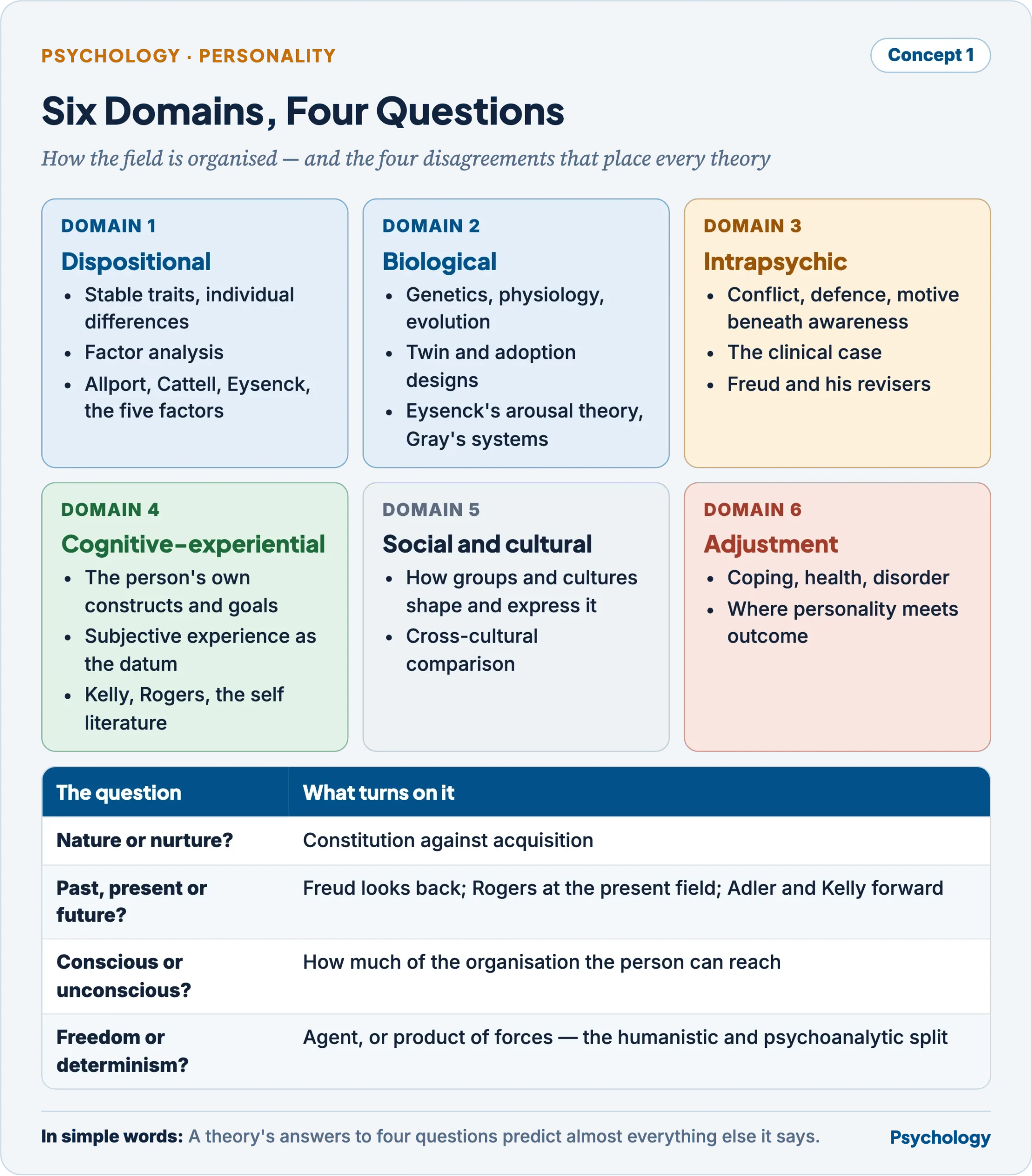
- The field is organised less by agreement than by which domain of evidence a theorist trusts. Six are conventionally distinguished, and each supplies one family of theories.
- Dispositional — the study of stable traits and individual differences, measured by factor analysis. Allport, Cattell, Eysenck, the five-factor tradition.
- Biological — genetics, physiology, evolution. Behaviour genetics, Eysenck’s arousal theory, Gray’s systems, evolutionary accounts.
- Intrapsychic — the dynamics beneath awareness: conflict, defence, motive. Freud and those who followed and revised him.
- Cognitive-experiential — the person’s own constructs, goals and subjective experience. Kelly, Rogers, the self literature.
- Social and cultural — how personality is shaped by, and expressed differently in, social groups and cultures.
- Adjustment — how personality bears on coping, health and disorder.
- Four questions cut across all six, and a theory’s answers predict most of its other commitments.
- Nature or nurture — is personality constitutional or acquired?
- Past, present or future — is behaviour explained by what has happened, what is happening, or what the person is aiming at? Freud looks back, Lewin and Rogers look at the present field, Adler and Kelly look forward.
- Conscious or unconscious — how much of the organisation is available to the person?
- Freedom or determinism — is the person an agent or the product of forces? Humanistic theories answer one way, psychoanalytic and behavioural theories the other.
- The unique and the general is the methodological version of the same split. Allport distinguished the idiographic study of the individual case from the nomothetic search for general laws, and held that personality psychology needed both — a position the discipline has mostly honoured in the breach, since its methods are overwhelmingly nomothetic.
The biological determinants
- Behaviour genetics supplies the numbers, and the designs are what make them interpretable. Twin designs compare identical and fraternal pairs; adoption designs separate the parents who supplied the genes from those who supplied the rearing; twins reared apart combine both.
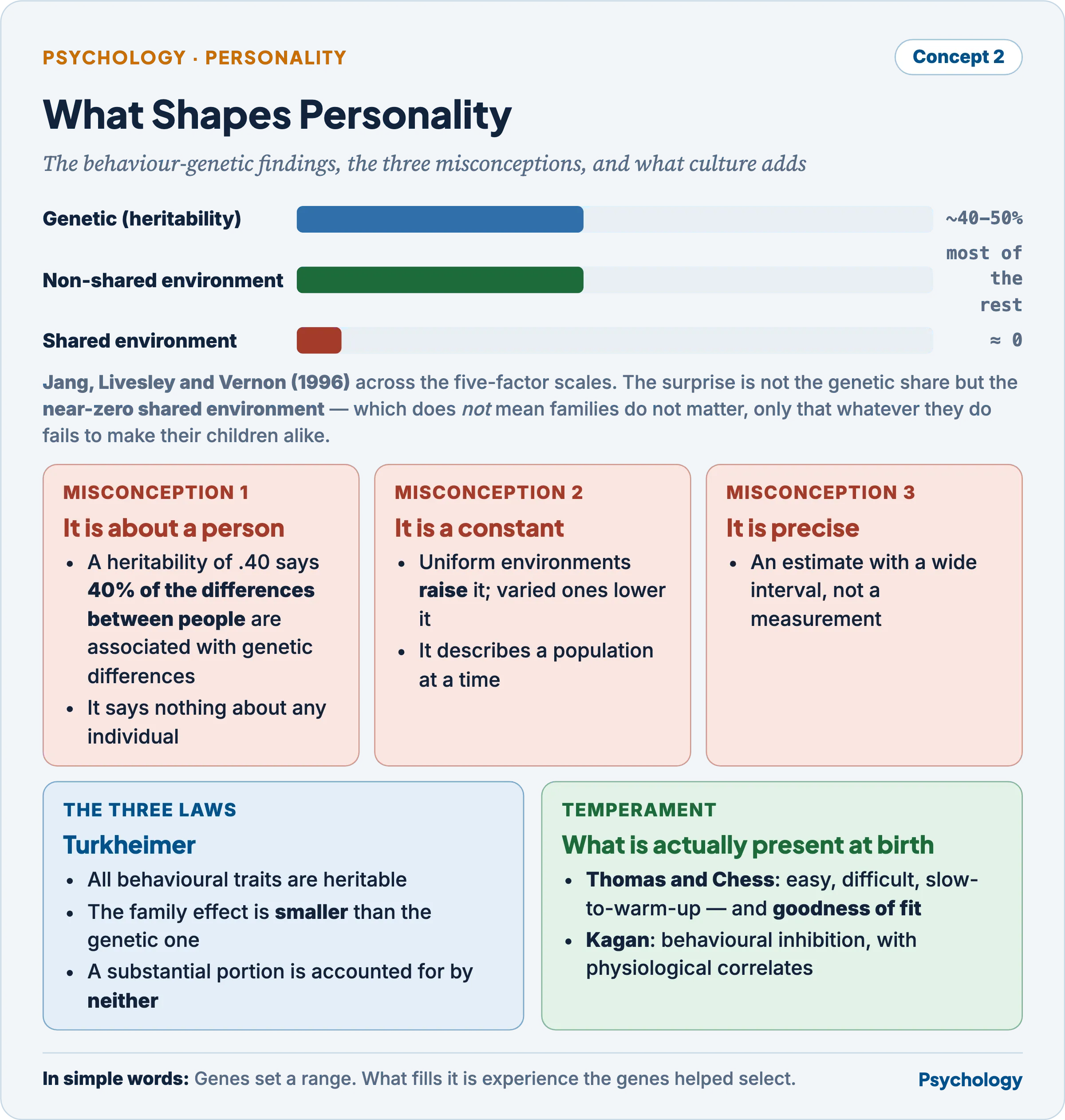
- The modal finding is a heritability of roughly 40 to 50 per cent for the broad personality dimensions. Jang, Livesley and Vernon (1996), using a standard five-factor inventory on a twin sample, found genetic effects accounting for about 30 to 50 per cent of the variance across the scales.
- The surprising finding is not the genetic one. In the same study, and in most others, shared environment — everything siblings raised together have in common — accounted for a negligible share, while non-shared environment carried most of the environmental variance. On personality measures, adopted siblings reared in the same home resemble each other little more than strangers do.
- This is not the finding it is often reported as. It does not show that families do not matter. It shows that whatever families do, it does not make the children in them alike — because siblings experience the same family differently, by birth order, by temperament, by the parents’ changing circumstances, and by the different peer worlds they enter.
- And it is not universal. Some twin studies, particularly outside the English-speaking samples, report a substantial shared-environment component, so “shared environment is zero” is the modal result rather than a law.
- Three misconceptions about heritability, each of them common:
- Heritability is a property of a population, not of a person. A heritability of .40 — taking the figure from Jang, Livesley and Vernon (1996) as the illustration — does not mean that 40 per cent of any individual’s extraversion is genetic. It means that 40 per cent of the differences between people in that sample are associated with genetic differences.
- It is not constant across environments. Where environments are uniform, heritability rises because there is little environmental variance left to detect; where they vary widely, it falls. The statistic describes a population at a time.
- It is an estimate, not a measurement, with a confidence interval that is usually wide.
- Turkheimer’s three laws summarise the field’s settled findings: all human behavioural traits are heritable; the effect of being raised in the same family is smaller than the effect of genes; and a substantial portion of the variation is accounted for by neither genes nor families. The third law is the one that keeps the field honest — most of the variance remains unexplained.
- Temperament is the developmental evidence for a constitutional component. Thomas and Chess, following infants longitudinally, identified easy, difficult and slow-to-warm-up patterns from nine behavioural dimensions, and argued that outcomes depend on the goodness of fit between the child’s temperament and the environment’s demands rather than on temperament alone. Kagan’s work on behavioural inhibition found a small proportion of infants reacting with high distress to novelty, a pattern with identifiable physiological correlates and considerable stability into childhood.
- Physiological theories propose the mechanism. Eysenck located extraversion in cortical arousal mediated by the ascending reticular activating system — introverts chronically more aroused and therefore avoiding stimulation, extraverts under-aroused and seeking it — and neuroticism in limbic reactivity. Gray reorganised the same space around a behavioural inhibition system sensitive to punishment and a behavioural activation system sensitive to reward, which maps better onto the anxiety and impulsivity dimensions than Eysenck’s rotation does. Cloninger proposed dimensions tied to specific neurotransmitter systems.
- Evolutionary accounts ask why variation persists at all. If one personality profile were optimal, selection should have fixed it; the persistence of variation suggests frequency-dependent advantages, in which a strategy pays precisely when few others use it, and trade-offs, in which high standing on a trait is advantageous in some environments and costly in others.
The socio-cultural determinants
- The culture-and-personality school made the first systematic case. Benedict argued that cultures select and amplify a narrow band from the arc of possible human temperaments, producing recognisable configurations; Mead’s comparative work on adolescence and on sex roles was used to argue that patterns treated as biologically inevitable varied across societies. Both have been criticised for over-reading limited fieldwork, but the structural claim — that culture shapes the content and expression of personality — survived the critique.
- The modal personality concept replaced the looser idea of national character: rather than claiming all members of a society share a type, it describes the most frequently occurring configuration, which leaves room for the full distribution.
- Individualism and collectivism is the dimension that organised the modern literature. In individualist settings the self is construed as independent, bounded and defined by internal attributes; in collectivist settings as interdependent, defined by relationships and obligations. The consequences run deep: what counts as consistency, whether behaviour is attributed to disposition or situation, and whether a stable cross-situational trait is even the expected unit of description.
- Socialisation is the mechanism, operating through identifiable agents — the family first, then peers, school, workplace, religion and media. Child-rearing practices differ systematically across cultures in ways that plausibly bear on personality: how long and how indulgently infants are held and fed, how early and how firmly autonomy is demanded, whether obedience or self-direction is the valued outcome.
- The peer group may matter more than the family, on the group-socialisation argument: since shared environment contributes little to adult personality, and since children learn to behave in the setting they expect to live in, the socialising force may be the peer group rather than the parents. The argument is contested and is a legitimate reading of the behaviour-genetic data rather than a settled finding.
The Indian evidence
- The Indian material is strongest where it is psychoanalytic and ethnographic, not psychometric. Sudhir Kakar’s The Inner World (1978) is the foundational work: a psychoanalytic study of childhood and society in India arguing that the prolonged and indulgent infancy characteristic of the extended household, followed by a comparatively abrupt demand for conformity in the second childhood, shapes a distinctive configuration of the self — and that the maternal-feminine has a weight in the Indian male psyche that Western psychoanalytic theory, built on the paternal, does not anticipate. The work is contested for generalising from clinical cases, and it remains the point of departure for the field.
- The self is relational rather than bounded in the Indian case, on the account that has dominated Indian psychology since. The person is constituted by their position in a web of obligations — family, jati, stage of life — so the stable, context-independent trait is not the natural unit of description. D. Sinha and others developed this into a sustained argument for indigenisation, on the ground that imported instruments measure a construct the culture does not organise itself around.
- Work on Indian organisational behaviour gave the argument an empirical form. J. B. P. Sinha’s nurturant-task leader was proposed as the effective Indian style — a leader who is directive about the task while being personally caring towards subordinates, and who moves towards participative management as subordinates mature. It was offered explicitly as a corrective to importing Western leadership typologies.
- The classical Indian account is the doctrine of the three gunas — sattva, rajas and tamas — which classifies persons by the proportions in which the three qualities combine. It is a genuine personality typology with its own measurement literature in modern Indian psychology, and it is treated separately with the Indian approach.
- The honest caveat. The Indian determinants literature is richer in theory than in large-sample empirical work, and much of what circulates as “Indian studies” is small, old or unreplicated. The defensible claims are the structural ones — relational self-construal, the family as the primary socialising unit well into adulthood, the salience of caste and community in identity — rather than specific coefficients.
Is personality consistent?
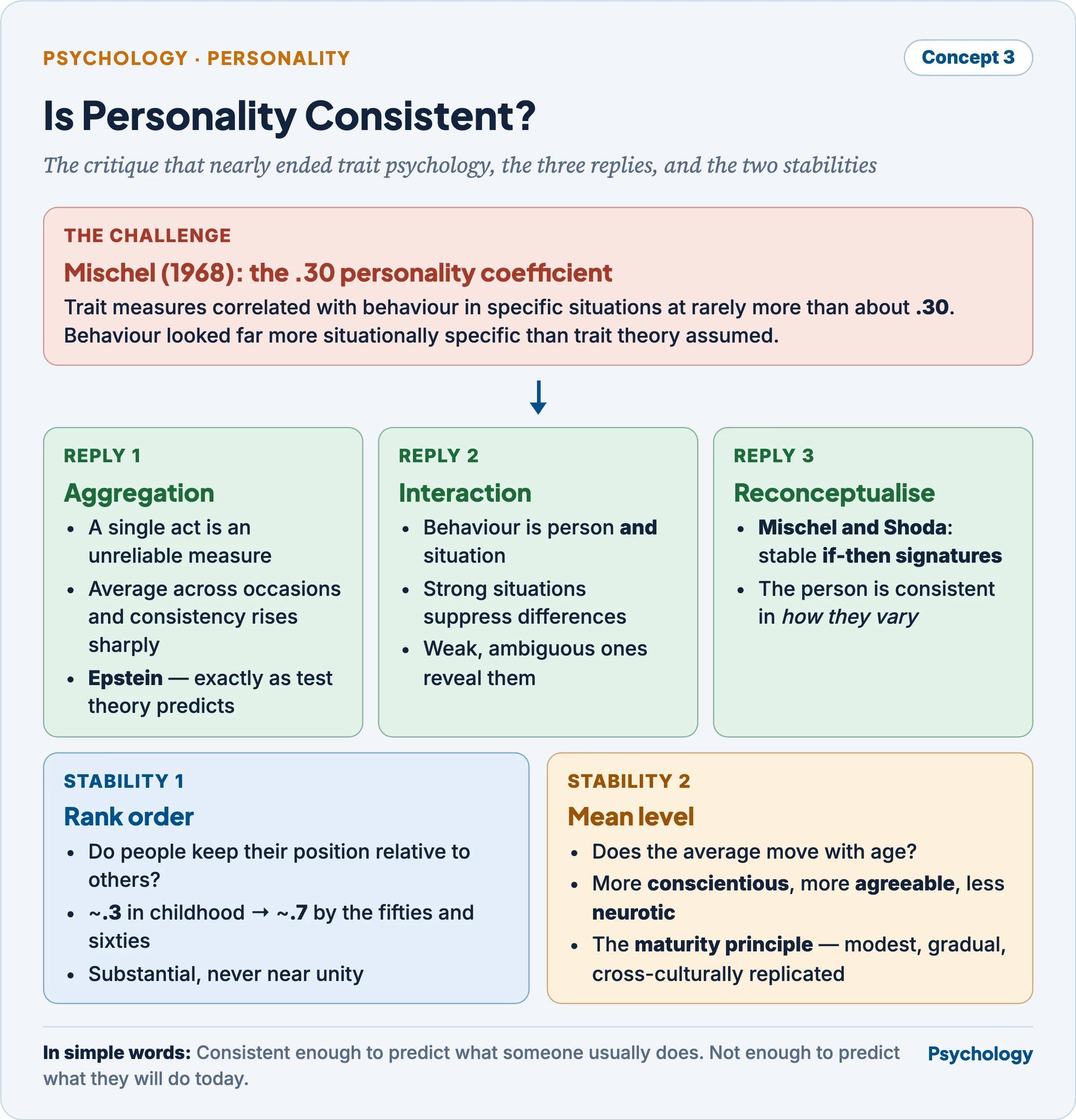
- The challenge was Mischel’s (1968), in Personality and Assessment, and it nearly ended the trait tradition. Reviewing the evidence, he found correlations between a trait measure and behaviour in a specific situation rarely exceeding about .30 — the so-called personality coefficient — and argued that behaviour is far more situationally specific than trait theory assumes.
- Three replies met it, and together they resolved the debate.
- Aggregation. A single act is an unreliable measure of anything. Epstein showed that averaging behaviour across many occasions produces consistency coefficients far higher than .30, exactly as classical test theory predicts. A trait predicts the aggregate, not the single instance — and the single instance was what Mischel’s studies measured.
- Interaction. Behaviour is a function of person and situation together, so the variance attributable to each separately understates the structure. Strong situations suppress individual differences; weak, ambiguous situations allow them to appear.
- Reconceptualisation. Mischel and Shoda later proposed that the consistency is real but lies in a different place: in stable if-then signatures — this person behaves this way in that class of situation — rather than in context-free averages. On this account the person is consistent precisely in how they vary.
- Two kinds of stability must be separated, and conflating them is the usual source of confusion. Rank-order stability asks whether people hold their position relative to others; mean-level change asks whether the average moves with age. Both are real, and they are compatible.
- Rank-order consistency rises steadily with age. Meta-analytic work puts it around .3 in childhood, rising through adolescence and early adulthood to around .7 by the fifties and sixties — substantial, but never approaching unity at any age.
- Mean levels change in a patterned way. Through early and middle adulthood people become on average more conscientious, more agreeable and less neurotic — the maturity principle. The change is modest, gradual and widely replicated across cultures.
- So the answer is neither yes nor no. Personality is consistent enough to predict aggregated behaviour and to persist in rank order across decades, and not consistent enough to predict what a particular person will do on a particular occasion. The question’s premise — that consistency is a single property the trait either has or lacks — is what the debate dissolved.
Are we born with personality, or is it all in our genes?
- The honest answer begins with the number. If heritability is around .40 to .50, then roughly half the variance is not genetic — so the strong claim is false on its own evidence. The claim is also self-undermining in a subtler way: because heritability depends on the range of environments sampled, a finding of high heritability in a uniform population is partly a statement about the uniformity of the environments, not about the power of genes.
- Genes and environment are not separable contributions. Gene-environment correlation means genotypes help select, evoke and construct the environments a person meets — an active child elicits different parenting and chooses different peers. Gene-environment interaction means the same environment acts differently on different genotypes. Where both operate, apportioning variance between them answers a question that has no environment-free answer.
- What we are born with is temperament, not personality. Reactivity and regulation are present and measurable in infancy; the traits, motives, defences, constructs and self-concept that make up personality are built on that base through development. The constitutional component is real, early and limiting — and it is a starting condition, not an outcome.
- The theories answer differently, and the differences are the substance.
- Trait and biological accounts give the largest role to constitution, and Eysenck explicitly grounded his dimensions in inherited nervous-system properties.
- Psychoanalytic accounts make personality the residue of early experience — the handling of drives in the first years — so the formative material is environmental but is laid down so early that it can look constitutional.
- Behavioural and social-cognitive accounts treat personality as learned, through conditioning, observation and the reciprocal influence of person, behaviour and environment.
- Humanistic accounts refuse the question’s framing: what matters is neither genes nor history but the person’s present capacity to choose and to actualise, and a determinism of either kind is what they exist to deny.
- Socio-cultural accounts locate the determinant outside the individual altogether, in the practices and categories of the community.
- The defensible position, which is what the evidence supports, is interactionist: a constitutionally given temperamental range, shaped by experience that is itself partly selected by that temperament, expressed through a culture that decides which configurations are recognised and valued.
Criticisms and limitations
- No definition commands agreement, and the operational definitions in use are circular — personality is what personality tests measure, in the same way intelligence has been said to be what intelligence tests test.
- The heritability statistic is routinely over-read, as a property of individuals, as a constant, and as a measure of how much genes “matter” rather than of variance in one population.
- The non-shared environment remains a black box. It carries most of the environmental variance and no programme has succeeded in identifying what is in it; some of it is probably measurement error and some of it chance.
- The culture-and-personality tradition over-generalised from thin ethnography, and the national-character literature that followed it was used to support stereotypes.
- The consistency debate was partly an artefact of method — single-occasion measures against aggregated ones — which should caution against treating any such controversy as settled before the measurement question has been examined.
- Western instruments carry Western assumptions, including the assumption that a context-independent trait is the natural unit, which is precisely what relational self-construal denies.
- The field is long on theory and short on decisive evidence, because the competing accounts rarely make incompatible predictions that a study could adjudicate.
Previous Year Questions
- 2025“Personality is all in our genes.” Evaluate the statement in the context of different personality theories.
- 2024Describe the biological and socio-cultural determinants of personality. Illustrate your answer with the help of Indian studies.
- 2021Are we born with personality? Critically evaluate with theoretical interpretation.
- 2005What is personality? Discuss Freudian approach to personality.
- 2003Is personality consistent? Give your answer with the support of relevant studies.