

Factors influencing attention including set and characteristics of stimulus.
Official Syllabus: Paper I · Unit 5 Sensation, Attention and Perception
“The taking possession by the mind, in clear and vivid form, of one out of what seem several simultaneously possible objects or trains of thought.”
— William James (1890), in The Principles of Psychology
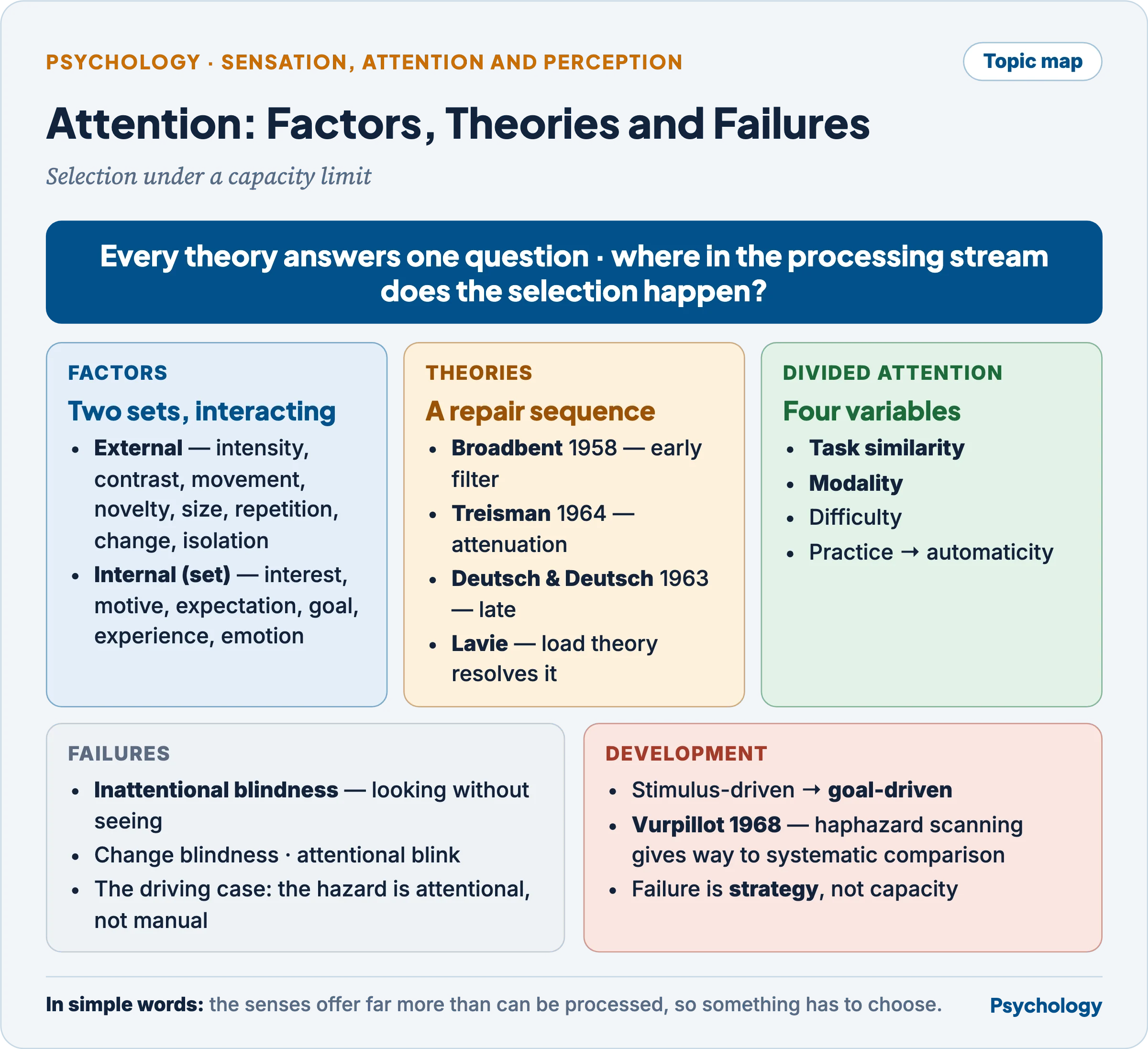
James added that attention “implies withdrawal from some things in order to deal effectively with others”, and that second clause is the whole subject. Attention is selection under a capacity limit: the senses deliver vastly more than can be processed, so something must be let through and the rest set aside. Every theory below is an answer to one question — where in the processing stream does the selection happen?
What attention is, and how it differs from perception
Attention is the process of selectively concentrating on one aspect of the environment while ignoring others. Perception is the organisation and interpretation of sensory input into a meaningful experience. The two are continuous in practice and distinct in function, and the contrast is worth setting out precisely.
| Attention | Perception | |
|---|---|---|
| Function | Selects what will be processed | Interprets what has been selected |
| Position | Earlier — a gatekeeper | Later — a meaning-maker |
| Capacity | Severely limited; its limits define it | Far less limited once input is admitted |
| Output | No content of its own | A percept — an organised, meaningful experience |
| Control | Can be voluntary and directed | Largely automatic and not open to will |
| Failure | Inattentional blindness — looking without seeing | Illusion — seeing wrongly |
The relation is best stated as a dependence rather than a sequence: attention determines what is perceived, and perception determines what is worth attending to next. A stimulus that is never attended is typically never perceived, which is what inattentional blindness demonstrates; but the system’s decision about where to look next is driven by partial perceptual analysis of what is currently unattended, which is why your own name reaches you across a noisy room.
The useful formulation is that attention is the bottleneck and perception is what happens on the far side of it — with the qualification, established by the theories below, that some analysis of the unattended material must occur before the bottleneck, or the bottleneck could not know what to select.
Characteristics of attention
- Span — the number of discrete items that can be apprehended in a single brief exposure, classically about five to nine.
- Shifting — attention is never stationary. What was margin becomes focus and the reverse, continuously.
- Fluctuation — even when held on one object, attention oscillates in small cycles, which is why a faint continuous tone seems to come and go.
- Division — attention can be split across two or more tasks, with costs set out below.
- Distraction — a stronger competing stimulus draws attention away involuntarily.
- Focus and margin — at any moment one object is clearly attended, with the rest dimly registered at the periphery of awareness. This pair of terms does most of the descriptive work in the topic.
The classical typology divides attention into voluntary (effortful, goal-directed — attending to a dull lecture), involuntary (captured by stimulus strength — a sudden crash), and habitual (automatic through practice and interest — a musician noticing a wrong note). The modern functional typology cuts differently: selective attention (focusing on one source among many), divided attention (two tasks at once), sustained attention or vigilance (holding attention over time), and executive attention (resolving conflict and controlling the other three).
Factors influencing attention
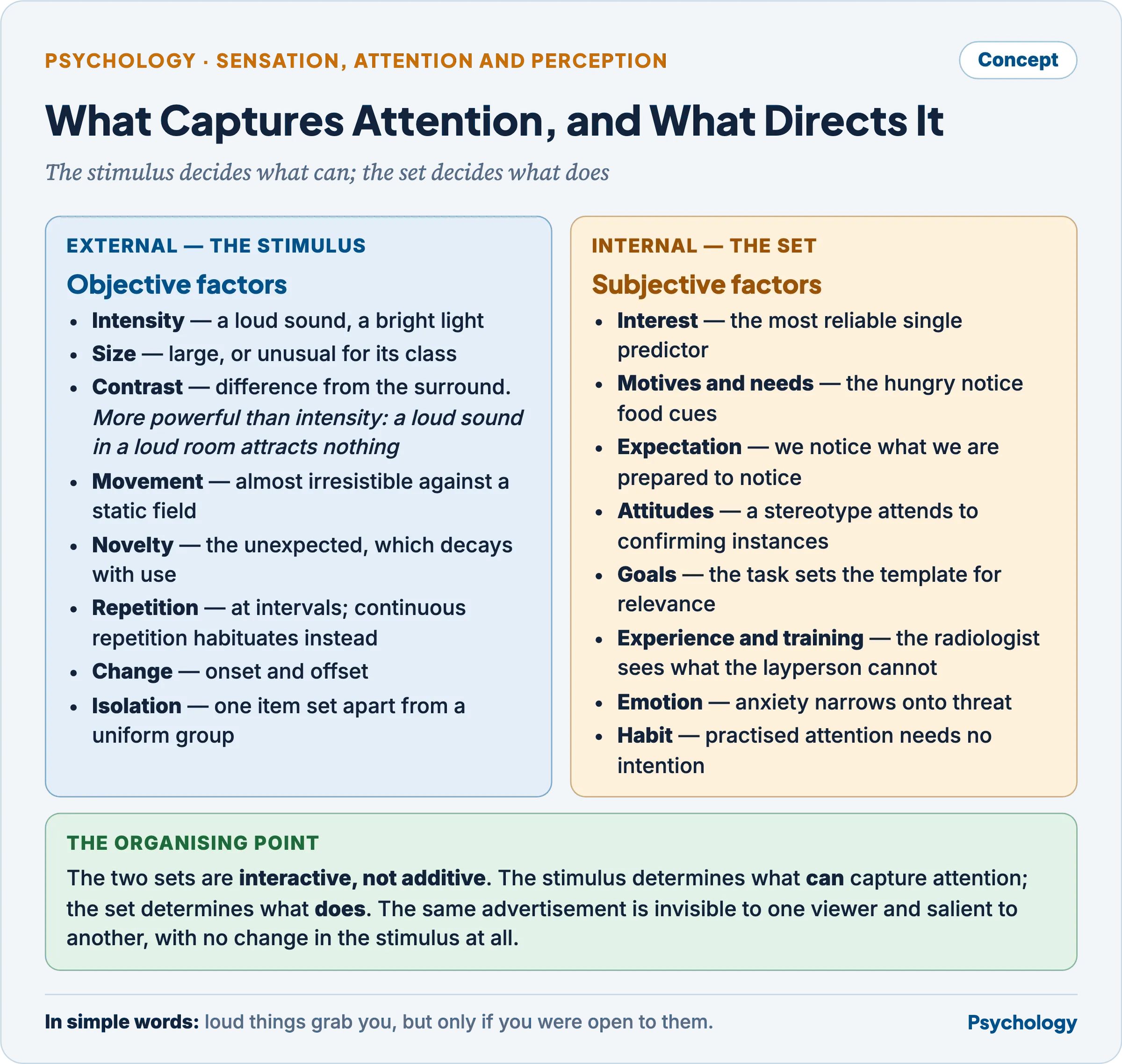
The factors divide into properties of the stimulus and properties of the person, and both must appear in any complete answer.
External factors — characteristics of the stimulus
- Intensity — a loud sound, a bright light, a strong smell. Attention follows magnitude.
- Size — a large stimulus, or one unusual in size for its class.
- Contrast — difference from the surroundings. This is more powerful than intensity alone, and the reason is informational: a loud sound in a loud room attracts nothing, while a quiet one in silence attracts everything. Contrast is relative where intensity is absolute.
- Movement — a moving object against a static field captures attention almost irresistibly, which has an obvious evolutionary reading.
- Novelty — the unfamiliar or unexpected. Advertising exploits this to the point of exhaustion, which is also why it decays.
- Repetition — a stimulus repeated at intervals draws attention, though repetition without variation produces habituation instead.
- Change — the onset or offset of a stimulus, which the sensory systems are built to detect.
- Isolation — a single item set apart from a uniform group is attended out of proportion to its intensity.
Internal factors — the set of the perceiver
Set, or mental set, is a readiness to attend and respond in a particular way, and it is the single most important internal factor because it determines what the external factors act upon.
- Interest — what matters to a person is noticed; what does not is not. Interest is the most reliable single predictor of what will be attended.
- Motives and needs — a hungry person notices food cues and food words, a thirsty one drink cues. Motivational states lower the effective threshold for motive-relevant stimuli.
- Expectation — we notice what we are prepared to notice. The listener expecting their name hears it; the proof-reader expecting correct text misses the typo.
- Attitudes and beliefs — someone holding a stereotype attends preferentially to confirming instances, which is one mechanism by which stereotypes resist disconfirmation.
- Goals — the current task sets the template for what is relevant. A person told to count passes attends to passes.
- Past experience and training — a radiologist attends to features on a film that a layperson cannot see at all; a musician hears a part in the texture that others cannot separate.
- Emotional state — anxiety narrows attention onto threat-relevant cues, which is adaptive in danger and maladaptive in an examination hall.
- Habit — practised attention requires no effort and runs without intention.
The organising point is that external and internal factors are not additive but interactive: the stimulus determines what can capture attention, the set determines what does. The same advertisement is invisible to one viewer and salient to another.
Theories of selective attention
The theories are a historical sequence in which each repairs a specific failure of its predecessor, and presenting them in that order is what turns a list into an argument.
The paradigm throughout is dichotic listening with shadowing, devised by Cherry (1953): different messages are played to the two ears and the listener repeats one aloud. Cherry found that listeners retained almost nothing of the unattended message — not its content, not its language, not whether it was played backwards — though they did notice physical changes such as a shift from a male to a female voice or to a pure tone. He also described the cocktail party problem: the ability to follow one conversation among many.
Broadbent’s filter theory (1958)
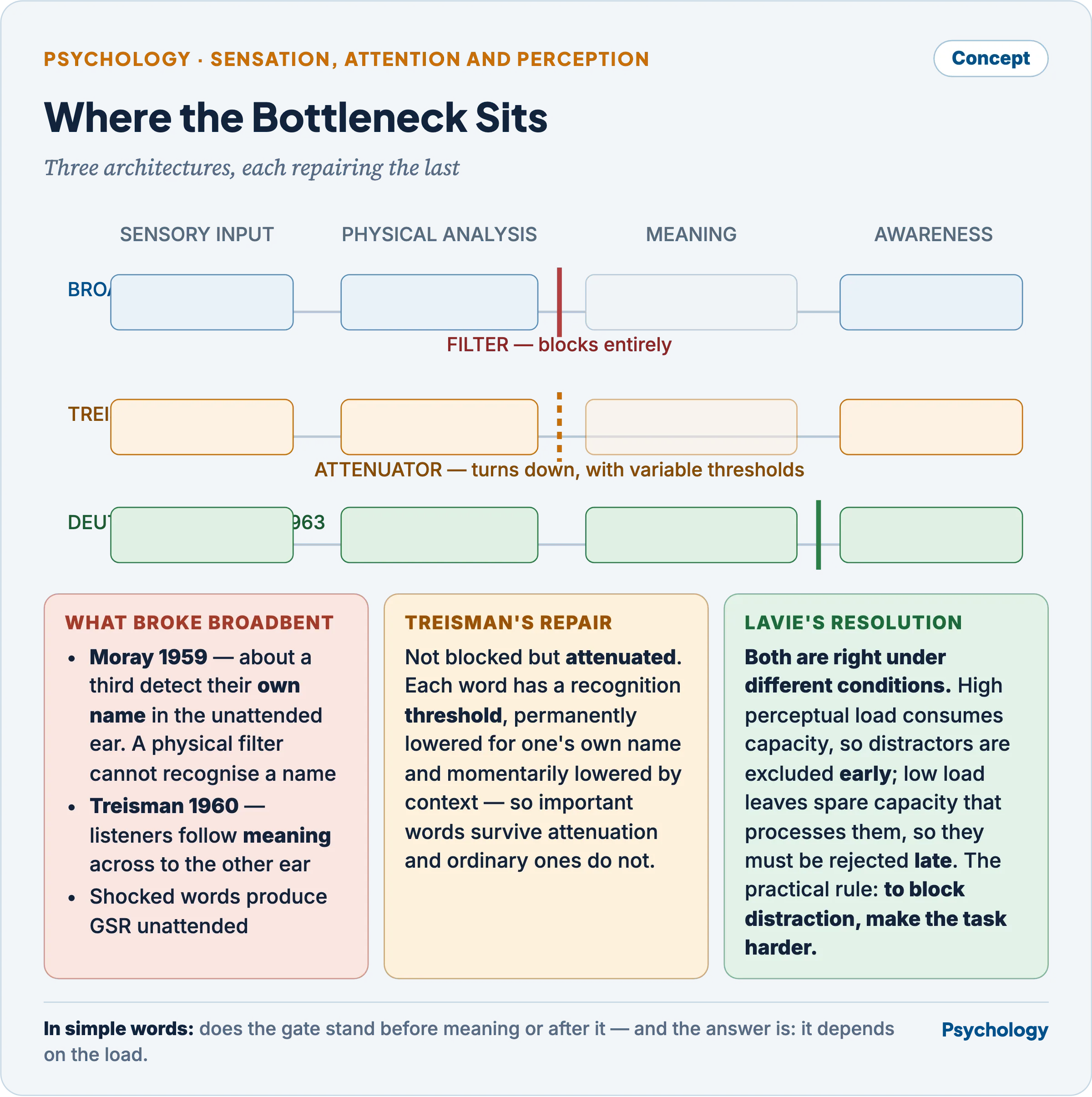
Broadbent proposed the first complete information-processing model of attention. All inputs enter a brief sensory buffer. A selective filter then operates on physical characteristics alone — location, pitch, loudness, voice quality — and admits one channel to a limited-capacity processing system, where meaning is extracted. The unattended channel is blocked entirely and decays unanalysed.
It is an early-selection, all-or-none model, and it explained Cherry’s core findings exactly: listeners retain physical properties of the unattended channel because the filter works on those, and retain no meaning because meaning is never reached.
Why the filter theory proved inadequate
Three findings broke it, and naming them is the substance of the critique.
- The own-name effect. Moray (1959) found that about a third of listeners detected their own name in the unattended channel. A filter operating on physical features alone cannot recognise a name, because recognising it requires the meaning to have been analysed. This is the decisive objection.
- Meaning-based switching. Treisman (1960) played a message that switched ears mid-sentence and found listeners following the meaning across to the other ear before correcting themselves — selection was being guided by content, not channel.
- Conditioned responses to unattended words. Words previously paired with shock produced galvanic skin responses when presented in the unattended ear, so they were being processed for meaning without awareness.
The general conclusion is that the unattended channel is not blocked. Some semantic analysis of it occurs, and Broadbent’s filter is too early and too absolute.
Treisman’s attenuation theory (1964)
Treisman kept the filter and weakened it. The unattended channel is not blocked but attenuated — turned down rather than switched off — so it still reaches the recognition system, only in a degraded form.
The second component does the explanatory work. Each word in the dictionary unit has a threshold for recognition, and thresholds differ. Words of high personal importance — one’s own name — and words primed by context have permanently or momentarily lowered thresholds, so they can be recognised even from an attenuated signal, while ordinary words cannot.
This accounts for every finding that defeated Broadbent while preserving his insight that selection is early and that capacity is limited. It remains the best-supported of the early-selection accounts. Its weakness is that the attenuator and the variable thresholds are postulated to fit the data rather than independently specified.
Deutsch and Deutsch’s late-selection theory (1963)
Deutsch and Deutsch proposed the opposite architecture: all inputs are analysed fully for meaning, and selection occurs after recognition, at the point of response and entry into awareness. The bottleneck is late, not early.
It explains the own-name effect effortlessly — of course the name is recognised, because everything is. Its difficulty is economy: it requires the full analysis of material that is then discarded, and the evidence does not support analysis of the unattended channel being as complete as the theory needs. Where attended and unattended material are tested directly, memory for the unattended is far poorer than full analysis would predict.
Load theory, and the resolution
The early–late dispute ran for decades without resolution because, as Lavie’s load theory proposes, both are right under different conditions. Selection is early when perceptual load is high — a demanding task consumes capacity, leaving none to spill onto distractors, which are therefore excluded early. Selection is late when perceptual load is low — spare capacity processes distractors involuntarily, so they are analysed and must be rejected later by executive control.
This explains why the laboratory literature was inconsistent: the answer depended on a variable nobody was controlling. It also yields a counter-intuitive practical rule — to block distraction, make the primary task harder, not easier.
Two further frameworks belong with these.
- Kahneman’s capacity model (1973) replaces the structural bottleneck with a single pool of undifferentiated mental effort, allocated by an allocation policy responsive to arousal, enduring dispositions, momentary intentions and the evaluated demands of the task. It explains why performance varies with motivation and arousal, which the structural models cannot, and why total capacity itself expands somewhat with arousal.
- Norman and Shallice’s supervisory attentional system distinguishes routine action, run off automatically by contention scheduling, from novel or dangerous situations requiring a supervisory system — the basis of modern accounts of executive attention and of the deficits that follow frontal damage.
Divided attention and dual-task performance
When two tasks are performed together, performance on one or both usually falls. The size of that cost is determined by four variables, and the first two are what the question on this topic turns on.
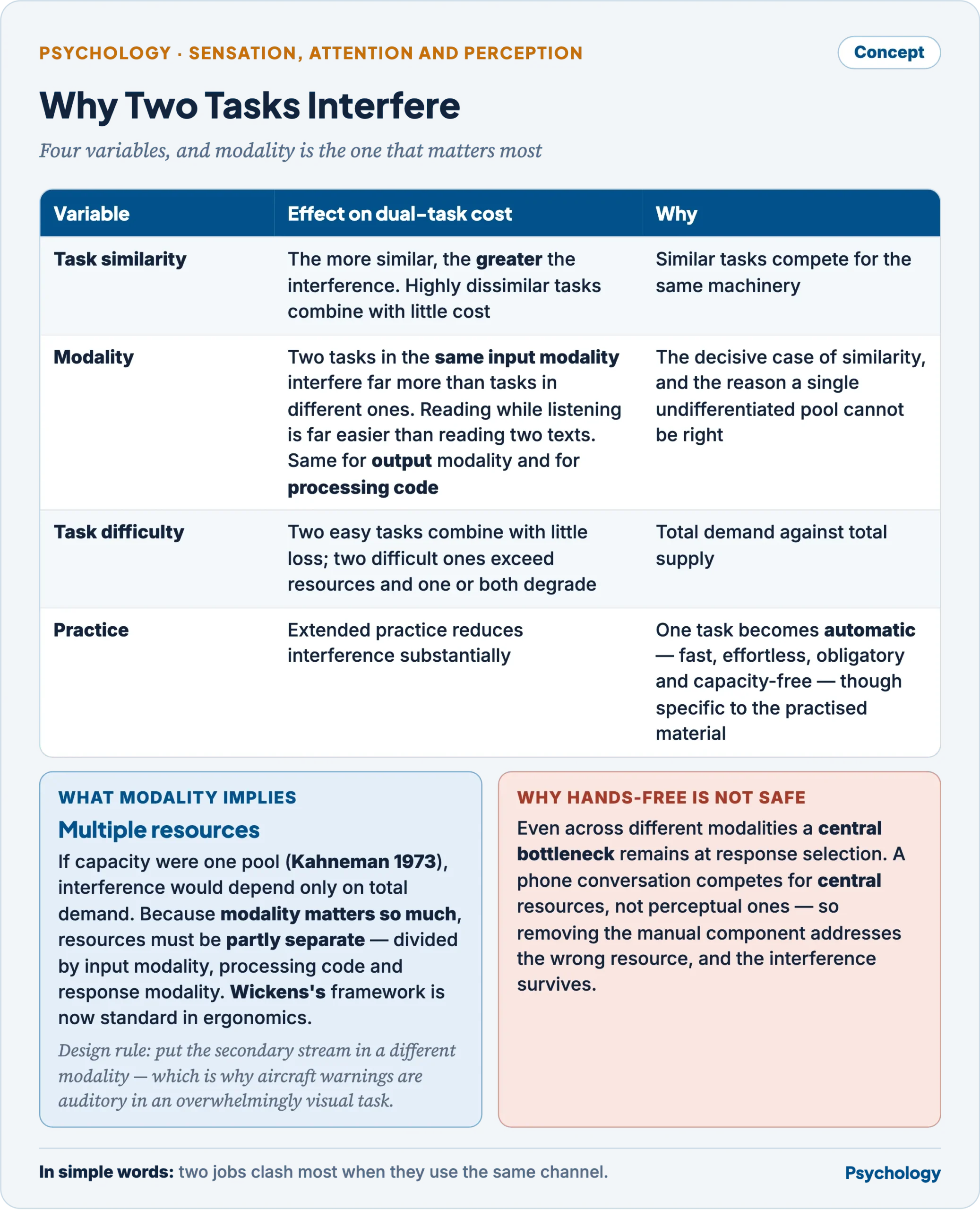
- Task similarity. The more similar two tasks, the greater the interference. Two tasks that are highly dissimilar can often be combined with little cost at all.
- Modality. This is similarity’s most important special case. Two tasks drawing on the same input modality — two visual tasks, or two auditory tasks — interfere far more than tasks using different modalities. Reading while listening is much easier than reading two texts. The same holds for output modality: two manual responses conflict where a manual and a vocal response do not, and for processing codes, where two verbal tasks conflict more than a verbal and a spatial one.
- Task difficulty. Two easy tasks combine with little loss; two difficult ones exceed available resources and performance on one or both degrades.
- Practice. Extended practice reduces interference substantially, by making one task automatic — fast, effortless, obligatory and capacity-free. The classic demonstration is that reading aloud while taking dictation becomes possible after enough training, though the automaticity is specific to the practised material.
The modality finding is what Wickens’s multiple resource theory was built to explain. If capacity were a single undifferentiated pool, as Kahneman proposed, interference would depend only on total demand and not on which modalities were used. Because modality matters so much, resources must be partly separate — divided along the dimensions of input modality, processing code and response modality. Tasks competing for the same resource interfere; tasks drawing on different ones do not. This is now the standard framework in applied ergonomics, and it produces a concrete design rule: present a secondary stream in a different modality from the primary one, which is why aircraft warnings are auditory in a task that is overwhelmingly visual, and why a driver’s phone conversation remains dangerous even though it is auditory, since it competes for central and not perceptual resources.
A caution completes the picture. Even where two tasks use different modalities, a central bottleneck remains at the stage of response selection, so some cost persists. This is why hands-free telephony does not make driving safe: the interference is central, and removing the manual component addresses the wrong resource.
Failures of attention
- Inattentional blindness is the failure to notice a fully visible but unattended object. The best-known demonstration asks viewers to count basketball passes, during which a person in a gorilla suit walks through the scene and remains in clear view for several seconds; about half of viewers do not see it. The finding matters because it shows that looking is not seeing — attention, not the retinal image, determines what reaches awareness.
- Change blindness is the failure to notice a large change between two views separated by a brief disruption. It demonstrates that we retain far less of a scene than introspection suggests.
- The attentional blink is a brief period after detecting one target during which a second target is missed, indicating that attentional engagement itself takes time to release.
- Everyday consequences follow directly, and the driving case is the clearest: conversation on a telephone produces inattentional blindness for events in plain view, which is why the hazard is attentional rather than manual.
The development of attention
Attention develops from unfocussed scanning to focussed planfulness, and the change has four strands.
- Control. The infant’s attention is captured by stimulus properties — movement, contrast, faces — and is largely involuntary. Over childhood control shifts from stimulus-driven to goal-driven, so that a child can attend to what the task requires rather than what is loudest.
- Systematicity. The classic demonstration is Vurpillot’s (1968) eye-movement study of children judging whether two drawn houses were identical. Young children scanned haphazardly and few windows, then guessed; older children compared window by corresponding window and stopped as soon as a difference was found. The younger child is not less attentive but less strategic.
- Sustained attention lengthens markedly across childhood, which is why attention span is an age norm, and why instructional design for younger children uses shorter segments.
- Selectivity and resistance to distraction improve, tracking the slow maturation of the prefrontal cortex, which continues into the twenties.
The applied reading is that a young child’s failure to attend is usually a failure of strategy and inhibition, not of capacity, and responds to being taught a search routine rather than to exhortation.
Criticisms and limitations
- The early–late debate was partly unfalsifiable. Each model could accommodate contrary findings by adjusting where the bottleneck sat or how leaky it was, and load theory resolved the dispute only by showing that the question was underspecified.
- Dichotic listening is a narrow base. Almost the whole structural literature rests on one paradigm with verbal auditory material, and its generality to vision and to everyday multitasking was assumed rather than demonstrated.
- “Attention” is not one thing. Selective, divided, sustained and executive attention dissociate behaviourally and neurally, so a single theory of attention is unlikely to be correct, and findings about one are routinely over-generalised to the others.
- Capacity remains undefined. Both the single-pool and multiple-resource accounts are powerful descriptions, but neither specifies what the resource physically is, which makes the central explanatory term circular — tasks interfere because they share resources, and we know they share resources because they interfere.
- The factor lists are descriptive, not explanatory. Intensity, novelty and contrast describe what captures attention without saying why, and they do not predict their relative weight when two conflict.
- Automaticity is less complete than claimed. Practised tasks remain vulnerable to disruption under stress or when the practised context changes, so the capacity-free state is an idealisation.
- The dramatic failure demonstrations can mislead. Inattentional blindness is often reported as evidence that we see almost nothing, which overstates it: the effect depends on a demanding concurrent task, and under ordinary conditions the scene is sampled far more fully.
Previous Year Questions
- 2021Why is selective attention important? Discuss the theories of selective attention.
- 2012Describe Broadbent’s filter theory of attention. Why this elegant theory turned out to be inadequate? Comment upon the alternate approaches.
- 2010How do task similarity and modality influence dual-task performance?
- 2005What is attention? Discuss factors influencing attention.
- 2004How is attention different from perception? Describe the role of various factors that influence attention.
- 2002Attention develops from unfocussed scanning to focussed planfulness. Discuss giving illustrative examples.