

Official syllabusPaper II · Unit 6 · Community Psychology
Group decision making and leadership for social change – leadership.
Definition
“Leadership is accepting responsibility to create conditions that enable others to achieve shared purpose in the face of uncertainty.”
Ganz (2010)
A leader of social change has to move people who owe no obedience towards goals that alter their own habits and the local distribution of power. The theories of leadership were built mostly inside organisations, so the question is which of them still predict effectiveness once formal authority, paid followers and agreed goals are taken away, and which personal qualities a community should cultivate in the members it prepares to lead.
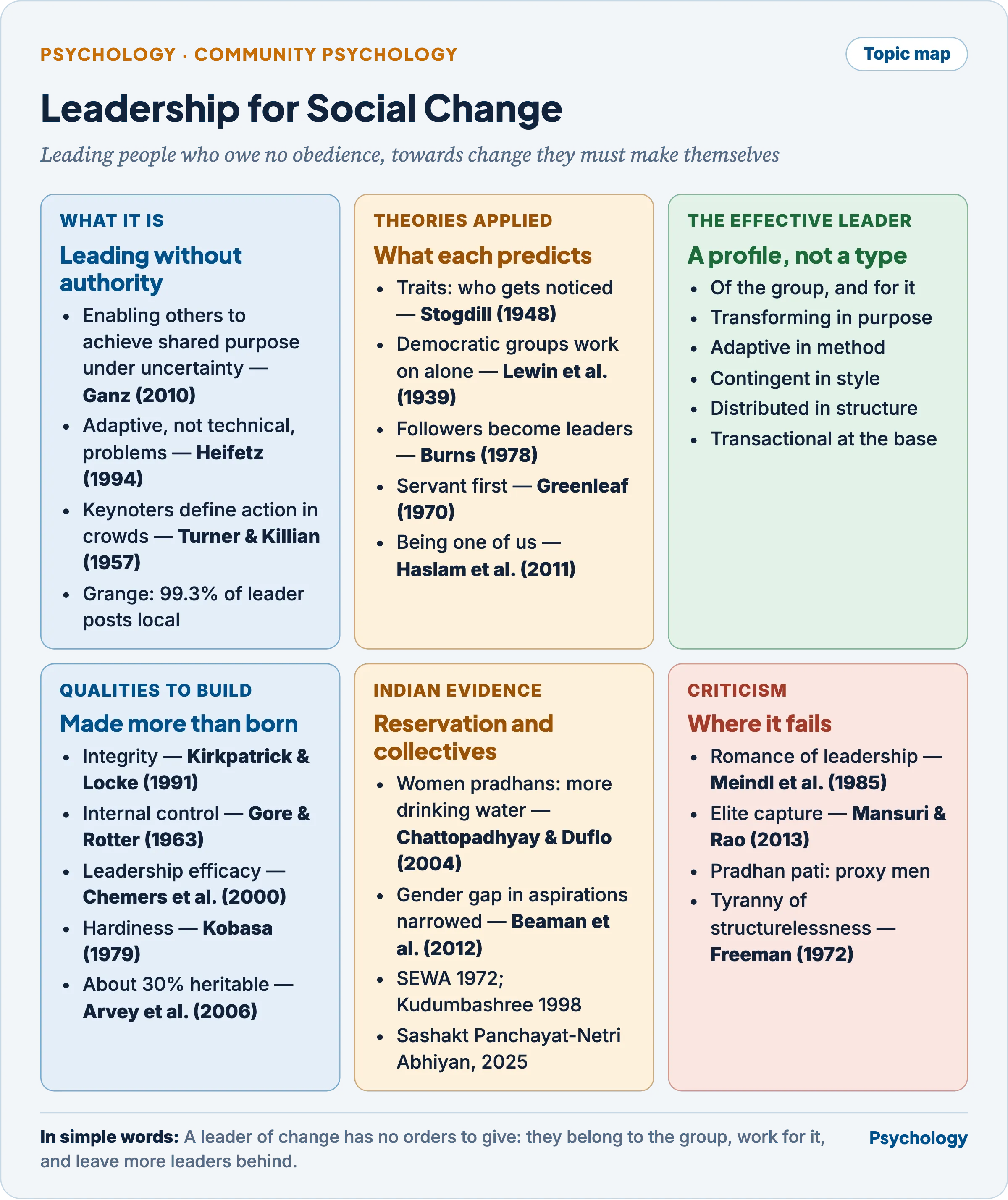
The theories converge on one profile: a leader who belongs to the group, works for it, and leaves more leaders behind.
Leadership for social change: what is distinctive
- Leadership for social change is influence directed at altering a community’s norms, institutions and power relations, exercised mostly without formal authority and judged by whether the change outlasts the leader.
- It differs from organisational leadership on four counts.
- Followers are volunteers. Authority rests on moral suasion more than on economic or political coercion, and output depends on committed, voluntary participation (Ganz, 2010).
- Problems are adaptive. Heifetz (1994) separated technical problems, which an expert can solve with known means, from adaptive challenges, which require the people who have the problem to change their values, beliefs and habits.
- Leaders are mostly informal. They emerge from the group on trust and competence rather than by appointment.
- Goals are contested. A reform such as ending child marriage has organised opponents inside the community itself.
Leadership in group decision making and social movements
- Lewin’s (1947) group-decision method, detailed in Group Decision Making for Social Change, is itself a leadership technique: the leader frames the discussion and the group commits publicly.
- In crowds and movements, emergent norm theory (Turner and Killian, 1957) gives leaders a specific function: in an ambiguous situation a few prominent members, the keynoters, define what the rest take to be appropriate action.
- Movements depend on leaders at every level. Ganz (2010) reports 77,775 voluntary leadership posts in the nineteenth-century American Grange, 99.3 per cent of them local: one member in five held a post at any time.
Theories of leadership applied to social change
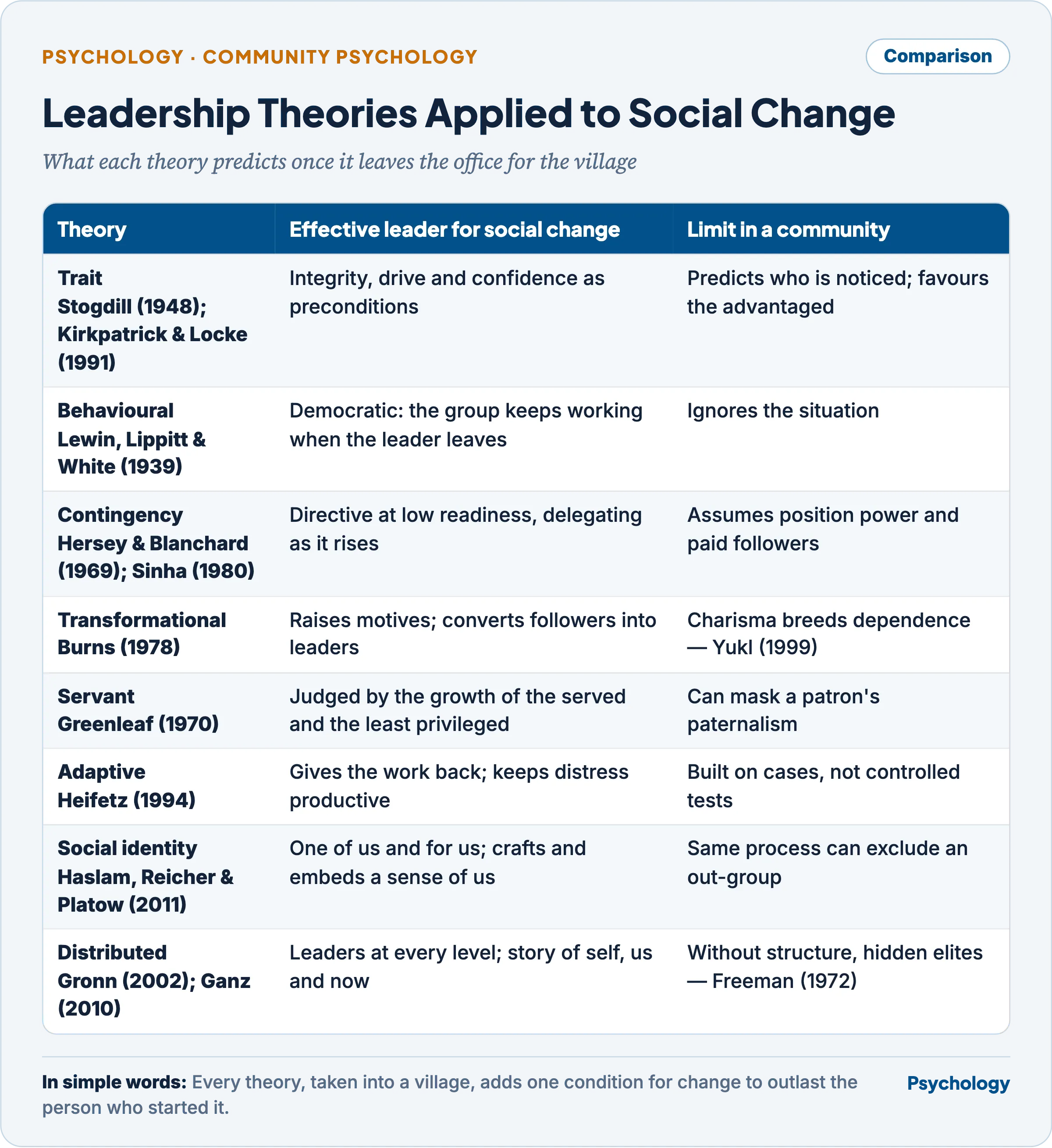
Read across each row: what a theory predicts once it leaves the office for the village, and where it stops applying.
Trait, behavioural and contingency theories
- Their evidence is in Leadership and Participatory Management; here each is applied to a community.
- Trait theory. Stogdill (1948) found no trait that predicts leadership across situations; Kirkpatrick and Locke (1991) treated drive, leadership motivation, honesty and integrity, self-confidence, cognitive ability and task knowledge as preconditions, not guarantees.
- In a village, a trait list describes who gets noticed; selecting by visibility and confidence would favour men, the educated and dominant castes.
- Arvey, Rotundo, Johnson, Zhang and McGue (2006), with male twins, attributed about 30 per cent of the variance in holding leadership roles to genetic factors, leaving most of it to experience and so to preparation.
- Behavioural theory. Lewin, Lippitt and White (1939) found that boys’ clubs under democratic leaders kept working when the leader left the room, while autocratic clubs stopped; a reform has to survive its leader’s absence in the same way.
- A campaign needs both initiating structure (plans, roles, deadlines) and consideration for volunteers who can walk away.
- Contingency theory. Hersey and Blanchard (1969) match style to followers’ readiness: telling and selling while a community is unable to act, participating and delegating as its ability grows.
- J. B. P. Sinha’s (1980) nurturant-task leader, designed to hand over decisions as dependence falls, is the Indian version of the same logic.
- Limitation: these models assume position power and paid subordinates, which a village organiser does not have.
Transformational and charismatic leadership
- Burns (1978) gave the concept its modern form from studies of political and social leaders. The result of transforming leadership, he wrote, is “a relationship of mutual stimulation and elevation that converts followers into leaders and may convert leaders into moral agents.”
- The four Is (Avolio, Waldman and Yammarino, 1991) translate directly into movement work.
- Idealised influence: visible personal sacrifice for the cause.
- Inspirational motivation: a vision of the changed community stated in its own idiom.
- Intellectual stimulation: questioning the custom everyone takes for granted.
- Individualised consideration: coaching each new volunteer towards leading.
- Shamir, House and Arthur (1993) proposed the mechanism: such leaders tie the cause to followers’ self-concepts, so participation expresses who the follower is.
- Yukl (1999) distinguished charismatic leaders, who keep followers reliant, from transformational leaders, who develop them; Weber (1922) noted that charisma must be routinised or the movement fades with its leader. Detail is in Transformational Leadership.
Servant leadership
- Greenleaf (1970): “The best test, and difficult to administer, is: do those served grow as persons; do they, while being served, become healthier, wiser, freer, more autonomous, more likely themselves to become servants?”
- He added a second test, the effect on the least privileged in society, so servant leadership’s own measure of success is a social-change measure.
- In community work the servant-leader is judged by how far the community comes to rely on itself.
- Hoch, Bommer, Dulebohn and Wu (2018) found servant leadership the most distinct of the value-based styles, adding to what transformational leadership explains.
- Limitation: the evidence comes chiefly from organisations, and “service” by an upper-caste or wealthy patron can slide into the paternalism it claims to oppose.
Adaptive leadership
- Heifetz (1994) separated leadership from authority: authority is conferred power to provide direction, protection and order, while leadership is mobilising people to do adaptive work, and it can be exercised with little or no authority, as Martin Luther King Jr. did.
- Dowry, caste exclusion and superstition are adaptive: they persist despite technical fixes because people must give up something they value.
- His five principles for the leader:
- Identify the adaptive challenge rather than offering a technical fix.
- Regulate distress: keep tension high enough to motivate and low enough not to overwhelm.
- Focus attention on ripening issues, not on stress-reducing distractions.
- Give the work back to the people at a rate they can stand, instead of solving it for them.
- Protect the voices of leadership without authority, the dissenters who name the problem.
- Limitation: the model rests on case analysis rather than controlled tests, and gives little guidance on when distress becomes harmful.
Social identity theory of leadership
- Haslam, Reicher and Platow (2011) argued that leaders gain influence by representing a shared social identity, a sense of “us”, rather than by possessing qualities that set them apart from followers.
- Steffens and colleagues (2014), in the Identity Leadership Inventory, named four dimensions.
- Identity prototypicality: being “one of us”.
- Identity advancement: “doing it for us”, championing the group’s interests.
- Identity entrepreneurship: “crafting a sense of us”, defining who the group is.
- Identity impresarioship: “embedding a sense of us” in activities and structures.
- Barreto and Hogg (2017), pooling 35 studies with 6,678 participants, found that leader prototypicality correlated .49 with leader evaluations, about a quarter of the variance.
- Applied: an outside reformer seen as not “one of us” is resisted however sound the reform; a leader who frames change as the group’s own value (“our village does not marry off its girls young”) recruits identity on its side.
- Limitation: Reicher, Haslam and Platow (2018) warned that when a leader becomes the sole definer of the group, dissenters are cast as enemies, the mark of authoritarian leadership.
Distributed and grassroots leadership
- Gronn (2002) described distributed leadership as a property of a group’s concertive action rather than of one person.
- Ganz (2010) set out the movement leader’s practices: building relationships, telling a public narrative (a story of self, a story of us and a story of now), devising strategy, and mobilising action, all through teams at every level.
- Distributed leadership still needs explicit structure. Freeman (1972) showed that “leaderless” groups develop a tyranny of structurelessness, in which informal elites exercise hidden, unaccountable authority.
What kind of leaders are effective in bringing about social change
- The theories converge on a profile with seven features.
- Of the group: prototypical and trusted, not an outsider (Haslam, Reicher and Platow, 2011).
- For the group: servant in motive, judged by the growth of the least privileged (Greenleaf, 1970).
- Transforming in purpose: raises motives and models sacrifice (Burns, 1978).
- Adaptive in method: gives the work back rather than imposing fixes (Heifetz, 1994).
- Contingent in style: directive while readiness is low, delegating as it rises (Hersey and Blanchard, 1969).
- Distributed in structure: builds many leaders and accountable roles (Ganz, 2010; Freeman, 1972).
- Transactional at the base: delivers resources and keeps accounts, since followers judge leaders on results.
- Effectiveness therefore turns more on the leader’s relationship with the group, and on whether the leader produces further leaders, than on distinguishing traits.
Personality qualities for preparing community members as leaders
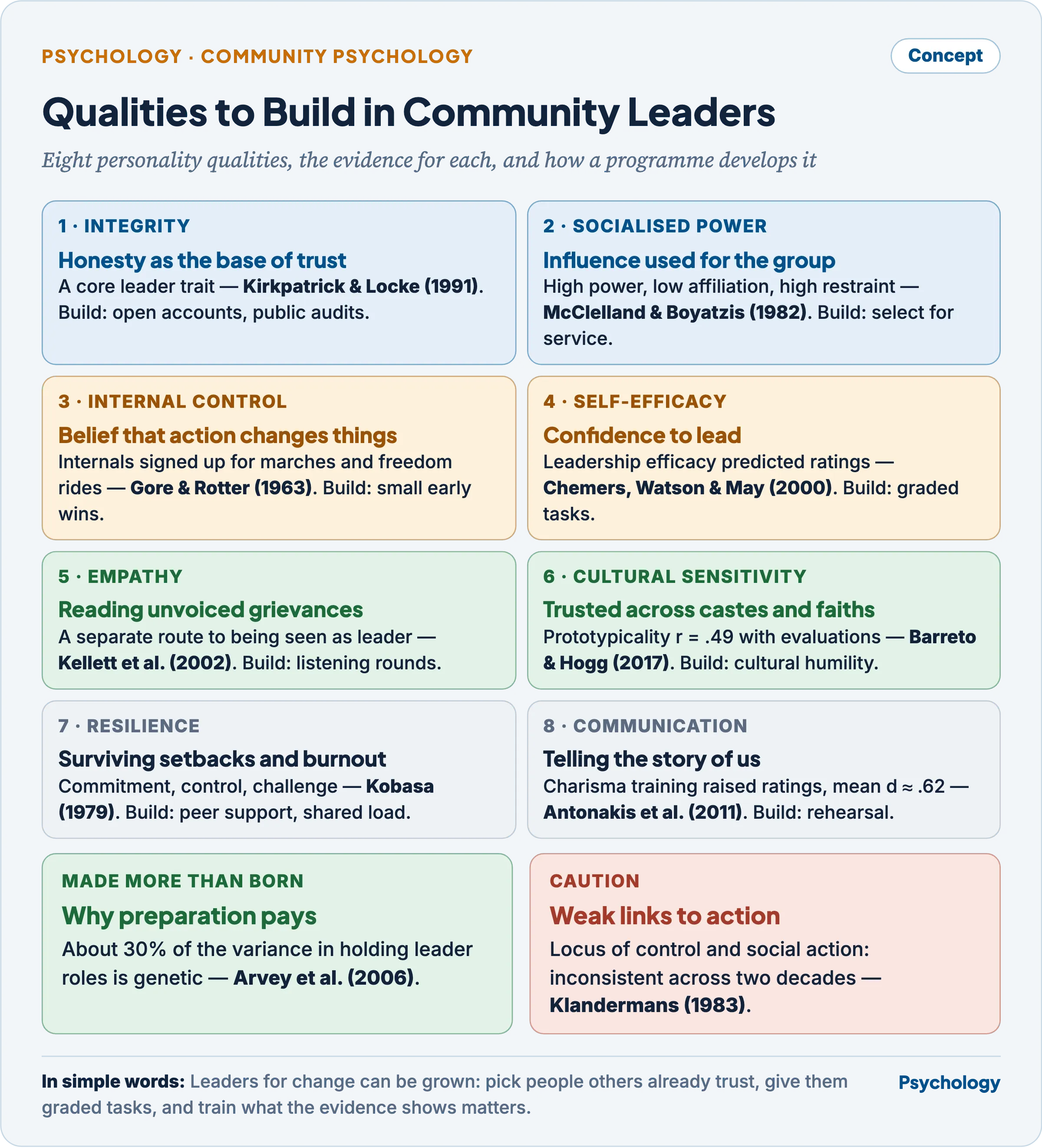
Each quality carries its evidence and the training that builds it; none is offered as a fixed trait.
- Integrity and honesty. Kirkpatrick and Locke (1991) placed honesty and integrity among the core leader traits; where communities expect leaders to divert funds, visible honesty is the precondition of trust.
- Socialised power motivation. McClelland and Boyatzis (1982) found that a leadership motive pattern, high need for power, low need for affiliation and high activity inhibition, predicted promotion among AT&T managers; restraint channels power towards collective rather than personal ends.
- Internal locus of control. Gore and Rotter (1963) found that students at a Southern Black college who committed to a march on the state capitol or a freedom ride were more internal than those willing only to attend a rally.
- Strickland (1965) found civil-rights activists more internal than matched non-activists; Phares (1965) found internal students more successful than external ones at changing others’ attitudes.
- Limitation: Gore and Rotter never checked actual participation, and Klandermans (1983), reviewing 31 studies from two decades, found no relationship in 19.
- Self-efficacy. Chemers, Watson and May (2000) found that cadets’ leadership efficacy, but not optimism, predicted their leadership ratings by observers, peers and superiors. Bandura (1997) identified mastery experience as its strongest source, which argues for graded responsibilities.
- Empathy and social perceptiveness. Kellett, Humphrey and Sleeth (2002) found empathy and complex-task performance to be two separate routes to being seen as a leader; empathy lets a leader read grievances that members do not voice.
- Cultural sensitivity. In a community divided by caste, religion and language, prototypicality must be earned across groups; Tervalon and Murray-García (1998) proposed cultural humility, a lifelong self-critique of one’s own assumptions, in place of claimed “competence” in other cultures.
- Prosocial motivation. Greenleaf (1970) called it the natural feeling that one wants to serve first; volunteers drawn by status leave when it fails to arrive.
- Resilience and hardiness. Kobasa (1979) found that executives who stayed healthy under heavy stress scored high on hardiness: commitment, control and challenge. Chen and Gorski (2015), interviewing 22 American activists, found that a movement “culture of martyrdom” hastened burnout and made activism less effective.
- Communication. Ganz (2010) treats public narrative as a learnable practice; Antonakis, Fenley and Liechti (2011) randomly assigned 34 middle managers and raised their rated charisma through training in verbal and non-verbal tactics (mean d over two studies, .62).
Leadership development for social change
- The social change model of leadership development (Higher Education Research Institute, 1996) names seven values, the “seven Cs”, aimed at change for the common good.
- Individual: consciousness of self, congruence, commitment. Group: collaboration, common purpose, controversy with civility. Community: citizenship.
- A programme for preparing community members as leaders runs in steps.
- Identify emergent leaders by peer nomination: whom do people consult, trust and copy?
- Assess efficacy, integrity and motive through tasks and references, not self-report alone.
- Train skills by rehearsal: role-play of meetings, public narrative, negotiation with officials.
- Assign graded tasks with a mentor, so that mastery builds efficacy (Bandura, 1997).
- Rotate posts and build teams, so that no one becomes indispensable.
- Link leaders to institutions: gram sabhas, self-help-group federations, line departments.
- Evaluate both the change achieved and leader burnout.
- Highlander Folk School (founded 1932 by Myles Horton, Don West and James Dombrowski) trained labour and then civil-rights leaders through workshops built on participants’ own problems.
- Rosa Parks attended a workshop there in the summer of 1955, mentored by Septima Clark, a few months before her arrest began the Montgomery bus boycott.
- Clark’s Citizenship Schools, begun on Johns Island, taught literacy through voter-registration materials and trained local people to teach the next class.
- Kelly and colleagues (1991), peer leadership for behaviour change.
- Men identified as popular opinion leaders in gay clubs of one small American city were trained to endorse safer sex to friends; two matched cities served as comparisons.
- Men reporting unprotected anal intercourse fell from 36.9 to 27.5 per cent in the intervention city, with little change elsewhere (Kelly and colleagues, 1991).
- Limitation: the NIMH Collaborative HIV/STD Prevention Trial Group (2010), across five countries including wine-shop venues in Chennai, found risk fell by about a third in both opinion-leader and comparison venues, so trained peer leaders added nothing over intensive services.
Leadership for social change in India
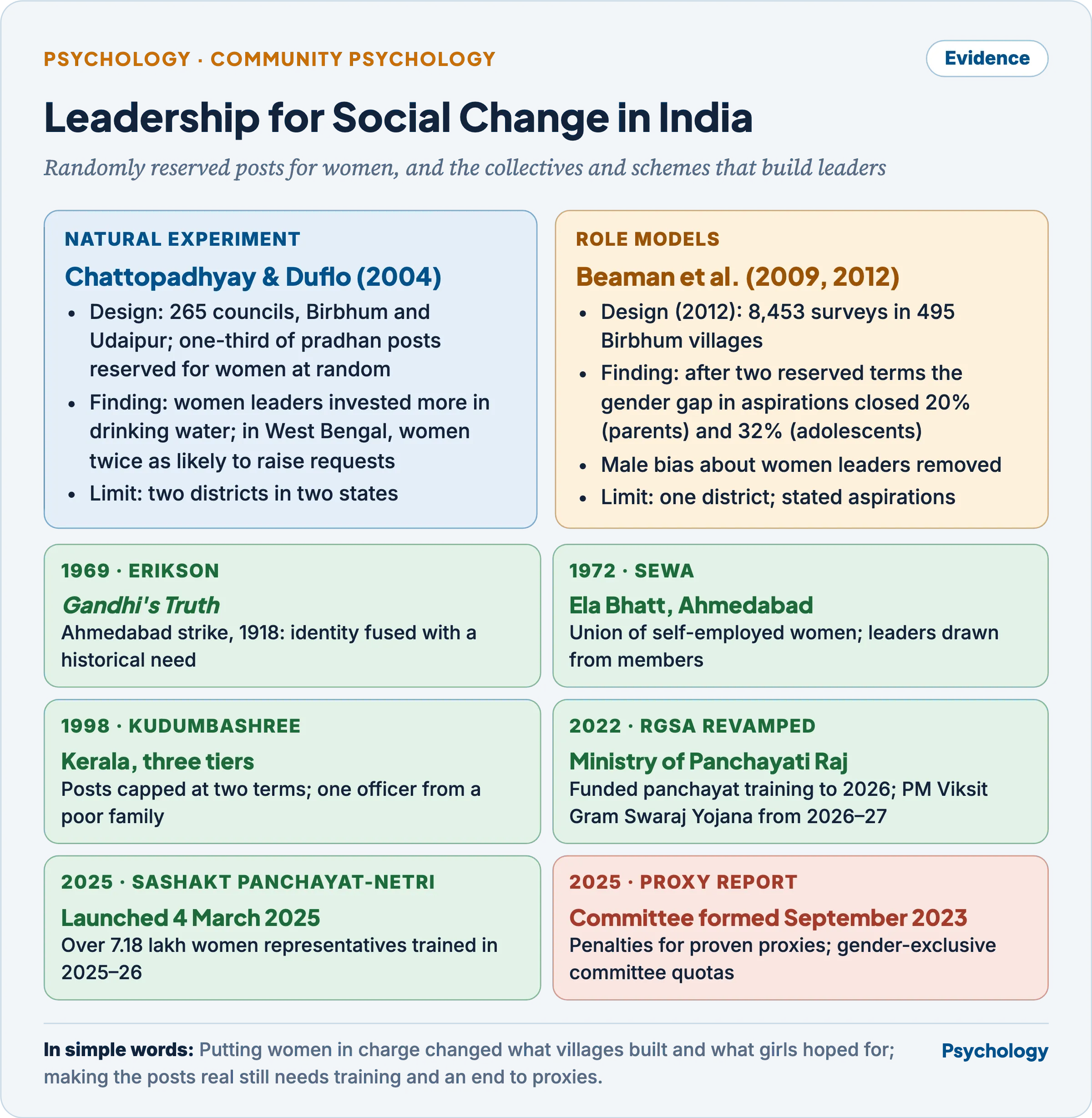
The reservation experiments show leadership changing a community twice over: through what women leaders did, and through what their presence made others believe.
- Erikson (1969), in Gandhi’s Truth: On the Origins of Militant Nonviolence, analysed Gandhi’s leadership of the 1918 Ahmedabad textile strike, which he called “the Event”, when Gandhi first fasted for a public cause.
- His thesis: Gandhi’s personal identity conflicts fused with a historical need, and satyagraha turned the follower’s suffering into a disciplined, active method.
- Limitation: psychobiography infers motive from documents and cannot be tested.
- Chattopadhyay and Duflo (2004) used the random reservation of one-third of village council head (pradhan) posts for women.
- Design: 265 councils in Birbhum, West Bengal and Udaipur, Rajasthan, compared by reservation status.
- Finding: leaders invested more in public goods closer to their own gender’s stated needs, drinking water above all; in West Bengal, women were twice as likely to raise requests with a woman-headed council.
- Limitation: two districts in two states, and investment shows what changed rather than how.
- Beaman, Chattopadhyay, Duflo, Pande and Topalova (2009) found that exposure to a woman pradhan removed male villagers’ bias about women leaders’ effectiveness without changing their stated preference for men, and that after two reserved terms more women stood for and won seats.
- Beaman, Duflo, Pande and Topalova (2012) drew on 8,453 surveys of adolescents and their parents in 495 Birbhum villages.
- After two cycles of women leaders the gender gap in aspirations closed by 20 per cent among parents and 32 per cent among adolescents (Beaman and colleagues, 2012); the gap in adolescents’ schooling was erased, and girls spent less time on chores.
- Young women’s labour-market outcomes did not change, which points to a role-model effect rather than new opportunities.
- Limitation: one district, and aspirations are stated intentions rather than realised careers.
- Self-Employed Women’s Association (SEWA) — founded by Ela Bhatt in Ahmedabad and registered as a trade union on 12 April 1972; its own 2026 figures list 3.7 million self-employed women members in 20 states.
- Leaders are drawn from the members, operationalising collective efficacy and a shared identity as workers.
- Kudumbashree (Government of Kerala, 1998) — a three-tier network of neighbourhood groups of 10 to 20 women, area development societies and community development societies; it reports 48.08 lakh women in 3.17 lakh neighbourhood groups (Kudumbashree, 2026).
- Each neighbourhood group elects a five-member committee; either the president or the secretary must come from a poor family, and both posts are limited to two consecutive terms.
- The principle is distributed leadership with compulsory rotation, which limits capture and spreads mastery experience.
- Sashakt Panchayat-Netri Abhiyan (Ministry of Panchayati Raj, launched 4 March 2025) — specialised leadership training for women elected representatives, operationalising leadership self-efficacy through mastery and role models.
- The Ministry of Panchayati Raj (March 2026) reported over 7.18 lakh trained in 2025–26, among more than 14.5 lakh women representatives, about 46 per cent of the total.
- Rashtriya Gram Swaraj Abhiyan (revamped on 13 April 2022 for 2022–26) funded training institutions for panchayat representatives; the Pradhan Mantri Viksit Gram Swaraj Yojana, approved on 28 October 2026 for 2026–31, funds capacity building for about 32 lakh elected representatives a year.
Criticisms and limitations
- Heroic-leader bias. Crediting a movement to one figure hides the organisers who built it, such as Septima Clark. The romance of leadership (Meindl, Ehrlich and Dukerich, 1985) is treated in Leadership and Participatory Management.
- Imported theory. Trait, behavioural, contingency and transformational models were tested mainly on Western managers with position power; their transfer to voluntary community settings is largely untested.
- Elite capture. Mansuri and Rao (2013), reviewing almost 500 studies of participatory development, found that funds placed in communities without a responsive state risk capture of decisions by local elites.
- Proxy leadership. Reservation creates posts without guaranteeing power: the pradhan pati or sarpanch pati is a male relative who acts for an elected woman.
- An advisory committee of the Ministry of Panchayati Raj, constituted on 19 September 2023 after a Supreme Court order and chaired by Sushil Kumar, reported on 5 February 2025.
- It recommended exemplary penalties for proven proxy leadership, gender-exclusive quotas in panchayat and ward committees, and annual awards for “anti-pradhan pati champions”.
- Weak trait evidence. Even locus of control predicts social action inconsistently (Klandermans, 1983), and a list of qualities can obscure the structural barriers of caste, gender and poverty that decide who is allowed to lead.
- Dependence. Charismatic movements stall when the leader goes (Weber, 1922); leaderless ones drift into hidden hierarchy (Freeman, 1972).
- Identity misuse. The same identity processes that mobilise reform can mobilise exclusion against an out-group (Reicher, Haslam and Platow, 2018); prejudice and intergroup conflict are treated in Unit 9.
Previous Year Questions
- 2025What are the personality qualities to be focused on, for preparing community members as leaders for social change?
- 2017In the light of various theories of leadership, what kind of leaders will be effective in bringing about social change?
