

Official syllabusPaper II · Unit 5 · Application of Psychology to Educational Field
Educational, vocational guidance and career counseling – career counselling.
Definition
“Career counseling is an interpersonal process designed to assist individuals with career development problems. Career development is that process of choosing, entering, adjusting to, and advancing in an occupation. It is a lifelong psychological process that interacts dynamically with other life roles.”
Brown and Brooks (1991)
Career counselling grew out of vocational guidance, which fitted a young person to a job at one point of decision. It widened as choice came to be seen as lifelong development bound up with other roles, and again as working lives grew less predictable. In India the need is greatest among first-generation learners, girls and educated young people without fitting work, the groups provision reaches least.
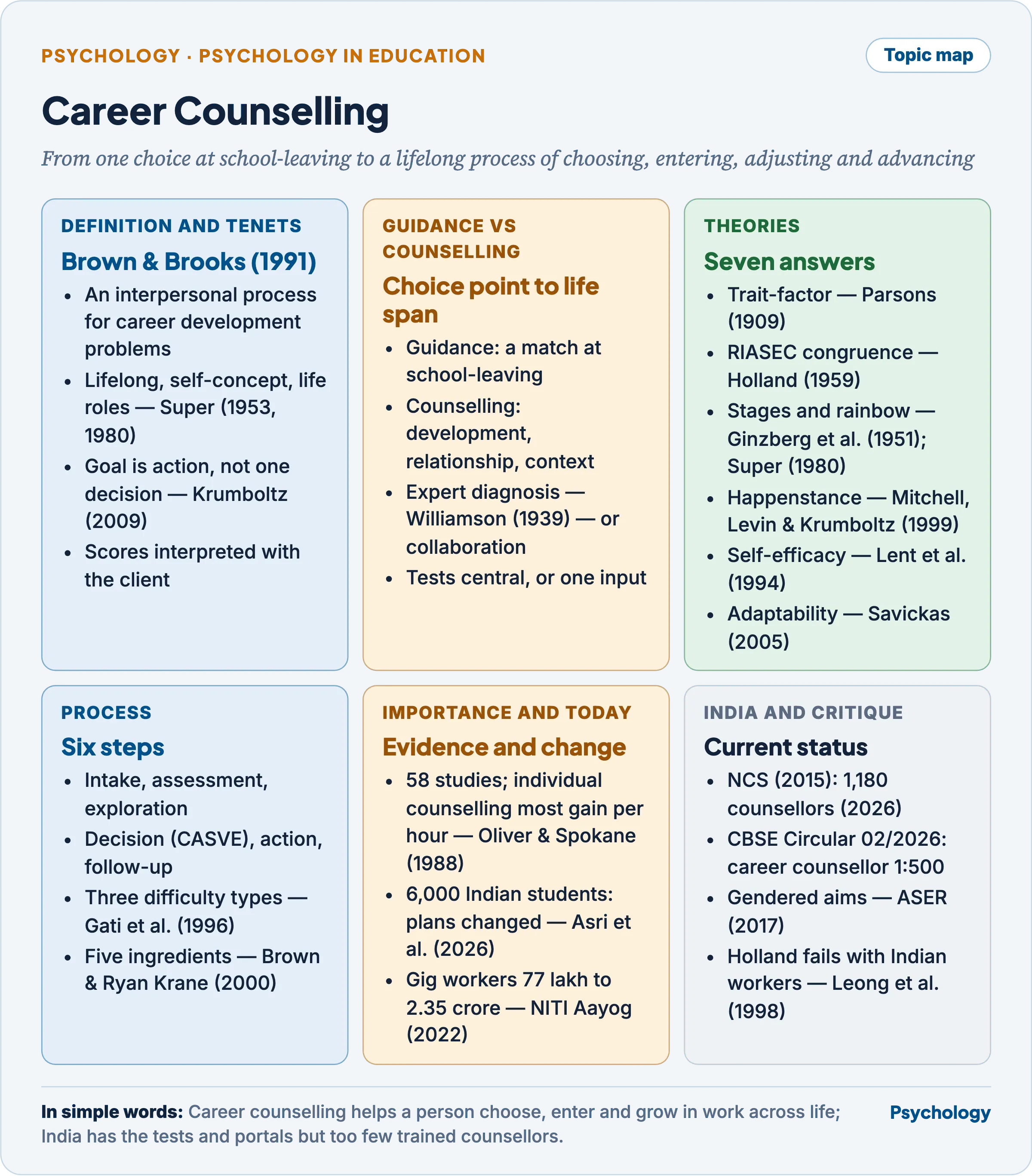
The theories in the top row explain why the process below has six steps rather than one test and one piece of advice.
Career counseling, educational and vocational guidance: salient tenets
- Super (1980) defined a career as the combination and sequence of roles a person plays across a lifetime, the worker role being only one of them.
Salient tenets of career counselling
- Lifelong development. Choice unfolds over years (Super, 1953) and can recycle through exploration and establishment at later transitions (Super, 1984).
- Self-concept implementation. People choose work that lets them express a picture of themselves; counselling clarifies that picture and tests it against reality (Super, 1953).
- Person–environment fit. Satisfaction and persistence are likelier when personality and work setting match (Parsons, 1909; Holland, 1959).
- Multiple life roles. Work is weighed against study, family, leisure and community, so counselling attends to the salience and balance of roles (Super, 1980).
- Career and personal concerns are intertwined. Career problems carry a strong emotional component, so Krumboltz (1993) held that career and personal counselling cannot be separated; Crites (1981) argued that career counselling can itself be therapeutic.
- Learning and agency. The client learns decision, exploration and job-search skills. In Krumboltz’s (2009) words, “The goal of career counseling is to help clients learn to take actions to achieve more satisfying career and personal lives—not to make a single career decision.”
- Context and culture. Self-beliefs, family expectations, gender norms and opportunity shape choice as much as traits do (Lent, Brown and Hackett, 1994; Arulmani, 2011).
- Adaptability. In unstable labour markets the aim moves from the right job to the resources for repeated transitions (Savickas, 2005).
- Assessment serves self-understanding. Scores are interpreted with the client, beside marks, work experience and leisure, and never read off as a verdict.
How career counselling differs from vocational guidance
| Dimension | Vocational guidance | Career counselling |
|---|---|---|
| Time frame | One choice point, usually leaving school | The whole life span, with recycling at transitions |
| View of the person | A profile of stable traits | A developing self-concept within several life roles |
| Core question | Which job fits this person? | What life is this person building, and how will change be managed? |
| Method | Testing, information and advice | A counselling relationship plus assessment, exploration and skill-building |
| Counsellor’s role | Expert who diagnoses and recommends (Williamson, 1939) | Collaborator who helps the client decide and act |
| Place of tests | Central, for matching | One input, interpreted with the client |
| Outcome sought | A suitable placement | Decision skills, adaptability and balance among roles |
| Theoretical base | Trait-and-factor | Developmental, social-cognitive and constructivist |
- The two overlap: career counselling keeps the matching step and adds development, relationship and context.
- It also works with the indecision, family conflict or lost confidence that stops a client acting on advice; guidance services are set out in Educational and Vocational Guidance.
Theories of career counselling
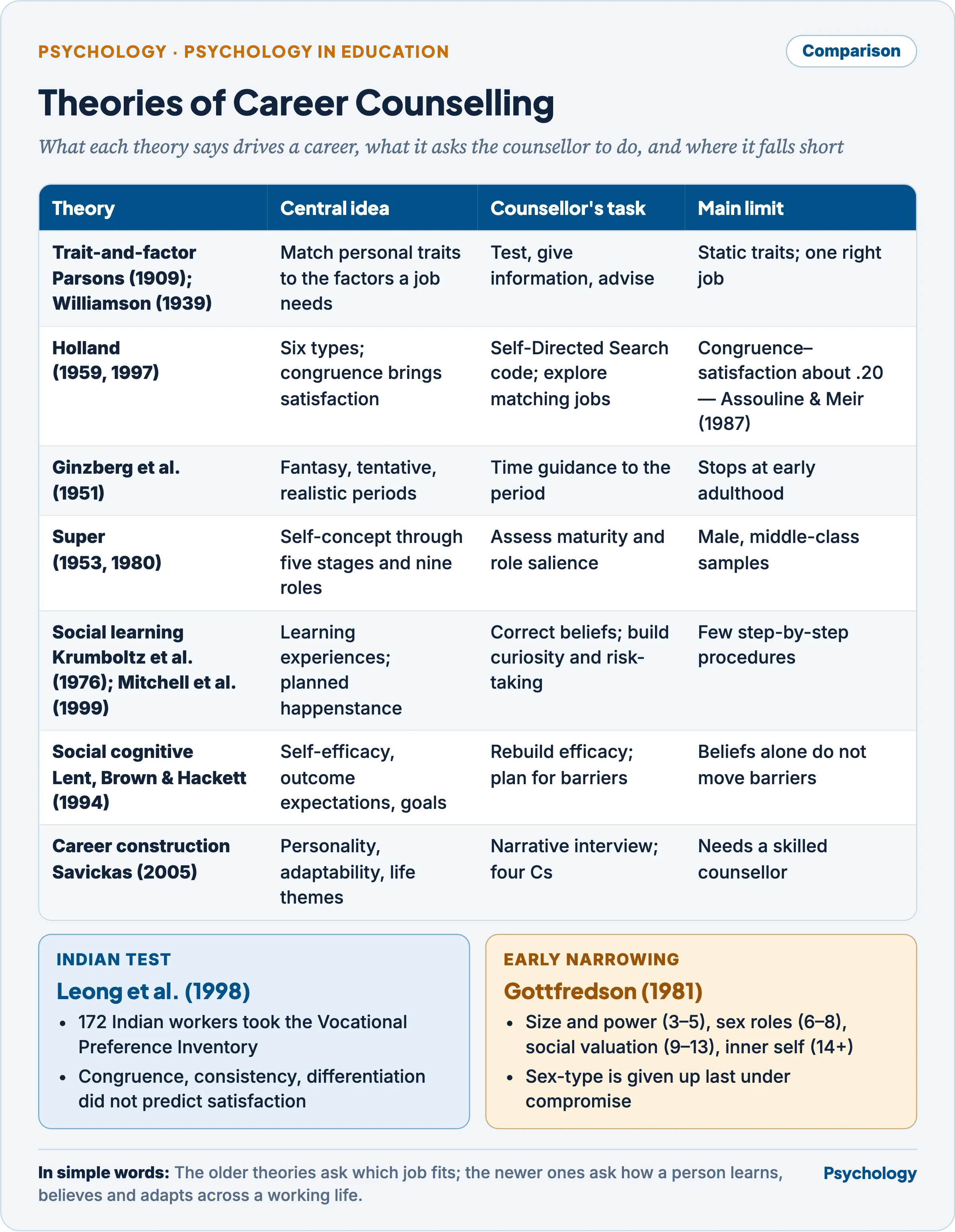
Each theory answers a different question: which job, at what stage, through what learning, or with what story.
Trait-and-factor theory: Parsons and Williamson
- Parsons (1909), in Choosing a Vocation, named three factors: understanding oneself, knowing the requirements and prospects of different lines of work, and “true reasoning on the relations of these two groups of facts”.
- Williamson (1939) made this a six-step, directive method at Minnesota: analysis, synthesis, diagnosis, prognosis, counselling and follow-up, with tests central to analysis.
- It gave counselling the habit of assessing before advising. Limits: it assumes stable, measurable traits, one right job and a rational chooser, and neglects development, motivation and the relationship.
Holland’s theory and its use in counselling
- Holland (1959) proposed six types of person and of work environment, Realistic, Investigative, Artistic, Social, Enterprising and Conventional (RIASEC); people seek environments that let them express their type.
- Holland (1997) set out four diagnostic signs: congruence (person–environment match), consistency (adjacent types on the hexagon), differentiation (a clearly peaked profile) and identity (clear, stable goals).
- In counselling, the client completes Holland’s Self-Directed Search, scores it and explores occupations carrying the resulting three-letter code; the inventories are covered in Interests: Nature, Structure and Measurement (Paper I).
- Evidence: across 63 studies, congruence went with satisfaction, stability and achievement but explained only about 5–10 per cent of their variance (Spokane, 1985); the mean congruence–satisfaction correlation was .21 (Assouline and Meir, 1987).
- Leong, Austin, Sekaran and Komarraju (1998) gave the Vocational Preference Inventory to 172 Indian workers; congruence, consistency and differentiation did not predict job satisfaction, suggesting cultural limits to the theory.
Developmental theories: Ginzberg and Super
- Ginzberg, Ginsburg, Axelrad and Herma (1951) described three periods of choice.
- Fantasy (to about 11): play-based wishes.
- Tentative (about 11–17): choice weighed by interest, then capacity, then values, then a transition to reality.
- Realistic (17 into early adulthood): exploration, crystallisation and specification.
- They saw the outcome as a largely irreversible compromise; Ginzberg (1972) later restated choice as lifelong.
- Super (1953) made vocational development the implementation of a self-concept through five stages (Super, 1957): growth (birth–14), exploration (15–24), establishment (25–44), maintenance (45–64) and decline (65 onwards), each with developmental tasks.
- Career maturity, readiness for age-appropriate decisions, was studied in the Career Pattern Study: ninth-grade boys were psychologically ready for vocational exploration but not yet for vocational choice (Super and Overstreet, 1960).
- Super (1980) added the life-span, life-space view in the life-career rainbow.
- Life-span: the stages form a maxicycle; job loss or migration triggers minicycles of re-exploration and re-establishment at any age (Super, 1984).
- Life-space: nine roles (child, student, leisurite, citizen, worker, spouse, homemaker, parent, pensioner) in four theatres: home, community, school and workplace.
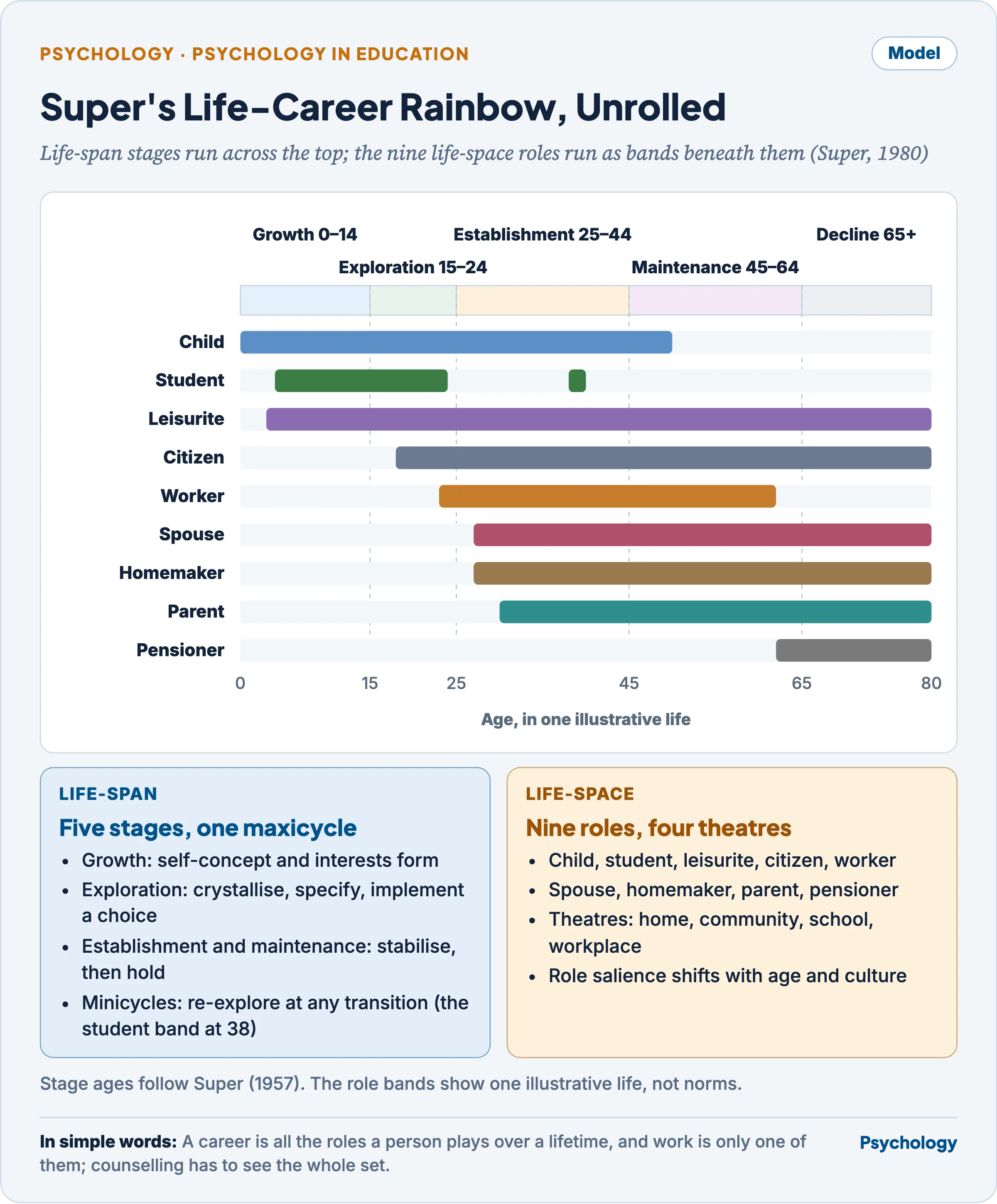
Read down any one age and several roles overlap; read across and the worker role is only one band among nine.
- In counselling: assess maturity and role salience, time the intervention to the stage, and treat a mid-life change as normal recycling.
- Limits: the stages came largely from male, middle-class samples, the self-concept is hard to measure, and the theory describes more than it prescribes.
- In India the family can outweigh personal salience: Agarwala (2008) found the father the most significant influence on the career choice of 93 management students.
Krumboltz: social learning and planned happenstance
- Krumboltz, Mitchell and Jones (1976) explained choice by four factors: genetic endowment and special abilities, environmental conditions and events, learning experiences and task-approach skills.
- These produce self-observation and world-view generalisations, beliefs that may be inaccurate and narrow choice; Krumboltz’s Career Beliefs Inventory finds them.
- Mitchell, Levin and Krumboltz (1999) argued that counselling wrongly tries to eliminate chance, and proposed planned happenstance: clients learn curiosity, persistence, flexibility, optimism and risk-taking to create and use unplanned opportunities.
- Krumboltz (2009) added that “Assessments are used to stimulate learning, not to match personal characteristics with occupational characteristics.”
- Limits: it gives few step-by-step procedures, and experimenting is easiest for those with the money and networks to absorb false starts.
Social cognitive career theory
- Hackett and Betz (1981) applied Bandura’s self-efficacy to women’s careers. Lent, Brown and Hackett (1994) built social cognitive career theory on self-efficacy (beliefs about capability), outcome expectations (beliefs about consequences) and personal goals.
- Its linked models cover interest, choice and performance, later adding work satisfaction (Lent and Brown, 2006) and career self-management (Lent and Brown, 2013).
- Contextual supports and barriers (family, money, gender norms) act directly and through self-efficacy, which gives the theory reach to first-generation learners and girls.
- In counselling: find options ruled out through low self-efficacy rather than low ability, rebuild efficacy by mastery, modelling and persuasion, and plan around barriers.
- Limits: it is cognitive and self-report-based, and changed beliefs do not remove structural barriers.
Career construction theory: Savickas
- Savickas (2005) joined three perspectives: vocational personality (what a person does, after Holland), career adaptability (how transitions are managed, after Super) and life themes (why the work matters).
- Adaptability has four resources, concern, control, curiosity and confidence, measured by the Career Adapt-Abilities Scale, built across 13 countries (Savickas and Porfeli, 2012).
- A narrative interview on role models, favourite stories and early recollections helps the client author a career story; it needs a skilled counsellor and suits clients facing repeated transitions.
Gottfredson: circumscription and compromise
- Gottfredson (1981) showed children narrowing acceptable occupations in four stages: orientation to size and power (3–5), sex roles (6–8), social valuation (9–13) and the unique, internal self (14 onwards).
- Under compromise, people give up field of interest first, then prestige, and sex-type last, because gender is most central to the self-concept.
The career counselling process
- The first task is to diagnose the difficulty: Gati, Krausz and Osipow (1996) classified it as lack of readiness, lack of information or inconsistent information.
- Relationship and intake. Rapport, agreed goals and a first map of the problem: indecision, family conflict, faulty beliefs or distress.
- Assessment. Interests, aptitudes, values, personality, maturity or adaptability, and career beliefs, interpreted with the client.
- Exploration. Occupational information, work shadowing, internships and portals, testing the emerging self-concept against reality.
- Decision. Options narrowed and weighed through the CASVE cycle of Peterson, Sampson and Reardon (1991): communication, analysis, synthesis, valuing, execution.
- Action. A written plan with dates; résumé, interview and job-search skills through role-play and job clubs; plans for barriers.
- Follow-up and evaluation. Progress reviewed; the client recycles to an earlier step when a plan fails.
- Brown and Ryan Krane (2000) found five ingredients that make choice interventions work: written exercises, individualised interpretation and feedback, world-of-work information, modelling, and building support for the choice in the client’s network.
- An illustration from an Indian school:
- A Class 10 girl scores high on spatial and mechanical aptitude in Tamanna and has a Realistic–Investigative interest code, while her family wants medicine.
- The counsellor works on her beliefs about what girls can do, arranges visits to a polytechnic and a workshop, and agrees a two-path plan, reviewed in Class 11.
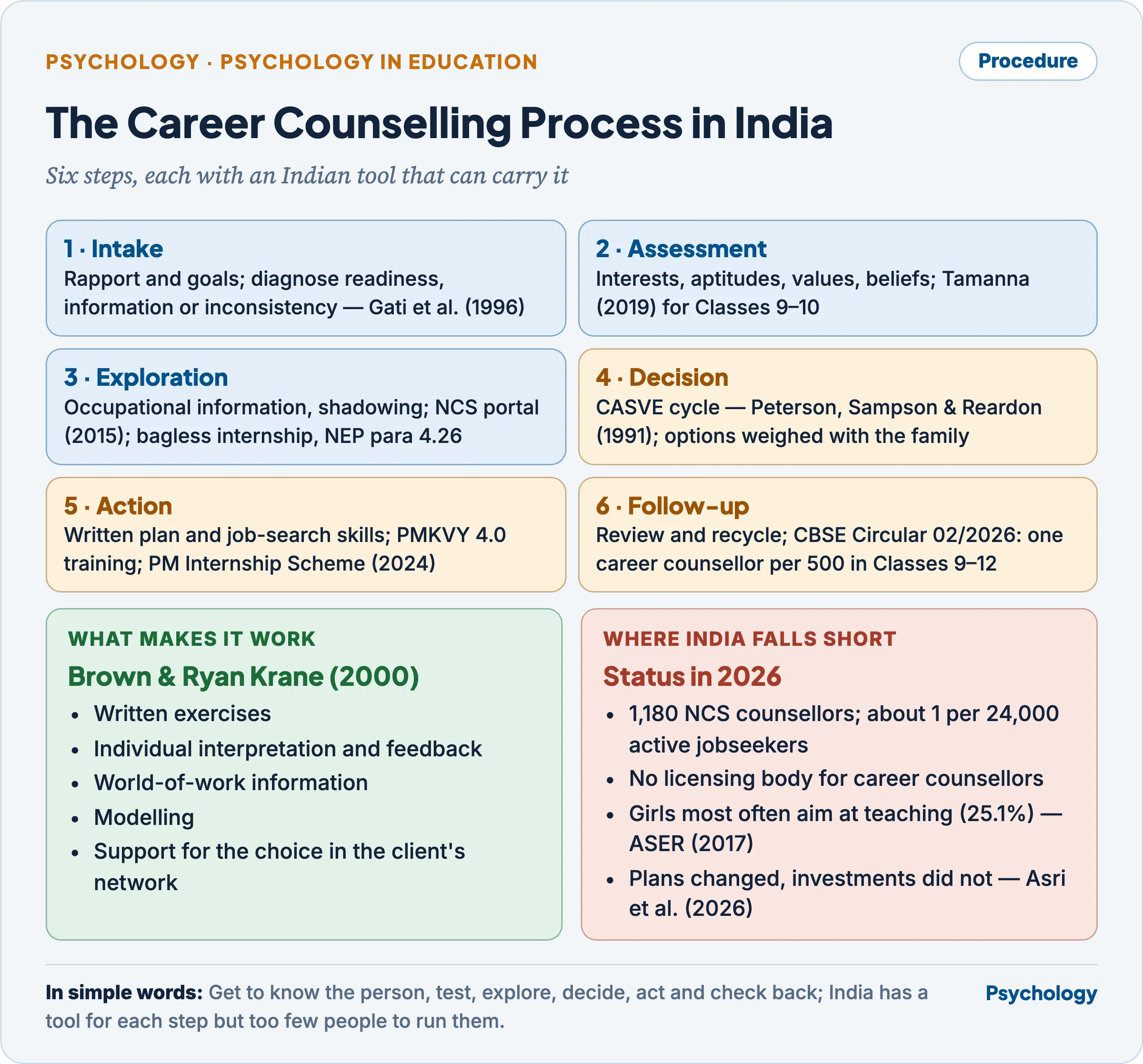
Each step has an Indian tool that could carry it; the missing link is a trained counsellor who joins the steps up.
Importance of career counselling for students’ success in life
- Oliver and Spokane (1988) pooled 240 treatment–control comparisons from 58 studies with 7,311 participants.
- Interventions helped; classes were most effective but took most time; individual counselling gave the most gain per hour.
- Limitation: over half the interventions lasted one or two sessions.
- Whiston, Sexton and Lasoff (1998) replicated this with 47 studies from 1983–1995: moderate positive effects, largest for counselling and for junior high school students.
- Whiston, Brecheisen and Stephens (2003) found counsellor-free interventions consistently less effective, structured groups better than unstructured ones, and computer systems better with a counsellor added.
- Whiston, Li, Goodrich Mitts and Wright (2017), replicating Brown and Ryan Krane across 57 studies, found the largest effects on career decision-making self-efficacy.
- Covacevich, Mann, Santos and Champaud (2021), analysing 10 longitudinal datasets from eight countries for the OECD, found that teenagers who explore, experience and think about future work have lower unemployment, higher wages and more career satisfaction as adults.
- Asri, Asri and Hoeffler (2026): a school-level randomised trial of a 10-hour career-exploration programme with over 6,000 mostly female students in urban India.
- Planning improved, and students gave more weight to personal interests in career choice.
- No medium-term change in educational or skill investments followed; norms and constraints limited what changed plans achieved.
- For a student, the gains are a reasoned stream choice, goal-directed study, confidence to act and a method to reuse at later transitions.
- In India the need comes from a mismatch between education and work, shown in the Periodic Labour Force Survey (PLFS) for 2025.
- Unemployment was 6.5 per cent among those with secondary education and above and 9.9 per cent among 15–29-year-olds, against 3.1 per cent overall (PLFS, 2025).
- One in four 15–29-year-olds, 25.0 per cent, was not in employment, education or training (PLFS, 2025).
Career counselling in the current scenario
- Gig and platform work. NITI Aayog (2022) estimated 77 lakh gig workers in 2020–21 and 2.35 crore by 2029–30.
- The Code on Social Security, 2020, in force from 21 November 2025, defines gig and platform work, so counselling must cover own-account work and irregular income.
- AI and automation. The World Economic Forum (2025) projects 170 million jobs created and 92 million displaced by 2030, with 39 per cent of core skills changing, so students must expect to retrain.
- Multiple careers. Hall (1996) described the protean career, steered by the person’s values rather than an employer; Pryor and Bright (2011) treat careers as complex systems open to chance.
- Decent work. The psychology of working theory (Duffy, Blustein, Diemer and Autin, 2016) centres access to decent work under economic and social marginalisation, which fits India’s informal workforce better than free-choice theories.
- Online tools. Portals, online inventories and the AI tracking proposed in NEP 2020 (para 4.35) widen reach, but counsellor-free help is weaker (Whiston, Brecheisen and Stephens, 2003), and access depends on devices and language.
- Flexible pathways. NEP 2020 removes hard separations between streams (para 4.9) and gives a ten-day bagless internship with local vocational experts in Grades 6–8 (para 4.26), so guidance has to start earlier.
Criticisms and limitations
- Western, individualist assumptions. The theories presume a free chooser, while choice in India is often a family decision (Agarwala, 2008) and Holland’s constructs failed with Indian workers (Leong and colleagues, 1998).
- Choice presumes options. For marginalised youth the question is access to any decent work (Duffy and colleagues, 2016), which counselling cannot supply.
- Test-centred practice. Advice drawn from a single test repeats trait-and-factor’s main weakness, ignoring development, beliefs and context.
- Thin evidence on long-run outcomes. Most studied interventions were brief (Oliver and Spokane, 1988), and changed plans need not change behaviour (Asri and colleagues, 2026).
- Gender bias. Super’s stages assume a continuous career, while women’s careers are more often interrupted and sex-typing begins by six to eight (Gottfredson, 1981).
- Over-cognitive models. Social-cognitive and information-processing models treat choice as reasoning; emotion and family conflict need personal counselling too (Krumboltz, 1993).
Indian context: the current status of career counselling in India
Provision
- National Education Policy, 2020 (Ministry of Education) — mentoring by alumni and volunteers (para 3.7), AI tools for “optimal career choices” (para 4.35), and career counselling in schools (para 17.8) and colleges (para 12.4). Principle: choice by interest, not stream hierarchy.
- Tamanna (CBSE and NCERT, 2019) — a voluntary seven-aptitude test for Classes 9 and 10, piloted with 17,000 students, not to be used to impose subjects or vocations. Principle: self-knowledge, Parsons’ first step.
- CBSE Circular 02/2026 (19 January 2026; amends Affiliation Bye-Laws clause 2.4.12) — one career counsellor per 500 students in Classes 9–12, beside a socio-emotional counsellor; failing one, a trained teacher who qualifies within two years. Principle: career counselling as a distinct role.
- National Career Service (Ministry of Labour and Employment, 20 July 2015) — a portal and 407 approved Model Career Centres; over 1,180 counsellors onboarded and 55 lakh guidance sessions held by January 2026 (PIB, 2026). Principle: world-of-work information at scale.
- Skill India Programme (Ministry of Skill Development and Entrepreneurship; restructured February 2025, ₹8,800 crore for 2022–23 to 2025–26) — PMKVY 4.0 short-term training with on-the-job training, and recognition of prior learning. Principle: self-efficacy through certified mastery.
- PM Internship Scheme (Ministry of Corporate Affairs; pilot from 3 October 2024, 1.25 lakh places) — top-company internships at ₹5,000 monthly plus ₹6,000 on joining (PIB, 2024); opened to final-year students aged 18–25 in April 2026. Principle: reality-testing, Super’s exploration.
- Block-level counsellors under Samagra Shiksha and state career portals are described in Educational and Vocational Guidance.
Evaluation of the current status
- Too few counsellors. About 1,180 portal counsellors against 2.89 crore active jobseekers in July 2026 (Lok Sabha reply, 3 August 2026) is roughly one per 24,000; CBSE’s 1:500 binds only CBSE schools.
- Information rather than counselling. Most provision is portals, tests and job fairs, supplying Parsons’ second factor but not the counsellor contact the evidence favours (Whiston, Brecheisen and Stephens, 2003).
- Unregulated private growth. Fee-charging counsellors and online test providers work without a licensing body or a single required qualification, so quality and norms vary.
- Aptitude-test culture. A one-off test verdict at Class 10 runs against Tamanna’s own caution.
- Gender stereotyping. In ASER (2017), rural boys aged 14–18 most often named the army or police (17.6 per cent) and engineering (11.6 per cent), girls teaching (25.1 per cent) and doctor or nurse (18.1 per cent).
- Almost 40 per cent had no role model for the work they wanted (ASER, 2017).
- Female labour force participation was 40.0 per cent against 79.1 per cent for men (PLFS, 2025).
- Status and family. Government jobs drew 12.8 per cent of boys and 9.3 per cent of girls, and agriculture 1.2 per cent of rural youth (ASER, 2017); fathers often decide (Agarwala, 2008).
- Culture-fitted models. Arulmani (2011), of The Promise Foundation, Bengaluru, argues that guidance must build on a community’s own beliefs about work; career beliefs by income are in Educational and Vocational Guidance.
- Judgement: policy names career counselling at every level and digital reach is large, but delivery is mostly information and testing. Workable ratios, registered counsellors, regional-language tools and outcome evaluation are missing.
Previous Year Questions
- 2024Evaluate the current status of career counselling in India.
- 2021Highlight the importance of career counseling in enhancing students’ success in life.
- 2007Write a short note on: Career counseling in the current scenario.
- 2005Write a short note on: Career counselling.
- 2003Describe the salient tenets of career counselling. Is it different from vocational guidance?
