

Official syllabusPaper II · Unit 5 · Application of Psychology to Educational Field
Training for improving memory and better academic achievement – academic achievement.
Definition
“Academic achievement represents performance outcomes that indicate the extent to which a person has accomplished specific goals that were the focus of activities in instructional environments, specifically in school, college, and university.”
Steinmayr, Meißner, Weidinger and Wirthwein (2014)
Achievement is the outcome schooling exists to produce, and it has many causes: what the learner brings, what the home supplies, what the school does, and the social position from which a child enters it. The practical questions are which of these can be changed, how a learner can be trained to organise study, and how the gap between what a child could do and does can be closed.
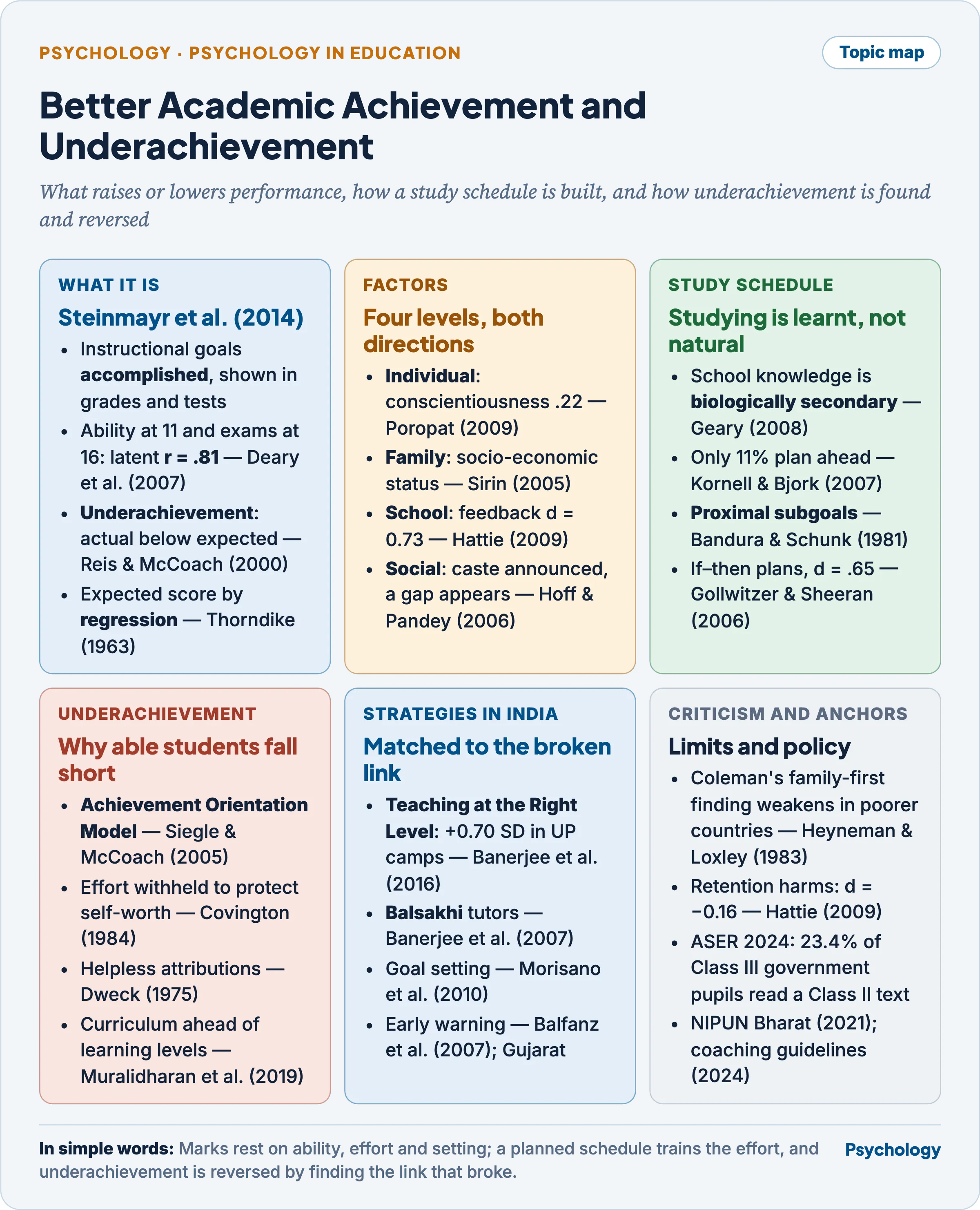
The factors set the conditions; the study schedule and the remedies for underachievement are the parts a student or a school can change.
Factors that affect academic performance
- Most factors raise performance when strong and depress it when weak. The evidence falls into four levels: individual, family, school and social.
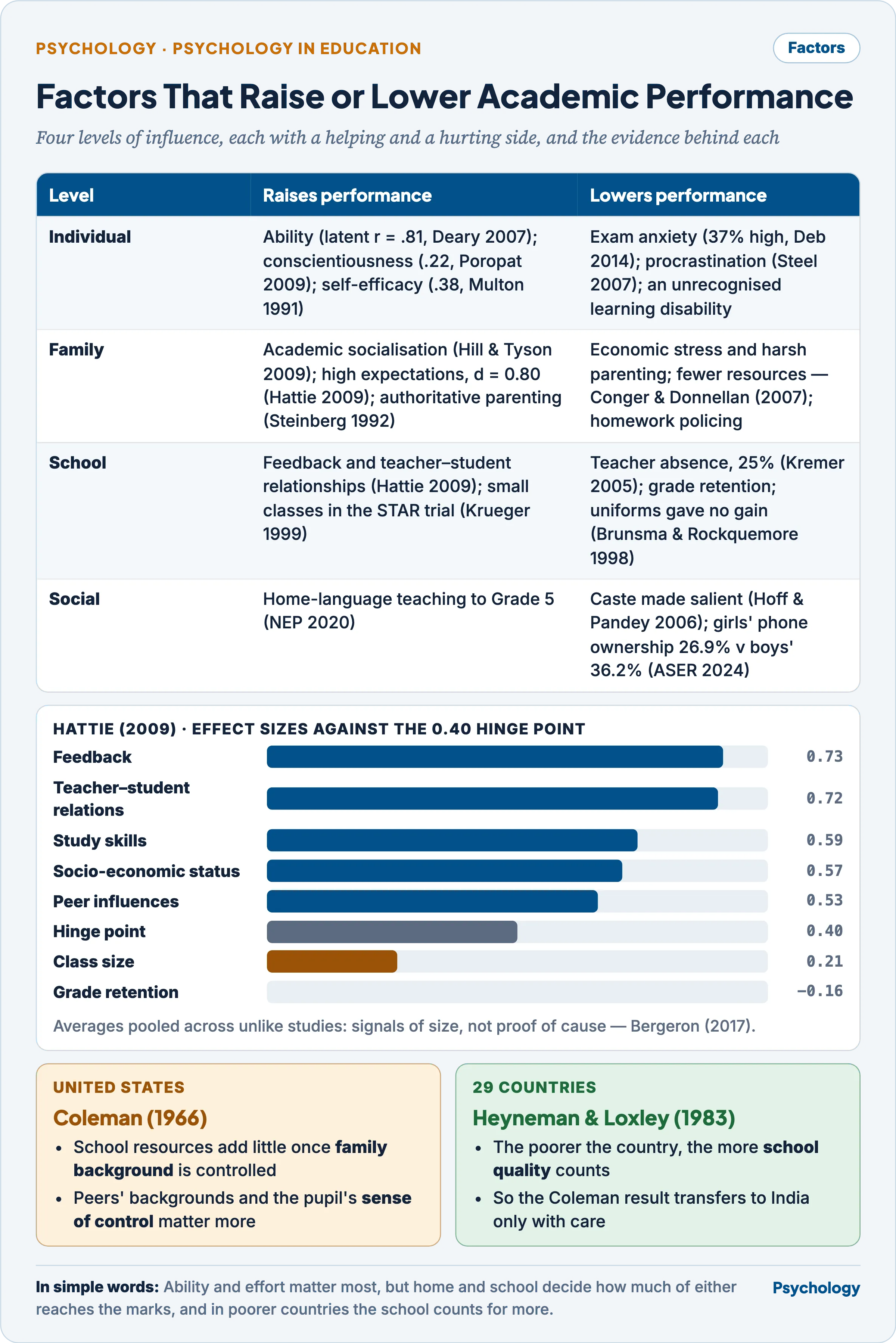
Every level has a factor that helps and one that hurts, and the largest single correlations sit with the learner.
Individual factors: ability, personality, self-efficacy and anxiety
- Ability and prior achievement predict most. Deary, Strand, Smith and Fernandes (2007) followed more than 70,000 English children: a latent intelligence factor at 11 correlated .81 with a latent factor of national-examination results at 16.
- Conscientiousness comes close at higher levels. Poropat (2009) pooled 138 samples (N = 70,926): conscientiousness correlated .22 with academic performance, against .25 for intelligence in the same database, and the two were largely independent.
- Duckworth and Seligman (2005): in two cohorts of eighth-graders (140 and 164), self-discipline measured in autumn accounted for more than twice as much variance as IQ in final grades, and its effect held with earlier grades and IQ controlled.
- Self-efficacy, the belief that one can carry out what a task requires (Bandura, 1977), correlated .38 with academic performance across 36 studies (Multon, Brown and Lent, 1991).
- Richardson, Abraham and Bond (2012), from 241 data sets on university grades: performance self-efficacy was the strongest of 50 correlates, ahead of school grades. The motive itself is in Achievement Motivation and the Measurement of Motivation (Paper I).
- Anxiety lowers performance. Deb, Strodl and Sun (2014) surveyed 400 Class 10 and 12 students in five private Kolkata schools: 35 per cent reported high academic stress and 37 per cent high exam anxiety, and stress was higher among those with lower grades.
- An unrecognised learning disability or attention deficit depresses achievement whatever the effort (see Learning Disabilities and Their Training).
Family factors: socio-economic status, parental education and involvement
- Sirin (2005) meta-analysed 74 independent samples (101,157 students, 6,871 schools): a medium-to-strong relation between socio-economic status and achievement, stronger with status measured at the school than at the student level.
- Conger and Donnellan (2007) give two mechanisms. In the family stress model, economic pressure brings parental distress and harsher, less consistent parenting; in the family investment model, income and parental education buy books, tuition, time and stimulation.
- The kind of involvement matters. Hill and Tyson (2009), across 50 middle-school studies, found academic socialisation (conveying expectations, linking schoolwork to future goals) the most strongly associated with achievement, and help with homework not associated at all.
- Hattie (2009) placed parental aspirations and expectations (d = 0.80) above every other home variable, and found surveillance-style involvement harmful.
- Steinberg and colleagues (1992), with about 6,400 American adolescents: authoritative parenting (Baumrind, 1971) predicted better school performance, partly by making parents’ involvement in schooling effective.
School factors: teachers, peers and class size
- Coleman (1966), in the Equality of Educational Opportunity survey, found school resources added little once family background was controlled; fellow pupils’ backgrounds and a child’s sense of control mattered more.
- Objection: Heyneman and Loxley (1983), across 29 countries, found school and teacher quality weigh more, and family status less, the poorer the country; 1990s TIMSS data no longer showed this pattern (Baker, Goesling and LeTendre, 2002).
- In India, teacher absence comes first: 25 per cent of government primary teachers were absent on unannounced visits (Kremer and colleagues, 2005).
- Hattie (2009) ranked feedback (d = 0.73), teacher–student relationships (0.72) and peer influences (0.53) far above class size (0.21); his method and its critics are in Psychological Principles Underlying Effective Teaching-Learning.
- Experiments do find a class-size effect. In Tennessee’s STAR experiment, with 11,600 pupils randomly assigned to small or regular classes, small classes gained about four percentile points in the first year, more for minority and low-income pupils (Krueger, 1999).
- Brunsma and Rockquemore (1998), using national longitudinal data, found that school uniforms, a popular remedy, had no effect on attendance or behaviour problems and a negative association with achievement.
Social factors: language, caste, gender and digital access
- Language: a child taught in a language not spoken at home spends on decoding the capacity meant for meaning, which is why the National Education Policy 2020 asks for home-language instruction until at least Grade 5 wherever possible.
- Caste can depress performance in the testing room itself: Hoff and Pandey (2006) found no caste gap in maze-solving among village boys until each boy’s caste was announced to the group (described in Psychological Principles Underlying Effective Teaching-Learning).
- Gender and digital access: almost 90 per cent of rural 14–16-year-olds had a smartphone at home, but 36.2 per cent of boys and 26.9 per cent of girls owned one (ASER, 2024).
Training for better academic achievement: organised study schedules
Why studying does not come naturally
- Geary (2008) separates what humans evolved to learn from the biologically secondary knowledge schools teach, such as reading and algebra. Evolved motives do not pull children towards it, so it has to be taught and worked at.
- Willingham (2009): “People are naturally curious, but they are not naturally good thinkers; unless the cognitive conditions are right, people will avoid thinking.”
- Kornell and Bjork (2007): 80 per cent of students said they did not study as they did because a teacher had taught them, 59 per cent studied whatever was due soonest, and only 11 per cent planned a schedule ahead.
- Hartwig and Dunlosky (2012), with 324 undergraduates, found low performers studied late at night more often, and all students, low performers most, were driven by impending deadlines.
- Longer hours do not solve it. Verma, Sharma and Larson (2002) had 100 urban middle-class Indian eighth-graders carry alarm watches for a week: school-related activity filled a third of waking time, and homework produced the most negative states.
- More homework went with lower mood and more internalising problems, while more leisure went with lower achievement and higher academic anxiety.
- Study does need a schedule, but a schedule only organises time. What it yields depends on the strategies used inside it and on whether the student keeps to it.
- That is self-regulation, which Zimmerman (2002) models as forethought, performance and self-reflection. A schedule is forethought made concrete; the cycle is in Psychological Principles Underlying Effective Teaching-Learning.
- Time-management practices measured in 90 college students predicted their grade point average four years later (R² = .21) better than entrance-test scores did (Britton and Tesser, 1991).
Steps in an organised study schedule
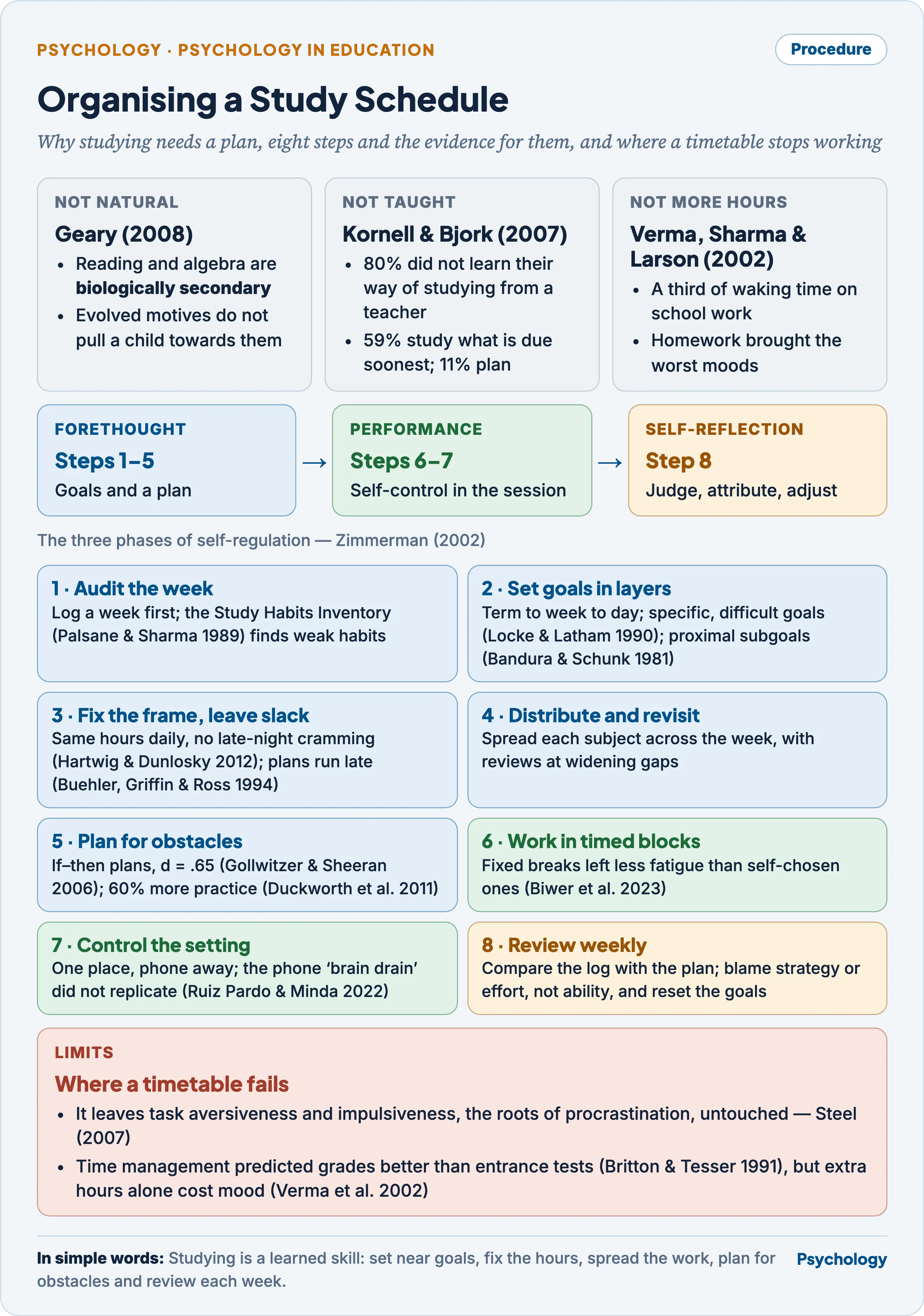
The planning steps come first and the weekly review feeds back into them, following the three phases of self-regulation.
- Audit the week. Log a typical week before planning, as the baseline the plan is judged against. The Study Habits Inventory of Palsane and Sharma (1989), 45 items over eight areas from time management to note-taking and test-taking, shows which habits are weak.
- Set goals in layers. Break the term’s goal into weekly and daily subgoals. Specific, difficult goals beat “do your best” by directing attention, effort, persistence and strategy (Locke and Latham, 1990, 2002); the SMART formula comes from management writing (Doran, 1981).
- Bandura and Schunk (1981): children with gross deficits in arithmetic progressed rapidly and gained self-efficacy and intrinsic interest under proximal subgoals; distal goals had no effect.
- Fix the frame and leave slack. Enter fixed commitments, put study blocks at the same hours daily and the hardest subject in the most alert hours, and protect sleep from late-night cramming.
- Students underestimate their own completion times because they plan from the best case; the bias vanished when they linked predictions to past experience (Buehler, Griffin and Ross, 1994).
- Distribute and revisit. Spread each subject across the week and schedule reviews at widening intervals; the spacing evidence and in-session techniques are in Training for Improving Memory.
- Plan for obstacles. If–then plans (“if a friend calls during mathematics, I call back at seven”) are implementation intentions; across 94 tests they improved goal attainment (d = .65; Gollwitzer and Sheeran, 2006).
- Duckworth and colleagues (2011): 66 high-school students given 30 minutes of mental contrasting with implementation intentions completed more than 60 per cent more practice questions for a high-stakes examination.
- Work in timed blocks. Biwer and colleagues (2023): among 87 students, self-chosen breaks brought more fatigue and distraction than fixed ones, such as the Pomodoro pattern of 24 minutes’ work and 6 minutes’ rest, for the same work done.
- Control the setting. One place, materials ready, phone away. Ward and colleagues (2017) reported that a phone’s mere presence reduced cognitive capacity, but a pre-registered replication found no effect (Ruiz Pardo and Minda, 2022); the rule rests on removing temptation.
- Review weekly. Compare log with plan, put shortfalls down to strategy or effort rather than ability, and reset next week’s goals, closing the cycle.
Limits of a schedule
- A timetable leaves untouched the task aversiveness, low self-efficacy and impulsiveness that Steel (2007) found behind procrastination across 691 correlations. Without strategies that make tasks manageable, and attributions that stop one missed day becoming “I cannot”, it is abandoned.
Academic underachievement
Definition and identification
- Reis and McCoach (2000) offered an “imperfect, yet workable” definition: “Underachievers are students who exhibit a severe discrepancy between expected achievement (as measured by standardized achievement test scores or cognitive or intellectual ability assessments) and actual achievement (as measured by class grades and teacher evaluations).”
- The gap must not be the direct result of a diagnosed learning disability, and must persist over an extended period.
- A low achiever performs in line with measured ability; an underachiever performs below it; a child with a specific learning disability falls short for a neurodevelopmental reason the definition excludes. The able underachiever is treated in Gifted Children: Identification and Training.
- Identification needs two measures: an aptitude test, sampling developed abilities that forecast later learning, and an achievement test of what a course has taught. Underachievement is a shortfall of the second against the first, confirmed by grades over time.
- Thorndike (1963): because ability and attainment correlate imperfectly, expected achievement must be predicted by regression; a simple difference lets regression to the mean label too many of the most able as underachievers.
Causes of underachievement
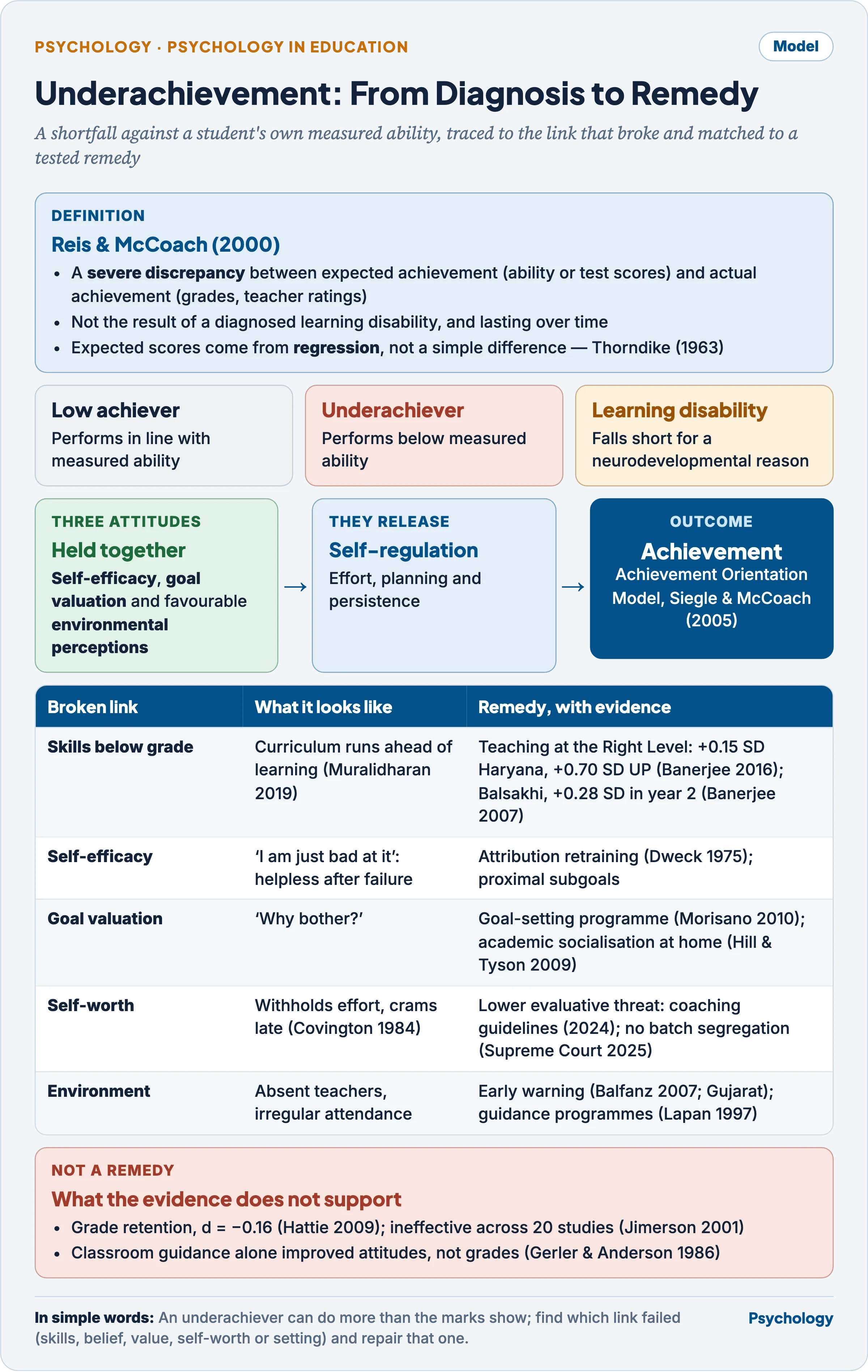
A remedy works only if it repairs the broken link, so diagnosis comes before treatment.
- Achievement Orientation Model (Siegle and McCoach, 2005): a student achieves when self-efficacy (“I can”), goal valuation (“it matters”) and favourable environmental perceptions (“the setting supports me”) together release self-regulation. A shortfall in any one can stall the rest.
- McCoach and Siegle (2003) compared 56 gifted underachievers with 122 gifted achievers: they differed in attitudes to school and teachers, motivation and self-regulation, and goal valuation, but not in academic self-perception.
- Self-worth theory (Covington, 1984): where ability is equated with worth, withholding effort protects the self, since failure after little effort says nothing about ability. Procrastination and last-minute cramming are its visible forms.
- Learned helplessness: a child who puts failure down to lack of ability rather than effort stops trying after setbacks (Dweck, 1975).
- Curricular mismatch: Muralidharan, Singh and Ganimian (2019) found very wide variation in learning levels within a single Delhi grade, with the weakest control-group students learning almost nothing.
- Family pressure, economic stress and identity threat (above) add routes outside the child.
Strategies for dealing with underachievement in Indian schools
- Diagnose before treating. Set an ability measure against a term’s achievement records, screen for learning disability, attention deficit, vision and hearing, and use a study-habits inventory.
- Teaching at the Right Level, developed by Pratham, regroups children by learning level rather than grade for part of the day.
- Banerjee and colleagues (2016): language gains of 0.15 standard deviation in Haryana (government teachers, a dedicated hour) and 0.70 in Uttar Pradesh’s 40-day in-school camps run by Pratham volunteers.
- Limitation: earlier attempts in Bihar and Uttarakhand failed because trained teachers did not adopt the method. The classroom model is in Constructivist Teaching and the Indian Classroom.
- Remedial tutoring. Banerjee, Cole, Duflo and Linden (2007) evaluated the Balsakhi programme in Mumbai and Vadodara, where young women from the community taught basic skills to lagging children: scores rose 0.14 standard deviations in the first year and 0.28 in the second.
- Personalised technology. The adaptive Mindspark programme raised Delhi students’ mathematics scores by 0.37 standard deviations in 4.5 months, with the largest relative gains for the weakest (Muralidharan and colleagues, 2019).
- Attribution retraining. Teaching helpless children to read failure as insufficient effort kept their performance up after failure, where success alone did not (Dweck, 1975); it helps only when effort, not a missing prerequisite, is the problem.
- Goal-setting programmes. Morisano and colleagues (2010) randomly assigned 85 struggling university students to an online personal goal-setting programme or a control task; four months later the goal-setters’ performance had improved significantly.
- With 703 first-year students, a similar programme closed the gender gap in achievement by 98 per cent in a year (Schippers, Scheepers and Peterson, 2015).
- Counselling. Lapan, Gysbers and Sun (1997), with 22,964 students in 236 Missouri high schools, found fuller guidance programmes went with higher reported grades. Gerler and Anderson (1986) found classroom guidance improved 896 children’s behaviour and attitudes but did not significantly change their grades.
- Parental engagement works through academic socialisation, not homework policing (Hill and Tyson, 2009). In Jaunpur district, Uttar Pradesh, information and community-mobilisation campaigns changed neither participation nor learning, while volunteer reading camps raised reading (Banerjee and colleagues, 2010).
- Early-warning systems. Balfanz, Herzog and Mac Iver (2007), following almost 13,000 students, found four sixth-grade signals (poor attendance, misbehaviour, failing mathematics or English) identified 60 per cent of eventual non-graduates.
- Gujarat’s AI-based early-warning system at the Vidya Samiksha Kendra flags elementary-school pupils at risk of dropping out from attendance, assessment and family data (reported 2025).
- Grade retention does not help: its effect is negative (d = −0.16; Hattie, 2009), and Jimerson (2001), reviewing 20 studies, found it ineffective.
- The RTE (Amendment) Act, 2019 nonetheless lets governments allow holding back Class 5 and 8 pupils after a failed re-examination, applied to central government schools from December 2024; the evidence favours the extra teaching before the re-examination over the holding back.
Criticisms and limitations
- Most factor evidence is correlational: part of the socio-economic gradient may reflect parental traits that cause both status and success, which raising income alone would not change (Conger and Donnellan, 2007).
- Underachievement is only as valid as the ability measure behind it, and ability tests themselves reflect schooling, so a deprived child’s “expected” level may be set too low.
- Labelling places the problem in the child. When only 45.8 per cent of rural Class VIII children could do a three-digit by one-digit division (ASER, 2024), the pace of the curriculum explains more of the shortfall than any one child does.
- Effects shrink at scale: Teaching at the Right Level failed in its first government roll-outs, and mindset interventions are weak on average (Sisk and colleagues, 2018).
- Much of the evidence is American, and the balance of family and school effects shifts with national income (Heyneman and Loxley, 1983).
- Marks leave out creativity and well-being, and the Indian time-use data show extra study time costing mood (Verma, Sharma and Larson, 2002).
Indian context
- ASER 2024, surveying 649,491 rural children: 23.4 per cent of Class III government-school children could read a Class II text (16.3 per cent in 2022), and 33.7 per cent of all Class III children could do two-digit subtraction (ASER, 2024).
- PARAKH Rashtriya Sarvekshan (2024), testing 21,15,022 students of Classes 3, 6 and 9 in 74,229 schools on 4 December 2024, found mean mathematics scores falling from 60 to 46 to 37 per cent across the grades, Scheduled Tribe students lowest throughout.
- NIPUN Bharat (2021) (Ministry of Education, under Samagra Shiksha) aims at foundational literacy and numeracy for every child by Grade 3 by 2026–27. It operationalises cumulative learning: “children who fall behind, get left behind”.
- Vidya Pravesh (2021) (Ministry of Education, NCERT): a 12-week, play-based school-preparation module at the start of Grade 1. It operationalises school readiness, narrowing the entry gap before the curriculum widens it.
- Manodarpan (2020) (Ministry of Education): psychosocial support for students, families and teachers through a toll-free helpline. It operationalises the stress–performance link: anxiety takes up the capacity achievement needs.
- The Ministry of Education’s coaching guidelines (2024), issued on 16 January 2024: no enrolment below 16, no misleading promises or rank guarantees, and counselling for students. They target evaluative threat and unrealistic expectation.
- Rajasthan, home to Kota’s coaching industry, enacted the Rajasthan Coaching Centres (Control and Regulation) Act, 2025 (assent 23 September 2025): every centre must register, and none is registered without a counselling system.
- Sukdeb Saha v State of Andhra Pradesh (2025): the Supreme Court held mental health part of the right to life under Article 21.
- Its 15 guidelines include a counsellor wherever 100 or more students are enrolled and, as far as possible, no batch segregation by performance or public shaming.
- Student suicides numbered 14,488 in 2024, 8.5 per cent of all suicides; among under-18s, failure in examination (1,071 deaths) came fourth, after family problems, love affairs and illness (National Crime Records Bureau, 2024).
Previous Year Questions
- 2019“If you accept that studying does not come naturally, then it is apparent that one should need to set-up an organized schedule to promote adequate study.” Comment on this statement and highlight the important steps.
- 2019Describe factors that may positively or negatively affect academic performance.
- 2015Discuss some strategies for dealing with academic underachievement in Indian schools.
