

Official syllabusPaper II · Unit 5 · Application of Psychology to Educational Field
Psychological principles underlying effective teaching-learning process.
Definition
“Using psychological terms, the art of teaching may be defined as the art of giving and withholding stimuli with the result of producing or preventing certain responses.”
Thorndike (1906)
Thorndike’s definition treats teaching as the arrangement of consequences. Later research kept that core and added the learner’s prior knowledge, beliefs about ability and motives. The principles below are grouped by the school that produced them, then read against the conditions of teaching, the learner, and the relationships that set motivation and aspirations.
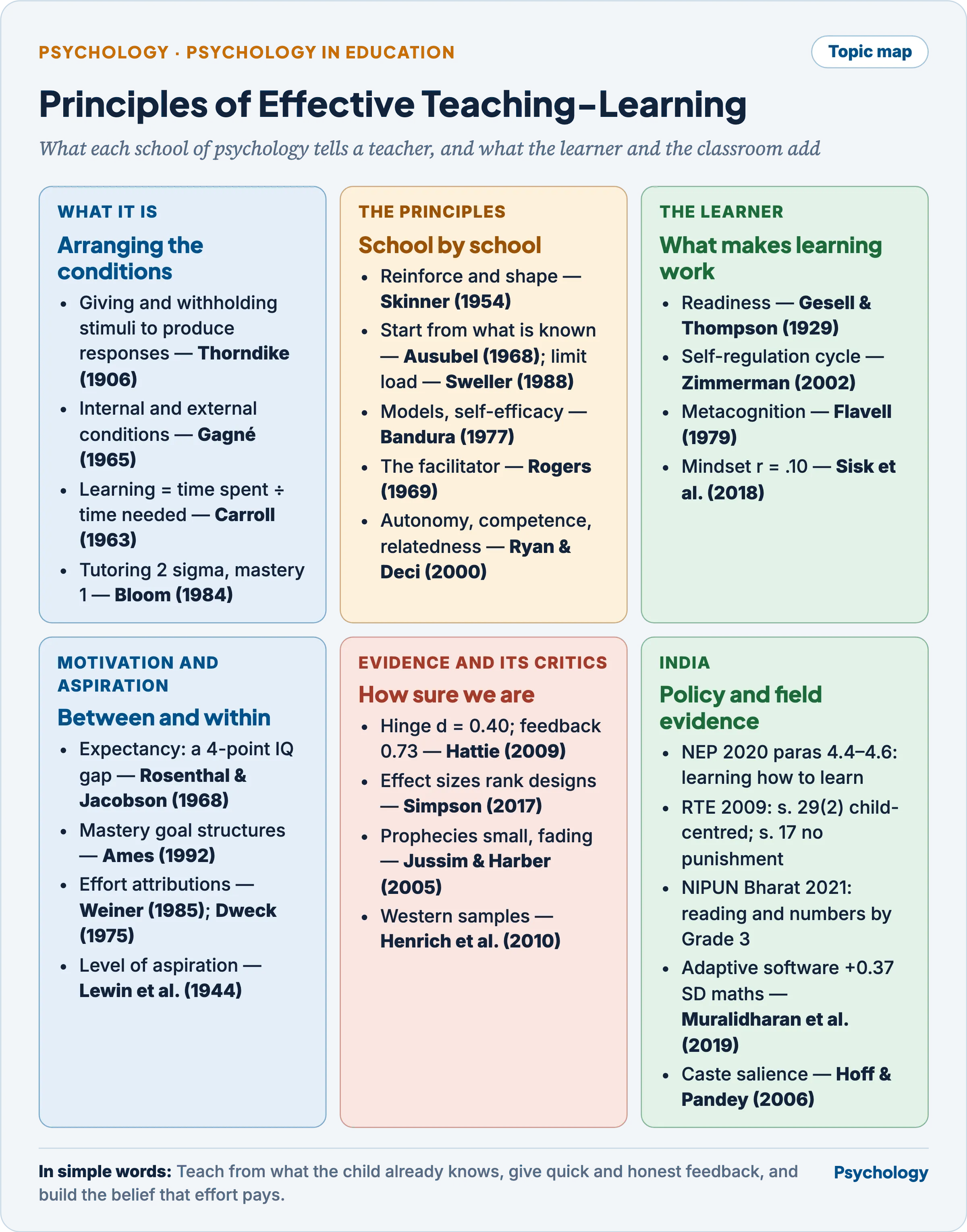
The principles in the top row work only through the learner and the relationships in the bottom row.
Psychological principles underlying effective teaching-learning process
- A psychological principle of teaching is a tested generalisation about how learning occurs, stated so that a teacher can act on it. Thorndike (1906) wanted teaching to rest on “the laws of the sciences of human nature”.
Behavioural principles: reinforcement, shaping, feedback and practice
- Thorndike (1913) stated three laws of learning. The law of readiness says that acting when prepared to act is satisfying; the law of exercise says that connections strengthen with use; the law of effect says that responses followed by satisfaction are stamped in.
- Classroom: practise a new skill several times, ending each attempt with success.
- Thorndike (1932) later weakened the law of effect: reward strengthened a response, but punishment did not weaken it by an equal amount.
- Skinner (1954, 1958) turned operant conditioning into instruction: small steps, an active response at each step, immediate reinforcement, and self-pacing. Teaching machines and programmed instruction followed, set out in Programmed, Probability and Self-Instructional Learning (Paper I).
- Shaping reinforces successive approximations to a target, as when a hesitant reader is praised first for one sentence aloud, then a paragraph. Schedules and their effects are treated in Reinforcement, its Types and Schedules (Paper I).
- The Premack (1965) principle uses a preferred activity to reinforce a less preferred one: “finish the sums, then the drawing”. Token economies and contingency contracts extend the same logic.
- Henderlong and Lepper (2002) concluded that praise helps motivation when it is sincere, credits controllable causes such as effort and strategy, supports autonomy, builds competence without leaning on social comparison, and conveys attainable standards.
- Skinner (1953) held that punishment suppresses behaviour without removing it, and breeds anxiety and avoidance of the punisher.
- Limitation: behavioural principles govern performance better than understanding, and expected rewards can undermine interest (see Motivational principles).
Cognitive principles: meaningful learning, discovery and the conditions of learning
- Ausubel (1968) stated the cognitive principle in his preface: “The most important single factor influencing learning is what the learner already knows. Ascertain this and teach him accordingly.”
- Meaningful reception learning links new material to relevant ideas already in the learner’s cognitive structure; rote learning stores it arbitrarily. An advance organiser is a short, more general introduction that supplies the anchoring ideas before the lesson.
- Classroom: before a unit on the French Revolution, a few minutes on “a revolution transfers power from one group to another” gives every later fact a place to attach.
- Ausubel (1960) — educational psychology students studied an unfamiliar 2,500-word passage on the metallurgical properties of carbon steel.
- One group first read a 500-word abstract, inclusive organiser; a control group, a historical introduction of equal length.
- The organiser group retained more of the passage on a test three days later.
- Limitation: an organiser helps only when learners understand it and it is more general than the lesson; later studies gave mixed results.
- Bruner (1961) argued for discovery learning: students who rearrange evidence to find a rule for themselves remember and transfer it better.
- Bruner (1960) proposed the spiral curriculum, from the hypothesis that “any subject can be taught effectively in some intellectually honest form to any child at any stage of development”.
- Limitation: Mayer (2004) found pure, unguided discovery repeatedly inferior to guided discovery.
- Gagné (1965), in The Conditions of Learning, separated internal conditions (prerequisite capabilities, attention, motivation) from external conditions arranged by the teacher.
- His later scheme (Gagné, 1985) names five learned capabilities needing different conditions: verbal information, intellectual skills, cognitive strategies, attitudes and motor skills.
- Intellectual skills form learning hierarchies: a rule cannot be learnt before the concepts it relates, so place value precedes carrying in addition.
- Gagné’s nine events of instruction: gain attention; state the objective; stimulate recall of prior learning; present the material; provide guidance; elicit practice; give feedback; assess performance; enhance retention and transfer.
- Sweller (1988) founded cognitive load theory: working memory is narrow, and a novice searching for a solution spends it on the search rather than on learning the method.
- Worked examples therefore teach novices better than unaided problem-solving (Sweller and Cooper, 1985): two solved equations before the first unsolved one.
- The expertise reversal effect (Kalyuga and colleagues, 2003): guidance that helps novices becomes redundant for experts.
- Paivio (1971) proposed dual coding: verbal and imaginal codes are separate, so a labelled diagram beside the text gives two routes to recall.
Social-cognitive principles: modelling and self-efficacy
- Bandura (1977) showed that much learning is observational, governed by four processes: attention to the model, retention in symbolic form, motor reproduction, and motivation to perform.
- Classroom: a teacher solving a problem aloud, mistakes included, models the strategy and the persistence together.
- Bandura (1965) — children watched a film of an adult attacking a Bobo doll, with the model rewarded, punished, or neither.
- Children who saw the model punished imitated least.
- When then offered an incentive to reproduce the acts, all three groups did so equally.
- Consequences regulate performance; the learning had occurred anyway.
- Self-efficacy is the belief in one’s capability to organise and execute the actions a task requires (Bandura, 1977, 1997). It draws on four sources: mastery experiences, vicarious experience, verbal persuasion and physiological and emotional states.
- Schunk and Hanson (1985) — children struggling with subtraction who watched a peer model gained more self-efficacy and achievement than those who watched a teacher model.
- Limitation: self-efficacy is domain-specific (Bandura, 1997), so confidence built in one subject does not carry to another.
Constructivist and humanistic principles
- Constructivism holds that learners build knowledge by acting on it and talking about it, with adults scaffolding what the learner cannot yet do alone.
- The theory sits in Piaget’s Theory of Cognitive Development and Socio-Cultural Theory and Multicultural Socialisation (Paper I); classroom practice in Constructivist Teaching and the Indian Classroom.
- Rogers (1969), in Freedom to Learn, held that “the goal of education, if we are to survive, is the facilitation of change and learning”.
- Significant learning is self-initiated, involves the whole person, and is evaluated by the learner.
- The facilitator needs realness (genuineness), prizing, acceptance and trust, and empathic understanding.
- Classroom: students choose a local water problem to investigate and judge their own report against criteria they helped set.
- Limitation: humanistic principles are hard to test as stated, and a classroom built on them alone can lose academic demand.
Motivational principles
- Lepper, Greene and Nisbett (1973) — preschool children who liked drawing were promised a “Good Player Award”, given one unexpectedly, or not rewarded.
- Later, in free time, the expected-award group drew least.
- The authors explained it by their overjustification hypothesis: a child who expects a reward credits the drawing to the reward and discounts their own interest.
- Limitation: a single nursery school and a short follow-up.
- Deci, Koestner and Ryan (1999), across 128 studies, found expected tangible rewards undermined free-choice intrinsic motivation, while positive feedback enhanced it (d = 0.33).
- Ryan and Deci (2000) named three needs whose satisfaction sustains intrinsic motivation: autonomy, competence and relatedness. In class: real choices, tasks of optimal difficulty, and a teacher who knows each child.
- The broader theory is in Intrinsic and Extrinsic Motivation and Achievement Motivation and the Measurement of Motivation (Paper I).
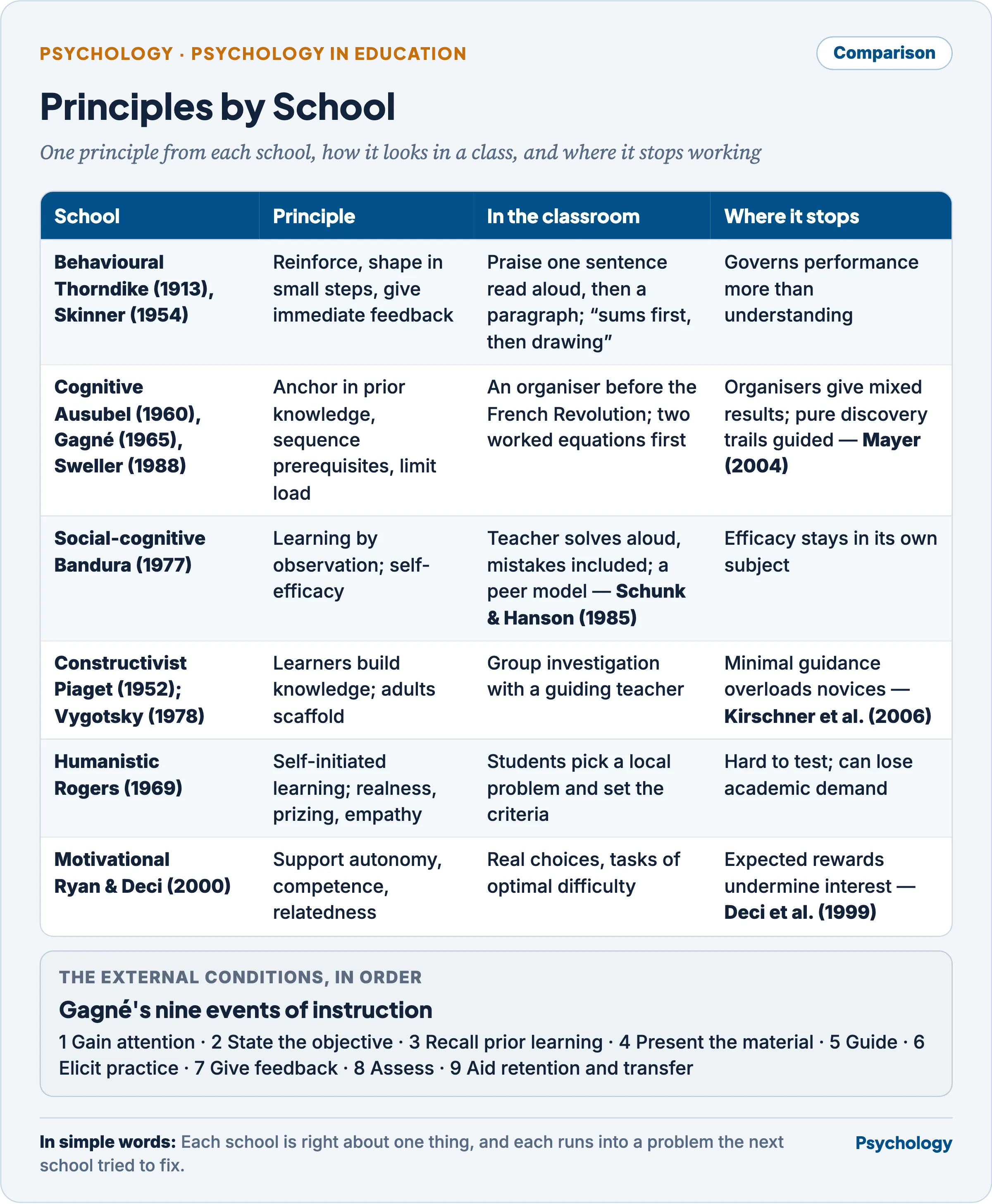
Each school’s principle has a limit that the next school was built to answer.
Conditions under which the teaching-learning process occurs
- Carroll (1963) defined the degree of learning as the ratio of time actually spent to time needed.
- Time spent depends on opportunity to learn and perseverance.
- Time needed depends on aptitude, quality of instruction and the learner’s ability to understand instruction.
- Bloom (1968) built mastery learning on Carroll’s model: give slower learners more time and corrective feedback, and most reach mastery.
- Bloom (1984) found that the average student taught one-to-one with mastery methods “was above 98% of the students in the control class”; the average mastery-learning student, above 84%.
- Gagné’s internal conditions add prerequisite knowledge, attention and motivation; his external conditions are the nine events.
- Affective conditions matter as much: a child afraid of ridicule or punishment cannot attend, which Indian law recognises (see Indian context).
- Practice conditions — spacing, retrieval and interleaving — are treated in Training for Improving Memory; how learning styles enter teaching, in Learning Styles.
Characteristics of a learner that make learning effective
- Readiness — maturational and cognitive. Gesell and Thompson (1929) trained one identical twin in stair-climbing for six weeks from 46 weeks; her untrained co-twin, first trained at 53 weeks, quickly reached her level. Limitation: a single pair of twins.
- Prior knowledge — the anchoring ideas Ausubel’s principle requires; gaps in prerequisites stall the hierarchy Gagné described.
- Motivation and self-efficacy, as above.
- Self-regulation. Zimmerman (2002): “Self-regulation is not a mental ability or an academic performance skill; rather it is the self-directive process by which learners transform their mental abilities into academic skills.”
- Three cyclical phases: forethought (task analysis, goal setting, self-efficacy beliefs), performance (self-control, self-observation), self-reflection (self-judgement, self-reaction).
- Metacognition: Flavell (1979) separated metacognitive knowledge of persons, tasks and strategies from metacognitive experiences, the felt sense of understanding.
- A monitoring learner notices when a paragraph has not made sense and rereads it. The theory is in Metamemory (Paper I).
- Growth mindset: Dweck (2006) argued that students who believe ability can grow persist after failure.
- Sisk and colleagues (2018): two meta-analyses found mindset correlated with achievement at r = .10 and interventions changed achievement by d = 0.08, with some benefit for low-SES and academically at-risk students.
- Yeager and colleagues (2019), in a nationally representative US sample, found an online session of under an hour raised lower-achievers’ grades, chiefly where peer norms supported the message.
- Attention and working memory set how much new material a lesson can carry (Sweller, 1988).
Interpersonal and intrapersonal processes affecting motivation and aspirations
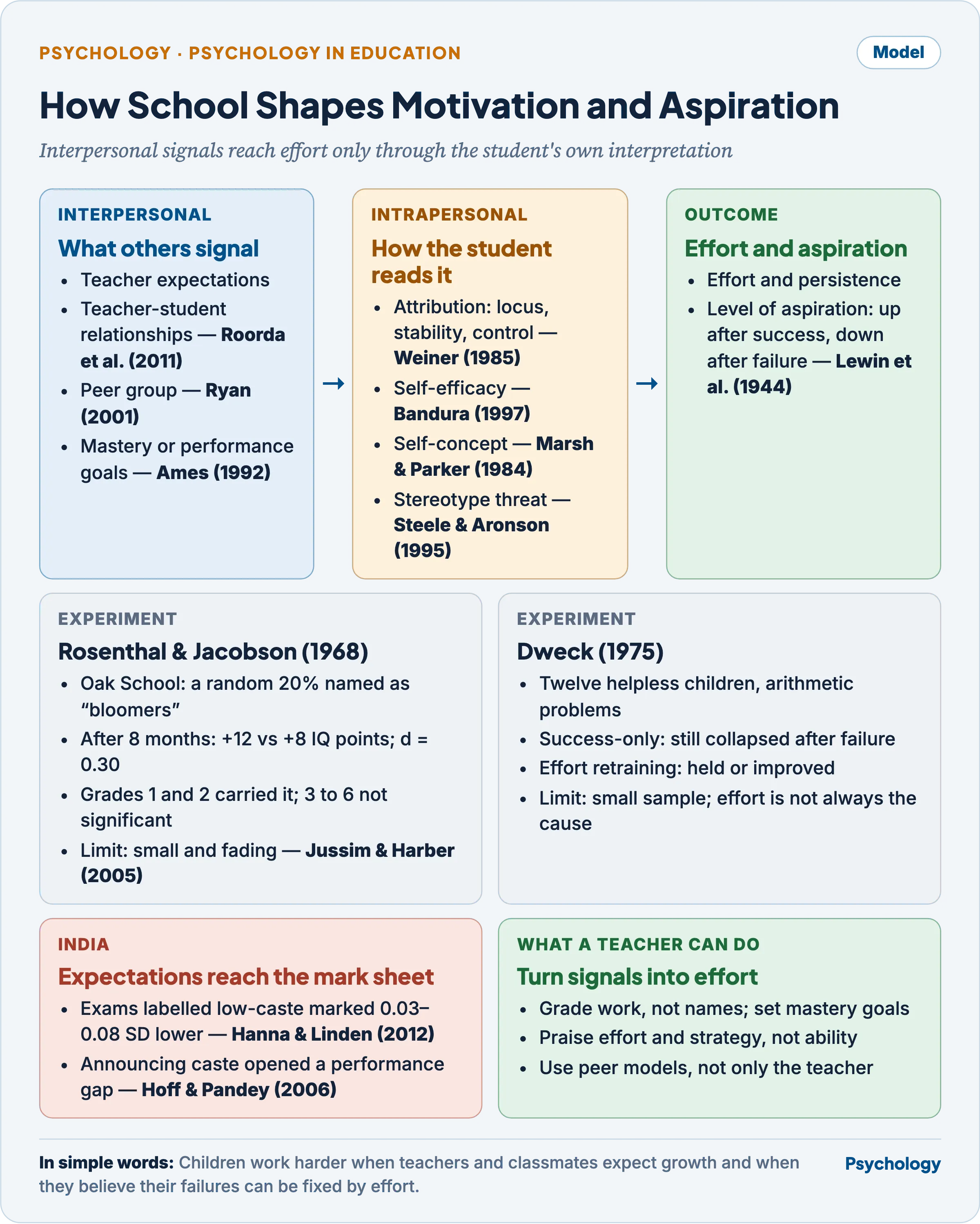
Expectations from teachers and peers reach motivation only after the student has interpreted them.
Interpersonal processes
- Rosenthal and Jacobson (1968) — Oak School, 18 classes across six grades; a group IQ test was presented as predicting “blooming”, and a random 20 per cent were named to teachers as bloomers.
- Eight months on, named children gained about 12 IQ points and controls about 8 — a 4-point difference, effect size 0.30.
- The reanalysis by Jussim and Harber (2005) shows the gain came almost entirely from grades 1 and 2 (about 15 and 10 points); grades 3 to 6 showed no significant effect.
- Raudenbush (1984), across 18 experiments, found expectancy effects only when the induction came within the first two weeks, before teachers knew their pupils.
- Jussim and Harber (2005) concluded that classroom self-fulfilling prophecies occur but are typically small and tend to dissipate, may be powerful for stigmatised groups, and that teacher expectations predict outcomes chiefly because they are accurate.
- Teacher-student relationships. Roorda and colleagues (2011), across 99 studies, found medium-to-large associations with engagement and small-to-medium with achievement; negative relationships mattered more in primary school.
- Peers. Ryan (2001) found that the peer group a young adolescent belonged to in the autumn predicted later change in liking for school and in achievement.
- Cooperative structures such as the jigsaw classroom (Aronson and colleagues, 1978) make each student’s piece essential to the group.
- Classroom goal structures. Ames (1992) showed that how a teacher designs tasks, shares authority, and evaluates and recognises work makes either mastery goals (learning, improvement) or performance goals (outdoing others) salient.
- The dimensions are summarised as TARGET: task, authority, recognition, grouping, evaluation, time.
- Students who saw their class as mastery-oriented used more effective strategies and linked success to effort (Ames and Archer, 1988).
Intrapersonal processes
- Attribution. Weiner (1985) classified causes of success and failure by locus, stability and controllability; failure blamed on low ability (internal, stable, uncontrollable) lowers expectancy, failure blamed on low effort does not.
- Dweck (1975) — twelve children identified as helpless solved arithmetic problems over a training period.
- Success-only training: performance still collapsed after failure.
- Attribution retraining, which taught them to read failure as insufficient effort: performance held or improved.
- Limitation: a small sample, and effort attributions mislead when a child genuinely lacks a prerequisite.
- Academic self-concept. Marsh and Parker (1984) described the big-fish-little-pond effect: equally able students report lower self-concept in high-ability schools.
- Marsh and Hau (2003) confirmed it across 26 countries; Marsh and Craven (2006) showed self-concept and achievement reinforce each other over time.
- Level of aspiration, studied by Hoppe (1930) and set out by Lewin, Dembo, Festinger and Sears (1944): the standard a person sets for the next attempt.
- Success typically raises it and failure lowers it, and success is felt only relative to it.
- The group’s standards shift it, the root of Festinger’s (1954) social comparison theory.
- Stereotype threat. Steele and Aronson (1995) found Black students underperformed White students on a difficult verbal test framed as diagnostic of ability, but not when it was framed as non-diagnostic.
- Limitation: a pre-registered test with 2,064 Dutch students found no stereotype-threat effect on girls’ mathematics scores (d = −0.05; Flore and colleagues, 2018).
Evidence of what works
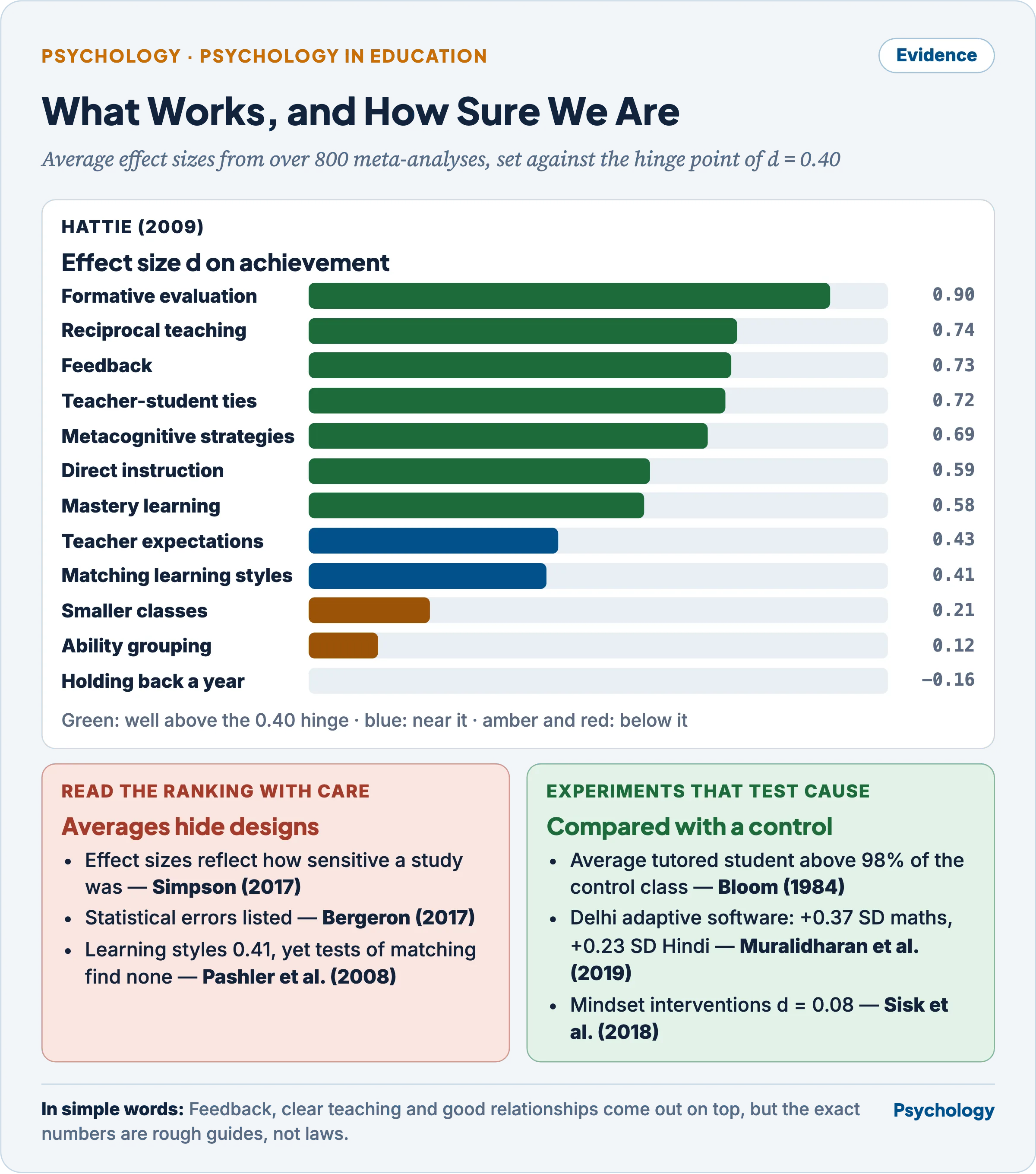
Feedback sits far above the hinge; matching learning styles clears it despite failing direct tests.
- Hattie (2009) synthesised over 800 meta-analyses of more than 50,000 studies into 138 influences, taking the average effect, d = 0.40, as the hinge point.
- High: formative evaluation 0.90, reciprocal teaching 0.74, feedback 0.73, teacher-student relationships 0.72, metacognitive strategies 0.69, direct instruction 0.59, mastery learning 0.58.
- Low: class-size reduction 0.21, ability grouping 0.12, holding a child back a year −0.16.
- Rosenshine (2012) distilled ten principles from research on cognition, master teachers and cognitive supports: daily review, small steps, many questions, models, guided practice, frequent checks for understanding, a high success rate, scaffolds, independent practice and periodic review.
- Criticism:
- Simpson (2017) showed that a standardised effect size reflects how sensitive a study’s design and measure were, so a league table averaged across unlike studies partly ranks the sensitivity of research designs.
- Bergeron (2017) listed statistical errors, including a common-language effect size miscalculated throughout the book, which Hattie acknowledged.
- Hattie’s 2009 list put “matching learning styles” at 0.41, above the hinge, though experiments designed to test matching find no benefit (Pashler and colleagues, 2008; see Learning Styles); his 2012 list cut it to 0.17.
Criticisms and limitations
- Henrich, Heine and Norenzayan (2010) showed psychology’s samples come overwhelmingly from Western, educated, industrialised, rich and democratic societies; most of these principles were tested in such classrooms.
- Celebrated findings have shrunk on replication: teacher expectancy (Jussim and Harber, 2005), growth mindset (Sisk and colleagues, 2018) and stereotype threat (Flore and colleagues, 2018).
- The schools conflict. Rewards that shape behaviour can undermine interest (Deci and colleagues, 1999); discovery that motivates can overload novices (Kirschner, Sweller and Clark, 2006).
- Principles describe the average learner; individual differences in readiness, language and ability decide which applies (The Nature of Individual Differences, Unit 1).
- They assume conditions Indian classrooms often lack: small classes, a shared language, time for feedback, and assessment that rewards understanding over recall.
Indian context
- National Education Policy 2020 (Ministry of Education) — para 4.4 moves pedagogy “towards real understanding and towards learning how to learn – and away from the culture of rote learning”.
- Para 4.6 adopts experiential learning and competency-based classrooms; para 4.34 makes assessment chiefly for learning.
- Principles operationalised: meaningful learning (Ausubel, 1968), constructivism, and formative feedback (Hattie, 2009).
- RTE Act, 2009 (Right of Children to Free and Compulsory Education) — section 29(2)(e) requires “learning through activities, discovery and exploration in a child friendly and child-centred manner”; 29(2)(g), “making the child free of fear, trauma and anxiety”.
- Section 17(1): “No child shall be subjected to physical punishment or mental harassment.”
- Principles operationalised: discovery learning (Bruner, 1961) and the side effects of punishment (Skinner, 1953).
- NIPUN Bharat (Ministry of Education, 5 July 2021, under Samagra Shiksha) — every child to attain foundational literacy and numeracy by the end of Grade 3 by 2026–27, with goals set as Lakshya Soochi targets and each child’s progress tracked.
- Principles operationalised: learning hierarchies (Gagné, 1965) and mastery learning (Bloom, 1968) — later learning waits on the foundation.
- Manodarpan (then Ministry of Human Resource Development, 21 July 2020) — psychosocial support for students’ mental health, with a national toll-free helpline. Principle: the affective conditions of learning.
- Muralidharan, Singh and Ganimian (2019) — Delhi; 619 mostly Grade 6–9 students in low-income neighbourhoods; a lottery offered free after-school access to Mindspark, software that teaches each child at their measured level with instant feedback, plus group instruction.
- Over 4.5 months, winners scored 0.37 SD higher in mathematics and 0.23 SD higher in Hindi; the weakest gained most relative to their start.
- It applies shaping, immediate feedback and teaching at the learner’s level. Limitation: an after-school setting, not a regular class.
- Hanna and Linden (2012) — teachers graded exams whose cover sheets carried randomly assigned caste, gender and age.
- Papers labelled low-caste received 0.03–0.08 SD lower marks; the bias came from low-caste teachers.
- Expectations can thus lower marks directly, through grading.
- Hoff and Pandey (2006) — 321 high-caste and 321 low-caste junior high school boys in rural Uttar Pradesh solved mazes for cash.
- With caste unannounced the groups performed equally; once caste was publicly announced, low-caste boys’ performance fell and a caste gap opened.
- The fall came where rewards involved others’ judgement: expected prejudice depressing effort. Limitation: a laboratory task, boys only.
- Teaching at the Right Level is treated in Constructivist Teaching and the Indian Classroom.
Previous Year Questions
- 2026Discuss the interpersonal and intrapersonal processes in educational environment that effect the motivational level and aspirations of students.
- 2024Explain various psychological principles underlying effective teaching-learning process. Illustrate your answer with the help of suitable examples.
- 2016Examine some important psychological principles underlying effective teaching-learning process.
- 2006What are the important psychological principles responsible for effective teaching and learning processes? Discuss in detail as to how Gifted and Retarded can be trained.
- 2002Discuss the various conditions under which the teaching-learning process occurs. Defining learning styles indicate how knowledge of learning style of student would contribute to more effective teaching-learning process.
- 1999Describe the characteristics of a learner, which make learning effective.
