

Official syllabusPaper II · Unit 4 · Work Psychology and Organisational Behaviour
Power and politics in organizations.
Definition
“Organizational politics involves those activities taken within organizations to acquire, develop, and use power and other resources to obtain one’s preferred outcomes in a situation in which there is uncertainty or dissensus about choices.”
Pfeffer (1981)
Power is the capacity to change what others do; politics is that capacity at work wherever formal rules leave choices open. Both arise from dependence and scarcity, so even the most rule-bound bureaucracy has a power structure and a politics of its own.
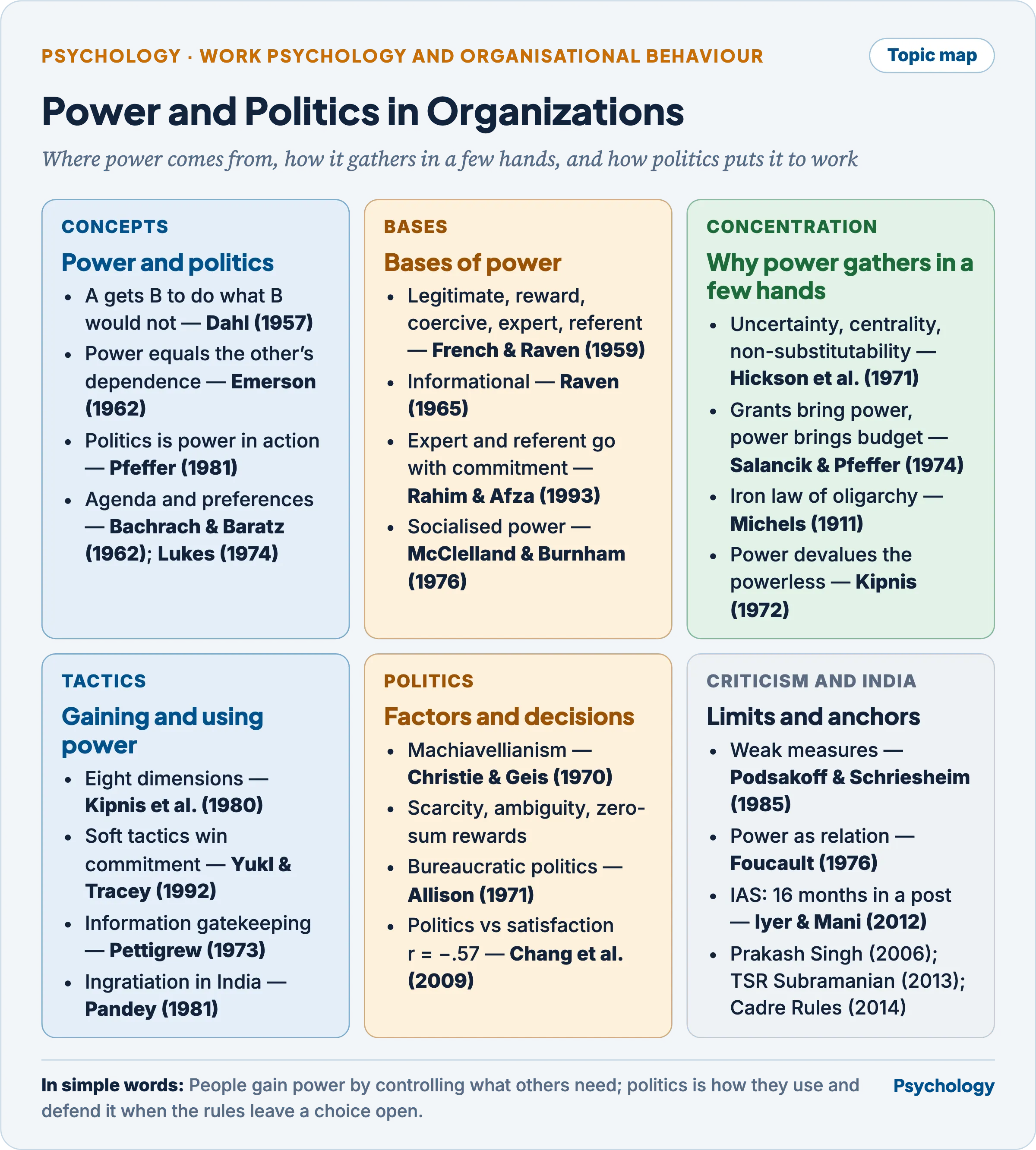
The top row is where power comes from; the bottom row is how tactics and politics spend it.
Power in organizations: definition and dependence
- Dahl (1957) gave the classic statement: “A has power over B to the extent that he can get B to do something that B would not otherwise do.”
- Weber (1922) defined power as “the probability that one actor within a social relationship will be in a position to carry out his own will despite resistance” — a probability, so it exists before it is used.
- Three terms are kept apart:
- Power — the potential to affect behaviour.
- Influence — the actual change produced when power is used.
- Authority — power accepted as rightful because it attaches to a position.
- Emerson (1962) stated the power-dependence principle: A’s power over B equals B’s dependence on A. Dependence rises with how much B values what A controls and falls with B’s alternatives.
- Hence three conditions make a resource a source of power: it is important, scarce and non-substitutable.
- Power differs from leadership. Power needs only dependence and can run in any direction; leadership needs some compatibility of goals with followers, which is set out in Leadership and Participatory Management.
How power and politics go hand in hand
- Pfeffer (1981) put the relation in one line: “Power is a property of the system at rest; politics is the study of power in action.”
- Pfeffer (1981) traced both to the same chain of conditions.
- Interdependence, differing goals and beliefs, and scarce resources produce conflict.
- Conflict is settled by power and politics rather than by rules or analysis — most of all when the decision is important and power is dispersed.
- Mintzberg (1983) described four systems of influence — authority, ideology, expertise and politics. Politics is the informal, parochial, divisive one, sanctioned by none of the other three though it exploits each of them.
- Farrell and Peterson (1982) defined political behaviour as activity not required by one’s formal role that influences, or tries to influence, the distribution of advantages and disadvantages within the organisation.
- Power works on three faces, and politics on all three.
- Decisions — who prevails on an open issue (Dahl, 1957).
- Non-decisions — keeping issues off the agenda (Bachrach and Baratz, 1962).
- Shaping preferences — so that a grievance never forms (Lukes, 1974).
- The two are therefore circular. Politics is how power is acquired, used and defended; power is what politics wins and then spends; and each round of winning enlarges the base for the next.
Bases of power
- French and Raven (1959) identified five bases of social power; Raven (1965) added a sixth, informational power.
- They fall into two classes:
- Position (formal) power — legitimate, reward and coercive, which come with the office and are lost with it.
- Personal power — expert and referent, which travel with the person.
| Base | Rests on | Why the target complies | Typical result |
|---|---|---|---|
| Legitimate | Accepted right of the office | “He has the right to ask” | Compliance within the role |
| Reward | Control of valued outcomes | To gain the outcome | Compliance while watched |
| Coercive | Control of punishments | To avoid the penalty | Compliance or resistance |
| Expert | Knowledge the target lacks | Trust in competence | Commitment |
| Referent | Liking and identification | To be like or please the agent | Commitment |
| Informational | The content of an argument | Understands the reason | Change that lasts unaided |
- Raven (1965, 1992) sorted the bases by the change they produce: reward and coercion, socially dependent change that needs the agent’s surveillance; legitimate, expert and referent, dependent change that needs none; informational, socially independent change.
- The bases map onto Kelman’s (1958) three processes of social influence: reward and coercion yield compliance, referent power identification, expert and informational power internalisation.
- Raven (1992) later split the six into finer forms — personal and impersonal reward and coercion; legitimacy of position, reciprocity, equity and dependence — measured by the Interpersonal Power Inventory (Raven, Schwarzwald and Koslowsky, 1998).
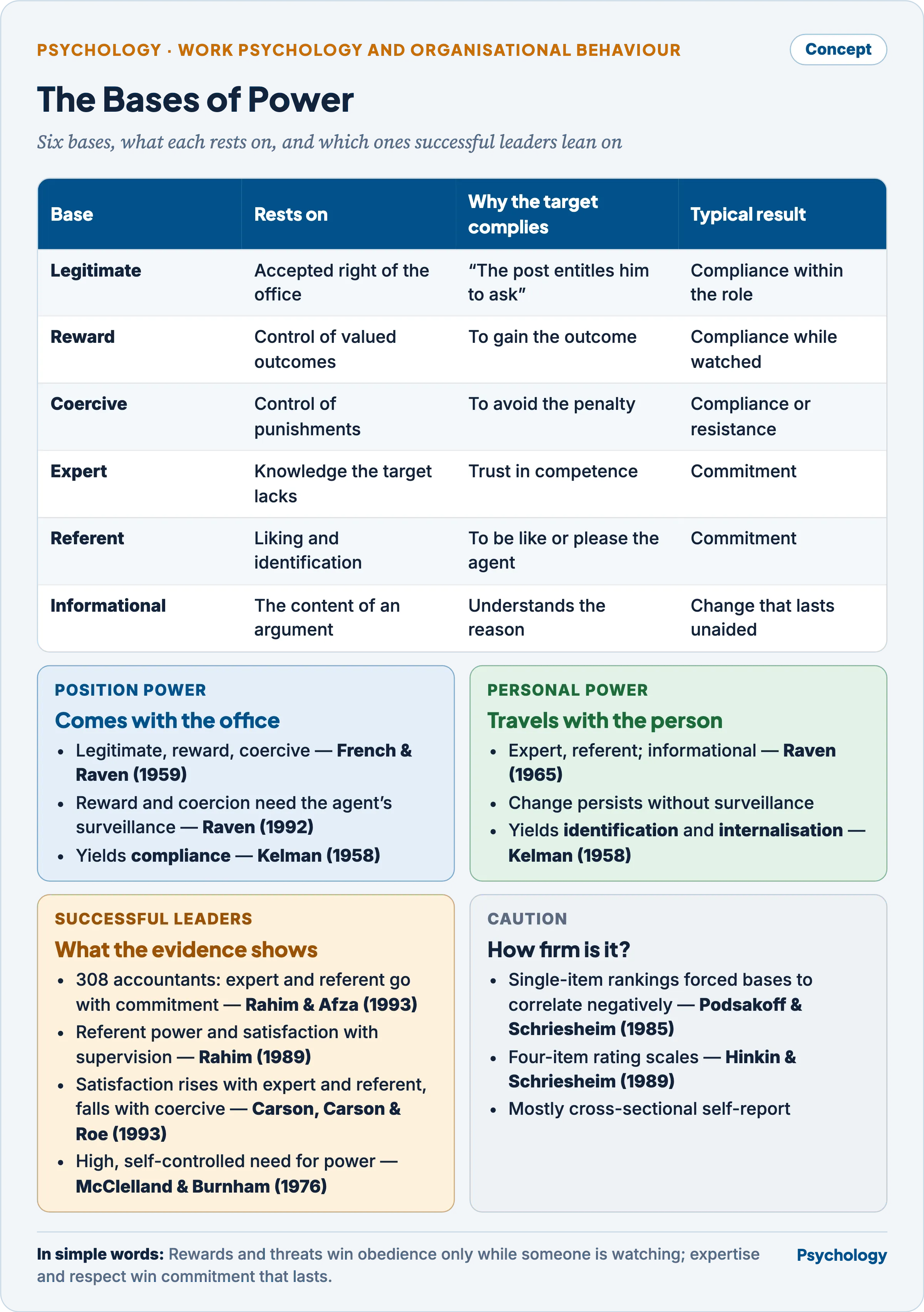
Moving down the table, compliance gives way to commitment, and the need to watch the target disappears.
Bases of power used by successful leaders
- Rahim and Afza (1993) surveyed a national random sample of 308 American accountants.
- Expert and referent power were positively related to commitment; referent power also to satisfaction; legitimate and referent power to behavioural compliance.
- Limitation: one occupation, one cross-sectional self-report survey.
- Rahim (1989), in a national sample of US managers, found referent power positively related to subordinates’ satisfaction with supervision.
- Carson, Carson and Roe (1993) meta-analysed the field studies: expert and referent power correlated strongly and positively with satisfaction with supervision, legitimate and reward power weakly positively, and coercive power strongly negatively.
- McClelland and Burnham (1976) found the most effective managers high in need for power, lower in need to be liked and high in self-control — socialised power, set out in Achievement Motivation and the Measurement of Motivation (Paper I).
- The pattern: successful leaders hold legitimate power anyway, build expert and referent power on top of it, and use reward sparingly and coercion as a last resort.
- In Indian settings the nurturant-task leader joins position power to personalised nurturance, set out in Leadership and Participatory Management.
- Limitation: Podsakoff and Schriesheim (1985) showed that most early field studies used single-item rankings, which forced the bases to correlate negatively, and were open to social-desirability bias. Hinkin and Schriesheim (1989) built a four-item-per-base rating scale in response.
How power in organizations tends to concentrate in the hands of a few
Structural sources: uncertainty, centrality and resources
- Crozier (1964) studied the French state tobacco monopoly. Every event was governed by rules except machine stoppages, so the maintenance workers who controlled repairs held real power over production workers and shop managers despite their lower formal rank.
- Hickson, Hinings, Lee, Schneck and Pennings (1971) generalised this as the strategic contingencies theory. A subunit gains power by:
- Coping with uncertainty that others face.
- Non-substitutability — no one else can do it.
- Centrality — how many activities depend on it (pervasiveness) and how quickly a stoppage hurts (immediacy).
- The factors combine, and none is sufficient alone; Hinings and colleagues (1974) tested the theory in breweries and packaging firms.
- Limitation: the theory explains how a subunit gains power better than how it keeps power once its contingency fades.
- Salancik and Pfeffer (1974) found departmental power in a large state university best predicted by the outside grant and contract money a department brought in.
- Pfeffer and Salancik (1974) then found that powerful departments received larger budget shares even after controlling for workload, national rank and staff size.
- So power turns resources into more resources: the cycle that concentrates it. Limitation: a single university.
- Salancik and Pfeffer (1977) added that a dominant coalition, once in power, institutes “constitutions, rules, procedures, and information systems that limit the potential power of others while continuing their own.”
Oligarchy and the corrupting effect of power
- Michels (1911) proposed the iron law of oligarchy from socialist parties and unions: “Who says organization, says oligarchy.”
- Leaders gain expertise, control of communication and organisational skill; members are dispersed, busy and dependent, so leaders come to put keeping their positions ahead of the members’ aims.
- Limitation: Lipset, Trow and Coleman (1956) documented a lasting two-party democracy in the International Typographical Union, so the law states a tendency, not a necessity.
- Kipnis (1972) tested what power does to its holder.
- Design: 28 business students supervised a simulated work task; half were given institutional powers to reward and punish, half had only persuasion.
- Power-holders made more influence attempts, relied far less on persuasion, devalued the workers’ performance and worth, and wanted more distance from them.
- Limitation: a small student sample in a laboratory simulation.
- Kipnis (1976) called these the metamorphic effects of power — the empirical form of Lord Acton’s (1887) “Power tends to corrupt, and absolute power corrupts absolutely.”
- Agenda control completes the concentration: those already in power decide what is discussed at all (Bachrach and Baratz, 1962).
Tactics used to gain power
- Kipnis, Schmidt and Wilkinson (1980) mapped how managers actually get their way.
- Design: 165 lower-level managers wrote essays on an incident of influencing a boss, co-worker or subordinate, yielding 370 tactics in 14 categories, which became a 58-item questionnaire answered by 754 managers.
- Factor analysis gave eight dimensions: assertiveness, ingratiation, rationality, sanctions, exchange, upward appeals, blocking and coalitions.
- Limitation: Schriesheim and Hinkin (1990) found weak content validity in many items and a factor structure that did not replicate well.
- Yukl and Falbe (1990) added inspirational appeals and consultation to the list and found the relative frequency of the tactics remarkably similar upward, downward and laterally.
- Yukl and Tracey (1992) tested nine tactics against target commitment.
- Most effective: rational persuasion, inspirational appeals, consultation.
- Intermediate: ingratiation and exchange, moderately effective with subordinates and peers but not with the boss.
- Least effective, yielding compliance at best: pressure, coalition, legitimating.
- Falbe and Yukl (1992), using managers’ accounts of real influence attempts, ranked inspirational appeals and consultation highest; Yukl, Seifert and Chavez (2008) extended the list to eleven with collaboration and apprising.
- Political tactics proper go beyond single requests.
- Controlling information and agendas. Pettigrew (1973) traced a British retailer’s computer-purchase decisions and showed a manager placed in the information flow structuring the choice towards his own preference.
- Building coalitions, cultivating sponsors and placing allies in key posts.
- Ingratiation — other-enhancement, opinion conformity, favour-rendering and self-presentation (Jones, 1964).
- Two Indian experiments separate the person from the setting (Pandey and Rastogi, 1979; Pandey, 1981).
- Pandey and Rastogi (1979), at IIT Kanpur, found Machiavellianism predicting ingratiation; competition mattered only for opinion conformity.
- Pandey (1981), in a 2 × 2 experiment, found more ingratiation in less formalised organisations, with Machiavellianism adding only a little.
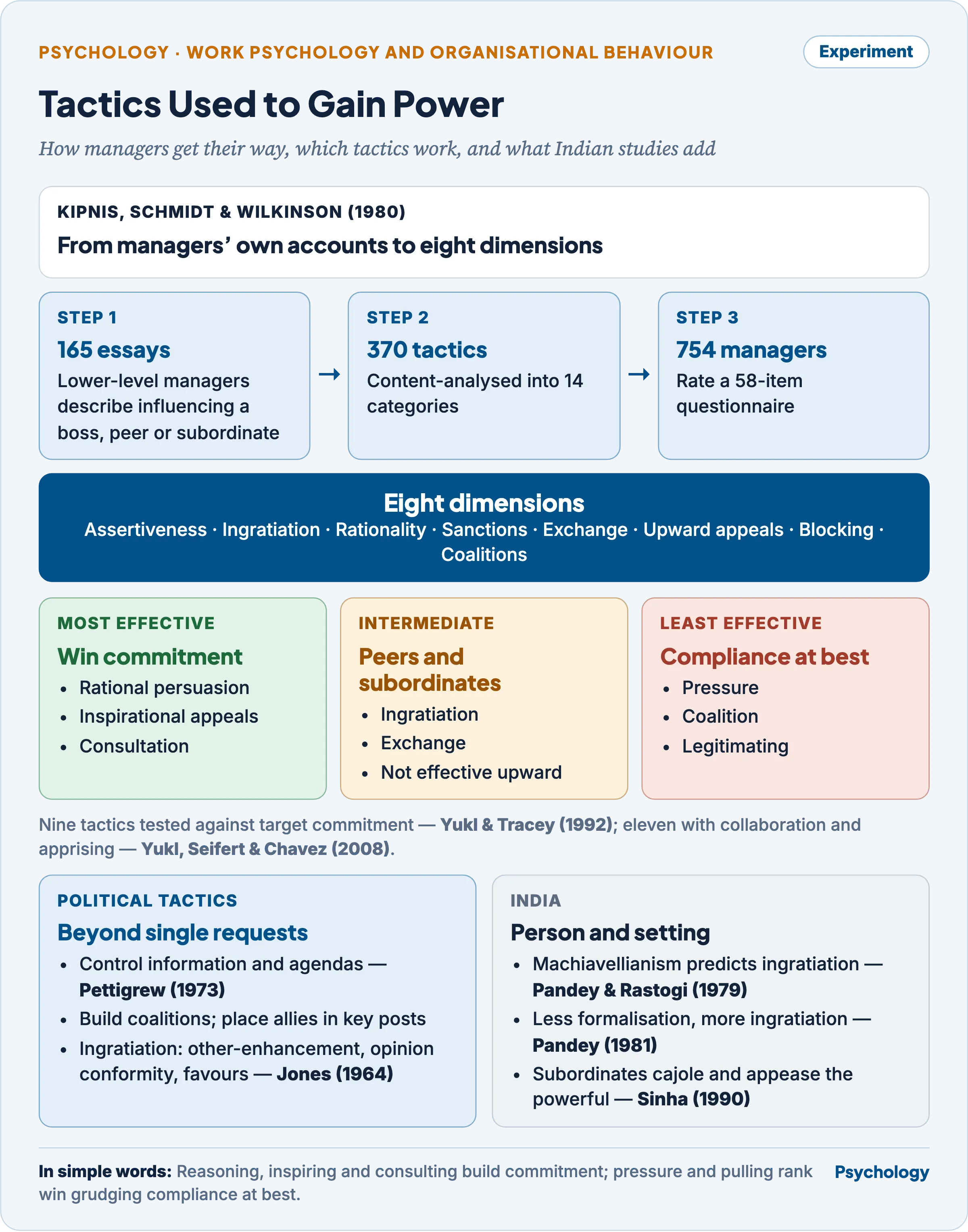
The tactics that build commitment are the soft ones; the hard ones win compliance and spend goodwill.
Organizational politics and the factors that contribute to political behaviour
- Politics is near-universal. In a survey of 428 managers, about nine in ten agreed that workplace politics was usual (Gandz and Murray, 1980).
- Ferris, Russ and Fandt (1989) shifted study to perceptions of organisational politics: people act on the politics they believe surrounds them. Kacmar and Ferris (1991) measured it with the POPS — general political behaviour, going along to get ahead, and pay and promotion policies.
Individual factors
- Machiavellianism — Christie and Geis (1970) built the Mach IV scale; in the Con Game and the Ten Dollar Game, high scorers bluffed more and manipulated more often and more successfully, with a detached “cool syndrome”.
- High self-monitoring — skill at reading and fitting social cues (Snyder, 1974).
- Internal locus of control (Rotter, 1966) — believing outcomes can be controlled makes people try to manipulate them.
- Personalised need for power — dominance sought for its own sake (McClelland, 1975).
- Political skill — “the ability to effectively understand others at work, and to use such knowledge to influence others to act in ways that enhance one’s personal and/or organizational objectives” (Ahearn and colleagues, 2004).
- Ferris and colleagues (2005) measured four dimensions: social astuteness, interpersonal influence, networking ability and apparent sincerity.
- Investment and expectations. Much invested and few outside options make illegitimate politics too risky; an expectation that politics will succeed makes it likelier.
Organisational factors
- Scarce resources and zero-sum rewards, where one person’s gain is another’s loss.
- Ambiguity — of goals, of roles (Kahn and colleagues, 1964), and of appraisal and promotion criteria; subjective appraisal invites lobbying.
- Low formalisation — Pandey (1981) found more ingratiation where rules were fewer.
- Non-programmed decisions and change — reorganisations, mergers and new technology reopen settled allocations.
- Democratic decision-making, which multiplies the people who can be lobbied; high performance pressure; low trust; and senior managers who visibly reward politicking.
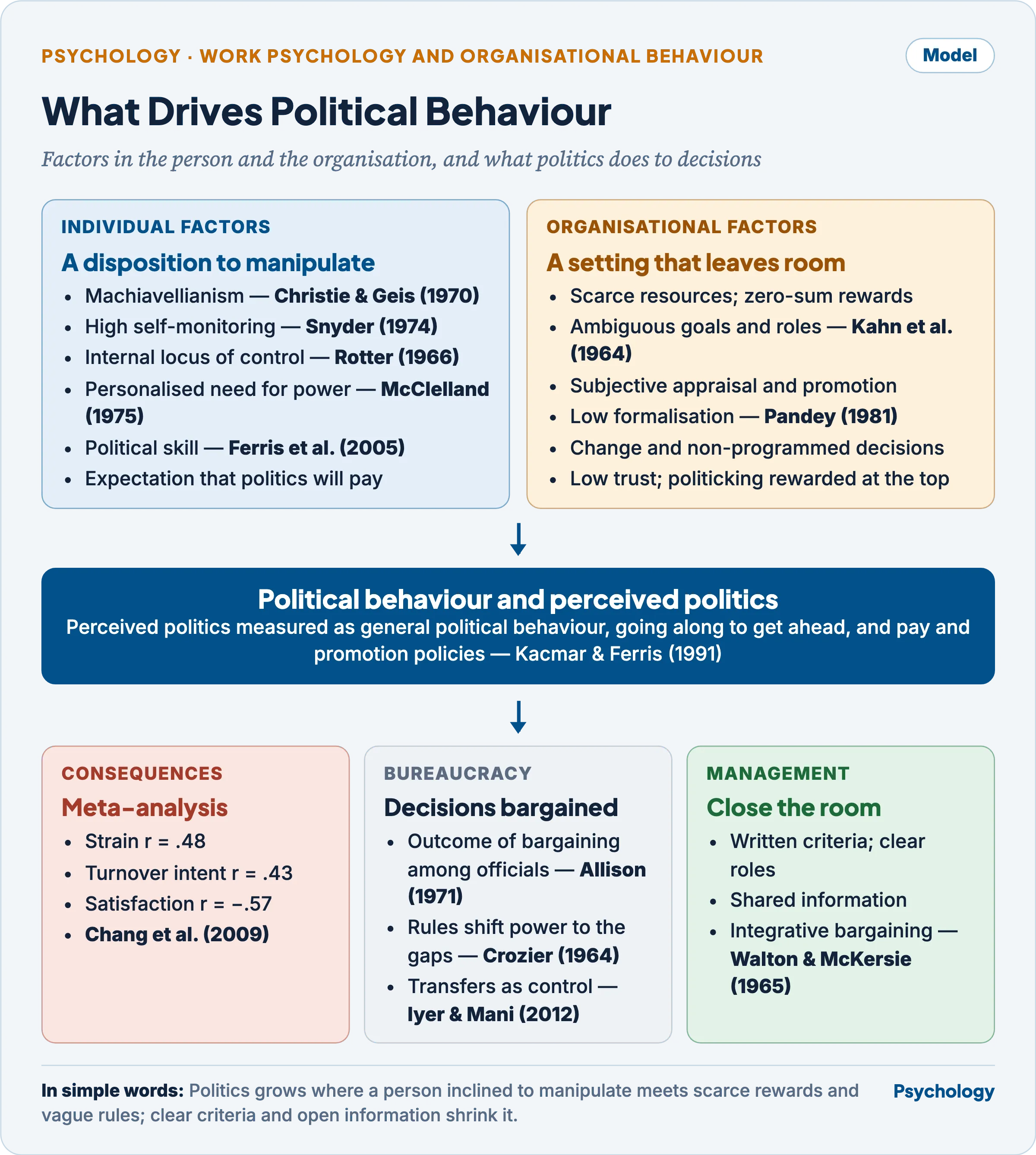
Political behaviour is likeliest where a disposition to manipulate meets a setting that leaves room for it.
Impact of organizational politics on decision-making in bureaucratic organizations
- Weber’s (1922) ideal type of bureaucracy — fixed rules, hierarchy, impersonality, merit — replaces personal power with rational-legal authority. Politics does not vanish; it moves into the gaps.
- Crozier (1964) called the result the bureaucratic vicious circle: new rules close one zone of discretion, power regroups around the next, and more rules follow.
- Allison (1971) explained the Cuban missile crisis with three models; Model III, bureaucratic (governmental) politics, treats a decision as the outcome of bargaining among officials whose positions shape their stands.
- Miles (1978): “where you stand depends on where you sit.”
- Politics changes bureaucratic decisions in five ways:
- Parochialism — departmental goals and turf displace the organisation’s.
- Filtered information — gatekeepers pass up what suits them (Pettigrew, 1973).
- Coalition outcomes — the result reflects who allied with whom, not the merits.
- Delay and risk aversion — files circulate; no one signs alone.
- Short tenures — officials moved before decisions mature.
- Iyer and Mani (2012) analysed the careers of 2,800 IAS officers, 1980–2004.
- An officer’s annual probability of transfer was 53 per cent; average tenure in a post was 16 months (Iyer and Mani, 2012).
- Transfers rose about 10 per cent above that baseline when a new Chief Minister took office, mostly within four months (Iyer and Mani, 2012).
- High-ability officers were moved less, and caste affinity with the ruling party’s base helped officers secure important posts.
- Districts with more politically induced transfers showed slightly less poverty reduction (Iyer and Mani, 2012). Limitation: observational data, and no difference in immunisation or road completion.
- Wade (1982) showed a corruption system in South Indian canal irrigation centred on control of transfers: engineers raised illicit revenue and passed part upward to superiors and politicians.
- Politics is not only dysfunctional. Mintzberg (1985) argued that it can correct the deficiencies of legitimate systems — surfacing suppressed issues, testing leaders and easing change that authority blocks.
Consequences and management of political behaviour
- Chang, Rosen and Levy (2009) meta-analysed perceived politics: it correlated .48 with strain, .43 with turnover intentions, −.57 with job satisfaction, −.54 with affective commitment and −.20 with task performance.
- It behaves as a hindrance stressor, the pathway treated in Occupational Stress and Its Management.
- Tripathi, Singh and Varma (2023) surveyed 211 consultancy employees in India: perceived politics lowered organisational citizenship behaviour, an effect softened among those high in both conscientiousness and political skill. Limitation: one sector, self-report.
- Management follows the factors.
- Reduce ambiguity: written criteria for appraisal, promotion and posting; clear roles.
- Widen and share information, which removes the gatekeeper’s advantage.
- Prefer integrative to distributive bargaining, enlarging the pie rather than splitting it (Walton and McKersie, 1965).
- Ensure procedural fairness and regular feedback; refuse to reward politicking, starting at the top.
Criticisms and limitations
- Measurement. Power-base evidence is largely correlational self-report (Podsakoff and Schriesheim, 1985), and Nye and Witt (1993) found the POPS unidimensional rather than three-factor.
- Perception versus behaviour. Since Ferris, Russ and Fandt (1989), perceived politics has been measured far more often than political acts, so the causes of actual political behaviour are less well established.
- Negative bias. Drory and Romm (1990) reviewed the competing definitions; many, such as Kacmar and Baron’s (1999), cast politics as self-interest pursued “without regard for the well-being of others or their organization”, ignoring constructive politics (Mintzberg, 1985).
- Power as a possession. Foucault (1976) argued that power is exercised, not owned — dispersed through relations, productive of conduct, and met everywhere by resistance: “Where there is power, there is resistance.” Base-counting misses that subordinates also hold power (Crozier, 1964).
- Cultural boundedness. The models come from US firms. In a high power-distance culture deference and personalised ties alter what counts as political, the point developed in Leadership and Participatory Management.
Indian context
- Sinha (1990) observed that Indian subordinates, depending on personalised favour, often cajole, appease and ingratiate superiors to get what they want.
- Sinha (1995) described subordinates who feel left out changing allegiance from old to new bosses and seeking more powerful contacts to pressure their superiors — loyalty to persons, not roles.
- Pandey (1981) listed eight ingratiation tactics in Indian work settings, among them name-dropping, yielding and conformity.
- The state has acted on the structural source the research identifies — control of transfers and postings.
- Prakash Singh v. Union of India (2006) (Supreme Court) — seven directives, among them State Security Commissions, two-year minimum tenure for the DGP and field officers down to station house officers, and Police Establishment Boards deciding transfers and postings at and below Deputy Superintendent rank.
- It removes posting as a reward-and-punishment lever, cutting officers’ dependence on the political executive. In 2021 no state complied fully with the directives taken together, and only Arunachal Pradesh and Karnataka complied fully on Establishment Boards (Commonwealth Human Rights Initiative, 2021).
- T. S. R. Subramanian v. Union of India (Supreme Court, 2013) — Civil Services Boards, minimum tenure and the recording of oral instructions: “Repeated shuffling/transfer of the officers is deleterious to good governance.” Written orders turn deniable pressure into accountable legitimate authority.
- IAS (Cadre) Amendment Rules, 2014 (Department of Personnel and Training, 28 January 2014; parallel IPS and IFoS rules) — a two-year minimum tenure, with premature transfer only on a Civil Services Board’s recommendation, reasons recorded in writing. It operationalises procedural justice in posting.
- Right to Information Act, 2005 (in force 12 October 2005) — access to official records erodes gatekeepers’ informational power and the secrecy in which politics thrives.
- Mission Karmayogi (National Programme for Civil Services Capacity Building; Union Cabinet, 2 September 2020) — shifts HR management from “Rules based” to “Roles based” through the iGOT Karmayogi platform. Defined roles reduce the role ambiguity that breeds politics and reward expert power.
Previous Year Questions
- 2022Explain how power and politics go hand-in-hand.
- 2021How does power in organizations tend to concentrate in the hands of a few persons? Discuss the tactics used to gain power.
- 2020Discuss the factors that contribute to political behaviour in organizations.
- 2013What is your understanding of organizational politics? Discuss how it impacts decision-making processes in bureaucratic organizations.
- 2013What bases of power are used by successful leaders to exercise influence within organizations? Discuss.