

Official syllabusPaper II · Unit 4 · Work Psychology and Organisational Behaviour
Sensitivity training.
Definition
“A T-group is a relatively unstructured group in which individuals participate as learners. The data for learning are not outside these individuals or remote from their immediate experience within the T-group.”
Bradford, Gibb and Benne (1964)
Sensitivity training teaches people how they behave in groups by making the group’s own behaviour, here and now, the thing studied. It was also the first technology of organisational development: OD grew out of attempts to carry what strangers learnt in a laboratory back into their organisations, and out of the failure of the first attempts.
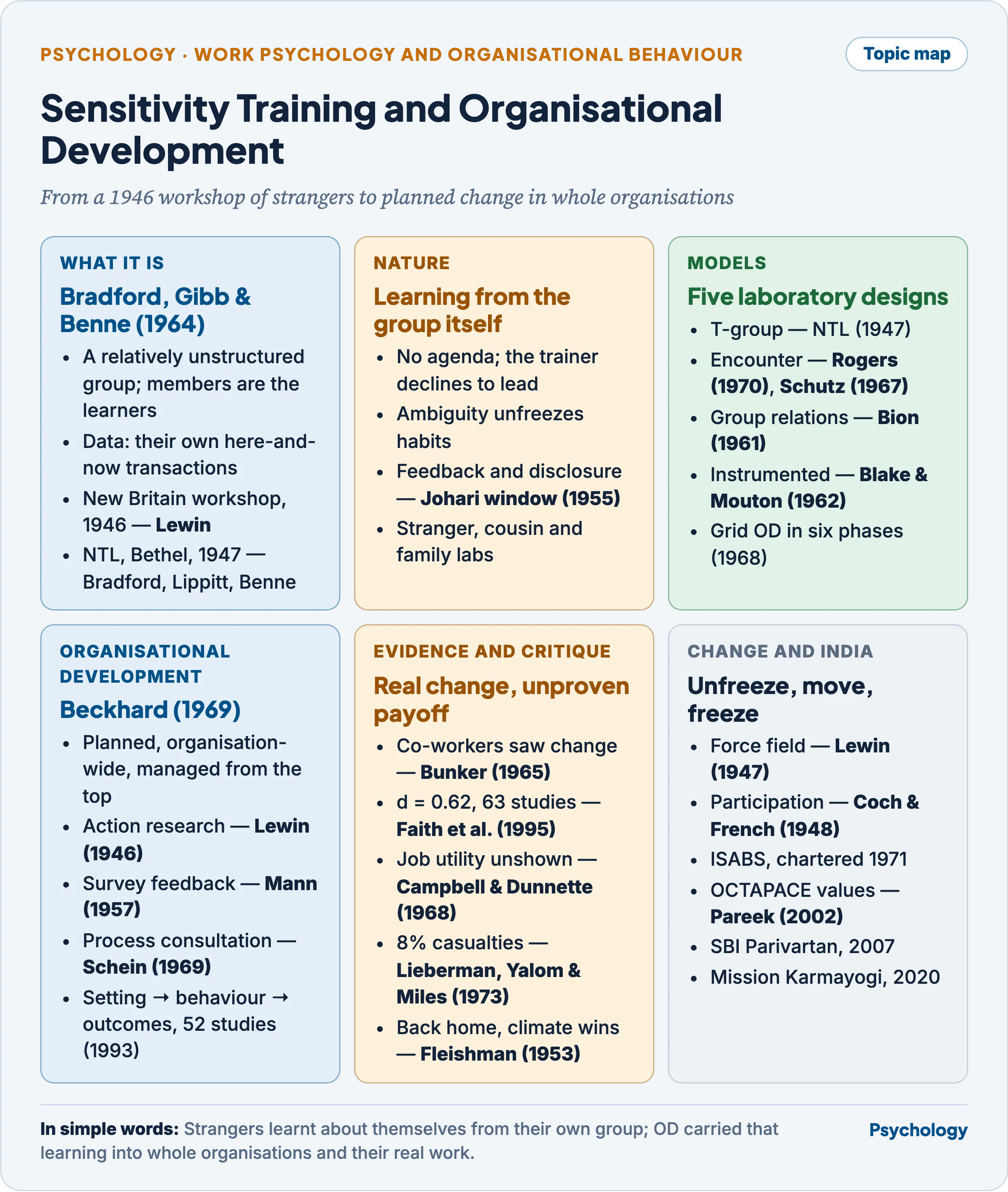
The map runs from a 1946 workshop to organisation-wide change; the evidence box explains why the second absorbed the first.
Sensitivity training: origins, 1946–1947
- New Britain, 1946: at the request of the Connecticut Interracial Commission, Kurt Lewin (1890–1947), then directing the Research Center for Group Dynamics at MIT, ran a summer workshop training community leaders to combat discrimination and promote fair employment.
- His staff were Leland Bradford, Ronald Lippitt and Kenneth Benne, with observers who recorded each session and met every evening to analyse it.
- The discovery: a few participants asked to sit in on those evening meetings, heard their own behaviour described and disputed it. The sessions soon drew the whole workshop, and feedback on here-and-now behaviour became the method.
- Bethel, 1947: Lewin died in February 1947. Bradford, Lippitt and Benne ran the first summer session, at Gould Academy in Bethel, Maine, of the National Training Laboratory in Group Development (NTL); its core unit was the T-group (training group).
- Into industry: from 1958 Robert Blake and Herbert Shepard ran laboratory training for managers at Esso’s Bayway refinery in New Jersey. Weisbord (1987) credits Douglas McGregor and Richard Beckhard, consulting at General Mills in the 1950s, with naming the result “organization development”.
- By the late 1950s the movement had split into an organisational wing (managers, teams, OD) and a personal-growth wing (encounter groups); “sensitivity training” names both.
Nature of sensitivity training (T-groups)
- The setting: about ten members and a trainer meet over one to three weeks, usually residentially, on a cultural island away from work, status and routine, with no agenda, no chairman and no task except to study the group itself.
- Here-and-now focus: the data are the members’ transactions inside the group, not their histories or their jobs, which separates the T-group from group therapy (Bradford, Gibb and Benne, 1964).
- Ambiguity as the engine: the trainer declines to lead. Members’ habitual bids for structure, dominance or approval stop working, and the tension that follows unfreezes habitual self-presentation in Lewin’s sense (Schein and Bennis, 1965).
- Feedback: members say how one another’s behaviour affects them, descriptively rather than judgementally. The Johari window of Luft and Ingham (1955), devised at a UCLA group-development laboratory, maps the aim.
- Feedback shrinks the blind area (known to others, not to oneself); self-disclosure shrinks the hidden area (known to oneself, not to others).
- Both enlarge the open area and leave a smaller unknown.
- Experimentation and generalisation: members try new behaviour where failure costs little, and theory sessions turn the experience into concepts — learning how to learn.
- Goals, at three levels:
- self-awareness — how one comes across, and why;
- interpersonal competence — listening, giving and receiving feedback, owning one’s feelings (Argyris, 1962);
- understanding of group process — roles, norms, decision-making, leadership and conflict, with the skill to diagnose and act on them.
- Composition: stranger labs mix people from different organisations; cousin labs draw from one organisation without reporting ties; family labs take an intact team with its boss. The family group is the bridge from sensitivity training to OD.
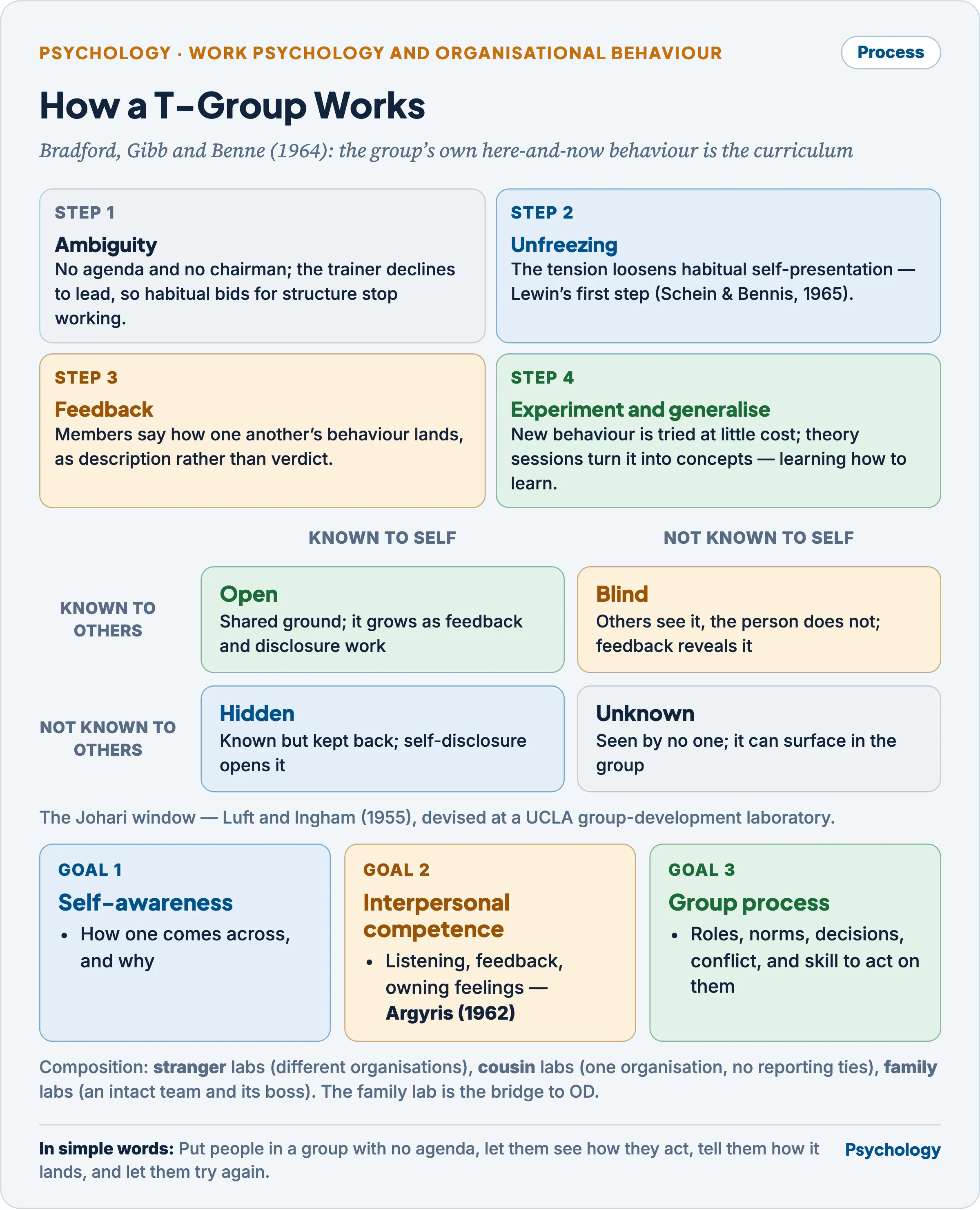
Nothing is taught at the start; the learning comes from what members do when nobody tells them what to do.
Models of sensitivity training
| Model | Originators | Unit of learning | Trainer’s role | Line into OD |
|---|---|---|---|---|
| T-group | Bradford, Lippitt and Benne (1947) | Interpersonal and group process | Non-directive resource; models feedback | Family groups became team building; the trainer’s role became process consultation |
| Encounter group | Rogers (1970); Schutz (1967) | Personal growth and emotional expression | Facilitator (Rogers) or active exerciser (Schutz) | Slight; the personal-growth wing |
| Group relations (Tavistock) | Bion (1961); Rice (1965) | The group-as-a-whole; authority and role | Consultant interprets the group, never the individual | Role, authority and boundary in organisations |
| Instrumented laboratory | Blake and Mouton (1962) | Team skills, through scored instruments | None; groups run themselves | Grid seminars at scale |
| Grid OD | Blake and Mouton (1964, 1968) | The whole organisation | Line managers as instructors | A complete six-phase OD programme |
- T-group (the NTL model): the laboratory around the group adds theory sessions and skill exercises, so the design is a curriculum.
- Encounter groups: Rogers’ basic encounter group (Rogers, 1970) aimed at personal growth through intense mutual openness, the facilitator supplying a whole group with the conditions set out in Client-Centred Therapy (Unit 3).
- Schutz (1958) proposed three interpersonal needs — inclusion, control and affection — measured by the FIRO-B; at the Esalen Institute his style (Schutz, 1967, Joy) added non-verbal and body exercises.
- The Tavistock group-relations model: Bion (1961) held that every group is at once a work group and a basic-assumption group, acting as if it had met for dependency, fight–flight or pairing.
- The Tavistock Institute and the University of Leicester held the first two-week group-relations conference in 1957, and Rice (1965) made the study of authority and leadership its task. Learning concerns role and authority in systems, not personal feedback.
- The instrumented laboratory: Blake and Mouton (1962) replaced the trainer with questionnaires, rating scales and self-scored feedback, letting whole managements pass through a laboratory cheaply.
- Grid OD: the Managerial Grid (Blake and Mouton, 1964) plots concern for production against concern for people; the theory is set out in Leadership and Participatory Management. Grid OD takes a whole organisation through six phases (Blake and Mouton, 1968):
- (1) the Grid seminar, in which managers assess their own style; (2) teamwork development; (3) intergroup development;
- (4) an ideal strategic model of the corporation; (5) implementing it; (6) systematic critique.
- Blake, Mouton, Barnes and Greiner (1964) reported changed managerial values and behaviour, better union relations and gains in profit at a 4,000-employee plant a year into the programme.
- Limitation: no control group, the designers evaluated their own product, and contingency theorists dispute a single best style.
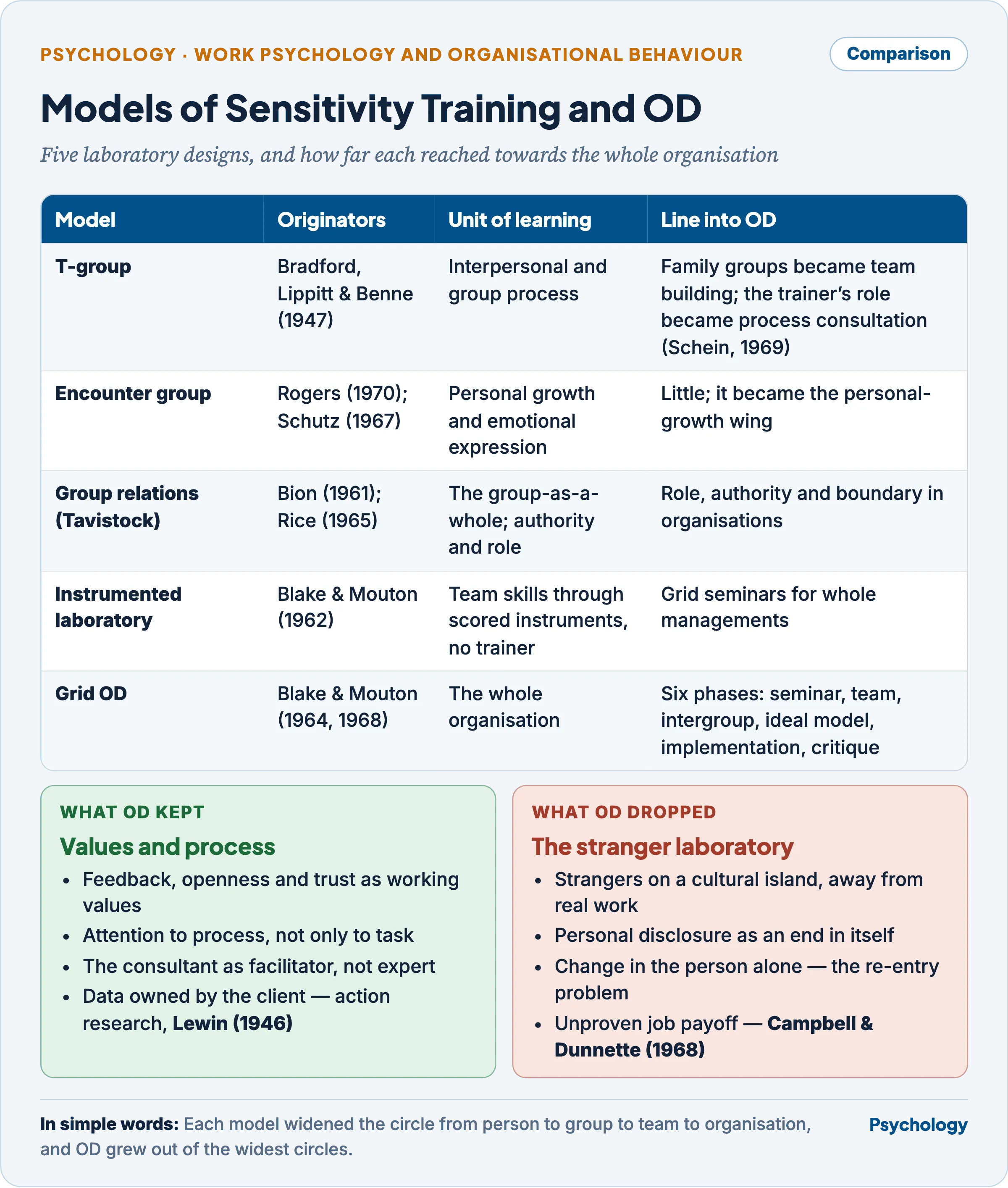
The further a model’s unit of learning reached towards the whole organisation, the more of it OD kept.
Organisational development and its interventions
- Beckhard (1969): “Organization development is an effort (1) planned, (2) organization-wide, and (3) managed from the top, to (4) increase organization effectiveness and health through (5) planned interventions in the organization’s ‘processes,’ using behavioral-science knowledge.”
- Roots and values: OD grew from two Lewinian stems, the NTL laboratory and survey research. Its values are humanistic and democratic — collaboration, openness, trust, the consultant as facilitator rather than expert — close to the Theory Y of McGregor (1960).
- Action research is the OD process: Lewin (1946) described rational change as a spiral of planning, action and fact-finding about the result of action, and French (1969) laid the spiral out for OD:
- diagnosis → data gathering → feedback to the client group → joint action planning → action → fresh data gathering, and round again.
- Interventions, in the families classified by French and Bell (1973):
- Survey feedback — attitude-survey results fed back unit by unit, the top team first, each unit interpreting its own data and planning action (Mann, 1957).
- Team building — a family group diagnoses its own goals, roles, procedures and relationships (Dyer, 1977).
- Process consultation — Schein (1969): the consultant helps the client perceive, understand and act on process events — communication, roles, decisions, norms — in real meetings, and the client owns the diagnosis. It is the T-group trainer’s role moved onto the job.
- Intergroup and third-party work — image exchange between groups in conflict (Blake, Shepard and Mouton, 1964); interpersonal peacemaking (Walton, 1969).
- Techno-structural — job redesign, socio-technical systems (Trist and Bamforth, 1951) and management by objectives (Drucker, 1954).
- Appreciative inquiry — Cooperrider and Srivastva (1987) start from what already works rather than from problems.
- Robertson, Roberts and Porras (1993) meta-analysed 52 evaluations of planned change and found support for OD’s working logic: interventions change the work setting, the setting changes individual behaviour, and behaviour changes organisational outcomes.
Utility of sensitivity training as an OD technique
- What it contributes:
- It unfreezes interpersonal norms and builds the openness and trust on which data-based OD depends; family labs improve an intact team’s working directly.
- It trains internal change agents who can facilitate later interventions.
- Argyris (1964) argued that laboratory education raises the interpersonal competence that pyramidal, bureaucratic organisations suppress.
- What it cannot do alone:
- It changes individuals, while Robertson, Roberts and Porras (1993) place lasting behaviour change downstream of changes in the work setting.
- The re-entry problem: a manager returns from a stranger lab to an unchanged boss, reward system and culture.
- Its job-performance payoff was unproven (Campbell and Dunnette, 1968).
- Verdict: OD kept the laboratory’s values, feedback and attention to process, and moved the work into intact units and real tasks. As a stand-alone OD technique sensitivity training is weak; as an entry intervention inside a planned programme it remains useful.
Merits and limitations of sensitivity training groups
Merits as a training programme
- It teaches what cannot be lectured — how one is seen, how groups decide, how to listen.
- It develops participative attitudes, tolerance of difference and skill in diagnosing group process, which participative management and teamwork require.
- Bunker (1965) compared laboratory participants with controls, using descriptions by co-workers some months after the laboratory.
- Co-workers reported more change in participants’ openness, behavioural skill and understanding of social processes, and long-range change correlated with learning measured during training (Bunker, 1965).
- Limitation: co-workers’ descriptions are open to expectancy, and job performance went unmeasured.
- Faith, Wong and Carpenter (1995) meta-analysed 63 studies of group sensitivity training.
- The mean effect was d = 0.62, larger on behavioural measures (1.03) than on self-reports (0.44), and larger with bigger groups and more sessions (Faith and colleagues, 1995).
- Limitation: the effects were heterogeneous, and the outcomes were individual rather than organisational.
- Its place among executive training methods is set out in Training and Human Resource Development.
Limitations and criticisms
- Campbell and Dunnette (1968), reviewing the T-group evidence, found that it changes observable behaviour, but that “the utility of these changes for the performance of individuals in their organizational roles remains to be demonstrated”. House (1967) reached a similar verdict.
- Transfer: Fleishman (1953) found that foremen’s conduct after human-relations training followed the leadership climate set by their own superiors more than the course.
- Psychological risk: Lieberman, Yalom and Miles (1973) studied 209 Stanford students in 18 thirty-hour groups run by well-known leaders of different schools, against 69 controls.
- About a third benefited lastingly at six months and a third were unchanged; 19 per cent dropped out and 8 per cent were casualties, against 3 per cent of controls (Lieberman and colleagues, 1973).
- Leader style mattered more than school: highly active, demanding “energisers” produced 17 per cent casualties and caring “providers” 3 per cent (Lieberman and colleagues, 1973).
- Limitation: casualties among controls were counted by a different procedure, so the risk may be overstated (Smith, 1973).
- Ethics: employer-sponsored attendance compromises voluntary consent; disclosure before colleagues threatens privacy and later careers; trainers must screen vulnerable participants and stop short of therapy.
- Culture: Jaeger (1986) compared OD’s values with the cultural profiles of 40 countries drawn from Hofstede (1980) and argued that OD’s fit varies with national culture, so methods built on open confrontation travel unevenly.
Lewin’s three-step model of change and force-field analysis
- Force-field analysis (Lewin, 1947). A level of behaviour — output, prejudice, a food habit — is a quasi-stationary equilibrium held between driving forces for change and restraining forces against it.
- Change follows when driving forces are added or restraints removed; removing restraints changes behaviour with less tension, since added pressure provokes counter-pressure (Lewin, 1947).
- The three steps: Lewin (1947) described successful change as unfreezing the present level, moving to the new level and “freezing group life on the new level”; “refreezing” is a later rendering.
- Unfreezing — the old equilibrium is disturbed by disconfirming data and felt dissatisfaction. Schein (1996): survival anxiety must exceed learning anxiety, best achieved by lowering learning anxiety through psychological safety.
- Moving — new attitudes and behaviour are learnt, by identification with a model or by scanning for solutions.
- Freezing — the new level is anchored in group norms, structures and rewards; behaviour changed in isolated individuals drifts back.
- Group decision: in Lewin’s wartime food-habits studies (Lewin, 1943), housewives who discussed and publicly committed to serving unfamiliar meats changed their cooking more than those given a lecture: commitment in a group freezes a decision.
- Coch and French (1948), at the Harwood pyjama factory in Virginia, introduced a job change to matched groups with no participation, participation through representatives, or total participation.
- No-participation output fell from about 60 to 50 units an hour, flat for 32 days, with 17 per cent quitting within 40 days; representation reached 61 units by day 14; total participation ended about 14 per cent above the pre-change level (Coch and French, 1948).
- Limitation: an atypical plant whose president, Alfred Marrow, was a psychologist; Bartlem and Locke (1981) argue that differences in explaining the change, running the time studies and extra training, not participation, may explain the result.
- Lippitt, Watson and Westley (1958) expanded the steps into seven phases of planned change, run by a change agent with a client system.
- Criticisms: the model assumes stability between changes, suits only small-scale change, ignores power and politics and is driven from the top — the four charges Burnes (2004) answers by reading the steps within Lewin’s field theory, group dynamics and action research.
- Cummings, Bridgman and Brown (2016) traced the model to one short passage in Lewin (1947) and argued that the textbook three-step model took shape after his death.
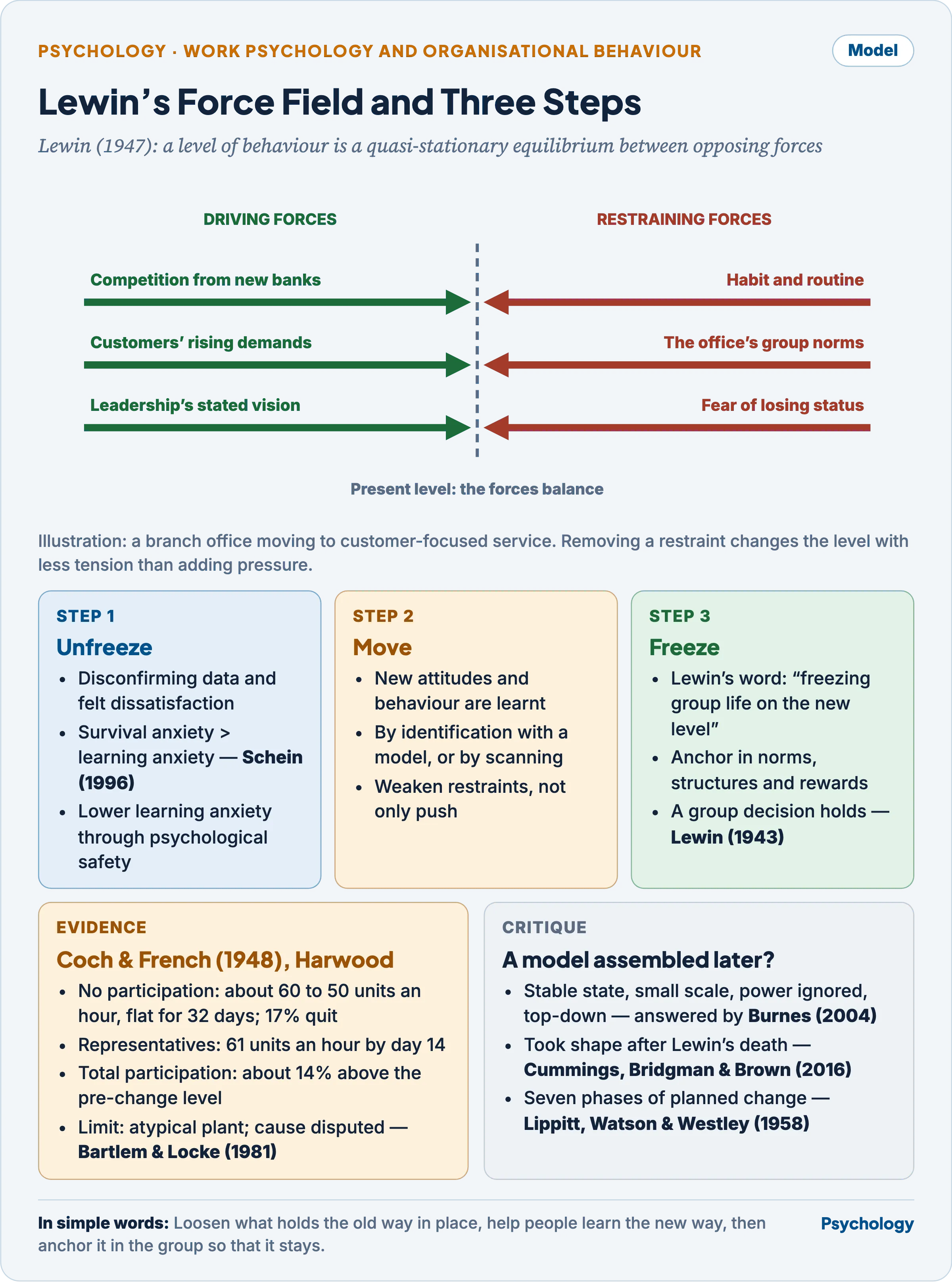
Change comes from weakening what holds the old level in place, not only from pushing harder against it.
Social change and organisational change
- One theory for both levels: Lewin’s three steps appear in a paper on “Social Equilibria and Social Change” (Lewin, 1947); force-field analysis and group decision were worked out on community problems and then carried into factories such as Harwood.
- Action research began on minority problems (Lewin, 1946), and the T-group out of a 1946 anti-discrimination workshop: social change first, organisational change after.
- Strategies that cross levels: Chin and Benne (1969) classified strategies of change for any human system:
- empirical-rational — information and incentives; normative-re-educative — changing norms through participation, the strategy of the T-group and of OD; power-coercive — law, sanctions and authority.
- From society to organisation: in the open-system view of Katz and Kahn (1966), organisations draw their inputs from the environment, so social change in law, technology, markets and values arrives as driving forces.
- The POSH Act, 2013 (Sexual Harassment of Women at Workplace (Prevention, Prohibition and Redressal) Act; Ministry of Women and Child Development) converted changing norms about gender at work into structure.
- Its s. 4 obliges every employer to constitute an Internal Committee; workplaces of fewer than ten workers go to a district Local Committee (s. 6).
- From organisation to society: Inkeles and Smith (1974) interviewed about 6,000 young men in six developing countries, India among them, and found that factory experience promoted individual modernity, second only to education. Limitation: a Western yardstick of modernity, and correlational data.
- Diffusion: Everett Rogers (1962) traced innovations spreading through a social system over time via innovators, early adopters, the early majority, the late majority and laggards; the same curve runs through a workforce adopting a new practice.
- Where the levels differ: an organisation has a legitimate centre that can plan and manage change, a bounded membership and measurable outcomes; social change is polycentric, slower and seldom managed. Resistance has the same roots at both levels — interests, habit, norms and identity.
Indian context
- Laboratory training reached India in the early 1960s, when Rolf Lynton and Udai Pareek ran laboratory groups, which they called L-groups (learning groups), at the Small Industry Extension Training (SIET) Institute, Hyderabad, written up in Lynton and Pareek (1967), Training for Development.
- Indian Society for Applied Behavioural Science (ISABS) — chartered on 5 December 1971 and registered at Pune on 7 January 1972; founded on the NTL pattern by Indians trained in T-groups, among them Pulin Garg, Somnath Chattopadhyay and Dharni Sinha.
- It runs Basic and Advanced Labs on Human Processes and is the Indian body that accredits T-group facilitators.
- OCTAPACE — Pareek (2002) profiles an organisation’s ethos in 40 items on eight values — openness, confrontation, trust, authenticity, proaction, autonomy, collaboration and experimentation — the laboratory’s values turned into a diagnostic of organisational climate.
- Culture: Sinha and Kanungo (1997) describe Indian organisational behaviour through context sensitivity — conduct varying with desh, kal and patra (place, time, person) — and balancing, with hierarchical, group-embedded relationships. A family lab asking subordinates for open feedback to a superior meets that hierarchy head-on.
- Project Parivartan (State Bank of India, launched 16 July 2007) — about 3,500 two-day workshops meant to reach some 1.3 lakh employees within 100 days, aimed at customer service and attitudes after a loss of market share.
- It operationalises organisation-wide unfreezing through participative workshops: the normative-re-educative strategy at the scale of a national bank.
- Mission Karmayogi — the National Programme for Civil Services Capacity Building (approved by the Union Cabinet, 2 September 2020) — supports a transition from “rules based” to “roles based” HR management through a Framework of Roles, Activities and Competencies (FRACs).
- The Capacity Building Commission (constituted 1 April 2021) helps approve annual capacity-building plans: planned, organisation-wide change managed from the top, in the sense of Beckhard (1969).
- Rashtriya Karmayogi Large Scale Jan Seva Programme (Capacity Building Commission, 2025–2026) — interactive behavioural training in seva bhav, the spirit of service; about 10.5 lakh government servants trained by February 2026 through 822 lead trainers and over 16,000 master trainers.
- It operationalises experiential, facilitated group learning about attitudes, and inherits sensitivity training’s transfer problem: the office climate decides what survives.
Previous Year Questions
- 2018Explain the nature of sensitivity training. Comment on its utility as an organizational development technique.
- 2012Explain the models of sensitivity training. Relate them to organizational development.
- 2009What are the merits of ‘sensitivity training groups’ as a training programme in organizations?
- 2000Show conceptual relationship between social change and organizational change.