

Official syllabusPaper II · Unit 4 · Work Psychology and Organisational Behaviour
Managerial effectiveness – organisational communication.
Definition
“Communication may be formally defined as any process whereby decisional premises are transmitted from one member of an organization to another.”
Simon (1947)
Organisational communication is communication shaped by structure: who may speak to whom, through which channel, in what order, and at what cost to the speaker. Its psychology lies in the gap between that formal design and what people actually pass on, and information technology has changed the channels without closing the gap.
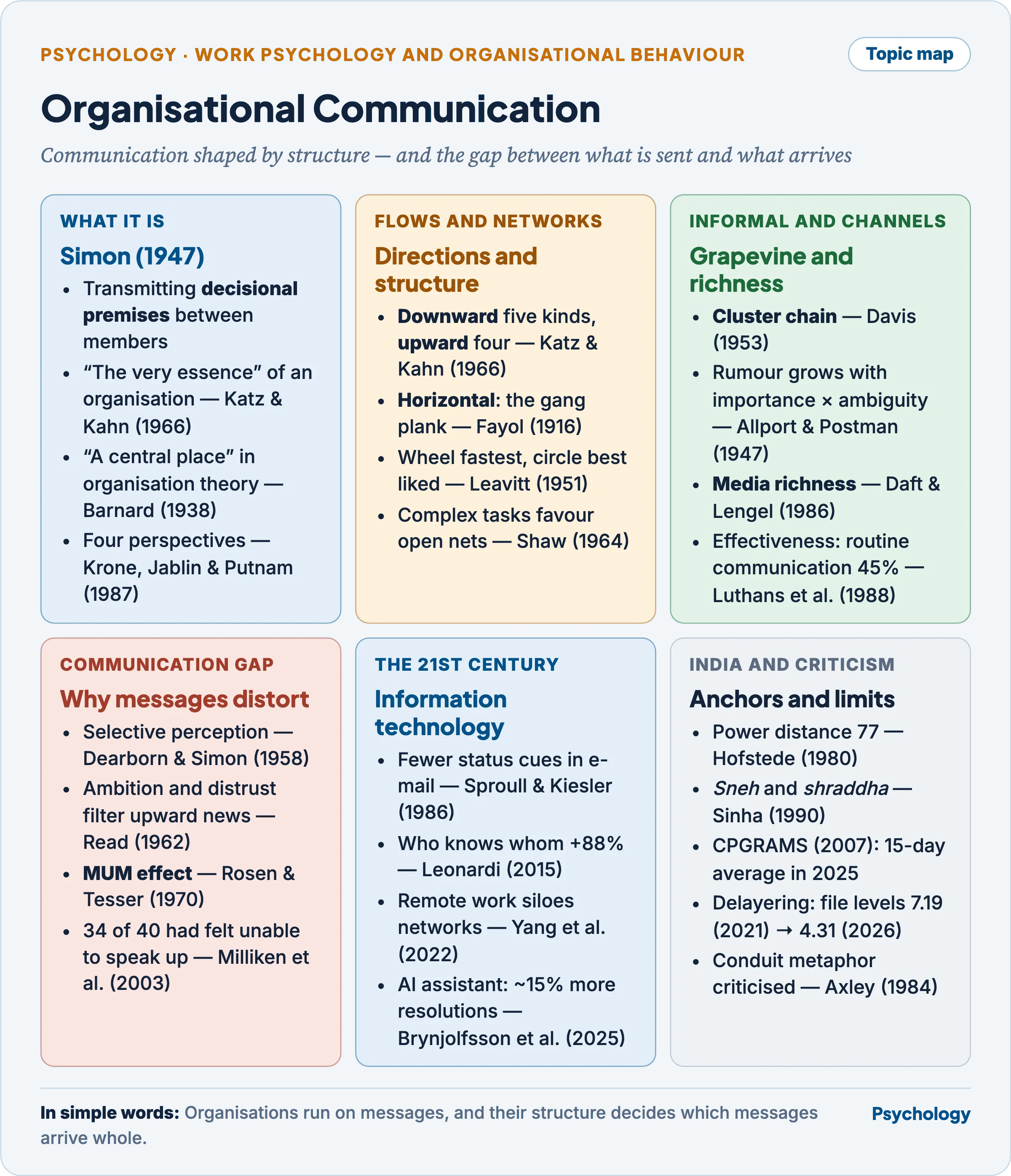
The formal structure in the top row explains most of the gaps in the bottom row: distortion follows status, distance and fear.
What organisational communication is
- Katz and Kahn (1966): “Communication—the exchange of information and the transmission of meaning—is the very essence of a social system or an organization.”
- Barnard (1938): “In an exhaustive theory of organization, communication would occupy a central place, because the structure, extensiveness, and scope of organization are almost entirely determined by communication techniques.”
- Simon’s (1947) unit is the decisional premise — a fact or value another member uses in deciding. Orders, rules, training and reports are all channels for premises.
- Unlike interpersonal communication, it travels through a structure of positions, carries the sender’s status and accountability, and repeats along fixed routes; the process model is in Communication: Process and Types (Paper I).
- Scott and Mitchell (1976) gave four functions: control (rules, chain of command), motivation (goals, feedback), emotional expression (the work group as a social setting) and information for decisions.
- Krone, Jablin and Putnam (1987) distinguished four perspectives by where communication is located:
- Mechanistic — in the channel; communication is transmission.
- Psychological — in each person’s conceptual filters of attitude, cognition and perception, so breakdown follows incongruent filters.
- Interpretive-symbolic — in shared meaning, built by consensual validation (Weick, 1979).
- Systems-interaction — in recurring sequences of messages between people.
Organisational communication and managerial effectiveness
- Mintzberg (1973) observed five chief executives spending 78 per cent of their working time in verbal interaction. Three of his ten roles are informational — monitor, disseminator and spokesperson — making the manager the unit’s nerve centre.
- Barnard (1938): “the first executive function is to develop and maintain a system of communication”.
- Luthans, Hodgetts and Rosenkrantz (1988) separated effective managers (high unit performance, satisfied and committed subordinates) from successful ones (rapid promotion).
- Routine communication made the largest relative contribution to effectiveness (45 per cent), networking the least (12 per cent) (Luthans and colleagues, 1988).
- Networking made the largest contribution to success (48 per cent) (Luthans and colleagues, 1988), so communication separates doing the job well from rising fast.
- Daft, Lengel and Treviño (1987), in a field study of middle and upper managers, found high performers more sensitive than low performers to matching a medium’s richness to the message’s ambiguity. The wider account is in Managerial Effectiveness.
Directions of organisational communication
| Direction | Typical content | Function | Characteristic failure |
|---|---|---|---|
| Downward | Instructions, rationale, procedures, feedback, goals | Control and coordination | Loss and overload along long chains; rationale omitted |
| Upward | Performance, problems, suggestions, grievances | Feedback and early warning | Filtered towards the favourable; bad news withheld |
| Horizontal | Coordination among peers and departments | Problem solving across units | Departmental rivalry, jargon, selective perception |
| Diagonal | Specialist to line staff across levels | Speed | Bypassed superiors resent it; accountability blurs |
- Katz and Kahn (1966) listed five kinds of downward communication: job instructions, job rationale, procedures and practices, feedback on performance and indoctrination of goals. Rationale is among the kinds most often neglected, which yields compliance without understanding.
- They listed four kinds of upward content: about oneself, one’s performance and problems; about others and their problems; about organisational practices and policies; and about what needs to be done and how.
- Fayol (1916) proposed the gang plank: peers at the same level communicate directly, with their superiors’ consent, instead of routing a message up the scalar chain and back down — the classic case for horizontal communication.
Formal networks: the Bavelas–Leavitt experiments
- Bavelas (1948, 1950), at the Group Networks Laboratory of the Massachusetts Institute of Technology, defined a position’s centrality — its closeness, in communication links, to every other position — the variable the network experiments manipulated.
- Leavitt (1951) — the canonical test.
- Design: 100 male undergraduates in 20 groups of five passed written notes across a partitioned table along permitted links; each member held five of six symbols, and the group had to find the one all held; 15 trials in a circle, chain, Y or wheel.
- The wheel was fastest at its best (mean 32 seconds, against 50 for the circle and 53 for the chain), the Y made fewest errors, and the circle made most errors and sent most messages.
- All 23 wheel members who named a leader named the hub. Leavitt summed up the circle as active, leaderless, unorganised and erratic, “and yet is enjoyed by its members”.
- Satisfaction followed position: central members enjoyed the task, peripheral members of centralised networks did not.
- Limitation: ad hoc student groups, a simple task with one right answer, minutes of shared history.
- Guetzkow and Simon (1955) found that networks affect efficiency only indirectly, by governing members’ ability to organise themselves.
- Shaw (1964) reviewed the studies: centralised networks win only on simple tasks; on complex ones decentralised networks are faster and more accurate.
- Saturation — the overload of the hub — and independence — freedom of action, which also raises satisfaction — explain the reversal.
- The all-channel network, in which everyone reaches everyone, suits task forces and crisis teams; routine dispatch suits a wheel.
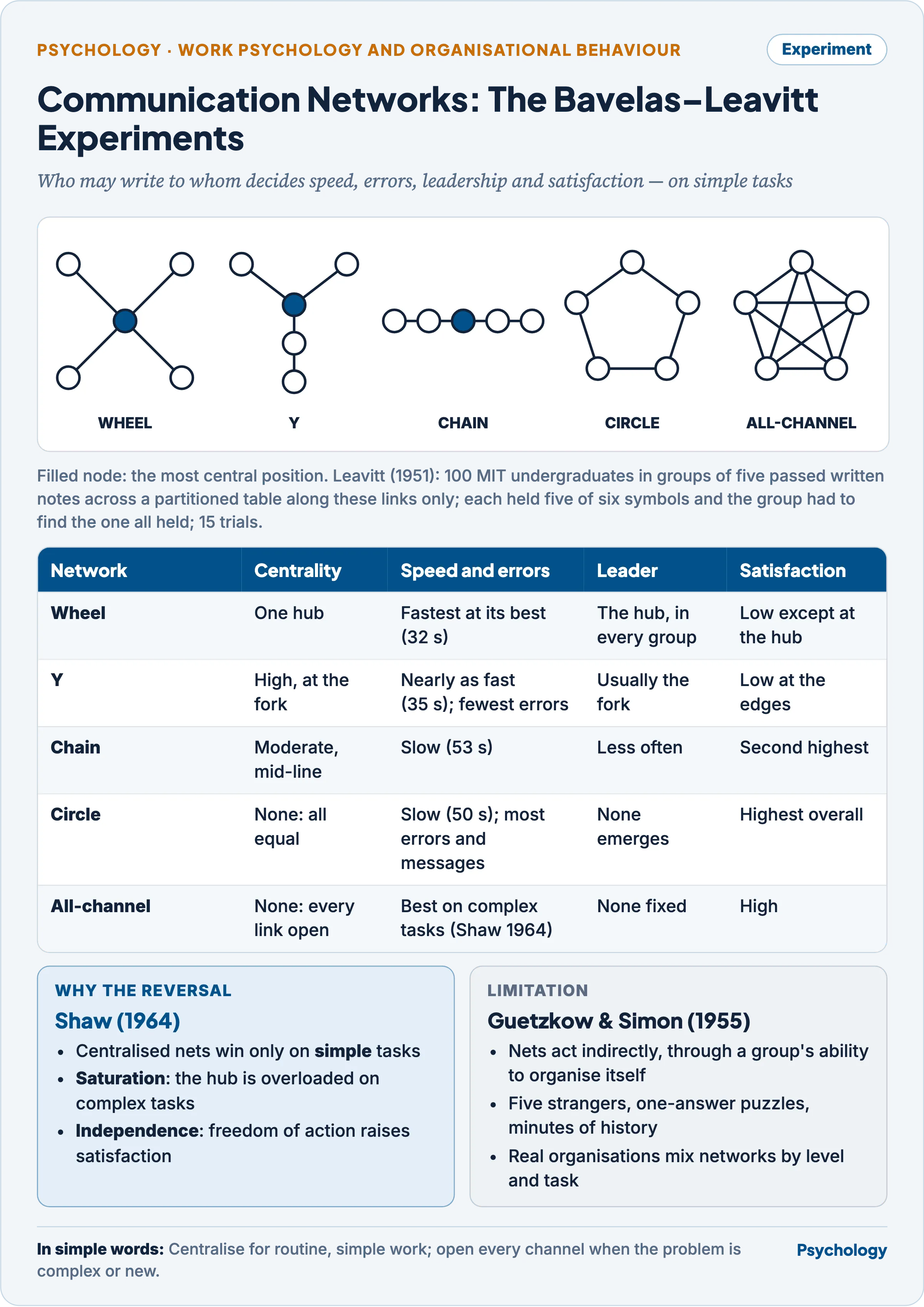
Centralisation buys speed and accuracy on simple tasks at the cost of satisfaction, and loses even that advantage on complex ones.
Informal communication: the grapevine
- Davis (1953) used ECCO analysis (episodic communication channels in organisation): ask each recipient how he first received an item of news, and trace it back to its source.
- Among the 67 managers of the Jason Company, the cluster chain — one person tells a few, of whom only some pass it on — predominated over the single-strand, gossip and probability chains.
- The grapevine therefore runs through a few liaison individuals; reaching them is how management reaches it. Limitation: one firm, managers only, the 1950s.
- Davis (1973) put 75–95 per cent of routine grapevine information as accurate, though incomplete, so a largely true story can still mislead.
- Allport and Postman (1947) made rumour proportional to importance × ambiguity. Reorganisation, transfers and closures score high on both, so rumour fills the gap formal channels leave.
- Sethi and Seth (2016) surveyed 150 managers in India: two factors emerged — the grapevine as an effective channel of communication, and grapevine promptness — though mean ratings were only moderate. Limitation: convenience sample, perceptions only.
- The grapevine cannot be abolished, only outrun: early, credible and repeated official messages lower ambiguity, and with it rumour.
Channels and media richness
- Daft and Lengel (1986) ranked media by richness: speed of feedback, number of cues, language variety and personal focus. Face-to-face ranks highest, then telephone, personal written messages, impersonal circulars and, lowest, numeric reports.
- Equivocal messages — reorganisation, appraisal, conflict — need rich media; clear but data-heavy ones are efficient in lean media. Announcing redundancies by circular is the classic mismatch.
- Criticism: Markus (1994) found managers using e-mail for equivocal matters too, because norms decide use; Carlson and Zmud (1999) showed a channel grows richer as users gain experience with it and with one another.
Factors of effective communication in industries
- Source — credibility (expertise and trustworthiness), clarity, and encoding from the receiver’s frame rather than one’s own.
- Message — relevance to the receiver, stated rationale, and the audience’s language: corporate English and the shop floor’s Hindi or regional language are different codes.
- Channel — richness matched to equivocality, redundancy across two channels, and timing.
- Receiver capacity — O’Reilly (1980), in two field studies, found that decision makers who felt overloaded were more satisfied but performed worse than those who felt underloaded.
- Structure — the number of relaying levels and a network suited to the task (Shaw, 1964).
- Climate — Redding (1972) named five components of the ideal communication climate: supportiveness; participative decision making; trust, confidence and credibility; openness and candour; and high performance goals.
- Gibb (1961) contrasted defensive and supportive climates in six pairs: evaluation–description, control–problem orientation, strategy–spontaneity, neutrality–empathy, superiority–equality, certainty–provisionalism. Defensive listeners distort what they hear. Limitation: drawn from recorded group discussions, little tested experimentally.
- Evidence from an Indian public enterprise: Singh and Mohanty (2014) surveyed 1,594 employees of Bharat Sanchar Nigam Limited; communication satisfaction was positively related to organisational commitment, and power distance moderated its link with normative commitment.
Psychosocial factors contributing to communication gap
A communication gap is the difference between what one level intends or knows and what another level receives or needs. Its sources are psychological before they are technical.
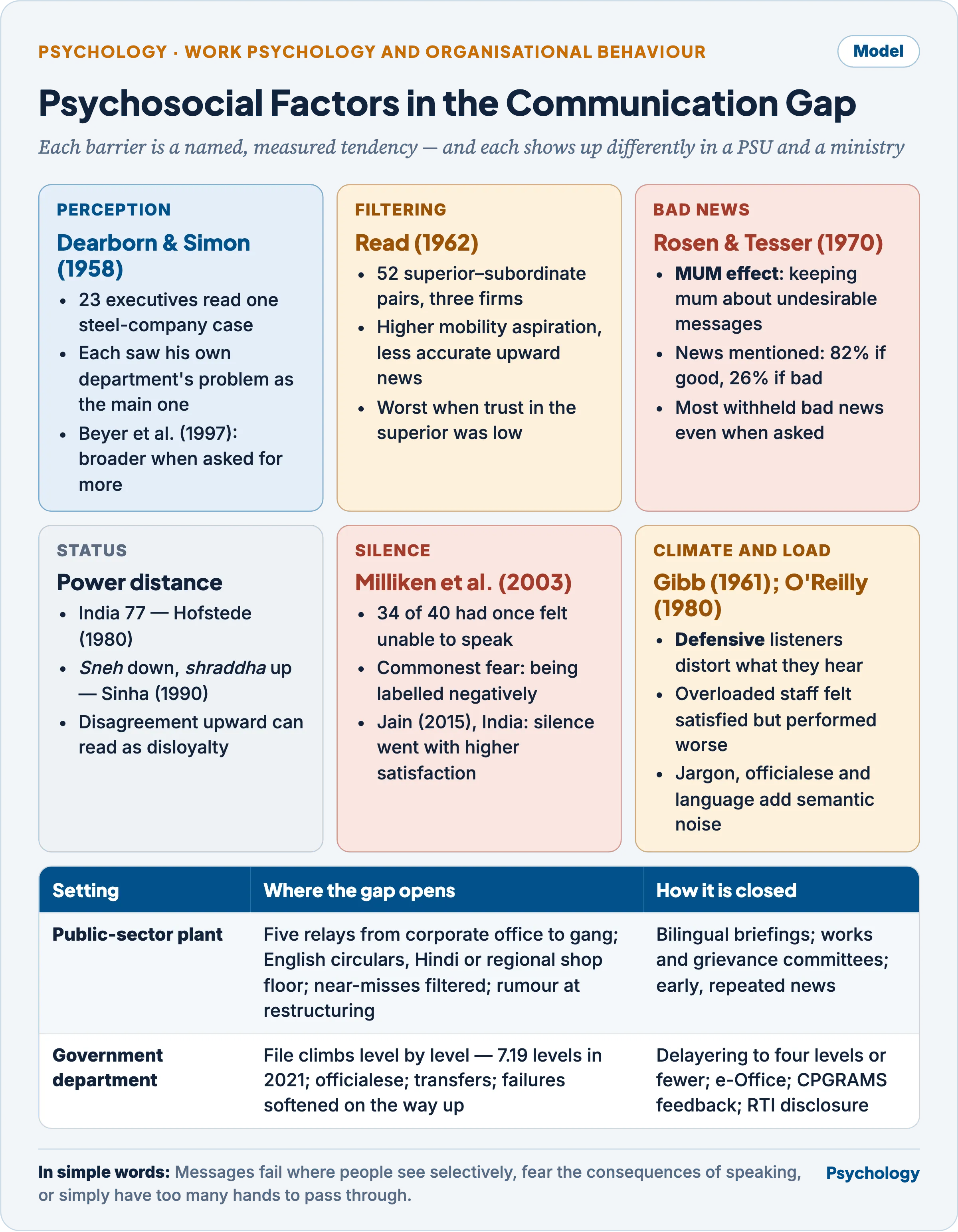
Every barrier on the card is a named, measured tendency, which is why exhortation to “communicate better” rarely closes the gap.
- Selective perception — Dearborn and Simon (1958): 23 executives read one case about a steel company; each tended to identify as its main problem the one belonging to his own department.
- Limitation: Beyer and colleagues (1997) found managers broader perceivers when asked to list more problems.
- Filtering by ambition and distrust — Read (1962): in 52 superior–subordinate pairs of executives in three industrial firms, the stronger the subordinate’s upward-mobility aspiration, the less accurately problems were communicated upward, especially when trust in the superior was low.
- Limitation: correlational, one national sample, one era.
- The MUM effect — Rosen and Tesser (1970): participants overheard that another student should call home at once about very good or very bad news.
- Of 36 participants, 35 passed on the request to call home, but 82 per cent mentioned the news when it was good and only 26 per cent when it was bad, even when asked (Rosen and Tesser, 1970). Limitation: laboratory, students.
- Status and power distance — Hofstede (1980) scored India 77 on power distance.
- J. B. P. Sinha (1990) described Indian work culture as preferring hierarchy and personalised ties of affection from the senior (sneh) and deference from the junior (shraddha), where disagreement upward can read as disloyalty.
- Silence — Milliken, Morrison and Hewlin (2003) interviewed 40 employees: 34 (85 per cent) had felt unable to raise an important issue with a superior; the commonest reason was fear of being viewed or labelled negatively.
- Jain (2015), in private, public and multinational organisations in northern India, found four dimensions of silence — fear of retaliation, internal motivation, self-competence and self-image — and, unlike Western findings, silence went with higher job satisfaction.
- Defensiveness (Gibb, 1961), semantic barriers (jargon, officialese, language) and overload (O’Reilly, 1980) complete the set; general barriers are in Effective Communication and Its Training (Paper I).
In a public-sector industrial organisation
- A public-sector steel plant or power utility relays policy through corporate office, plant, department, shift and gang; every level re-encodes, and shop-floor workers often hear the union’s or the grapevine’s version first.
- Circulars are drafted in English for a workforce that speaks Hindi or a regional language — formally complete, functionally void.
- The officer–worker status gap and appraisal by the immediate superior make safety near-misses and defects the hardest news to send up (Read, 1962; Rosen and Tesser, 1970).
- Announcements of restructuring, voluntary retirement or disinvestment are high in importance and ambiguity, so rumour peaks exactly then (Allport and Postman, 1947).
In a government department
- Communication is written and file-borne: a note climbs level by level, and each level adds comment. In central ministries active files passed through 7.19 distinct levels on average in 2021 (PIB, 23 February 2026).
- Officialese and precedent shape every message; frequent transfers break continuity, so informal channels — who knows whom — carry what files do not.
- Reports of implementation failure rising towards the political executive are softened — the MUM effect of Rosen and Tesser (1970) at scale — and fear of an adverse appraisal entry adds filtering.
- Facing outwards, the department–citizen gap appears as unanswered grievances and opaque decisions, the target of CPGRAMS and the Right to Information Act (see Indian context).
Overcoming the communication gap
- Shorten the chain — delayering, the desk officer system and e-files. The Department of Administrative Reforms and Public Grievances (DARPG) told ministries in 2023 that no file should pass more than four levels; the average fell to 4.31 by January 2026 (PIB, 23 February 2026).
- Change the climate — Gibb’s supportive behaviours and Redding’s five components, beginning with visible openness from the top.
- Engineer the message — rationale stated, bilingual drafting, plain language, two channels for anything equivocal, and checking back.
- Pre-empt rumour — brief early and repeatedly whenever importance and ambiguity are high.
- Measure it — communication audits and surveys, fed back and acted upon.
Improving upward communication
- Open-door policy — simple, but rarely used across a status gap.
- Suggestion schemes — with a quick reply and a reward, flat or a share of savings; quality circles extend this to groups (Leadership and Participatory Management).
- Grievance machinery — the Grievance Redressal Committee of the Industrial Relations Code, 2020 (section 4): every establishment with 20 or more workers, up to ten members, equal employer and worker representation.
- Attitude and engagement surveys, anonymous, with results returned and acted on.
- Skip-level and brown-bag meetings — Detert and Treviño (2010), from 89 interviews in a high-technology firm, found leaders two to five levels up cited almost as often as immediate supervisors as reasons speaking up seemed risky or futile.
- Ombudsperson, hotlines and the vigil mechanism (Companies Act, 2013, section 177).
- Management by wandering around — Peters and Waterman (1982) — and exit and stay interviews.
- Digital channels — e-mail to the top, enterprise social media and pulse surveys, which weaken status cues (Sproull and Kiesler, 1986).
- What makes the methods work:
- Edmondson (1999), in 51 work teams of a manufacturing firm, found team psychological safety predicted learning behaviour — asking for help, admitting errors, seeking feedback.
- Detert and Burris (2007) found managerial openness predicted subordinates’ improvement-oriented voice.
- Limitation: a channel does not remove the reasons for silence — fear of labels and retaliation, and futility (Milliken and colleagues, 2003) — so visible action on what is raised matters more than the box.
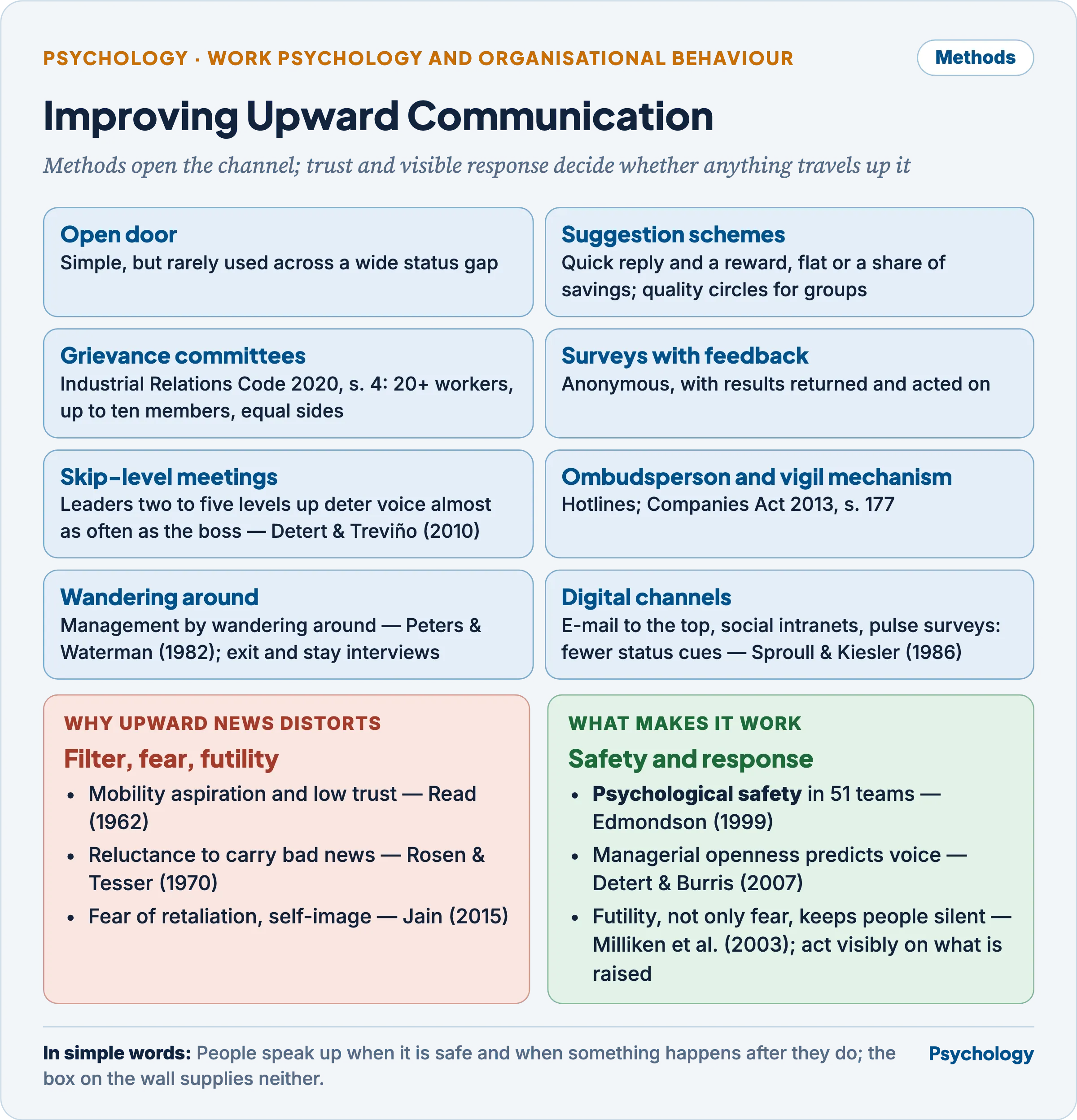
Methods open the channel, but whether anything travels up it depends on trust, ambition and what happened to the last person who spoke.
Organisational communication in the 21st century: information technology
- Memos and notice boards have given way to e-mail, intranets, enterprise social media, video calls and artificial-intelligence assistants, raising questions of status, visibility, overload and lost cues.
- Sproull and Kiesler (1986) studied e-mail in a Fortune 500 firm: fewer social context cues weakened awareness of status, made messages less inhibited, and carried information that would otherwise not have been sent — a flattening of upward flow.
- Leonardi (2015), in a six-month quasi-natural field experiment, found enterprise social-networking users improved their knowledge of who knows what by 31 per cent and of who knows whom by 88 per cent — communication visibility strengthening horizontal flow.
- Yang and colleagues (2022) analysed 61,182 Microsoft employees in 2020: firm-wide remote work made collaboration networks more static and siloed, cut cross-group collaboration and shifted communication to asynchronous media.
- Bloom, Liang, Roberts and Ying (2015): home working in a Chinese travel firm raised performance 13 per cent and halved attrition, but promotion conditional on performance fell — out of sight, out of the upward channel.
- Bailenson (2021) traced video-call fatigue to excessive close-up eye gaze, constant self-view, reduced mobility and the extra effort of sending and reading non-verbal cues.
- Brynjolfsson, Li and Raymond (2025): among 5,172 customer-support agents a generative-AI assistant raised resolutions per hour by about 15 per cent, most for novices, and customers asked for a manager less often.
- The resulting form is networked rather than hierarchical, asynchronous, searchable and permanent, and algorithmically filtered. Its risks — surveillance, always-on availability, the digital divide — are taken up in Unit 10.
Criticisms and limitations
- Axley (1984) criticised the conduit metaphor — meaning packed into words and shipped — which makes miscommunication look exceptional when it is normal; the interpretive perspective (Krone and colleagues, 1987) starts from that objection.
- The network experiments used five strangers on puzzles; once groups could organise, structure mattered far less (Guetzkow and Simon, 1955).
- The grapevine evidence is old and rests on single firms (Davis, 1953); accuracy estimates are impressionistic.
- Media richness predicts poorly once norms and experience are counted (Markus, 1994).
- Communication is blamed for what is structural: clearer messages cannot settle a conflict of interests, and more information can lower performance (O’Reilly, 1980).
- Western samples dominate, and Indian findings can differ in direction — silence went with higher satisfaction (Jain, 2015). Most measures are self-reported.
Indian context
- CPGRAMS — Centralised Public Grievance Redress and Monitoring System (DARPG with the National Informatics Centre, 2007): an online channel from any citizen to any central or state department.
- Central ministries’ average disposal took 15 days in 2025 against a 21-day limit set by the August 2024 guidelines, which also require grievance cells, root-cause analysis and action on citizen feedback (PIB, 11 February 2026).
- Principle: a tracked upward channel defeats silence and the MUM effect, because a complaint cannot be quietly dropped.
- e-Office (DARPG; a mission-mode project of the National e-Governance Plan, 2006): 93.81 per cent of files created in central ministries in January 2026 were electronic (PIB, 23 February 2026).
- Principle: fewer, visible relay points shorten the serial reproduction chain that distorts messages.
- Right to Information Act, 2005 (Department of Personnel and Training): any citizen may obtain official information within 30 days, and section 4 requires public authorities to publish key information suo motu.
- Principle: lowering ambiguity lowers rumour (Allport and Postman, 1947) and narrows the information gap between state and citizen.
- PRAGATI (Prime Minister’s Office with the National Informatics Centre, 25 March 2015): monthly video-conference reviews with Union secretaries and state chief secretaries on grievances, programmes and projects.
- Principle: a rich, skip-level channel for equivocal problems, bypassing serial relay.
- Industrial Relations Code, 2020 (Ministry of Labour and Employment; in force from 21 November 2025): grievance redressal committees (section 4), and works committees that government may require in establishments of 100 or more workers (section 3).
- Principle: institutionalised voice reduces the futility that keeps workers silent.
Previous Year Questions
- 2000What is organizational communication? What will be the form of organizational communication in the 21st century because of the advent of information technology?
- 1999Enumerate the methods for improving the effectiveness of upward communication in the organization.
- 1998What is organizational communication? Discuss the various factors of effective communication in industries.
- 1995Describe the various psycho-social factors which contribute to communication gap. Illustrate your answer from a public sector industrial organisation as well as a Govt. Department. How would you overcome communication gap?