

Official syllabusPaper II · Unit 4 · Work Psychology and Organisational Behaviour
Managerial effectiveness.
Definition
“Effectiveness is the extent to which a manager achieves the output requirements of his position.”
Reddin (1970)
Managerial effectiveness asks whether a manager produces what the position exists to produce, a different question from how busy, likeable or economical the manager is. It depends on the person, the job, the group and the organisation’s culture, so reasoning, citizenship and group behaviour all bear on it.
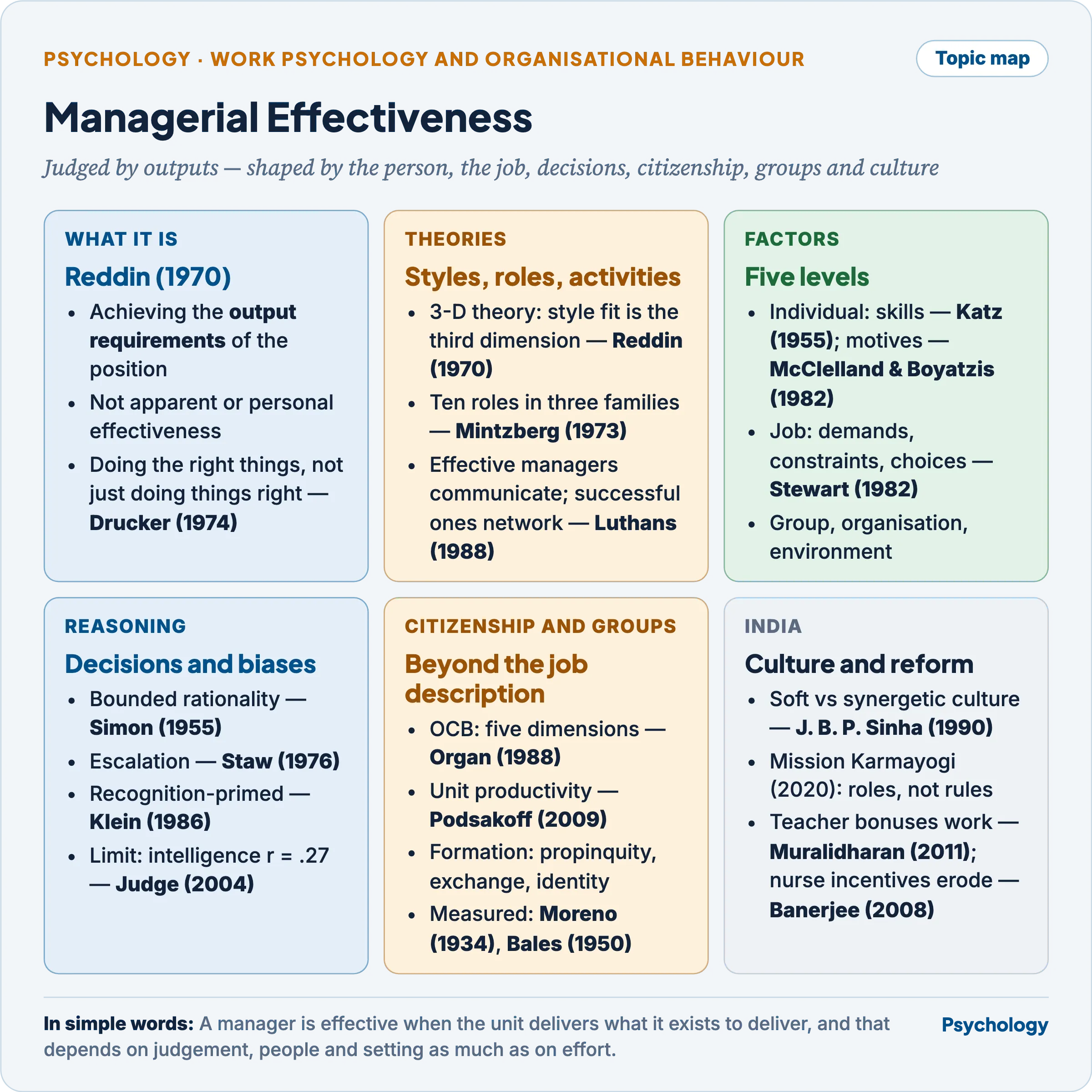
Effectiveness is judged by outputs; every other box is a reason those outputs rise or fall.
Managerial effectiveness and efficiency
- Efficiency is the ratio of outputs to inputs. Effectiveness is attainment of the outputs the position is meant to deliver.
- Drucker (1974) fixed the distinction: “Efficiency is concerned with doing things right. Effectiveness is doing the right things.”
- Reddin (1970) separated managerial effectiveness from two look-alikes.
- Apparent effectiveness — looking effective: punctuality, prompt answers, a tidy desk, quick decisions, good public relations. It may or may not produce output.
- Personal effectiveness — achieving one’s own private objectives, such as promotion, rather than the position’s outputs.
| Dimension | Efficiency | Effectiveness |
|---|---|---|
| Question | Are things done right? | Are the right things done? |
| Criterion | Input–output ratio | Goal and output attainment |
| Focus | Means, methods, cost | Ends, results, impact |
| Time frame | Usually short-term | Short- and long-term |
| Typical failure | Waste, delay, duplication | Wrong goal pursued well |
| District office example | Files disposed of per day | Eligible households actually covered |
- The two diverge: a vaccination drive can be cheap per dose yet miss the unreached. Effectiveness is prior; efficiency economises it.
- Luthans, Hodgetts and Rosenkrantz (1988) showed that rising fast and being effective are different achievements.
- Design: four years of observing managers’ activities in varied organisations; success indexed by speed of promotion, effectiveness by unit performance and subordinates’ satisfaction and commitment.
- Relative contributions to success: networking 48 per cent, human resource management 11 per cent (Luthans and colleagues, 1988).
- Relative contributions to effectiveness: routine communication 45 per cent, human resource management 27 per cent, networking 12 per cent (Luthans and colleagues, 1988).
- Limitation: American managers and correlational data.
- Mintzberg (1973) timed five chief executives for a week each and found work marked by brevity, variety and fragmentation, with a preference for talk over documents.
- He grouped the job into ten managerial roles: interpersonal (figurehead, leader, liaison), informational (monitor, disseminator, spokesperson) and decisional (entrepreneur, disturbance handler, resource allocator, negotiator).
- Effectiveness lies in performing the mix of roles a job demands; the limitation is a sample of five.
Reddin’s 3-D theory
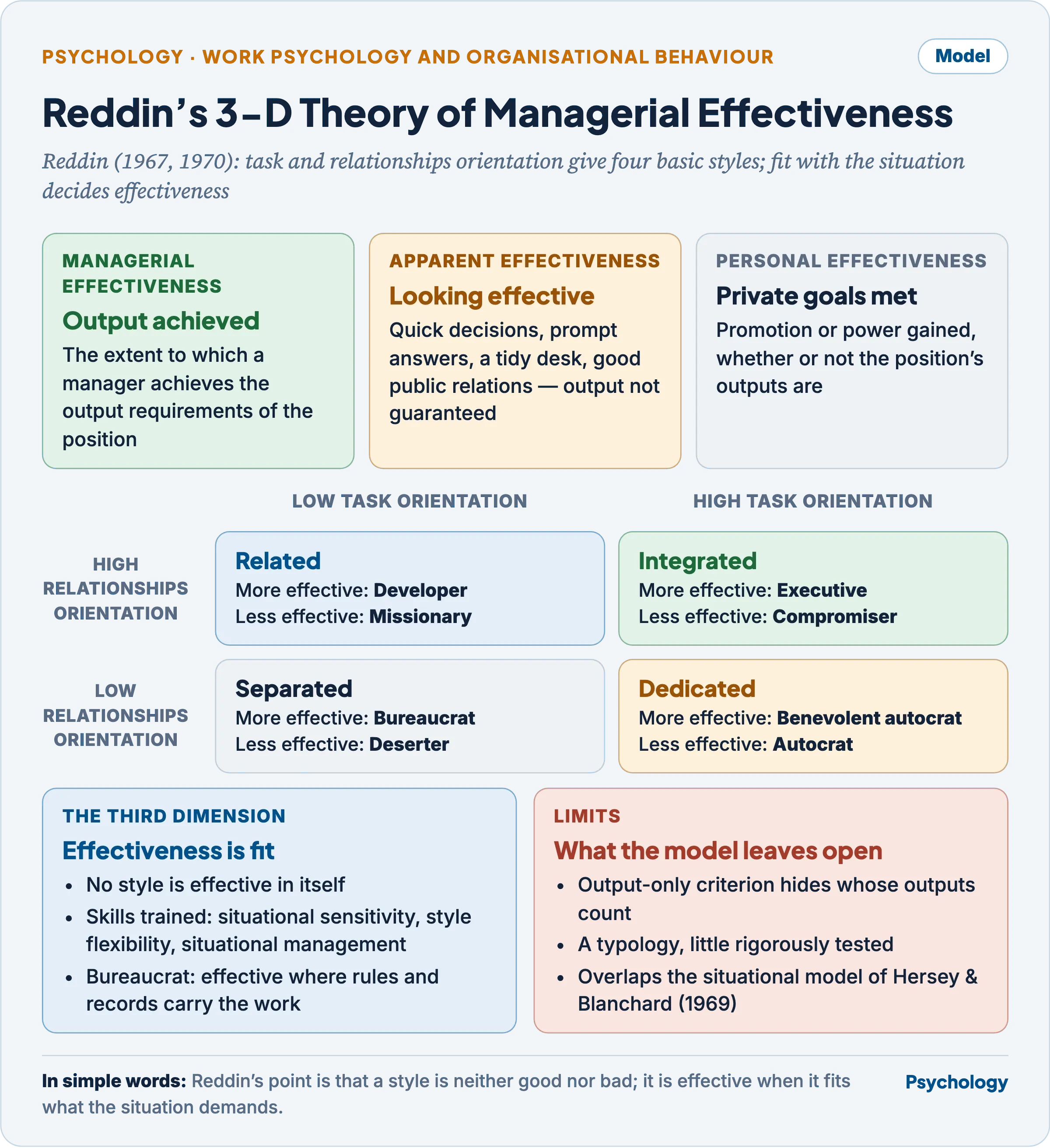
The same style is effective in one situation and ineffective in another; effectiveness is the fit, not the style.
- Reddin (1967, 1970) added effectiveness as a third dimension to the two leader-behaviour dimensions of the Ohio State tradition: task orientation and relationships orientation.
- Four basic styles follow: separated (low on both), related (relationships high), dedicated (task high) and integrated (both high).
- Each has a more effective and a less effective form, depending on fit with the situation’s demands.
- Separated: bureaucrat or deserter. Related: developer or missionary.
- Dedicated: benevolent autocrat or autocrat. Integrated: executive or compromiser.
- Reddin therefore trained situational sensitivity, style flexibility and situational management — changing the situation where the style cannot change.
- The bureaucrat style is the effective choice where rules and records carry the work.
Factors influencing managerial effectiveness and efficiency
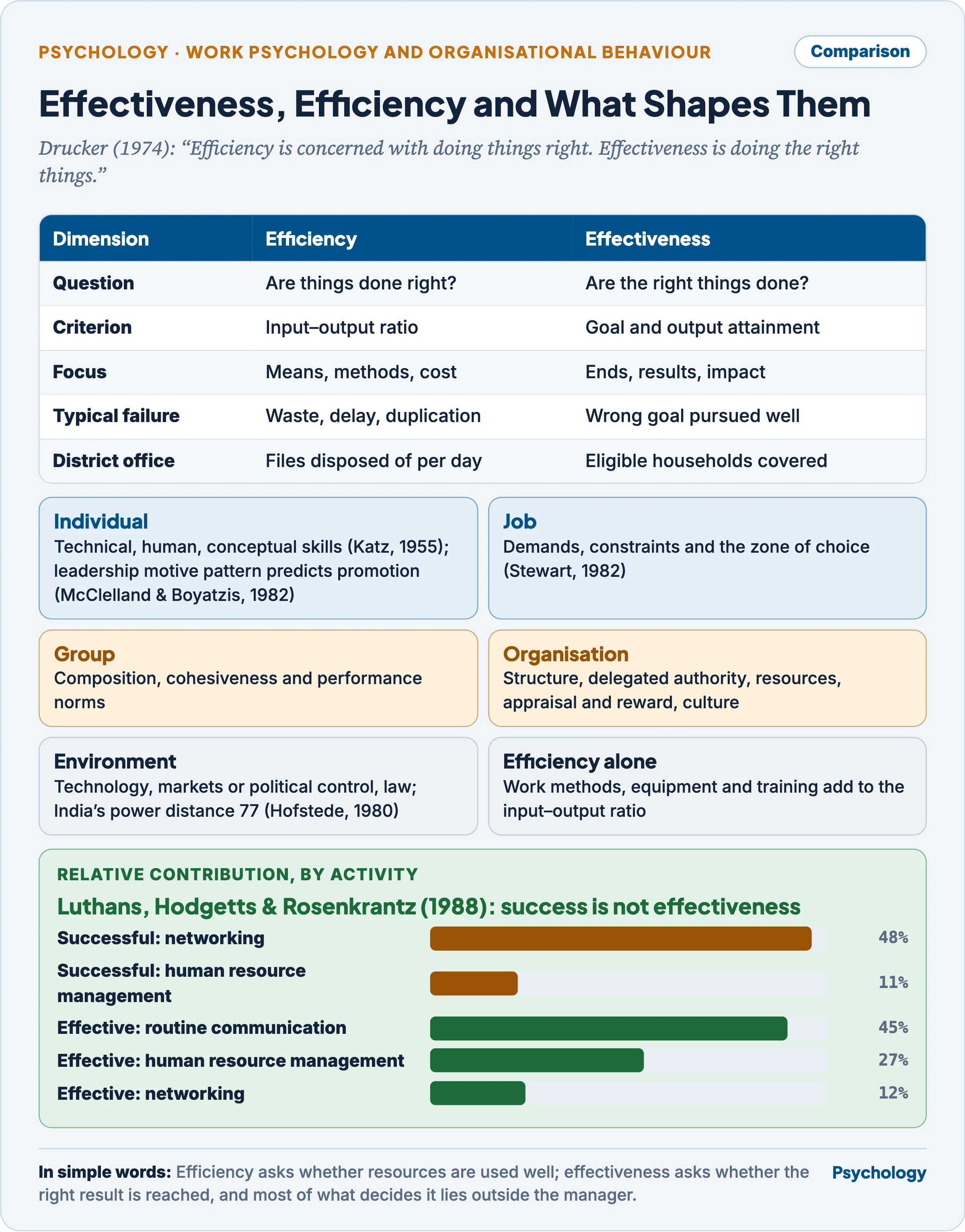
Most of what decides a manager’s effectiveness sits outside the manager.
- Individual factors.
- Katz (1955) named three skills: technical, human and conceptual. Technical skill matters most at the supervisory level, conceptual skill at the top; human skill matters at every level.
- Motives: McClelland and Boyatzis (1982) followed 237 AT&T managers; the leadership motive pattern — high need for power, low need for affiliation, high self-control — predicted promotion after 8 and 16 years among non-technical managers, not technical ones.
- Job factors. Stewart (1982) described every managerial job as demands (what must be done), constraints (rules, resources, technology) and choices (the zone of discretion). Effective managers recognise and use their choices.
- Group factors. Team composition, cohesiveness and norms, treated under work groups below.
- Organisational factors. Structure and delegated authority; resources; information systems; the appraisal and reward system, since what is measured is what gets done; and culture and climate.
- Environmental factors. Technology, markets or political control, the legal framework, and national culture: India scores 77 on Hofstede’s (1980) power distance, so subordinates expect direction.
- Efficiency also depends on work methods and equipment (Ergonomics and Human Engineering) and on skill (Training and Human Resource Development).
Reasoning and decision-making abilities and managerial effectiveness
- Simon (1960) treated decision making as synonymous with managing, in three phases: intelligence (finding the problem), design (generating options) and choice; implementation and review were added later.
- Programmed decisions follow routines; non-programmed decisions are novel and ill-structured, and there managerial reasoning matters most.
- Bounded rationality (Simon, 1955): limited information, capacity and time rule out optimising, so managers satisfice — accept the first option meeting an aspiration level. Lindblom (1959) found public policy made by muddling through, in small steps from the existing policy.
- Managers inherit the biases set out in Decision Making, Heuristics and Biases (Paper I).
- Overconfidence: answers given odds of 1,000 to 1 were right only 81–88 per cent of the time (Fischhoff, Slovic and Lichtenstein, 1977).
- Anchoring, availability and framing (Tversky and Kahneman, 1974, 1981).
- Staw (1976) demonstrated escalation of commitment.
- Design: 240 business students, as financial officers of the “Adams & Smith Company”, gave $10 million of research funds to one division, then divided $20 million after learning how it fared. Half had made the first choice themselves.
- Those personally responsible for a failing choice gave it $13.07 million on average — more than any other group.
- Limitation: students in a one-shot role-play, not managers with careers at stake.
- Klein, Calderwood and Clinton-Cirocco (1986) studied urban fireground commanders under time pressure, a founding study of naturalistic decision making.
- Of 156 decision points, about 80 per cent were recognition-primed: the commander recognised the situation, generated one workable option and simulated it mentally, without comparing alternatives (Klein, 1998).
- Limitation: retrospective interviews. Intuition is trustworthy only where the environment gives regular, valid feedback (Kahneman and Klein, 2009).
- Judge, Colbert and Ilies (2004), meta-analysing 151 samples, found intelligence correlated .21 with leadership (.27 corrected for range restriction), “considerably lower than previously thought”, and weaker under stress.
- Fiedler and Garcia’s (1987) cognitive resource theory explains why: under high stress, a leader’s experience predicts group performance and intelligence does not.
- Stanovich and West (2008), across seven studies, found anchoring, framing and conjunction effects largely uncorrelated with cognitive ability: intelligence does not immunise against bias.
- Process improves outcomes: in 1,048 major business decisions described by managers, the quality of the decision process mattered six times as much as the quantity of analysis (Lovallo and Sibony, 2010), though outcomes were self-rated.
- “Consider the opposite” instructions reduce overconfidence, anchoring and hindsight bias (Larrick, 2004).
- The nominal group technique (Delbecq and Van de Ven, 1971), the Delphi method (Dalkey and Helmer, 1963) and a devil’s advocate guard against groupthink, which Janis (1972) traced in the Bay of Pigs invasion.
- Critical evaluation: reasoning is necessary but not sufficient.
- Mintzberg (1973) found little orderly deciding in managerial work, and Luthans and colleagues (1988) found communication and people management, not analysis, set effective managers apart.
- A good decision can turn out badly, so judging managers by outcomes alone commits outcome bias (Baron and Hershey, 1988).
- Much evidence comes from students and laboratories, and Indian managers also weigh person, place and time — context sensitivity (Sinha and Kanungo, 1997).
Organisational citizenship behaviour and successful organisational environments
- Organ (1988) defined organisational citizenship behaviour (OCB) as “individual behavior that is discretionary, not directly or explicitly recognized by the formal reward system, and that in the aggregate promotes the effective functioning of the organization.”
- Bateman and Organ (1983) coined the term; Organ (1988) named five dimensions:
- Altruism (helping a colleague), conscientiousness (exceeding minimum attendance and rules), sportsmanship (not complaining about trivial impositions), courtesy (consulting before acting) and civic virtue (taking part in the organisation’s life).
- Williams and Anderson (1991) grouped them by target: OCB-I towards individuals, OCB-O towards the organisation.
- Antecedents: Organ and Ryan (1995), meta-analysing 55 studies, found job satisfaction, perceived fairness, commitment and leader support robust predictors, and dispositions weaker.
- The mechanism is social exchange (Blau, 1964): fairly treated employees repay the organisation with contributions no contract can specify.
- Podsakoff, Ahearne and MacKenzie (1997) studied 218 employees in 40 machine crews of a paper mill.
- Helping and sportsmanship raised the quantity of crew output; helping raised its quality; civic virtue affected neither.
- Limitation: one plant and one technology.
- Podsakoff, Whiting, Podsakoff and Blume (2009) meta-analysed the consequences.
- In 168 samples (N = 51,235), OCB predicted managers’ ratings, reward decisions and lower turnover and absenteeism (Podsakoff and colleagues, 2009).
- In 38 samples of 3,611 units, it went with higher productivity, efficiency and customer satisfaction and lower costs and turnover, more strongly in longitudinal designs (Podsakoff and colleagues, 2009).
- OCB builds a successful environment by raising co-workers’ and managers’ productivity, freeing resources, coordinating work, helping retain staff and stabilising performance (Podsakoff and colleagues, 2000).
- Its limits. Bolino and Turnley (2005) linked high individual initiative to role overload, job stress and work–family conflict. Heilman and Chen (2005) found altruism raised evaluations of men but not women, while withholding it penalised women only.
- OCB grows from fairness, support and recognition; compelling it turns citizenship into unpaid in-role work.
Principles of management from industrial organisations applied to bureaucratic organisations in India
- The transferable principles are management by objectives (Drucker, 1954), measurement with feedback, delegation, competency-based development, citizen orientation and incentive pay, whose motivational basis is set out in Theories of Work Motivation: Vroom, Adams’ Equity Theory and Porter-Lawler.
- Hood (1991) named the package New Public Management: hands-on professional management, explicit standards and measures of performance, output controls, disaggregated units, competition, private-sector management styles and discipline in resource use.
- Muralidharan and Sundararaman (2011) tested performance pay in rural government primary schools in Andhra Pradesh.
- Design: schools randomised to group or individual teacher bonuses tied to pupils’ test gains, averaging 3 per cent of annual pay, or to control (Muralidharan and Sundararaman, 2011).
- After two years, incentive-school pupils scored 0.27 and 0.17 standard deviations higher in mathematics and language, and gained in unincentivised subjects too.
- Limitation: test scores capture only part of what schools are for.
- Banerjee, Glennerster and Duflo (2008) tested attendance incentives for nurses at rural sub-centres in Udaipur, Rajasthan, from 2006.
- Time-stamped monitoring with pay deductions first raised presence; in single-nurse centres, 59 against 30 per cent (Banerjee and colleagues, 2008).
- The local health administration then let nurses claim ever more “exempt days”, and stamping machines were broken; by sixteen months the centres did not differ.
- Incentives work in government only if supervisors cannot quietly neutralise them.
- The limits are psychological as well as administrative.
- Public goals are multiple and hard to measure (Dixit, 2002), so measured targets crowd out unmeasured duties, and an indicator used for decisions becomes corrupted (Campbell, 1979).
- Merton (1940) described goal displacement: rules become ends, producing the bureaucratic personality’s “trained incapacity”, Veblen’s term.
- Pay for performance can crowd out public service motivation (Perry and Wise, 1990), a hidden cost that helps explain its modest public-sector record (Weibel, Rost and Osterloh, 2010).
- Tenure, time-bound promotion, transfers and the political interface blunt the effort–reward link; see Power and Politics in Organizations and, for participation in bureaucracies, Leadership and Participatory Management.
- The principles transfer where outputs are measurable, tasks clear and enforcement credible; elsewhere they must be adapted to public values, not copied.
Work culture as a component of effective work motivation in public and private industry in India
- Schein (1992) defined culture as “a pattern of shared basic assumptions that the group learned as it solved its problems of external adaptation and internal integration”, visible at three levels: artefacts, espoused values and basic underlying assumptions.
- Work culture is the part of it about work: what counts as a day’s work, punctuality, initiative, and whether reward follows effort.
- J. B. P. Sinha (1990) described two broad Indian work cultures.
- Soft work culture: pliant management, and employees’ lives dominated by non-work activities and influences — personal obligations, status and connections.
- Synergetic work culture: assertive management, reward for hard work, provision for welfare and cultivated union relations.
- His cases included banking organisations, and his central finding was that Indian socio-cultural values can equally support either culture: management shapes it.
- Work culture is an essential component of motivation because it sets which rewards are valued, who the comparison other is, and whether effort is believed to bring reward — the processes of Theories of Work Motivation: Vroom, Adams’ Equity Theory and Porter-Lawler.
- In the public sector, security of tenure, seniority-based promotion and rule-bound discretion weaken the effort–reward link, which favours a soft culture.
- In private industry, performance-linked pay and careers strengthen it, at the risk of stress (Occupational Stress and Its Management).
- Sinha’s (1980) nurturant-task leader, treated in Leadership and Participatory Management, was his prescription for building task commitment in such settings.
Types of group at work situations and theories of group formation
- A group is “two or more persons who are interacting with one another in such a manner that each person influences and is influenced by each other person” (Shaw, 1981).
- Formal groups are created by the organisation: command groups (a manager and direct reports) and task groups (committees, task forces, project teams).
- Informal groups arise from members’ needs: interest groups and friendship groups. Primary groups are small and face-to-face (Cooley, 1909); reference groups supply the norms a person conforms to.
- In the Hawthorne Bank Wiring Observation Room, 14 men enforced an informal output norm against “rate-busters” and “chiselers” (Roethlisberger and Dickson, 1939): informal groups can override management’s standard.
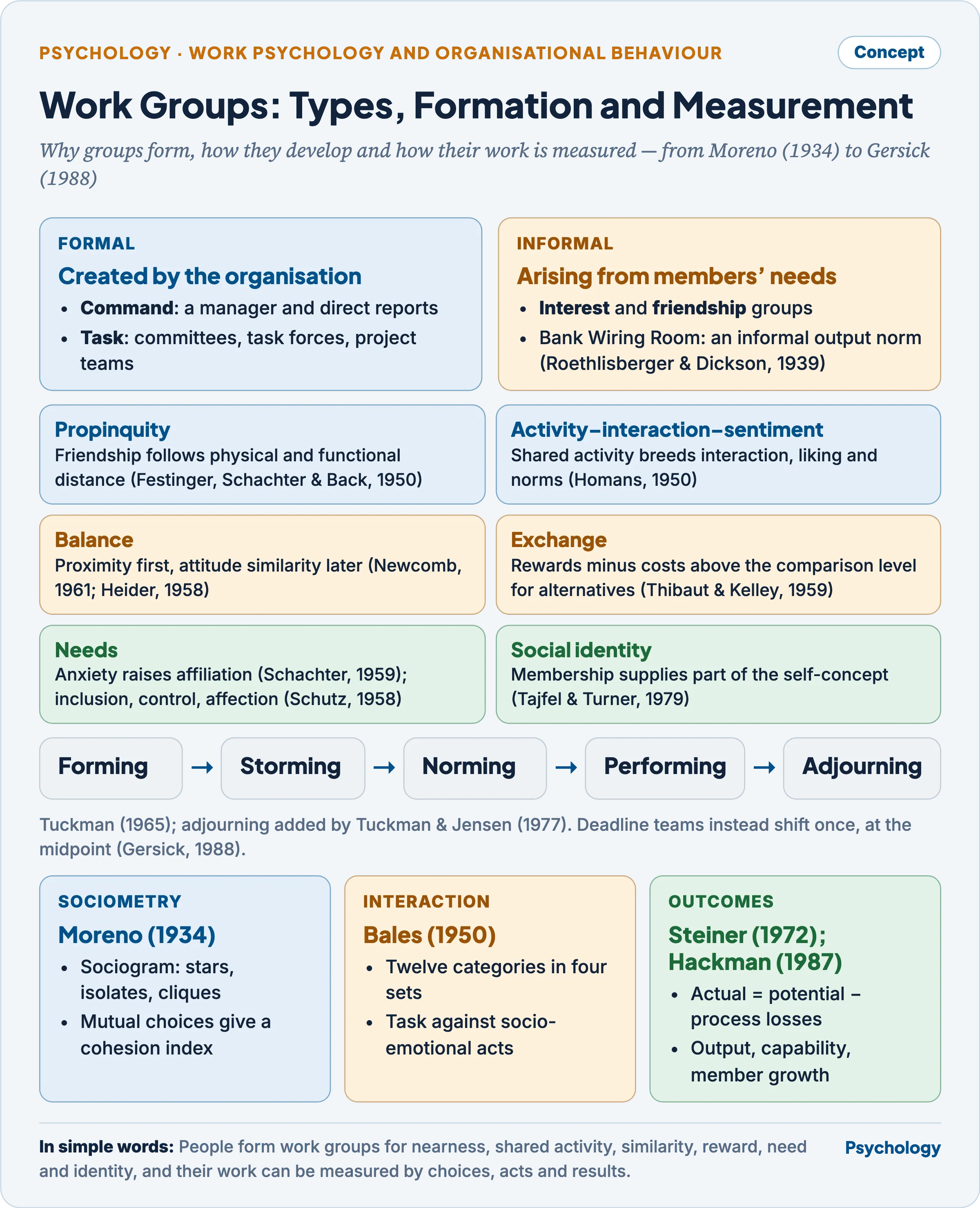
Each theory names a different reason to join; real groups usually rest on several at once.
- Propinquity: Festinger, Schachter and Back (1950) found that friendships in a student housing project followed physical and functional distance between doors.
- Activity–interaction–sentiment: Homans (1950) argued that shared activities produce interaction, interaction produces liking, and liking produces further interaction and shared norms.
- Balance: Newcomb (1961), housing 17 transfer students free at the University of Michigan, found attraction followed proximity at first and attitude similarity later, as Heider’s (1958) balance theory predicts.
- Exchange: Thibaut and Kelley (1959) held that people stay in a group while its rewards minus costs exceed their comparison level for alternatives.
- Needs: anxiety raises affiliation (Schachter, 1959); Schutz (1958) named needs for inclusion, control and affection.
- Social identity: Tajfel and Turner (1979) — membership supplies part of the self-concept, so people join and favour groups that enhance self-esteem.
- Development: Tuckman (1965) proposed forming, storming, norming and performing; Tuckman and Jensen (1977) added adjourning.
- Limitation: it came from a review of about 50 articles, mostly on therapy and training groups. Gersick (1988), following eight project teams, found instead one transition at the midpoint of their allotted time — punctuated equilibrium.
How group work can be measured
- Sociometry: Moreno (1934) asked members whom they would choose to work or live with; the sociogram shows stars, isolates, mutual pairs and cliques, and mutual choices over possible ones give a cohesion index.
- Interaction process analysis: Bales (1950) coded each act into twelve categories in four sets — positive reactions, attempted answers, questions and negative reactions — revealing the balance of task and socio-emotional activity and who leads each.
- Cohesiveness: Seashore (1954), measuring attraction to the group in 228 factory work groups, found output more uniform within cohesive groups, which departed further from the plant norm, upward where members felt secure with the company.
- Process and outcome: Steiner (1972) expressed actual productivity as potential productivity minus process losses, such as social loafing (Ringelmann, 1913; Latané, Williams and Harkins, 1979).
- Hackman (1987) judged team effectiveness by three criteria: output meeting its users’ standards, growing capability to work together, and members’ satisfaction and growth.
- Limitation: sociometry measures preference, not work; interaction coding is laborious; cohesion scales are self-report.
Criticisms and limitations
- Effectiveness has no single criterion: owners, superiors, subordinates and citizens judge a unit differently (Connolly, Conlon and Deutsch, 1980), and Reddin’s output-only definition hides whose outputs count.
- Reddin’s eight styles are a descriptive typology with little rigorous testing, overlapping Hersey and Blanchard’s (1969) situational model.
- Observational studies rest on small or American samples (Mintzberg; Luthans); decision research relies on students (Staw) and recall (Klein).
- OCB overlaps with in-role performance, is usually rated by the supervisor who rates performance, and costs the employee.
- Most models were built in Western firms; Indian organisations work through relationships, hierarchy and context sensitivity (Sinha and Kanungo, 1997).
Indian context
- Mission Karmayogi — National Programme for Civil Services Capacity Building (Union Cabinet, 2 September 2020; Department of Personnel and Training).
- Mechanism: posts calibrated to a Framework of Roles, Activities and Competencies (FRAC); behavioural, functional and domain competencies built on the iGOT Karmayogi platform; a Capacity Building Commission supervises training institutions.
- Principle: the shift from “rules based” to “roles based” human resource management applies the competency model of effectiveness (Boyatzis, 1982).
- iGOT had more than 1.70 crore registered users and over 5,600 courses (PIB, 5 August 2026); from 2025–26 prescribed courses are recorded in the annual appraisal.
- Second Administrative Reforms Commission, Tenth Report (November 2008) — criticised the secret confidential report and recommended a performance management system with annual performance agreements between ministers and secretaries. Principle: goal-setting and feedback.
- All India Services (Performance Appraisal Report) Rules, 2007 (Department of Personnel and Training) — replaced the Confidential Rolls Rules, 1970 with 1–10 numerical grading and disclosure of the full report, which the officer may contest before a Referral Board. Principle: feedback and procedural justice.
- Results-Framework Documents (Performance Management Division, Cabinet Secretariat, 2009) — yearly ministry objectives, targets and weights, prepared from 2009–10 to 2014–15. Principle: management by objectives.
- Udai Pareek’s (1980) role efficacy — a person’s potential effectiveness in a role — has three clusters, role making, role centring and role linking, measured by his Role Efficacy Scale.
Previous Year Questions
- 2026What is the role of citizenship behaviour towards successful organizational environments?
- 2025Managerial effectiveness is influenced by the reasoning and decision-making abilities of a manager. Critically evaluate with the help of researches.
- 2014To what extent, do you think that the principles of management derived from the study of industrial organisations can be applied to improve the functioning of bureaucratic organisations in India?
- 2011Differentiate between managerial effectiveness and efficiency, and discuss the factors influencing them.
- 1999Comment on: Briefly discuss the major theoretical explanations for group formation in the organization set-up.
- 1998Discuss the types of group at work situations. How can group work be measured?
- 1996Is work culture an essential component of effective work motivation? Discuss its operation in public and private industrial set-up in India.