

Official syllabusPaper II · Unit 4 · Work Psychology and Organisational Behaviour
Stress and its management.
Definition
“Work-related stress is the response people may have when presented with work demands and pressures that are not matched to their knowledge and abilities and which challenge their ability to cope.”
Leka, Griffiths and Cox (2003), for the World Health Organization
Occupational stress applies the general theory of stress, set out in Stress, Psychosomatic Disorders and Stress Management (Unit 2), to the job itself. It asks which features of work design, role and reward produce strain, and whether the remedy lies with the employee or with the organisation; the evidence answers the two questions differently.
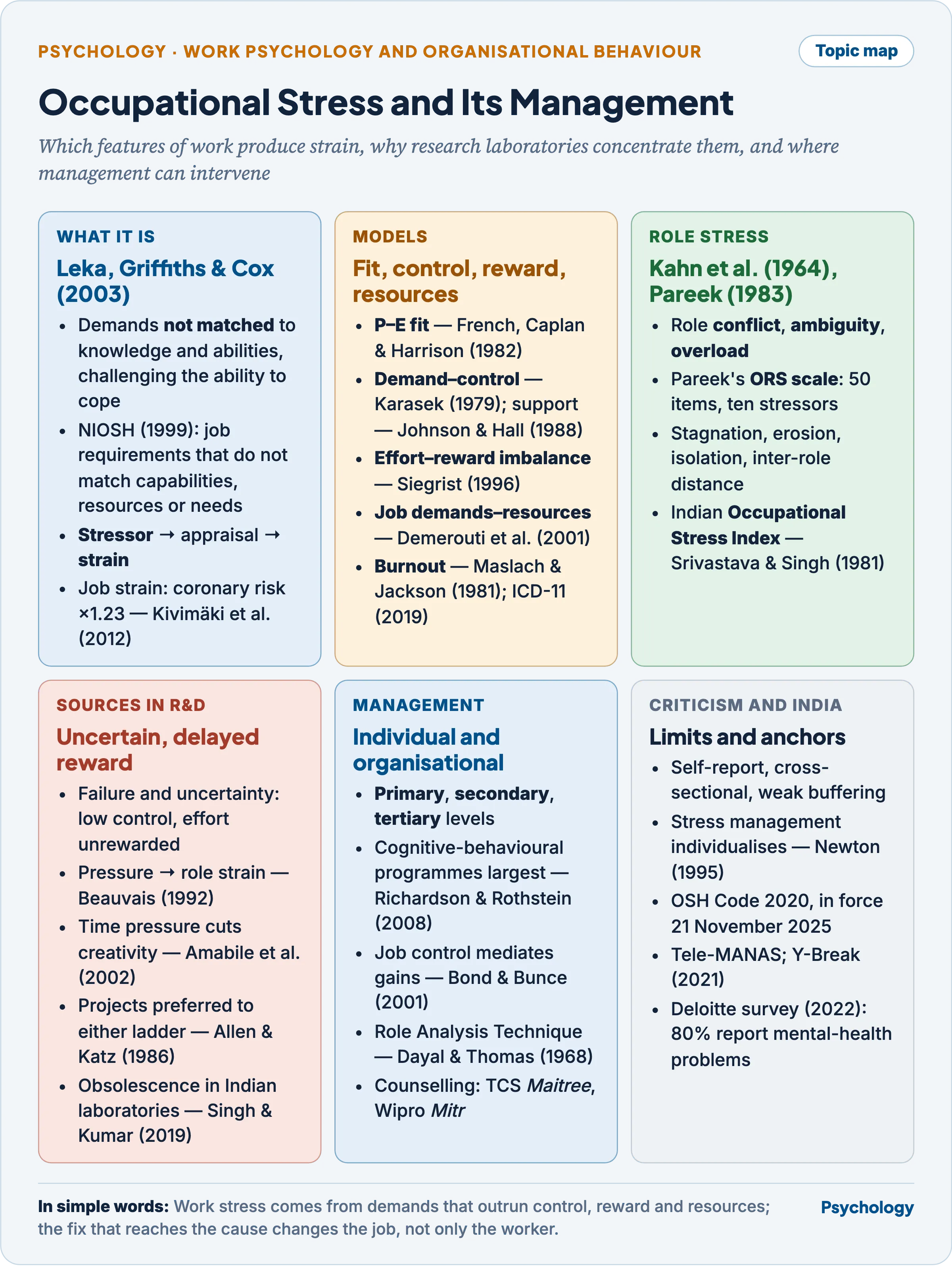
The models place the causes of strain in job design, yet the best-measured remedies act on the worker.
Stress and its management at work: stressor, strain and fit
- A stressor is a demand in the work environment, strain is the person’s physiological, psychological or behavioural reaction to it, and stress names the whole process.
- NIOSH (1999) defines job stress as “the harmful physical and emotional responses that occur when the requirements of the job do not match the capabilities, resources, or needs of the worker”.
- Its model runs from stressful job conditions to strain, with individual and situational factors able to strengthen or weaken the link.
- Appraisal sits between stressor and strain, so the same transfer order is a challenge to one officer and a threat to another; Selye’s (1936) general adaptation syndrome, eustress and distress, and Lazarus and Folkman’s (1984) appraisal belong to the Unit 2 article.
- The claim that moderate stress is optimal is usually credited to Yerkes and Dodson (1908), but they varied shock strength while dancing mice learned black–white discriminations, and the best shock was weaker for harder discriminations.
- A universal stress–performance inverted U is a later generalisation, not their finding (Theories of Motivation, Paper I).
- Strain appears at three levels.
- Physiological: Kivimäki and colleagues (2012) pooled 13 European cohorts of 197,473 employees; job strain raised coronary heart disease risk (hazard ratio 1.23), a population-attributable risk of only 3.4 per cent.
- Long hours: Pega and colleagues (2021), for the WHO and ILO, attributed 745,194 deaths from ischaemic heart disease and stroke in 2016 to working 55 or more hours a week.
- Psychological: anxiety, depression, dissatisfaction and burnout; the WHO and ILO (2022) estimate 12 billion working days lost each year to depression and anxiety, costing nearly US$1 trillion.
- Behavioural: absenteeism, turnover, accidents, smoking and drinking.
Models of occupational stress
| Model | Stressor | What protects | Prediction | Main limitation |
|---|---|---|---|---|
| Person–environment fit | Misfit of demands and abilities, or of needs and supplies | Better fit | Strain from misfit | Difference scores blur person and environment |
| Demand–control(–support) | High demands, low decision latitude | Control; co-worker support | Strain in high-strain jobs, learning in active ones | Buffering weakly supported |
| Effort–reward imbalance | High effort, low reward | Reciprocity; low overcommitment | Strain when the exchange fails | Effort overlaps with demands |
| Job demands–resources | Any demand costing sustained effort | Any job resource | Exhaustion from demands, disengagement from missing resources | Demands and resources defined case by case |
Person–environment fit
- French, Caplan and Harrison (1982) set out the Michigan model: strain arises from misfit between job demands and abilities, or between the person’s needs and supplies the job provides.
- Subjective fit, environment and self as perceived, acts on strain directly; objective fit acts through it.
- Limitation: fit was measured as difference scores, which Edwards and Harrison (1993) showed confound the separate effects of person and environment.
Karasek’s demand–control model
- Karasek (1979), using national survey data from Sweden and the United States, proposed that mental strain results from the interaction of psychological job demands and decision latitude — authority over decisions and discretion in using one’s skills.
- High-strain jobs (high demands, low latitude) produce exhaustion and depression; active jobs (high, high) produce learning; low-strain and passive jobs complete the quadrants.
- The redesign implication is to raise latitude without lowering output.
- Johnson and Hall (1988) added co-worker social support: in a random sample of 13,779 Swedish workers, high demands, low control and low support together, or iso-strain, more than doubled cardiovascular disease prevalence (ratio 2.17) — a cross-sectional design.
- Bosma and colleagues (1997) followed 10,308 London civil servants in the Whitehall II study: low control on two occasions nearly doubled the odds of a coronary event (odds ratio 1.93), independent of grade and standard risk factors.
- Criticism: Van der Doef and Maes (1999), reviewing 63 samples, found considerable support for the strain and iso-strain hypotheses but inconsistent support for control buffering demands; control helps chiefly when it fits the kind of demand faced.
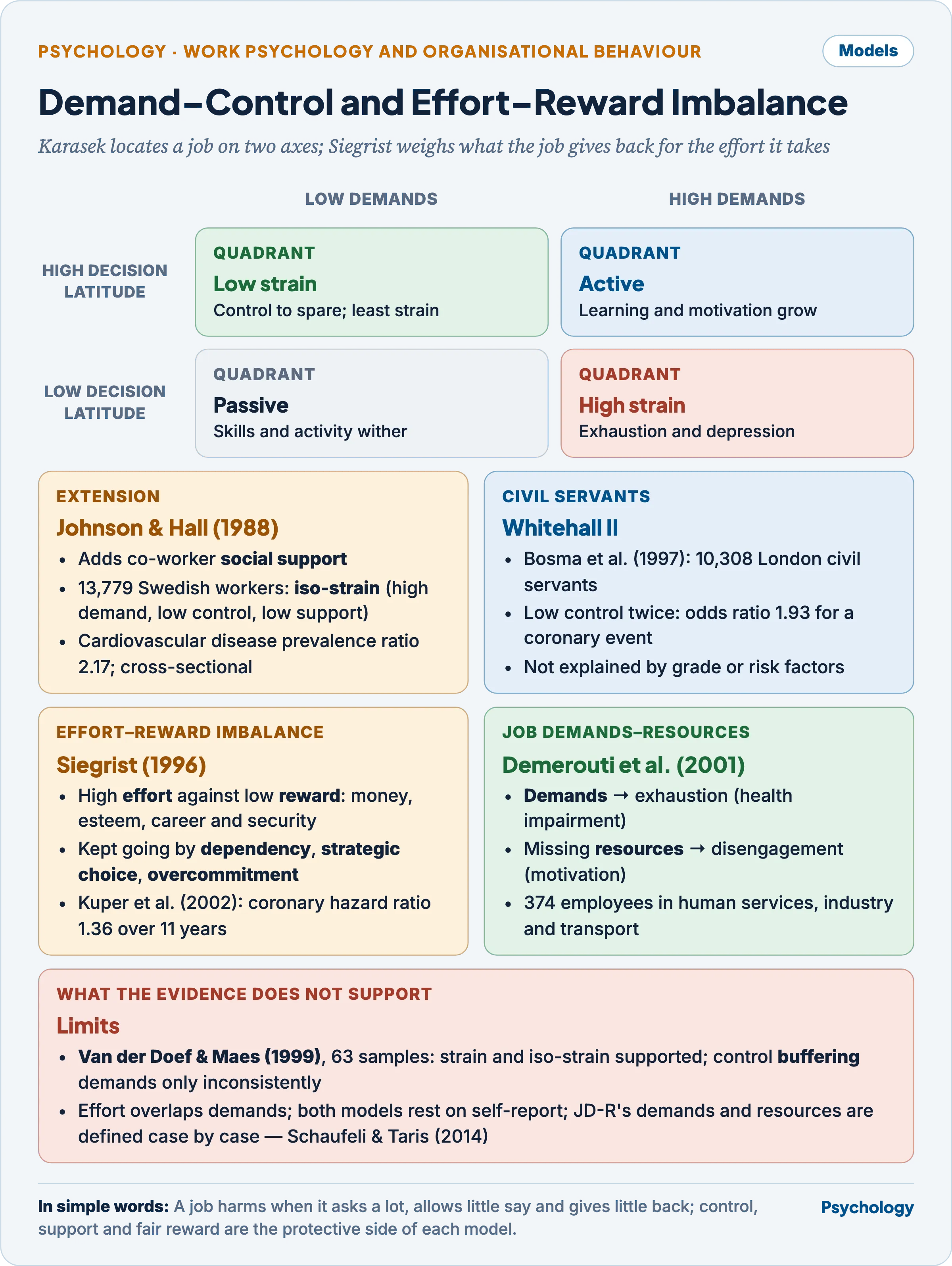
Karasek’s axes locate a job and Siegrist’s scale weighs an exchange, so a post can be low in strain and still unrewarded.
Siegrist’s effort–reward imbalance model
- Siegrist (1996) grounded strain in failed reciprocity: high effort met by low reward through money, esteem and career opportunities including job security.
- The imbalance persists when there is no alternative job (dependency), when it is accepted as an investment in future prospects (strategic choice), and with overcommitment, an excessive work commitment that distorts appraisal of cost and gain.
- Kuper and colleagues (2002) measured imbalance in the Whitehall II civil servants and followed them for 11 years: it predicted coronary heart disease (hazard ratio 1.36) and poor mental functioning (odds ratio 2.24), net of employment grade.
- Limitation: effort overlaps with Karasek’s demands, and both models rest on self-report.
Job demands–resources model
- Demerouti, Bakker, Nachreiner and Schaufeli (2001) sorted all working conditions into job demands, which cost sustained effort, and job resources, which serve goals and growth.
- Demands drive exhaustion (the health-impairment process); missing resources drive disengagement (the motivational process). The pattern held for 374 employees in human services, industry and transport.
- Limitation: Schaufeli and Taris (2014) questioned its status as a theory, the line between demands and resources, and its direction of causality.
Burnout
- Maslach and Jackson (1981) built the Maslach Burnout Inventory on three dimensions: emotional exhaustion, depersonalisation and reduced personal accomplishment.
- ICD-11 (World Health Organization, 2019) codes burn-out (QD85) as “a syndrome conceptualized as resulting from chronic workplace stress that has not been successfully managed”, with exhaustion, mental distance or cynicism, and reduced professional efficacy; it is an occupational phenomenon, not a medical condition.
- Criticism: Bianchi, Schonfeld and Laurent (2015), reviewing 92 studies, found the distinction between burnout and depression “conceptually fragile”.
Sources of occupational stress
- NIOSH (1999) groups the job conditions that produce stress under six heads.
- Design of tasks — heavy workload, few breaks, long hours, shift work, routine tasks with little control.
- Management style — little participation in decisions, poor communication.
- Interpersonal relationships — poor social climate and little support.
- Work roles — conflicting or uncertain expectations, too much responsibility.
- Career concerns — insecurity, no growth or promotion, rapid change without preparation.
- Environmental conditions — crowding, noise, air pollution, ergonomic problems.
- Outside the job, economic insecurity, technological change and family demands enter through the work–family interface.
- Individual vulnerability moderates exposure: Type A behaviour (Friedman and Rosenman, 1959) raises reactivity, while hardiness (Kobasa, 1979) is a buffer rather than a stressor, both set out in the Unit 2 article.
Role stress
Kahn’s role conflict and role ambiguity
- Kahn, Wolfe, Quinn, Snoek and Rosenthal (1964) treated a job as a role defined by the expectations that role senders, the role set, transmit to a focal person.
- Role conflict takes four forms: intra-sender (one sender’s incompatible demands), inter-sender (incompatible demands from two senders), inter-role (two roles one holds) and person–role (a demand against one’s values).
- Role ambiguity is uncertainty about what the role requires; role overload, more expected than the time allows, completes the classic trio of role stressors.
- In their national survey and case studies, conflict and ambiguity were common, and both went with lower job satisfaction and higher job-related tension.
Pareek’s Organisational Role Stress scale
- Udai Pareek (1983) built the Organisational Role Stress (ORS) scale — 50 items, five for each of ten stressors.
- It grew from his analysis of the role space (the roles a person holds, centred on the self) and the role set (the roles linked to one organisational role).
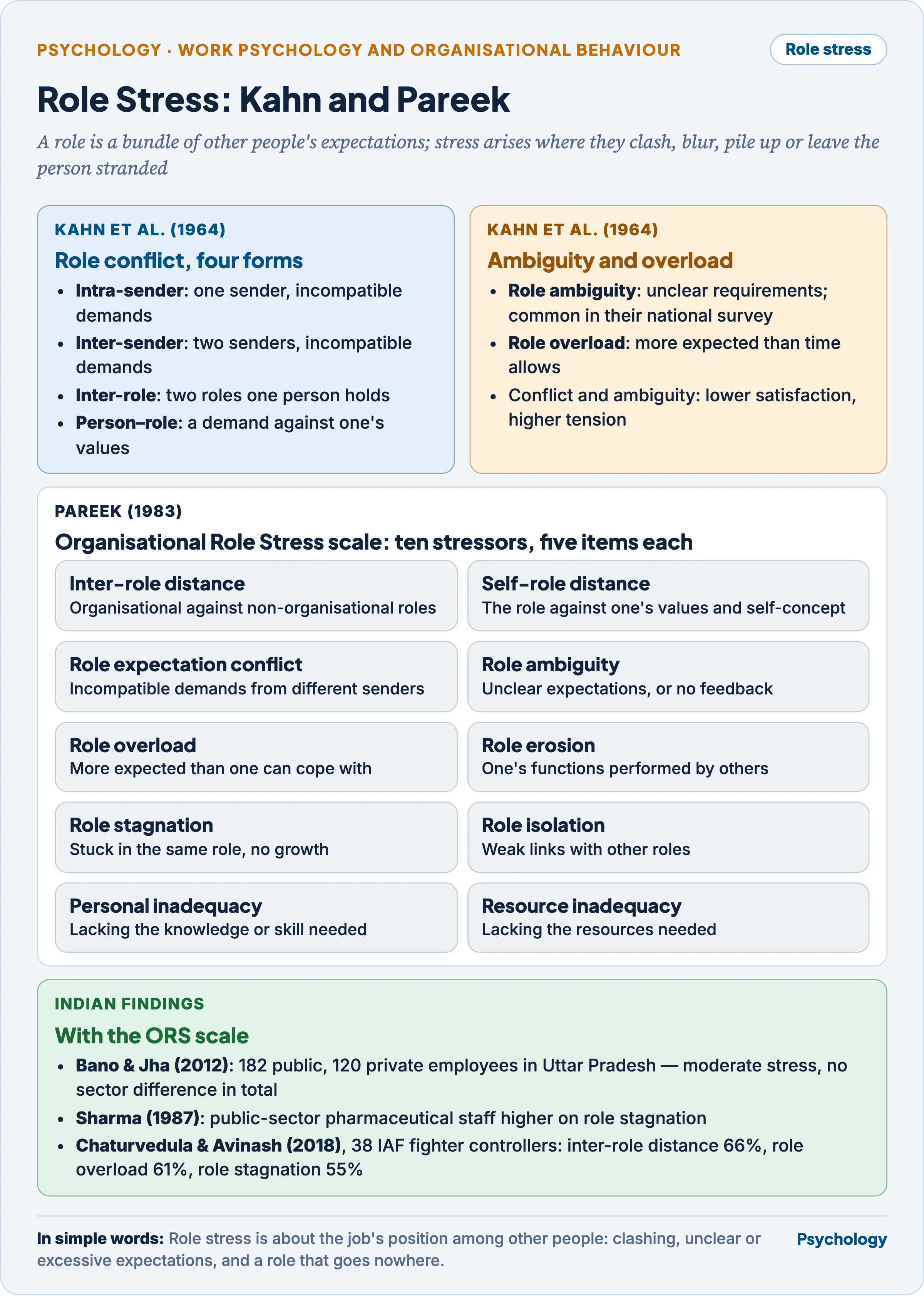
Kahn’s conflicts reappear in Pareek’s list, which adds what Kahn left out: stagnation, erosion, isolation and inadequacy.
- The ten stressors:
- Inter-role distance — organisational against non-organisational roles; self-role distance — the role against one’s values and self-concept.
- Role expectation conflict — incompatible demands from different senders; role ambiguity — unclear expectations or no feedback.
- Role overload — more expected than one can cope with; role erosion — functions that belong to one’s role performed by others.
- Role stagnation — being stuck in the same role; role isolation — weak links with other roles.
- Personal inadequacy — lacking the knowledge or skill the role needs; resource inadequacy — lacking the resources.
- Bano and Jha (2012) surveyed 182 public-sector and 120 private-sector employees in Uttar Pradesh with the scale: both carried moderate role stress, with no significant difference in total.
- In earlier Indian work they review, managers and supervisors of public-sector pharmaceutical firms scored higher on role stagnation than their private-sector counterparts (Sharma, 1987).
- Chaturvedula and Avinash (2018) tested 38 Indian Air Force fighter controllers: 66 per cent named inter-role distance, 61 per cent role overload and 55 per cent role stagnation as sources of high stress.
- Srivastava and Singh (1981) built the Indian Occupational Stress Index, 46 items across 12 subscales, among them role overload, role ambiguity, role conflict, intrinsic impoverishment and unprofitability.
Sources of stress in research and development organisations
- R&D work joins high demands to uncertain, delayed and often invisible reward, so each model above locates a specific source.
- Uncertainty and failure: outcomes are uncertain and many projects fail for reasons no one controls — low control over outcomes in Karasek’s sense, effort without reward in Siegrist’s.
- Long gestation and delayed recognition: years separate effort from visible output, and peer review and rejected proposals withhold the esteem reward.
- Pressure and role strain: Beauvais (1992) studied PhD scientists and engineers in a large energy R&D laboratory; those who felt pressured reported more role strain and a poorer climate, were less satisfied, and received lower supervisor ratings.
- Time pressure against creativity: Amabile, Hadley and Kramer (2002) analysed daily diaries from 177 employees in seven companies; creative thinking was less likely on high-pressure days, and the dip persisted for the next two days, a “time-pressure hangover”.
- Autonomy against control: scientists expect professional autonomy, while matrix structures give them a project head and a functional head (inter-sender conflict), and procurement and approval rules in government laboratories create resource inadequacy.
- Career structure: Allen and Katz (1986) surveyed nearly 1,500 engineers and scientists in nine US organisations; 45.8 per cent preferred challenging project work to promotion on either ladder (managerial 32.6, technical 21.6 per cent).
- They warned that the technical ladder often becomes a reward for loyalty rather than contribution, and traced obsolescence to the less challenging work older engineers are given. Moving a research-minded scientist into administration risks self-role distance.
- Obsolescence: Singh and Kumar (2019) studied 200 researchers in Indian government scientific institutions; obsolescence rose with amotivation and resistance to change and fell with engagement, climate and self-esteem; recognition, training and challenging work predicted less of it.
- Resources over demands: Sharma, Misra and Gupta (2020) found that among 64 Indian scientists flow at work was predicted by job resources and self-efficacy, not by job demands.
Individual and organisational approaches to stress management
- Interventions are classed by level — primary (remove the stressor), secondary (strengthen coping or detect strain early) and tertiary (treat and rehabilitate) — and by target, the individual or the organisation (LaMontagne and colleagues, 2007).
Individual approaches
- Time management and planning cut overload and last-minute pressure; physical exercise, social support and assertiveness — refusing unreasonable demands without aggression — add resources.
- Relaxation — progressive muscle relaxation (Jacobson, 1929) and the relaxation response (Benson, 1975) — and stress inoculation (Meichenbaum, 1985) are set out in the Unit 2 article; cognitive restructuring in Cognitive Therapies: Beck and Cognitive-Behavioural Therapy and yoga in Indigenous Therapies: Yoga and Meditation (Unit 3).
- Richardson and Rothstein (2008) pooled 36 experimental studies, 55 interventions and 2,847 employees: the mean effect was medium to large (d = 0.53), cognitive-behavioural programmes produced the largest effects, and adding components to them weakened the effect.
- Van der Klink and colleagues (2001), pooling 48 studies of 3,736 employees, found moderate effects for cognitive-behavioural and multimodal programmes, small effects for relaxation and none significant for organisation-focused interventions.
Organisational approaches
- Job redesign raises decision latitude, the remedy Karasek’s model prescribes; enrichment itself is treated in Theories of Work Motivation: Maslow and Herzberg.
- Role clarification — in the Role Analysis Technique of Dayal and Thomas (1968), each incumbent sets out the role’s purpose, its prescribed and discretionary duties, and what it expects from and owes other roles, then agrees a written role profile with them.
- Participation: Jackson (1983) ran a field experiment (a Solomon four-group design) in a hospital outpatient facility, randomly assigning nursing and clerical staff to increased participation in decisions or to control.
- Six months on, participation had lowered role conflict and role ambiguity and raised perceived influence; these role strains in turn predicted emotional strain, absence and turnover intention.
- Realistic goals, clear communication, flexible hours, sabbaticals and wellness programmes of screening, fitness and stress-management training.
- Employee assistance programmes and workplace counselling form a three-way relationship among organisation, counsellor and employee (Carroll, 1996), supplied in-house or by an external provider.
- Navare (2008) reports Tata Consultancy Services’ counselling network Maitree (2005) for 30,000 employees and Wipro’s in-house Mitr (2003), which trains employees to help distressed colleagues.
- Newton (1995) objected that stress management, counselling included, makes stress the individual’s problem of coping and leaves its social and political sources in the organisation unchallenged.
- Bond and Bunce (2001) — a longitudinal quasi-experiment in a UK central government department, with a control group.
- Staff used participative action research to reorganise their own work for more discretion and choice.
- At one year, mental health, sickness absence and self-rated performance had improved, and the rise in job control mediated the gains.
- Limitation: a single department and no random allocation, so selection effects cannot be excluded.
Approaches in research and development organisations
- Primary: protected time and milestones that respect creative cycles (Amabile, Hadley and Kramer, 2002); project reviews that credit sound but failed work, restoring esteem; challenging project assignments as a reward beside either ladder (Allen and Katz, 1986); role analysis for matrix posts.
- Secondary: training and challenging assignments against obsolescence (Singh and Kumar, 2019); mentoring and peer support; cognitive-behavioural stress-management groups, which carry the strongest individual evidence (Richardson and Rothstein, 2008).
- Tertiary: confidential counselling and referral to Tele-MANAS.
What the evidence shows
- LaMontagne and colleagues (2007) rated 90 evaluations: individual-focused approaches improved individual outcomes but seldom organisational ones, whereas organisation-focused approaches, alone or with individual components, benefited both levels.
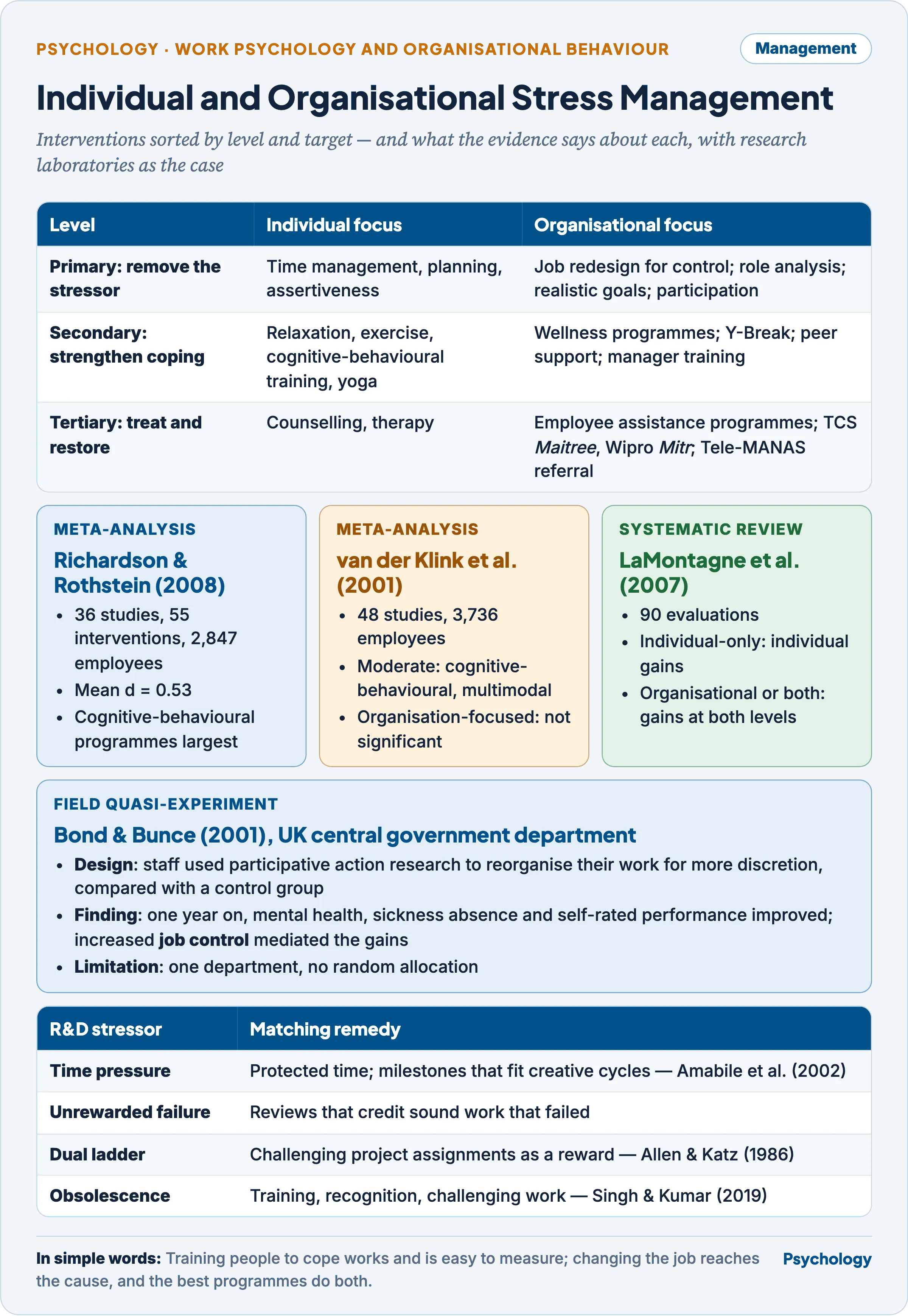
Individual techniques carry the larger measured effects, but only organisational changes reach the stressor itself.
Criticisms and limitations
- Stressors and strain usually come from the same questionnaire, and Brief and colleagues (1988) argued that negative affectivity inflates their correlation.
- Most designs are cross-sectional (Johnson and Hall, 1988), leaving reverse causation open: strained workers may perceive less control.
- The buffering interaction at the core of Karasek’s model is weakly supported (Van der Doef and Maes, 1999).
- Effects on hard outcomes are real but small (Kivimäki and colleagues, 2012).
- Burnout’s distinctness from depression is uncertain (Bianchi, Schonfeld and Laurent, 2015).
- Intervention research is dominated by individual programmes and psychological outcomes; organisational interventions remain scarce (Richardson and Rothstein, 2008).
- Stress management can change the employee instead of the stressor (Newton, 1995).
- Models and scales are mostly Western, while in an Indian sample inter-role distance, the clash of work with non-work roles, led the stressors (Chaturvedula and Avinash, 2018).
Indian context
- OSH Code, 2020 — the Occupational Safety, Health and Working Conditions Code (Ministry of Labour and Employment) — consolidates 13 central laws and took effect on 21 November 2025 with the other three labour codes (PIB, 21 November 2025).
- Workers above 40 get a free annual health check-up, and overtime earns double wages.
- It operationalises primary prevention by limiting exposure, and early detection of ill-health.
- Tele-MANAS (Ministry of Health and Family Welfare, 2022) — a free 24×7 helpline (14416) that handled 47,75,644 calls through 53 cells, beside a District Mental Health Programme sanctioned for 767 districts (PIB, 9 October 2026). It operationalises low-threshold help-seeking at the tertiary level.
- Y-Break (Ministry of Ayush, 1 September 2021) — a five-minute workplace protocol of āsana, prāṇāyāma and dhyāna that the Department of Personnel and Training asked all ministries to spread among employees (office memorandum, 12 June 2023); it operationalises brief recovery breaks, a secondary measure.
- Deloitte (2022), a consultancy survey of 3,995 Indian employees, found 80 per cent reporting mental-health problems in the past year, 47 per cent naming workplace stress the chief cause; it put employers’ cost at about US$14 billion annually in absence, presenteeism and attrition.
- Indian measurement and synthesis: Pareek’s ORS (1983), Srivastava and Singh’s index (1981), and Pestonjee’s (1992) Stress and Coping: The Indian Experience.
Previous Year Questions
- 2020What are the potential sources of stress for people working in research and development organisations? Discuss some of the individual and organizational approaches in these organizations to manage stress.
- 1998What is stress? Discuss certain methods of stress management.