

Official syllabusPaper II · Unit 4 · Work Psychology and Organisational Behaviour
consumer psychology.
Definition
“…consumer behavior encompasses the acquisition, consumption, and disposition of goods, services, time, and ideas by decision-making units (e.g., individuals, families, organizations, etc.).”
Jacoby (1978)
Consumer psychology studies the person on the buying side of the market: how a need becomes a choice, what inside and around the buyer shapes that choice, and why some purchases escape deliberation altogether. In India the deciding unit is often a family, and payment has moved to the phone, so both the cultural and the self-control questions are sharper here than in the Western studies that founded the field.
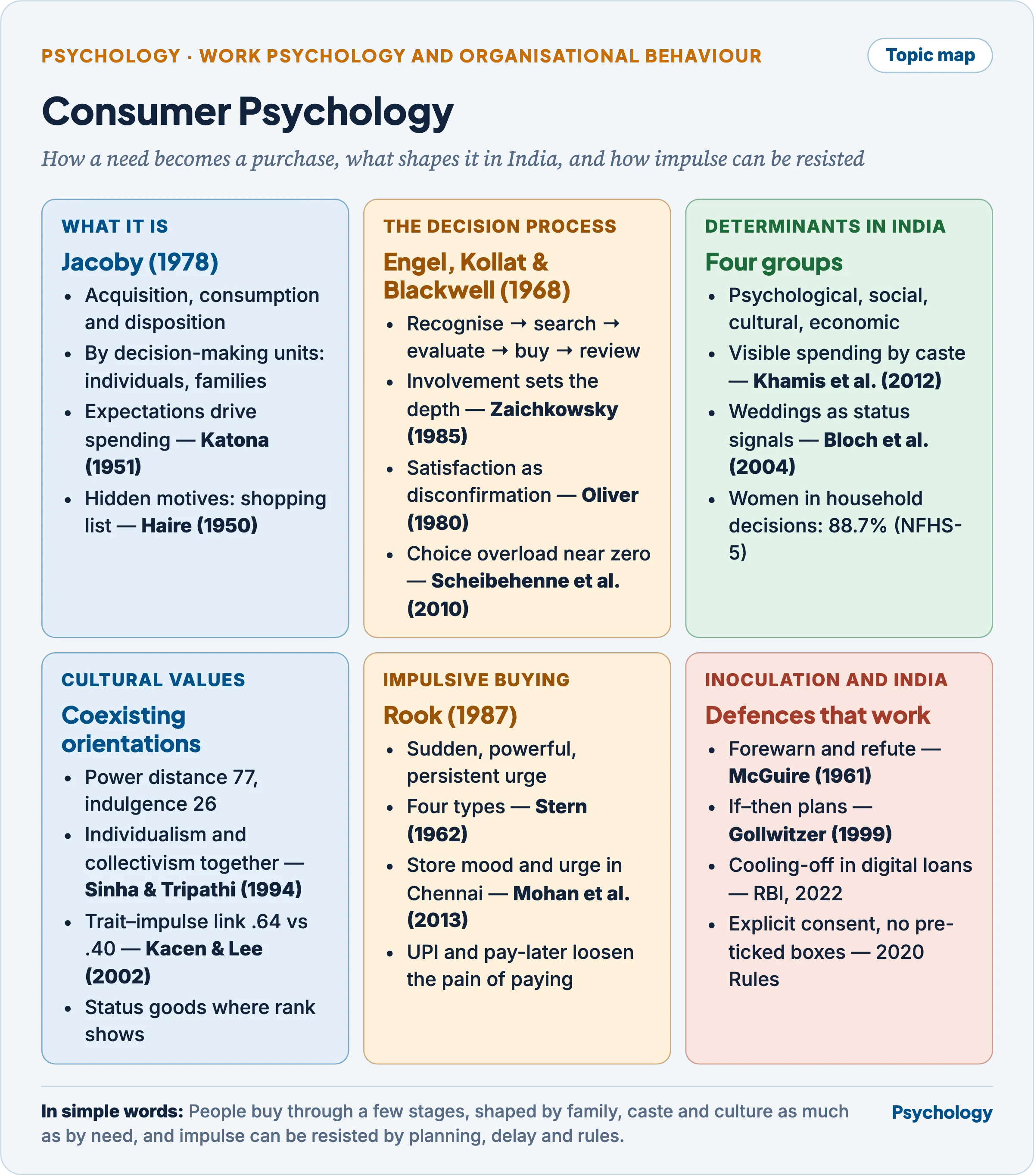
Every determinant acts through one of the decision stages, and impulsive buying is what happens when the middle stages are skipped.
Consumer psychology: nature and scope
- Consumer psychology is the applied study of the mental processes behind acquiring, using and disposing of goods and services.
- Jacoby’s (1978) definition widens the field in three ways.
- Acquisition, not only purchase: gifts, exchange, renting and inheritance are included.
- Disposition: what is done with a product after use — resale, repair, discarding — is part of the behaviour.
- Decision-making units: families and organisations decide, not only individuals.
- Its scope: the decision sequence, its social and cultural influences, satisfaction, and consumer welfare — impulsive buying, debt, protection.
- Katona (1951) argued that households’ attitudes and expectations, not income alone, shape how they spend, save and borrow.
- Consumer psychology studies the buyer; hierarchy models, persuasion routes and advertising ethics, which study the message, are in Advertising and Marketing.
The consumer decision process
Engel, Kollat and Blackwell (1968) modelled buying as a sequence of five stages, each governed by a distinct psychological process.
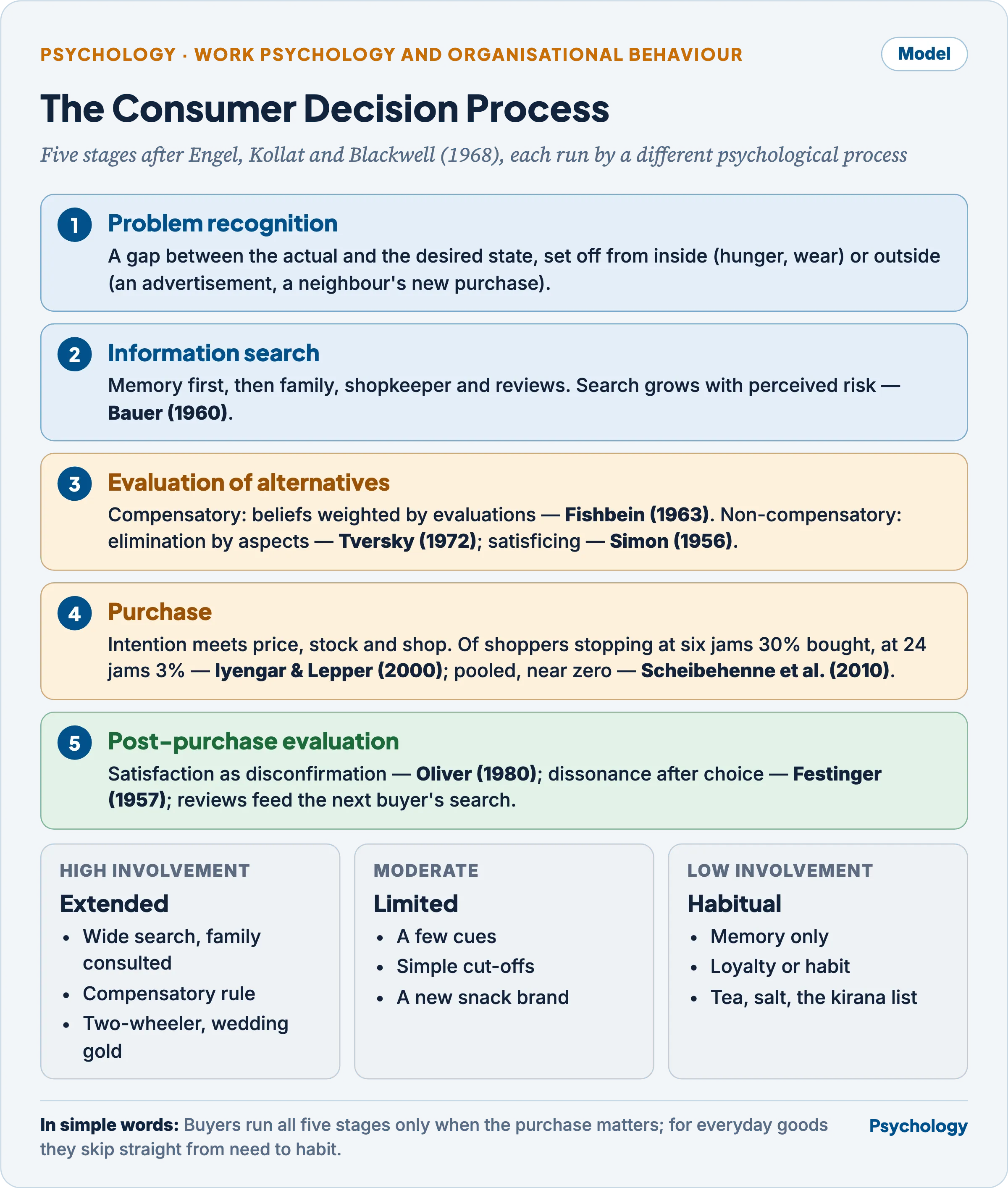
The stages describe deliberate buying; how many are worked through depends on involvement.
- Problem recognition — a felt gap between the actual and the desired state, triggered internally (hunger, wear) or externally (an advertisement, a neighbour’s purchase).
- Information search — internal (memory, past experience) and external (family, shopkeeper, reviews). Search grows with perceived risk (Bauer, 1960) — financial, functional, social.
- Evaluation of alternatives — among the few brands in the consideration set, by two kinds of rule.
- Compensatory: a weak attribute is offset by a strong one; the attitude is the sum of beliefs weighted by their evaluations (Fishbein, 1963).
- Non-compensatory: elimination by aspects (Tversky, 1972) discards, one aspect at a time, the options lacking a required feature; satisficing (Simon, 1956) takes the first acceptable option.
- Purchase — intention meets the situation: stock-outs, price, time, the shop. Iyengar and Lepper (2000) found that 30 per cent of shoppers who stopped at a six-jam display bought, against 3 per cent at a 24-jam display — choice overload.
- Limitation: across 63 conditions from 50 experiments (5,036 participants), the mean effect was virtually zero (Scheibehenne, Greifeneder and Todd, 2010), so overload appears only under specific conditions.
- Post-purchase evaluation — satisfaction follows the disconfirmation of expectations: performance above expectation satisfies, below it dissatisfies (Oliver, 1980).
- Post-decision dissonance (Festinger, 1957) leads buyers to inflate the chosen brand and seek reassuring information; the free-choice evidence (Brehm, 1956) is in Cognitive Dissonance and the Consistency Theories of Attitude Change (Paper I).
- Outcomes feed others’ search: better online reviews raised a book’s sales, and one-star reviews hurt more than five-star ones helped (Chevalier and Mayzlin, 2006).
- Involvement — personal relevance, measured by Zaichkowsky’s (1985) Personal Involvement Inventory — and product experience set how much of the sequence is run: extensive problem solving, limited problem solving or routinised response (Howard and Sheth, 1969).
| Extended problem solving | Limited problem solving | Habitual (routinised) buying | |
|---|---|---|---|
| Involvement and risk | High | Moderate | Low |
| Search | Wide, external, family consulted | Brief, a few cues | None; memory only |
| Decision rule | Compensatory | Simple cut-offs | Brand loyalty or habit |
| Post-purchase dissonance | Likely | Occasional | Rare |
| Indian example | Two-wheeler, gold for a wedding | New snack brand | Tea, salt, a monthly kirana list |
Key determinants of consumer behaviour in India
The determinants fall into four groups — psychological, social, cultural and personal-economic.
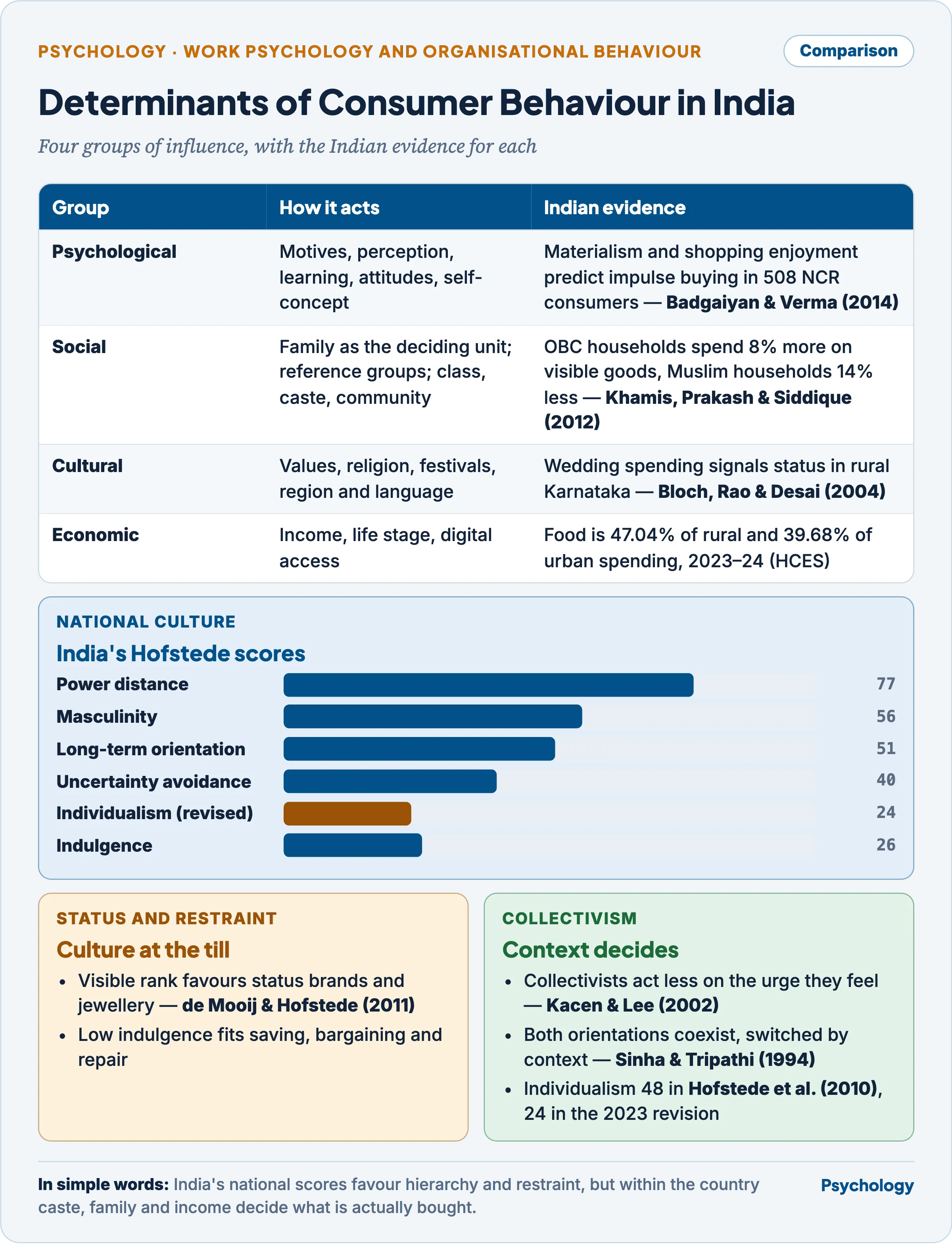
National scores frame the market; caste, family and region decide what a household buys.
Psychological determinants
- Motivation — buying serves needs from security to esteem (Maslow, 1943; the theory is in Theories of Motivation, Paper I), and the stated reason often masks the real one.
- Haire (1950) gave women one of two shopping lists identical except for Nescafé instant or Maxwell House drip coffee, and asked them to describe the woman who bought those groceries.
- The instant-coffee shopper was described less favourably — lazy, a poor planner — revealing a social cost that direct questions, which drew only complaints about flavour, had missed.
- Limitation: projective descriptions are interpretive and say nothing directly about purchase.
- Perception — selective attention filters a cluttered market, and buyers infer quality from price and brand where they cannot judge it.
- Learning — brand loyalty is a habit reinforced by satisfaction and loyalty schemes; brand conditioning is in Advertising and Marketing.
- Attitudes — the bridge from belief to choice, weakened by norms and situations, as set out in Attitudes and Behaviour (Paper I).
- Personality and self-concept — brands carry personalities, in five dimensions: sincerity, excitement, competence, sophistication and ruggedness (Aaker, 1997); possessions become part of the extended self (Belk, 1988).
- Badgaiyan and Verma (2014), surveying 508 consumers in the National Capital Region, found materialism, shopping enjoyment and impulsive buying tendency each positively related to impulsive buying.
Social determinants
- Family is the primary decision-making unit. Davis and Rigaux (1974) classified household decisions as husband-dominant, wife-dominant, syncratic (joint) or autonomic (either spouse alone), varying by product and stage.
- In joint families the unit widens to elders and children; currently married women usually participating in three household decisions, major purchases among them, rose from 84.0 to 88.7 per cent (NFHS-4 to NFHS-5, 2019–21).
- Reference groups — influence is strongest for publicly consumed luxuries and weakest for privately consumed necessities (Bearden and Etzel, 1982).
- Social class, caste and community — Khamis, Prakash and Siddique (2012), using India Human Development Survey data (2005), found Other Backward Class households spent 8 per cent more on visible goods than upper-caste households of equal income, and Muslim households 14 per cent less.
- The extra visible spending came partly out of education spending — status competition with a real cost.
- Conspicuous consumption (Veblen, 1899) — spending to display rank. Bloch, Rao and Desai (2004), surveying 800 households in five districts of rural Karnataka, found wedding expenditure behaved as a status signal, larger where the groom came from outside the village and was less known.
Cultural determinants
- Religion and festivals — Dhanteras, Diwali, Eid, Onam, Durga Puja and the wedding season concentrate durable and gold purchases; dietary rules shape product forms. UPI carried a record 25.47 billion transactions worth ₹31.53 lakh crore in festive October 2026 (NPCI, 2026).
- Regional and linguistic diversity — taste and price sensitivity vary sharply across states; language segmentation is in Advertising and Marketing.
Personal and economic determinants
- Income, age and life-cycle stage set the budget. Average monthly per capita consumption was ₹4,122 rural and ₹6,996 urban in 2023–24, with food 47.04 and 39.68 per cent of it (HCES, MoSPI, 2024).
- As income rises the food share falls — Engel’s law (Engel, 1857) — releasing discretionary spending, which is where brand, status and impulse operate.
- Digital access — quick-commerce gross orders more than doubled to an estimated ₹64,000 crore in 2024–25 (CareEdge, 2025); ten-minute delivery shortens the gap between urge and purchase. E-commerce itself is in Entrepreneurship through E-Commerce and Multilevel Marketing (Unit 10).
How cultural values influence consumer behaviour
- Hofstede’s dimensions give India power distance 77, masculinity 56, uncertainty avoidance 40, long-term orientation 51 and indulgence 26. Individualism, 48 in Hofstede, Hofstede and Minkov (2010), is 24 in the 2023 revision of the published scores, based on Minkov and Kaasa (2022).
- Sinha and Tripathi (1994) argued that Indians hold individualist and collectivist orientations together and switch by context. For buying, that predicts family-oriented choice in household and ritual purchases and self-oriented choice in personal ones.
- Collectivism restrains impulse. Kacen and Lee (2002) surveyed 706 students and non-students in Australia, the United States, Singapore and Malaysia.
- Trait buying impulsiveness correlated .64 with impulse purchasing in the individualist countries and .40 in the collectivist ones: collectivists act less on the urge they feel, because norms of moderation intervene.
- Limitation (Kacen and Lee, 2002): no Indian sample, and purchasing was self-reported.
- Power distance and masculinity favour status goods: where rank must be visible, global brands and jewellery signal it (de Mooij and Hofstede, 2011) — consistent with Indian weddings and visible spending.
- Low indulgence and a middling long-term orientation fit saving, bargaining and value-seeking; jugaad, frugal ingenuity whose principles include doing more with less (Radjou, Prabhu and Ahuja, 2012), extends product life through repair and reuse.
- Consumer ethnocentrism — the belief that buying foreign goods is wrong, measured by the CETSCALE (Shimp and Sharma, 1987) — has an Indian precedent in the swadeshi boycotts of 1905.
Behavioural-economic principles in consumer choice
The heuristics and prospect theory behind these effects are in Decision Making, Heuristics and Biases (Paper I).
- Anchoring — students with above-median social-security digits valued the same goods 57 to 107 per cent higher (Ariely, Loewenstein and Prelec, 2003); a struck-through “MRP” beside a sale price works the same way.
- Decoy effect — adding an inferior option that one product dominates raises that product’s share (Huber, Payne and Puto, 1982) — the logic of a mid-sized pack priced near the large one.
- Loss aversion and the endowment effect — mug owners demanded more than twice what non-owners would pay (Kahneman, Knetsch and Thaler, 1990); free trials exploit it, since a trial product already feels owned.
- Scarcity — cookies from a jar of two were rated more desirable than from a jar of ten, more so when scarcity was attributed to others’ demand (Worchel, Lee and Adewole, 1975).
- Mental accounting — money is spent from mental budgets, not as fungible wealth (Thaler, 1985).
- Pain of paying — paying hurts, most when payment is tightly coupled to consumption, as with cash; cards loosen the coupling (Prelec and Loewenstein, 1998).
- Bidders told to pay by credit card bid roughly twice as much for basketball tickets as those paying cash (Prelec and Simester, 2001).
Impulsive buying
Definition
“Impulse buying occurs when a consumer experiences a sudden, often powerful and persistent urge to buy something immediately. The impulse to buy is hedonically complex and may stimulate emotional conflict.”
Rook (1987)
- Stern (1962) classified it into pure (novelty, breaking routine), reminder (seeing an item recalls a need), suggestion (seeing a new item creates one) and planned impulse (expecting to buy extras, chosen by in-store specials).
- It differs from compulsive buying, a repetitive, distress-driven pattern; its pooled prevalence is 4.9 per cent in representative adult samples (Maraz, Griffiths and Demetrovics, 2016).
- The mechanism is time inconsistency: a reward’s value falls steeply with the first moments of delay — hyperbolic discounting (Ainslie, 1975) — so an item available now outweighs a larger later benefit; self-control is a contest between desire and willpower (Hoch and Loewenstein, 1991).
- In a calm state people underestimate how strongly a visceral urge will drive them when it arrives (Loewenstein, 1996).
- Iyer and colleagues (2020), pooling 231 samples with over 75,000 consumers, grouped the antecedents as traits, motives, consumer resources and marketing stimuli, acting through mood and self-control.
The triggers
- Trait and norm — trait buying impulsiveness predicts behaviour only when the buyer judges acting on impulse appropriate (Rook and Fisher, 1995).
- Store environment — Mohan, Sivakumaran and Sharma (2013) surveyed 733 mall shoppers in Chennai.
- Music, lighting, staff and layout raised positive affect and the urge to buy, which carried the effect to impulse buying.
- Limitation: a cross-sectional self-report survey, so causal direction is inferred from the model.
- Mood repair — shoppers buy to lift a bad mood, and in student diaries such purchases brought no regret or guilt (Atalay and Meloy, 2011).
- Distressed participants ate more fattening snacks unless told their mood was frozen: mood repair takes priority over impulse control (Tice, Bratslavsky and Baumeister, 2001).
- Depleted self-control — Vohs and Faber (2007) had participants suppress thoughts before an unexpected chance to buy.
- Suppressors spent $4.05 on average against $1.21 for controls, and were willing to pay more.
- Limitation: a 23-laboratory preregistered replication of ego depletion with 2,141 participants found d = 0.04 (Hagger and colleagues, 2016), so resource depletion is contested as the mechanism.
- Frictionless payment — 74.2 per cent of 235 Indian UPI users reported spending more because of UPI (Dev and colleagues, 2024, a self-report preprint).
- Buy-now-pay-later access raised total and retail spending, the credit “sticking where it hits” (Di Maggio, Katz and Williams, 2022).
- Interface design — one-click checkout, countdown timers and “only two left” banners compress deliberation; their regulation as dark patterns is set out in Advertising and Marketing.
Inoculating people against impulsive buying: psychological theories in use
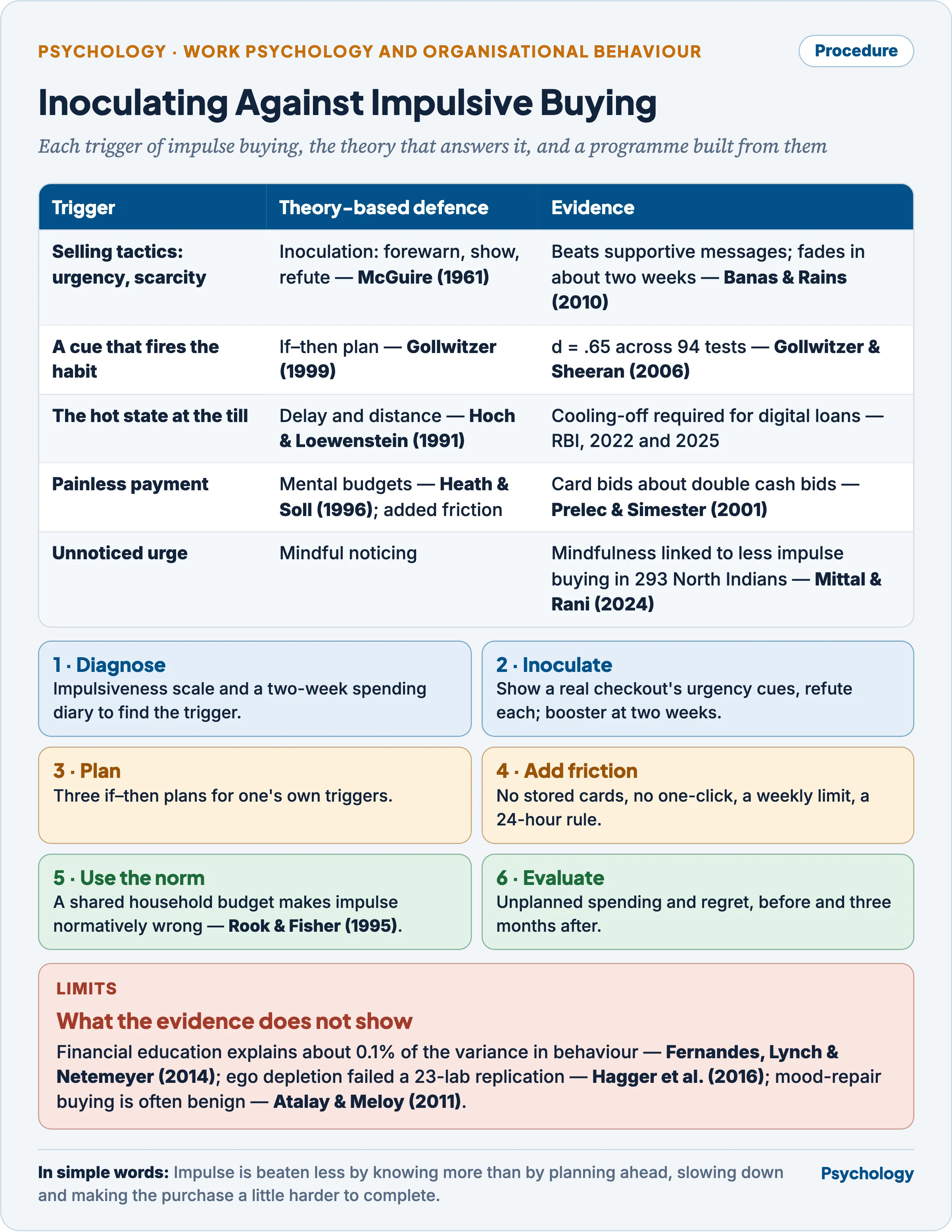
Each defence answers one trigger: inoculation the tactic, a plan the cue, a delay the hot state.
| Theory | What it targets | Technique | Evidence and limit |
|---|---|---|---|
| Inoculation — McGuire (1961) | Persuasive selling tactics | Forewarn, show a weakened tactic, refute it | Beats supportive messages and no treatment, but fades after about two weeks (Banas and Rains, 2010) |
| Persuasion knowledge — Friestad and Wright (1994) | Failure to see a tactic as a tactic | Teach buyers to name urgency, scarcity and social-proof cues | Prebunking videos raised technique recognition about 5 per cent among YouTube users (Roozenbeek and colleagues, 2022; Persuasion and Attitude Change through Communication, Paper I) |
| Implementation intentions — Gollwitzer (1999) | Automatic response to a cue | “If I see a sale banner, then I add it to the wish list” | d = .65 across 94 tests (Gollwitzer and Sheeran, 2006); smaller after bias correction across 642 tests (Sheeran and colleagues, 2024) |
| Time inconsistency — Hoch and Loewenstein (1991) | The hot state at the point of sale | Cooling-off: a 24-hour rule; distance from the item | Postponement lets desire decay; the RBI’s cooling-off period applies it to digital loans |
| Precommitment and mental budgeting — Heath and Soll (1996) | Weak willpower in the moment | Delete saved cards, set UPI limits, weekly budgets | A category already charged is spent on less |
| Mindfulness | Unnoticed urges and low self-esteem | Noticing the urge without acting on it | Mindfulness negatively related to impulse buying via self-esteem in 293 North Indian consumers (Mittal and Rani, 2024) |
| Financial literacy | Ignorance of cost and debt | Teaching interest, APR and budgeting | Explains about 0.1 per cent of the variance in financial behaviour (Fernandes, Lynch and Netemeyer, 2014) |
- A worked programme for a college or workplace group:
- Diagnose: a buying-impulsiveness scale (Rook and Fisher, 1995) and a two-week spending diary to locate the trigger — time, mood, app.
- Inoculate: one session showing a real checkout’s urgency and scarcity cues and refuting each, with a booster after two weeks because resistance decays.
- Plan: each person writes three if–then plans for their own triggers.
- Add friction: remove stored payment details, disable one-click, set a weekly limit and a 24-hour rule above a chosen amount.
- Use the norm: a shared household or peer budget makes impulse buying normatively inappropriate, the condition under which trait impulsiveness stops predicting behaviour (Rook and Fisher, 1995; Kacen and Lee, 2002).
- Evaluate: unplanned spending and post-purchase regret, before and three months after.
- Structural defences outlast individual ones: choice architecture — defaults, disclosures, friction — changes behaviour without relying on willpower (Thaler and Sunstein, 2008).
Criticisms and limitations
- Rational-stage models overstate deliberation: most purchases are habitual or impulsive, the five stages are often reconstructed after the fact, and comprehensive models such as Howard and Sheth’s (1969) have rarely been tested whole.
- Replication has removed some foundations: choice overload (Scheibehenne and colleagues, 2010), ego depletion (Hagger and colleagues, 2016) and the size of implementation-intention effects (Sheeran and colleagues, 2024).
- Hofstede’s averages are criticised for treating one company’s employees as a nation and assuming a uniform national culture (McSweeney, 2002); India’s individualism score halving on re-measurement shows their fragility, and caste, region and class vary more than any national score.
- Indian evidence is mostly cross-sectional surveys analysed with structural models (Mohan and colleagues, 2013; Badgaiyan and Verma, 2014; Mittal and Rani, 2024), so causal claims rest on the model; rural and low-income buyers are under-studied.
- Impulse is not pathology: mood-repair purchases are often benign (Atalay and Meloy, 2011), so a programme that treats all unplanned buying as harmful mislabels ordinary hedonic choice.
- The same findings that explain impulse are used to engineer it, and the data asymmetry between platform and buyer is now the central ethical question.
Indian context: digital buying and consumer protection
- Consumer Protection (E-Commerce) Rules, 2020 (Ministry of Consumer Affairs, Food and Public Distribution; notified 23 July 2020) — consent to a purchase must be “explicit and affirmative”, never recorded automatically through pre-ticked boxes, and sellers and inventory platforms may not post reviews posing as consumers.
- It operationalises default effects and the integrity of social proof: inertia cannot be counted as consent, and reviews must reflect real buyers.
- RBI Guidelines on Digital Lending (Reserve Bank of India, 2 September 2022) — a Key Fact Statement with the all-inclusive annual percentage rate before signing, and no automatic credit-limit increase without explicit consent.
- A cooling-off period, at least three days for loans of seven days or more, lets the borrower exit without penalty.
- Replaced by the Digital Lending Directions, 2025 (8 May 2025), with a cooling-off minimum of one day for all loans; since 28 November 2025 they sit in the RBI’s Credit Facilities Directions.
- It operationalises the hot–cold empathy gap and salience of cost: the borrower decides again once the urge has cooled.
- National Strategy for Financial Education 2020–25 (RBI and the National Centre for Financial Education, 20 August 2020) — a “5 C” approach: content, capacity, community, communication and collaboration.
- It operationalises knowledge plus social norm: community-led teaching carries a peer standard that information alone lacks.
- It concluded in March 2025; its successor, NSFE 2026–31, is being drafted (NCFE, 2025).
- The Dark Patterns Guidelines, 2023 ban thirteen patterns, false urgency and basket sneaking among them; their detail is in Advertising and Marketing.
- Consumer rights, commissions and awareness campaigns are in Consumer Rights and Consumer Awareness (Unit 11).
Previous Year Questions
- 2016How can psychological theories be put to use to inoculate people against their impulsive buying behaviour?
- 2013Discuss the key determinants of consumer behaviour in India. How do cultural values influence it?