

Official syllabusPaper II · Unit 3 · Therapeutic Approaches
Cognitive therapies.
Definition
“Cognitive therapy is an active, directive, time-limited, structured approach used to treat a variety of psychiatric disorders … It is based on an underlying theoretical rationale that an individual’s affect and behavior are largely determined by the way in which he structures the world.”
Beck, Rush, Shaw and Emery (1979)
Cognitive therapies treat a disorder by changing the meanings a person gives to events, on the premise that emotion and behaviour follow appraisal. Beck’s version, built for depression in the 1960s, became the most tested psychotherapy: it matches medication and outlasts it, though its theory of change is less secure than the treatment.
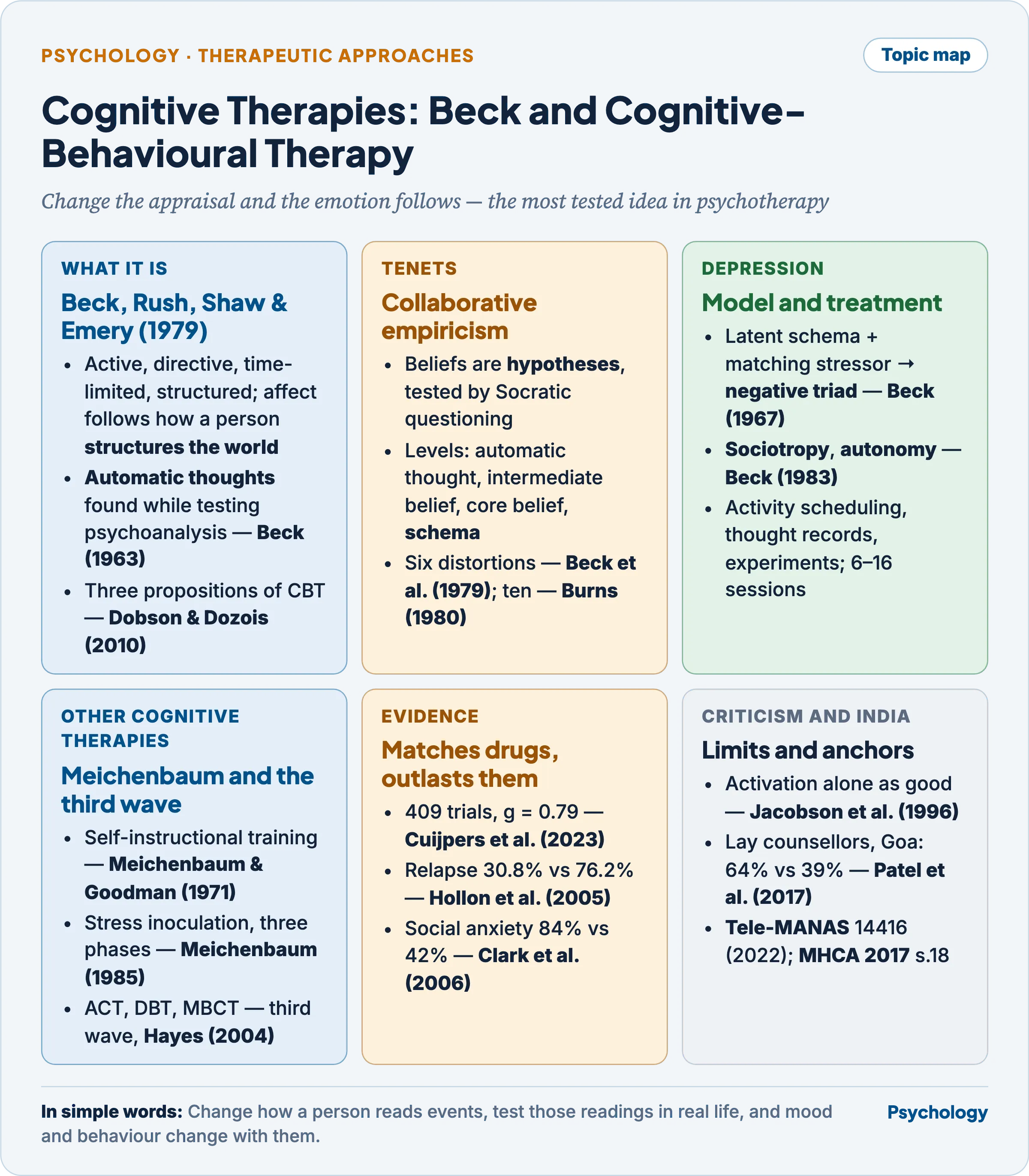
The top row is the model and its method; the bottom row is what rival versions, trials and critics made of it.
Cognitive therapies: origins and the cognitive model
- Epictetus (Enchiridion, 5, second century CE) stated the premise first: “Men are disturbed not by the things which happen, but by the opinions about the things” (Long’s translation).
- Beck (2019) recalled testing, from 1956, the claim that depression is inverted hostility: depressed patients’ dreams held less hostility and a consistently negative self-image (Beck and Hurvich, 1959).
- Attending to patients’ stream of consciousness, he identified rapid unreported automatic thoughts linking situation to emotion (Beck, 1963).
- Founding texts: the Thinking and Depression papers (Beck, 1963, 1964), Depression (Beck, 1967), Cognitive Therapy and the Emotional Disorders (Beck, 1976) and the 1979 manual.
- The first outcome trial, Rush and colleagues (1977), randomised 41 depressed outpatients: cognitive therapy (CT) improved them more than imipramine.
- Parallel streams: Ellis’s rational therapy (1955), set out in Rational Emotive Behaviour Therapy, and Meichenbaum’s (1977) cognitive-behaviour modification.
- Cognitive-behavioural therapy (CBT) is the umbrella. Dobson and Dozois (2010) define it by three propositions: “Cognitive activity affects behavior”; “Cognitive activity may be monitored and altered”; “Desired behavior change may be effected through cognitive change.”
Main tenets and assumptions of cognitive therapy
- Cognitive mediation: affect and behaviour follow construal. Judith Beck (2011): “dysfunctional thinking (which influences the patient’s mood and behavior) is common to all psychological disturbances.”
- Weishaar (1993) listed three assumptions: internal communication is open to introspection; beliefs carry highly personal meanings; the client can discover those meanings rather than be taught them.
- Beliefs are hypotheses to be tested, not irrationalities to be disputed, which separates CT from Ellis’s method.
- Collaborative empiricism: therapist and patient test beliefs as co-investigators, through guided discovery and Socratic questioning rather than persuasion (Beck et al., 1979).
- Present-focused, structured, time-limited and educational: weekly, more often when severe, six to 14 sessions in straightforward cases, then boosters; the patient learns to be their own therapist (J. Beck, 2011).
- Beck and colleagues (1979) held warmth, accurate empathy and genuineness necessary but not sufficient, qualifying Rogers (1957).
Levels of cognition
- Automatic thoughts: rapid, situation-specific, plausible appraisals (“He didn’t reply; he finds me boring”).
- Intermediate beliefs: attitudes, rules and assumptions (“If I try to do something difficult, I’ll fail”) (J. Beck, 2011).
- Core beliefs: global, rigid, overgeneralised ideas about self, others and world; negative ones cluster as helpless and unlovable, with worthless added by J. Beck (2005).
- Schemas: the structures holding core beliefs, laid down early and latent until a matching event activates them; once active they admit confirming information and screen out the rest.
- Therapy works from the surface down: “Modification of their underlying dysfunctional beliefs produces more enduring change” (J. Beck, 2011).
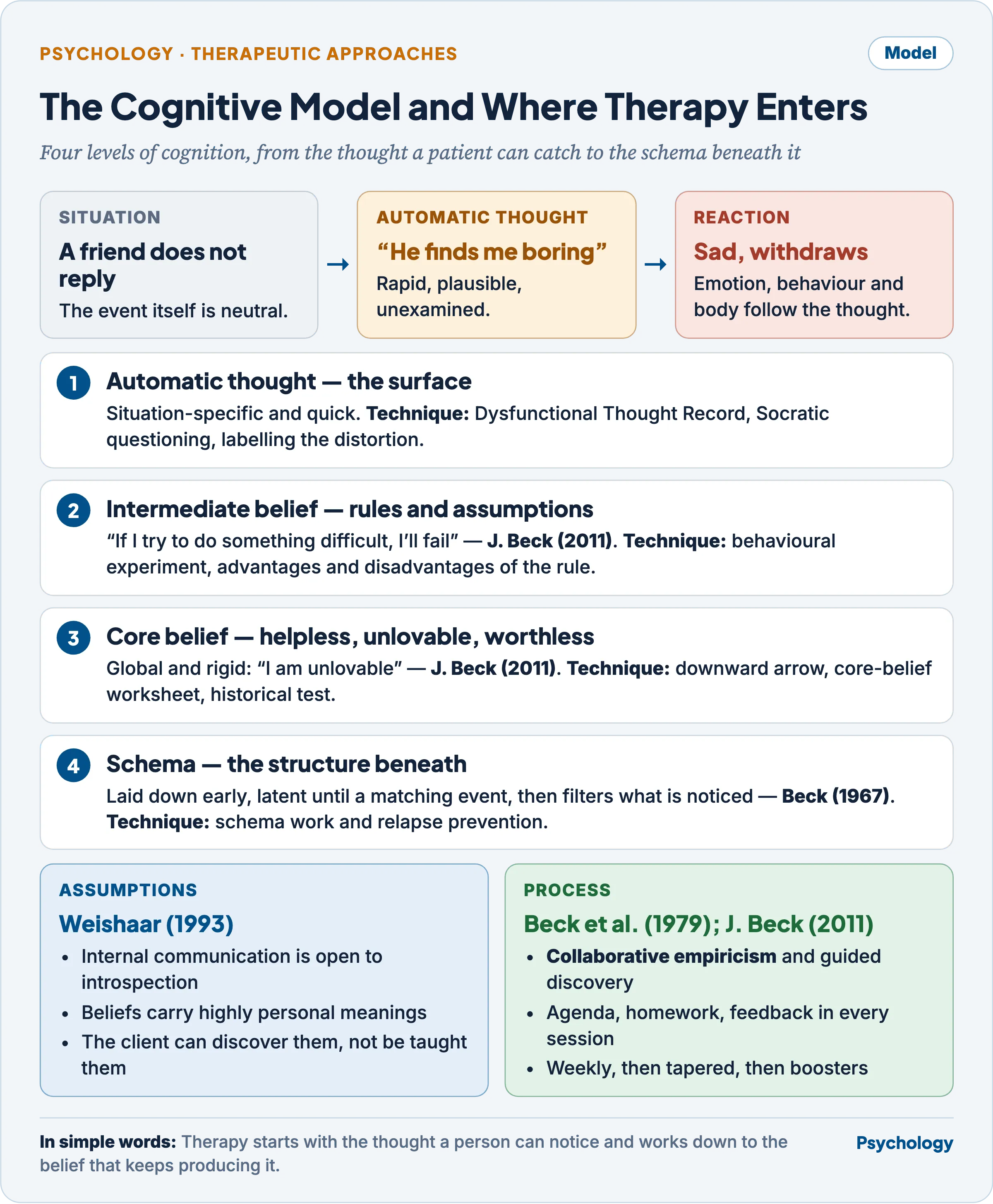
The therapy enters at the automatic thought and works down to the belief that keeps producing it.
Cognitive distortions
- Beck and colleagues (1979) listed six errors linking schema to thought: arbitrary inference, selective abstraction, overgeneralisation, magnification and minimisation, personalisation and dichotomous (absolutistic) thinking.
- Burns (1980), in Feeling Good, extended it to ten for patients, among them disqualifying the positive, emotional reasoning, should statements, labelling, and jumping to conclusions (mind-reading, fortune-telling).
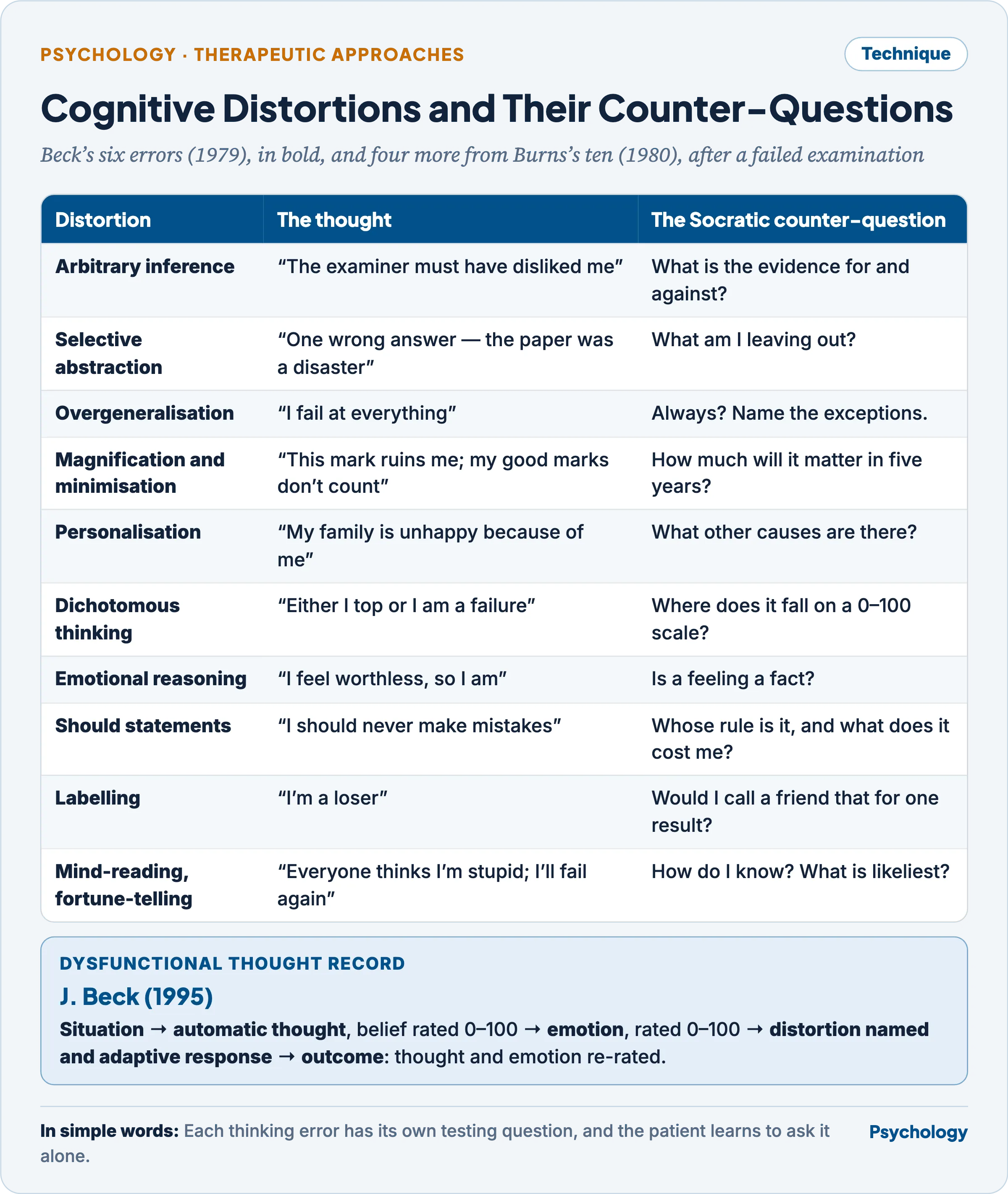
Each distortion has its own counter-question; the therapist teaches the question, not the answer.
Beck’s cognitive therapy of depression
How cognitive therapy explains clinical depression
- A latent depressogenic schema, laid down by early loss, rejection or criticism, is activated by a matching stressor: a diathesis–stress account (Beck, 1967).
- The active schema produces the negative cognitive triad, a negative view of the self, the world and the future, through the distortions above.
- Beck (1983) named two vulnerable modes: sociotropy, activated by rejection or loss, and autonomy, activated by failure.
- Withdrawal cuts reinforcement and supplies fresh evidence for the triad. The causal evidence is weighed in Mood Disorders: Depression and Bipolar Disorder.
The therapeutic approach: structure and techniques
- Assessment: the Beck Depression Inventory (Beck and colleagues, 1961), the Hopelessness Scale for suicide risk (Beck and colleagues, 1974), and a case formulation tying problems and precipitants to core beliefs and their history (Persons, 1989).
- Session structure (J. Beck, 2011): mood check; bridge from last session; joint agenda; homework review; agenda items; new homework; summary; feedback.
- Behavioural techniques come first in more severe depression (Beck et al., 1979; J. Beck, 2011): activity monitoring, activity scheduling with mastery and pleasure ratings, and graded task assignment, which also test beliefs such as “I can’t do anything”.
- Cognitive techniques:
- Eliciting thoughts (“What was going through your mind just then?”, J. Beck, 2011) and logging them on the Dysfunctional Thought Record: situation, automatic thought rated 0–100, emotion and intensity, adaptive response, outcome.
- Socratic questioning: evidence for and against, alternative explanations, the worst, best and most likely outcome, and what the patient would tell a friend.
- Behavioural experiments: a prediction (“If I speak, they will laugh”) tested in action, so evidence comes from experience, not argument.
- Reattribution of blame, and the downward arrow (Burns, 1980): “if that were true, what would it mean?”, asked until a core belief surfaces.
- Schema work and relapse prevention: core-belief worksheets, a historical test of the belief, sessions tapered to fortnightly, then boosters (J. Beck, 2011).
A worked case
- An illustrative 16-session course: a 23-year-old graduate has failed a state recruitment examination three times; four months of low mood, poor sleep and withdrawal; Beck Depression Inventory-II score 32; passive death wishes.
- Sessions 1–3: risk assessment, safety plan, the model explained, goals set; his mood ratings run higher on cricket days, so graded tasks restart study.
- Sessions 4–10: thought records. “I am a failure; the whole colony laughs at me” (belief 90) is labelled overgeneralisation and mind-reading; evidence review and an experiment, talking to two neighbours, cut belief to 35.
- Sessions 11–16: the downward arrow from “If I fail again, my parents’ sacrifice is wasted” reaches “I am worthless unless I succeed”; an alternative belief is built; a relapse plan, a family session and boosters close.
Meichenbaum’s cognitive-behaviour modification
- Meichenbaum (1977) treated self-statements, what people tell themselves, as behaviour to be modelled and reshaped: a less rationalist approach than Beck’s.
- Self-instructional training: Meichenbaum and Goodman (1971) trained impulsive children in five steps: cognitive modelling by an adult thinking aloud, overt external guidance, overt self-guidance, faded overt self-guidance (whispering) and covert self-instruction.
- Trained children improved on the Porteus Maze, WISC performance IQ and the Matching Familiar Figures Test; modelling alone slowed responding without cutting errors. Limitation: five children per group, and no transfer to classroom behaviour.
- Stress inoculation training (Meichenbaum, 1985) has three overlapping phases: conceptualisation, skills acquisition and rehearsal (relaxation, self-instruction, problem-solving, restructuring), and application and follow-through against graded stressors.
- Saunders and colleagues (1996), meta-analysing 37 studies with 1,837 participants, found it reduced performance and state anxiety and improved performance under stress.
How cognitive therapy develops a person’s cognition
- CT is skill training. Beck and colleagues (1979) set five operations: monitoring automatic thoughts; seeing links among cognition, affect and behaviour; weighing evidence; substituting reality-based interpretations; and altering predisposing beliefs.
- Metacognitive awareness, experiencing a thought as a mental event rather than a fact, rose where CT reduced relapse (Teasdale and colleagues, 2002).
- Strunk and colleagues (2007): among 35 CT responders, acquired coping skills and their independent use predicted lower relapse over the next year, beyond end-of-treatment symptoms.
- Self-instruction builds verbal self-regulation and problem-solving training (D’Zurilla and Goldfried, 1971) a general method, matched to development: behavioural for children, schema work for abstract reasoners.
Effectiveness of cognitive therapy in different types of depression
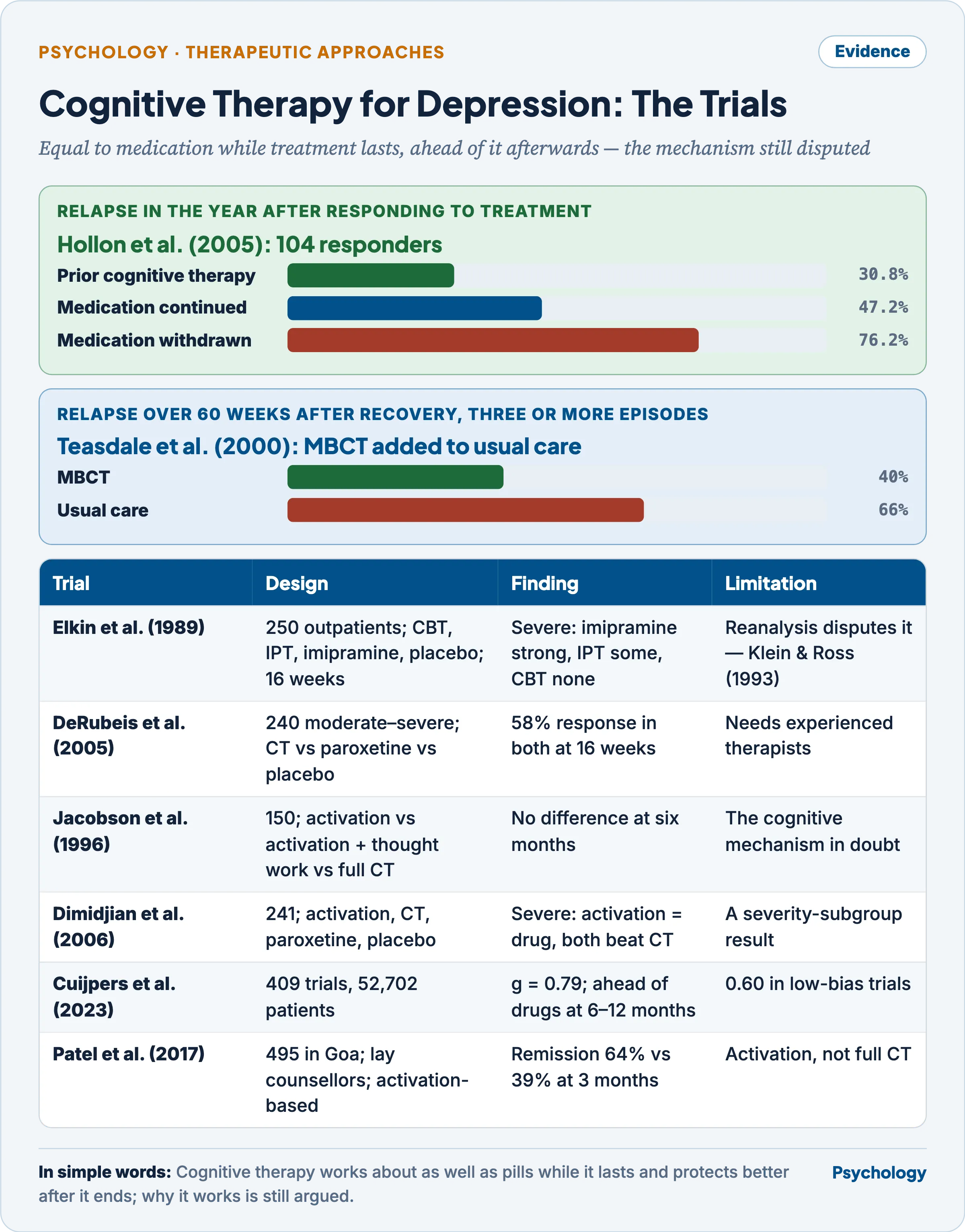
Medication matches cognitive therapy while treatment lasts; the difference shows after it stops.
Mild, moderate and severe depression
- Cuijpers and colleagues (2023) pooled 409 trials with 52,702 patients. CBT beat usual care and waiting list (g = 0.79; 0.60 in low-risk-of-bias trials); 42% responded against 19%.
- It barely differed from other psychotherapies (g = 0.06), matched medication short term and exceeded it at 6–12 months (g = 0.34); combined treatment beat medication alone but not CBT alone.
- Elkin and colleagues (1989), the NIMH Treatment of Depression Collaborative Research Program, randomised 250 outpatients to CBT, interpersonal psychotherapy, imipramine or placebo for 16 weeks, the last two with clinical management.
- In less severe patients nothing beat placebo; in the more severe, imipramine had strong evidence, interpersonal psychotherapy some, CBT none.
- Limitation: a Klein and Ross (1993) reanalysis ranked medication above both psychotherapies.
- DeRubeis and colleagues (2005): 240 moderate to severe outpatients; 58% responded to CT and to paroxetine at 16 weeks; CT trailed only where therapists were less experienced.
- Weitz and colleagues (2015), pooling patient-level data from 16 trials (1,700 outpatients), found baseline severity did not moderate the CBT–medication difference.
- Dimidjian and colleagues (2006): among the more severely depressed of 241 adults, behavioural activation matched medication and both outperformed CT.
Chronic, recurrent and adolescent depression
- Chronic: Keller and colleagues (2000), 681 adults: response 48% with nefazodone, 48% with McCullough’s (2000) cognitive behavioural-analysis system of psychotherapy, 73% with both.
- Relapse: Hollon and colleagues (2005): over the year after response, 30.8% relapsed after CT, 76.2% when medication was withdrawn, 47.2% when it was continued.
- Recurrent: Teasdale and colleagues (2000): among 145 recovered patients, mindfulness-based cognitive therapy (MBCT) cut 60-week relapse to 40% from 66% in those with three or more episodes, but not with two.
- Kuyken and colleagues (2016), nine trials, 1,258 patients: relapse 38% against 49% (hazard ratio 0.69), and 0.79 against active treatments.
- Adolescent: the Treatment for Adolescents with Depression Study (2004), 439 aged 12–17: 12-week response 71.0% with fluoxetine plus CBT, 60.6% fluoxetine, 43.2% CBT, 34.8% placebo.
- Bipolar depression: added to medication, nine months of CBT, family-focused or interpersonal and social rhythm therapy brought 64% to recovery within a year against 52% after three psychoeducation sessions (Miklowitz and colleagues, 2007, 293 patients).
Which therapy is most efficacious for depression
- No therapy wins overall: CBT’s edge over other psychotherapies is negligible (Cuijpers et al., 2023), and behavioural activation and interpersonal psychotherapy perform comparably.
- Mild to moderate: CBT, behavioural activation or guided self-help. Moderate to severe outpatient: CT from an experienced therapist equals medication (DeRubeis et al., 2005; Weitz et al., 2015), and NICE (2022) lists CBT plus an antidepressant first for more severe depression.
- Chronic: combined (Keller et al., 2000). Recurrent: acute CT or MBCT in remission (Hollon et al., 2005; Kuyken et al., 2016). Psychotic: antidepressant plus antipsychotic, electroconvulsive therapy if life-threatening, psychotherapy once symptoms ease (Tripathi and colleagues, 2026).
- For the typical outpatient, CBT, with medication when severe or chronic, is most efficacious once relapse is counted; the cross-school comparison is in Psychotherapy: Effectiveness, Common Factors and Eclecticism.
Evaluation of the cognitive-behavioural model of depression
- Strength: it is testable and yielded a manualised treatment supported by over 400 trials (Cuijpers et al., 2023).
- Causal tests cut both ways: high cognitive-risk freshmen had more first onsets and recurrences of major depression (Alloy and colleagues, 2006), yet among 998 community residents, cognitions measured before onset did not predict later depression (Lewinsohn and colleagues, 1981).
- Strength: Tang and DeRubeis (1999) found sudden gains (11 Beck Depression Inventory points on average, half those patients’ improvement) preceded by marked cognitive change the session before; the link is correlational.
- Weakness: Jacobson and colleagues (1996) dismantled CT among 150 outpatients; behavioural activation alone, activation plus automatic-thought work, and full CT did equally well through six months; activation changed negative thinking as much as CT.
- Longmore and Worrell (2007), reviewing component studies, found little evidence that cognitive techniques add to behavioural ones or that cognitive change causes improvement.
- Contested decline: Johnsen and Friborg (2015), 70 trials from 1977 to 2014, found CBT’s effect falling, with experienced psychologists outperforming student therapists (g = 1.55 against 0.98); Cuijpers and colleagues (2023) found no decline by publication year.
- Judgement: the model explains maintenance and relapse better than onset, and the therapy may work through behavioural and metacognitive routes it did not specify (Teasdale et al., 2002).
Cognitive therapy compared with psychoanalytic and behaviour therapy
Cognitive versus psychoanalytic therapy
- Shared ground: Beck trained as an analyst; both locate disorder in personal meaning and seek lasting structural change. Psychoanalysis is covered in Psychodynamic Therapies.
| Dimension | Cognitive therapy | Psychoanalytic therapy |
|---|---|---|
| Cause of disorder | Accessible distorted beliefs and schemas | Unconscious conflict rooted in childhood |
| Time focus | Present problems; past explains beliefs | Past relationships relived in transference |
| Therapist | Active, directive, collaborative | Neutral, interpretive |
| Relationship | Working alliance; transference not cultivated | Transference cultivated and analysed |
| Techniques | Socratic questioning, thought records, experiments, homework | Free association, dream analysis, interpretation, working through |
| Length and goal | Often 6–16 sessions; symptom relief, belief change, skills | Months to years; insight, restructured personality |
Cognitive versus behaviour therapy, and students’ social anxiety
| Dimension | Cognitive therapy | Behaviour therapy |
|---|---|---|
| Theory | Appraisal mediates emotion | Conditioning and reinforcement |
| Target | Beliefs and interpretations | Overt behaviour and conditioned fear |
| Assessment | Thought records, belief ratings | Functional analysis, behaviour counts |
| Role of exposure | Experiment to disconfirm a prediction | Extinction or habituation of fear |
- CBT merges the two, so the contrast is of emphasis. Learning principles are in Behaviour Therapies, behavioural treatment of anxiety in Systematic Desensitization and Exposure Therapies.
- Clark and Wells (1995) modelled social anxiety through four maintaining processes: self-focused attention; judging one’s appearance from feelings and an observer-perspective self-image; safety behaviours; and anticipatory and post-event processing.
- Clark and colleagues (2006) randomised 62 patients to CT, exposure plus applied relaxation, or waiting list: 84%, 42% and 0% no longer met diagnostic criteria, differences persisting at one year.
- Mayo-Wilson and colleagues (2014), a network meta-analysis of 101 trials with 13,164 adults, found individual CBT the most effective psychological treatment and the only one to beat psychological placebo; the Clark–Wells protocol had the largest effect.
- For a socially anxious student, individual CT on the Clark–Wells model comes first, group CBT or supported self-help second; exposure is shared, and dropping safety behaviours, outward attention and video feedback give CT its edge.
Utility in the treatment of mental disorders and third-wave developments
- Hofmann and colleagues (2012) identified 269 meta-analyses and reviewed 106: support was strongest for anxiety disorders, somatoform disorders, bulimia, anger control and general stress.
- In schizophrenia CBT’s effect is small (−0.33) and falls to −0.15 with masked assessors (Jauhar and colleagues, 2014).
- The third wave named by Hayes (2004) includes acceptance and commitment therapy (Hayes, Strosahl and Wilson, 1999), aiming at psychological flexibility rather than changed thought content; across 39 trials it beat waiting list, placebo and usual care but not CBT (A-Tjak and colleagues, 2015).
- Dialectical behaviour therapy (Linehan, 1993) joins acceptance with change in borderline personality disorder; in 101 women 23.1% attempted suicide against 46% under community experts (Linehan and colleagues, 2006).
- MBCT (Segal, Williams and Teasdale, 2002) changes the relation to thoughts, not their content; see Meditation and Its Effects (Paper I).
Criticisms and limitations
- Mechanism: the active ingredient may be behavioural or metacognitive rather than belief change (Jacobson et al., 1996; Longmore and Worrell, 2007).
- Expertise-dependence: outcomes vary with therapist skill (DeRubeis et al., 2005; Johnsen and Friborg, 2015), a handicap where training is scarce.
- Client fit: it assumes literacy, abstract reasoning and homework; the Indian Psychiatric Society guideline notes difficulty with severe personality disorder and subnormal intelligence (Gautam and colleagues, 2020).
- Scope: modest in psychosis (Jauhar et al., 2014), secondary to medication in psychotic depression, and schema-level gains beyond automatic-thought work are unproven (Jacobson et al., 1996).
- Rationalism and context: an appraisal can be accurate, locating distress in thinking can understate poverty or abuse, and an individualist frame may not fit a relational self.
Indian context
- The National Mental Health Survey 2015–16 (NIMHANS) found an 80.4% treatment gap for common mental disorders (Jayasankar and colleagues, 2022); psychiatrists ranged from 0.05 per lakh (Madhya Pradesh) to 1.2 (Kerala), which also led on clinical psychologists (0.6).
- The Indian Psychiatric Society guideline (Gautam et al., 2020) makes CBT first-line in mild to moderate depression, adding medication when severe, though scarce therapists make medication the usual first offer.
- Patel and colleagues (2017), the Healthy Activity Program in the PREMIUM trial, enrolled 495 adults with moderately severe to severe depression in ten Goa primary health centres.
- Up to eight activation-based sessions from lay counsellors gave 64% remission at three months against 39% with enhanced usual care (Patel et al., 2017), with fewer suicidal thoughts and good cost-effectiveness.
- Limitation: one state, a three-month primary outcome, and activation rather than full CT.
- Fuhr and colleagues (2019): the peer-delivered Thinking Healthy Programme, a CBT-based package, raised six-month postpartum remission to 73% from 60% among 280 depressed pregnant women in Goa, without changing symptom severity.
- Adaptation: Bhargava, Kumar and Gupta (2017) argue for blending Bhagavad Gita and other indigenous ideas into therapy; Sinha and Chatterji (2021) want culturally adapted CBT rigorously tested; Indian therapists favour proverbs, local stories and simpler terms (Jameel and colleagues, 2022).
- Tele-MANAS (Ministry of Health and Family Welfare, 10 October 2022) — a 24×7 toll-free line, 14416, with state-cell counsellors and specialists on referral; 53 cells had taken 47,75,644 calls by October 2026 (PIB, 9 October 2026). It operationalises stepped care and task-sharing.
- Mental Healthcare Act, 2017, Section 18 (Ministry of Health and Family Welfare) — a right to affordable, good-quality mental health care from government-run or funded services, making psychological treatment an entitlement, not a metropolitan privilege.
Previous Year Questions
- 2025Evaluate the cognitive-behavioural model of depression.
- 2021Describe the main tenets of cognitive therapy. Compare it with psychoanalytic therapy.
- 2019How would cognitive therapy explain the cause for clinical depression of a client and what would be the therapeutic approach followed for the treatment?
- 2015Elucidate the learning principles underlying behaviour therapies. Examine the relative efficacy of cognitive therapy and behaviour therapy in helping students overcome social anxiety.
- 2014What therapy will be most efficacious in case of someone who is suffering from depression? Give reasons in support of your answer.
- 2012Explain the assumptions underlying cognitive therapy. Critically comment on its utility in the treatment of mental disorders.
- 2011Critically evaluate the effectiveness of Beck’s cognitive behaviour therapy in treatment of different types of depressions.
- 2002Compare Cognitive Therapies and Behaviour Therapies. Present behaviour therapy as a method of treatment for anxiety disorders.
- 2000How can cognitive therapy help a person develop his cognition?
- 1999Describe Beck’s cognitive behaviour therapy for the treatment of depression.