

Official syllabusPaper II · Unit 3 · Therapeutic Approaches
Client centered therapy.
Definition
“Individuals have within themselves vast resources for self-understanding and for altering their self-concepts, basic attitudes, and self-directed behavior; these resources can be tapped if a definable climate of facilitative psychological attitudes can be provided.”
Rogers (1980)
Client-centred therapy locates the agent of change in the client and the instrument of change in the relationship, not in the therapist’s techniques or diagnosis. Its central claim, that three therapist attitudes are enough for change, was put as a testable if-then hypothesis, and the evidence has since vindicated the attitudes more than the claim of sufficiency.
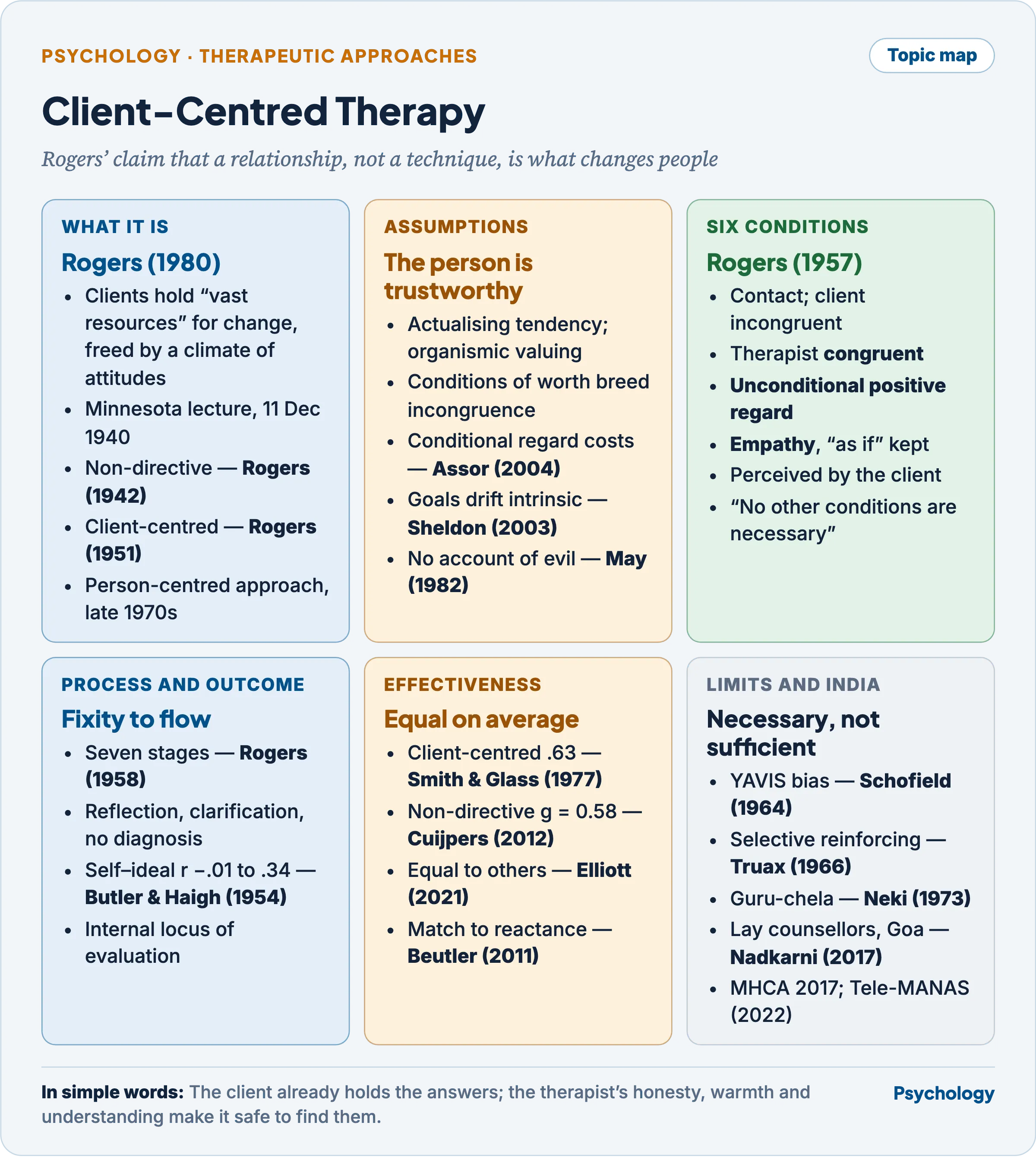
Every box on the map traces back to one idea: the relationship, not the technique, carries the change.
Client centered therapy: development
- Its birth is dated to 11 December 1940, Rogers’ University of Minnesota lecture “Newer Concepts in Psychotherapy” (Kirschenbaum, 1979). The aim was growth, not one solved problem, with feelings, the present and the relationship placed above intellect and the past.
- Its roots lie in the Rankian “relationship therapy” of Taft (1933), which reached Rogers during his child-guidance work at Rochester.
- Non-directive phase — Rogers (1942), Counseling and Psychotherapy: the counsellor gives up advice, persuasion, suggestion, diagnosis and interpretation, and recognises and clarifies the client’s feelings.
- Client-centred phase — Rogers (1951), Client-Centered Therapy: the stress moves from what the counsellor avoids to the attitudes he holds and to the client’s internal frame of reference, the world as the client perceives it; nineteen propositions supply a theory of personality.
- Formal theory — Rogers (1957) stated the six conditions; Rogers (1959) gave the full theory of therapy and personality; Rogers (1961), On Becoming a Person, added the process conception and the fully functioning person.
- Person-centred phase — the same conditions were carried into education (Freedom to Learn, Rogers, 1969), encounter groups (Rogers, 1970) and later conflict resolution; by the late 1970s the wider label, the person-centred approach, was in use (Carl Rogers on Personal Power, Rogers, 1977).
Assumptions underlying client-centred therapy
- The actualising tendency — one motive, towards maintaining and enhancing the organism, so the client already contains the direction of growth.
- The organismic valuing process — an inborn capacity to value experiences by whether they enhance the organism.
- Phenomenal field — behaviour follows the world as perceived, so only the client’s frame of reference explains it and the client is the expert on himself.
- The self-concept, learned from the regard of others, and the need for positive regard.
- Conditions of worth — regard made conditional (“loved if obedient”) is internalised, and the person values experience by others’ standards instead of organismically. This is the origin of incongruence.
- Therapy as reversal — a relationship free of conditions lets the client symbolise what was denied, and growth resumes. The personality theory itself is set out in Humanistic and Existential Theories of Personality (Paper I).
Evaluation of the assumptions
- Conditions of worth are supported. Assor, Roth and Deci (2004) found that students’ perceptions of parental conditional regard predicted introjected internalisation, fluctuating self-esteem and resentment of parents; it secured the desired behaviour, but at an emotional cost.
- Organismic valuing is partly supported. Sheldon, Arndt and Houser-Marko (2003), across three studies, found participants’ goal choices drifting towards intrinsic and away from extrinsic goals over 20 minutes to six weeks, the direction the concept predicts.
- Self-ideal congruence as a sign of health is qualified. Block and Thomas (1955) linked very high self–ideal congruence with overcontrol, suggesting a curvilinear relation: very large and very small discrepancies both mark poorer adjustment.
- The actualising tendency is close to unfalsifiable: growth confirms it and failure is blamed on conditions. May (1982), in an open letter to Rogers, charged that it leaves no account of human evil.
- The client as expert has limits. Kirtner (1955), whom Rogers (1957) cited, found clients who externalised their problems, feeling little responsibility for them, much more likely to fail.
The necessary and sufficient conditions
Rogers (1957) stated that for constructive personality change it is necessary that these conditions “exist and continue over a period of time”:
- “Two persons are in psychological contact.”
- “The first, whom we shall term the client, is in a state of incongruence, being vulnerable or anxious.”
- “The second person, whom we shall term the therapist, is congruent or integrated in the relationship.”
- “The therapist experiences unconditional positive regard for the client.”
- “The therapist experiences an empathic understanding of the client’s internal frame of reference and endeavors to communicate this experience to the client.”
- “The communication to the client of the therapist’s empathic understanding and unconditional positive regard is to a minimal degree achieved.”
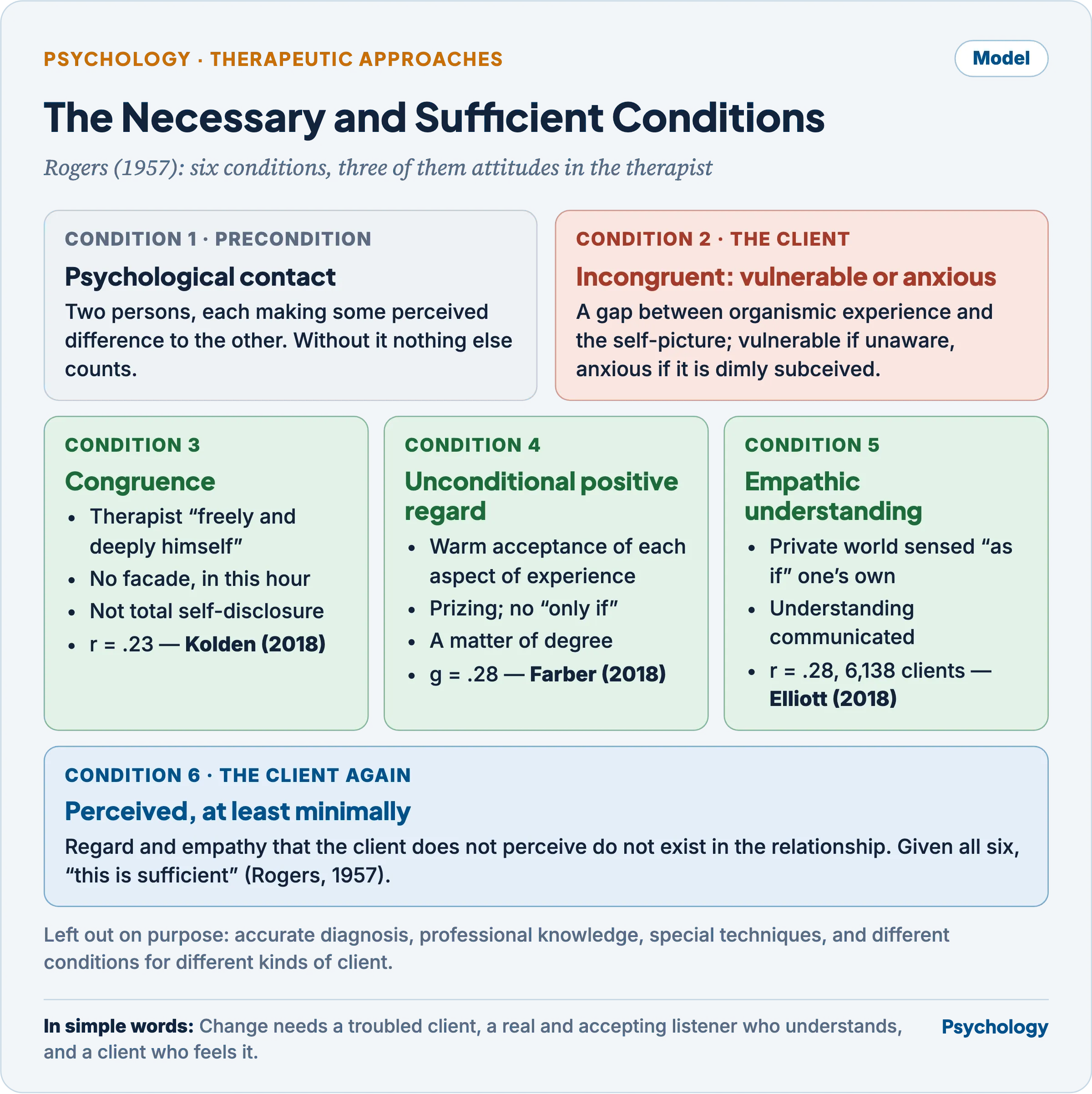
Three of the six conditions describe the therapist’s attitudes; the last makes them count only if the client perceives them.
- “No other conditions are necessary. If these six conditions exist, and continue over a period of time, this is sufficient.” (Rogers, 1957)
- The significant omissions were the provocation: no special conditions for psychotics, no professional knowledge, no accurate diagnosis, and no technique except as a channel for the attitudes.
- The conditions were offered as common to all effective therapy. Fiedler (1950), rating recorded interviews of psychoanalytic, non-directive and Adlerian therapists, found experts of different schools more alike than experts and novices of the same school.
Unconditional positive regard
- Unconditional positive regard — “To the extent that the therapist finds himself experiencing a warm acceptance of each aspect of the client’s experience as being a part of that client, he is experiencing unconditional positive regard” (Rogers, 1957). Standal (1954) developed the concept.
- It is prizing, “no feeling of ‘I like you only if you are thus and so'”, and extends to the client’s “bad”, defensive and abnormal feelings. It accepts the person, not every act.
- Example: a client admits copying in an examination and despising himself. The therapist neither excuses nor condemns the act, and conveys that the client’s shame and anger can be voiced without losing regard.
- Rogers conceded that completely unconditional regard “would never exist except in theory”; it is a matter of degree.
- Evidence: Farber, Suzuki and Lynch (2018), pooling 64 studies, found positive regard related to outcome at g = .28.
Empathic understanding and genuineness
- Empathy — “To sense the client’s private world as if it were your own, but without ever losing the ‘as if’ quality—this is empathy” (Rogers, 1957). Lose the “as if” and empathy becomes identification.
- Elliott, Bohart, Watson and Murphy (2018): across 82 samples and 6,138 clients, empathy predicted outcome at r = .28, about 9 per cent of outcome variance, across orientations.
- Genuineness (congruence) — the therapist “is freely and deeply himself, with his actual experience accurately represented by his awareness of himself” (Rogers, 1957); it is “the opposite of presenting a facade”.
- Kolden and colleagues (2018): congruence related to outcome at r = .23 across 21 studies of 1,192 patients.
Incongruence in person-centred therapy
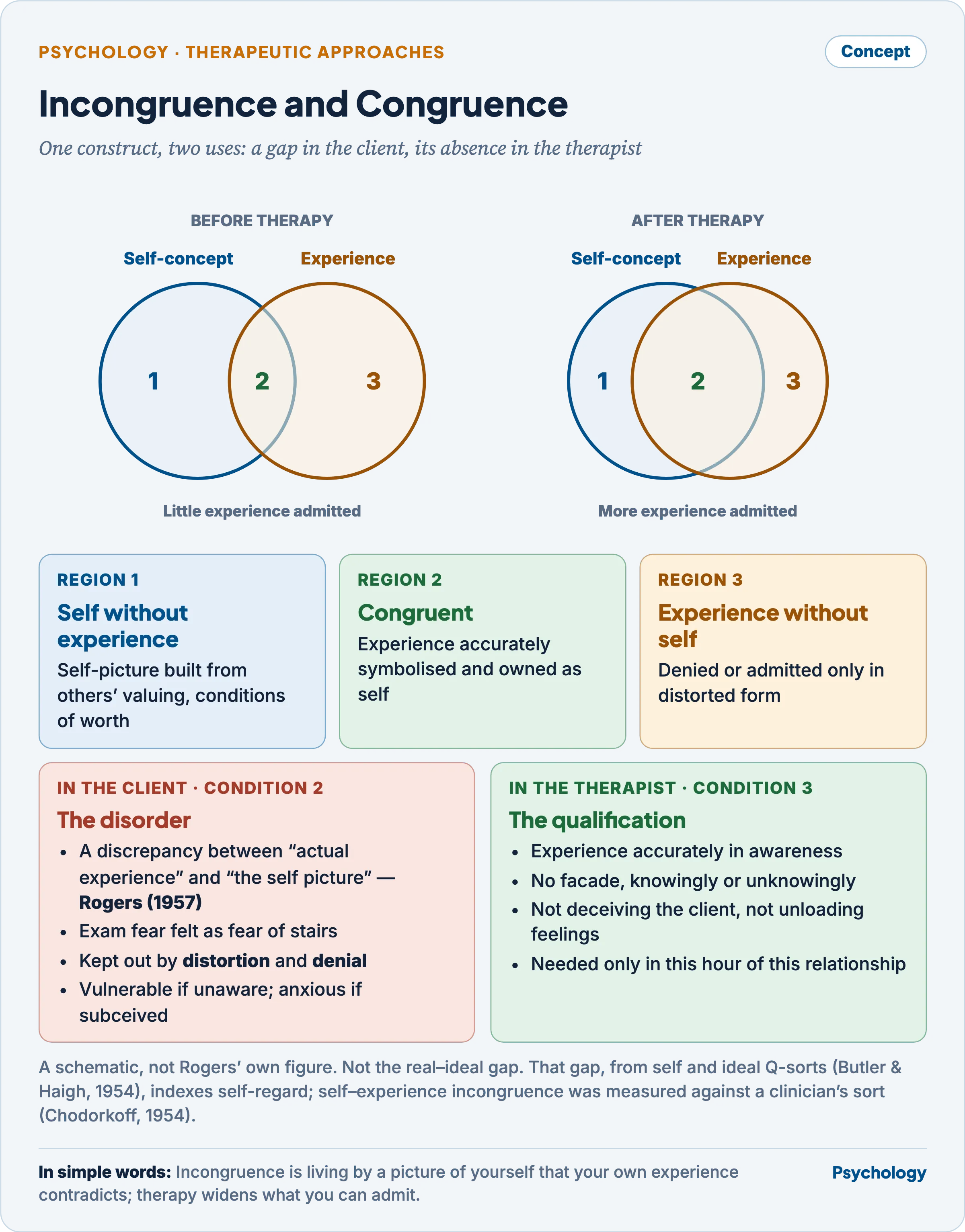
The overlap of self and experience widens as therapy proceeds; the same construct names the client’s gap and the therapist’s lack of one.
- Incongruence “refers to a discrepancy between the actual experience of the organism and the self picture of the individual insofar as it represents that experience” (Rogers, 1957).
- Rogers’ (1957) example: a student feels, organismically, that examinations might reveal a basic inadequacy. That clashes with his self-concept, so the fear reaches awareness distorted, as an unreasonable fear of climbing stairs, then of crossing the campus.
- A parallel case: a student whose parents’ regard depended on rank calls himself a born engineer. His dread of the course is admitted only as exam-morning headaches, which his self-concept can accept.
- Vulnerable — incongruence exists without awareness of it. Anxious — it is dimly subceived as a threat to the self before its content is known.
- Defences keep it out (Rogers, 1959): distortion admits the experience in altered form; denial excludes it.
- Two uses of one construct. In the client (condition 2) incongruence is the disorder; in the therapist (condition 3) congruence is a qualification, limited to this hour and this relationship.
- Therapist congruence is not self-disclosure: “the aim is not for the therapist to express or talk out his own feelings, but primarily that he should not be deceiving the client as to himself” (Rogers, 1957).
- Measurement: Chodorkoff (1954) compared a client’s own Q-sort with a clinician’s sort built from projective tests, a crude index of self–experience incongruence.
- A correction: incongruence is often equated with the gap between real and ideal self. That gap, measured by self and ideal Q-sorts, is a related index of low self-regard, not Rogers’ definition.
The therapeutic process
- Techniques are channels for the attitudes (Rogers, 1957): attending and active listening, restatement, reflection of feeling, clarification and summarising.
- Avoided: case-history intake, tests, diagnosis, interpretation, probing questions and advice. The client sets the content, pace and ending.
- Rogers was among the first to record sessions and publish verbatim transcripts, which opened therapy to research; the Chicago studies are collected in Rogers and Dymond (1954).
Rogers’ seven stages of process
- Rogers (1958) described change as movement along a continuum from fixity to changingness, from rigid structure to flow, divided into seven stages.
- The stages track strands — feelings and personal meanings, manner of experiencing, incongruence, communication of self, construing of experience, relationship to problems, manner of relating.
- Stage 1 — communication only about externals; feelings unrecognised, problems not owned; such a person rarely comes voluntarily.
- Stage 2 — freer talk on non-self topics; feelings described as past or not one’s own; problems located in others.
- Stage 3 — self described as an object; past feelings, often as shameful; many clients begin here.
- Stage 4 — feelings closer to the present but feared; personal constructs questioned; incongruence recognised.
- Stage 5 — present feelings expressed freely and owned; wish to be the real self.
- Stage 6 — a previously stuck feeling is lived fully in the moment and accepted; Rogers judged such moments “in some sense almost irreversible”.
- Stage 7 — new feelings experienced immediately and trusted as a guide; change continues outside therapy.
- A correction: the stages describe the client’s manner of experiencing, not milestones in the client–counsellor relationship. Walker, Rablen and Rogers (1960) turned them into a rating scale.
Outcomes of therapy
- Rogers (1959): the client becomes more congruent, open to experience and less defensive, perceives more realistically, accepts self and others more, and moves to an internal locus of evaluation.
- Rogers (1961) described the direction as away from façades, “oughts” and pleasing others, towards self-direction and trust of self.
- Butler and Haigh (1954), Chicago Counseling Center: 25 clients sorted 100 self-referent statements as “self” and “ideal” before therapy, after it and at follow-up.
- Mean self–ideal correlation rose from −.01 to .34, holding at .31. Matched non-clients stayed near .58–.59.
- Own-control clients, tested before and after a wait for therapy, stayed at −.01, so time alone did not produce the change.
- Limitation: self-report alone; a higher correlation can come from lowering the ideal, and very high congruence can be defensive (Block and Thomas, 1955).
Salient features and advantages
- Features: “client” not “patient”; the client is the expert; phenomenological and non-directive; present over past; feeling over intellect; relationship over technique; growth, not cure, as the aim; diagnosis held unnecessary; research-based.
- Advantages: safe and non-stigmatising; shorter than psychoanalysis; free of a model the client must learn; respectful of autonomy; and the attitudes can be trained in non-specialists.
- Its attitudes underlie motivational interviewing and emotion-focused therapy, and student-centred teaching and encounter groups.
Directive and non-directive therapies
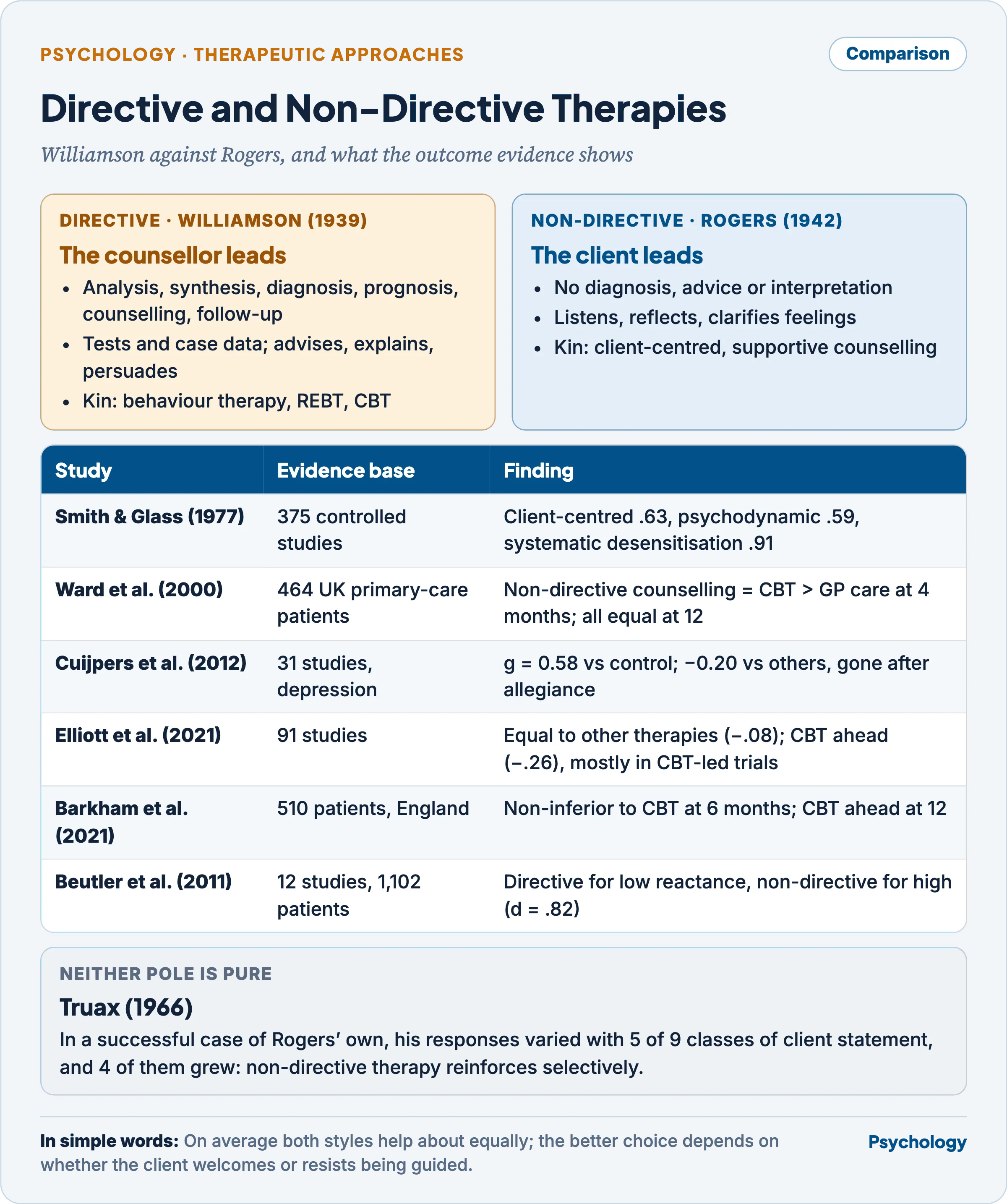
Neither pole wins outright; the better match depends on the client’s reactance and the problem in hand.
- Directive counselling — Williamson (1939), How to Counsel Students, the Minnesota trait-and-factor model, runs six steps: analysis, synthesis, diagnosis, prognosis, counselling, follow-up. The counsellor gathers tests and data, diagnoses and advises.
- Behaviour therapy, Rational Emotive Behaviour Therapy and Cognitive Therapies: Beck and Cognitive-Behavioural Therapy are directive in the same sense: the therapist sets goals and assigns tasks.
| Dimension | Directive (Williamson, 1939) | Non-directive (Rogers, 1942) |
|---|---|---|
| Who leads | Counsellor | Client |
| Assessment | Tests, case data, diagnosis | Little or none |
| Counsellor activity | Advises, explains, persuades | Listens, reflects, clarifies |
| Focus | The problem and its solution | The person and his feelings |
| Responsibility | Mainly the counsellor | The client |
| Best suited | Informational, educational and vocational choices | Emotional conflict, self-exploration |
Effectiveness compared
- Smith and Glass (1977), pooling 375 controlled studies: mean effect sizes were .63 for client-centred therapy, .59 psychodynamic, .77 rational-emotive and .91 systematic desensitisation.
- Ward and colleagues (2000), 464 UK primary-care patients with depression or mixed anxiety and depression: non-directive counselling and CBT each beat usual GP care at four months; by twelve months the three did not differ.
- Cuijpers and colleagues (2012), 31 studies: non-directive supportive therapy beat controls (g = 0.58) and trailed other therapies (g = −0.20), a gap that vanished once researcher allegiance was controlled.
- Elliott, Watson, Timulak and Sharbanee (2021), 91 studies: humanistic-experiential therapies gave large pre-post change (d = .86), equalled other therapies (−.08), and trailed CBT (−.26) in comparisons run overwhelmingly by CBT researchers.
- Barkham and colleagues (2021), 510 patients with moderate or severe depression in England: person-centred experiential therapy was non-inferior to CBT at six months; at twelve months CBT was ahead.
- Beutler and colleagues (2011), 12 studies of 1,102 patients: matching mattered (d = .82). Low-reactance clients did better with directive therapy, highly reactant ones with non-directive therapy.
- Truax (1966) showed the poles are not pure. In a successful case of Rogers’ own, Rogers responded differentially to 5 of 9 classes of client statement, and 4 of those classes increased.
- Non-directive therapy reinforces selectively. Limitation: one case, correlational (Lieberman, 1969). The dodo-bird debate is set out in Psychotherapy: Effectiveness, Common Factors and Eclecticism.
Psychoanalytic and client-centred therapy compared
| Dimension | Psychoanalytic (Freud) | Client-centred (Rogers) |
|---|---|---|
| Human nature | Driven by instinct and conflict | Trustworthy, growth-directed |
| Source of disorder | Repressed infantile conflict | Incongruence from conditions of worth |
| Focus | Past and unconscious | Present, phenomenal field |
| Therapist | Expert interpreter, neutral screen | Congruent, empathic companion |
| Method | Free association, dream and resistance analysis | Reflection, clarification, empathic listening |
| Transference | Fostered and interpreted | Accepted like any feeling, not cultivated |
| Diagnosis | Required | Held unnecessary |
| Goal | Make the unconscious conscious, strengthen the ego | Congruence, fully functioning person |
- Similarities: both are talking cures aiming at awareness; both place anxiety and defence at the centre, denial and distortion paralleling repression; both value the relationship; both suit verbal, motivated clients.
- On effectiveness the client-centred half is stated above. The psychodynamic evidence, including Shedler (2010), is in Psychodynamic Therapies.
Utility in treating psychological problems
- Strongest for relationship and interpersonal difficulties, self-damaging activities, coping with chronic medical illness and psychosis; more mixed for depression and anxiety (Elliott and colleagues, 2021).
- Effective for adult depression (Cuijpers and colleagues, 2012), with evidence for moderate and severe depression in the short term (Barkham and colleagues, 2021).
- Not a stand-alone treatment for schizophrenia. The Wisconsin project (Rogers, Gendlin, Kiesler and Truax, 1967) found few significant differences between therapy and hospital-care control patients, though patients of high-empathy, high-genuineness therapists improved more.
- Specific phobias and obsessive-compulsive disorder need exposure, set out in Systematic Desensitization and Exposure Therapies.
Limitations and criticisms
- Passivity with severe disorders and crisis. A suicidal client or one in acute psychosis needs risk assessment, structure and often medication; reflection alone can leave the danger unaddressed, as the Wisconsin results imply.
- Bias towards able clients. Schofield (1964) named the preferred “YAVIS” client — young, attractive, verbal, intelligent, successful. A child, a person with intellectual disability or a client who cannot introspect gains little from reflected feelings.
- Cultural fit. A client who expects a doctor-like expert to advise may read reflection as evasion and stop attending.
- The “sufficient” claim fails. Core conditions explain modest variance, about 9 per cent for empathy (Elliott and colleagues, 2018), and Rogers (1957) granted that Kirtner’s (1955) externalising clients implied a need for “some other conditions”.
- Non-directiveness is partly illusory (Truax, 1966).
- A thin early research base — self-report and Q-sorts, few controls, rival explanations untested.
- Theory: optimism without an account of evil (May, 1982); neglect of the unconscious, the past and biology.
Indian context
- Surya and Jayaram (1964) argued that Indian patients are more dependent than Western ones and look for direct, situational support in their own language rather than intrapsychic explanation.
- Neki (1973) proposed the guru-chela relationship as a therapeutic paradigm: an active guide who accepts responsibility for the disciple’s growth. Neki (1976) argued that the West’s treating of dependence as a defect is culturally relative.
- Arulmani (2007) described Indian counselling as resting on Western approaches widely criticised as culturally unsuited, and urged a blend with indigenous traditions.
- The workforce gap: India had 0.07 psychologists and 0.29 psychiatrists per lakh population (WHO Mental Health Atlas, 2017); the treatment gap for any mental morbidity was 84.5 per cent (National Mental Health Survey, 2015–16; Gautham and colleagues, 2020).
- Nadkarni and colleagues (2017), Counselling for Alcohol Problems, Goa: 377 harmful-drinking men in ten primary health centres were randomised to lay-counsellor treatment plus enhanced usual care, or usual care alone.
- Counsellors worked in a motivational-interviewing style, which builds on client-centred empathic listening.
- Remission was 36 against 26 per cent at three months and 54.3 against 31.9 per cent at twelve (Nadkarni and colleagues, 2017). Limitation: self-reported drinking.
- Mental Healthcare Act, 2017 (Ministry of Health and Family Welfare; in force 29 May 2018) — section 18 gives a right to access mental healthcare; section 5 allows advance directives.
- Section 4(3): a decision “perceived by others as inappropriate or wrong” is not by itself proof of incapacity. The Act operationalises client autonomy, the person as the locus of evaluation.
- Tele-MANAS (Ministry of Health and Family Welfare, 10 October 2022; helpline 14416; 53 cells; over 47 lakh calls by October 2026, per the Ministry) offers toll-free telephone counselling. It operationalises empathic listening as first-level care.
Previous Year Questions
- 2023Compare directional and non-directional therapies with reference to their effectiveness.
- 2020Illustrate the basic tenets of psycho-dynamic and client centered therapies. Discuss the effectiveness of these therapies as forms of treatment of mental disorders.
- 2017Explain the concept of incongruence in person-centred therapy.
- 2014What is meant by unconditional positive regard?
- 2013What are the necessary conditions required in client-centred therapy? Discuss the therapeutic process involved in it.
- 2011Explain person-centred therapy and state its limitation with suitable examples.
- 2008Explain the nature and advantages of client centered therapy. Critically evaluate its utility in treating various psychological problems.
- 2007Write a short note on: Assumptions underlying client-centered therapy and their evaluation.
- 2002Comment on: Describing the important features of client centered therapy, present the similarities and differences between psychoanalytic therapy and client centered therapy.
- 1998Discuss the salient features of client-centered therapy.