

Official syllabusPaper II · Unit 2 · Psychological Well Being and Mental Disorders
Factors influencing positive health, well being, life style and quality of life – stress and its management.
Definition
“Psychological stress is a particular relationship between the person and the environment that is appraised by the person as taxing or exceeding his or her resources and endangering his or her well-being.”
Lazarus and Folkman (1984)
Stress is where psychology reaches into the body: the same event is harmless or damaging depending on how it is appraised, and a sustained response helps produce ulcers, hypertension and heart disease. Each classic answer — on definition, illness and management — has since been qualified.
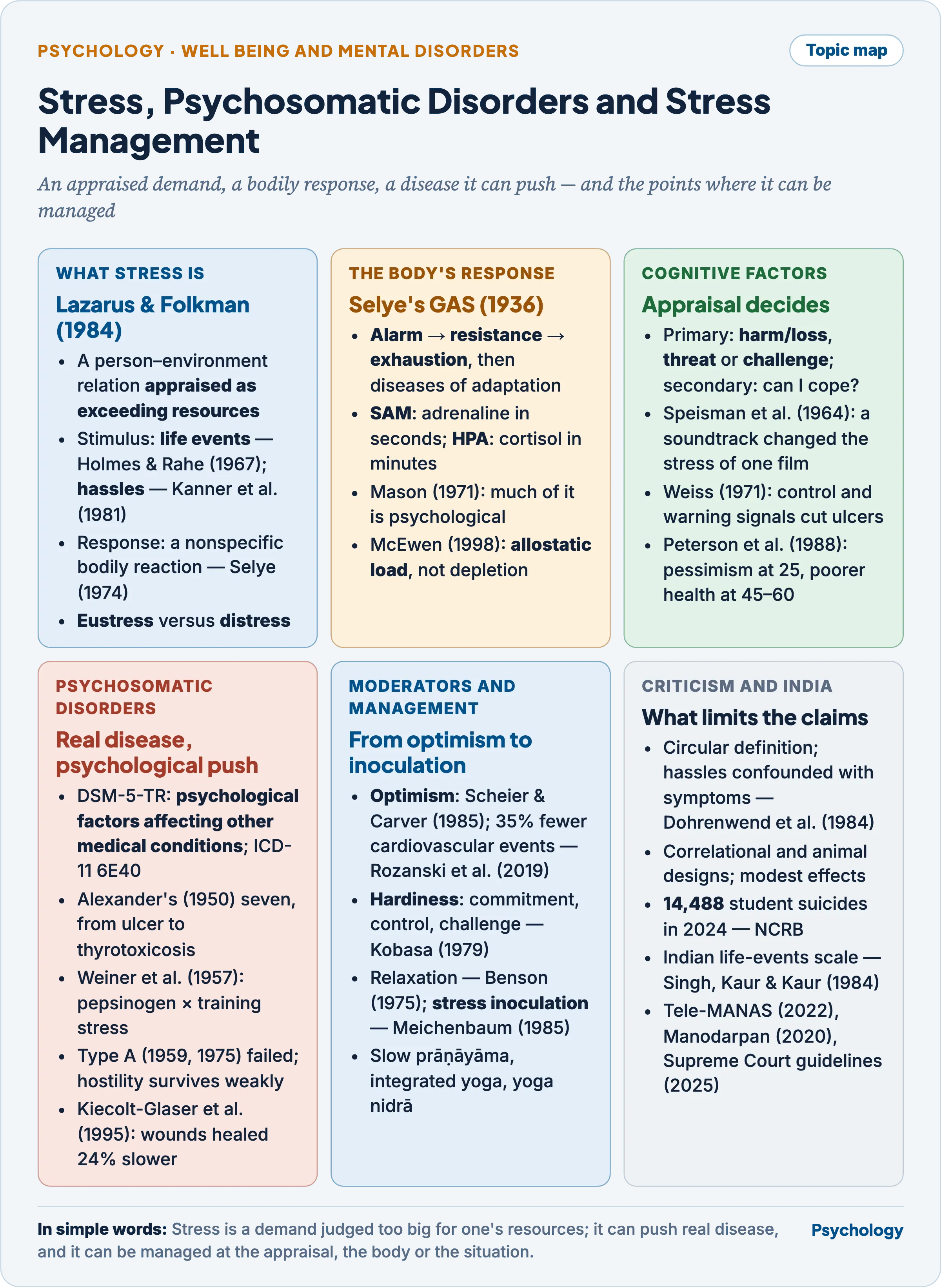
Selye’s response, Lazarus’s appraisal and the psychosomatic disorders form one chain, and management can enter at every link.
What stress is: stimulus, response and transaction
| Approach | Stress is | Key figure | Weakness |
|---|---|---|---|
| Stimulus | An external demand, the stressor | Holmes and Rahe (1967) | The same event affects people differently |
| Response | “the nonspecific response of the body to any demand made upon it” | Selye (1974) | Ignores what the event means |
| Transaction | A person–environment relation appraised as exceeding resources | Lazarus and Folkman (1984) | Circular: stress is whatever is appraised as stressful |
- Selye (1974) separated eustress from distress: the stressor effect depends on the intensity of demand, not its pleasantness, so promotion and bereavement both tax adaptation, but only distress damages.
Selye’s general adaptation syndrome
- Selye (1936), in a letter to Nature, reported that rats exposed to cold, surgical injury, excessive exercise or sublethal drugs all developed one triad — enlarged adrenals, shrunken thymus and lymph glands, and gastrointestinal ulcers — whatever the agent.
- He named it the general adaptation syndrome; the word “stress” is absent from the letter.
- The three stages:
- Alarm reaction: a brief fall in resistance (shock), then mobilisation (countershock) — the emergency reaction Cannon (1915) tied to “the necessities of fighting or flight”.
- Resistance: arousal stays high and the body adapts, at the cost of resistance to other stressors.
- Exhaustion: under prolonged demand resistance collapses and diseases of adaptation — ulcers, hypertension, cardiovascular damage — appear (Selye, 1956).
- Two axes carry the response.
- Sympathetic–adrenal–medullary (SAM): sympathetic nerves drive the adrenal medulla to release adrenaline and noradrenaline within seconds.
- Hypothalamic–pituitary–adrenal (HPA): CRH releases pituitary ACTH, which drives the adrenal cortex to secrete cortisol; cortisol mobilises energy, damps inflammation and ends the response by negative feedback.
- Criticisms:
- Mason (1971) found heat and fasting produced little adrenocortical response once their emotional impact was minimised, so much of the “non-specific” response was psychological; cold and hypoxia still evoked it.
- Pacák and Palkovits (2001) showed that immobilisation, haemorrhage, cold, pain and hypoglycaemia each leave a distinct neuroendocrine “signature”.
- McEwen (1998) replaced exhaustion-as-depletion with allostatic load: wear and tear from mediators that protect briefly but damage when repeated, prolonged or not switched off.
- Stress research had relied mostly on males; Taylor and colleagues (2000) proposed that females more often tend and befriend.
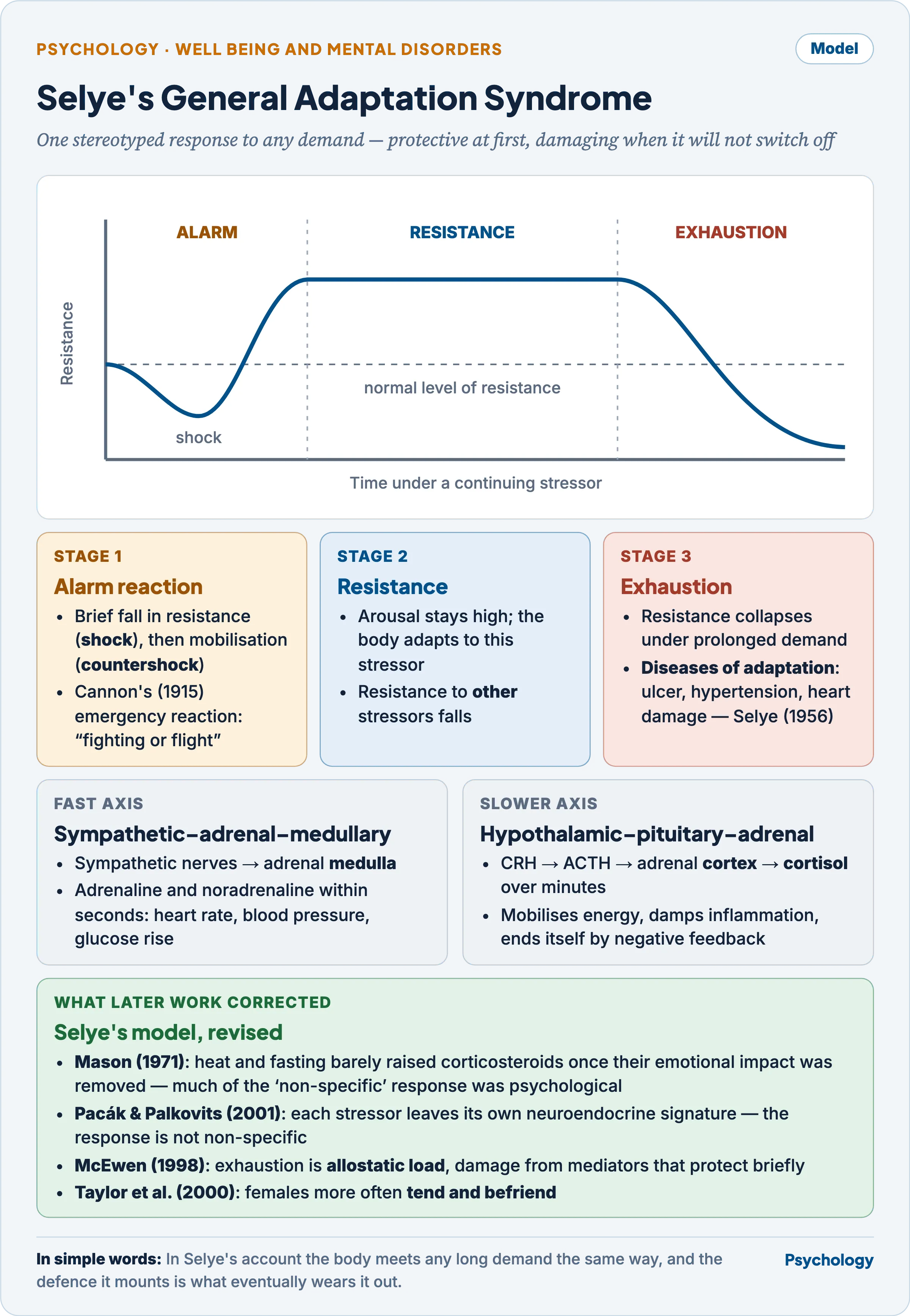
Resistance to one stressor is bought by lowering resistance to others, and prolonged demand ends in exhaustion.
The role of cognitive factors in the experience of stress
Primary and secondary appraisal
- Lazarus and Folkman (1984) placed appraisal between event and response.
- Primary appraisal asks what is at stake: the encounter is irrelevant, benign-positive or stressful, and a stressful one is a harm/loss, a threat or a challenge.
- Secondary appraisal asks what can be done — coping options and resources such as health, skills, support and self-efficacy.
- Reappraisal revises both; appraisal as a cause of emotion is set out in Theories of Emotion (Paper I).
- Coping is “constantly changing cognitive and behavioral efforts to manage specific external and/or internal demands that are appraised as taxing or exceeding the resources of the person” (Lazarus and Folkman, 1984).
- Problem-focused coping changes the situation, emotion-focused coping regulates the distress, avoidance disengages.
- Folkman and Lazarus (1980), analysing 1,332 episodes from 100 adults aged 45–64, found both forms in 98 per cent, with problem-focused coping favoured when the situation seemed changeable.
- Speisman, Lazarus and colleagues (1964) showed students and airline executives a film of subincision rites with one of four soundtracks: trauma (stressing mutilation), denial, intellectualisation (detached anthropology) or none.
- Skin conductance rose with the trauma track and fell with the denial and intellectualisation tracks: identical pictures, different stress.
- Limitation: a brief laboratory analogue, and the tracks worked differently for students and executives.
Control and predictability
- Weiss (1971) ran 180 rats in triplets: one could avoid or escape shock, a yoked partner wired in series received identical shocks without control, a third none.
- The helpless yoked rats developed more stomach ulceration; a warning signal before each shock reduced it in both shocked groups.
- This reversed Brady’s (1958) “executive monkey” result — four pairs, with the “executives” chosen because they learned avoidance fastest, not at random.
- Limitation: rats and shock; extension to people is by analogy.
- In humans, perceived control removed the after-effects of unpredictable noise (Glass and Singer, 1972), set out in Effects of Noise (Unit 12).
Attribution and rumination
- Peterson, Seligman and Vaillant (1988) coded explanatory style from questionnaires completed at 25 by 99 Harvard graduates: explaining bad events as internal, stable and global predicted poorer physician-rated health at 45–60.
- It applies the attributional reformulation (Abramson, Seligman and Teasdale, 1978); the dog experiments are in Escape, Avoidance and Learned Helplessness (Paper I).
- Brosschot, Gerin and Thayer (2006) proposed the perseverative cognition hypothesis: worry and rumination prolong cardiovascular, endocrine and immune activation, so damage depends on how long a stressor is kept alive in thought.
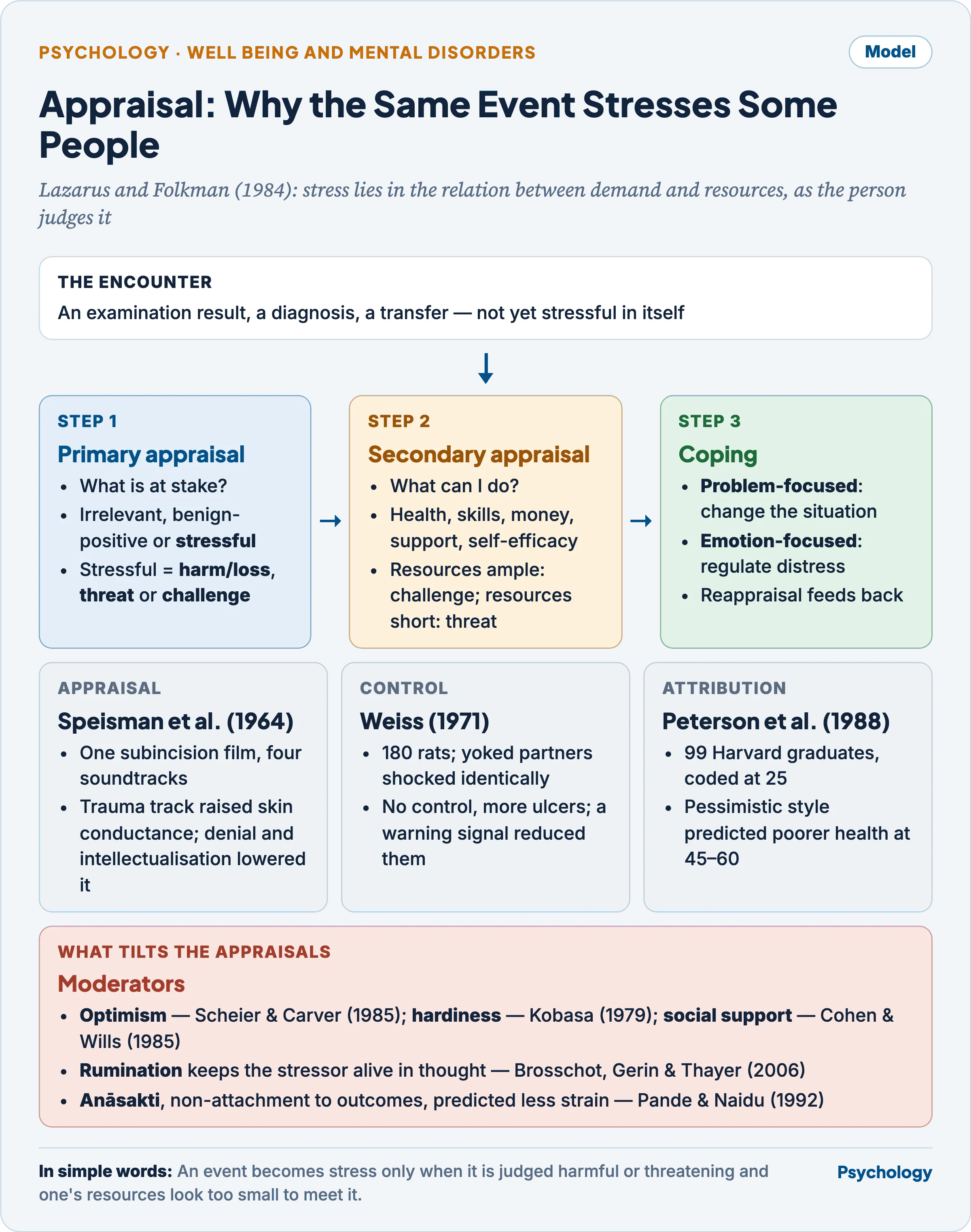
The same event becomes challenge or threat at primary appraisal, and illness only if coping resources fail at secondary appraisal.
Sources of stress in society
- Life events — Holmes and Rahe (1967) had 394 people rate 43 events against marriage; the Social Readjustment Rating Scale runs from death of a spouse (100 life change units) and divorce (73) to minor violations of the law (11).
- Limitations: good and bad events are summed alike, recall is retrospective, and some items (illness, sleep change) are symptoms.
- Singh, Kaur and Kaur (1984) built the Indian Presumptive Stressful Life Events Scale from 200 urban and rural adults in Patiala: 51 items, including a daughter’s marriage, crop damage, lack of a child and appearing for an examination.
- Daily hassles — Kanner and colleagues (1981) gave 100 adults aged 45–64 a 117-item Hassles Scale monthly: hassles predicted psychological symptoms better than life events did.
- Limitation: Dohrenwend and colleagues (1984) had 371 clinicians rate the items and found hassles more confounded with symptoms than the life-events scale.
- Chronic and societal stressors — poverty, caste discrimination, caregiving, unemployment, disasters, crowding (Effects of Crowding and High Density, Unit 12) and work (Occupational Stress and Its Management, Unit 4).
- Academic pressure — Deb, Strodl and Sun (2015) surveyed 190 Class 11–12 students in six Kolkata schools: 63.5 per cent reported academic stress, 66 per cent parental pressure, and academic stress doubled the odds of psychiatric caseness.
Consequences of stress for positive health, well being, life style and quality of life
- Physical: raised heart rate, blood pressure, glucose and muscle tension; Segerstrom and Miller (2004), pooling over 300 studies, found acute stressors up-regulate natural immunity and chronic stressors suppress cellular and humoral immunity.
- Psychological: anxiety, irritability, low mood, poor concentration and burnout; performance follows an inverted U only on difficult tasks (Theories of Motivation, Paper I).
- Severe stressors produce the DSM-5-TR trauma- and stressor-related disorders — post-traumatic stress disorder, acute stress disorder (three days to a month after trauma) and adjustment disorder.
- Behavioural: more smoking, drinking and comfort eating, less sleep and exercise, absenteeism and accidents — habits that are themselves routes to illness.
Psychosomatic disorders
From psychosomatic disease to psychological factors affecting other medical conditions
- A psychosomatic (psychophysiological) disorder is a physical disease with real pathology that psychological factors help start or worsen; somatic symptom and conversion disorders lack such pathology.
- DSM-I (1952) called them “psychophysiologic autonomic and visceral disorders”, DSM-II (1968) “psychophysiologic disorders”, DSM-III (1980) “psychological factors affecting physical condition”.
- DSM-5-TR (2022) keeps psychological factors affecting other medical conditions in the somatic symptom chapter — factors that alter the course, impede treatment, add risk or act on pathophysiology; ICD-11 codes it 6E40, with stress-related physiological response as 6E40.4.
Types of psychosomatic disorders
- Alexander (1950) studied seven — duodenal ulcer, asthma, essential hypertension, rheumatoid arthritis, ulcerative colitis, neurodermatitis, thyrotoxicosis — later the “holy seven”, each tied to a specific unconscious conflict — a specificity claim since abandoned.
| Disorder | Stress pathway | Evidence | Caveat |
|---|---|---|---|
| Peptic ulcer | Acid and pepsin, weaker mucosal defence, smoking | Weiner and colleagues (1957); Levenstein and colleagues (2015) | H. pylori and NSAIDs cause most ulcers |
| Essential hypertension | Repeated sympathetic surges | Chida and Steptoe (2010): high stress reactivity predicts later hypertension | Effect small (r about .09) |
| Bronchial asthma | Emotion-triggered bronchoconstriction | Nagarathna and Nagendra (1985) yoga trial | Allergic basis primary |
| Tension headache, migraine | Sustained muscle tension, vascular change | Biofeedback, 55 migraine studies, d = .58 (Nestoriuc and Martin, 2007) | No better than relaxation |
| Coronary heart disease | Catecholamines, inflammation, behaviour | Type A and hostility studies below | Type A failed later trials |
- Weiner and colleagues (1957) measured serum pepsinogen in 2,073 army inductees and followed 120 extreme high and low secretors through basic training.
- The nine who had or developed duodenal ulcers were all high secretors: neither high secretion nor psychological conflict sufficed alone, only both under training stress — the classic diathesis–stress demonstration.
- Limitation: few cases and interpretive psychodynamic ratings.
- After Marshall and Warren (1984) identified Helicobacter pylori, ulcers were recast as infections; yet Levenstein and colleagues (2015), following 3,379 Danish adults for 11–12 years, found the most stressed third had 2.2 times the odds of ulcer, with or without the bacterium.
Type A behaviour, hostility and coronary heart disease
- Friedman and Rosenman (1959) described the Type A behaviour pattern — competitive drive, time urgency, hostility — and found coronary disease seven times more often in 83 Type A than in 83 Type B men.
- The Western Collaborative Group Study (Rosenman and colleagues, 1975) followed 3,154 men aged 39–59 for 8½ years: Type A roughly doubled coronary incidence, independent of standard risk factors.
- Then it failed: no Type A effect in 3,110 high-risk men of the Multiple Risk Factor Intervention Trial (Shekelle and colleagues, 1985), and none on 22-year coronary death in the original cohort (Ragland and Brand, 1988).
- The hostility revision isolated the toxic part: Barefoot, Dahlstrom and Williams (1983) found high MMPI hostility in 255 medical students predicted coronary disease and death over 25 years.
- Chida and Steptoe (2009), pooling 25 healthy cohorts, found a hazard ratio of only 1.19, which vanished once smoking, activity and weight were controlled — a mainly behavioural route.
- Rosengren and colleagues (2004) compared 11,119 heart-attack patients with 13,648 controls in 52 countries (INTERHEART): permanent stress at work or home roughly doubled the odds of infarction (odds ratio 2.17).
How stress contributes to physical illness
- Directly, through repeated SAM and HPA activation and allostatic load (McEwen, 1998).
- Through the immune system — Ader and Cohen (1975) classically conditioned immune suppression in rats, founding psychoneuroimmunology.
- Kiecolt-Glaser and colleagues (1995) gave 13 women caring for relatives with dementia and 13 matched controls a 3.5 mm punch-biopsy wound: caregivers healed nine days (24 per cent) more slowly and produced less interleukin-1β.
- Limitation: a small, non-random sample.
- The common-cold inoculation study of Cohen, Tyrrell and Smith (1991) is set out in Health, Ill-Health, Positive Health and Well-Being.
- Behaviourally, through smoking, inactivity, diet, sleep and poor adherence; smoking and inactivity carried part of the stress–ulcer effect (Levenstein and colleagues, 2015).
Factors influencing the impact of stress: optimism, hardiness and social support
- Scheier and Carver (1985) defined dispositional optimism as generalised expectancies of good rather than bad outcomes, measured by the Life Orientation Test.
- Scheier and colleagues (1989) followed 51 men through coronary bypass surgery: optimists used more problem-focused coping and less denial, recovered faster and had better quality of life at six months.
- Rozanski and colleagues (2019), pooling 15 studies of 229,391 people, found optimism associated with 35 per cent fewer cardiovascular events and 14 per cent lower mortality.
- Mechanism: optimists appraise stressors as challenges, cope actively and keep healthier habits.
- Objections: the evidence is observational; early scores overlapped with neuroticism, corrected in the revised test (Scheier, Carver and Bridges, 1994); and Segerstrom (2005) found optimists’ cellular immunity falls under difficult, uncontrollable stressors, because they keep engaging.
- Hardiness — Kobasa (1979) compared 86 high-stress executives who stayed well with 75 who fell ill: the well scored higher on commitment, control and challenge; the design was retrospective.
- Social support buffers stress chiefly when it fits the demand (Cohen and Wills, 1985), developed in Factors Influencing Positive Health, Well-Being, Lifestyle and Quality of Life.
- Pande and Naidu (1992) measured anāsakti — non-attachment to outcomes, modelled on the Gītā’s sthitaprajña — in 465 Allahabad adults: high scorers reported less distress and fewer strain symptoms, and anāsakti predicted strain better than stress scores did.
Can stress be totally eliminated?
- No. “Complete freedom from stress is death” (Selye, 1974): demand never ceases — heart, gut and brain work even in sleep — so the target is distress, not stress.
- Moderate demand sustains motivation, and understimulation is itself a stressor.
- Moderate adversity builds resilience: in a national panel of 2,398 Americans followed from 2001 to 2004, people with some lifetime adversity fared better than those with none or with much (Seery, Holman and Silver, 2010).
- The acute response is adaptive (Segerstrom and Miller, 2004), and many stressors — poverty, caste, disasters — are beyond individual removal; the aim is an optimal level and fast recovery.
Stress management
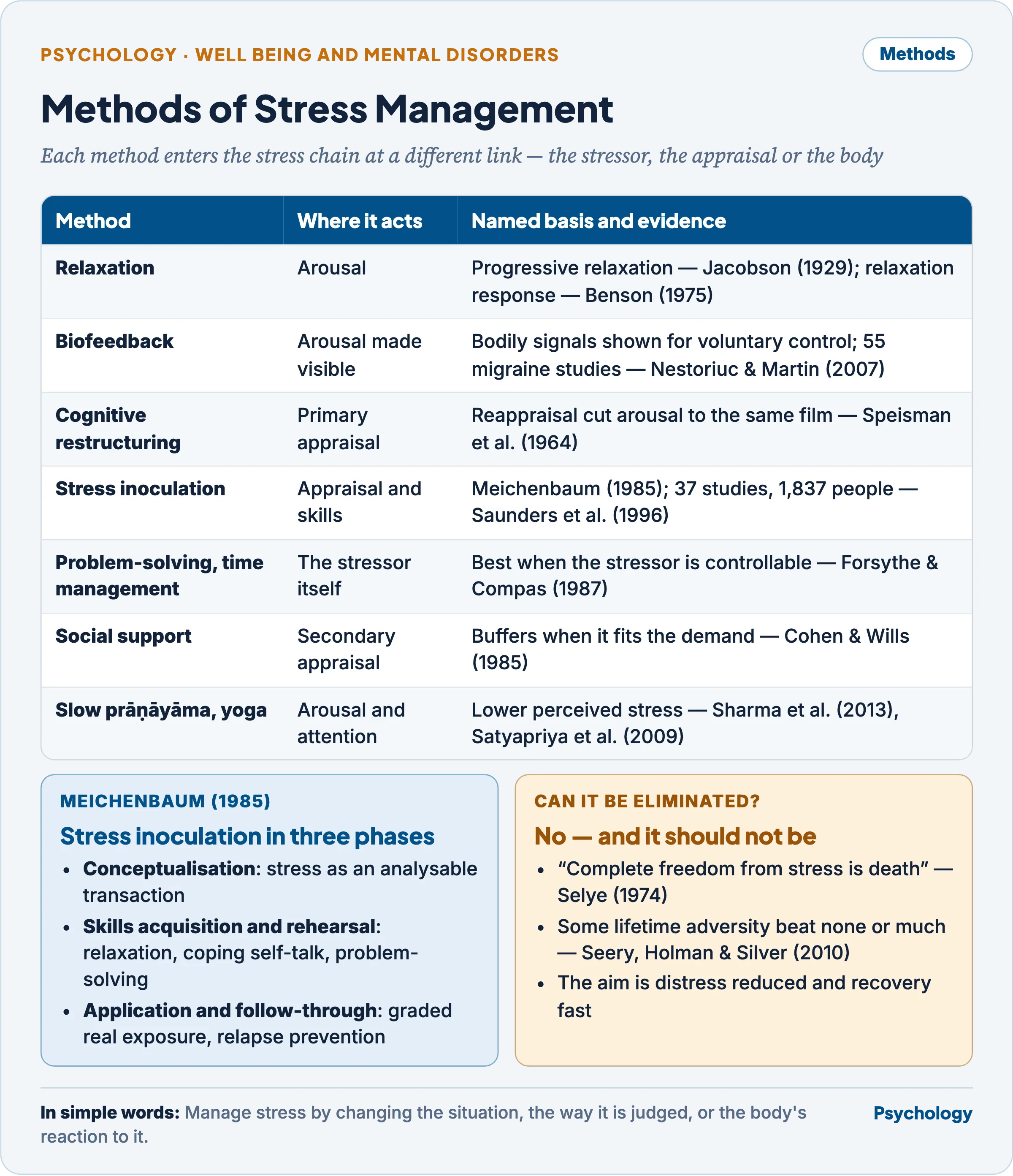
Each method enters the stress chain at a different link, so one programme can combine several.
- Physiological methods lower arousal.
- Progressive muscle relaxation (Jacobson, 1929) alternately tenses and releases muscle groups; autogenic training (Schultz, 1932) uses self-suggested heaviness and warmth.
- Benson (1975) described the relaxation response — slower heart and breathing, lower oxygen use — elicited by a repeated word, a passive attitude and a quiet setting.
- Biofeedback and cognitive restructuring are set out in Biofeedback Therapy, Cognitive Therapies: Beck and Cognitive-Behavioural Therapy and Rational Emotive Behaviour Therapy (Unit 3).
- Stress inoculation training (Meichenbaum, 1985) works like a vaccine, in three phases.
- Conceptualisation: stress reframed as an analysable transaction.
- Skills acquisition and rehearsal: relaxation, coping self-statements, problem-solving.
- Application and follow-through: graded real-life exposure and relapse prevention.
- Saunders and colleagues (1996), pooling 37 studies of 1,837 participants, found it reduced performance and state anxiety and improved performance under stress.
- Behavioural and social methods: time management, problem-solving, assertiveness, exercise, sleep and support; coping works best when problem-focused for controllable and emotion-focused for uncontrollable major stressors (Forsythe and Compas, 1987).
Indian techniques for stress management
- Yoga’s limbs and therapeutic use are set out in Meditation and Its Effects (Paper I) and Indigenous Therapies: Yoga and Meditation (Unit 3).
- Prāṇāyāma — slow breathing (nāḍī śodhana, bhrāmarī) shifts autonomic balance towards the parasympathetic; fast breathing (kapālabhāti, bhastrikā) is activating.
- Sharma and colleagues (2013) randomised 90 students at JIPMER, Puducherry, to fast, slow or no prāṇāyāma for 12 weeks: perceived stress fell with both, but only slow breathing lowered heart rate and diastolic pressure. Limitation: unblinded.
- Integrated yoga — Satyapriya and colleagues (2009) randomised 122 pregnant women in Bangalore to yoga with deep relaxation or standard prenatal exercise: perceived stress fell 31.6 per cent with yoga and rose 6.6 per cent in controls. Limitation: only 90 completed.
- Yoga nidrā — a guided rotation of awareness through the body, adapted from tantric nyāsa by Satyananda Saraswati (1976) as a practice of pratyāhāra, Patañjali’s fifth limb.
- Rani and colleagues (2011) randomised 150 Lucknow women with menstrual disorders to medication alone or medication plus six months of yoga nidrā: pain, gastrointestinal and cardiovascular symptoms improved more with yoga nidrā.
- Nagarathna and Nagendra (1985) matched 53 pairs of asthma patients: yoga cut attacks and drug use and raised peak flow over 54 months — a psychosomatic disorder yielding to practice.
- Objections: small, unblinded trials against usual care, often run by the programme’s developers; against active controls the effect of meditation shrinks (Meditation and Its Effects, Paper I).
Criticisms and limitations
- The concept is elastic: stimulus, response and transaction are different things.
- Stress and outcome are often both self-reported, and hassles overlap with symptoms (Dohrenwend and colleagues, 1984).
- Designs are mostly correlational or animal-based, so human causal claims rest on inference.
- Flagship ideas weakened: Alexander’s specificity, Type A, and stress as the cause of ulcers.
- Effects are modest: self-reported stress was largely unrelated to immune change (Segerstrom and Miller, 2004).
- Management research favours individual techniques, though many stressors are structural.
- Samples are mostly Western; Indian life-event weights (Singh, Kaur and Kaur, 1984) and anāsakti (Pande and Naidu, 1992) show culture shaping appraisal.
Indian context
- Accidental Deaths and Suicides in India 2024 (National Crime Records Bureau, May 2026) recorded 1,70,746 suicides, 0.4 per cent fewer than in 2023, yet student suicides rose 4.3 per cent to 14,488, 8.5 per cent of all.
- Misra (1999) edited Psychological Perspectives on Stress and Health, gathering Indian research on control, coping and environmental stress.
- Tele-MANAS (Ministry of Health and Family Welfare, 10 October 2022) — a free 24×7 helpline (14416), NIMHANS as nodal centre, with 47,75,644 calls by October 2026 (PIB, 9 October 2026); it operationalises low-threshold help-seeking, a coping resource at secondary appraisal.
- Manodarpan (Ministry of Human Resource Development, now Education, 21 July 2020) — tele-counselling on 8448440632, advisories and a counsellor directory for students and families; it operationalises social support and psychoeducation.
- Sukdeb Saha v. State of Andhra Pradesh (Supreme Court, 25 July 2025) — 15 binding guidelines, including a counsellor where enrolment reaches 100, avoiding batch segregation by performance, displayed helplines and twice-yearly staff training; it operationalises reduction of uncontrollable evaluative stressors and gatekeeper detection.
- Y-Break (Ministry of Ayush, app launched 1 September 2021) — a five-minute workplace protocol of āsana, nāḍī śodhana, bhrāmarī and dhyāna, piloted from January 2020 with 717 employees in a 15-day, single-arm trial; it operationalises brief relaxation breaks.
Previous Year Questions
- 2018How does stress contribute to the causation of physical illness? Discuss the role of optimism as factor moderating the impact of stress.
- 2009Comment on the role of cognitive factors in the experience of stress.
- 2000What is stress? Can you suggest some Indian techniques for stress management? Elaborate.
- 1999Mention the physical, psychological and behavioural consequences of stress.
- 1998Discuss the types of psychosomatic diseases.
- 1998What is stress? Discuss certain methods of stress management.
- 1997Can stress be totally eliminated? Discuss the main sources of stress in our society.
- 1996What are the typical psychophysiologic disorders caused by anxiety and stress? Give your reasons for the same.