

Official syllabusPaper II · Unit 2 · Psychological Well Being and Mental Disorders
Causal factors in mental disorders (substance abuse disorders).
Definition
“Drug addiction is a chronically relapsing disorder that has been characterized by (1) compulsion to seek and take the drug, (2) loss of control in limiting intake, and (3) emergence of a negative emotional state (eg, dysphoria, anxiety, irritability) reflecting a motivational withdrawal syndrome when access to the drug is prevented.”
Koob and Volkow (2010)
“Substance abuse” is DSM-IV’s term; the current manuals speak of substance use disorder (DSM-5-TR) and of harmful use and dependence (ICD-11). The causal question is why only a minority of users lose control, and each approach — genes and reward circuitry, learning, belief, temperament, culture — explains one step from first use to relapse.
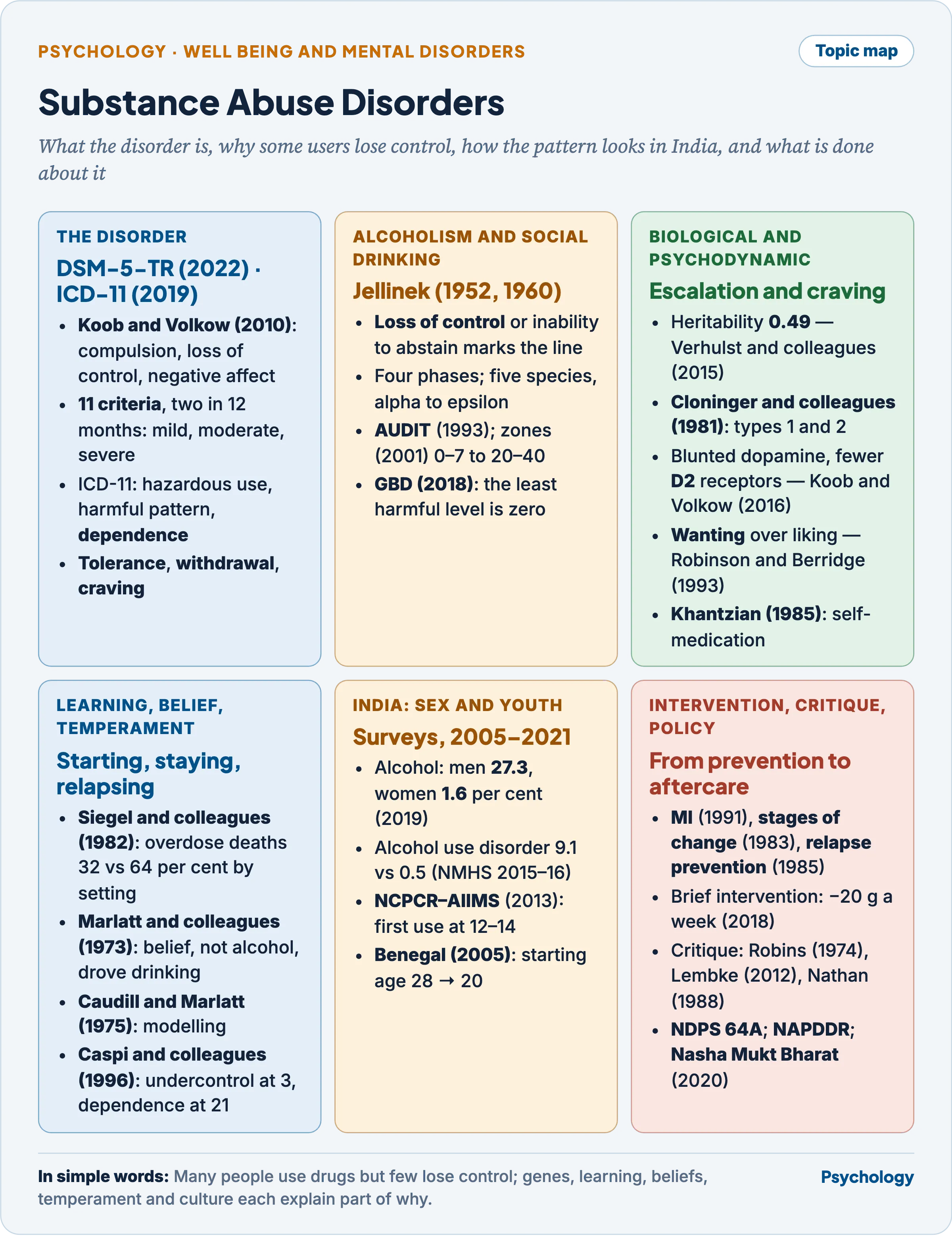
The two causal boxes split the path — escalation and craving in one, starting, staying and relapsing in the other.
Substance abuse disorders as mental disorders: use, abuse and dependence
- A psychoactive substance is any chemical taken to alter mood, perception or behaviour; alcohol, nicotine and caffeine qualify.
- Four points on a continuum:
- Use — ingestion without impaired functioning: tea, an occasional drink.
- Intoxication — the reversible effect of a recent dose on judgement, perception, mood and motor control.
- Abuse — in DSM-IV (1994), a pattern of recurrent harm: neglected obligations, drunk driving, legal trouble, use despite quarrels.
- Dependence — compulsive use with loss of control, usually with physiological adaptation.
- Three clinical terms:
- Tolerance — a markedly higher dose is needed for the same effect.
- Withdrawal — a substance-specific syndrome as levels fall after heavy use, relieved by using again.
- Craving — an intense urge, strongest where the drug was once used; it “has also been shown to involve classical conditioning” (American Psychiatric Association, 2013).
Substance use disorder in DSM-5-TR
- DSM-5 (2013), unchanged here in DSM-5-TR (2022), merged abuse and dependence into one substance use disorder: “The essential feature of a substance use disorder is a cluster of cognitive, behavioral, and physiological symptoms indicating that the individual continues using the substance despite significant substance-related problems.”
- Eleven criteria in four groups; two within 12 months make the diagnosis.
- Impaired control — more or longer than intended; failed efforts to cut down; much time spent; craving.
- Social impairment — failed obligations; use despite interpersonal problems; activities given up.
- Risky use — use in hazardous situations or despite a known physical or psychological problem.
- Pharmacological — tolerance; withdrawal.
- Severity: mild 2–3 criteria, moderate 4–5, severe 6 or more.
- The legal-problems criterion was dropped and craving added; the merger ended the diagnostic orphan, who had two dependence symptoms, no abuse symptom and no DSM-IV diagnosis (SAMHSA, 2016).
- Ten substance classes are recognised; use disorder applies to all but caffeine. Cannabis withdrawal is new; none is specified for hallucinogens or inhalants.
- Gambling disorder joined the renamed chapter, substance-related and addictive disorders, because gambling engages the reward system as drugs do (American Psychiatric Association, 2013).
ICD-11 and the older terms
- ICD-11 (adopted 2019, in force January 2022) grades unhealthy use as hazardous use, single episode of harmful use, harmful pattern of use and dependence, and counts harm to others’ health (WHO, 2019).
- Dependence needs two of three features — impaired control, increasing priority over other interests, physiological features — over 12 months, or 3 months of continuous use. Gaming disorder sits beside gambling disorder.
- DSM-I (1952) had filed alcoholism and drug addiction under sociopathic personality disturbance, a moral reading since abandoned.
Alcoholism and social drinking
- Social drinking is moderate, occasional drinking governed by the occasion’s norms and stopped at will. Alcoholism, the older name for alcohol dependence, is today moderate-to-severe alcohol use disorder.
- Jellinek (1960) called alcoholism “any use of alcoholic beverages that causes any damage to the individual or society or both”, counting as disease only loss of control and inability to abstain.
| Dimension | Social drinking | Alcoholism |
|---|---|---|
| Motive | Taste, company, ritual | Relief of tension, later of withdrawal |
| Control | Stops at will | Cannot stop once started, or cannot abstain |
| Pattern | Occasional, limited by the setting | Daily or binge; morning drinking |
| Setting | Shared, with food | Solitary, often concealed |
| Neuroadaptation | None | Tolerance and withdrawal |
| Consequences | None to roles or health | Work, family, medical and legal harm |
- The boundary is a gradient. The AUDIT (Saunders and colleagues, 1993), developed for the World Health Organization in six countries, has ten items on consumption, dependence and harm, scored 0–40.
- Babor and colleagues (2001) set four zones: 0–7 education; 8–15 simple advice; 16–19 brief counselling and monitoring; 20–40 specialist referral.
- “Social” is not “safe”: the GBD 2016 Alcohol Collaborators (2018) concluded that “the level of consumption that minimises health loss is zero”.
- Benegal (2005) reported that over half of Indian drinkers meet hazardous-drinking criteria, the “signature pattern” being heavy drinking of spirits, often alone.
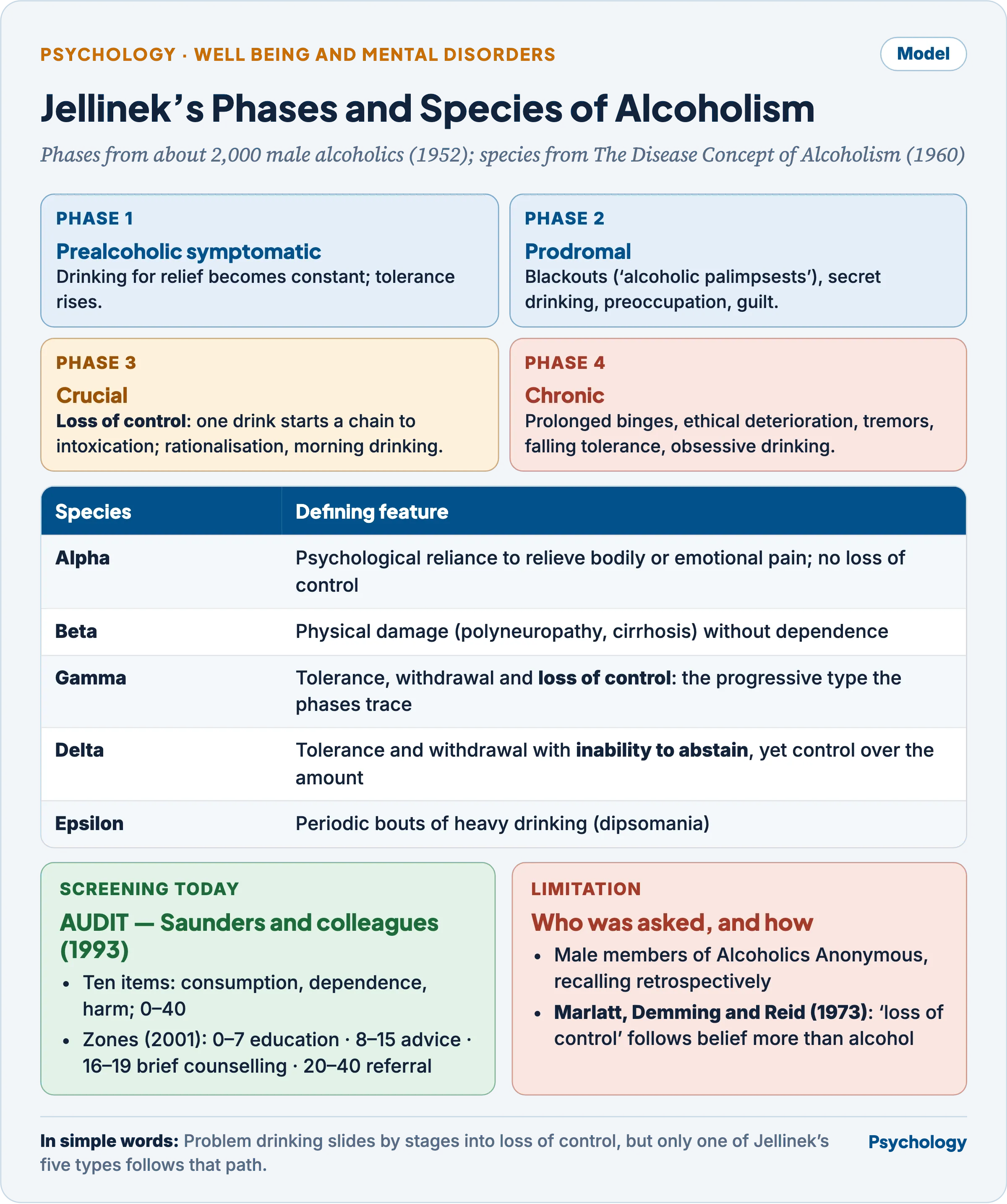
Jellinek’s phases describe only his gamma type; the other four species show why “alcoholism” was never one condition.
Jellinek’s phases and types
- Jellinek (1952) drew the phases from about 2,000 male alcoholics, extending his 1946 analysis of 98 questionnaires from members of Alcoholics Anonymous.
- Prealcoholic symptomatic — drinking for relief becomes constant; tolerance rises.
- Prodromal — blackouts (“alcoholic palimpsests”), secret drinking, preoccupation, guilt.
- Crucial — loss of control: one drink starts a chain ending in intoxication; rationalisation, remorse, morning drinking.
- Chronic — prolonged binges, ethical deterioration, tremors, falling tolerance, obsessive drinking.
- Jellinek (1960) named five species: alpha, psychological reliance without loss of control; beta, physical damage such as cirrhosis without dependence; gamma, tolerance, withdrawal and loss of control; delta, inability to abstain with control over amount; epsilon, periodic bouts.
- Limitation: male, Alcoholics Anonymous, retrospective samples; the balanced-placebo experiment below showed “loss of control” tracks belief more than alcohol (Marlatt and colleagues, 1973).
Causal factors in substance abuse disorders: the psychological approaches
- The general models are in Abnormality, Classification and the Causal Factors of Mental Disorders; applied here, each explains initiation, escalation, maintenance or relapse.
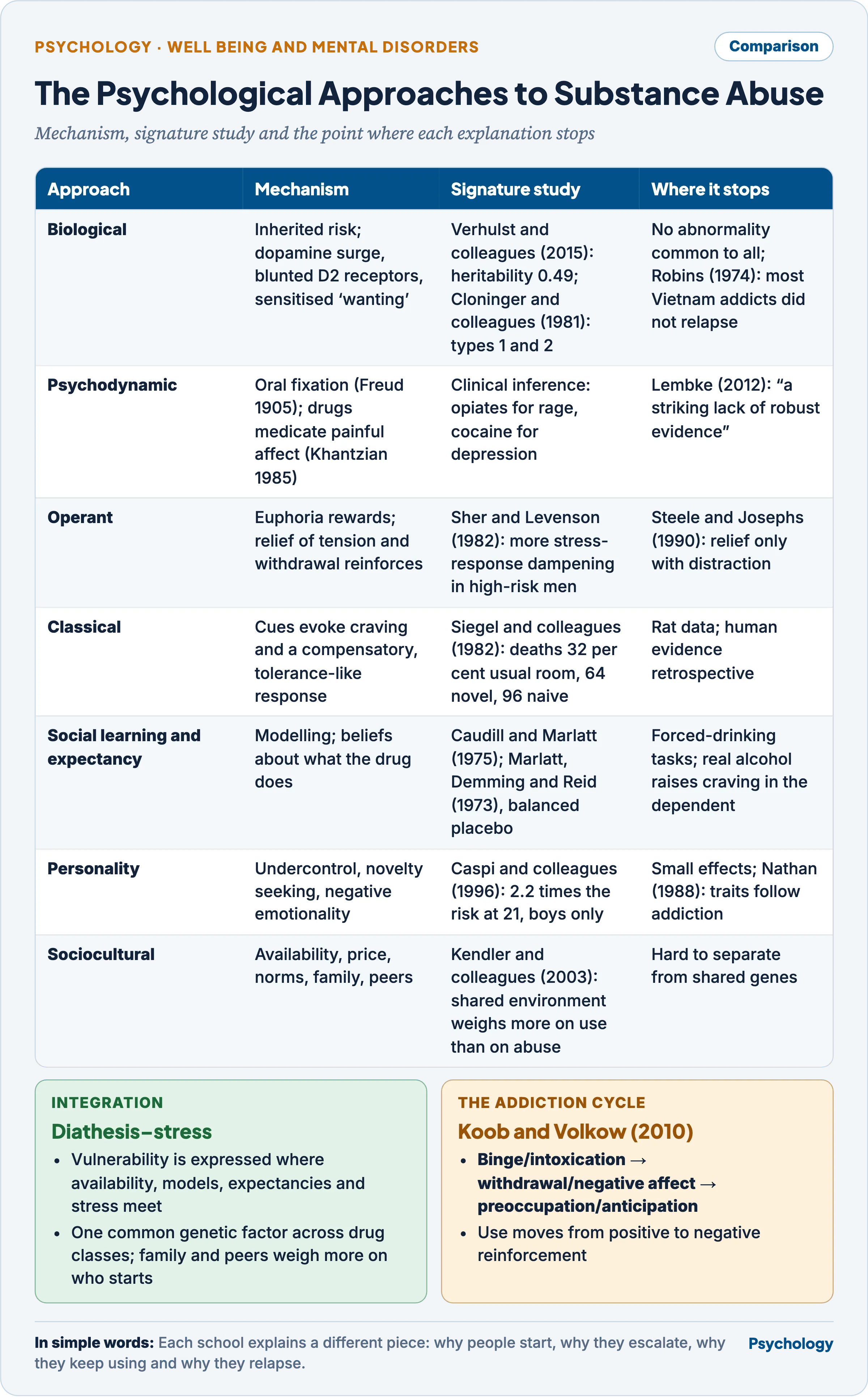
Each row pairs a mechanism with its signature evidence and the point where it stops; none covers the whole path.
Biological approach: genes and the dopamine reward pathway
- Verhulst, Neale and Kendler (2015) — a meta-analysis of 12 twin and five adoption studies put the heritability of alcohol use disorder at 0.49, the same in both sexes.
- Kendler and colleagues (2003) — in 1,196 male twin pairs, one common genetic factor raised the risk of use and of abuse or dependence for all six illicit drug classes; shared environment mattered more for use than for abuse.
- Cloninger, Bohman and Sigvardsson (1981) — 862 Swedish men adopted early by non-relatives, traced with both sets of parents through temperance-board records.
- Type 1 (milieu-limited): both sexes, adult onset, needing genetic and environmental risk together.
- Type 2 (male-limited): father to son, early onset with criminality, highly heritable whatever the adoptive home. Limitation: registers catch only visible abuse.
- Every addictive drug sharply raises dopamine in the mesolimbic pathway, ventral tegmental area to nucleus accumbens, and drug cues come to trigger conditioned surges and craving (Volkow, Koob and McLellan, 2016).
- In addiction, drug-induced dopamine release is blunted and striatal D2 receptors are reduced for months, so ordinary rewards lose their pull (Koob and Volkow, 2016).
- Koob and Volkow (2010) describe a cycle of binge/intoxication, withdrawal/negative affect and preoccupation/anticipation, with use shifting from positive to negative reinforcement.
- Robinson and Berridge (1993) — incentive sensitisation: repeated use sensitises the system that makes drug cues “wanted”, independently of how much the drug is “liked”, so craving outlasts pleasure.
- Limitation: Volkow and colleagues (2016) acknowledge the objections: no brain abnormality applies consistently to addicted people, and many recover untreated.
- Robins (1974) found one in five US soldiers addicted to heroin in Vietnam, yet only about 5 per cent relapsed within ten months of returning (Satel and Lilienfeld, 2014).
Psychodynamic approach
- Freud (1905) held that where oral erotism persists, such men “will have a powerful motive for drinking and smoking”: substance use as oral fixation, a regressive search for passive gratification.
- Khantzian (1985) — the self-medication hypothesis: addicts suffer painful affects, and “The drugs that addicts select are not chosen randomly.” Opiates mute rage; cocaine relieves depression and hyperactivity.
- Limitation: Lembke (2012) found “a striking lack of robust evidence” for self-medication and warned that it leaves the addiction under-treated; both accounts are inferred from people already addicted, confounding cause and consequence.
Behavioural approach: reinforcement and conditioning
- Operant account: drugs are strong positive reinforcers (euphoria) and negative reinforcers (relief of anxiety, later of withdrawal); reinforcement is immediate, punishment delayed.
- The tension-reduction hypothesis (Conger, 1956) holds that alcohol is drunk because it relieves tension. Sher and Levenson (1982) found high-risk men showed more stress-response dampening after alcohol — vulnerability may lie in greater relief.
- Steele and Josephs (1990) — alcohol myopia: alcohol narrows attention to immediate cues, so it relieves stress only with distraction and can sharpen it when the stressor is salient.
- Classical conditioning turns places, people and paraphernalia into cues for craving, the mechanism set out in Classical Conditioning (Paper I).
- Siegel, Hinson, Krank and McCully (1982) gave rats 15 heroin infusions in one distinctive setting, then a large dose: 96 per cent of drug-naive controls died, 64 per cent of rats dosed in an unfamiliar setting, 32 per cent in the usual one.
- Tolerance is partly a conditioned compensatory response to cues, so a usual dose in an unusual place can kill.
- Limitation: animal data; human support is retrospective — 7 of 10 overdose survivors had used somewhere unfamiliar (Siegel, 1984).
Social learning, expectancy and cognitive approaches
- Social learning (Bandura, 1977): use is learned from rewarded models — parents, peers, film.
- Caudill and Marlatt (1975) — 48 male heavy social drinkers drank significantly more wine in a taste test beside a heavy-drinking confederate than beside a light drinker or alone.
- Limitation: drinking was obligatory; Larsen and colleagues (2009) replicated the effect in a bar laboratory with soft drinks on offer.
- Marlatt, Demming and Reid (1973) — alcoholics and social drinkers rated drinks in a balanced placebo design crossing what they were told (vodka and tonic, or tonic) with what they got.
- Both groups drank more whenever they expected alcohol, whatever the glass held: “loss of control” was an expectancy effect.
- Limitation: actual alcohol did raise craving in severely dependent drinkers (Stockwell and colleagues, 1982).
- Cognitive factors: positive outcome expectancies, low self-efficacy for refusing, attentional bias to drug cues and relapse thinking — the targets of Cognitive Therapies: Beck and Cognitive-Behavioural Therapy (Unit 3).
Personality factors
- Caspi and colleagues (1996) — in the Dunedin cohort of 1,037, impulsive “undercontrolled” 3-year-olds were 2.2 times as likely to be alcohol dependent at 21; the effect held for boys only and was small.
- Cloninger and colleagues (1988) linked type 1 to anxious, harm-avoidant drinking for relief and type 2 to antisocial novelty seeking and drinking for euphoria.
- Limitation: no single addictive personality exists; Nathan (1988) argued that “the addictive personality is the behavior of the addict”.
Sociocultural and family factors
- Availability, price and norms set a population’s level of use: more outlets mean more drinking, and higher prices cut heavy drinking, especially among the young (Chartier and colleagues, 2017).
- Parental use, family conflict, abuse and peer use are common among substance-using Indian children (Dhawan and colleagues, 2017).
- The integration is diathesis–stress: vulnerability is expressed where availability, models, expectancies and stress converge — shared family and peer environment weighs more on starting than on progressing (Kendler and colleagues, 2003).
Gender differences in prevalence of substance abuse in India
- Ambekar and colleagues (2019), Magnitude of Substance Use in India (Ministry of Social Justice and Empowerment with NDDTC, AIIMS; 473,569 people aged 10–75 in all 36 states and union territories):
- Current use, men against women (2019): alcohol 27.3 against 1.6 per cent, seventeen men per woman; cannabis 5.0 against 0.6; opioids 4.0 against 0.2; inhalants 1.34 against 0.07.
- Among drinkers, one man in five but one woman in sixteen was dependent.
- The National Mental Health Survey 2015–16 (NIMHANS, 2016) found substance use disorders, tobacco included, in 35.7 per cent of men and 10.1 per cent of women; alcohol use disorder 9.1 against 0.5.
- NFHS-5 (2019–21): alcohol 18.8 per cent of men and 1.3 of women, tobacco 38.0 against 8.9 — but 6 per cent of Scheduled Tribe women and 24 per cent of women in Arunachal Pradesh drink.
- The gap is cultural before it is biological: use is coded as masculine and a woman’s use as moral failure; women have less money, mobility and unsupervised leisure; and household interviews under-report stigmatised use, as the 2019 report concedes for Bihar.
- It is narrowing. Slade and colleagues (2016), pooling 68 studies, found the male-to-female ratio for alcohol use fell from 2.2 in the 1891–1910 birth cohort to 1.1 in the 1991–2000 cohort.
- Randall and colleagues (1999) found women in treatment progressed faster from regular drunkenness to problems — telescoping; Keyes and colleagues (2010) found little of it in the general population.
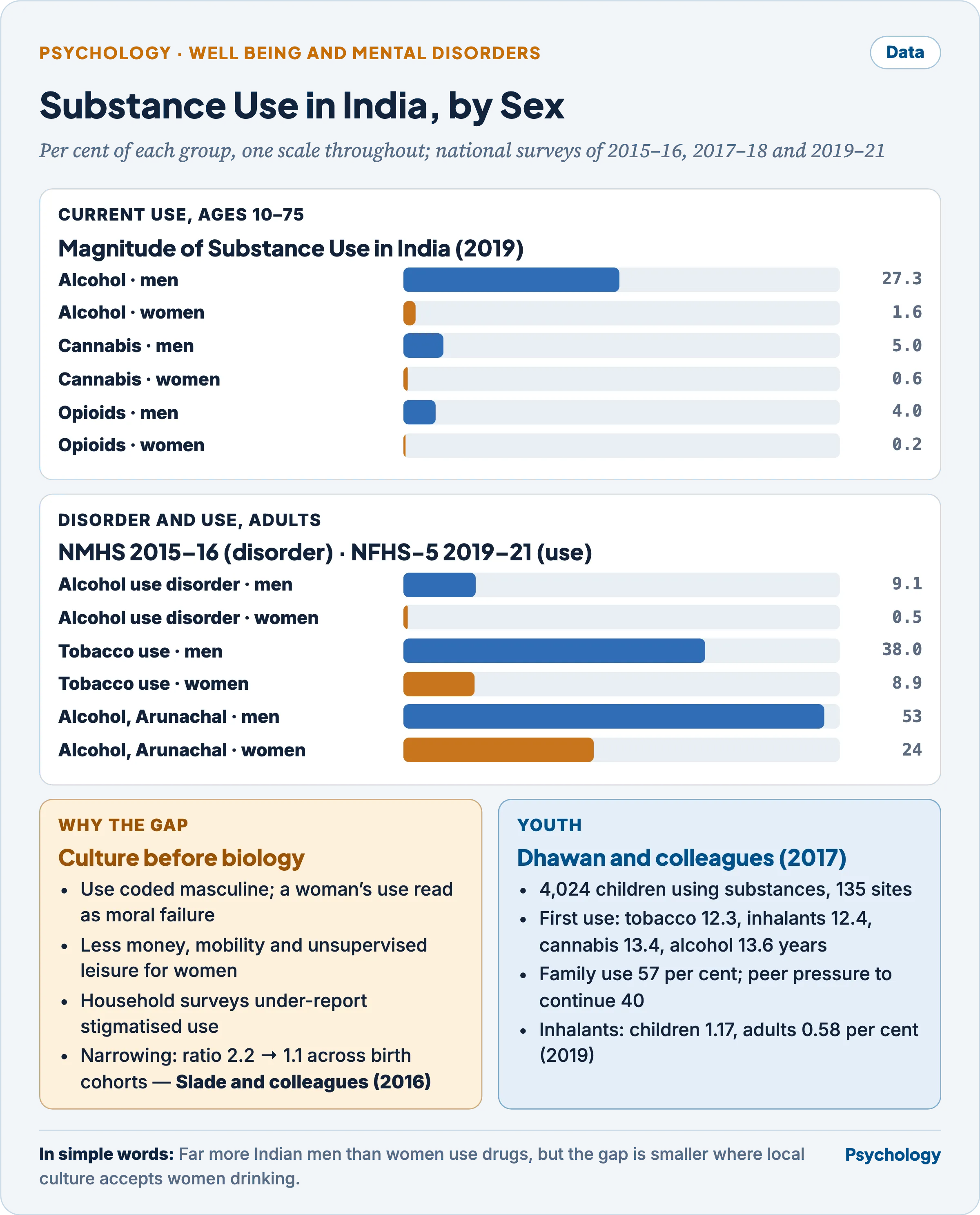
The sex gap is widest for opioids and narrowest in Arunachal Pradesh, where about one woman drinks for every two men — it follows culture more than sex.
Psychological causes of substance abuse among Indian youth
- Benegal (2005) — in Karnataka the mean age of starting to drink fell from 28 years in the 1920–30 birth cohort to 20 in the 1980–90 cohort.
- Ambekar and colleagues (2019) — inhalants are the one class used more by children aged 10–17 (1.17 per cent) than by adults (0.58).
- Dhawan and colleagues (2017), reporting the National Commission for Protection of Child Rights study with AIIMS (2013): 4,024 substance-using children at 135 sites.
- First use (2013): tobacco at 12.3 years, inhalants 12.4, cannabis 13.4, alcohol 13.6 — a licit-to-illicit, gateway progression.
- Risk (2013): family substance use 57 per cent, family conflict 47, abuse 46; peer pressure the reason for continuing in 40; a difficult or stressful event in 58; about 70 never treated. Limitation: a purposive sample gives no prevalence.
- The Punjab Opioid Dependence Survey (Ambekar and colleagues, 2015) estimated 2.3 lakh dependent users, 76 per cent aged 18–35, with peer influence the commonest reason for starting (75 per cent).
- Read through the approaches: curiosity and sensation seeking (undercontrol), peer modelling (social learning), stress and family conflict (negative reinforcement, self-medication), media-fed expectancies, and easy availability during adolescence.
Intervention measures and rehabilitation
- Prevention is tiered: universal (life-skills modules for classes 6 to 11), selective (peer-led early prevention among vulnerable adolescents) and indicated (screening and early treatment) — the frame of Prevention and Rehabilitation of the Mentally Ill (Unit 3).
- Screening and brief intervention: AUDIT plus up to five short sessions. Kaner and colleagues (2018), reviewing 69 trials with 33,642 participants, found drinking fell by about 20 g a week at one year.
- Motivational interviewing (Miller and Rollnick, 1991) — a collaborative, non-confrontational style that resolves ambivalence by eliciting the person’s own reasons for change.
- Stages of change (Prochaska and DiClemente, 1983) — from 872 self-changing smokers: precontemplation, contemplation, action, maintenance, relapse; preparation was added later (Prochaska, DiClemente and Norcross, 1992). West (2005) objected that the stage boundaries are arbitrary.
- Relapse prevention (Marlatt and Gordon, 1985) maps high-risk situations — negative emotion, conflict, social pressure — and rehearses coping to build self-efficacy, defusing the abstinence violation effect, the slip read as total failure.
- Supports: contingency management; aversive disulfiram, antagonist naltrexone, agonist methadone and partial-agonist buprenorphine.
- Rehabilitation — detoxification, treatment, residential or community rehabilitation, mutual-help groups, vocational retraining and aftercare — is long-term, because relapse rates resemble those of hypertension and asthma (McLellan and colleagues, 2000); the process is in Rehabilitation of Persons Suffering from Substance Abuse (Unit 7).
Criticisms and limitations
- Disease or learning? The disease models (Jellinek, 1960; Volkow and colleagues, 2016) are challenged by expectancy effects (Marlatt and colleagues, 1973) and untreated recovery (Robins, 1974).
- Thresholds: two of eleven criteria folds mild cases into “disorder”, and DSM-IV and DSM-5 identify different people (SAMHSA, 2016).
- Partial theories: self-medication lacks robust evidence (Lembke, 2012), personality effects are small (Caspi and colleagues, 1996), conditioned tolerance rests on rats, and Jellinek’s phases on male members of Alcoholics Anonymous.
- Laboratory analogues such as taste tests force drinking and so lack ecological validity (Larsen and colleagues, 2009).
- Indian data: the 2004 national survey sampled men only, household surveys under-report, and only one alcohol-dependent person in 38 had ever been treated (Ambekar and colleagues, 2019).
Indian context
- Article 47 of the Constitution directs the State to endeavour to prohibit intoxicating drinks and harmful drugs except for medicinal use.
- NDPS Act, 1985 (Ministry of Finance) — Section 27 punishes consumption; Section 39 lets a court release an addict for treatment; Section 64A gives immunity to an addict who volunteers for de-addiction; Section 71 provides treatment centres. Principle: removing punishment as a barrier to help-seeking.
- Limitation: 39 and 64A are seldom used, as claiming them implies admitting guilt (Ambekar and colleagues, 2022).
- Mental Healthcare Act, 2017 (Ministry of Health and Family Welfare) — section 2(1)(s) counts “mental conditions associated with the abuse of alcohol and drugs” as mental illness, so dependence carries treatment rights: illness, not vice.
- National Action Plan for Drug Demand Reduction (Ministry of Social Justice and Empowerment, 2018–25, continued with ₹333 crore for 2026–27) — prevention, treatment, rehabilitation and stigma reduction (PIB, 2026).
- Network on 10 November 2026: 344 Integrated Rehabilitation Centres for Addicts, 198 District De-Addiction Centres, 155 Addiction Treatment Facilities, 71 Outreach and Drop-In Centres, 45 peer-led intervention centres — a continuum of care.
- Nasha Mukt Bharat Abhiyaan (Ministry of Social Justice and Empowerment, 15 August 2020) — 272 districts, 372 in 2022, all districts from August 2023; 35.84 crore people reached by 10 November 2026, including 14.33 crore youth and 11.32 crore women (PIB, 2026).
- Campus pledges, volunteer Nasha Mukti Mitr and faith partners apply social-norms change and community ownership to the peer and expectancy causes.
- Helplines: the national de-addiction line (since March 2017, now 14446), the Narcotics Control Bureau’s MANAS 1933, and Tele-MANAS (October 2022); a second national survey with district estimates is due in 2027 (PIB, 2026).
Previous Year Questions
- 2019How can substance abuse be explained through different psychological approaches? How can rehabilitation process help the people indulging in substance abuse?
- 2015Substance abuse is a growing phenomenon among Indian youths. Discuss the psychological causes of and intervention measures for substance abuse.
- 2009Compare gender differences in prevalence of substance abuse in India.
- 2008Distinguish ‘alcoholism’ from ‘social drinking’ and discuss the factors contributing to alcoholism.
- 2007What are substance abuse disorders? Explain etiological factors underlying them. Indicate the strategies for rehabilitation of persons suffering from substance abuse disorders.