

Official syllabusPaper II · Unit 2 · Psychological Well Being and Mental Disorders
Causal factors in mental disorders (mood disorders).
Definition
“Depression may now be defined in terms of the following attributes: (1) A specific alteration in mood: sadness, loneliness, apathy. (2) A negative self-concept associated with self-reproaches and self-blame. (3) Regressive and self-punitive wishes: desires to escape, hide, or die. (4) Vegetative changes: anorexia, insomnia, loss of libido. (5) Change in activity level: retardation or agitation.”
Beck (1967)
In a mood disorder a sustained disturbance of mood, lowered in depression and elevated or irritable in mania, is the primary feature, and thought, activity and bodily rhythm change with it. Kraepelin’s single manic-depressive illness was later split into unipolar and bipolar forms, which need separate causal accounts.
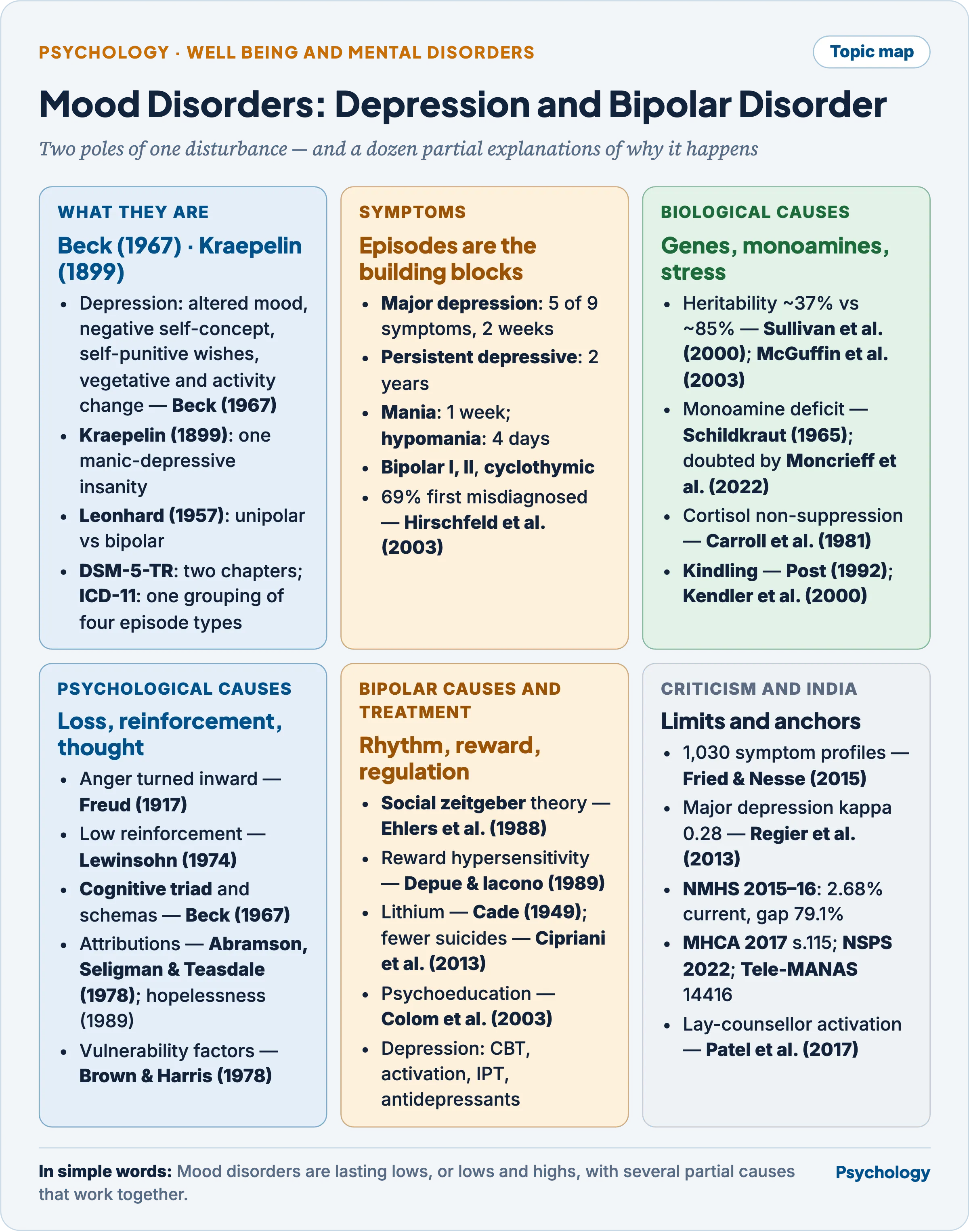
Biological causes close the top row and psychological ones open the bottom; each explains only part of either pole.
Mood disorders among the mental disorders: concept and classification
- Mood is a sustained emotional state lasting days or weeks; affect is its moment-to-moment expression. A mood disorder is a disturbance severe and persistent enough to impair functioning.
- Kraepelin (1899) united mania and melancholia as manic-depressive insanity, one periodic illness with a better outcome than dementia praecox.
- Leonhard (1957) separated unipolar (depression only) from bipolar (mania, with or without depression) forms; Angst (1966) and Perris (1966) confirmed differences in family history, onset and course.
- DSM-5-TR (2022) gives them separate chapters, Depressive Disorders and Bipolar and Related Disorders. ICD-11 (in force from 1 January 2022) keeps one grouping, Mood disorders, built from four episode types (depressive, manic, mixed, hypomanic) that are building blocks, not diagnoses.
- Older terms map onto current ones: endogenous depression is the melancholic specifier, neurotic depression is major depression or dysthymia, manic-depressive illness is chiefly bipolar I.
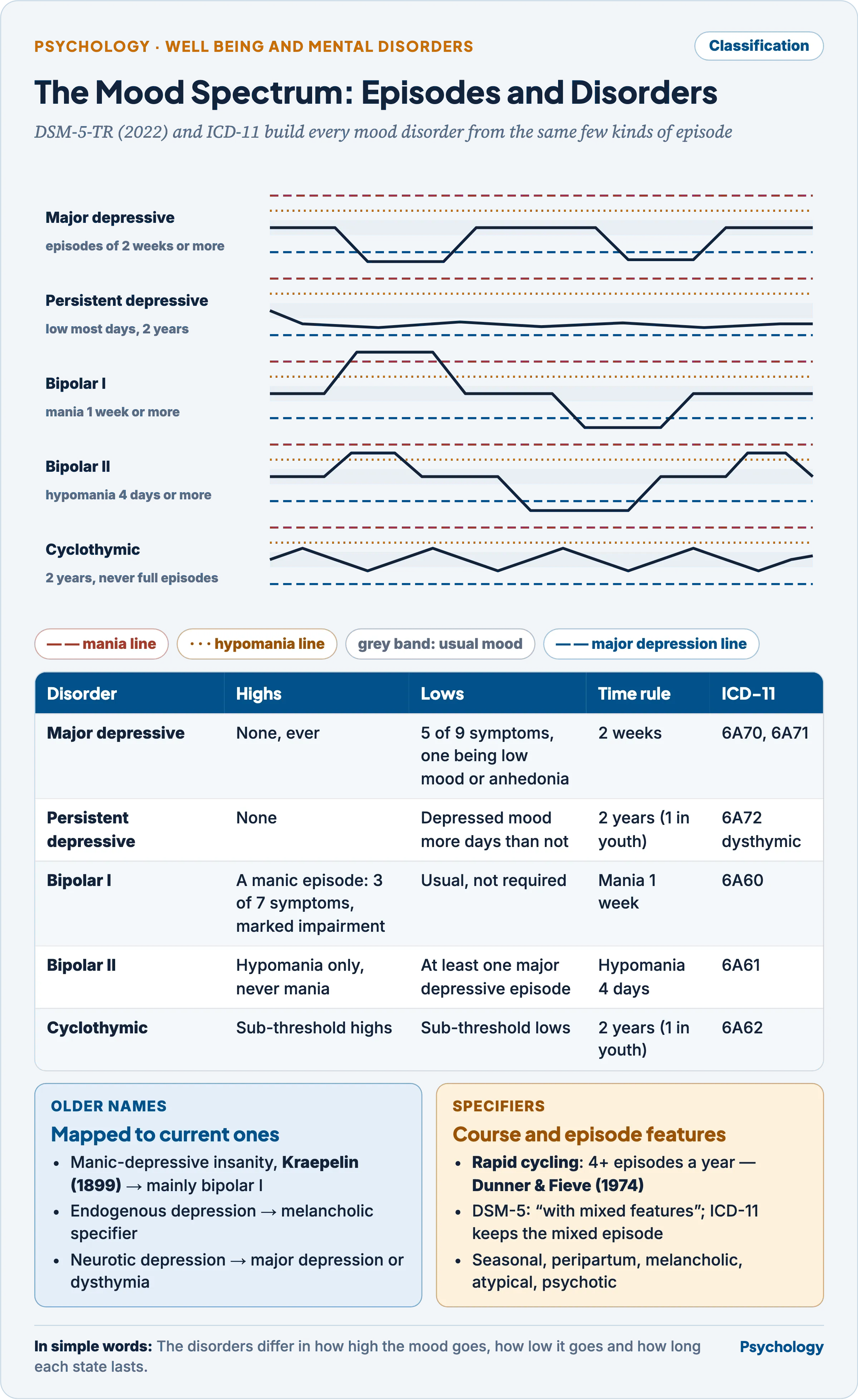
What separates the five disorders is how high, how low and for how long, not the kind of symptom.
| Dimension | Major depressive disorder | Bipolar I disorder |
|---|---|---|
| Heritability | About 37% (Sullivan et al., 2000) | About 85% (McGuffin et al., 2003) |
| Sex ratio | About 2 women : 1 man (Salk et al., 2017) | Near equal (Weissman et al., 1996) |
| Indian lifetime prevalence | 5.25% (NMHS 2015–16) | 0.5% (NMHS 2015–16) |
Symptoms of depressive disorders
- Major depressive disorder (DSM-5-TR) needs five of nine symptoms over two weeks, one being depressed mood or anhedonia (loss of pleasure): appetite or weight change, insomnia or hypersomnia, agitation or retardation, fatigue, worthlessness or guilt, poor concentration, thoughts of death or suicide.
- Persistent depressive disorder (ICD-11 dysthymic disorder): depressed mood on most days for two years. A major episode superimposed on it is double depression.
- Specifiers mark distinct forms: melancholic (pervasive anhedonia, early waking), atypical (mood reactivity, oversleeping, rejection sensitivity), psychotic (delusions of guilt or disease), peripartum onset, seasonal pattern and anxious distress.
- DSM-5 (2013) removed the bereavement exclusion; DSM-5-TR added prolonged grief disorder.
- Late-life depression shows more somatic complaint, less voiced guilt; Alexopoulos et al. (1997) proposed vascular depression, late onset driven by cerebrovascular disease (see Ageing – Physical, Cognitive and Psychosocial Change, Paper I).
Symptoms of bipolar and related disorders
- A manic episode lasts at least a week (any length if hospitalised): elevated, expansive or irritable mood with raised energy, and marked impairment, admission or psychosis.
- Plus three (four if only irritable) of grandiosity, little need for sleep, pressured speech, flight of ideas, distractibility, overactivity and risky pleasure-seeking.
- A hypomanic episode has the same symptoms for four days without marked impairment or psychosis, and often goes unreported because it feels productive.
- Bipolar I needs one manic episode; bipolar II a hypomanic and a major depressive episode, never mania, with depression dominating; cyclothymic disorder two years of sub-threshold highs and lows.
- Rapid cycling, four or more episodes a year, was identified by Dunner and Fieve (1974). DSM-5 replaced the mixed episode with a “with mixed features” specifier; ICD-11 keeps the mixed episode.
- Misdiagnosis is common: 69% of 600 US patients surveyed had been misdiagnosed, mostly as unipolar, and over a third waited ten years or more (Hirschfeld et al., 2003).
Causal factors in depression
- General models are in Abnormality, Classification and the Causal Factors of Mental Disorders.
Biological factors
- Genes: twin concordance is 46% in MZ and 20% in DZ pairs (McGuffin et al., 1996), heritability about 37% (Sullivan et al., 2000). The liability is polygenic; Howard et al. (2019) found 102 variants, each tiny.
- Caspi et al. (2003) reported a serotonin-transporter gene × stress interaction; Border et al. (2019), in very large samples, found no support for it or other candidate genes.
- Monoamine hypothesis: Schildkraut (1965) proposed catecholamine deficiency and Coppen (1967) serotonin deficiency, reasoning from reserpine, which depletes monoamines and can depress mood, and from MAO inhibitors and tricyclics.
- Limits: drugs raise monoamines in hours but lift mood only after weeks, and an umbrella review found no consistent evidence of low serotonin (Moncrieff et al., 2022).
- HPA axis: melancholia often shows raised cortisol, and Carroll et al. (1981) found melancholic patients failing to suppress it on the dexamethasone suppression test.
- Kindling: Post (1992) proposed that early episodes need major stressors but sensitise the brain, so later ones need less. Kendler et al. (2000), following 2,395 female twins for nine years, found the effect of life events fell with each prior episode.
- Brain and body: left frontal hypoactivation (Henriques and Davidson, 1991), and raised inflammatory IL-6 and TNF-α (Dowlati et al., 2010).
Psychodynamic factors
- Freud (1917), in Mourning and Melancholia, contrasted grief, a conscious reaction to real loss, with melancholia, where the loss is partly unconscious and anger at the ambivalently loved, introjected object turns against the self.
- “In mourning it is the world which has become poor and empty; in melancholia it is the ego itself.” — Freud (1917)
- Abraham (1911) traced melancholia to repressed hatred, and later (1924) to oral fixation; Bowlby (1980) recast loss as broken attachment.
- Evaluation: it explains self-reproach and the tie to loss but resists testing, and Weissman et al. (1971) found depressed women more overtly hostile to family, not less.
Behavioural factors
- Ferster (1973) likened depression to extinction. Lewinsohn (1974) specified a low rate of response-contingent positive reinforcement — few reinforcers, poor social skill in obtaining them, or reduced enjoyment — and withdrawal removes still more; Lewinsohn and Libet (1972) found daily mood tracked pleasant activities.
- Coyne (1976) added an interpersonal cycle: reassurance-seeking makes others more rejecting, confirming the depressed person’s fears.
- Evaluation: correlations cannot show whether low reinforcement precedes depression or follows it, though the account yielded behavioural activation (Jacobson et al., 1996).
Beck’s cognitive model
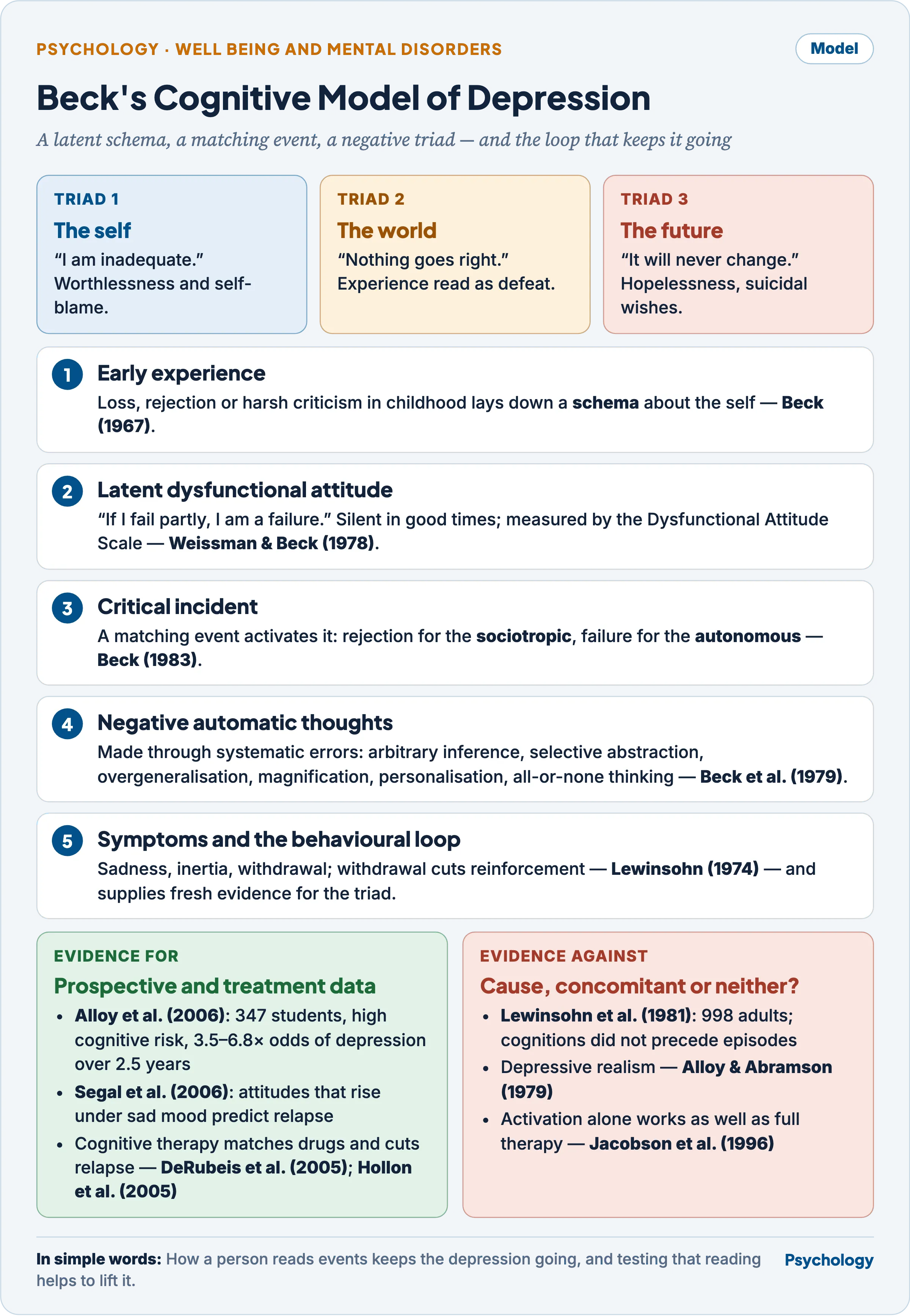
The schema stays silent until an event matches it, which is why the same loss depresses one person and not another.
- Beck (1967) placed the primary disturbance in thinking, at three levels.
- Cognitive triad: a negative view of the self (“I am inadequate”), the world (“nothing goes right”) and the future (“it will never change”).
- Schemas: enduring dysfunctional attitudes laid down by early loss or rejection (“if I fail partly, I am a failure”), measured by the Dysfunctional Attitude Scale (Weissman and Beck, 1978).
- Automatic thoughts: rapid, plausible negative appraisals in the moment.
- Systematic errors link them (Beck et al., 1979): arbitrary inference, selective abstraction, overgeneralisation, magnification and minimisation, personalisation, dichotomous thinking.
- It is a diathesis–stress model: a matching event activates the latent schema. Beck (1983) named two vulnerable modes, sociotropy (sensitive to rejection) and autonomy (sensitive to failure).
- The cognitive-behavioural model closes the loop: withdrawal cuts reinforcement, which supplies fresh evidence for the triad.
- Evidence.
- Alloy et al. (2006) followed 347 non-depressed first-year students of high or low cognitive risk for 2.5 years: the high-risk group had 3.5 to 6.8 times the odds of depressive episodes, first onsets included. Limitation: students, self-report risk measures.
- Segal et al. (2006) induced sad mood in recovered patients; those whose dysfunctional attitudes rose most relapsed more over 18 months, so the schema is latent in remission.
- Evaluation.
- Lewinsohn et al. (1981) followed 998 adults for a year: those who later became depressed had not differed beforehand, so the cognitions looked like concomitants, not causes.
- Coyne and Gotlib (1983) found most evidence cross-sectional; Alloy and Abramson (1979) found mildly depressed students judged their control more accurately (depressive realism).
- Jacobson et al. (1996) found behavioural activation alone as effective as full cognitive therapy, so changing thoughts may not be the mechanism (Longmore and Worrell, 2007).
- It neglects biology and explains relapse better than first onset.
Learned helplessness, attributions and hopelessness
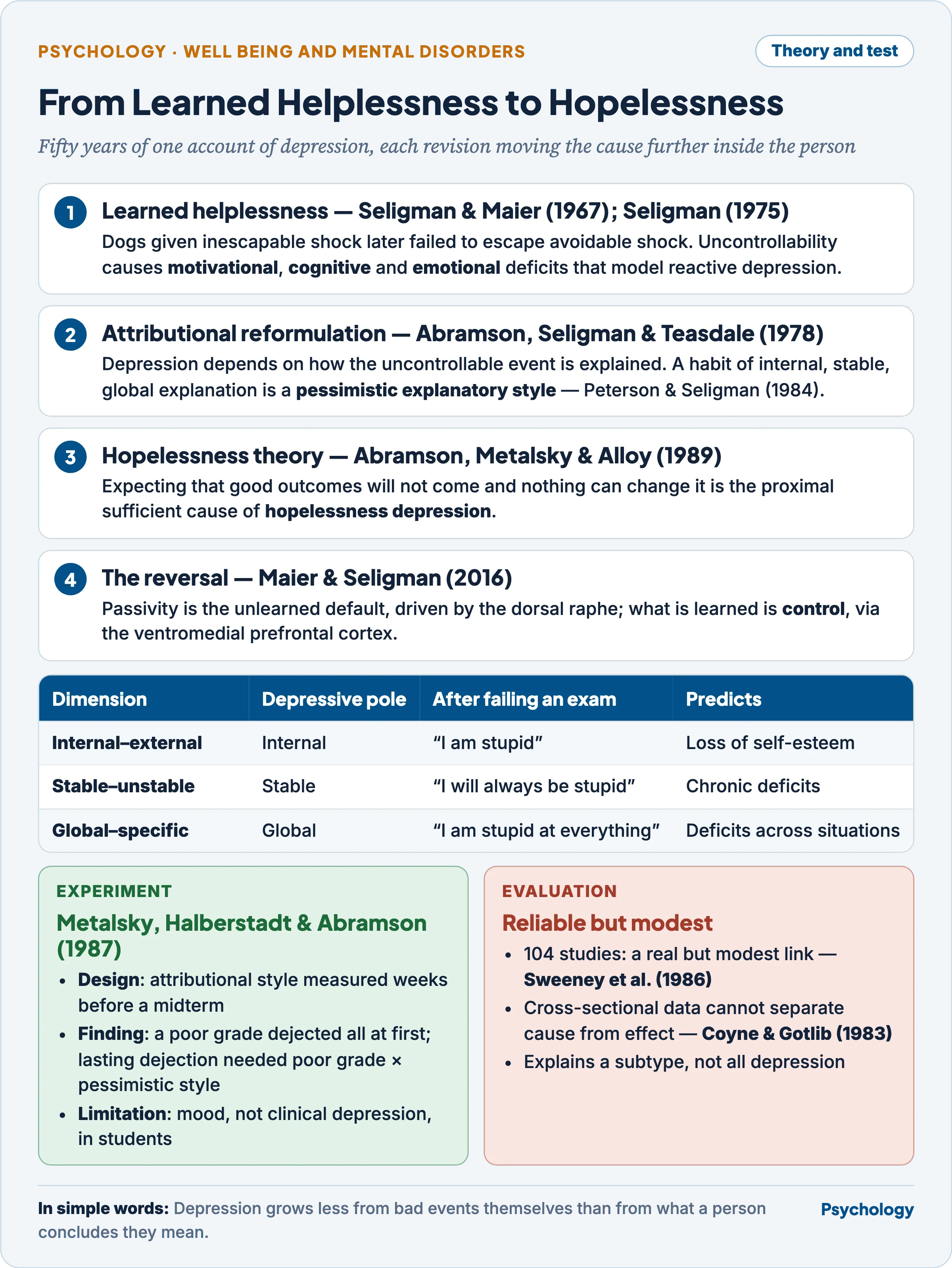
Each revision moved the cause further inside the person: from the shocks, to the explanation of them, to the expectation they leave.
- Learned helplessness is passivity following uncontrollable aversive events. In the triadic design of Seligman and Maier (1967) dogs given inescapable shock later failed to escape avoidable shock, unlike dogs given equal escapable shock (see Escape, Avoidance and Learned Helplessness, Paper I).
- Seligman (1975) offered it as a model of reactive depression: motivational (passivity), cognitive (failure to see that responses now work) and emotional deficits parallel depressive symptoms.
- It could not explain individual differences, or self-blame alongside uncontrollability, so Abramson, Seligman and Teasdale (1978) made the explanation of the event decisive.
- Internal–external: an internal cause (“I am stupid”) brings loss of self-esteem.
- Stable–unstable: a stable cause makes deficits chronic.
- Global–specific: a global cause makes them generalise across situations.
- A habit of explaining bad events internally, stably and globally is a pessimistic explanatory style, measured by the Attributional Style Questionnaire (Peterson et al., 1982).
- Metalsky et al. (1987) tested the diathesis–stress prediction on a midterm examination.
- Style was measured weeks before grades arrived; a poor grade dejected everyone at first, but lasting dejection was predicted only by poor grade × pessimistic style, mediated by the attribution for that grade.
- Limitation: depressed mood, not clinical depression, in students.
- Abramson, Metalsky and Alloy (1989) made hopelessness — expecting desired outcomes not to occur and nothing to change it — the proximal sufficient cause of hopelessness depression, with negative inferences about cause, consequence and self as the distal diathesis.
- Maier and Seligman (2016) reversed the original reading: passivity is the default, unlearned response to prolonged aversive events, driven by the dorsal raphe, and what is learned is control, detected by the ventromedial prefrontal cortex. Depression becomes a failure to expect control.
- Evaluation: across 104 studies attributional style related to depression reliably but modestly (Sweeney et al., 1986), and the theory fits a subtype, not all depression.
Life stress and sociocultural factors
- Brown and Harris (1978), interviewing Camberwell women, separated provoking agents (severe events and difficulties, mostly losses) from vulnerability factors that raised risk only alongside them.
- The four: mother lost before 11; three or more children aged 14 or under at home; no outside employment; no confiding partner.
- Low self-esteem turned one loss into generalised hopelessness. Limitation: Campbell et al. (1983), testing three factors in 110 Oxford women, replicated only the confiding relationship.
- Hammen (1991) found depressed women generate more interpersonal stress than controls, stress generation.
- Women’s odds of major depression are about twice men’s across 90 nations, already at 12 (Salk et al., 2017); Nolen-Hoeksema (1991) traced part of the gap to a ruminative response style.
Causal factors in bipolar (manic-depressive) disorder
- Genes weigh more than in depression. McGuffin et al. (2003), from the Maudsley twin register, found bipolar concordance of 40% in MZ and 5.4% in DZ co-twins, heritability about 85%; Mullins et al. (2021) found 64 risk loci, 17 also implicated in schizophrenia.
- Neurochemistry: Schildkraut (1965) read mania as catecholamine excess; Cade (1949) found lithium calmed manic excitement, and its action on both poles suggests faulty regulation rather than surplus.
- Circadian rhythm: Wehr et al. (1987) proposed sleep loss as a final common pathway into mania; in social zeitgeber theory (Ehlers et al., 1988) disrupted routines destabilise biological rhythms, and such events preceded manic but not depressive episodes (Malkoff-Schwartz et al., 1998).
- Reward: Depue and Iacono (1989) proposed an over-reactive behavioural approach system; goal-attainment events raised manic but not depressive symptoms (Johnson et al., 2000), and high reward sensitivity predicted earlier manic episodes (Alloy et al., 2008).
- Life events and family: severe negative events made recovery take more than three times as long (Johnson and Miller, 1997), and high expressed emotion (critical, hostile relatives) predicted relapse (Miklowitz et al., 1988).
- Freud (1917) read mania as escape from melancholia, and Klein (1935) as a manic defence of denial and omnipotence: clinically suggestive, empirically thin.
Therapeutic treatment and its suitability
- Full accounts are in Cognitive Therapies: Beck and Cognitive-Behavioural Therapy, Behaviour Therapies, Psychodynamic Therapies and Prevention and Rehabilitation of the Mentally Ill (Unit 3).
Depressive disorders
- Antidepressants: a network meta-analysis of 522 trials found all 21 drugs better than placebo (Cipriani et al., 2018), the gap widening with severity and small in mild depression (Kirsch et al., 2008).
- Cognitive therapy tests automatic thoughts and schemas; it matched medication in moderate-to-severe depression (DeRubeis et al., 2005), and relapse after it was under half that after stopping drugs (Hollon et al., 2005).
- Behavioural activation restores reinforcement through scheduled mastery and pleasure; among 241 adults it matched medication and beat cognitive therapy in severe cases (Dimidjian et al., 2006).
- Interpersonal therapy (Klerman et al., 1984) targets grief, role disputes, role transitions or interpersonal deficits; in the NIMH trial imipramine and, more weakly, interpersonal therapy, but not CBT, beat placebo in severe depression (Elkin et al., 1989).
- Electroconvulsive therapy outperformed drugs in the short term (UK ECT Review Group, 2003); mindfulness-based relapse prevention is in Meditation and Its Effects (Paper I).
- Suitability: less severe depression, guided self-help, group CBT or behavioural activation first, with no routine first-line antidepressant (NICE, 2022); moderate to severe, medication or psychotherapy, often combined; psychotic or acutely suicidal, ECT.
Bipolar disorder
- Mood stabilisers are the base: lithium is the reference prophylactic and reduced suicide against placebo across 48 trials (Cipriani et al., 2013); valproate, lamotrigine and atypical antipsychotics are alternatives.
- Antidepressants alone risk switching into mania; added to a mood stabiliser they did no better than placebo, without extra switching (Sachs et al., 2007).
- Suitability: drugs for acute mania, and a structured psychological intervention designed for bipolar disorder for depression and relapse prevention (NICE, 2014), though that trial evidence is contested (Jauhar et al., 2016).
- Psychosocial treatment prevents relapse.
- Group psychoeducation on warning signs, adherence and routine: 21 sessions cut two-year recurrence to 67% against 92% in 120 remitted patients (Colom et al., 2003).
- Family-focused therapy, interpersonal and social rhythm therapy (Frank et al., 2005) and CBT: up to 30 sessions raised one-year recovery to 64.4% against 51.5% for three sessions in 293 patients (Miklowitz et al., 2007).
Criticisms and limitations
- Heterogeneity: Fried and Nesse (2015) counted 1,030 symptom profiles among 3,703 patients with the same diagnosis; the commonest covered 1.8%.
- Reliability: in the DSM-5 field trials major depression reached a pooled kappa of 0.28 against 0.56 for bipolar I, and mixed anxiety-depressive disorder about zero, so DSM-5 left it out while ICD-11 kept it (Regier et al., 2013).
- Medicalising sadness: Horwitz and Wakefield (2007) argued that context-free symptom counts turn normal sorrow after loss into disorder.
- Bipolar boundaries: late recognition delays treatment for years (Hirschfeld et al., 2003), and a widened bipolar spectrum risks overdiagnosis.
- Partial theories: monoamine theory explains drug action poorly (Moncrieff et al., 2022); cognitive theories lean on students, self-report and correlations (Lewinsohn et al., 1981); kindling and stress generation show cause and consequence feeding each other.
- Integration: inherited and cognitive vulnerability, activated by loss and maintained by inactivity, rumination and disrupted rhythm, fits better than any single model.
- Culture: sadness-centred criteria under-detect distress voiced bodily (Raguram et al., 1996).
Indian context
- National Mental Health Survey 2015–16 (NIMHANS for the Ministry of Health and Family Welfare; 34,802 adults, 12 states): current depressive disorder 2.68%, lifetime 5.25%, treatment gap 79.1% (Arvind et al., 2019).
- Prevalence peaked at 40–59 years, in women, among the widowed or separated, and in cities above a million (5.2% against 2.15% rural; Arvind et al., 2019).
- Bipolar affective disorder: current 0.3%, lifetime 0.5%, treatment gap 70.4%, with higher lifetime risk in men and in metros (Vajawat et al., 2023).
- NMHS-2 (2024–26) covers all 36 states and union territories and adolescents nationwide (Rao et al., 2026).
- Accidental Deaths and Suicides in India 2024 (NCRB, released May 2026): 1,70,746 suicides, 12.2 per lakh, with family problems (33.5%) and illness (17.9%) the leading recorded causes.
- Mental Healthcare Act, 2017, Section 115 (Ministry of Health and Family Welfare) presumes, unless proved otherwise, severe stress in anyone who attempts suicide, bars prosecution under IPC Section 309 and makes care a government duty.
- The Bharatiya Nyaya Sanhita, 2023 keeps only attempted suicide to coerce a public servant (s.226).
- Principle: an attempt signals hopelessness that needs treatment; punishment deters help-seeking.
- National Suicide Prevention Strategy, 2022 (Ministry of Health and Family Welfare, 2022) aims to cut suicide mortality 10% by 2030: surveillance in three years, suicide-prevention services in every district in five, a well-being curriculum in all institutions in eight.
- Principle: tiered prevention, with media guidelines against the imitative Werther effect (Phillips, 1974).
- Tele-MANAS (Ministry of Health and Family Welfare; launched 10 October 2022; helpline 14416): 53 cells in all 36 states and union territories, 47.75 lakh calls by October 2026.
- Principle: anonymity and immediacy lower stigma and access barriers.
- Patel et al. (2017) tested the Healthy Activity Programme in ten Goa primary health centres: 495 adults with moderately severe to severe depression got enhanced usual care alone or plus up to eight lay-counsellor sessions built on behavioural activation.
- Remission at three months was 64% against 39%, with fewer suicidal thoughts (Patel et al., 2017): Lewinsohn’s principle works through non-specialists. Limitation: one state, a three-month primary outcome.
- Raguram et al. (1996), in 80 Bangalore outpatients, found stigma rose with depressive symptoms and fell with somatic ones, so depression in India is often voiced through the body.
Previous Year Questions
- 2025Evaluate the cognitive-behavioural model of depression.
- 2024What is learned helplessness? How will you explain depression using the concept of learned helplessness?
- 2021What do you understand by mood disorders? Discuss the causes.
- 2020Describe the symptoms of depression and mood disorder. Give an account of etiological factors and suggest the appropriate therapeutic treatment for these disorders.
- 2018Explain the etiology of manic-depressive disorder. Evaluate the suitability of therapeutic methods for the treatment of manic-depressive disorder.
- 2012Define ‘learned helplessness’. How can this concept be used to explain depressive disorders?