

Official syllabusPaper II · Unit 1 · Psychological Measurement of Individual Differences
Ethical issues in the use of psychological tests.
Definition
“Questions of the adequacy of a test as a measure of the characteristic it is interpreted to assess are answerable on scientific grounds by appraising psychometric evidence, especially construct validity. Questions of the appropriateness of test use in proposed applications are answerable on ethical grounds by appraising potential social consequences of the testing.”
Messick (1980)
A psychological test samples behaviour in order to decide something about a person — admission, a job, a diagnosis, sometimes liberty — and the person tested usually knows less and holds less power than the tester. The ethics of testing settles who may test, with which instrument, with whose consent, and what may be done with the result, from the first item written to the disposal of the last record.
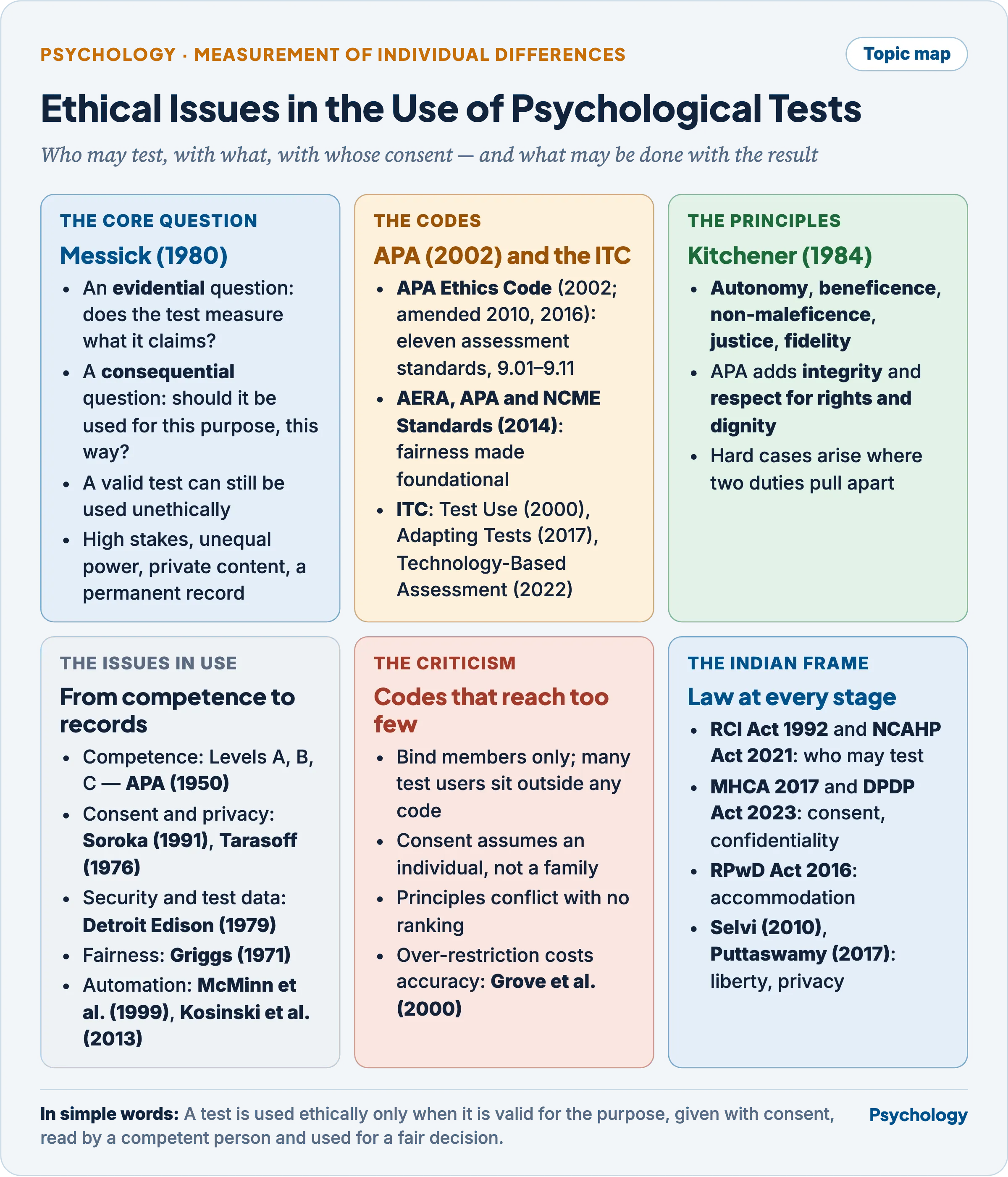
Every issue on the map is a point where the tester’s power over the test-taker can be used well or badly.
Why the use of psychological tests raises ethical issues
- Messick (1980) separated an evidential question — does the test measure what it claims? — from a consequential one — should it be used for this purpose in this way? A valid test can still be used unethically.
- A test’s efficacy rests on the three foundations of the AERA, APA and NCME (2014) Standards — validity, reliability and fairness — plus current norms and standardised administration, set out in Construction and Standardization of Psychological Tests.
- Testing is ethically loaded because scores feed high-stakes decisions, the test-taker rarely knows what an item measures, items can reach private domains such as religion and sexuality, and a score becomes a permanent record.
- The APA’s first code (1953) was built by a committee chaired by Nicholas Hobbs (1948) using the critical incident method (Flanagan, 1954): over 1,000 real dilemmas were reviewed, including psychologists asked to design tests that would keep a workforce racially segregated.
Codes and standards governing test use
| Code | Body and year | Status | What it contributes |
|---|---|---|---|
| Ethical Principles of Psychologists and Code of Conduct | APA, 2002; amended 2010 and 2016 | Binds members; draft revision open for comment December 2024–March 2025, not adopted | Five aspirational principles; eleven enforceable assessment standards, 9.01–9.11 |
| Standards for Educational and Psychological Testing | AERA, APA and NCME, 2014 | Professional consensus; revision under way | Fairness made a foundational chapter beside validity and reliability |
| Guidelines on Test Use | International Test Commission (ITC), 2000; version 1.2, 2013 | International guidance | Competences of the responsible test user |
| Guidelines for Translating and Adapting Tests | ITC, 2nd edition 2017 | International guidance | Eighteen guidelines in six groups |
| Guidelines for Technology-Based Assessment | ITC with the test-industry association, 2022 | International guidance | Online delivery, remote proctoring, automated scoring |
- Section 9 of the APA (2002) code covers bases for assessment, use, informed consent, release of test data, test construction, interpretation, unqualified persons, obsolete tests, scoring services, explaining results and test security — the issues below follow it.
- ITC (2000): “A competent test user will use tests appropriately, professionally, and in an ethical manner, paying due regard to the needs and rights of those involved in the testing process, the reasons for testing, and the broader context in which the testing takes place.”
- Its Part 1, taking responsibility for ethical test use, adds competence, responsibility for use, secure materials and confidential results.
Important ethical principles in the use of psychological tests
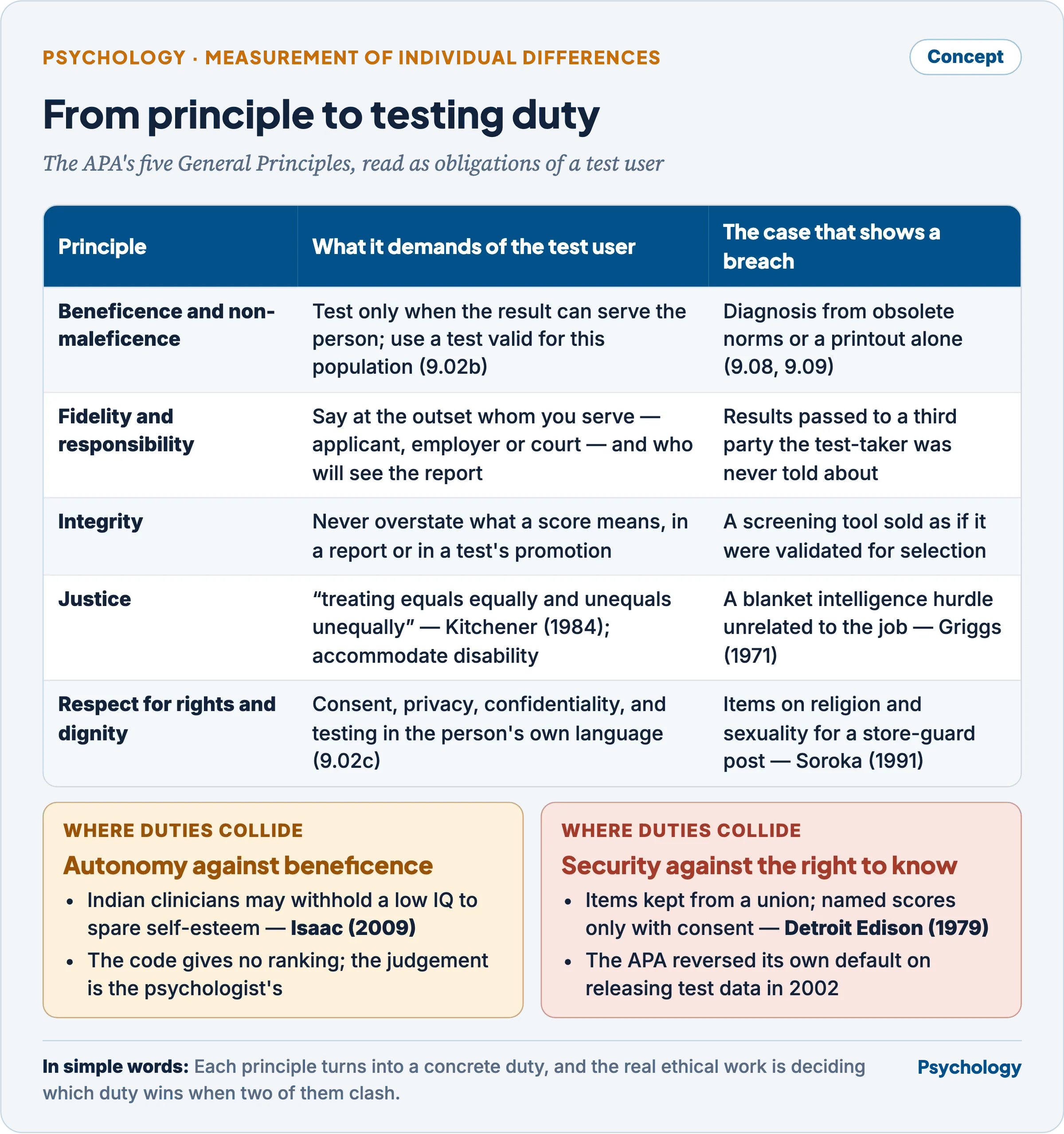
Each abstract principle becomes a concrete testing duty; the hard cases arise where two duties pull apart.
- Beauchamp and Childress (1979) named autonomy, beneficence, non-maleficence and justice; Kitchener (1984) added fidelity for counselling psychology. The APA (2002) General Principles are Beneficence and Nonmaleficence, Fidelity and Responsibility, Integrity, Justice, and Respect for People’s Rights and Dignity.
- Each becomes a testing duty.
- Beneficence and non-maleficence: test only when the result can serve the person or a legitimate decision, with instruments valid for the population tested (Standard 9.02b).
- Fidelity and responsibility: settle at the outset whom the psychologist serves — applicant, employer or court — because that decides who sees the report.
- Integrity: never overstate what a score means, in a report or in a test’s promotion.
- Justice: “treating equals equally and unequals unequally but in proportion to their relevant differences” (Kitchener, 1984) — the basis for a Braille form or a scribe.
- Respect for rights and dignity: consent, privacy, confidentiality, and testing in the person’s own language (Standard 9.02c).
Ethical issues in the use of psychological tests
Competence of the test user and qualification levels
- The APA (1950) Ethical Standards for the Distribution of Psychological Tests graded tests by the knowledge their use demands.
- Level A: usable with the manual alone — achievement and proficiency tests.
- Level B: needing knowledge of construction and statistics — general intelligence tests, interest inventories.
- Level C: individual intelligence, personality and projective tests — a master’s in psychology plus a year’s supervised experience.
- Competence is specific to the instrument. Standard 9.07 forbids promoting assessment by unqualified persons except in supervised training; skill with group ability tests confers no competence with a projective technique or a neuropsychological battery.
Informed consent
- Standard 9.03(a) requires explaining the nature and purpose of the assessment, fees, third parties involved and the limits of confidentiality.
- It exempts testing mandated by law, implied consent in routine institutional activity such as applying for a job, and assessment of decisional capacity. Implied consent is thin: an applicant who declines the test loses the job, so purpose and use must still be disclosed.
- Children give assent alongside parental consent; for research, the ICMR (2017) guidelines require oral assent from ages 7 to 12 and written assent from 12 to 18.
Confidentiality, privacy and invasion of privacy
- Privacy is the right to decide what of oneself to reveal; confidentiality is the duty to protect what has been revealed. A test can keep every answer confidential and still invade privacy by asking what its purpose does not need.
- Confidentiality has limits that must be stated beforehand. Tarasoff v. Regents (1976), in California, imposed a duty to protect a foreseeable victim: “The protective privilege ends where the public peril begins.”
- Soroka v. Dayton Hudson (1991) — a retail chain screened store-security applicants with a 704-item condensed CPI-MMPI, including items on religion and same-sex attraction.
- The California Court of Appeal held such items unconstitutional unless directly and narrowly job-related; the case settled in 1993 for about $2 million.
- Limitation: the APA warned that items work only in combination, so an item-by-item rule would bar empirically keyed inventories; the state Supreme Court’s grant of review depublished the ruling.
Test security and the release of test data
- Many tests depend on the test-taker’s naiveté; once items circulate, scores stop meaning what the norms say, so security protects validity.
- The APA (2002) code separates test materials — manuals, protocols, items, kept secure (9.11) — from test data — scores, responses and examiner’s notes, released to the client or a named person on written release (9.04).
- The 1992 code presumed raw data withheld from persons “not qualified to use such information”; the 2002 code reversed that presumption, keeping a power to withhold to prevent substantial harm or misuse.
- Detroit Edison v. NLRB (1979) — a union contesting promotions denied on aptitude scores sought the test battery, answer sheets and named scores.
- The US Supreme Court (1979) held that the items need not be handed directly to the union, given the link between secrecy and validity, and that named scores required each employee’s consent.
- Limitation: the Court split 5–4 on the items, showing the balance between security and the right to know is contested.
- Admission testing settles it differently: the National Testing Agency publishes the question papers and provisional keys with candidates’ recorded responses, and revises the key for all when a challenge succeeds (public notice, 4 February 2026).
- Published items cannot be reused, a cost a clinical inventory cannot bear. Paper-leak offences are treated in Use, Misuse and Limitations of Psychological Tests.
Fairness and cultural appropriateness
- A test is fair to a person only if its validity holds for people like that person; the 2014 Standards require accessibility, removal of construct-irrelevant barriers and safeguards against inappropriate interpretation.
- Griggs v. Duke Power (1971) — an intelligence test and a mechanical comprehension test barred Black workers from better jobs without shown job relevance.
- The US Supreme Court held that tests with disparate impact must be job-related: “any tests used must measure the person for the job and not the person in the abstract.”
- Limitation: American employment law — a principle for India, not a rule.
- Item bias and stereotype threat are treated in Use, Misuse and Limitations of Psychological Tests.
Interpretation, communication of results and labelling
- Standard 9.06 requires interpretation that weighs situational, linguistic and cultural factors and states its limits; 9.10 requires results to be explained, except in pre-employment, security or forensic work where this was made clear in advance.
- Results go to parents and teachers as meaning, not bare numbers; a label outlives the test, as set out in Use, Misuse and Limitations of Psychological Tests.
Obsolete tests and outdated norms
- Standard 9.08 forbids decisions on outdated results or obsolete tests; why old norms mislead is set out in Test Norms and Norm-Referenced Measurement.
- The corrective is restandardisation: the MMPI, normed in the 1930s on rural Minnesotans, was renormed as the MMPI-2 (Butcher and colleagues, 1989) on 2,600 adults matched to the census.
Automated, online and AI-based testing
- Standard 9.09(c) keeps responsibility with the psychologist whether scoring and interpretation are done by hand or by software.
- McMinn, Ellens and Soref (1999) surveyed 364 members of the Society for Personality Assessment on six uses of computer-based interpretation.
- Computer scoring and printouts used alongside judgement were rated ethical; 86 per cent judged a printout as the primary basis for case formulation unethical (1999).
- Pasting narrative into one’s own report split respondents, 42 against 38 per cent (1999). Limitation: stated beliefs, not observed practice.
- Kosinski, Stillwell and Graepel (2013) showed that private traits can be inferred without any test.
- From 58,000 volunteers’ Facebook Likes, models identified male sexual orientation with 88 per cent accuracy and party affiliation with 85 per cent (2013).
- In 2018 Facebook estimated that a personality-quiz app installed by about 305,000 people had exposed up to 87 million profiles to a political consultancy.
- The EU Artificial Intelligence Act (2024) bars AI inference of emotions in workplaces and schools from 2 February 2025 and classes recruitment AI as high-risk.
- The validity of computer interpretation is treated in Computer Application in the Psychological Laboratory and in Testing (Paper I).
Ethical issues in test construction
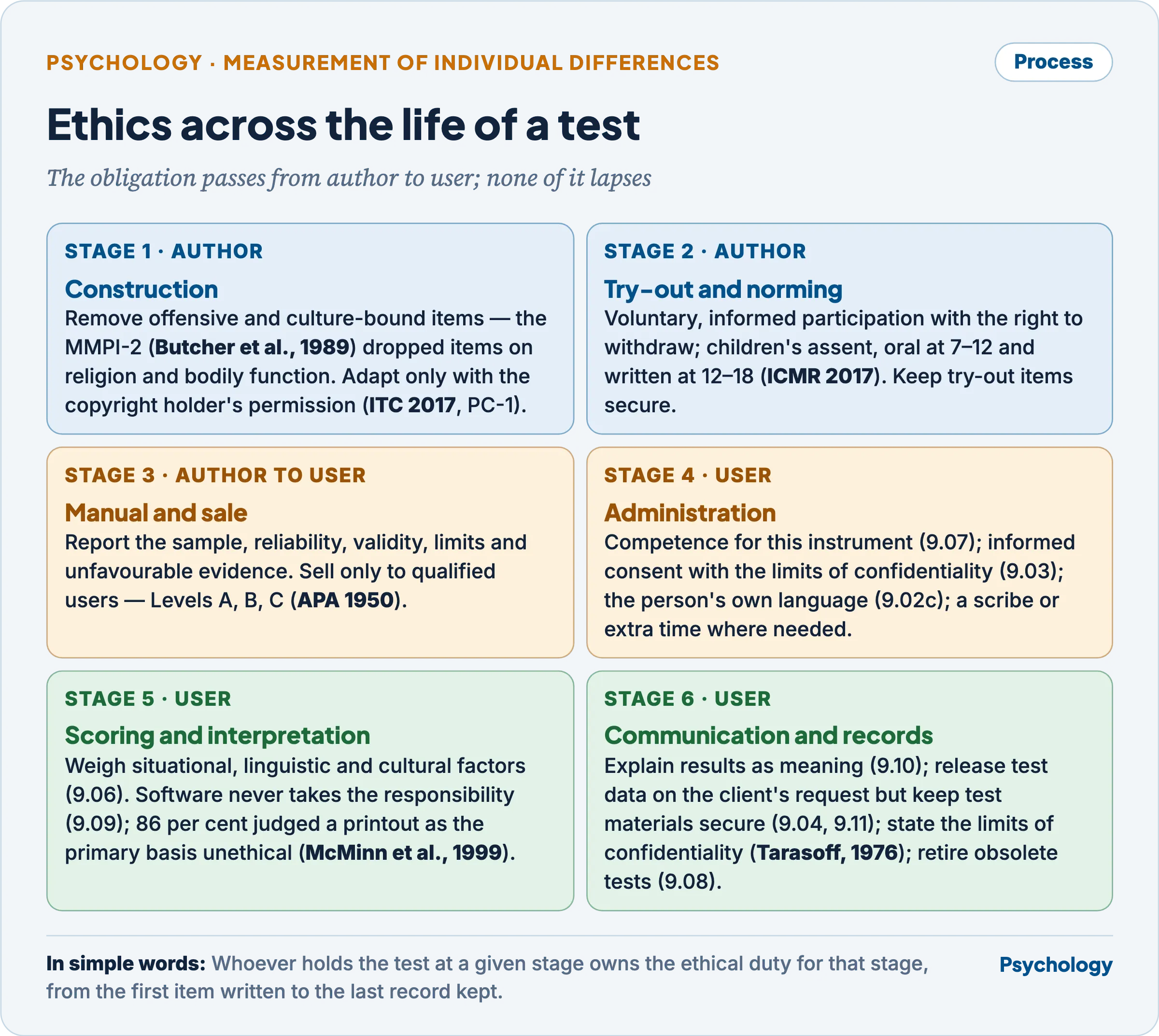
The obligations pass from author to user as a test moves through its life, but none of them lapses.
- Standard 9.05 requires sound psychometric procedure, reduction or elimination of bias, and recommendations for use; the steps themselves are in Construction and Standardization of Psychological Tests.
- Content review: offensive, stereotyped and culture-bound items are removed before try-out. The MMPI-2 (Butcher and colleagues, 1989) dropped items on religious belief, sexist wording and bowel and bladder function.
- Norm-sample protection: voluntary, informed participation — purpose, risks, confidentiality, the right to withdraw — with children’s assent and ethics-committee review (ICMR, 2017).
- Security during development: items exposed in try-out are lost to the final test.
- Honest documentation: the manual reports the standardisation sample, reliability, validity, intended population, limitations and user qualifications, including unfavourable evidence.
- Adaptation: the ITC (2017) requires the copyright holder’s permission (PC-1), evidence that the construct overlaps across populations (PC-2), and minimising irrelevant cultural and linguistic differences (PC-3). Copying a test’s structure with new items is itself a breach.
- Promotion: claims about a test rest on published evidence, and sale is restricted to qualified users.
Ethical and non-ethical uses of psychological tests
| Setting | Ethical use | Non-ethical use | Principle at stake |
|---|---|---|---|
| Personnel selection | Aptitude battery chosen after job analysis and shown to predict performance | Blanket intelligence hurdle unrelated to the job (Griggs, 1971) | Justice; validity for the purpose |
| Personality screening | Inventory scored at scale level for a safety-critical post | Items probing religion and sexuality for a store-guard post (Soroka, 1991) | Privacy; relevance |
| School | Testing to identify a learning disability and secure accommodations | IQ used to stream or publicly label a child; a test in a language the child does not command | Beneficence; Standard 9.02(c) |
| Clinic | Tests as one input with interview and history, results explained | Diagnosis from a printout or obsolete norms alone | Standards 9.01, 9.08, 9.09 |
| Criminal investigation | Polygraph only with consent recorded before a magistrate | Compulsory narco-analysis of an accused (Selvi, 2010) | Autonomy; Article 20(3) |
| Research and online services | Consented data used for the stated purpose | Quiz data harvested for political targeting (2018) | Consent; purpose limitation |
- What separates the columns is not the instrument but four conditions: validity for this purpose and population, informed consent, competent interpretation, and use for the person’s benefit or a fair decision. A sound test fails ethically if any one is missing.
- Measuring individual differences ranks persons. It is ethical where the difference measured is relevant to the decision, and unethical where a group difference in scores becomes group exclusion without shown relevance — what Griggs (1971) forbade.
Criticisms and limitations of the ethical framework
- Limited reach: the APA code binds only APA members; in India the Rehabilitation Council binds only registered clinical and rehabilitation professionals, leaving personnel departments, schools and app-based testing largely outside any code.
- Western individualism: consent assumes an autonomous individual, while Indian families often decide jointly; ICMR (2017) accepts that women may consult husbands or family, and no code says when family wishes should yield.
- Principles conflict without a ranking: Isaac (2009) noted that Indian clinicians may withhold low IQ results to protect self-esteem — beneficence against autonomy; in Detroit Edison (1979) security met the right to know, and the APA reversed its own presumption in 2002.
- Item-level privacy against scale-level validity: the Soroka (1991) rule protects applicants but would forbid empirically keyed inventories whose single items mean nothing alone.
- Technology outruns the codes: the APA code dates from 2002, while Kosinski and colleagues (2013) inferred personality from online behaviour without any test.
- Over-restriction has costs: Grove and colleagues (2000), pooling 136 studies, found mechanical prediction about 10 per cent more accurate than clinical judgement, with clinicians clearly better in only 6–16 per cent of studies.
- Abandoning tests for unstructured judgement can therefore harm the people a restriction means to protect.
Indian context
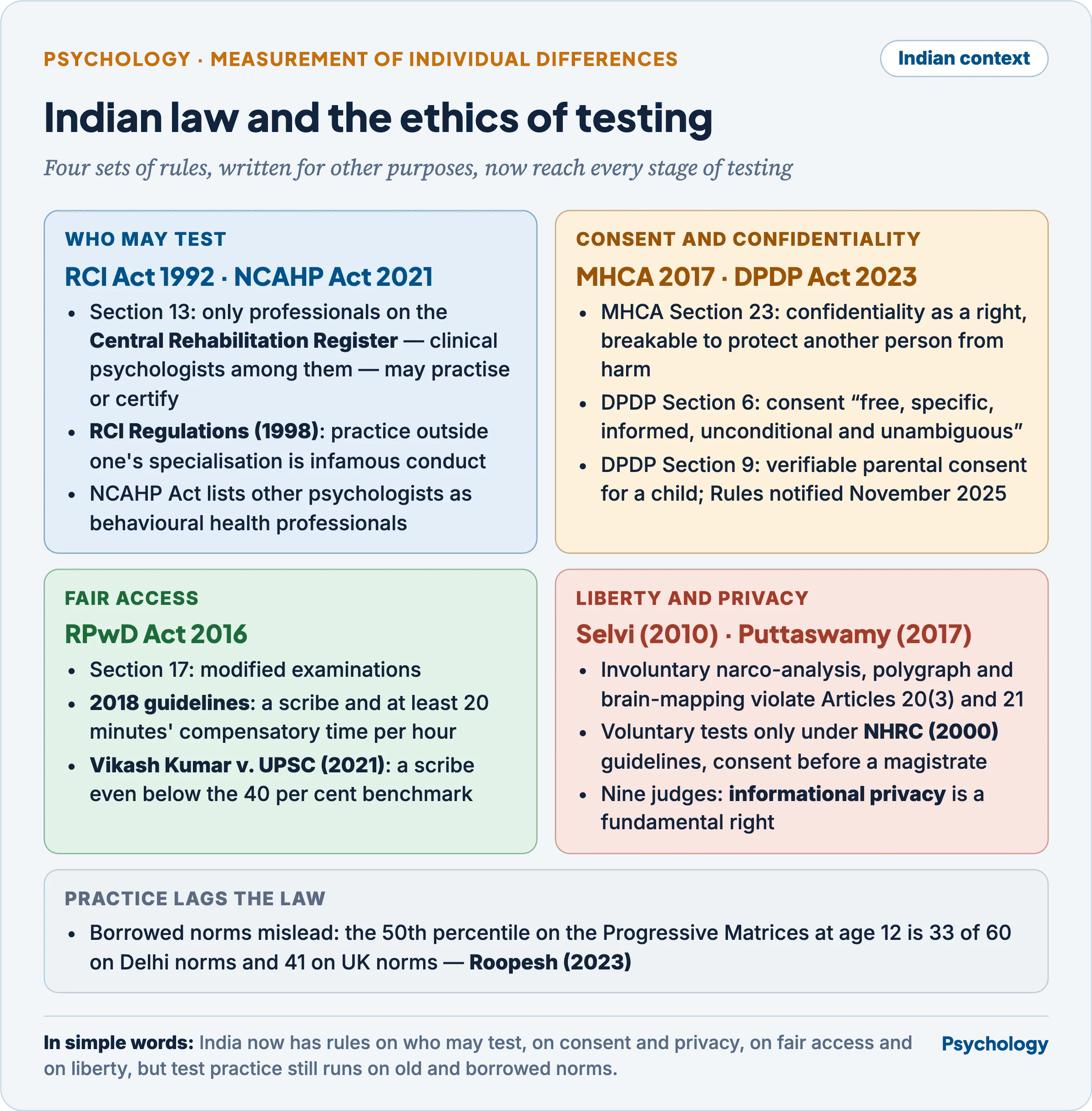
Indian law now reaches every stage of testing, but through statutes written for other purposes.
- Rehabilitation Council of India Act, 1992 (Ministry of Social Justice and Empowerment; amended 2000) — Section 13 lets only professionals on the Central Rehabilitation Register, clinical psychologists among them, practise, sign certificates or testify as experts. It operationalises competence certified before trust.
- Registration runs seven years, renewed on 100 continuing-education credits (circular, 14 October 2025); the RCI Regulations (1998) on professional conduct and ethics make exaggerated prognosis and practice outside one’s specialisation infamous conduct.
- National Commission for Allied and Healthcare Professions Act, 2021 (Ministry of Health and Family Welfare) — lists the psychologist other than the clinical psychologist as a behavioural health sciences professional, providing a statutory register for non-clinical testers.
- Mental Healthcare Act, 2017 (Ministry of Health and Family Welfare; in force 29 May 2018) — defines informed consent as free of force or misrepresentation, obtained after disclosing risks, benefits and alternatives in a language understood (Section 2(1)(i)). It operationalises autonomy with bounded confidentiality.
- Section 23 makes confidentiality a right of persons with mental illness, breakable to protect another person from harm — India’s statutory Tarasoff (1976); Section 24 covers digital records; Section 25 grants access to records unless disclosure would cause serious mental harm or harm to others.
- Digital Personal Data Protection Act, 2023 (Ministry of Electronics and Information Technology) — consent must be “free, specific, informed, unconditional and unambiguous” (Section 6); a child’s data needs verifiable parental consent and no behavioural monitoring (Section 9). It operationalises purpose limitation.
- Under the notification issued with the Rules on 13 November 2025, both duties take effect in May 2027.
- Rights of Persons with Disabilities Act, 2016 (Department of Empowerment of Persons with Disabilities) — Section 17 requires modified examinations; the 2018 guidelines give a scribe and at least 20 minutes’ compensatory time per hour. It operationalises justice as reasonable accommodation.
- Vikash Kumar v. UPSC (2021) extended a scribe to a candidate with writer’s cramp below the 40 per cent benchmark; a 2022 memorandum followed.
- Revised guidelines (1 August 2025), extending assistance to any candidate whose disability limits writing, stand in abeyance until 31 December 2026, so the 2018 and 2022 rules still govern.
- Selvi v. State of Karnataka (2010) — a three-judge Supreme Court bench on compulsory narco-analysis, polygraph and Brain Electrical Activation Profile tests of accused persons.
- Held that involuntary administration violates the right against self-incrimination (Article 20(3)) and personal liberty and mental privacy (Article 21).
- Voluntary testing must follow the NHRC (2000) polygraph guidelines, with consent recorded before a magistrate; results are not evidence, though facts discovered through them can be.
- Limitation: it governs investigation, not testing by employers or schools.
- Puttaswamy v. Union of India (2017) — a nine-judge bench unanimously held privacy, including informational privacy, a fundamental right under Article 21: the constitutional ground for treating test scores as personal data.
- Practice lags the law. Isaac (2009) observed imported tests used without re-standardisation: “Not only do we need good tests, we also need good testers.”
- Venkatesan (2010): “Ours is probably the only country where testers continue to use decade old versions of tests”.
- Roopesh (2023): a 12-year-old needs 33 of 60 on the Standard Progressive Matrices for the 50th percentile on Delhi norms but 41 on UK norms; a “Narasimha” Rorschach fusion can be misread as a schizophrenic sign.
- Porrselvi and colleagues (2024) found the Indian WAIS-IV normed on highly educated English speakers, unrepresentative of India.
Previous Year Questions
- 2025What are the factors that determine the efficacy of psychological tests? Discuss the ethical issues in the use of psychological tests.
- 2015What are some important ethical principles that psychologists must adhere to while making use of psychological tests?
- 2013Identify the ethical and non-ethical uses of psychological tests especially measuring individual differences. Provide suitable examples.
- 2005Discuss the different types of psychological tests. Describe ethical issues involved in the use of psychological tests.
- 2003Discuss the salient features of a psychological test. Identify the process involved in construction and standardization of a psychological test. What are the ethical issues involved in the use of a psychological test?
- 2002Discuss critically the ethical issues involved in the construction and use of psychological tests.