

Study of consciousness – sleep-wake schedules.
Official Syllabus: Paper I · Unit 14 Issues and Perspectives in Modern Contemporary Psychology
“Sleep debt is best understood as additional wakefulness, which carries a neurobiological cost accumulating over time.”
— after Van Dongen, Maislin, Mullington and Dinges (2003)
Taking sleep away is the main source of evidence that sleep is a requirement and not a habit. Two bodies of work follow: what happens to a healthy person denied sleep, a dose-response problem, and what happens to a person whose sleep is broken by disorder, a problem of classification and treatment. The stages of sleep, their electroencephalographic signatures and the functional theories of sleep are set out in Sleep: Stages, Physiology and Functions.
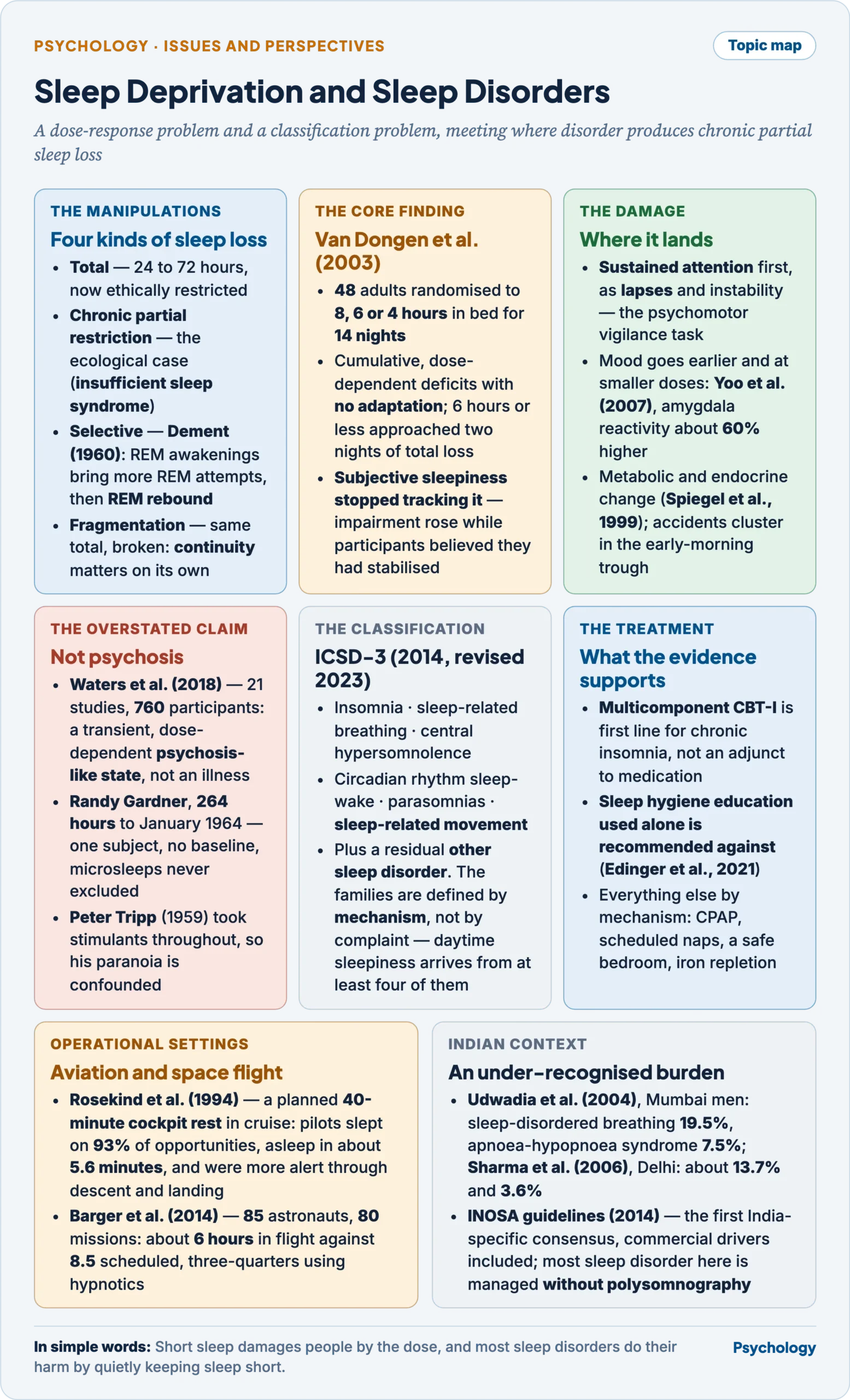
The two halves meet in the middle: most sleep disorders cause their damage by producing chronic partial deprivation, so the effects column applies to both.
Sleep loss and the study of consciousness: total, partial and selective deprivation
- Total sleep deprivation keeps the person continuously awake, usually for 24 to 72 hours, and is now ethically restricted, so most extreme-duration evidence is historical.
- Chronic partial sleep restriction limits sleep to a fixed quantity nightly over days or weeks, and is the ecologically important case, being what shift work, caregiving, study and early school starts produce.
- Its real-world form is a diagnosis in its own right, insufficient sleep syndrome, where sleep is curtailed by schedule and sleepiness resolves once sleep is extended.
- Selective deprivation removes one kind of sleep and leaves the rest. Dement (1960) woke sleepers at the first sign of each REM period, producing more attempts to enter REM on successive nights and a REM rebound on recovery — so REM sleep is separately regulated rather than optional.
- Slow-wave deprivation yields a slow-wave rebound, the basis of the homeostatic process in Sleep-Wake Schedules and Circadian Rhythms.
- Sleep fragmentation keeps total sleep time but interrupts it repeatedly, reproducing much of the impairment of restriction. Continuity, not duration alone, is part of what sleep delivers — which is why untreated apnoea impairs people who spend eight hours in bed.
Effects of sleep deprivation on cognitive performance
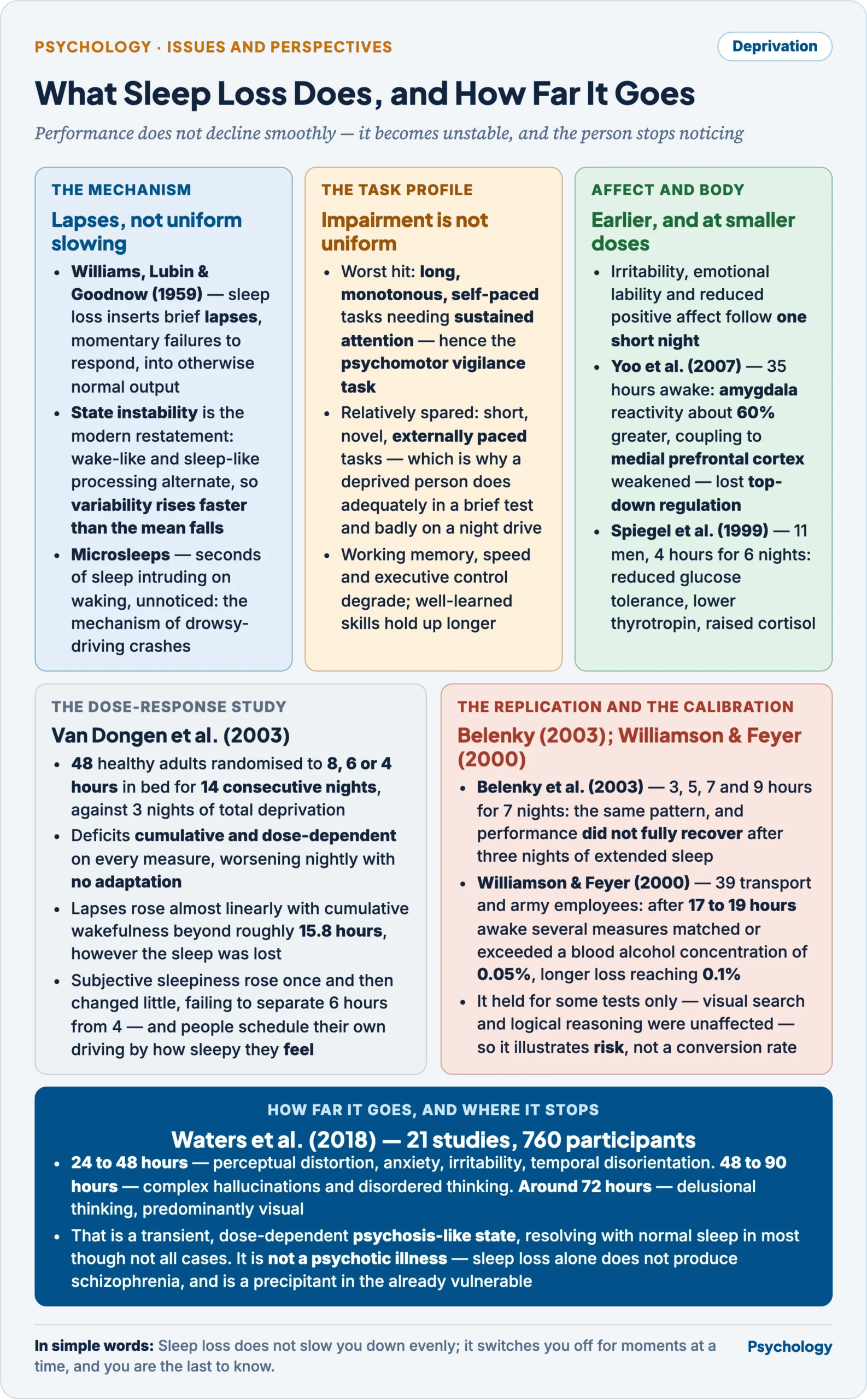
Performance does not decline smoothly; it becomes unstable, with normal responses interrupted by lapses that lengthen as sleep loss accumulates.
- The classical mechanism is the lapse hypothesis of Williams, Lubin and Goodnow (1959): sleep loss inserts brief lapses — momentary failures to respond — into otherwise normal output, and the mean falls because the lapses drag it down.
- The modern restatement is state instability: the deprived brain oscillates between wake-like and sleep-like processing, so variability rises faster than the mean falls.
- Microsleeps are the extreme form — a few seconds of sleep intruding into waking, often with the eyes open and unnoticed — and are the mechanism behind drowsy-driving crashes.
- Impairment is not uniform across tasks, and the moderating variables matter as much as the main effect.
- Worst affected are long, monotonous, self-paced tasks demanding sustained attention; the standard instrument is the psychomotor vigilance task, whose lapse count is highly sensitive to sleep loss.
- Relatively spared are short, novel, externally paced tasks, where stimulation compensates — which is why a deprived person does adequately in a brief test and badly on a night drive.
- Working memory, processing speed and executive control degrade; well-learned skills hold up longer.
- Van Dongen, Maislin, Mullington and Dinges (2003) supplied the dose-response evidence, the single most important study here.
- 48 healthy adults were randomised to 8, 6 or 4 hours in bed for 14 consecutive nights, against a condition of 3 nights of total deprivation.
- Restriction to 4 or 6 hours produced cumulative, dose-dependent deficits on every measure, worsening nightly with no adaptation.
- Lapses rose almost linearly with cumulative wakefulness beyond roughly 15.8 hours however the sleep was lost, and 6 hours or less approached the effect of two nights of total deprivation.
- Subjective sleepiness rose once and then changed little, failing to distinguish the 6-hour from the 4-hour condition, so participants grew steadily more impaired while believing they had stabilised.
- That dissociation matters most practically, since people schedule their own driving and working by how sleepy they feel.
- Belenky and colleagues (2003) found the same pattern with 3, 5, 7 and 9 hours in bed for 7 nights, and added that performance did not fully recover after three nights of extended sleep.
- Williamson and Feyer (2000) calibrated the impairment against alcohol in 39 transport-industry and army employees, tested both sleep-deprived and after measured doses.
- After 17 to 19 hours awake, several measures were equivalent to or worse than at a blood alcohol concentration of 0.05 per cent, and longer deprivation reached the equivalent of 0.1 per cent (Williamson and Feyer, 2000).
- The equivalence held for some tests only — visual search and logical reasoning were unaffected — so it illustrates risk rather than giving a conversion rate.
Effects on affect and on behaviour
- Mood effects appear earlier and at smaller doses than cognitive ones: irritability, emotional lability, reduced positive affect and intolerance of frustration follow one short night.
- Yoo, Gujar, Hu, Jolesz and Walker (2007) imaged the mechanism, comparing participants kept awake about 35 hours with a rested group viewing increasingly aversive pictures.
- The deprived group showed markedly greater amygdala reactivity, of the order of 60 per cent higher, with weakened coupling to medial prefrontal cortex (Yoo and colleagues, 2007).
- The reading is loss of top-down regulation: the response is larger and less governed, which fits the observation that sleep loss amplifies reactions to events rather than lowering mood uniformly.
- The relation to psychopathology runs both ways: insomnia is a symptom of depressive and anxiety disorders and a prospective risk factor for their onset, so it is a partly independent target.
- Accident risk rises sharply in driving, industrial work and clinical practice, concentrated in the circadian trough of the early morning.
- Spiegel, Leproult and Van Cauter (1999) restricted 11 young men to 4 hours in bed for 6 nights and found reduced glucose tolerance, lower thyrotropin, raised evening cortisol and raised sympathetic activity, resembling changes of normal ageing.
- Rechtschaffen and colleagues (1983) established lethality in the rat by the disk-over-water method, deprived animals dying in roughly two to three weeks while yoked controls stayed healthy; no anatomical cause of death was found, and the result does not transfer to humans.
The limits of deprivation, and why deprivation-psychosis is overstated
- Randy Gardner, a 17-year-old in San Diego, stayed awake 264 hours — eleven days — ending in January 1964, observed by the sleep researcher William Dement and a physician, John Ross.
- He took no stimulants, and became irritable, forgetful, unable to concentrate or complete serial tasks, slurred in speech and prone to perceptual distortion, recovering after one long night’s sleep.
- The caveats weigh as much as the case: a single subject, no quantified baseline, companions keeping him awake and active so microsleeps were neither excluded nor measured, and no modern replication.
- The claim that sleep deprivation causes psychosis is overstated, and the correction is precise rather than dismissive.
- Waters, Chiu, Atkinson and Blom (2018) reviewed 21 studies of 760 participants deprived for 24 hours to 11 nights.
- Perceptual distortion, anxiety, irritability and temporal disorientation appeared within 24 to 48 hours; complex hallucinations and disordered thinking at roughly 48 to 90 hours; delusional thinking around 72 hours, predominantly visual (Waters and colleagues, 2018).
- That is a transient, dose-dependent psychosis-like state, resolving with normal sleep in most though not all cases. It is not a psychotic illness, and sleep loss alone does not produce schizophrenia.
- The most dramatic historical case, the radio presenter Peter Tripp, awake about 201 hours in 1959 and frankly paranoid by the end, took stimulants throughout, so his symptoms are confounded with amphetamine psychosis.
- Sleep loss is a precipitant in the already vulnerable, and in healthy people produces reversible disturbance at durations now considered unethical to impose.
Sleep-wake schedules in aviation and space flight
- Aviation and spaceflight impose sleep restriction, circadian misalignment and monotony together, and are where fatigue countermeasures were first tested.
- Rosekind and colleagues (1994) tested a planned 40-minute cockpit rest in the cruise phase of long-haul flights, comparing 12 crew given the opportunity with 9 who were not.
- Pilots slept on 93 per cent of opportunities, falling asleep in about 5.6 minutes (Rosekind and colleagues, 1994), and the rest group showed better alertness and performance through descent and landing, where the risk lies.
- Barger and colleagues (2014) measured sleep in 85 astronauts across 80 shuttle missions and station expeditions.
- Mean in-flight sleep was about 6 hours against 8.5 scheduled, the deficit was already present in training months before launch, and about three-quarters of station crew used hypnotic medication in flight.
- Short sleep, misalignment and heavy hypnotic use in an operational setting make the point that scheduling sleep is not the same as obtaining it.
- Monotony and reduced sensory input interact with sleep loss here; stimulus and sensory deprivation in its own right is set out in Stimulus and Sensory Deprivation.
Sleep disorders: the current classification
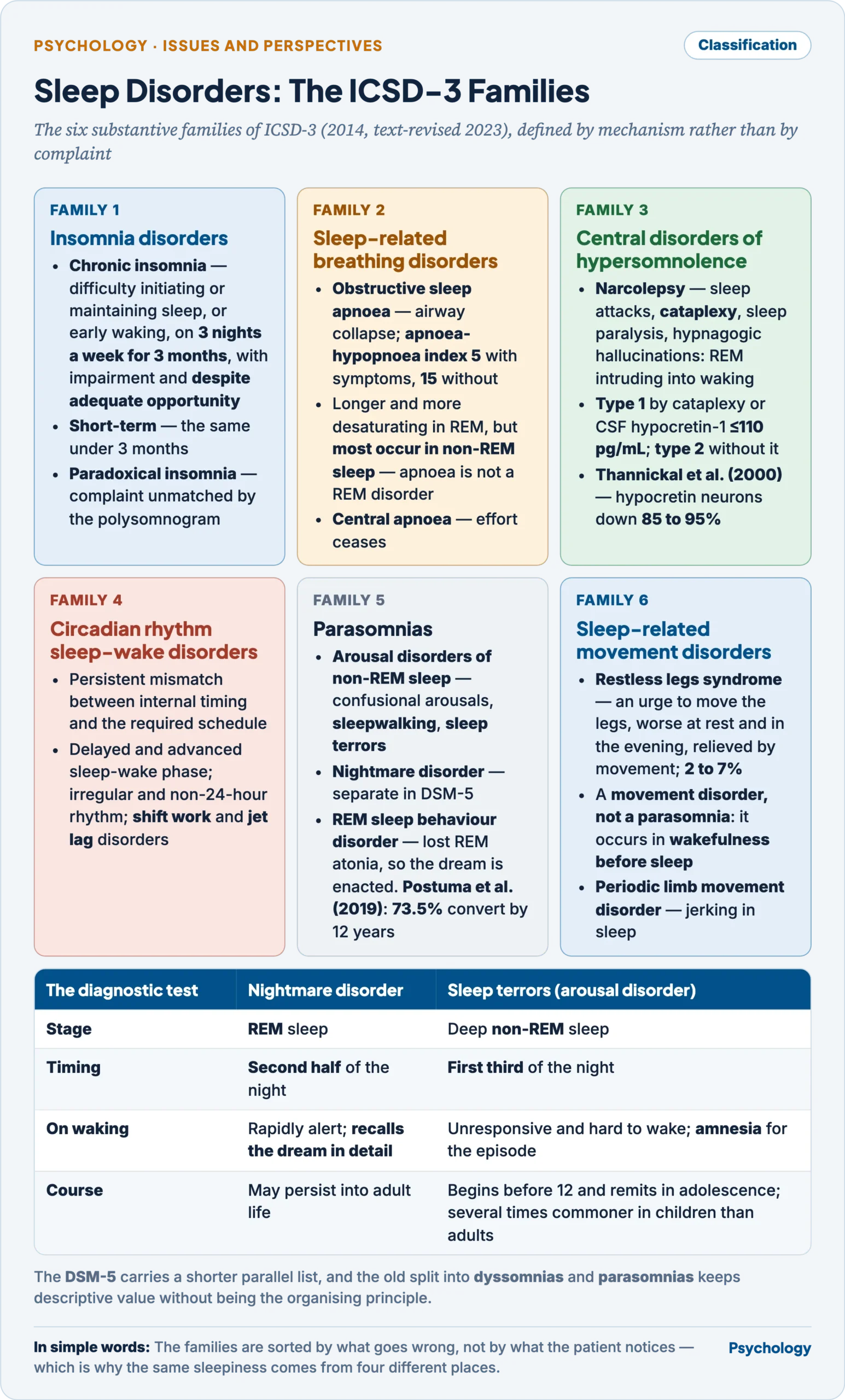
The families are defined by mechanism, not by symptom: the same complaint of daytime sleepiness arrives from at least four of these boxes.
- A sleep disorder is a condition in which the amount, quality, timing or behaviour of sleep is disturbed enough to cause distress or daytime impairment, and classification matters because the complaint rarely identifies the mechanism.
- The current scheme is the International Classification of Sleep Disorders (ICSD-3, 2014), text-revised in 2023, which groups disorders into six substantive families with a residual other sleep disorder category.
- Insomnia disorders; sleep-related breathing disorders; central disorders of hypersomnolence; circadian rhythm sleep-wake disorders; parasomnias; sleep-related movement disorders.
- The DSM-5 carries a shorter parallel list. The older division into dyssomnias — disturbances of amount, quality or timing — and parasomnias, abnormal events during sleep, is no longer the organising principle but keeps descriptive value.
Insomnia disorder
- Chronic insomnia disorder requires difficulty initiating or maintaining sleep, or early waking, on at least three nights a week for three months, with daytime impairment and despite adequate opportunity to sleep — without which the diagnosis would capture everyone short of time. Short-term insomnia disorder has the same features for under three months.
- Paradoxical insomnia, formerly sleep-state misperception, is the case where the complaint is not matched by the polysomnogram: insomnia cannot be diagnosed from report alone, and the distress is nonetheless real.
- The standard aetiology is the three-factor or 3-P model of Spielman and colleagues (1987) — predisposing traits such as hyperarousal, a precipitating stressor, and perpetuating behaviours such as extended time in bed, napping and clock-watching, which outlast the stressor and are what treatment targets.
Sleep-related breathing disorders
- Obstructive sleep apnoea is repeated upper-airway collapse, with snoring, witnessed pauses, desaturation and arousals, giving non-restorative sleep and daytime sleepiness. The threshold is an apnoea-hypopnoea index of 5 or more an hour with symptoms, or 15 without.
- Events are longer and more desaturating in REM sleep because of REM atonia, but most occur in non-REM sleep, which occupies most of the night; calling apnoea a REM disorder is inaccurate.
- Risk factors are obesity, male sex, middle age and craniofacial structure; untreated it carries hypertension, arrhythmia and metabolic risk.
- Central sleep apnoea is cessation of respiratory effort rather than obstruction, from brainstem failure, heart failure, altitude or opioids; sleep-related hypoventilation is inadequate ventilation with carbon dioxide retention rather than discrete apnoeas.
Central disorders of hypersomnolence
- Narcolepsy is irrepressible daytime sleep attacks, with a classical tetrad completed by cataplexy — sudden bilateral loss of muscle tone with consciousness retained, triggered by emotion and characteristically by laughter — sleep paralysis, the same atonia at sleep onset or waking, and hypnagogic hallucinations.
- All three accessory symptoms are intrusions of REM phenomena into wakefulness, and narcolepsy involves sleep-onset REM without the usual preceding non-REM: the unifying mechanism.
- ICSD-3 divides it into narcolepsy type 1, defined by cataplexy or by cerebrospinal hypocretin-1 at or below 110 pg/mL, and narcolepsy type 2 without either.
- The cause is loss of the orexin (hypocretin) system, on unusually complete evidence.
- Lin and colleagues (1999) traced canine narcolepsy to a mutation in the gene for the hypocretin receptor 2, and Chemelli and colleagues (1999) found a narcoleptic phenotype in mice with the orexin gene deleted.
- Thannickal and colleagues (2000) found hypocretin-producing hypothalamic neurons reduced by the order of 85 to 95 per cent in human narcolepsy, and Nishino and colleagues (2000) found cerebrospinal hypocretin-1 undetectable in 7 of 9 patients.
- Human narcolepsy is therefore usually loss of the orexin neurons rather than a receptor mutation, and a strong association with the HLA-DQB1*06:02 allele supports an autoimmune mechanism.
- The family also holds idiopathic hypersomnia, Kleine-Levin syndrome and insufficient sleep syndrome.
Circadian rhythm sleep-wake disorders
- These involve persistent mismatch between internal circadian timing and the required schedule: delayed and advanced sleep-wake phase disorders, irregular and non-24-hour rhythm disorders, shift work disorder and jet lag disorder — all set out in Sleep-Wake Schedules and Circadian Rhythms.
Parasomnias
- Disorders of arousal from non-REM sleep — confusional arousals, sleepwalking and sleep terrors — are incomplete awakenings from deep non-REM sleep, typically in the first third of the night, with the person unresponsive and hard to wake, little or no dream imagery recalled, and amnesia for the episode.
- They begin before age 12 and remit through adolescence, and are several times more common in children than in adults — the diagnostic manuals give separate prevalence ranges for sleepwalking and for sleep terrors rather than one combined figure, so a single percentage should not be quoted. A family history is frequent.
- In the DSM-5 these combined sleepwalking disorder and sleep terror disorder; nightmare disorder was not merged into them and remains separate, a point the secondary literature often gets wrong.
- Nightmare disorder is repeated frightening dreams that wake the sleeper, who becomes rapidly alert and recalls the dream in detail. Nightmares arise from REM sleep and cluster in the second half of the night; the contrast with sleep terrors in timing, recall and amnesia is the diagnostic test.
- REM sleep behaviour disorder is loss of the atonia that normally accompanies REM sleep, so the sleeper enacts the dream, often with shouting, punching or kicking.
- Commonest in older men, it matters as a prodrome of the alpha-synucleinopathies: Postuma and colleagues (2019), following 1,280 patients across 24 centres, found conversion to parkinsonism or dementia at about 6.3 per cent a year and 73.5 per cent by 12 years.
Sleep-related movement disorders
- Restless legs syndrome is an urge to move the legs, usually with uncomfortable sensations, worse at rest and in the evening and relieved by movement, at least three times a week for three months, with reported prevalence of the order of 2 to 7 per cent (American Psychiatric Association, 2013) and an association with iron deficiency and dopaminergic dysfunction.
- It is a movement disorder, not a parasomnia: it occurs in wakefulness before sleep, not as an abnormal event during sleep.
- Periodic limb movement disorder, formerly nocturnal myoclonus, is repetitive limb jerking during sleep that fragments it and often accompanies restless legs syndrome without being the same thing.
Management: what the evidence supports
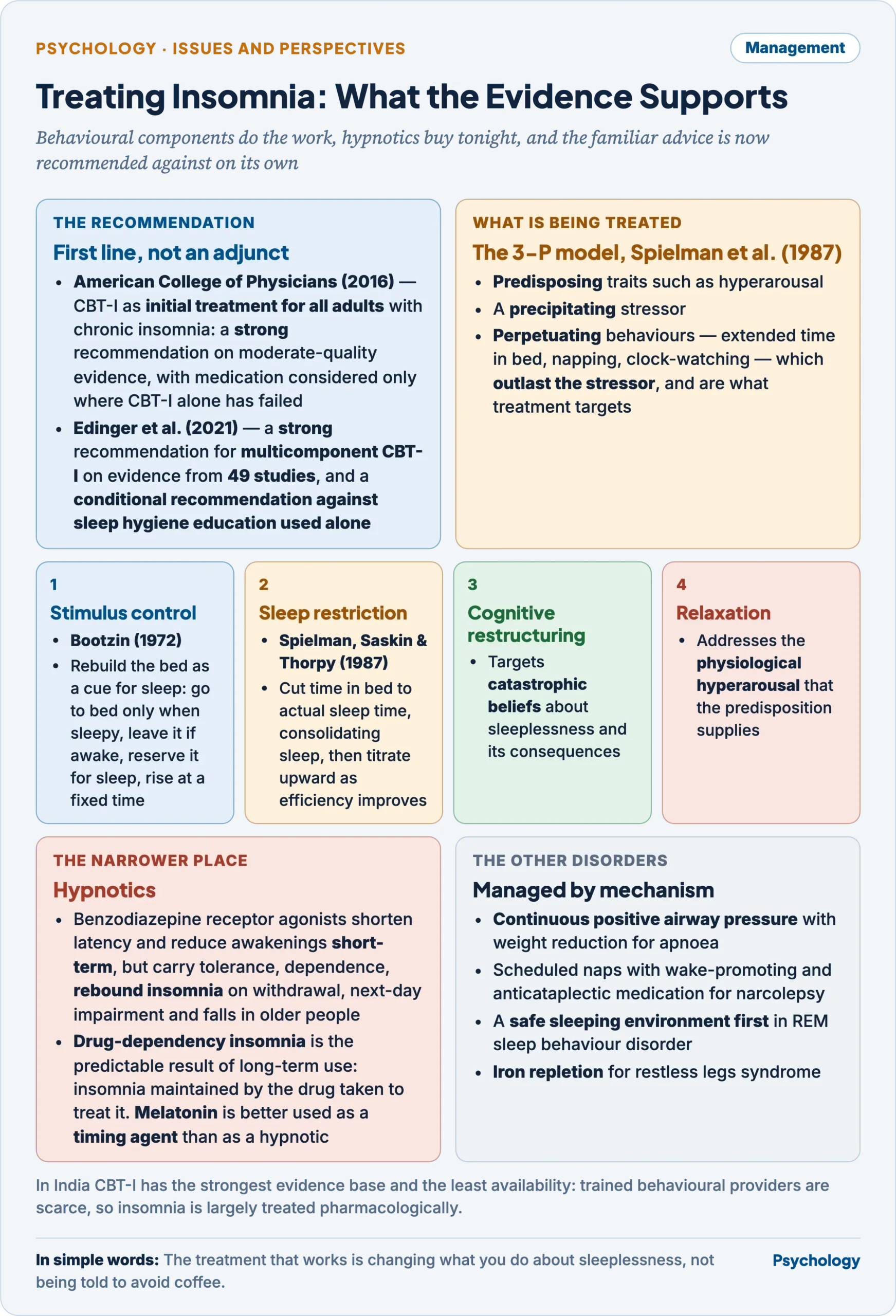
The behavioural components do the work; hypnotics shorten tonight’s latency and leave the perpetuating factors in place.
- Cognitive behavioural therapy for insomnia (CBT-I) is first-line treatment rather than an adjunct to medication, and two independent guideline bodies say so in the same terms.
- The American College of Physicians (2016) recommended CBT-I as initial treatment for all adults with chronic insomnia, a strong recommendation on moderate-quality evidence, with medication considered only where CBT-I alone has failed.
- Edinger and colleagues (2021) made a strong recommendation for multicomponent CBT-I on evidence from 49 studies, and a conditional recommendation against sleep hygiene education used alone.
- Its components are specific behavioural procedures rather than advice.
- Stimulus control (Bootzin, 1972) re-establishes the bed as a cue for sleep: go to bed only when sleepy, leave it if awake, reserve it for sleep, rise at a fixed time.
- Sleep restriction (Spielman, Saskin and Thorpy, 1987) curtails time in bed to match actual sleep time, consolidating sleep, then titrates upward as efficiency improves.
- Cognitive restructuring targets catastrophic beliefs about sleeplessness; relaxation addresses physiological hyperarousal.
- Hypnotics have a narrower place than prescribing patterns suggest. Benzodiazepine receptor agonists shorten latency and reduce awakenings short-term, but carry tolerance, dependence, rebound insomnia on withdrawal, next-day impairment and falls in older people.
- Drug-dependency insomnia is the predictable result of long-term use: insomnia maintained by the drug taken to treat it. Melatonin is better used as a timing agent than as a hypnotic.
- Other disorders are managed by mechanism: continuous positive airway pressure with weight reduction for apnoea; scheduled naps with wake-promoting and anticataplectic medication for narcolepsy; a safe sleeping environment first in REM sleep behaviour disorder; iron repletion for restless legs syndrome.
Indian context
- Indian community studies show a substantial, under-recognised burden of sleep-disordered breathing. Udwadia and colleagues (2004), in urban Mumbai men aged 35 to 65, estimated sleep-disordered breathing at 19.5 per cent and the apnoea-hypopnoea syndrome at 7.5 per cent; Sharma and colleagues (2006), in Delhi adults aged 30 to 60, extrapolated about 13.7 and 3.6 per cent respectively.
- Indian estimates vary widely with definition and sampling, so these are orders of magnitude rather than national rates.
- The Indian initiative on obstructive sleep apnoea guidelines (2014) gave the first India-specific consensus on screening, diagnosis and treatment, including commercial drivers — making fatigue-related road risk a transport-safety matter and not only a clinical one.
- Sleep laboratories are concentrated in a few tertiary institutions, so most sleep disorder in India is managed without polysomnography and insomnia is treated pharmacologically, trained behavioural providers being scarce.
Criticisms and evaluation
- The deprivation literature rests on short protocols in young, screened volunteers, and durations beyond 48 hours are no longer permitted, so the most-cited extreme findings are historical, uncontrolled and unrepeatable.
- Laboratory deprivation is not real sleep loss. Participants are monitored, motivated and relieved of ordinary demands, which understates impairment, while enforced boredom exaggerates the vigilance decrement.
- Single cases carry more weight than they should: the Gardner case has no baseline and no instrumentation adequate to exclude microsleeps, yet is cited as establishing what humans can tolerate.
- Classification is syndromal rather than aetiological. Only narcolepsy type 1 has a securely identified mechanism; insomnia, idiopathic hypersomnia and the disorders of arousal are defined by description, and prevalence rates for restless legs syndrome and the parasomnias rest on questionnaires of uncertain specificity.
- Treatment evidence is uneven: CBT-I has the strongest evidence base here and the least availability, and hypnotic trials are short and rarely measure daytime function.
- What survives is substantial, and five findings are secure.
- Sleep loss produces cumulative, dose-dependent impairment, and chronic restriction approaches the effects of total deprivation.
- People systematically underestimate their own impairment, so self-report cannot govern safety-critical scheduling.
- Impairment falls hardest on sustained attention, as instability and lapses rather than uniform slowing, and continuity of sleep matters independently of duration.
- Extreme deprivation produces reversible perceptual and cognitive disturbance, not psychotic illness.
- Narcolepsy type 1 follows loss of hypothalamic orexin neurons, and CBT-I rather than hypnotic medication is first-line for chronic insomnia.
Previous Year Questions
- 2016Describe the physiological changes that are accompanied by shifts in consciousness in the process of sleep. Also discuss major sleep disorders.
- 2012Enumerate different stages of sleep. Discuss the effects of sleep deprivation on cognitive performance.
- 2009What are the different stages of sleep? How are these stages assessed experimentally? Citing relevant research studies discuss the effects of sleep deprivation on cognitive, affective and behavioral dimensions.
- 1997How does sleep and sensory deprivation affect behaviour of individuals who go for aviation and space flights?