

Study of consciousness – sleep-wake schedules.
Official Syllabus: Paper I · Unit 14 Issues and Perspectives in Modern Contemporary Psychology
“Sleep is a reversible behavioral state of perceptual disengagement from and unresponsiveness to the environment.”
— Carskadon and Dement (2011)
Every word in that definition excludes something. Reversible separates sleep from coma and anaesthesia; perceptual disengagement separates it from quiet wakefulness; and behavioral concedes a definition of convenience, since sleep is an amalgam of physiological processes no behavioural criterion captures. What the electroencephalograph added was that one word had been covering two entirely different brain states.
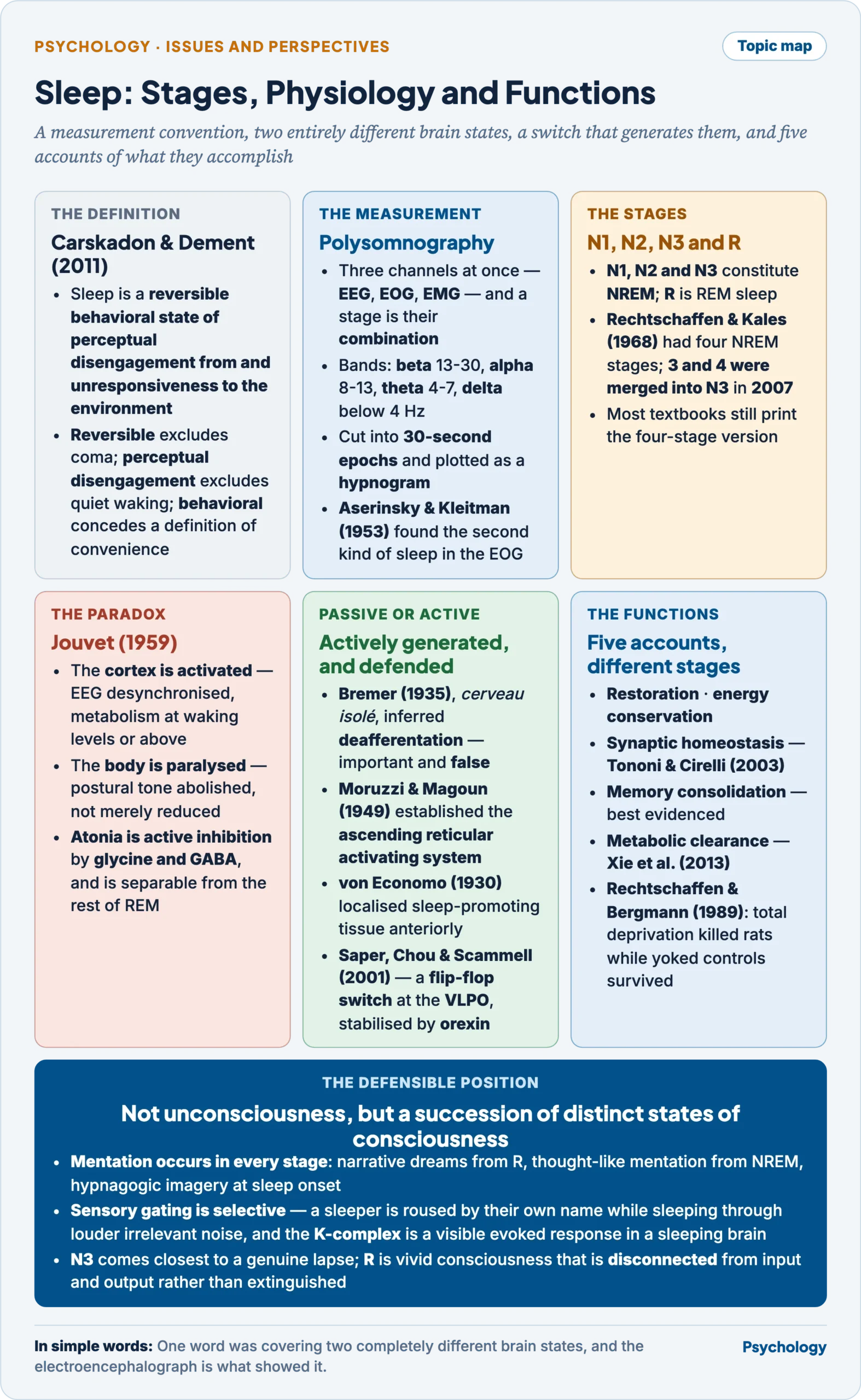
The stages are a measurement convention; what generates sleep and what it accomplishes are what it was built to study.
How sleep is assessed experimentally
- Polysomnography records three channels at once, and a stage is defined by their combination, not by any one of them.
- Electroencephalogram (EEG) — the summed activity of cortical neurons recorded from the scalp, classified by frequency and amplitude.
- Electro-oculogram (EOG) — electrodes beside the eyes, registering slow rolling and rapid eye movements.
- Electromyogram (EMG) — electrodes under the chin, registering tonic muscle tone and phasic twitches.
- The EEG bands are the vocabulary of staging: beta (about 13-30 Hz, alert waking), alpha (about 8-13 Hz, relaxed waking with eyes closed), theta (about 4-7 Hz) and delta (below 4 Hz, the slow-wave activity of deep sleep).
- The record is cut into consecutive 30-second epochs, each scored as one stage and plotted as a hypnogram — which is why a night’s architecture looks like a staircase rather than a gradient.
- Aserinsky and Kleitman (1953) discovered the second kind of sleep by watching the EOG: bouts of rapid eye movement recurred periodically through the night, and waking participants during them produced detailed, visually vivid dream reports.
- Their contrast was sharp: 20 detailed dreams from 27 such awakenings, against 19 complete failures of recall from 23 awakenings during ocular quiescence (Aserinsky and Kleitman, 1953).
- Dement and Kleitman (1957) turned this into a method, establishing that dream recall, estimated dream duration and the direction of eye movement all tracked the rapid-eye-movement state — making a subjective report experimentally tractable.
- Two limitations are intrinsic. The first-night effect means a first laboratory night under-represents deep and REM sleep, so one night is a biased sample, and electrodes in an unfamiliar bed alter what is measured. Actigraphy at home trades precision for ecological validity.
The stages of sleep
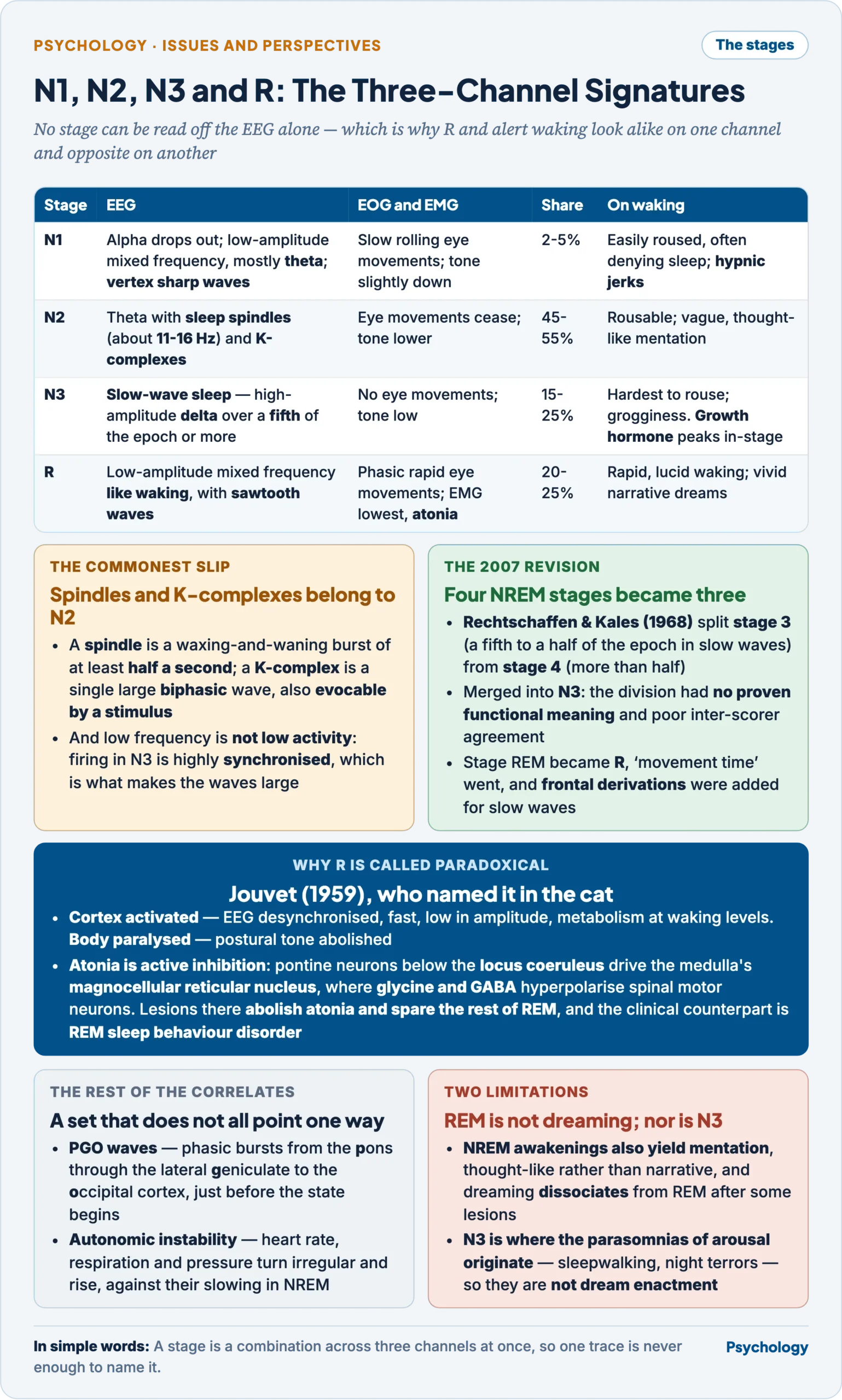
Each stage is a combination across three channels, which is why none can be read off the EEG alone — and why REM and alert waking look alike on one channel and opposite on another.
- The current scheme recognises four stages besides wake: N1, N2 and N3, together constituting NREM (non-rapid eye movement) sleep, and R, which is REM (rapid eye movement) sleep.
- The older scheme of Rechtschaffen and Kales (1968) had four NREM stages — 1, 2, 3 and 4 — the last two separated by how much of the epoch slow waves filled: a fifth to a half for stage 3, more than half for stage 4.
- Stages 3 and 4 were merged into N3 when the rules were revised in 2007, the division having no proven functional meaning and poor inter-scorer agreement. Stage REM became stage R, “movement time” was dropped, and frontal derivations were added for scoring slow waves.
- Most textbooks still print the four-stage NREM version. The current total — N1, N2, N3 and R — is the one to state, naming the older scheme as the earlier convention it is.
| Stage | EEG | EOG and EMG | Share of adult night | Character on waking |
|---|---|---|---|---|
| N1 | Alpha drops out; low-amplitude mixed frequency, mostly theta; vertex sharp waves | Slow rolling eye movements; tone slightly reduced | 2-5% | Easily roused, often denying having slept; hypnic jerks, hypnagogic imagery |
| N2 | Theta background with sleep spindles (about 11-16 Hz bursts) and K-complexes | Eye movements cease; tone lower | 45-55% | Rousable with moderate stimulation; vague, thought-like mentation |
| N3 | Slow-wave sleep — high-amplitude delta over at least a fifth of the epoch | No eye movements; tone low | 15-25% | Hardest to rouse; grogginess; growth hormone secreted |
| R | Low-amplitude mixed frequency resembling waking, with sawtooth waves | Phasic rapid eye movements; EMG at its lowest — atonia | 20-25% | Rapid, lucid waking; vivid narrative dream reports |
- The proportions are conventional adult values and shift markedly with age; the stages are defined by their signatures, not by them. Each range is reported independently, so they are not meant to be added — taken together they do not sum to a hundred, and treating them as a partition of the night is a mistake.
- Sleep spindles and K-complexes belong to N2, not N1. A spindle is a waxing-and-waning burst of at least half a second; a K-complex is a single large biphasic wave, arising spontaneously and also evocable by an external stimulus.
- N3 is where the parasomnias of arousal originate — sleepwalking, confusional arousal, night terrors — so they are not dream enactment and the sleeper has no narrative to give. They are treated in Sleep Deprivation and Sleep Disorders.
- Low frequency is not low activity: cortical firing in N3 is not silenced but highly synchronised, which is what produces the large slow waves.
Why REM sleep is called paradoxical
- Jouvet (1959), who described the muscle atonia in the cat and gave the state its name of paradoxical sleep, identified both halves of the paradox.
- The cortex is activated — the EEG desynchronised, fast and low in amplitude, close to alert waking, with cerebral metabolism and blood flow at waking levels or above.
- The body is paralysed — postural tone is not merely reduced but abolished, the knee-jerk reflex suppressed, voluntary movement impossible.
- REM atonia is active inhibition, not relaxation. Pontine neurons below the locus coeruleus project to the magnocellular reticular nucleus of the medulla, which sends inhibitory axons to spinal motor neurons; glycine and GABA hyperpolarise them below threshold.
- Lesions confined to this pathway abolish the atonia and leave the rest of REM sleep intact, so atonia is a separable, actively imposed component.
- Its clinical counterpart is REM sleep behaviour disorder, in which the atonia fails and dreams are enacted.
- The remaining correlates form a coherent set that does not all point one way.
- PGO waves — phasic bursts originating in the pons, relayed through the lateral geniculate nucleus to the occipital cortex, appearing shortly before the state begins.
- Phasic eye movements and small distal twitches break through the atonia.
- Autonomic instability — heart rate, respiration and blood pressure turn irregular and rise, against their steady slowing in NREM sleep.
- Thermoregulation is suspended, with shivering and sweating largely absent, so the sleeper becomes transiently poikilothermic.
- Genital tumescence occurs independently of dream content.
- Dream recall is highest from this state, and the reports are narrative, vivid and self-involving.
- The limitation to carry is that REM and dreaming are not the same thing: NREM awakenings also yield mentation, thought-like rather than narrative, and dreaming dissociates from REM sleep after some brain lesions. Dream theory is set out in Dreams: Theories and Functions.
The architecture of a night and the sleep-wake cycle
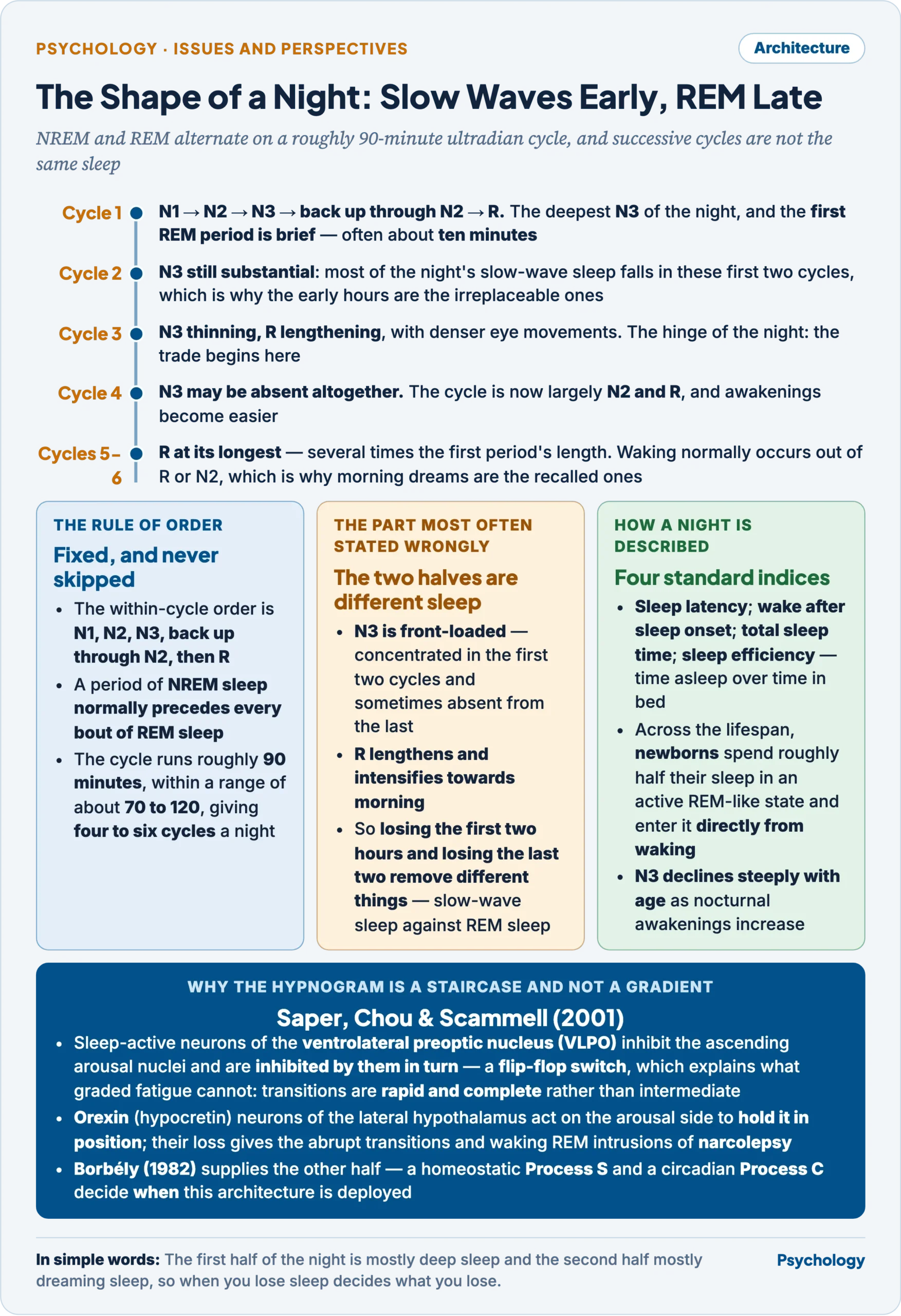
The two halves of the night are not the same sleep: slow waves early, REM late, so losing the last two hours and the first two remove different things.
- NREM and REM sleep alternate in an ultradian cycle of roughly 90 minutes, within a range of about 70 to 120, giving four to six cycles a night.
- The order within a cycle is fixed — N1, N2, N3, back up through N2, then REM — and a period of NREM sleep normally precedes every bout of REM sleep.
- Successive cycles differ systematically, and this is the part most often stated wrongly.
- N3 is front-loaded — most slow-wave sleep falls in the first two cycles and it may be absent from the last.
- REM lengthens and intensifies towards morning — the first REM period is brief, often about ten minutes, while the final ones run several times longer with denser eye movements.
- A night is described by sleep latency, wake after sleep onset, total sleep time and sleep efficiency — time asleep over time in bed.
- Across the lifespan, newborns spend roughly half their sleep in an active REM-like state and enter it directly from waking, while N3 declines steeply with age as nocturnal awakenings increase.
- Borbély (1982) set out the two-process model governing when this architecture is deployed: a homeostatic Process S, building with time awake and dissipating in sleep, interacting with a circadian Process C independent of prior waking. The circadian half belongs to Sleep-Wake Schedules and Circadian Rhythms.
Sleep is an actively generated state, not a passive one
- The passive account came first and had a real basis. Bremer (1935) cut the cat brainstem at the midbrain — the cerveau isolé — and found the isolated forebrain locked in a permanent slow-wave state, while a lower cut, separating brain from spinal cord, left sleep and waking alternating.
- His inference was deafferentation: sleep is what happens when sensory inflow to the cortex is interrupted, so sleep is the default and waking is what needs explaining.
- Five lines of evidence overturn that inference.
- Arousal is generated, not merely admitted. Moruzzi and Magoun (1949) stimulated the brainstem reticular formation in cats and desynchronised the EEG exactly as natural arousal does, establishing an ascending reticular activating system fed by collaterals from the sensory pathways — the system Bremer’s cut had severed.
- Sleep has its own generators, and destroying them prevents sleep. von Economo (1930), from autopsies of encephalitis lethargica patients, localised sleep-promoting tissue anteriorly and wake-promoting tissue posteriorly: lesions of the preoptic and anterior hypothalamus gave severe insomnia, of the posterior hypothalamus somnolence and coma.
- Those generators have been identified. Sleep-active neurons of the ventrolateral preoptic nucleus (VLPO) inhibit the ascending arousal nuclei and are inhibited by them in turn.
- Saper, Chou and Scammell (2001) called this mutual inhibition a flip-flop switch, which explains what graded fatigue cannot: transitions are rapid and complete rather than intermediate.
- The switch is stabilised by orexin. Orexin (hypocretin) neurons of the lateral hypothalamus act on the arousal side to hold it in position, and their loss produces the abrupt state transitions and intrusions of REM phenomena into waking — cataplexy, sleep paralysis, hypnagogic hallucination — of narcolepsy.
- Sleep is homeostatically defended. Selective deprivation of REM sleep produces REM rebound on recovery nights, and slow-wave activity rebounds after extended waking. Nothing merely passive is repaid with interest.
- Rechtschaffen and Bergmann (1989), reviewing a series of disk-over-water experiments in rats, described total sleep deprivation reliably producing a syndrome ending in death, while yoked controls given identical stimulation but allowed sleep survived.
- The position the evidence supports is unambiguous: sleep is an actively generated, switch-controlled, homeostatically defended brain state with its own generators and products. Deafferentation is historically important and false.
The neurochemistry of waking and sleeping
- Waking is sustained by parallel ascending systems, which is why no single lesion abolishes it: acetylcholine from pontine and basal forebrain nuclei, noradrenaline from the locus coeruleus, serotonin from the raphe nuclei, histamine from the tuberomammillary nucleus and orexin from the lateral hypothalamus.
- Two everyday facts follow. Antihistamines that enter the brain block histaminergic arousal and cause drowsiness; and caffeine promotes wakefulness by antagonising adenosine receptors, adenosine being the metabolite that accumulates with time awake and signals homeostatic sleep pressure.
- REM sleep is produced reciprocally within the pons: cholinergic REM-on cells fire at high rates in REM sleep and waking, while aminergic REM-off cells of the locus coeruleus and raphe fall nearly silent.
- Cholinergic agonists applied to the pons lengthen and hasten REM bouts.
- NREM sleep is maintained by GABA from preoptic and basal forebrain neurons, the mechanism benzodiazepines and many general anaesthetics exploit.
Sleep as a state of consciousness rather than its absence
- The issue turns on separating the level of consciousness from its content, a distinction set out in Consciousness: Nature, Levels and Altered States: sleep lowers the level without emptying the content.
- Three lines of evidence point to consciousness persisting through sleep.
- Mentation occurs in every stage. REM awakenings yield narrative, hallucinatory dreams (Aserinsky and Kleitman, 1953); NREM awakenings thought-like mentation; sleep onset hypnagogic imagery.
- Sensory gating is selective, not absolute. A sleeper is roused by their own name or an infant’s cry while sleeping through louder irrelevant noise, so stimuli are still evaluated for significance. The K-complex is a visible evoked response to an external stimulus in a sleeping brain.
- Volitional awareness is possible within sleep. In lucid dreaming, sleepers who know they are dreaming signal with prearranged eye movements that appear on the EOG while polysomnography confirms uninterrupted REM sleep.
- Three features mark it off sharply from waking consciousness: loss of reflective self-awareness and reality testing, loss of voluntary control over the contents, and dense amnesia for almost all of the night.
- N3 additionally involves a breakdown of long-range cortical effective connectivity, which is why awakening from it produces confusion rather than a report.
- The defensible position is that sleep is not unconsciousness but a succession of distinct states of consciousness: N3 comes closest to a genuine lapse, while REM sleep is vivid consciousness that is disconnected — cut off from sensory input and motor output — rather than extinguished.
- The limitation travels with the position: all of it rests on report after awakening, and an absent report is not an absent experience, so the content of N3 is underdetermined rather than empty.
The functions of sleep
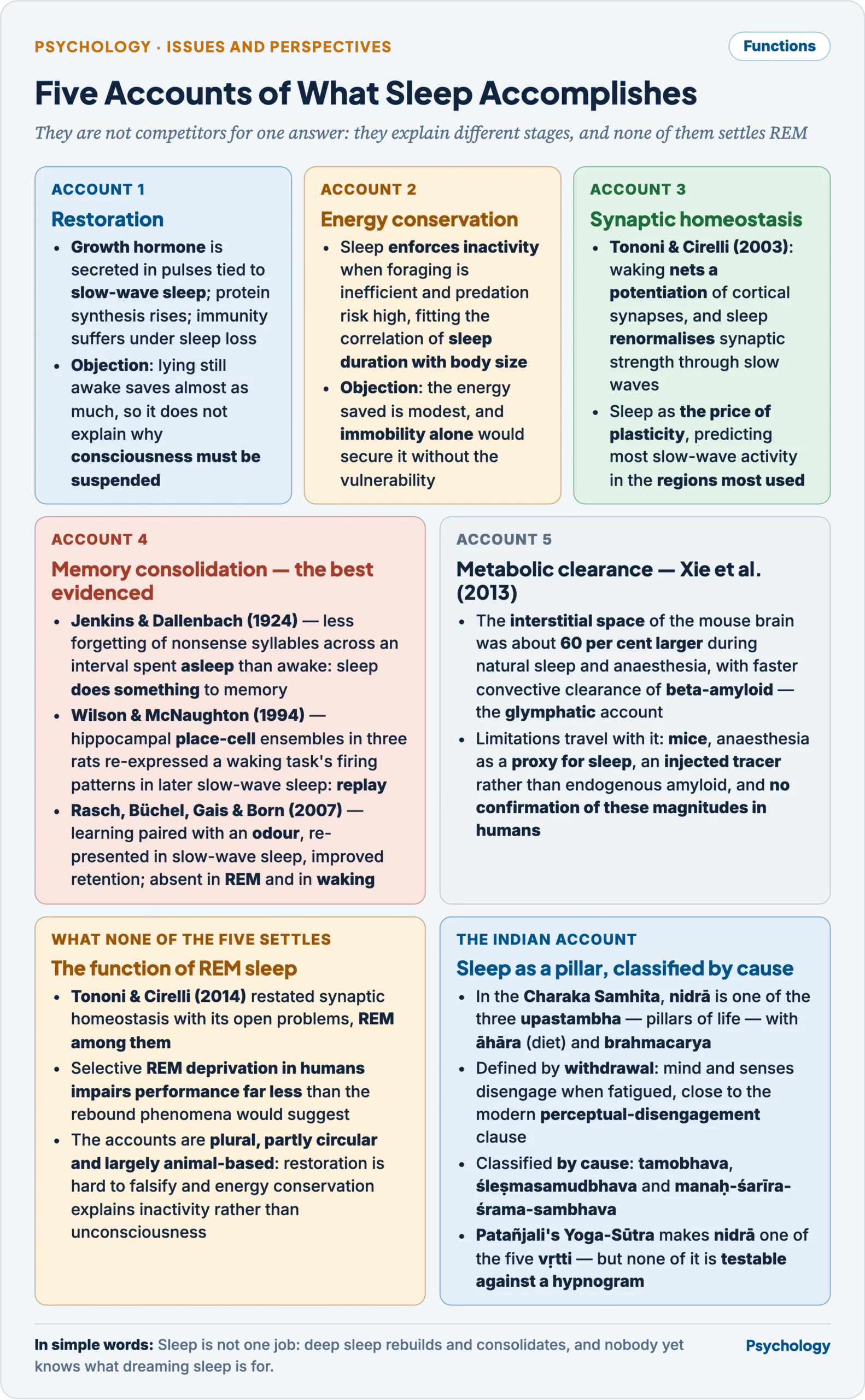
The five accounts are not competitors for one answer: they explain different stages, and the function of REM sleep is what none of them settles.
- Restoration. Growth hormone is secreted in pulses tied to slow-wave sleep, protein synthesis rises, and immune function is impaired by sleep loss. Objection: lying still awake saves almost as much, so restoration does not explain why consciousness must be suspended.
- Energy conservation and adaptive inactivity. On the evolutionary account sleep enforces inactivity when foraging is inefficient and predation risk high, which fits the correlation of sleep duration with body size across species.
- Objection: the energy saved is modest, and immobility alone would secure it without the vulnerability of unconsciousness.
- Synaptic homeostasis. Tononi and Cirelli (2003) proposed that waking nets a potentiation of cortical synapses that cannot continue indefinitely, and that sleep renormalises synaptic strength through slow-wave activity — sleep as the price the brain pays for plasticity.
- The prediction is specific: slow-wave activity should rise in the cortical regions most used before sleep and decline across the night as downscaling proceeds.
- Tononi and Cirelli (2014) restated the hypothesis with its open problems, the function of REM sleep among them.
- Memory consolidation. This is the best-evidenced function, and the evidence is cumulative.
- Jenkins and Dallenbach (1924) found less forgetting of nonsense syllables across an interval spent asleep than across an equal interval awake — the first sign that sleep does something to memory rather than merely avoiding interference.
- Wilson and McNaughton (1994) recorded large ensembles of hippocampal place cells in three rats and found the firing patterns of a waking spatial task re-expressed in later slow-wave sleep — replay, the mechanism consolidation theories had postulated.
- Rasch, Büchel, Gais and Born (2007) paired declarative learning with an odour, re-presented it during slow-wave sleep, and improved retention. The effect was absent in REM sleep, in waking, and when the odour was absent at learning — so it cues a sleep-dependent process, not general arousal.
- Metabolic clearance. Xie and colleagues (2013) found the interstitial space of the mouse brain about 60 per cent larger during natural sleep and anaesthesia, with correspondingly faster convective clearance of beta-amyloid — the glymphatic account of why sleep loss has immediate cognitive consequences.
- Its limitations travel with it: mice, anaesthesia as a proxy for sleep, an injected tracer rather than endogenous amyloid, and no confirmation of these magnitudes in humans.
- The cognitive, affective and behavioural costs of losing these functions are set out in Sleep Deprivation and Sleep Disorders.
The account of sleep in the Indian tradition
- Classical Indian medicine treats sleep as a positive requirement, not an interruption. In the Charaka Samhita, nidrā is one of the three upastambha — the supporting pillars of life — with āhāra (diet) and brahmacarya (regulated conduct).
- It is defined by withdrawal rather than absence: mind and senses disengage from their objects when fatigued, close to the perceptual-disengagement clause of the modern definition.
- The classification is by cause, with three principal types — tamobhava (from tamas), śleṣmasamudbhava (from kapha) and manaḥ-śarīra-śrama-sambhava (from mental and physical exertion).
- Divāsvapna, daytime sleep, is proscribed for most people, and no fixed duration is set, the requirement varying with constitution (prakṛti).
- Patañjali’s Yoga-Sūtra makes the sharper claim: nidrā is one of the five vṛtti, so sleep is a process of consciousness with its own character rather than a gap in mental life.
- The limitation is plain: these are aetiological and prescriptive schemes that do not map onto stages and cannot be tested against a hypnogram.
Criticisms and limitations
- The stages are a scoring convention, not natural kinds. Thirty-second epochs impose discreteness on a continuous process, one stage per epoch discards everything else in that half-minute, and transitions smear across boundaries.
- The 2007 revision traded information for reliability. Merging stages 3 and 4 raised inter-scorer agreement and lost a gradation some researchers still want, and frontal derivations changed how much N3 the same sleeper appears to have.
- The normative percentages are weak ground, varying with age, sex, prior sleep debt and laboratory conditions, so departure from them is not pathology.
- The measurement alters the object: the first-night effect, electrode load and single-night sampling all bias laboratory architecture.
- REM is not dreaming. The equation was made early and has needed repeated qualification, since NREM mentation is common and the two dissociate after some lesions.
- The functional accounts are plural, partly circular and largely animal-based. Restoration is hard to falsify, energy conservation explains inactivity rather than unconsciousness, synaptic homeostasis rests on rodent recordings, and glymphatic clearance on mice under anaesthesia.
- REM sleep’s function remains open, as Tononi and Cirelli (2014) concede, and selective REM deprivation in humans impairs performance far less than the rebound phenomena would suggest.
- What is nevertheless secure is substantial: the two-state division of sleep, the three-channel signatures of each stage, the cyclical architecture with its early slow waves and late REM, the switch that generates the states, and the role of sleep in consolidating memory.
Previous Year Questions
- 2022Is sleep a conscious phenomenon? Illustrate different states of sleep and explain the functions and role it serves in human life.
- 2018Is sleep a passive process? Justify your answer with proper scientific support.
- 2017What is paradoxical in REM sleep? How active is a person during different stages of sleep?
- 2016Describe the physiological changes that are accompanied by shifts in consciousness in the process of sleep. Also discuss major sleep disorders.
- 2012Enumerate different stages of sleep. Discuss the effects of sleep deprivation on cognitive performance.
- 2009What are the different stages of sleep? How are these stages assessed experimentally? Citing relevant research studies discuss the effects of sleep deprivation on cognitive, affective and behavioral dimensions.
- 1998Comment on: Detail the correlates of Rapid Eye Movements (REM) in sleep.