

Official syllabusPaper I · Unit 13 · Language and Communication
Theories of language development – Skinner and Chomsky.
Definition
The cognition hypothesis: cognitive development is a prerequisite for language development and accounts for it, so a linguistic form enters the child’s speech only once the concept it encodes is already available.
after Cromer (1974)
Between reinforcement and innate grammar sits a family of accounts placing the engine of language development elsewhere — in general cognition, in adult-child interaction, or in the statistics of the input. All deny that conditioning or a pre-specified grammar suffices.
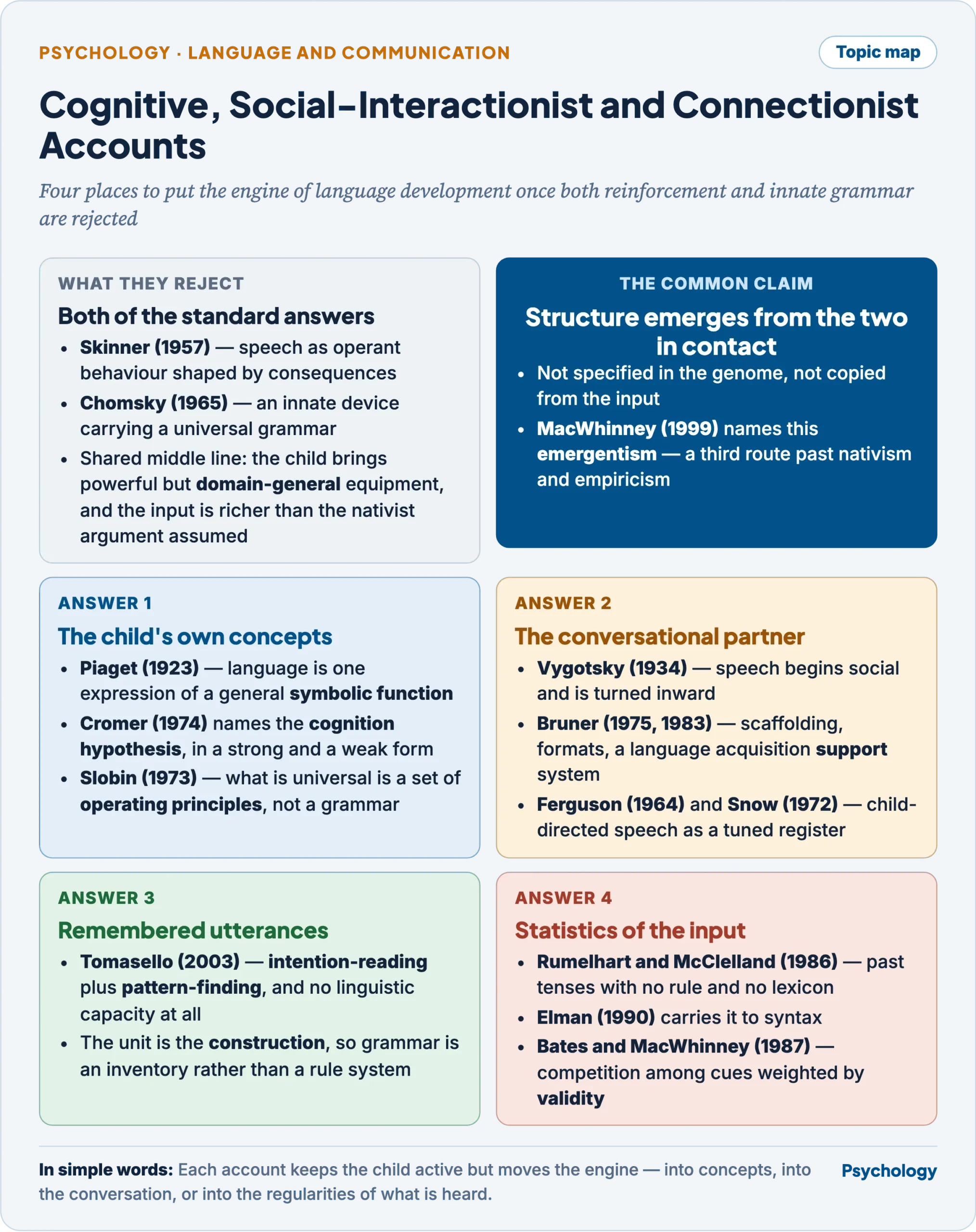
Four answers to one question: structure comes from the child’s concepts, the conversational partner, or the input’s own regularities.
What these accounts are arguing against
- Skinner (1957) treated speech as operant behaviour shaped by consequences, its units the mand (a request reinforced by getting the thing) and the tact (a label reinforced by approval).
- Chomsky (1965) replied that children’s output is novel, rule-governed and richer than the input, and posited an innate language acquisition device carrying a universal grammar.
- Both are treated at length in the companion article on the behaviourist-nativist debate. The accounts below take a middle line: the child brings powerful but domain-general equipment — concepts, imitation, attention-sharing, statistical learning — and the input is richer than nativism assumed.
- Structure then emerges from the two in contact, which makes these explanations developmental, not architectural.
Piaget’s cognition-first account of language development
- Piaget (1923), in The Language and Thought of the Child, treated language as one expression of a general symbolic function, not a faculty of its own. Thought is built from action; speech reports what the sensorimotor child has constructed.
- The mechanism is the close of the sensorimotor stage, at roughly 18 to 24 months. Object permanence (a hidden thing still exists), deferred imitation and symbolic play mark the capacity to let one thing stand for another; words are its social case.
- Cromer (1974) named this the cognition hypothesis. Its strong form makes cognitive attainment necessary and sufficient; the weak form, defended by Cromer (1979), makes it necessary but adds that linguistic machinery must encode it.
The evidence and the objections
- Sinclair-de-Zwart (1969) gave the position its test. Non-conserving children trained in the comparative vocabulary of conservation — more, less, longer — used the terms correctly and still failed conservation tasks: language training did not create the operation. Later work qualifies this: training on the operation itself does succeed.
- The decisive objection is dissociation. Specific language impairment pairs normal non-verbal cognition with disordered grammar; Williams syndrome pairs fluent, structured speech with marked cognitive deficit. On a cognition-first account neither should exist.
- A second objection is timing: the attainments Piaget nominated are in place well before the grammatical growth they license, and nothing addresses why acquisition is so fast or so uniform.
Slobin’s cognitive theory of language development

Each principle names something a learner attends to, so each also says which languages make a meaning easy and which make it late.
- Slobin (1973), in Cognitive Prerequisites for the Development of Grammar, argued that what is universal is not a grammar but a set of operating principles — procedures applied to any input to perceive, store and analyse it.
- The claim is cognitive, not nativist: the principles are processing strategies, so acquisition order follows from how easily a processor detects a language’s forms, not from a parameter being set.
- Seven principles were stated, conventionally lettered A to G.
- A. Ends of words — suffixes come before prefixes and free particles.
- B. Modifiable word forms — grammatical meaning is expected in changes of word shape.
- C. Order of words and morphemes — sequence is meaningful and preserved.
- D. No interruption or rearrangement — discontinuous and embedded structures come late.
- E. Overt and clear marking — an audibly marked relation precedes one left implicit.
- F. Avoid exceptions — the child regularises, so overregularisation needs no separate explanation.
- G. Semantically sensible markers — one marker for one meaning precedes a syncretic marker.
- Two do work no nativist account attempts: F derives overregularisation from a processing preference, and E and G entail that one meaning is acquired at different ages in different languages.
The cross-linguistic evidence
- The method is the real contribution: hold age and concept constant, vary the language, attribute the difference to the form. It culminated in The Crosslinguistic Study of Language Acquisition (Slobin, 1985), the list growing to forty.
- Turkish is the strongest case for A and E, its inflections being suffixal, regular and transparent. Aksu-Koç and Slobin (1985) record Turkish children acquiring the case paradigm early, with utterances short but rarely ungrammatical.
- Slobin and Bever (1982) tested children aged 2;0 to 4;4 in English (ordered, uninflected), Italian, Serbo-Croatian and Turkish (minimally ordered, inflected) on acting out transitive sentences. Each group responded to its own canonical sentence schema and failed on sequences violating it.
- From inside the programme, Johnston and Slobin (1979) compared locative terms across those languages and found Turkish’s postpositions did not confer the advantage principle A implies.
- Haznedar (2014) reports abundant case-omission errors in early Turkish, against the error-free picture. Bowerman objected that nothing fixes how many principles there are, or which wins when two conflict.
Vygotsky: social speech, private speech and inner speech
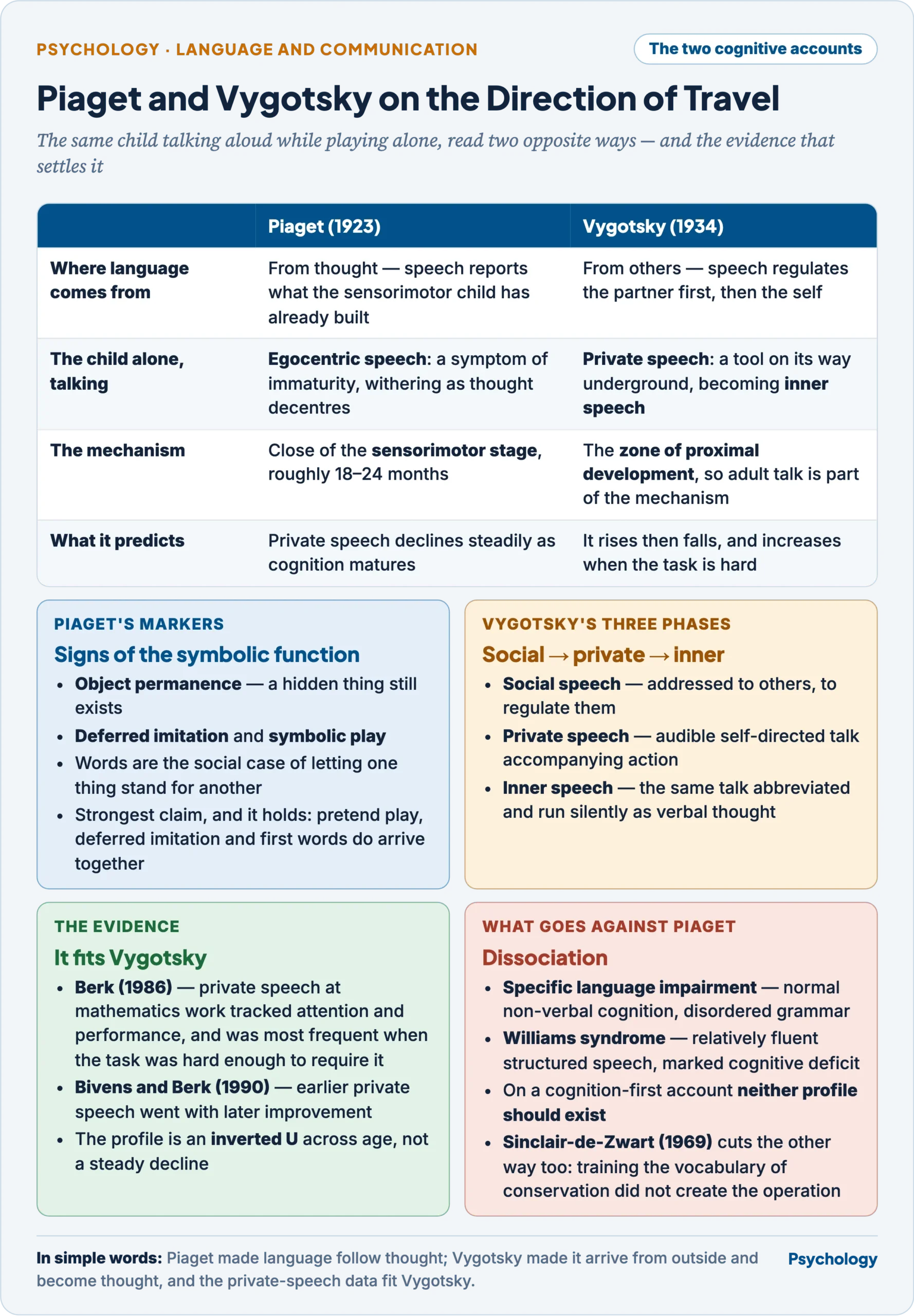
The same behaviour — a child talking aloud while playing alone — is immaturity on one account, self-control on the other.
- Vygotsky (1934), in Thought and Language, reversed Piaget’s direction of travel: language begins as a social instrument for regulating others and is turned inward to regulate the self, so higher mental function exists between people before it exists within one.
- It runs in three phases: social speech addressed to others; private speech, audible self-directed talk accompanying action; and inner speech, the same talk abbreviated and run silently as verbal thought.
- All of it unfolds inside the zone of proximal development, so the adult’s talk is part of the mechanism, not mere exposure.
- Where Piaget read a child’s monologue as egocentric speech, withering as thought decentres, Vygotsky read it as speech going underground to become thought.
- Berk (1986), observing schoolchildren at mathematics work, related private speech to attention and performance and found it most frequent when the task was hard enough to need it; Bivens and Berk (1990) found it predicting later improvement.
- The profile fits Vygotsky, not Piaget: private speech rises then falls with age in an inverted U, increases with difficulty, and tracks self-regulation. Its limitation is that this is a programme rather than a model of grammar, silent on how syntax is acquired.
Bruner: scaffolding, formats and the language acquisition support system
- Bruner (1975) located the origin of grammar in pre-linguistic turn-taking, where agent and object are already distinguished in action.
- Wood, Bruner and Ross (1976) introduced scaffolding, the process letting a novice solve a problem beyond their unassisted reach. Thirty children aged three to five were tutored in building a wooden-block pyramid, the support analysed into six functions.
- Recruitment of interest, reduction in degrees of freedom (simplifying the task), direction maintenance, marking critical features, frustration control, and demonstration of a solution for imitation.
- All run under contingent control: support is calibrated to performance moment by moment and withdrawn as competence grows, so the scaffold is temporary by design.
- Bruner (1983), in Child’s Talk, carried this into language through formats — repeated script-like routines such as peekaboo, give-and-take and picture-book reading. Each supplies a fixed frame with one varying slot, the structure needed to work out what a new word contributes.
- The adult side is the language acquisition support system, Bruner’s counterweight to Chomsky’s device: a partner who repeats, simplifies, holds a slot open and treats the child’s output as communicative makes the regularities detectable.
- Criticism: scaffolding describes good interaction without specifying how grammar transfers, and the contingent-instruction finding of Wood, Wood and Middleton (1978) has not held up. A preregistered direct replication by Smit and colleagues (2025) assigned 285 three-year-olds to contingent instruction or one of three less responsive methods, matched the original’s instruction times and tutor accuracy, and found no advantage for contingency in children’s later unassisted problem-solving, the evidence favouring the null.
Child-directed speech: Snow, Ferguson and the evidence on input
- Ferguson (1964), in Baby Talk in Six Languages, established the phenomenon cross-linguistically, and Ferguson (1977) analysed it as a simplified register — a conventionalised variety of the adult language with its own lexicon and phonology.
- Snow (1972) showed the adjustment is real and graded: mothers’ speech to two-year-olds was simpler and more redundant than their speech to ten-year-olds, and experienced mothers predicted a child’s needs only slightly better than non-mothers.
- Its features are consistent — shorter utterances, slower rate, exaggerated high-pitched prosody, repetition, recasting of the child’s utterance, reference to the here and now.
- If input is this tuned to the learner, the poverty of the stimulus motivating an innate grammar is overstated.
- But this proves less than it claims. Newport, Gleitman and Gleitman (1977) found the effects of maternal style narrow and item-specific; in the reanalysis by Gleitman, Newport and Gleitman (1984) they appeared mainly in the youngest group, where greater complexity sped growth.
- The register is also not universal: Ochs and Schieffelin (1984) describe Kaluli caregivers speaking for the infant rather than to it, and Samoan caregivers declining to simplify at all.
- Shneidman and Goldin-Meadow (2012) quantified the gap: Yucatec Maya children received roughly a tenth as much directly addressed speech as a Chicago group, yet directed, not overheard, speech predicted their vocabulary growth.
- Cristia and colleagues (2017) report Tsimane’ children in Bolivia addressed directly for only minutes per hour and acquiring language normally, so the register facilitates acquisition without being necessary.
- An Indian anchor: Shukla and Mohanty (1995) relate structural properties of maternal input to children’s syntactic development, in a setting where joint families and sibling caretaking spread input widely.
Tomasello’s usage-based account
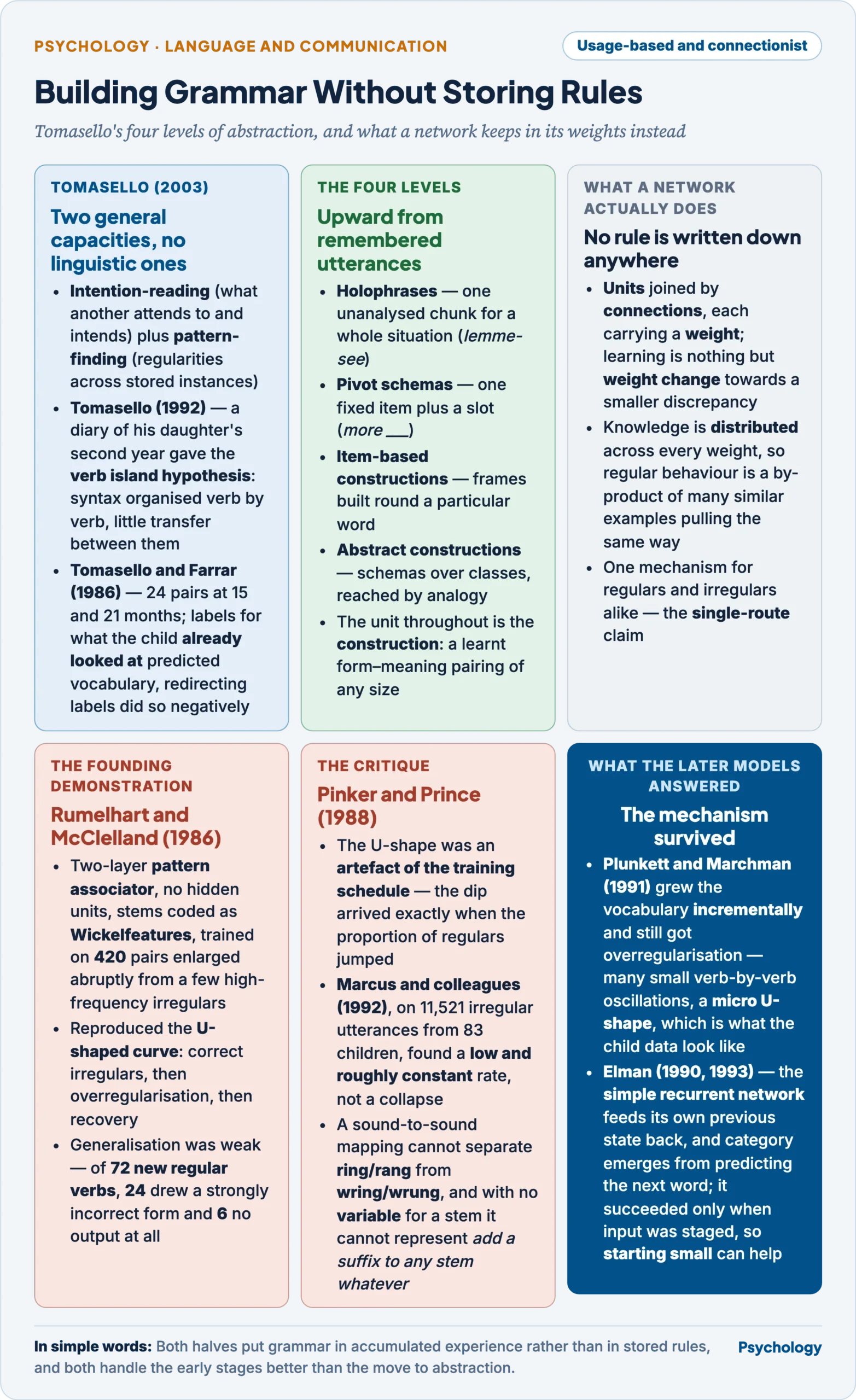
Both reject stored rules: the usage-based account builds structure from remembered utterances, the network keeps it in connection strengths.
- Tomasello (2003), in Constructing a Language, argues that language is acquired by two general capacities and no linguistic ones: intention-reading, working out what another person attends to and intends, and pattern-finding, extracting regularities from instances.
- The unit of acquisition is the construction, a learnt pairing of form with meaning, so grammar is an inventory of constructions rather than a rule system over a lexicon, reached through four levels of abstraction.
- Holophrases — a whole situation carried by one unanalysed chunk (lemme-see).
- Pivot schemas — one fixed item with a slot (more _, _ gone).
- Item-based constructions — frames organised around a particular word, so early grammar is verb-by-verb rather than general.
- Abstract constructions — schemas over classes of item, reached by analogy across many item-based frames.
- Tomasello (1992), a diary study of his daughter’s second year, gave the verb island hypothesis its evidence: a two-year-old’s syntax is organised around individual verbs, each with its own argument pattern and little transfer.
- Tomasello and Farrar (1986) supplied the social half. Twenty-four mother-child pairs were videotaped at 15 and 21 months; within joint attentional episodes, mothers’ labels for objects the child was already looking at correlated positively with vocabulary at 21 months, labels redirecting attention negatively.
- Criticism: that evidence is correlational, so whether joint attention drives vocabulary growth stays open; and the account handles the early stages well and the move to abstraction least well, analogy being invoked without being specified.
Connectionist models of language development
What a network actually does
- A connectionist network is a set of simple units joined by connections, each carrying a weight — a number stating how strongly one unit excites or inhibits the next.
- Features of the stimulus switch input units on, activation spreads, and the active output units are the response.
- Learning is nothing but weight change: the output is compared with the correct one and every weight nudged in the direction that shrinks the discrepancy, until the weights handle the whole set.
- What the network knows is therefore distributed — no stored rule, no list of words, nowhere that add -ed is written down.
- One mechanism thus handles regular and irregular forms alike: a single-route claim, against the dual-route account in which a rule generates regulars and a memory store supplies irregulars.
- A two-layer network wires input straight to output and learns only simple mappings; a hidden layer, trained by back-propagation of the error signal, builds its own intermediate representations.
The Rumelhart and McClelland past-tense model
- Rumelhart and McClelland (1986) built the founding demonstration: a network taking a verb stem’s phonological form and producing that of its past tense, with no lexicon and no rule.
- The architecture is minimal — a two-layer pattern associator with no hidden units, trained by the perceptron convergence procedure. Stems were coded as Wickelfeatures, trigrams of phonological features, giving 460 units a side.
- Training used 420 stem-past pairs: a handful of high-frequency verbs, mostly irregular, with the set then abruptly enlarged to the full 420, overwhelmingly regular.
- The celebrated result was children’s three-phase profile: correct irregulars first, then overregularisation (comed, goed) reaching even irregulars previously produced correctly, then recovery — the U-shaped curve.
- Generalisation was weak, and this is usually misreported. Rumelhart and McClelland (1986) submitted seventy-two new regular verbs to the trained network.
- Twenty-four of them drew a strong tendency to an incorrect form, a third of the set, and six produced no output above threshold at all (Rumelhart and McClelland, 1986).
- Counting only the seriously wrong forms, Pinker and Prince (1988) put the failure rate at twenty of the seventy-two — after the network had been trained some two hundred times on each of 336 regular verbs.
Pinker and Prince’s critique
- Pinker and Prince (1988) argued the U-shape was an artefact of the training schedule: the dip arrived when the proportion of regulars in the input jumped, and no child’s vocabulary is restructured that way.
- The children’s curve is also shallower. Marcus and colleagues (1992), analysing 11,521 irregular past-tense utterances from 83 children, found overregularisation at a low, roughly constant rate rather than a collapse, though a long period of correct use precedes the first error.
- Because the mapping is purely sound-to-sound, the model cannot separate homophones with different pasts — ring/rang against wring/wrung. Past-tense form depends on lexical identity and derivational history, which a phoneme string does not carry.
- They also pressed a structural point: the network has no variable for a stem, so it cannot represent the operation attach a suffix to any stem whatever — what lets a speaker inflect a word unlike anything heard before.
- Its outputs included double-marked blends no child produces, and Lachter and Bever (1988) argued the Wickelfeature coding smuggled in the structure the model claimed to learn.
Plunkett, Marchman and the later models
- Plunkett and Marchman (1991) answered with a three-layer network trained by back-propagation, establishing that the single-layer design could not handle an English-like mapping at all.
- Crucially, they grew the vocabulary incrementally rather than abruptly and still obtained overregularisation — but as small verb-by-verb oscillations between correct and overregularised forms, a micro U-shape, rather than one global dip, which matches the child data.
- Plunkett and Marchman (1993) traced the same network from rote learning of individual pairs to system building, the transition driven by the accumulating mass of regulars with no change of mechanism.
- Elman (1990) carried connectionism from morphology to syntax with the simple recurrent network, which feeds its previous internal state back as input, category and agreement emerging from predicting the next word.
- Elman (1993) found it failing on complex input given all at once and succeeding when input or memory was staged simple to complex: starting small can be an advantage.
The competition model and emergentism
- The competition model of Bates and MacWhinney (1987) treats acquisition as competition among cues to meaning — word order, case inflection, agreement, animacy — each weighted by its cue validity, the product of availability and reliability.
- A cue is discounted by its cue cost, since a valid cue may still be costly to process.
- Children acquire their own language’s highest-validity cues first: where word order is highly valid, as in English, two-year-olds follow order and ignore animacy when the two conflict, while Italian children weight animacy more heavily.
- Differences between languages therefore follow from their statistics, not from parameter settings. MacWhinney (1999) generalised this as emergentism, a third route past nativism and empiricism: complexity is neither specified in the genome nor copied from the input but emerges from simpler processes over time.
- Rethinking Innateness (Elman and colleagues, 1996) separates innate representations from innate architecture and timing, holding that only the weaker kinds are needed.
Criticisms and evaluation
- The cognitive account over-reaches. The strong cognition hypothesis is refuted by the dissociations between language and non-verbal cognition, and the weak form makes cognition necessary without saying what the linguistic contribution is.
- Slobin’s principles are a collection, not a system, as Bowerman objected from inside the programme, and the Turkish evidence carrying most of the weight is itself qualified by Haznedar (2014).
- Interaction is described, not the machinery, and the input evidence cuts both ways: scaffolding, formats and joint attention are facilitative without explaining the move to a recursive grammar, and child-directed speech is culturally variable, sometimes nearly absent, and not shown to teach syntax.
- Connectionist models remain demonstrations. Trained on hand-prepared lists in one corner of morphology, with representations chosen by the modeller and knowledge held in uninspectable weights, a success is hard to attribute.
- The evidence base is narrow — English past-tense morphology, picture-book interaction, university-educated caregivers — leaving Hindi and the Dravidian languages, far richer in inflection, the obvious untried test of Slobin’s principles.
- The debate is live. Language models trained on text alone acquire syntactic regularities, which Piantadosi (2023) treats as undermining strong innateness claims, though such systems consume far more language than a child hears.
- The sharper test trains networks on child-scale input and probes constructions with minimal pairs, as Lan, Chemla and Katzir (2024) do for filler-gap dependencies.
- What survives is substantial: cognitive prerequisites in weak form, the operating principles, scaffolding and formats, joint attention, the construction as the unit of early grammar, cue validity, and the demonstration that statistical learning alone yields rule-like behaviour.
Previous Year Questions
- 2004Explain the role of language in communication. Give a brief theoretical account of language development.
- 2002State and critically evaluate Slobin’s cognitive theory of language development.