

Official syllabusPaper I · Unit 12 · Attitudes, Values and Interests
Strategies for fostering values.
Definition
“Students will be taught at a young age the importance of ‘doing what’s right’, and will be given a logical framework for making ethical decisions.”
National Education Policy, 2020, paragraph 4.28
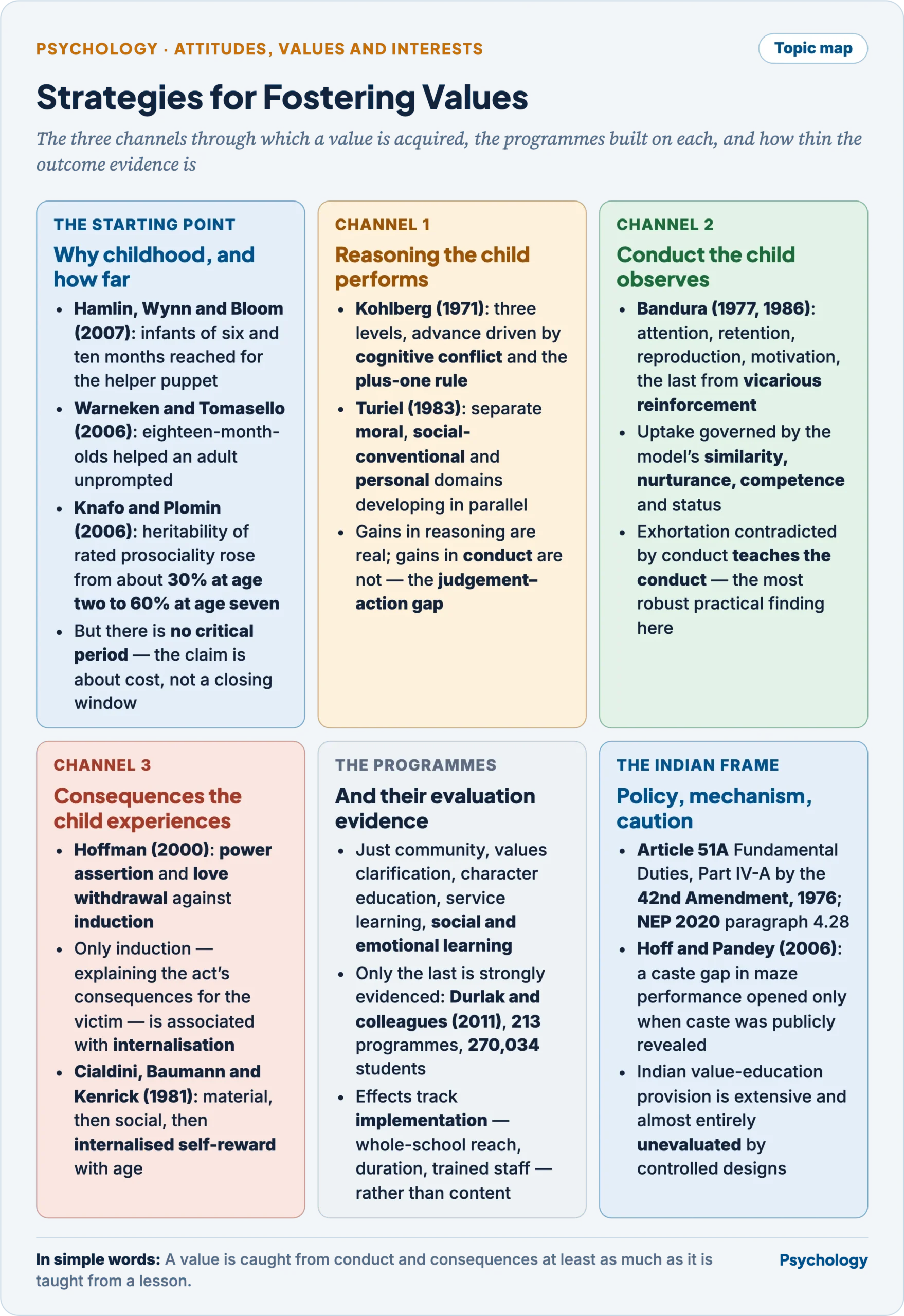
The question the clause leaves open is how. Kohlberg (1971) located the answer in the child’s own moral reasoning; Bandura (1977) in what the child sees done and rewarded; Hoffman (2000) in how an adult explains a transgression as it occurs.
A value is not information, so it cannot be transmitted by being stated. It is a trans-situational standard held with feeling and ranked against rivals, so it is acquired only through reasoning the child performs, conduct the child observes and consequences the child experiences. Every strategy below claims one of those three channels carries the weight, and each can be judged by its evaluation evidence.
Why childhood is the leverage point, and where the claim is overstated
- The precursors precede language. Hamlin, Wynn and Bloom (2007) showed infants of six and ten months a puppet struggling up a hill, helped by one character and pushed down by another; both ages reached for the helper.
- Helping appears spontaneously in the second year. Warneken and Tomasello (2006) found eighteen-month-olds helping an adult whose hands were full, without prompting, in tasks where young chimpanzees did not.
- Knafo and Plomin (2006), in a longitudinal twin study, reported heritability of parent-rated prosociality rising from about 30 per cent at age two to 60 per cent at age seven — placing the environmental leverage earliest.
- Value content is taught in these years in absolute rather than conditional terms, which is part of why early values endure: later learning must overwrite a structure rather than write on a blank one.
- Three qualifications keep the claim honest.
- The infant findings are contested. Scarf and colleagues (2012) argued the helper preference reflects a perceptual preference for the character associated with the climber’s bouncing, infants choosing at random when the climber was an inanimate block.
- A child’s value structure is not adult-like at the start. Döring and colleagues (2010) built the Picture-Based Value Survey for Children — 20 sticker items, two per basic value, usable from about age six — and work with it finds structures growing more differentiated with age.
- Values keep changing afterwards. Priorities shift in adolescence, at the transition to university, on migration and on entering work. There is no critical period for values in the sense in which there is one for binocular vision.
- So the defensible claim is about cost, not a closing window. Childhood is where intervention is cheapest, least resisted and acts on the whole later structure — not the only time values can be fostered.
Kohlberg’s stages as the basis for moral education
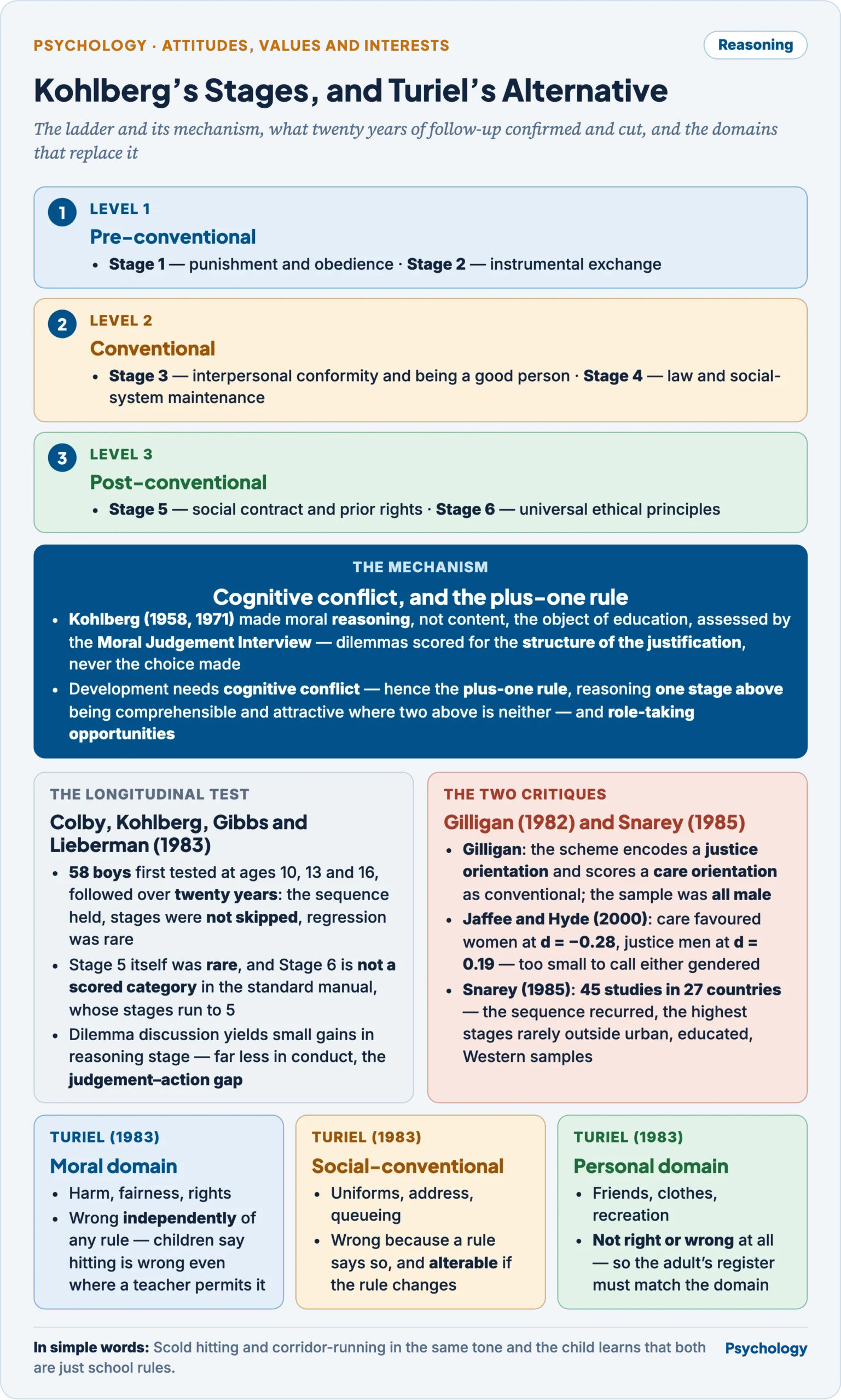
- Kohlberg (1958, 1971) made moral reasoning, not content, the object of education, assessed by the Moral Judgement Interview — dilemmas scored for the structure of the justification, not the choice made.
- Three levels, two stages each.
- Pre-conventional — Stage 1, punishment and obedience; Stage 2, instrumental exchange.
- Conventional — Stage 3, interpersonal conformity and being a good person; Stage 4, law and social-system maintenance.
- Post-conventional — Stage 5, social contract and prior rights; Stage 6, universal ethical principles.
- The mechanism is cognitive conflict: development occurs when reasoning at the child’s own stage proves inadequate to a dilemma. Hence the plus-one rule — expose the child to reasoning one stage above, which is comprehensible and attractive, while two above is neither.
- Role-taking opportunities are the second mechanism. Stage advance needs occasions to take others’ perspectives, which is why Kohlberg moved from dilemma discussion to reorganising the school itself.
- Colby, Kohlberg, Gibbs and Lieberman (1983) followed 58 boys first tested at ages 10, 13 and 16 over twenty years: the sequence held, stages were not skipped, and regression was rare.
- Stage 6 was not supported by the data. It is not a scored category in the standard scoring manual, whose stages run to 5, and Stage 5 itself was rare. The highest stage survives as a theoretical construct.
- Dilemma discussion works, modestly. Reviews of curricular moral-education studies find small but real gains in reasoning stage; gains in conduct are far less consistent — the judgement–action gap.
The Gilligan and cross-cultural critiques
- Gilligan (1982) argued the scheme encodes a justice orientation — rights, rules, impartiality — and scores a care orientation of responsibility, relationship and context as merely conventional, so that women reasoning from care appear arrested at Stage 3. The original longitudinal sample was all male.
- The verdict vindicates the concept and rejects the gender claim. Jaffee and Hyde (2000) found care favouring women at d = −0.28 and justice favouring men at d = 0.19 — too small to call the orientations gendered.
- Care nevertheless remains a distinct moral idiom that justice scoring undervalues.
- Snarey (1985) reviewed 45 cross-cultural studies in 27 countries using Kohlberg’s method. The basic stage sequence recurred, but the highest stages were culturally specific, appearing rarely outside urban, educated, Western samples.
- The deeper objection is that collective and communitarian reasoning scores as conventional: where duty to family, caste or community is the moral idiom, a scheme whose terminus is individual autonomy misreads sophistication as conformity.
Turiel’s domain theory
- Turiel (1983) rejected the single developmental ladder and argued children build separate conceptual domains that develop in parallel rather than one transforming into another.
- The moral domain — harm, fairness, rights. Wrong independently of rules or authority.
- The social-conventional domain — uniforms, forms of address, queueing. Wrong because a rule or authority says so, and alterable if the rule changes.
- The personal domain — choice of friends, clothes, recreation. Not a matter of right and wrong at all.
- The evidence is in criterion judgements, available from early childhood: young children say hitting would be wrong even if a teacher permitted it and wrong in another school; a teacher’s first name would not.
- The implication is sharp. An adult who enforces hitting and corridor-running in the same tone teaches that both are conventions, making the moral rule as negotiable as the convention.
- Domain-appropriate discipline follows: address harm through its consequences for the victim, convention through coordination and order. Treating the two alike is the commonest error in school discipline.
School programmes and their evaluation evidence
The just community approach
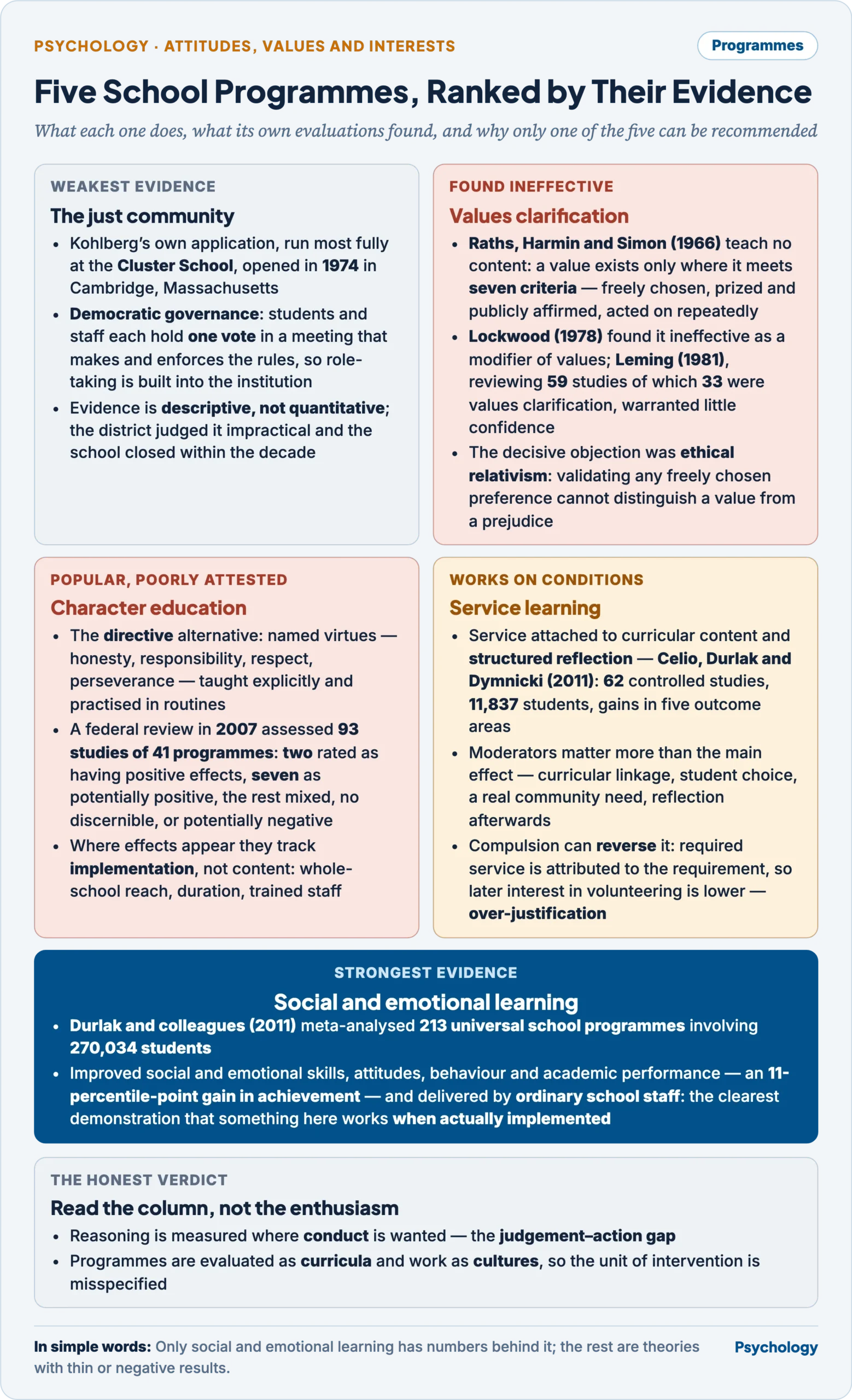
- The just community approach is Kohlberg’s own application, run most fully at the Cluster School, a school-within-a-school opened in 1974 in Cambridge, Massachusetts. Its premise is that moral reasoning advances through exercising real authority, not discussing imaginary cases.
- The mechanism is democratic governance: a community meeting in which students and staff each hold one vote makes and enforces the rules that govern the school, so role-taking is built into the institution rather than added as a lesson.
- The evaluation evidence is descriptive, not quantitative. Accounts describe a culture supporting socio-moral reasoning and action; the district judged the arrangement impractical and the school closed within the decade — a well-theorised approach with thin outcome data.
Values clarification
- Values clarification, from Raths, Harmin and Simon (1966), teaches no value content. A value exists only where it satisfies seven criteria in three groups — chosen freely after weighing consequences; prized and publicly affirmed; acted on repeatedly and consistently.
- Lockwood (1978) reviewed the research and found the interventions ineffective as modifiers of values and equivocal on affective outcomes. Leming (1981), reviewing 59 studies of which 33 concerned values clarification, found little or no confidence in its effectiveness warranted.
- The decisive objection was conceptual: ethical relativism. A procedure validating any freely chosen, consistently enacted preference cannot distinguish a value from a prejudice — indefensible on the very content value education addresses.
- What survives is the procedural insight that an unexamined value is not held, and the techniques themselves, now used inside frameworks that do commit to content.
Character education
- Character education is the directive alternative: named virtues — honesty, responsibility, respect, perseverance — taught explicitly, modelled by staff and practised in school routines.
- The evidence base is much weaker than the approach’s popularity. A federal review in 2007 assessed 93 studies of 41 programmes: two were rated as having positive effects and seven as potentially positive, the rest mixed, no discernible, or potentially negative.
- Where effects appear they track implementation rather than content: whole-school reach, duration, trained staff, and consistency between the taught value and the school’s practice.
Service learning and social and emotional learning
- Service learning attaches community service to curricular content and structured reflection, so the value is exercised and then examined. Celio, Durlak and Dymnicki (2011) meta-analysed 62 controlled studies covering 11,837 students and found gains in five outcome areas, including civic engagement.
- The moderators matter more than the main effect: gains were larger where service was linked to the curriculum, students chose it, it met a real community need, and reflection followed.
- Compulsion can reverse the effect: where service is required, the behaviour is attributable to the requirement rather than the self, and later interest in volunteering is lower — the over-justification problem.
- Social and emotional learning has the strongest evidence here. Durlak and colleagues (2011) meta-analysed 213 universal school programmes involving 270,034 students and found improved social and emotional skills, attitudes, behaviour and academic performance — an 11-percentile-point gain in achievement.
- Programmes were delivered by ordinary school staff, outcomes moderated by four recommended skill-development practices and by implementation problems — the clearest demonstration that something here works when actually implemented.
Modelling, parenting, the hidden curriculum and media
- Bandura (1977, 1986) supplies the mechanism for everything caught rather than taught. Observational learning needs four sub-processes — attention, retention, reproduction and motivation — the last supplied by vicarious reinforcement: the child learns both the act and what happened to the actor.
- Model characteristics govern uptake: similarity to the observer, nurturance, competence, perceived status. A warm, admired adult is copied; a remote one is not.
- Inconsistency between a model’s precept and conduct teaches the conduct: exhortation accompanied by contrary behaviour produces the behaviour. This is the most robust practical finding here.
- Hoffman (2000) distinguishes three discipline techniques by what each makes the child attend to.
- Power assertion — force, threat, withdrawal of privileges. Produces compliance under surveillance and attributes the restraint to the parent’s power, so the norm is never internalised.
- Love withdrawal — coldness, threatened rejection. Produces anxiety-driven inhibition rather than a standard the child owns.
- Induction — explaining the act’s consequences for the victim. This is the technique associated with internalisation.
- Induction’s mechanism is specific: it arouses empathic distress at an optimal level, directs attention to the harm rather than the punisher, and leaves the child attributing the norm to themselves. Over-arousal defeats it, so severity is not the active ingredient.
- Cialdini, Baumann and Kenrick (1981) describe a three-step sequence: prosocial behaviour driven by material rewards in the young child, by social and material rewards in the preadolescent, and by internalised self-reward thereafter. The reinforcement that works at one age is wrong at another.
- The hidden curriculum is what a school’s arrangements teach regardless of its syllabus: how teachers’ time is distributed, who is made monitor, how a complaint is handled, whether the midday meal is eaten together.
- These are the lived rather than the stated norm, and outweigh any lesson.
- Media are a modelling environment at scale; the content-analytic and algorithmic evidence sits in Values: Nature, Structure and Measurement. Media literacy — treating the medium’s selection rules as an object of study — becomes part of value education.
Fostering the value of equality in early childhood
- Equality has to be built rather than left alone, because the mechanisms producing its opposite are developmentally normal: young children categorise, prefer the in-group and essentialise group differences untaught.
- Bigler and Liben (2007), in developmental intergroup theory, identify the causal lever: a category becomes a basis for stereotyping when made psychologically salient — perceptually distinctive, labelled by adults, used by institutions to sort people. Salience being environmental, bias is largely under adult control.
- The first strategy is therefore to stop making the category functionally salient: do not sort, seat, line up or address children by caste, religion, gender or complexion, and never use a group label where a name will serve.
- The second is contact on the right terms. Allport (1954) specified four conditions: equal status within the situation, common goals, cooperation rather than competition, institutional sanction.
- Pettigrew and Tropp (2006), meta-analysing 713 samples from 515 studies, found contact typically reduces prejudice, with larger reductions under Allport’s conditions, which are facilitating rather than strictly necessary.
- The third is structured cooperative interdependence: mixed small groups in which each child holds a piece the others need — the jigsaw classroom, and Sherif’s superordinate goals. This converts proximity into the contact effect.
- Hoff and Pandey (2006) supply the Indian anchor. Junior-high boys in rural India solved mazes for pay: with caste unannounced there was no caste gap; when caste was publicly revealed, a large gap opened.
- Concrete measures follow from the mechanism, not sentiment: shared seating and shared eating; rotation of classroom responsibility; girls and boys in the same leadership roles; picture material in which doctor and labourer are not caste- or gender-typed.
- Exclusion should be corrected as a moral matter in Turiel’s sense, not a breach of convention — otherwise the child learns fairness is a school rule rather than a standard.
- The policy frame supports this: early childhood care and education is to develop “social capacities, sensitivity, good behaviour, courtesy, ethics, personal and public cleanliness, teamwork, and cooperation”, with socio-emotional-ethical development among its aims.
Fostering values in Indian settings
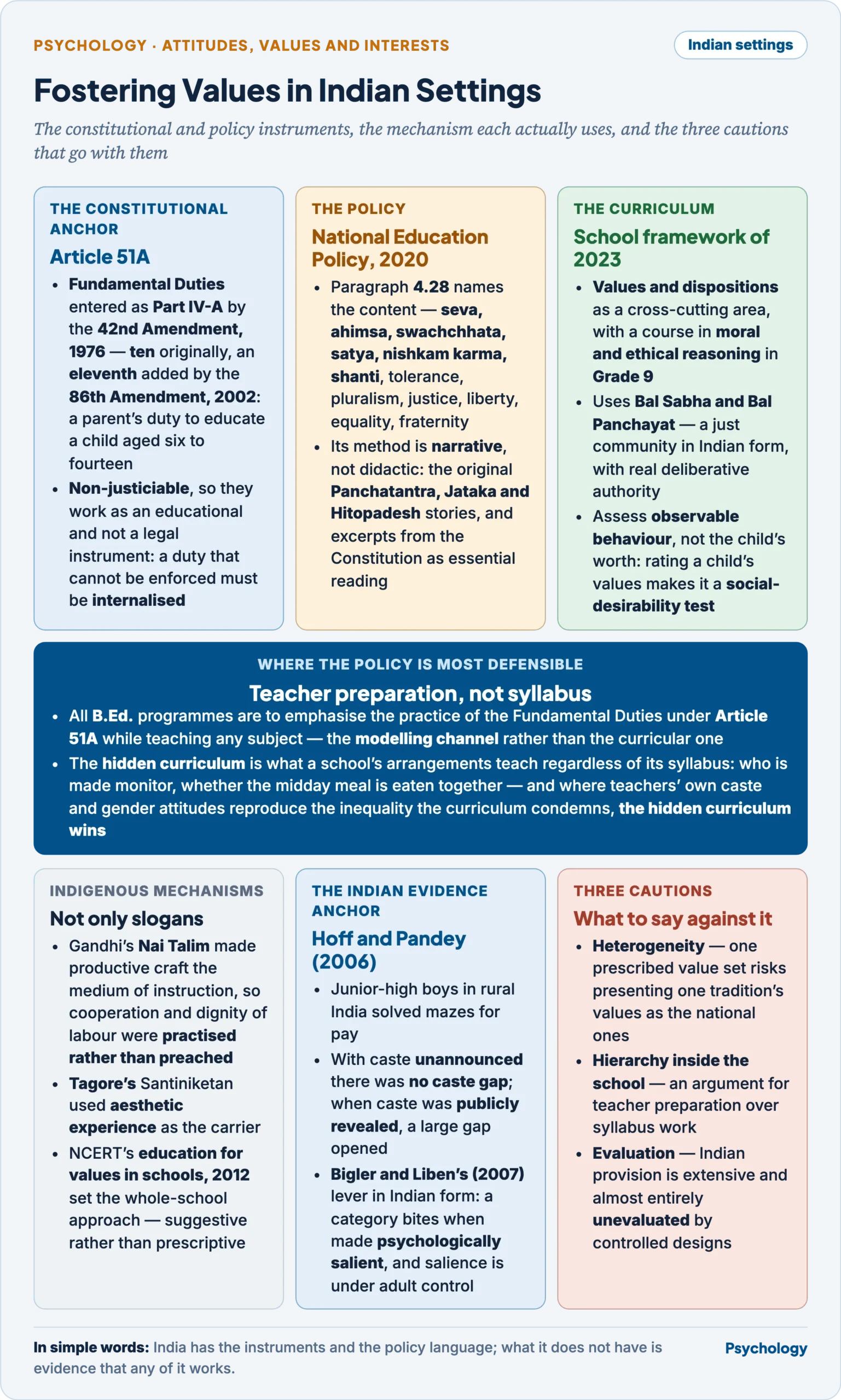
- The constitutional anchor is Article 51A. The Fundamental Duties entered as Part IV-A by the 42nd Amendment, 1976 on the Swaran Singh Committee’s recommendation — ten originally, an eleventh added by the 86th Amendment, 2002: a parent’s duty to educate a child aged six to fourteen.
- They are non-justiciable, which is why they function as an educational rather than a legal instrument: a duty that cannot be enforced must be internalised.
- The National Education Policy, 2020 carries them into pedagogy, requiring curriculum and pedagogy to “develop among the students a deep sense of respect towards the Fundamental Duties and Constitutional values”.
- Paragraph 4.28 specifies content — “seva, ahimsa, swachchhata, satya, nishkam karma, shanti, sacrifice, tolerance, diversity, pluralism, righteous conduct… justice, liberty, equality, and fraternity” — approached first through the importance of doing what is right, later through cheating, violence, plagiarism, littering and empathy.
- Its method is narrative rather than didactic: the original stories of the Panchatantra, Jataka and Hitopadesh, and excerpts from the Indian Constitution as essential reading for all students.
- Teacher preparation is where the policy is most specific, and psychologically the most defensible: all B.Ed. programmes are to emphasise the practice of the Fundamental Duties under Article 51A while teaching any subject — the modelling channel rather than the curricular one.
- The school curriculum framework of 2023 makes this a cross-cutting area of values and dispositions, taught directly and through languages, history and social science, with a course in moral and ethical reasoning in Grade 9.
- It is staged: story and play at the foundational level, positive habits at the preparatory level, collaborative group work in the middle years, and handling criticism and failure with equanimity at the secondary level.
- It uses Bal Sabha and Bal Panchayat — student forums that are a just community in Indian form, giving children real deliberative authority over school matters.
- Its assessment rule is psychologically sound and often ignored: assess observable behaviour, not the child’s worth. Rating a child’s values converts the exercise into a social-desirability test.
- NCERT’s framework for education for values in schools, 2012 preceded these and set the whole-school approach, schools identifying their own value priorities; it is suggestive rather than prescriptive.
- The indigenous tradition supplies mechanisms, not only slogans. Gandhi’s Nai Talim made productive craft the medium of instruction, so cooperation and dignity of labour were practised rather than preached; Tagore’s Santiniketan used aesthetic experience as the carrier.
- Three Indian-specific cautions belong with the strategies.
- Heterogeneity. A single prescribed value set in a society of this religious and linguistic range risks presenting one tradition’s values as the national ones.
- Hierarchy inside the school. Where teachers’ own caste and gender attitudes reproduce the inequality the curriculum condemns, the hidden curriculum wins — an argument for teacher preparation over syllabus work.
- Evaluation. Indian value-education provision is extensive and almost entirely unevaluated by controlled designs, so claims about it rest on policy intent rather than outcome data.
Criticisms and limitations
- The outcome evidence is far weaker than the enthusiasm. The best-attested approach here is social and emotional learning; character education’s own field review rated most programmes as showing no discernible effects.
- Reasoning is measured where conduct is wanted. Most evaluations assess moral judgement, attitude or self-rated value, and the judgement–action gap means a programme can move the measure without moving behaviour.
- Measurement is compromised at the point of use. Values are assessed by self-report on moral content in a setting where the adult has just taught the desired answer, so social desirability inflates outcomes in the intended direction.
- Attribution undermines intervention. Rewarded or compelled virtue is attributed to the reward rather than the self, which is why incentive schemes and mandatory service can leave the value weaker than before.
- Stage theories carry cultural bias at the top end. Snarey’s review and the communitarian objection both indicate that the post-conventional stages encode an individualist terminus, an uneasy foundation for Indian moral education.
- Programmes are evaluated as curricula and work as cultures. The consistent moderators — whole-school reach, duration, implementation quality, staff modelling — are features of the institution, not the lesson plan, so the unit of intervention is misspecified.
- What stands up is substantial and specific. Induction outperforms power assertion for internalisation; modelling beats exhortation, and contradicted exhortation is worse than silence; cooperative interdependence reduces intergroup bias where proximity alone does not.
- So too: category salience is under adult control; reflection and curricular integration are what make service work; and the domain distinction tells an adult which register to use.
- A programme assembled from those mechanisms is defensible in a way that a list of virtues on a wall is not.
Previous Year Questions
- 2022What are values? What strategies can be used in fostering value of equality in early childhood? Discuss.
- 2020Suggest some strategies for fostering values in Indian settings.
- 2019Illustrate that values can best be fostered during childhood. Discuss different methods for fostering moral and ethical values among school-going children.
- 2011Describe different psychological measures of values and outline a programme for fostering values among school-going children.