

Official syllabusPaper I · Unit 12 · Attitudes, Values and Interests
Definition of attitudes, values and interests; Measurement of attitudes, values and interests.
Definition
“A value is an enduring belief that a specific mode of conduct or end-state of existence is personally or socially preferable to an opposite or converse mode of conduct or end-state of existence.”
Rokeach (1973)
Schwartz (1994) recast the same object in motivational terms: values are “desirable transsituational goals, varying in importance, that serve as guiding principles in the life of a person or other social entity.”
Three words in Rokeach’s definition carry the subject. Enduring separates a value from a mood or a passing preference. Preferable makes its content normative rather than factual — a value says what ought to be, not what is. And belief places it in the cognitive system, which is what allows it to be reported, ranked and measured. Schwartz’s reconstruction of a value as a goal is what made value content predictable rather than merely listable, since goals can conflict and compatible goals can be arranged around a structure.
Definition of values: the defining features
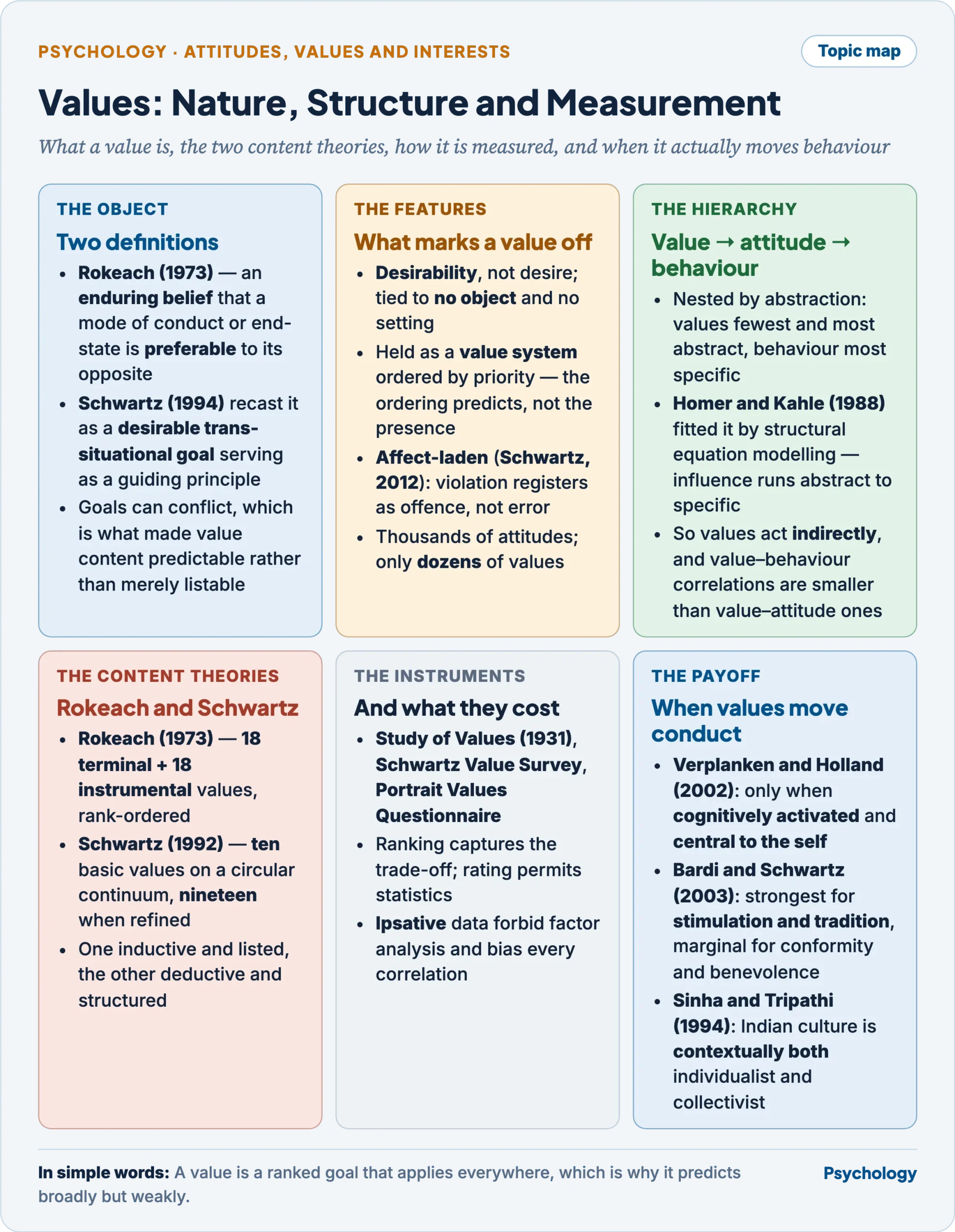
- Desirability, not desire. A value states what is worth wanting. It supplies the defensible ground on which wanting it is justified, which is why values are used to excuse conduct afterwards.
- Trans-situational. A value is tied to no object and no setting; honesty applies to an examination, a tax return and a conversation alike. This separates a value from an attitude, which always has an object.
- Ordered by priority. Values are held as a value system, a hierarchy of relative importance. Conduct follows from the trade-off between two values a situation sets in conflict, so the ordering, not the mere presence, predicts anything.
- A standard of judgement. A value supplies a criterion — for evaluating actions, people and policies, and for deciding what is worth attending to.
- Affect-laden. Schwartz (2012) puts this first among the features common to all values: a value is a belief infused with feeling, so its violation registers as offence rather than as error.
- Content and intensity. Values carry two attributes — content, that a conduct or end-state matters, and intensity, how much. A person holds thousands of attitudes and only dozens of values.
- Early acquisition and relative stability. Most of a value system is laid down in childhood by parents, teachers, peers and national culture, in absolute rather than conditional terms. A genetic contribution is also established.
The value–attitude–behaviour hierarchy
- The three constructs form a nested hierarchy of abstraction: values fewest and most abstract, attitudes object-bound, behaviour most specific. Homer and Kahle (1988) tested it with structural equation modelling and found influence running from abstract to specific.
- Values therefore act on behaviour largely indirectly. A value is too abstract to specify an act; it needs an attitude or a norm to translate it, so value–behaviour correlations are smaller than value–attitude ones.
- Where values and attitudes rank in motivational properties, and how the three differ along object, abstractness and centrality, is set out in Attitudes: Nature, Components and Functions. One value organises many attitudes, hence the superordinate position.
Rokeach’s terminal and instrumental values
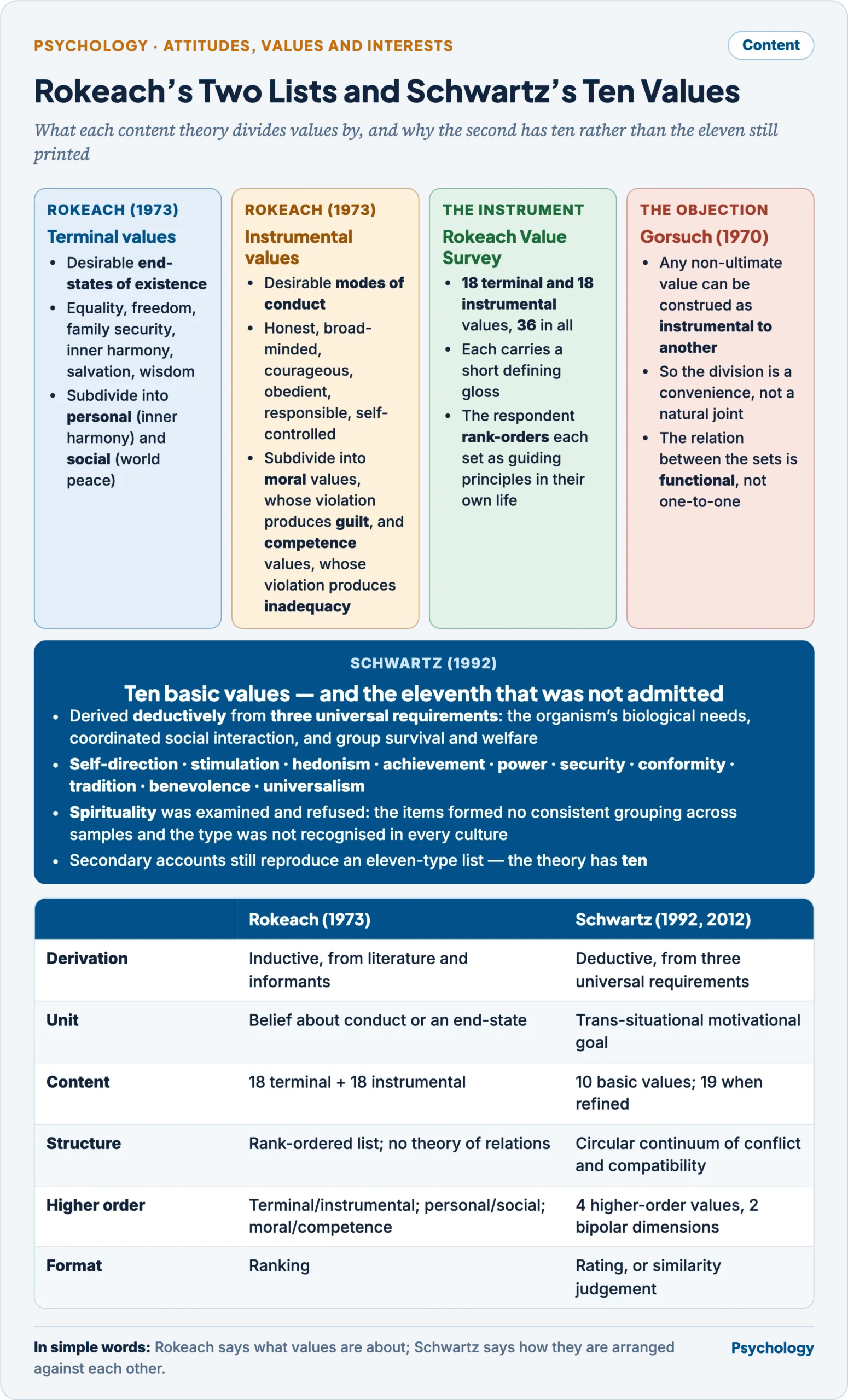
- Rokeach (1973) divided values by what they are about. Terminal values concern desirable end-states of existence — equality, freedom, family security, inner harmony, salvation, wisdom. Instrumental values concern desirable modes of conduct — honest, broad-minded, courageous, obedient, responsible, self-controlled.
- The Rokeach Value Survey presents 18 terminal and 18 instrumental values, 36 in all, each with a short defining gloss, and asks the respondent to rank-order each set as guiding principles in their own life.
- Each set subdivides. Terminal values split into personal (inner harmony) and social (world peace); instrumental values into moral values, whose violation produces guilt, and competence values, whose violation produces inadequacy.
- The relation between the sets is functional, not one-to-one. Gorsuch (1970) objected that any non-ultimate value can be construed as instrumental to another, making the distinction a convenience rather than a natural joint.
Schwartz’s theory of basic values
- Schwartz (1992) derived his set deductively, from the claim that values represent three universal requirements of human existence: the biological needs of the organism, coordinated social interaction, and the survival and welfare needs of groups.
- The original theory specifies ten basic values, each defined by its motivational goal.
- Self-direction — independent thought and action, choosing and exploring.
- Stimulation — novelty, excitement and challenge.
- Hedonism — pleasure and sensuous gratification for oneself.
- Achievement — personal success through competence by social standards.
- Power — status and prestige, control over people and resources.
- Security — safety, harmony and stability of society, relationships and self.
- Conformity — restraint of impulses likely to upset others or violate norms.
- Tradition — respect for the customs and ideas of one’s culture or religion.
- Benevolence — enhancing the welfare of those one is in frequent contact with.
- Universalism — tolerance and protection for all people and for nature.
- Schwartz (1992) examined an eleventh candidate, spirituality, and did not admit it: the spiritual items formed no consistent grouping across samples and the type was not recognised in every culture. Secondary accounts still reproduce an eleven-type list; the theory has ten.
The circular motivational structure
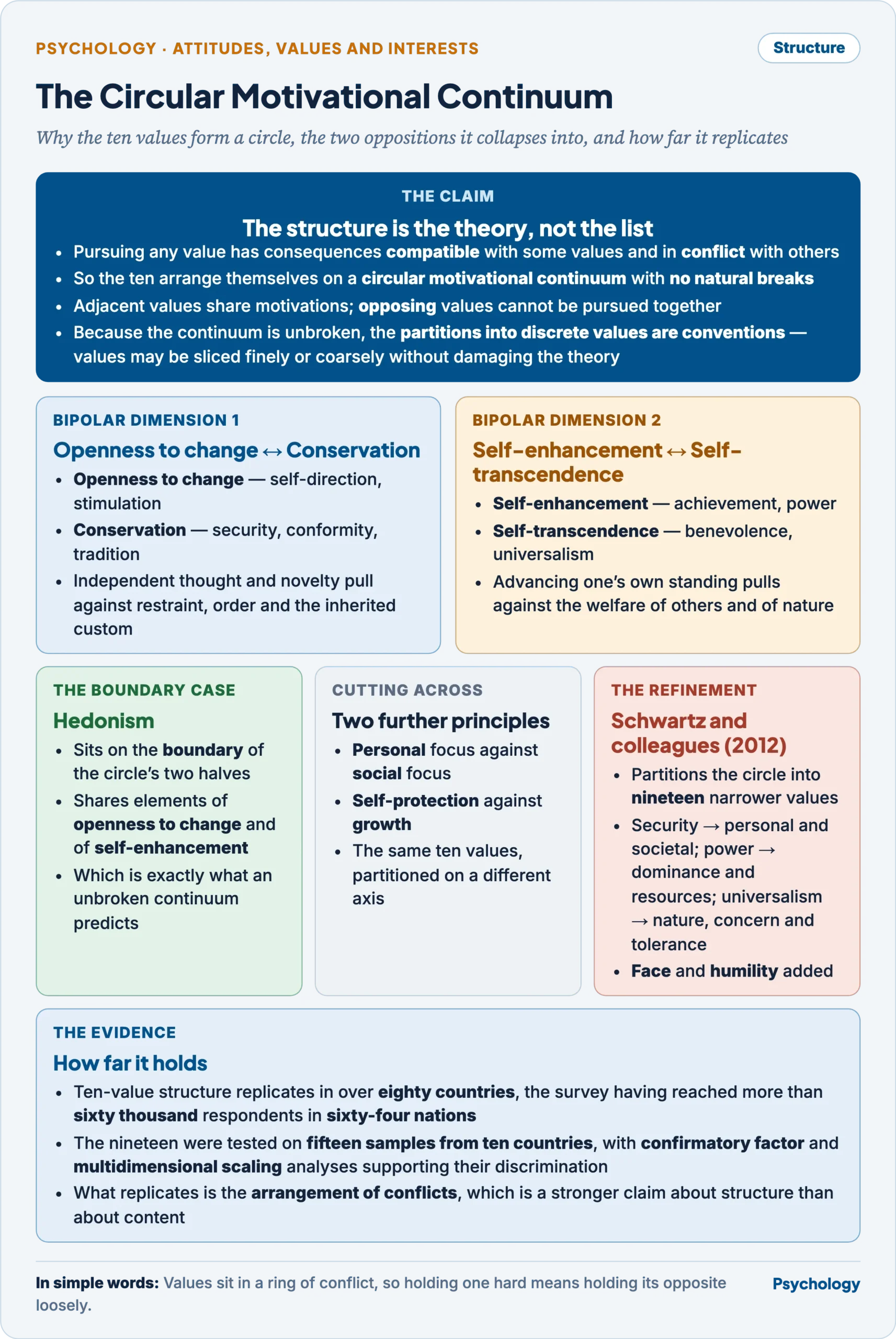
- The theory’s content is the structure, not the list. Pursuing any value has consequences compatible with some values and in conflict with others, so the ten arrange themselves on a circular motivational continuum with no natural breaks.
- Because the continuum is unbroken, the partitions into discrete values are conventions, and values may be sliced finely or coarsely without damaging the theory.
- The circle collapses into four higher-order values forming two bipolar dimensions.
- Openness to change (self-direction, stimulation) against conservation (security, conformity, tradition).
- Self-enhancement (achievement, power) against self-transcendence (benevolence, universalism).
- Hedonism sits on the boundary, sharing elements of openness to change and self-enhancement.
- Two further principles cut across the circle: personal against social focus, and self-protection against growth.
- The refined theory of Schwartz and colleagues (2012) partitions the circle into nineteen values with narrower motivations — security into personal and societal, power into dominance and resources, universalism into nature, concern and tolerance, with face and humility added.
- It was tested on fifteen samples from ten countries, confirmatory factor and multidimensional scaling analyses supporting discrimination of the nineteen. The ten-value structure holds in over eighty countries, the survey having reached more than sixty thousand respondents in sixty-four nations.
| Rokeach (1973) | Schwartz (1992, 2012) | |
|---|---|---|
| Derivation | Inductive, from literature and informants | Deductive, from three universal requirements |
| Unit | Belief about conduct or an end-state | Trans-situational motivational goal |
| Content | 18 terminal + 18 instrumental | 10 basic values; 19 when refined |
| Structure | Rank-ordered list; no theory of relations | Circular continuum of conflict and compatibility |
| Higher order | Terminal/instrumental; personal/social; moral/competence | 4 higher-order values, 2 bipolar dimensions |
| Format | Ranking | Rating, or similarity judgement |
Measurement of values
Ranking versus rating
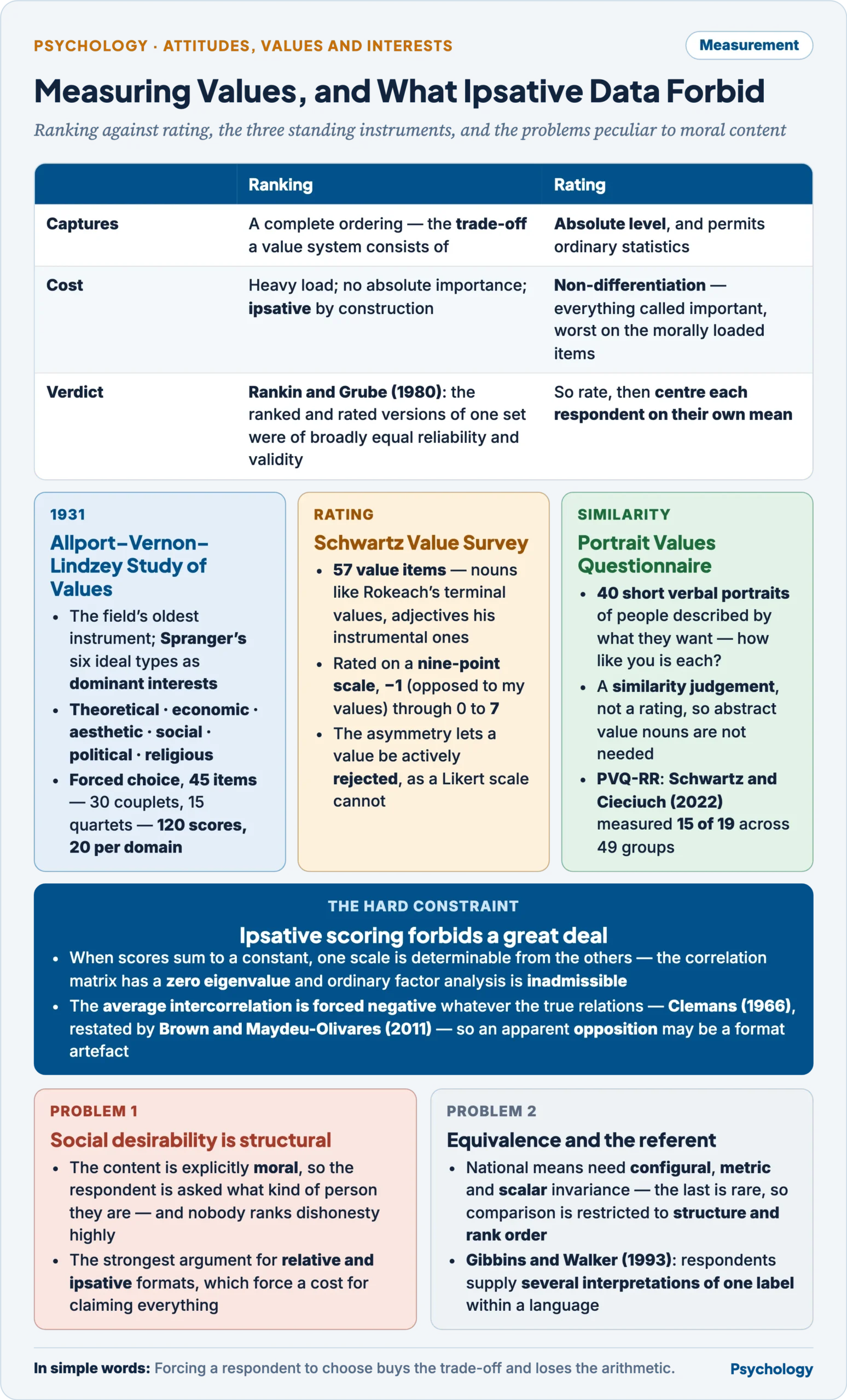
- Ranking forces a complete ordering and so captures the trade-off a value system consists of. Its costs: heavy cognitive load, no information about absolute importance, and data that are ipsative by construction.
- Rating preserves absolute level and permits ordinary statistics, but lets a respondent call everything important — the non-differentiation problem, worst on the morally loaded items where it matters most.
- The empirical comparison is less dramatic than the argument. Rankin and Grube (1980) compared ranked and rated versions of one value set and found them of broadly equal reliability and validity.
- Standard practice is a compromise: rate each value, then centre each respondent’s scores on their own mean, recovering relative priority while keeping ratings’ tractability.
The Allport–Vernon–Lindzey Study of Values
- The Study of Values, first published in 1931, is the field’s oldest instrument and was among the most cited non-projective personality measures of its era. It operationalises Spranger’s six ideal types, measuring values as dominant interests.
- The six orientations are theoretical (truth), economic (the useful), aesthetic (form and harmony), social (altruistic love of people), political (power and influence) and religious (unity and the transcendent).
- The format is forced choice across 45 items — 30 couplets in Part I, 15 quartets in Part II — yielding 120 scores, 20 per domain. Scoring is ipsative: the six orientations sum to a constant.
- Its decline is instructive. Items were substantively revised only in 1951 and became archaic in wording. Kopelman and colleagues (2003) modernised it and showed the six-factor structure survived.
The Schwartz Value Survey and the Portrait Values Questionnaire
- The Schwartz Value Survey presents 57 value items — nouns resembling Rokeach’s terminal values, adjectives his instrumental ones — rated for importance as a guiding principle on a nine-point scale from −1 (opposed to my values) through 0 to 7 (of supreme importance).
- The asymmetry is deliberate: it lets a value be actively rejected, which a Likert scale cannot represent.
- The Portrait Values Questionnaire serves respondents to whom abstract value nouns are difficult — children, the elderly, the little-schooled. It gives 40 short verbal portraits of people described by what they want, asking how much each is like the respondent.
- The value is thus inferred from a similarity judgement rather than rated, which also lowers the pressure of being asked directly what one believes in.
- A 21-item short form measuring the ten values is carried in large social surveys. The PVQ-RR extends the method to the refined theory with 57 portraits, three per value; Schwartz and Cieciuch (2022) found it measured 15 of the 19 values reliably across 49 cultural groups.
Problems peculiar to measuring values
- Social desirability is structural, not incidental. A value measure’s content is explicitly moral, so the respondent is asked what kind of person they are, and nobody ranks dishonesty highly. This is the strongest argument for relative and ipsative formats, which force a cost for claiming everything.
- Ipsative scoring forbids a great deal. When scores sum to a constant, one scale is determinable from the others, so the correlation matrix has a zero eigenvalue and ordinary factor analysis is inadmissible.
- Worse, the average intercorrelation among the scales is forced negative whatever the true relations among the attributes — from Clemans (1966), restated by Brown and Maydeu-Olivares (2011) — so an apparent opposition between two values may be a format artefact.
- In practice: scores are interpretable within a person and not between people, absolute level is unrecoverable, reliability estimates are distorted, and correlations with external criteria are biased. Thurstonian item-response models are the current remedy.
- Cross-cultural equivalence is unavoidable here, since the theory’s claims are universalist. Before national means can be compared, the same items must load the same factors (configural), with equal loadings (metric) and equal intercepts (scalar).
- Full scalar invariance is rarely achieved across many countries, so comparison is mostly restricted to value structure and rank order. Response style compounds it, acquiescence and extreme responding differing by country.
- Interpretation shifts with the respondent. Gibbins and Walker (1993) showed respondents supply multiple interpretations of the same value label within one language, so ranking may not rank the same referents across persons.
How values motivate behaviour
- The mechanism has four parts, and naming them is what distinguishes an account of value motivation from a restatement that values matter.
- Goal activation. A value is a goal; once activated it supplies direction and energy, and does so for a whole class of acts rather than one.
- Perceptual filtering. A held value makes value-relevant features of a situation salient and the rest invisible, so two people in one situation face different decision problems.
- A standard for self-evaluation. Acting against a central value produces guilt, acting with it self-respect. The motivation is partly self-regulatory, which is why values move behaviour with no audience present.
- Justification. Values supply the defensible account of conduct, shaping what can be publicly maintained.
- The conditions on the mechanism are the important finding. Verplanken and Holland (2002), across six studies, showed that values guided choice only when cognitively activated and central to the self-concept.
- Priming a value raised value-congruent choice; so did raising self-focus, which increased donating among those for whom altruistic values were central. Value centrality also predicted voting, and proved distinct from attitude.
- A value therefore lies dormant until the situation or the self makes it salient, which explains both the weak average prediction and the strong prediction under self-awareness.
- Bardi and Schwartz (2003) measured value–behaviour relations across all ten values and found them uneven: strongest for stimulation and tradition, moderate for hedonism, power, universalism and self-direction, marginal for security, conformity, achievement and benevolence.
- Their explanation is that normative pressure obscures the relation. Where everyone is expected to behave conformingly or benevolently whatever their priorities, the norm determines behaviour and the value’s signal is suppressed.
- Evidence across domains: Sagiv and Schwartz (1995) found value priorities predicted readiness for out-group social contact; Caprara and colleagues (2006) found values predicted voting choice beyond traits; self-transcendence values predict environmental action; work values predict occupational choice.
- Value–behaviour correlations are modest — weak to moderate, and stronger at higher levels of value importance. Four reasons account for the gap: the abstraction mismatch between a trans-situational goal and a specific act; suppression by norms and situational constraint; measurement error from social desirability and ipsativity; and value conflict, since real situations engage several values at once.
Significance and correlates of values
- Personality. Values correlate with traits in a patterned way — openness with self-direction, conscientiousness with conformity, agreeableness with benevolence — without redundancy: traits describe what a person tends to do, values what ought to be done.
- Religiosity is among the strongest single correlates: positively with tradition and conformity, negatively with hedonism, stimulation and self-direction, across religions.
- Age shifts priorities, conservation rising and openness-to-change declining across adulthood; cross-sectional data cannot separate ageing from cohort. Education raises self-direction and universalism; insecure material conditions raise security and power.
- Gender differences are small and consistent in direction — higher benevolence and universalism among women, higher power and achievement among men — and far smaller than between-culture differences on the same values.
- Group-level significance. Values predict political ideology, prejudice, consumer choice, occupational selection and organisational commitment, and they are the standard operationalisation of culture itself in cross-cultural work.
- Well-being does not track value content alone. Self-transcendent priorities go with better adjustment and materialistic ones with worse, but the fit between personal and surrounding cultural values independently predicts well-being.
The impact of social media on values
- What social media supplies is not new value content but new selection. Algorithmic ranking optimises for engagement, which advantages some value appeals over others with no editorial decision about values having been taken.
- Moral-emotional content is amplified. Brady and colleagues (2017) analysed large samples of messages on gun control, same-sex marriage and climate change: each additional moral-emotional word raised diffusion by about a fifth, the amplification operating strongly within ideological networks and weakly across them.
- Moral discourse is thus selected for outrage and circulated among those who already agree — strengthening value expression while weakening value argument.
- Uhls and Greenfield (2011) content-analysed the two most popular American tween television shows once a decade from 1967 to 2007: fame rose from fifteenth of sixteen values in earlier decades to first by 2007, community feeling falling from first or second until 1997 to eleventh.
- Materialism through upward social comparison is the best-evidenced individual pathway: passive consumption of curated self-presentation feeds upward comparison, itself a correlate of materialistic value orientation across adolescent samples, Asian ones included.
- Countervailing effects are real: networked media lower the cost of collective action around universalism values and give voice to groups excluded from legacy media.
- The limitation is the design. Most of this evidence is cross-sectional or content-analytic, longitudinal studies are few and small, and exposure effects on psychological outcomes are generally small on large representative samples.
Values in the Indian context
- Hofstede (1980) built the dominant cross-cultural framework from work-related values reported by employees of a single multinational across forty nations, locating India towards the collectivist pole. The design is the standing criticism: one firm’s employees are not a nation.
- Sinha and Tripathi (1994) made the finding that matters here: individualism and collectivism coexist synchronously in Indian culture, the same person behaving either way according to context and issue. India is not weakly collectivist but contextually both.
- Sinha and Verma (1994) found master’s-level students expressing idiocentric rather than allocentric orientations, attributed to mass media exposure, Western cultural influence and short-horizon life decisions.
- Indian values are also organised in indigenous schemes rather than trait theories. The purusharthas — dharma, artha, kama, moksha — set the legitimate aims of life with dharma regulating the rest; the triguna scheme carries a hierarchy and a direction of cultivation. Both are treated in The Indian Approach to Personality.
Criticisms and limitations
- Discriminant validity is the weakest part of the case. Values, attitudes, needs, motives, traits, norms and interests overlap, and a value measure correlating substantially with a personality measure has not shown it measures something distinct.
- Self-report on moral content is the wrong instrument, and no good alternative exists at scale. Observation of actual choices is the right method and is almost never used, because it yields no value profile.
- The terminal–instrumental distinction does not survive as a natural division, for Gorsuch’s reason; and the Rokeach list both omits held values and is read differently by different respondents.
- Ranking and rating each invalidate something. Ranking yields ipsative data that forbid factor analysis and bias every correlation; rating permits non-differentiation where it matters most. Centring is a repair, not a solution.
- The universality claim is stronger about structure than content. What replicates across eighty countries is the circular arrangement of conflicts; the partitions are conventions by the theory’s own admission, and invariance sufficient to compare national levels is rarely attained.
- The unit of analysis is the autonomous individual, which fits uneasily where values are held as positions within a family, caste or community rather than as personal possessions.
- What stands up is substantial. The defining features are agreed across rival accounts; the circular structure of value conflict is among the most replicated results in cross-cultural psychology; the conditions under which values move behaviour are now specified rather than assumed; and the modest value–behaviour correlation is explained rather than anomalous. Values remain, too, the only construct here answerable to situations the person has never met, precisely because they attach to no object.
Previous Year Questions
- 2026Discuss the nature and functions of attitudes and values with reference to development of human behaviour. Suggest relevant strategies for attitude change and development.
- 2018Discuss the significance and correlates of values. Comment on the impact of social media on values.
- 2011Describe different psychological measures of values and outline a programme for fostering values among school-going children.
- 2006Trace the common linkages between interests and values. Describe the factor analytical studies of the structure of interests and values. Also delineate upon those strategies that ought to be adopted for fostering values in the Indian socio-cultural milieu.
- 1998How do one’s values motivate his behaviour? Illustrate your answer.
- 1997In terms of motivational properties how would you rank attitudes and values?
- 1996How do values motivate human beings? Answer giving suitable examples from research.