

The Indian approach to personality.
Official Syllabus: Paper I · Unit 11 Personality
“Sattva, rajas and tamas — these gunas, born of prakriti, bind fast in the body the embodied one, the imperishable dweller.”
— Bhagavad Gita, 14.5
Modern Indian psychology treats the three as “personality dispositions” measurable as individual differences — the premise of the Mysore Triguna Scale (Shilpa and Murthy, 2012) and of the inventories before it.
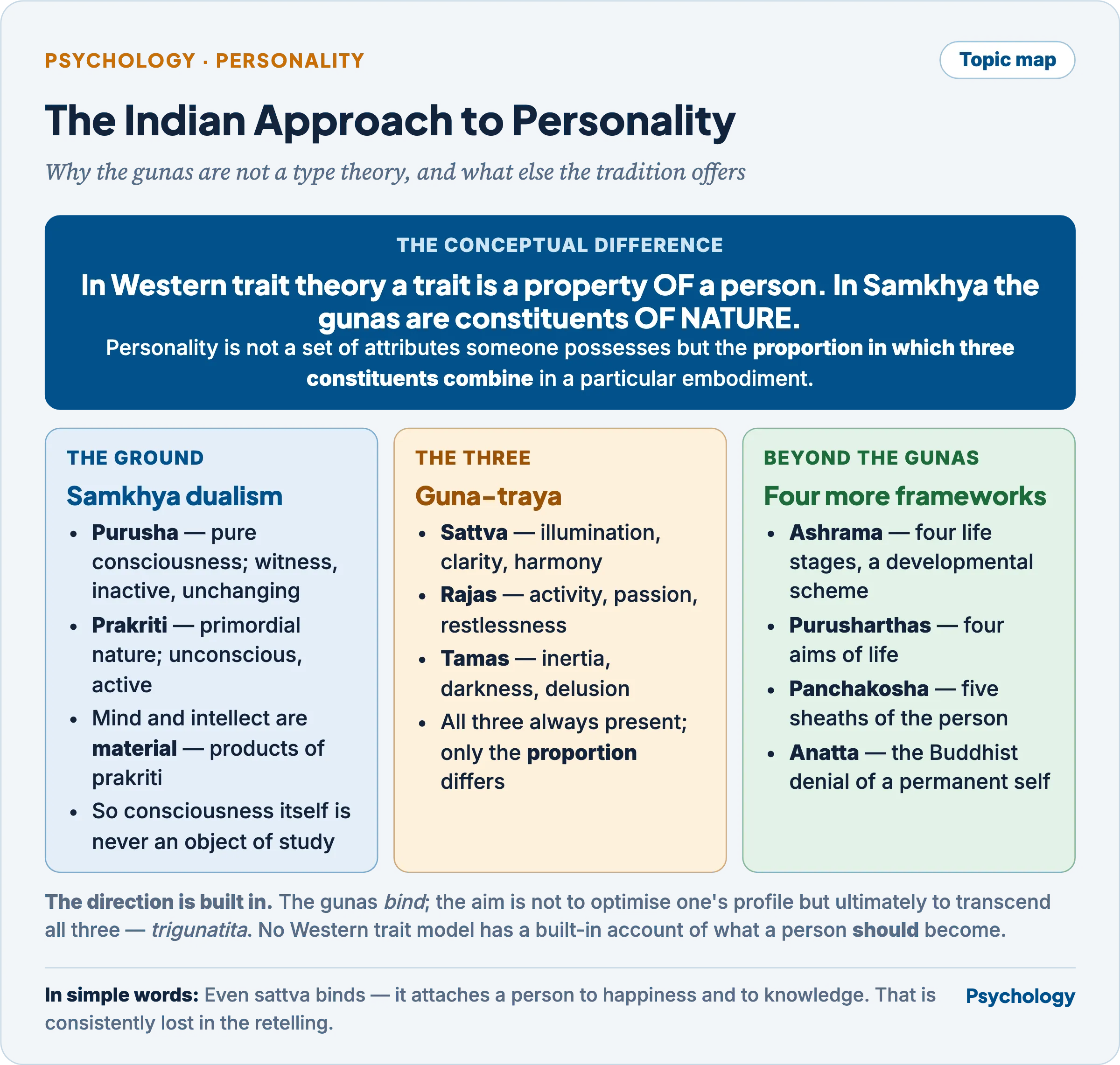
The triguna scheme looks like a type theory and is not one. In Western trait psychology a trait is a property of a person; in Samkhya the gunas are the constituents of nature itself, of which mind and body are products. Personality on this account is not a set of attributes someone possesses but the proportion in which the three constituents are combined in a particular embodiment — which is why the scheme can be at once a psychology, a cosmology and a prescription.
The philosophical ground
- Samkhya is a dualism of two ultimate principles. Purusha is pure consciousness — the witness, inactive, unchanging, plural. Prakriti is primordial nature — unconscious, active, the material from which everything evolves, including the mind.
- The gunas are the constituents of prakriti, not qualities added to it. In its unmanifest state the three are in equilibrium; evolution begins when the equilibrium is disturbed, and everything that exists is a particular configuration of them.
- The consequence for psychology is substantial. Mind, intellect and ego-sense are material on this account — products of prakriti, not of purusha. Consciousness itself belongs to purusha and is never an object of study. So the Indian scheme locates personality entirely on the material side and reserves a category, the witnessing self, for which Western personality theory has no equivalent.
- Bondage and liberation are built into the framework. The gunas bind, as the verse says; the aim is not to optimise one’s profile but ultimately to transcend all three — trigunatita, beyond the gunas. This is a theory with a direction built into it, which no Western trait model has.
The three gunas
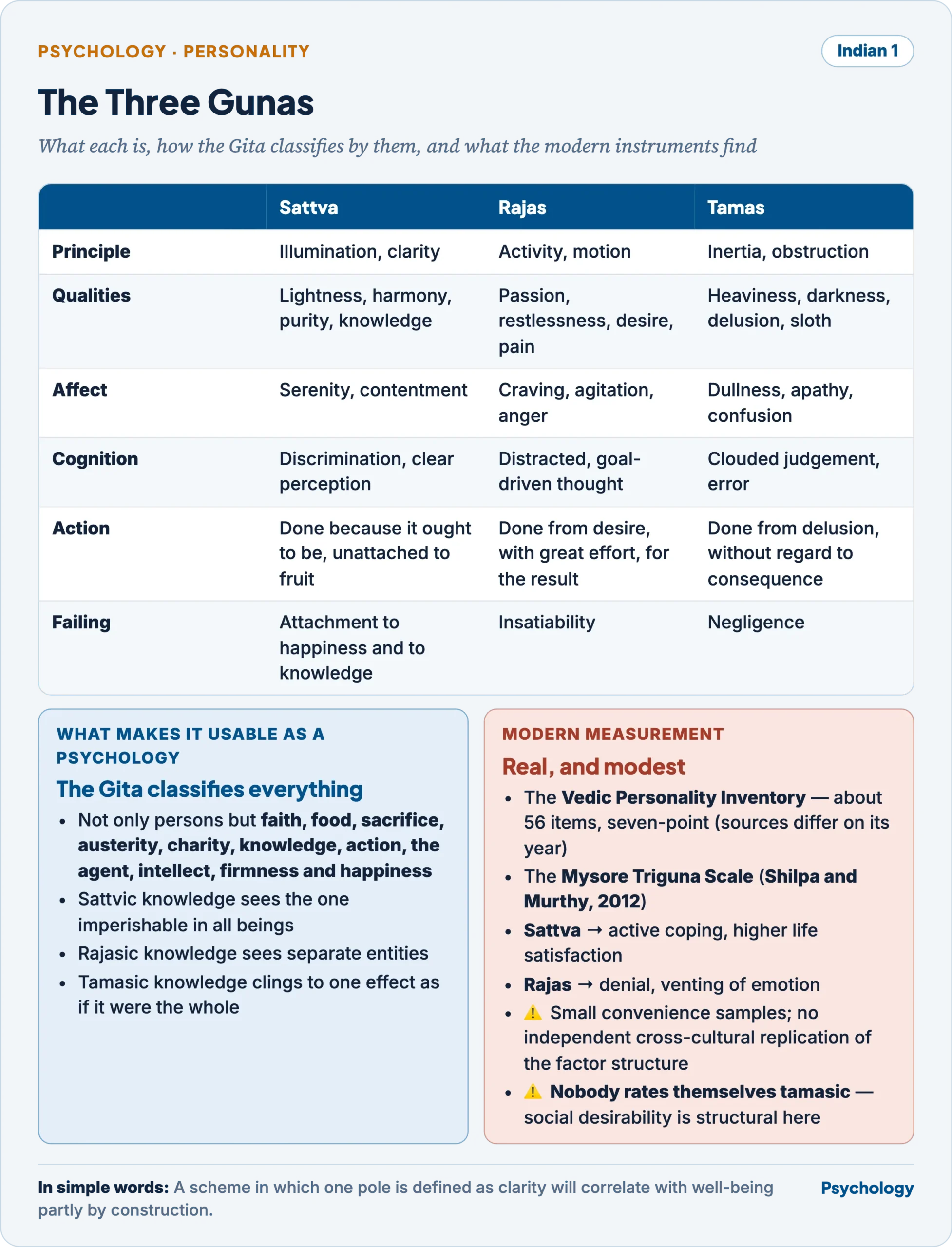
| Sattva | Rajas | Tamas | |
|---|---|---|---|
| Principle | Illumination, clarity | Activity, motion | Inertia, obstruction |
| Qualities | Lightness, harmony, purity, knowledge | Passion, restlessness, desire, pain | Heaviness, darkness, delusion, sloth |
| Affect | Serenity, contentment | Craving, agitation, anger | Dullness, apathy, confusion |
| Cognition | Discrimination, clear perception | Distracted, goal-driven thought | Clouded judgement, error |
| Action | Done because it ought to be, without attachment to fruit | Done from desire, with great effort, for the result | Done from delusion, without regard to consequence or capacity |
| Characteristic failing | Attachment to happiness and to knowledge itself | Insatiability | Negligence |
- All three are present in everyone, always. The scheme is explicitly proportional, not categorical: what differs between people, and in the same person at different times, is which guna predominates. This is the respect in which it is unlike a type theory despite resembling one.
- They are mutually suppressing and mutually dependent. Each rises by overpowering the other two, and each requires the others to act at all — sattva needs rajas to become action, rajas needs tamas to have anything to work on.
- The classification extends to everything a person does. The Gita’s later chapters classify by guna not only persons but faith, food, sacrifice, austerity, charity, knowledge, action, the agent, intellect, firmness and happiness — which is what makes the scheme usable as a psychology rather than only a metaphysics. The same threefold distinction is applied to each: sattvic knowledge sees the one imperishable in all beings, rajasic knowledge sees separate entities, tamasic knowledge clings to one effect as if it were the whole.
- Even sattva binds. The Gita is explicit that sattva attaches a person to happiness and to knowledge, which is a subtler bondage but bondage nonetheless — a point consistently lost when the scheme is presented as a simple hierarchy of better and worse personality types.
Modern measurement
- Several instruments exist, and the research base is genuine but modest.
- The Vedic Personality Inventory is the most used: a self-report instrument of about fifty-six items on a seven-point scale, reduced from a longer initial pool on psychometric grounds, yielding scores on all three gunas. Sources differ on the year of the original publication, so it is safer to name the instrument than to date it.
- The Mysore Triguna Scale (Shilpa and Murthy, 2012) is an independently developed Indian alternative with published psychometric properties.
- Other scales have been constructed from the Gita’s own descriptions and from Ayurvedic sources, including instruments pairing the gunas with the tridosha.
- The findings are consistent in direction. Sattva is associated with active coping, higher life satisfaction and lower perceived stress; rajas with denial and the venting of emotion; tamas with the poorest adjustment profile. These are the expected associations, which is both reassuring and a warning — a scheme in which one pole is defined as clarity and harmony will correlate with well-being measures partly by construction.
- The methodological caveats are serious and belong with the findings.
- The literature is largely in Indian journals, with small and convenience samples, and the factor structure has not been independently replicated outside India.
- It is self-report, applied to categories with an overt moral ordering. Nobody rates themselves tamasic, so social desirability is a structural rather than incidental problem.
- Converting a metaphysical category into a psychometric scale may change what it is. The gunas are constituents of nature that fluctuate hour by hour and with diet, company and action; a trait scale measures a stable individual difference. The instrument may measure something real and not the thing the tradition is describing.
Relating the guna theory to Western models
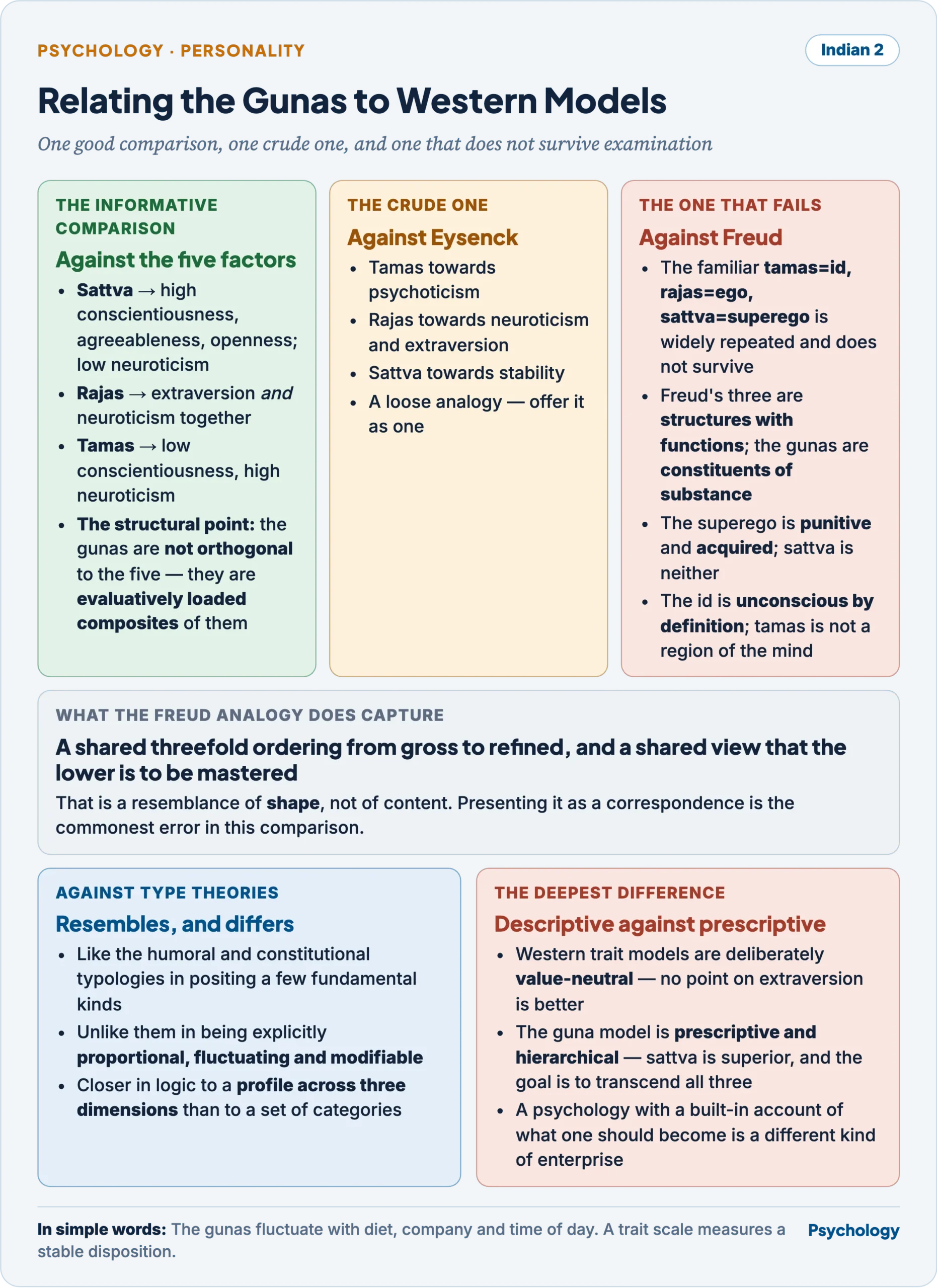
- Against the five-factor model, the most informative comparison because both are empirical.
- Sattva aligns with high conscientiousness, agreeableness and openness, and low neuroticism.
- Rajas aligns with extraversion and neuroticism together — the energetic, striving, easily disturbed profile.
- Tamas aligns with low conscientiousness and high neuroticism.
- The gunas are not orthogonal to the five — they are evaluatively loaded composites of them. Each guna bundles several five-factor dimensions according to whether they contribute to clarity, agitation or inertia. That is a different kind of construct, not a rival set of the same kind.
- Against Eysenck, the mapping is cruder and sometimes drawn: tamas towards psychoticism, rajas towards neuroticism and extraversion, sattva towards stability. It is a loose analogy and should be offered as one.
- Against Freud, the familiar equation of tamas with the id, rajas with the ego and sattva with the superego is widely repeated and does not survive examination.
- Freud’s three are structures with functions — a reservoir of drive, an executive, an internalised prohibition. The gunas are constituents of substance, not agencies, and none of them does anything on behalf of the others.
- The superego is a punitive internalisation acquired from parents; sattva is neither punitive nor acquired.
- The id is unconscious by definition; tamas is not a region of the mind.
- What the analogy does capture is a shared threefold ordering from gross to refined, and a shared view that the lower is to be mastered. That is a resemblance of shape, not of content, and presenting it as a correspondence is the commonest error in this comparison.
- Against type theories generally, the gunas resemble Hippocratic and constitutional typologies in positing a small number of fundamental kinds, and differ in being explicitly proportional, fluctuating and modifiable — closer in logic to a profile across three dimensions than to a set of categories.
- The deepest difference is evaluative. Western trait models are descriptive and deliberately value-neutral: no point on extraversion is better than another. The guna model is prescriptive and hierarchical — sattva is superior, the cultivation of sattva is the goal of practice, and the ultimate aim is to transcend all three. A psychology with a built-in account of what a person should become is doing something Western personality psychology explicitly declines to do, which makes the comparison a comparison between different kinds of enterprise.
The other Indian frameworks
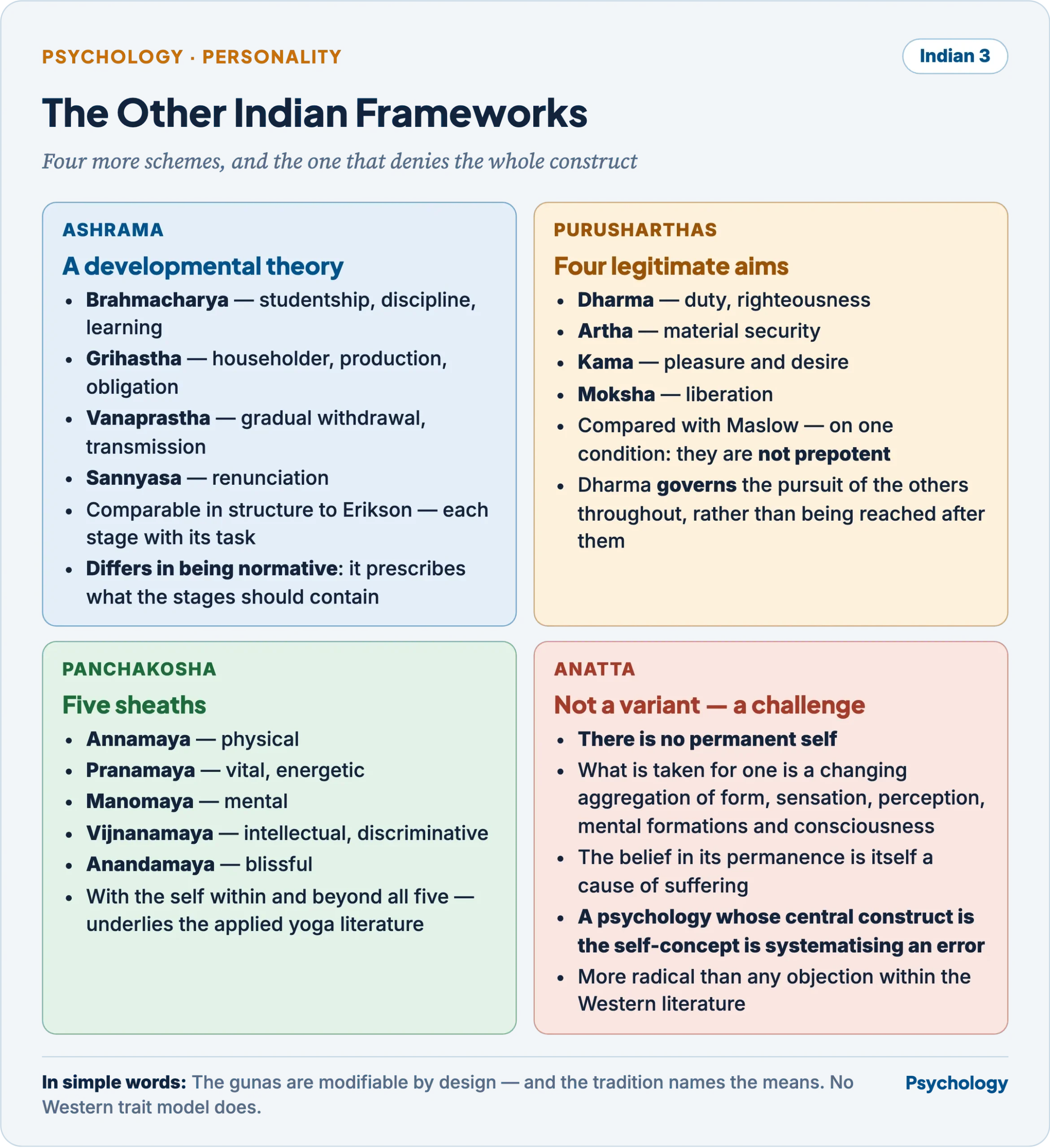
- The ashrama scheme is a developmental theory of personality: brahmacharya (studentship, discipline and learning), grihastha (householder, productive and social obligation), vanaprastha (gradual withdrawal, transmission to the next generation) and sannyasa (renunciation). It is comparable in structure to Erikson’s psychosocial stages — each has its characteristic task and its virtue — and differs in being normative, prescribing what the stages should contain rather than describing what they do.
- The purusharthas are the four legitimate aims of life: dharma (duty, righteousness), artha (material security and prosperity), kama (pleasure and desire) and moksha (liberation). Read as a motivational scheme it is often compared with Maslow’s hierarchy, and the comparison is useful on one condition: the purusharthas are not prepotent — dharma governs the pursuit of the other three throughout rather than being reached after them, so the structure is one of regulation rather than of sequence.
- The panchakosha model describes the person as five concentric sheaths — the physical (annamaya), vital or energetic (pranamaya), mental (manomaya), intellectual or discriminative (vijnanamaya) and blissful (anandamaya) — with the self within and beyond all of them. It is a holistic account in the literal sense, and underlies much of the applied work linking yoga practice to psychological outcomes.
- The Buddhist position is the sharpest challenge, and it is a challenge rather than a variant. Anatta denies a permanent self altogether: what is taken for a self is a changing aggregation of form, sensation, perception, mental formations and consciousness, and the belief in a stable self is itself the source of suffering. A psychology whose central construct is the self-concept is, on this account, systematising an error — which is a more radical objection than anything in the Western literature.
- The psychoanalytic engagement with Indian material is the fourth strand, and belongs with the neo-Freudian developments.
Applied work, and why the approach matters practically
- The gunas are modifiable by design, which is the feature with the clearest applied consequence. The tradition specifies the means — diet, conduct, company, practice — by which sattva is cultivated and rajas and tamas reduced. A Western trait model, holding dispositions to be substantially heritable and slow to change, has no comparable technology of deliberate change.
- Yoga and meditation research is the empirical bridge. Studies comparing practitioners with controls, and pre-post intervention studies, have used guna measures as outcome variables — and the results are mixed in an instructive way: some find shifts on related measures of mental state while the guna scores themselves do not move, which suggests either that the gunas are more stable than the theory implies or that the instruments are not sensitive to the change the practice produces.
- Organisational and educational applications have used the scheme for leadership style, work motivation and teacher effectiveness, generally finding sattva associated with the favoured outcome. The pattern is consistent and the designs are mostly cross-sectional and self-report, so it establishes association rather than mechanism.
- The most defensible claim for the approach is conceptual rather than psychometric: it supplies a model in which personality is a changeable proportion rather than a fixed position, it names the means of change, and it treats the person as continuous with the natural order rather than as a bounded individual. Those are real contributions whether or not the current instruments measure them well.
Criticisms and limitations
- The textual base is prescriptive, not observational. The Gita classifies persons in the course of an argument about right action; it is not a research report, and converting its categories into variables imports a normative framework along with them.
- The evaluative ordering contaminates measurement, since the constructs are not value-neutral and self-report is the dominant method.
- The empirical literature is thin by the standards applied to Western models: small samples, limited replication, almost no prospective or cross-cultural work, and few demonstrations of incremental validity over established instruments.
- The gunas are states as much as traits. The tradition treats them as fluctuating with diet, company, time of day and action, which sits awkwardly with instruments designed to measure stable dispositions, and the literature rarely confronts this.
- The Western comparisons are frequently drawn too confidently, the id-ego-superego mapping being the clearest case of a formal resemblance presented as a correspondence.
- Indigenisation can become insulation. The argument that Indian constructs require Indian instruments is sound; it becomes a problem when it is used to exempt those instruments from the psychometric standards applied to everything else.
- And the case in favour is real. The scheme supplies a genuinely different unit of analysis — a proportion among constituents rather than a position on a dimension — a built-in developmental direction, an explicit account of how personality may be deliberately changed through practice, and a conception of the person in which consciousness is not reduced to its contents. Those are contributions Western personality psychology does not make, and they are the reason the approach deserves examination rather than a paragraph.
Previous Year Questions
- 2016Discuss the Indian approach to personality as evident in tri-gunas.
- 2013Describe the Indian approach to personality as reflected in the principle of three Gunas.
- 1997Can you relate the ‘Guna’ theory of personality with any Western model of personality?