

Measurement of personality (projective tests).
Official Syllabus: Paper I · Unit 11 Personality
“A projective method for the study of personality involves the presentation of a stimulus situation designed… to be maximally ambiguous.”
— Frank (1939), who named the family
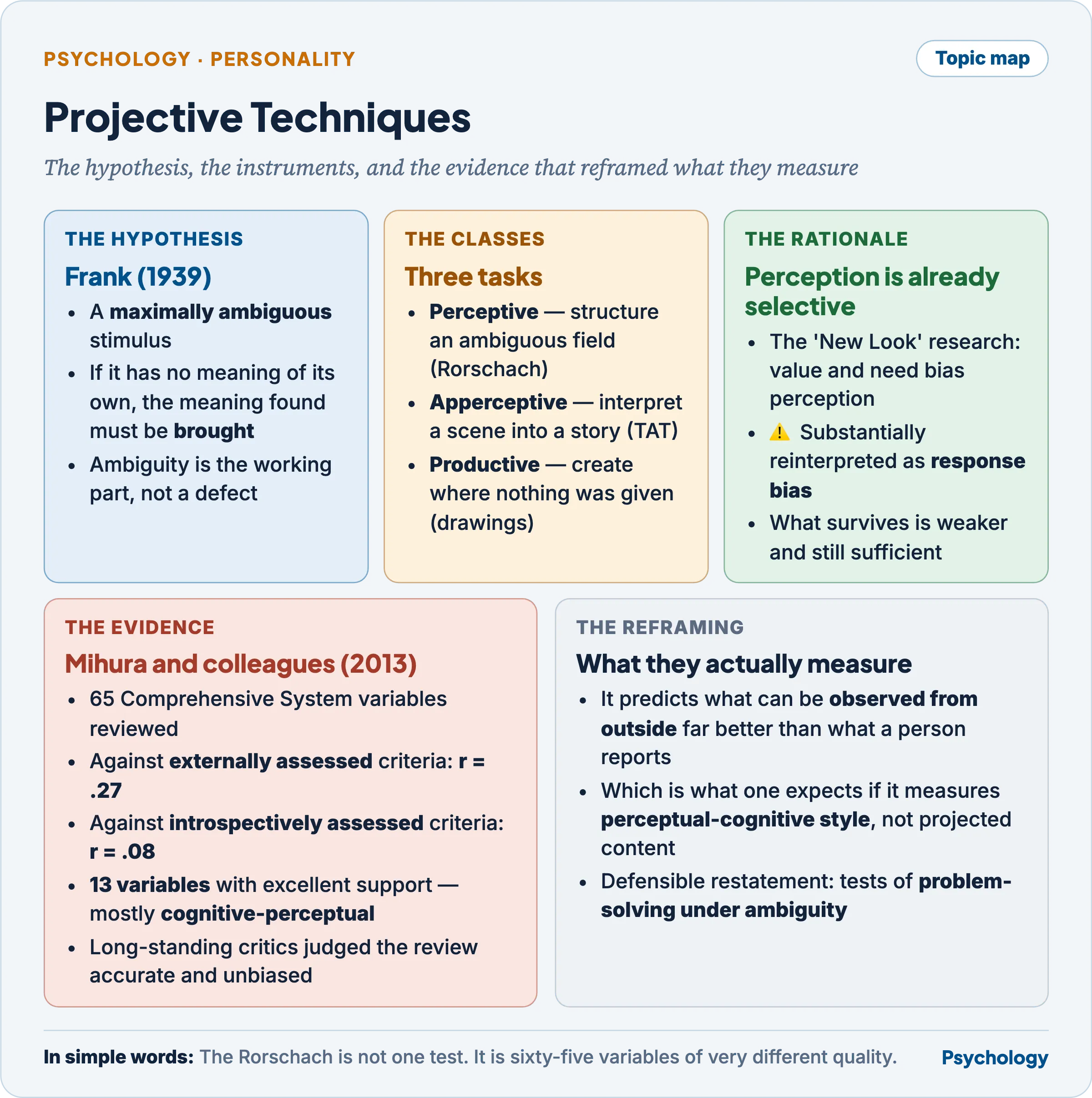
The reasoning behind every projective technique is a single inference: if a stimulus genuinely has no meaning of its own, then whatever meaning a person finds in it must have been brought by them. The ambiguity is not a defect of the test but its working part.
The projective hypothesis and its assumptions
- Frank (1939) gave the family its name, proposing that an ambiguous stimulus induces the person to impose their own private world upon it, revealing their organisation of experience rather than their conformity to a standard.
- The hypothetical ideas that generated the method can be set out as a chain, and each link is an assumption that can be examined.
- Ambiguity transfers determination to the respondent. If the stimulus does not constrain the answer, the answer is determined by the person.
- Responses are lawful, not random. What looks arbitrary is structured by the respondent’s needs, conflicts and habitual ways of construing.
- The purpose is disguised, so defences are bypassed. The person does not know what is being assessed and therefore cannot manage the impression — which is the central claim of superiority over self-report.
- What is revealed is largely unconscious, and therefore unavailable to the person by any method of direct questioning.
- Personality is organised and must be assessed globally. The unit of interpretation is the whole response pattern, not the item — an explicitly idiographic commitment inherited from the clinical tradition.
- Projection is the mechanism, in a sense wider than Freud’s defensive projection: not only the externalising of unacceptable impulses but the shaping of any ambiguous perception by the perceiver’s dispositions.
- Every one of these is contestable, and most of the technical difficulties in this literature follow from one or another of them being only partly true.
Why perception, and what the perception research found
- The rationale is that perception is already selective, so an ambiguous field maximises a bias that is present in ordinary seeing and makes it readable.
- The “New Look” research of the 1940s and 1950s supplied the evidence that motivation and value influence perception itself.
- Bruner and Goodman (1947) had children estimate the size of coins and of matched cardboard discs. Coins were overestimated relative to the discs, and poorer children overestimated more — value appearing to magnify perceived size.
- McGinnies (1949) presented neutral and taboo words tachistoscopically at increasing exposures. Taboo words needed significantly longer exposure to be reported correctly and produced raised galvanic skin response before correct report — presented as perceptual defence, a demonstration that the perceptual system screens threatening material before awareness.
- Perceptual vigilance was the complementary finding: need-relevant stimuli recognised at shorter exposures.
- The critique of that research matters for the projective rationale, because the rationale rests on it. The taboo-word result was reinterpreted as response bias: participants may have recognised the word at the same exposure as a neutral one and hesitated to say it aloud to an experimenter. The galvanic response before report is consistent with both readings. Later work using methods that remove the reporting problem found the effects smaller and less consistent than first claimed.
- What survives is weaker and still sufficient: perception is organised by expectation, set and context, and the perceiver contributes to what is perceived. That supports the projective premise. It does not establish that what a person contributes is their unconscious conflict rather than their habits of categorisation — a distinction that becomes decisive below.
Classifying the techniques
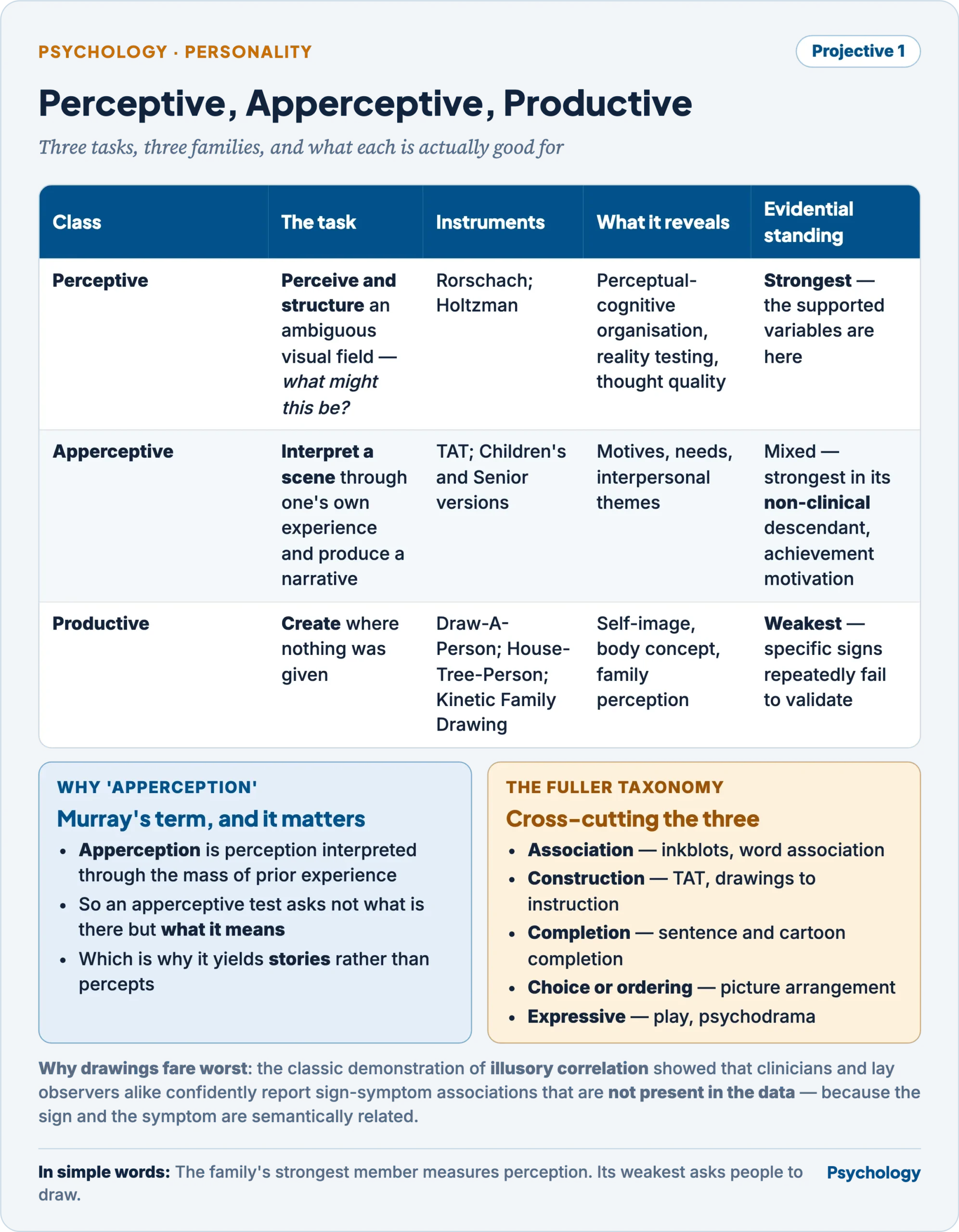
- The perceptive, apperceptive and productive division organises the family by what the respondent is asked to do with the stimulus.
| Class | The task | Instruments | What it best reveals |
|---|---|---|---|
| Perceptive | Perceive and structure an ambiguous visual field — what might this be? | Rorschach; Holtzman Inkblot Technique | Perceptual-cognitive organisation, reality testing, thought quality |
| Apperceptive | Interpret a scene in the light of one’s own experience and produce a narrative | Thematic Apperception Test; Children’s Apperception Test; Senior Apperception Test | Motives, needs, interpersonal themes, the view of relationships |
| Productive | Create something where nothing was given | Draw-A-Person; House-Tree-Person; Kinetic Family Drawing; play techniques | Self-image, body concept, family perception — and the weakest evidence base |
- Apperception is Murray’s term and is worth unpacking: apperception is perception interpreted through the mass of one’s prior experience, so an apperceptive test asks not what is there but what it means — which is why it yields stories rather than percepts.
- The fuller conventional taxonomy cross-cuts this one and is worth having: association techniques (inkblots, word association), construction (TAT, drawings from instruction), completion (sentence completion, cartoon completion), choice or ordering (picture arrangement, Szondi), and expressive (play, psychodrama, handwriting).
The Rorschach
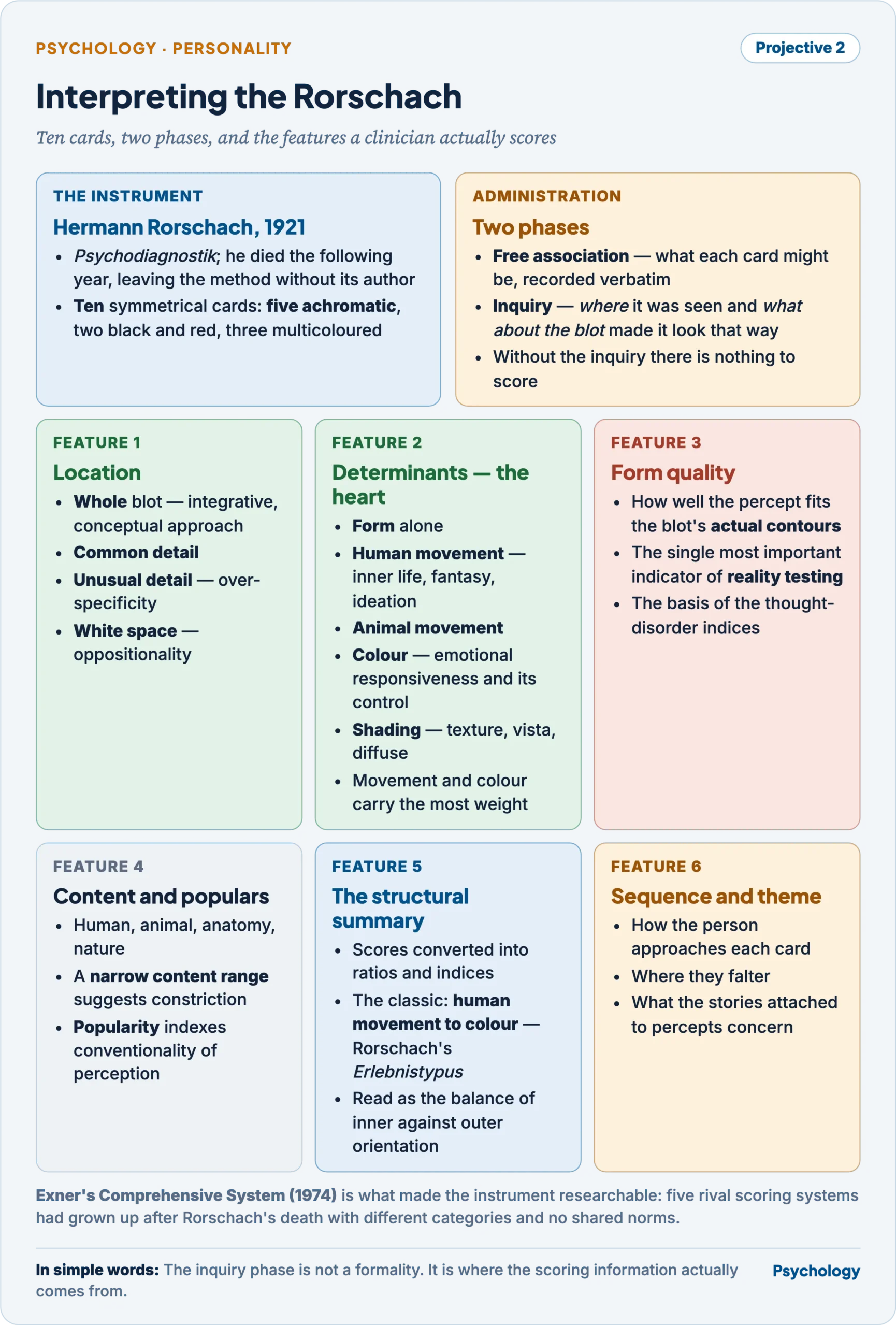
- The instrument. Hermann Rorschach published Psychodiagnostik in 1921 and died the following year, leaving the method without its author. It comprises ten symmetrical inkblot cards: five achromatic, two in black and red, and three multicoloured.
- Administration has two phases. In the free association phase the cards are presented in order and the respondent says what each might be, with the examiner recording responses verbatim. In the inquiry phase the examiner returns to each response to establish where it was seen and what about the blot made it look that way — which is what makes scoring possible at all.
- The major features used in interpretation are the scoring categories, and the question is usually about these.
- Location — which part of the blot was used: the whole blot, a common detail, an unusual detail, or the white space. Whole responses are associated with integrative, conceptual approach; excessive unusual detail with over-specificity; space responses with oppositionality.
- Determinants — what about the blot produced the percept, and this is the heart of the system. Form alone; human movement; animal movement; colour, chromatic and achromatic; shading in its texture, vista and diffuse variants; and reflection and pairs. Movement and colour carry the most interpretive weight — movement conventionally associated with inner life, fantasy and ideation, colour with emotional responsiveness and its control.
- Form quality — how well the percept fits the blot’s actual contours, which is the single most important indicator of reality testing and the basis of the thought-disorder indices.
- Content — human, animal, anatomy, nature and the rest, with a narrow content range suggesting constriction.
- Popularity and originality — whether the response is one most people give, which indexes conventionality of perception.
- The structural summary then converts these into ratios and indices, of which the ratio of human movement to colour — Rorschach’s Erlebnistypus — is the classic, read as the balance between an inner and an outer orientation.
- Sequence and thematic content are read alongside the scores: how the person approaches each card, where they falter, and what the stories they attach to percepts concern.
- Exner’s Comprehensive System (1974) made the instrument researchable. Five competing scoring systems had grown up after Rorschach’s death, each with different categories and no shared norms; Exner selected the empirically defensible elements, standardised administration and scoring, and supplied normative data. Virtually all modern research refers to this system.
The Thematic Apperception Test
- Murray and Morgan (1935) introduced it at the Harvard Psychological Clinic. It comprises 31 cards, of which one is blank; a selection of about twenty is administered, chosen for the respondent’s age and sex.
- The task is to tell a story for each picture: what is happening, what led up to it, what the characters are thinking and feeling, and how it turns out.
- Murray’s interpretive scheme is need-press analysis. The examiner identifies the hero — the figure the respondent identifies with — then catalogues the needs the hero expresses (achievement, affiliation, dominance, nurturance, abasement) and the press, the environmental forces acting on the hero. The recurring thema of need and press is taken as the structure of the respondent’s own concerns.
- The variants extend the method: the Children’s Apperception Test substitutes animal figures for young children, a senior version addresses the concerns of later life, and Indian adaptations have replaced the original pictures with culturally appropriate scenes — a necessary step, since the original cards depict a particular society and period.
- Its most successful descendant is not clinical. The TAT’s scoring for achievement imagery became the standard measure of the achievement motive, and that line of work has a far better evidential record than the clinical use — which is treated with the motivation topics.
The other techniques, briefly evaluated
- Sentence completion presents stems to be finished. It is the most psychometrically respectable member of the family: scoring can be made objective, reliability is adequate, and validity for specific constructs is demonstrable. The cost is that it is barely disguised, so it is open to the impression management projectives exist to avoid.
- Word association, the oldest technique, records the response and the reaction time to each stimulus word; delays, blockages, unusual responses and repetitions are taken to mark complexes. It has a defined mechanism and a measurable index, and it is now little used clinically.
- Drawing techniques — a person, a house-tree-person, a family in action — are quick, non-verbal and usable with children. Their evidence base is the weakest in the family. Specific sign interpretations of the kind that fill the manuals have repeatedly failed to validate, and the classic demonstration of illusory correlation showed that clinicians and lay observers alike confidently report sign-symptom associations that are not present in the data, because the sign and the symptom are semantically related. Global ratings of drawings fare better than specific signs.
- The picture-frustration study presents cartoon figures in frustrating situations and classifies the response by direction — extrapunitive, intropunitive, impunitive — and by type. It is semi-structured and scorable, and has an Indian adaptation.
Reliability and validity: the problems and the evidence
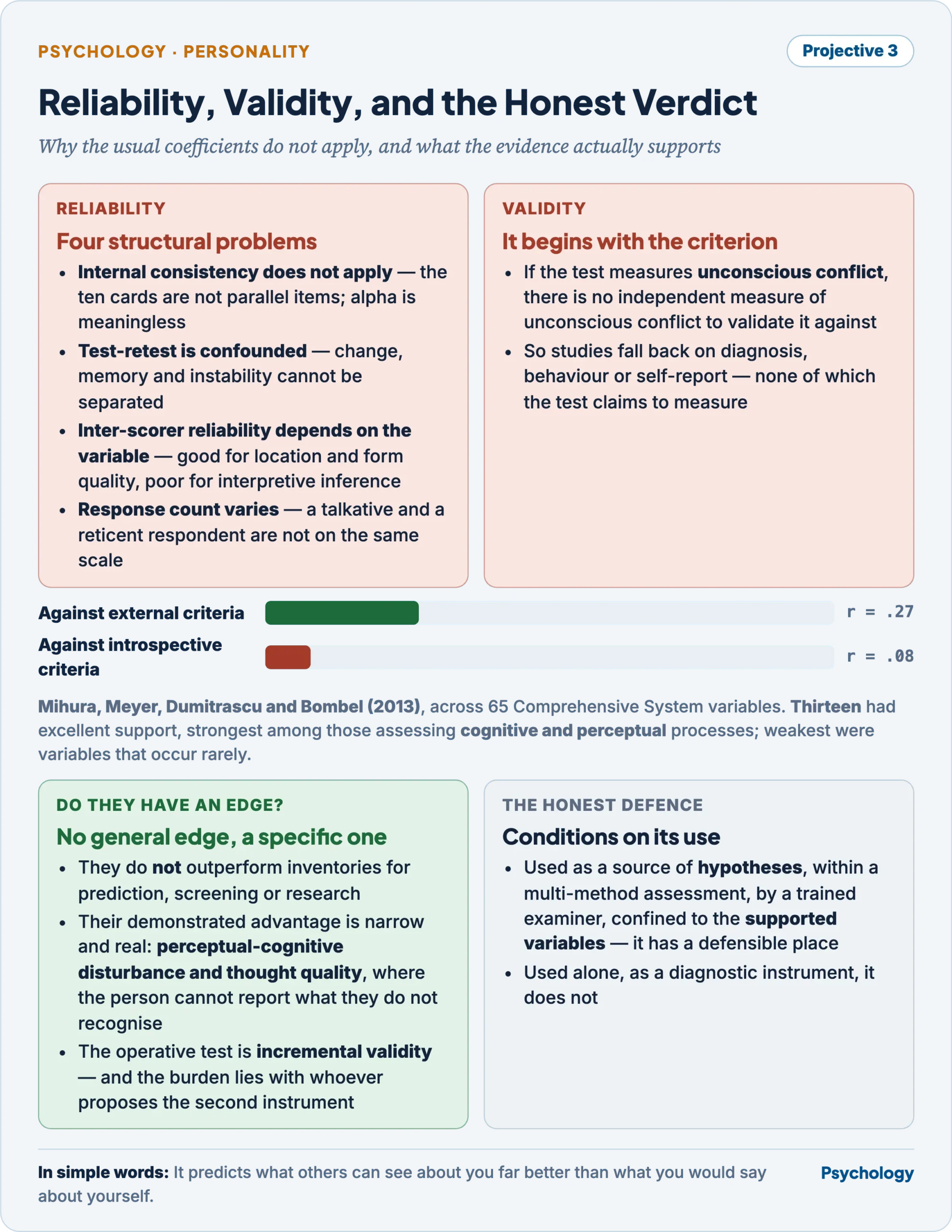
- The reliability problems are structural, not incidental.
- Internal consistency does not apply. The ten cards are not parallel items measuring one thing; each is designed to pull differently, so a coefficient alpha is meaningless.
- Test-retest is confounded. A changed response may reflect changed personality, memory of the previous session, or the instrument’s own instability, and the design cannot separate them.
- Inter-scorer reliability depends entirely on the variable. Under a standardised system it is good for well-defined codes such as location and form quality, and poor for interpretive inference, where the examiner’s judgement does the work.
- The number of responses varies between people, and because many scores are counts, a talkative respondent and a reticent one are not on the same scale — a problem specific to this family and only partly solved.
- The validity problem begins with the criterion. If the test measures unconscious conflict, there is no independent measure of unconscious conflict against which to validate it, so studies fall back on diagnosis, behaviour or self-report — none of which the test claims to be measuring.
- The best evidence is a systematic review of the Rorschach’s individual variables, and its result is more interesting than either camp’s slogan. Mihura, Meyer, Dumitrascu and Bombel (2013) meta-analysed the peer-reviewed validity literature for 65 variables of the Comprehensive System.
- Against externally assessed criteria — behaviour, observer report, diagnosis — the mean validity across 53 meta-analyses was r = .27.
- Against introspectively assessed criteria — what the person says about themselves — it was r = .08.
- Thirteen variables had excellent support, and the strongest were those assessing cognitive and perceptual processes, such as the perceptual-thinking index. The weakest were variables that occur rarely.
- The review’s standing is unusual: long-standing critics of the instrument examined it and judged it accurate and unbiased, which makes it the nearest thing to an agreed statement in a bitterly contested literature.
- How to read that result. The Rorschach is not one test but a collection of scores of very different quality, so blanket verdicts in either direction are wrong. And the pattern of the findings is diagnostic: it predicts what can be observed from outside far better than what a person reports about themselves — which is precisely what one should expect if it measures perceptual and cognitive style rather than self-concept.
Are projective tests really projective?
- The honest answer: partly, and the parts that work best are the least projective.
- What argues against pure projection.
- Card pull. The stimuli are not meaningless. Particular blots and pictures reliably elicit particular content across respondents, so the stimulus is doing part of the determining that the hypothesis assigns to the person.
- Situational and examiner effects. Responses shift with instructions, with the stated purpose, with the examiner’s manner and with the respondent’s set — which a purely internal determination would not predict.
- Responses can be managed. Respondents instructed to create an impression can shift their protocols, so the claim that the disguise defeats defensiveness is not fully sustained.
- The evidence pattern. The perceptual and structural scores validate better than the thematic and content scores. If projection of unconscious material were the active ingredient, the content ought to carry the signal — and it carries less of it.
- What argues for it. The respondent does organise an under-determined field, the organisation differs reliably between people, and it relates to externally observable characteristics at a respectable level.
- The defensible reformulation, which the evidence supports better than the original hypothesis: these are tests of perceptual-cognitive problem solving under ambiguity. What they capture is how a person structures unclear information, which is a real and stable characteristic — and which is not the same as projecting unconscious conflict.
Projective against psychometric tests
| Projective | Psychometric / objective | |
|---|---|---|
| Stimulus | Ambiguous, unstructured | Structured, specific items |
| Response | Free, unlimited | Fixed, selected from options |
| Purpose | Disguised | Usually transparent |
| Interpretation | Global and idiographic | Nomothetic, against norms |
| Scoring | Judgement-dependent, costly | Objective, often machine-scored |
| Reliability | Problematic, variable by score | Generally good and routinely reported |
| Validity | Contested; good for some variables | Better established, though construct-specific |
| Faking | Harder but not impossible | Easier; detectable by validity scales |
| Time and cost | High; requires a trained examiner | Low; group administration possible |
| Best at | Hypothesis generation; thought quality; the individual case | Prediction, screening, research, comparison |
- Advantages of the projective family: resistance to deliberate impression management; access to material the respondent cannot or will not report; richness and individuality of the data; usability with children and with people of limited literacy; and value as a source of hypotheses in a clinical formulation.
- Disadvantages: time and cost; dependence on examiner skill; contested reliability and validity; vulnerability to the examiner’s own biases; weak norms for many populations; and poor incremental validity over cheaper measures in most demonstrations.
- Do they have an edge? No general edge, and a specific one in places. They do not outperform objective inventories for prediction, screening or research. Their demonstrated advantage is narrow and real: for perceptual-cognitive disturbance and thought quality, where the person cannot report what they do not recognise, the Rorschach’s supported variables carry information an inventory does not. The sensible position is complementarity — the question is what a projective adds over and above a cheaper measure, and the burden of showing that increment lies with the person proposing to use it.
Criticisms and limitations
- The theoretical rationale is weaker than assumed, since the perception research it rests on was substantially reinterpreted as response bias.
- The Rorschach is treated as one instrument when it is sixty-five variables of widely differing quality, and both its defenders and its critics generalise improperly.
- Drawing interpretation is the weakest point, with specific signs repeatedly failing to validate and illusory correlation demonstrated as the mechanism sustaining clinicians’ confidence.
- Norms are thin and often old, and almost entirely Western — a serious problem for Indian use, where the stimulus materials themselves depict another society.
- Examiner effects are substantial and are not eliminated by standardised scoring, because interpretation remains a judgement.
- The method is expensive in a system with few clinicians, which is a distributional argument against its routine use.
- The forensic use is the sharpest concern, since testimony derived from scores with little validity can affect custody and criminal matters.
- And the honest defence: used as a source of hypotheses within a multi-method assessment, by a trained examiner who confines interpretation to the supported variables, the technique has a defensible place. Used alone, as a diagnostic instrument, it does not.
Previous Year Questions
- 2026Distinguish between projective tests and psychometric tests of personality along with their advantages and disadvantages.
- 2023What hypothetical ideas lead to the development of projective personality tests?
- 2020What are the major features do clinicians use to interpret Rorschach responses?
- 2016Are projective tests really projective in nature? Describe Rorschach and TAT tests and comment on their reliabilities.
- 2012What is the essence of a projective technique? Critically evaluate perceptive, apperceptive and productive projective tests in the measurement of personality.
- 2007What are the key assumptions of projective tests? Indicate the problems encountered in determining their reliability and validity.
- 1998Do the projective techniques of personality assessment have an edge over psychometric tests? Cite experimental evidences in this context.
- 1996Explain the rationale in using perception as a medium for studying personality. Cite major findings of research in this area.
- 1996Briefly describe various projective measures of personality. Evaluate each of them.