

Theories of personality (psychoanalytical, sociocultural, interpersonal, developmental).
Official Syllabus: Paper I · Unit 11 Personality
“Personality is the relatively enduring pattern of recurrent interpersonal situations which characterize a human life.”
— Sullivan (1953)
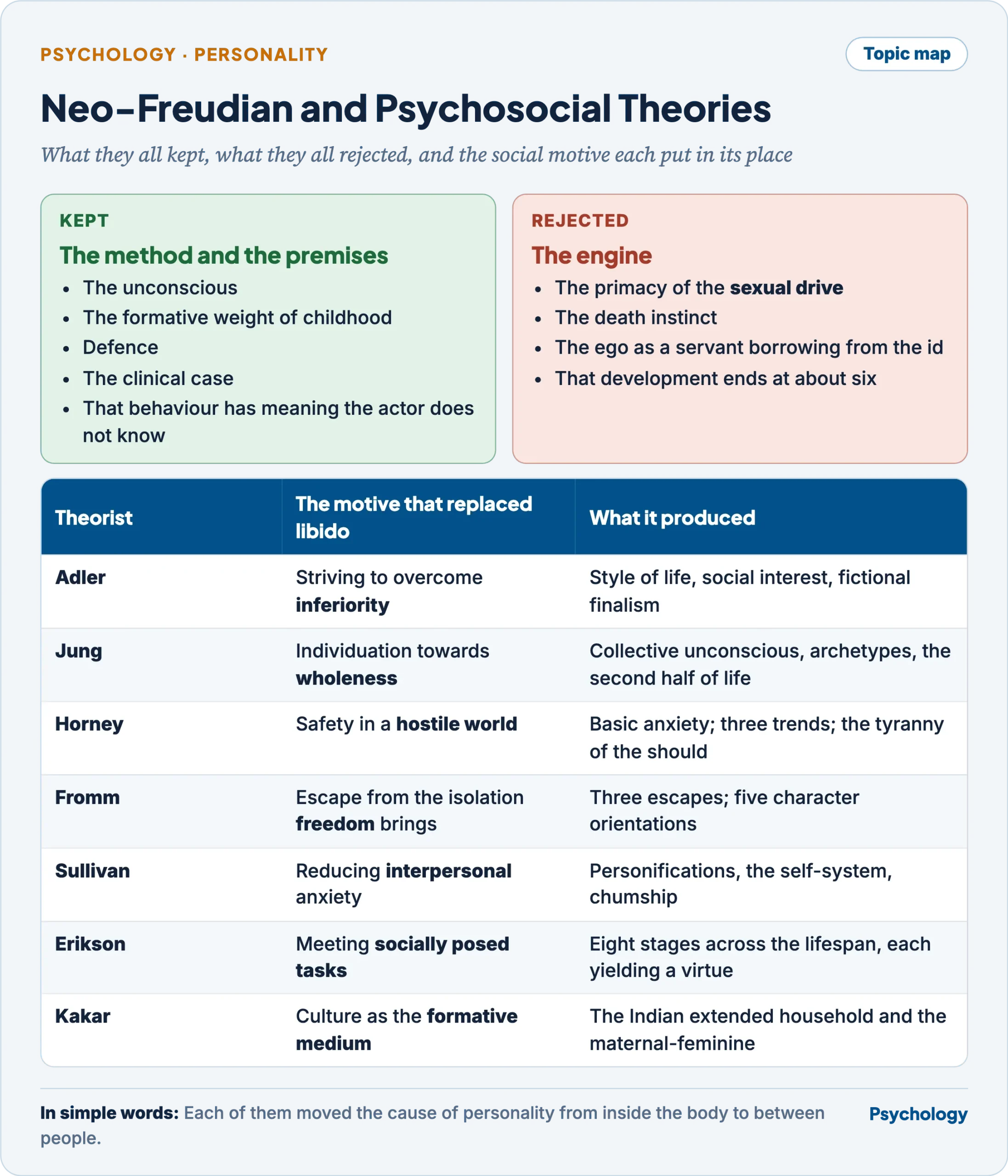
The theorists who followed Freud kept his method and rejected his engine. Each of them replaced the sexual drive with something social — inferiority, culture, relationships, society, the lifespan — and each therefore relocated the cause of personality from inside the body to between people. The syllabus’s sociocultural, interpersonal and developmental approaches are all in this group, which is why they belong together rather than scattered.
What they all rejected, and what they kept
- Kept: the unconscious; the formative weight of childhood; defence; the clinical method; the idea that behaviour has meaning the actor does not know.
- Rejected: the primacy of the sexual drive; the death instinct; the ego as a servant borrowing energy from the id; and the view that development is finished by about six.
- Replaced it with, in each case, a social motive: Adler’s striving to overcome inferiority, Horney’s need for safety in a hostile world, Fromm’s need to escape the isolation that freedom brings, Sullivan’s need to reduce interpersonal anxiety, Erikson’s sequence of socially posed tasks.
Adler: individual psychology
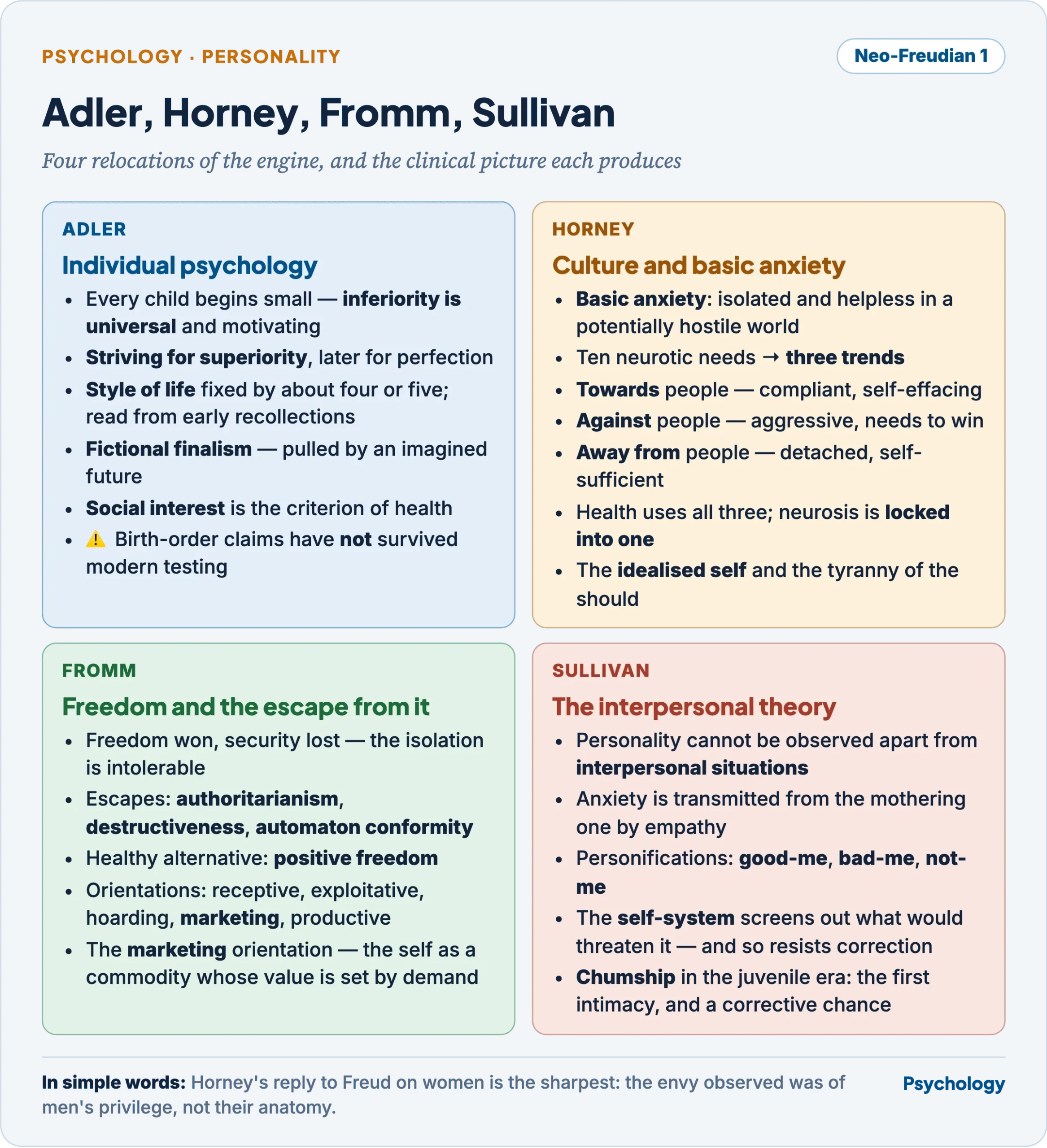
- The founding idea is compensation. Every child begins small, weak and dependent, so feelings of inferiority are universal and are the motive for development rather than a disorder. What matters is what the person does with them.
- Striving for superiority is Adler’s single dynamic force — not dominance over others but the drive towards completion and mastery. It later became striving for perfection, which makes it clearer that the goal is self-realisation and not victory.
- The inferiority complex is the pathological outcome, where the feeling overwhelms rather than motivates — from organ inferiority, from pampering, or from neglect. Its mirror, the superiority complex, is an overcompensation that conceals the same thing.
- Style of life is the unique pattern of goals, beliefs and behaviours each person devises to pursue superiority, fixed in its outline by about four or five. Adler read it from early recollections, on the argument that what we remember from childhood is selected to fit the style we have adopted.
- Fictional finalism — later guiding self-ideal — is the claim that we are pulled by an imagined future rather than pushed by the past. The goal need not be true to be effective, which is the sharpest contrast with Freud available in this literature.
- Social interest is the criterion of health. A capacity for cooperation and concern for the community is innate but must be developed; Adler judged every style of life by whether it is useful to others. This makes his theory the first in which mental health is defined socially rather than intrapsychically.
- Birth order is the best-known and weakest part. Adler characterised first-borns as dethroned and conservative, second-borns as competitive, youngest as pampered, only children as precocious. The modern evidence finds, at most, very small effects on personality and a modest one on measured ability, so it should be given as his claim rather than as a finding.
Jung: analytical psychology
- The psyche has three layers on Jung’s account, and the third is his innovation. The conscious ego; the personal unconscious, which holds forgotten and repressed material organised into emotionally charged complexes; and the collective unconscious, inherited and universal, which holds the archetypes.
- Archetypes are not inherited images but inherited predispositions to respond to recurring human situations in patterned ways. The principal ones: the persona, the mask presented to the world; the shadow, the disowned and usually dark side, which carries vitality as well as danger; the anima and animus, the contrasexual element in each person; and the self, the archetype of wholeness and the centre of the whole psyche, which is the goal rather than the starting point.
- Individuation is the process of integrating these elements — confronting the shadow, differentiating from the persona, reconciling the contrasexual — into a balanced whole. Jung placed it in the second half of life, which is a direct rejection of Freud’s view that character is settled in childhood.
- The energy principle is teleological as well as causal. Jung held that the psyche is directed by purpose and by the past together, and that symptoms may express an unlived possibility rather than only a buried injury.
- His attitude and function types — introversion and extraversion, crossed with thinking, feeling, sensation and intuition — are treated with the type and trait approaches, where the eight resulting types and their weaknesses belong.
Horney: culture, basic anxiety, and the critique of Freud
- Basic anxiety is the foundation: the feeling of being isolated and helpless in a potentially hostile world, arising when parents fail to provide warmth and security. Not drive, but insecurity, is the engine.
- Ten neurotic needs were her first classification, later reduced to three trends, which is the more useful form.
- Moving towards people — the compliant type, seeking affection and approval, self-effacing.
- Moving against people — the aggressive type, seeking power, exploiting, needing to win.
- Moving away from people — the detached type, seeking self-sufficiency and privacy.
- The healthy person uses all three as circumstances require. The neurotic is locked into one and denies the others, which is the structural definition of neurosis in her system.
- The idealised self and the tyranny of the should. Unable to accept the real self, the neurotic constructs an idealised image and then tyrannises themselves with its demands — I should always be generous, competent, unafraid. The gap between the two generates self-hatred, and the pursuit of the image consumes the energy that growth would need.
- Her critique of Freud on women is a substantive theoretical argument, not merely a protest. She held that penis envy described men’s fantasies rather than women’s experience; that the clinically observable envy was of men’s social privilege, not their anatomy; and she proposed womb envy — men’s envy of women’s capacity to bear children — as a deliberate mirror, arguing that male productivity in work may be its compensation. The wider point is methodological: a theory built from one sex’s analysts and one culture’s patients will mistake its local findings for human nature.
Fromm: freedom, and the escape from it
- The central thesis is historical. As people won freedom from medieval structures of belonging, they gained autonomy and lost security, and the resulting isolation is intolerable. Personality is shaped by how a person resolves that dilemma.
- Three mechanisms of escape from freedom: authoritarianism, submitting to or dominating others to regain belonging; destructiveness, removing what threatens by eliminating it; and automaton conformity, dissolving into the crowd by adopting its opinions wholesale so that the burden of being a separate self disappears. The healthy alternative he called positive freedom — relating to others spontaneously, in love and work, without surrendering individuality.
- Five character orientations describe how people relate to the world: receptive, expecting everything from outside; exploitative, taking by force or guile; hoarding, securing by saving and withholding; marketing, experiencing oneself as a commodity whose value is set by demand; and the productive orientation, the single healthy one, in which the person uses their powers to create and to love.
- The marketing orientation is his most-cited contribution because it describes something that was new when he named it: the self as a package to be sold, with personality itself becoming an item of exchange value.
- Five existential needs follow from the human condition: relatedness, transcendence, rootedness, a sense of identity, and a frame of orientation. Each can be met productively or destructively, and the choice is the substance of character.
Sullivan: the interpersonal theory
- The unit of study is not the person but the situation. Sullivan held that personality is a hypothetical entity that cannot be observed apart from interpersonal situations, which is the most radical relocation in this group.
- Anxiety is interpersonal in origin. It is transmitted from the mothering one to the infant by empathy, and the infant’s whole development is organised around reducing it.
- Personifications are the images built of oneself and others. Three self-personifications emerge from the handling of anxiety: the good-me, associated with approval; the bad-me, with disapproval and anxiety; and the not-me, with anxiety so severe that the experience is dissociated altogether.
- The self-system is the organisation of security operations that keeps anxiety out of awareness. It is useful and it is conservative: because it screens out experience that would threaten it, it resists the very information that could correct it.
- Developmental epochs run from infancy to late adolescence, each defined by the relationships it makes possible. The distinctive one is the juvenile era’s chumship — a close same-sex friendship in pre-adolescence, which Sullivan regarded as the first experience of genuine intimacy and a corrective opportunity for children whose family relationships were damaging.
Erikson: the psychosocial stages
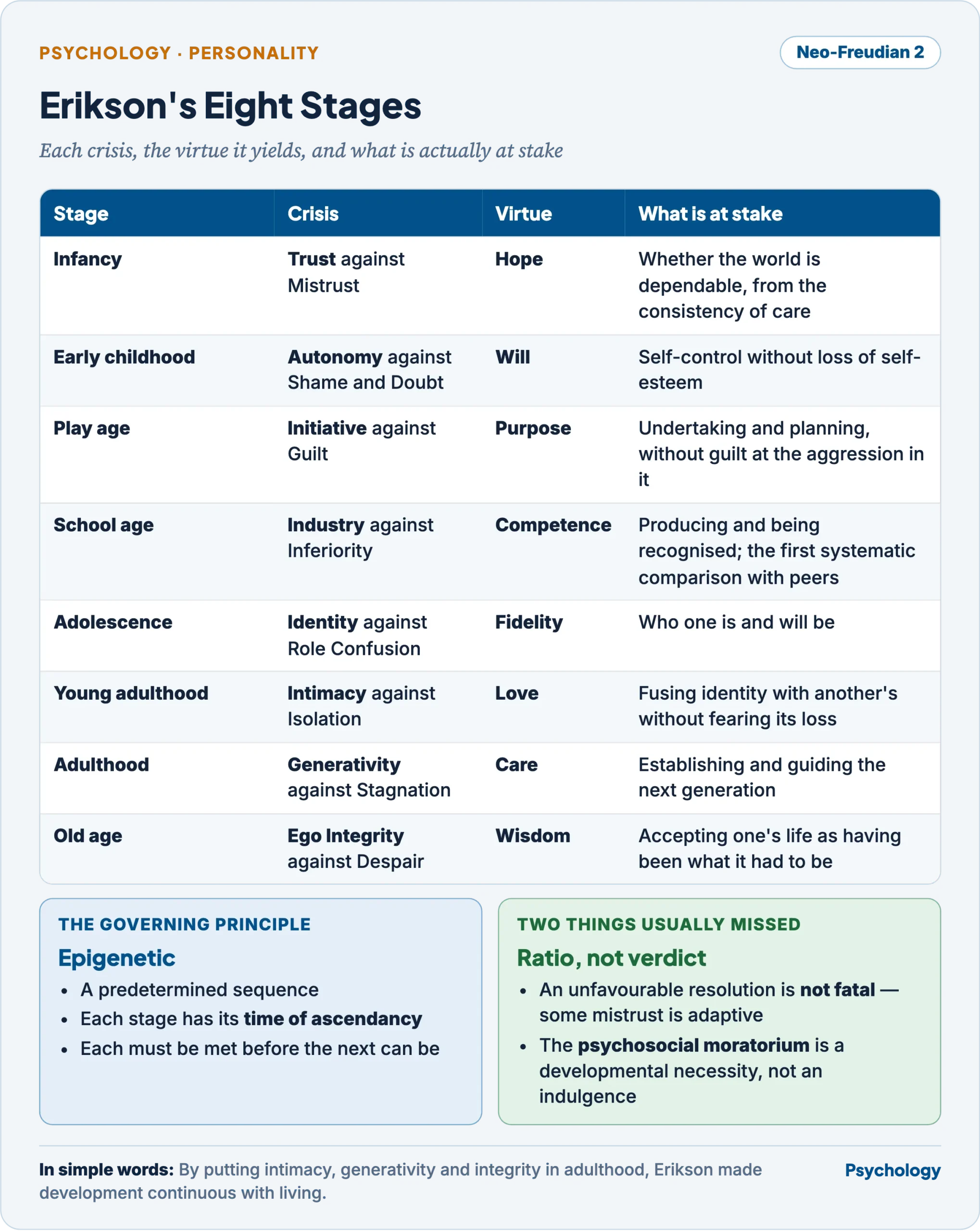
- The epigenetic principle governs the whole scheme: development unfolds in a predetermined sequence, each stage has a time of ascendancy, and each must be negotiated before the next can be properly met. Each stage is a crisis — a turning point of heightened potential, not a catastrophe — between two outcomes, and the resolution yields a virtue or basic strength.
| Stage | Crisis | Virtue | What is at stake |
|---|---|---|---|
| Infancy | Trust against Mistrust | Hope | Whether the world is dependable, from the consistency of care |
| Early childhood | Autonomy against Shame and Doubt | Will | Self-control without loss of self-esteem; toilet training and the first “no” |
| Play age | Initiative against Guilt | Purpose | Undertaking and planning, without excessive guilt at the aggression in doing so |
| School age | Industry against Inferiority | Competence | Producing things and being recognised for it; the first systematic comparison with peers |
| Adolescence | Identity against Role Confusion | Fidelity | Who one is and will be; the stage Erikson made his own |
| Young adulthood | Intimacy against Isolation | Love | Fusing identity with another’s without fearing its loss |
| Adulthood | Generativity against Stagnation | Care | Establishing and guiding the next generation, or any lasting contribution |
| Old age | Ego Integrity against Despair | Wisdom | Accepting one’s life as having been what it had to be |
- The identity stage carries the theory’s best-known contributions: the identity crisis, and the psychosocial moratorium — a socially sanctioned delay in which the adolescent may try out roles before committing. Erikson treated the moratorium as a developmental necessity rather than an indulgence, which has obvious application where societies compress it.
- An unfavourable resolution is not fatal. Each stage yields a ratio rather than a verdict — some mistrust is adaptive — and later stages can revisit earlier failures. This is the structural reason Erikson’s scheme is more optimistic than Freud’s.
Erikson against Freud
| Freud: psychosexual | Erikson: psychosocial | |
|---|---|---|
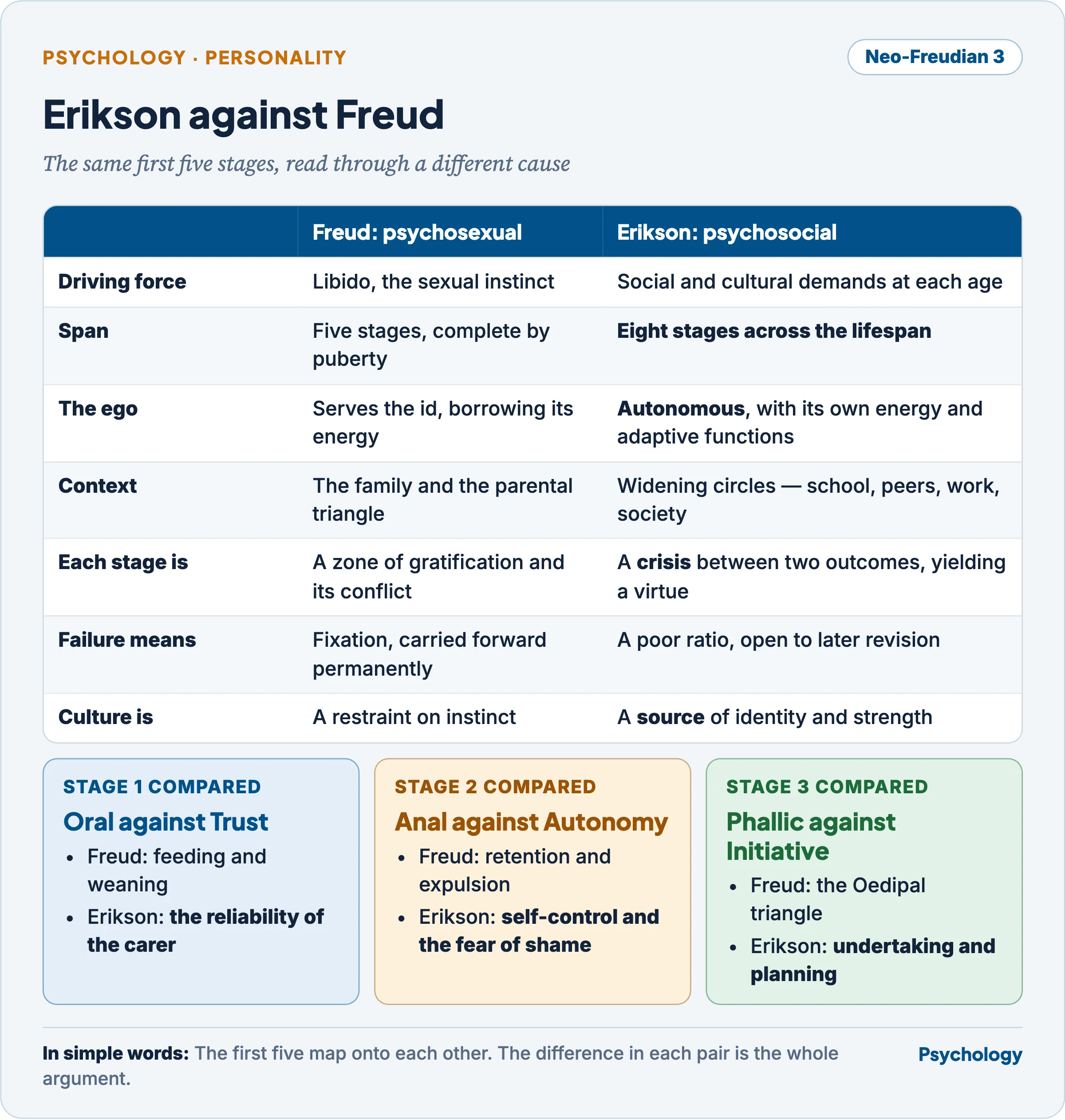
| Driving force | Libido, the sexual instinct | Social and cultural demands at each age |
| Span | Five stages, essentially complete by puberty | Eight stages across the whole lifespan |
| The ego | Serves the id, borrowing its energy | Autonomous, with its own energy and adaptive functions |
| Formative context | The family, and the parental triangle | Family, then widening circles — school, peers, work, society |
| Each stage is | A zone of gratification and its conflict | A crisis between two outcomes, yielding a virtue |
| Outcome of failure | Fixation, carried forward permanently | A poor ratio, open to later revision |
| View of culture | A restraint on instinct | A source of identity and strength |
| Tone | The person is in conflict with civilisation | The person is supported by, and grows through, society |
- The stages map onto each other for the first five, and the difference in each pair is the point: Freud’s oral stage is about feeding, Erikson’s trust stage about the reliability of the carer; Freud’s anal stage about retention and expulsion, Erikson’s autonomy stage about self-control and the fear of shame; Freud’s phallic stage about the Oedipal triangle, Erikson’s initiative stage about undertaking and planning.
- The decisive extension is the last three stages. By placing intimacy, generativity and integrity in adulthood and old age, Erikson made personality development continuous with living, which no psychoanalytic scheme had done.
The Indian development: Kakar
- The Indian extension of psychoanalysis is substantially Sudhir Kakar’s. The Inner World (1978) applied psychoanalytic method to Indian childhood and society and argued that the developmental sequence Freud described is not universal in its timing or its content.
- The structural claim is that the extended household produces a prolonged and indulgent infancy with multiple caretakers, followed by a comparatively abrupt demand for conformity as the child enters the world of the household’s hierarchy. The consequences he drew: a self organised around relationship and obligation rather than separation; and a weight of the maternal-feminine in the male psyche that a theory built on the paternal does not anticipate.
- Why it belongs in this group rather than with Freud. Kakar does to Freud what Horney and Fromm did — holds the method, denies the universality of the content, and makes culture the formative medium. The line from Horney’s objection that psychoanalysis universalised one culture’s family to Kakar’s demonstration of what another culture’s family produces is direct.
- The honest qualification: the work generalises from clinical cases and from a particular class and community, it is contested within Indian psychology, and it is better read as the founding argument of a field than as a settled description.
Criticisms and limitations
- The same unfalsifiability problem inherited from Freud applies to most of this group, whose constructs — basic anxiety, social interest, the not-me — are no more directly testable than the id.
- Adler’s birth-order claims have not survived. Large modern studies find effects on personality that are very small or absent.
- Jung’s collective unconscious is the least testable construct in personality psychology, and the inheritance of archetypes has no mechanism consistent with what is known about genetics.
- Erikson’s stages are described, not measured. The sequence is plausible and widely used, but the evidence that the crises occur in that order, or that virtues emerge as claimed, is thin — and the identity stage is the only one with a substantial research literature, through Marcia’s operationalisation.
- The lifespan scheme is culturally specific in its content: a psychosocial moratorium presupposes a society that can afford one, and generativity and integrity are described in terms that fit an industrial middle class.
- Sullivan’s influence exceeds his evidence, and his terminology — obscure even by this field’s standards — has kept his contribution less read than it deserves.
- What survived is substantial, and it is mostly the relocation itself: that personality is formed in relationships rather than in the management of drives is now the mainstream position, carried forward by attachment theory, object relations and interpersonal approaches to therapy.
Previous Year Questions
- 2022Can human beings be fully functioning and self-actualized? Evaluate it from humanistic and psychoanalytic perspectives of personality.
- 2020Differentiate between Erikson’s psychosocial and Freudian psychosexual theories. Also explain different virtues attached to each stage of psychosocial theory.
- 2014Briefly discuss the evolution of psychoanalytic theory as reflected in the works of Fromm, Erikson and Sudhir Kakar.