

Theories of personality (psychoanalytical).
Official Syllabus: Paper I · Unit 11 Personality
“The ego is not master in its own house.”
— Freud (1917), on the third blow to human self-regard
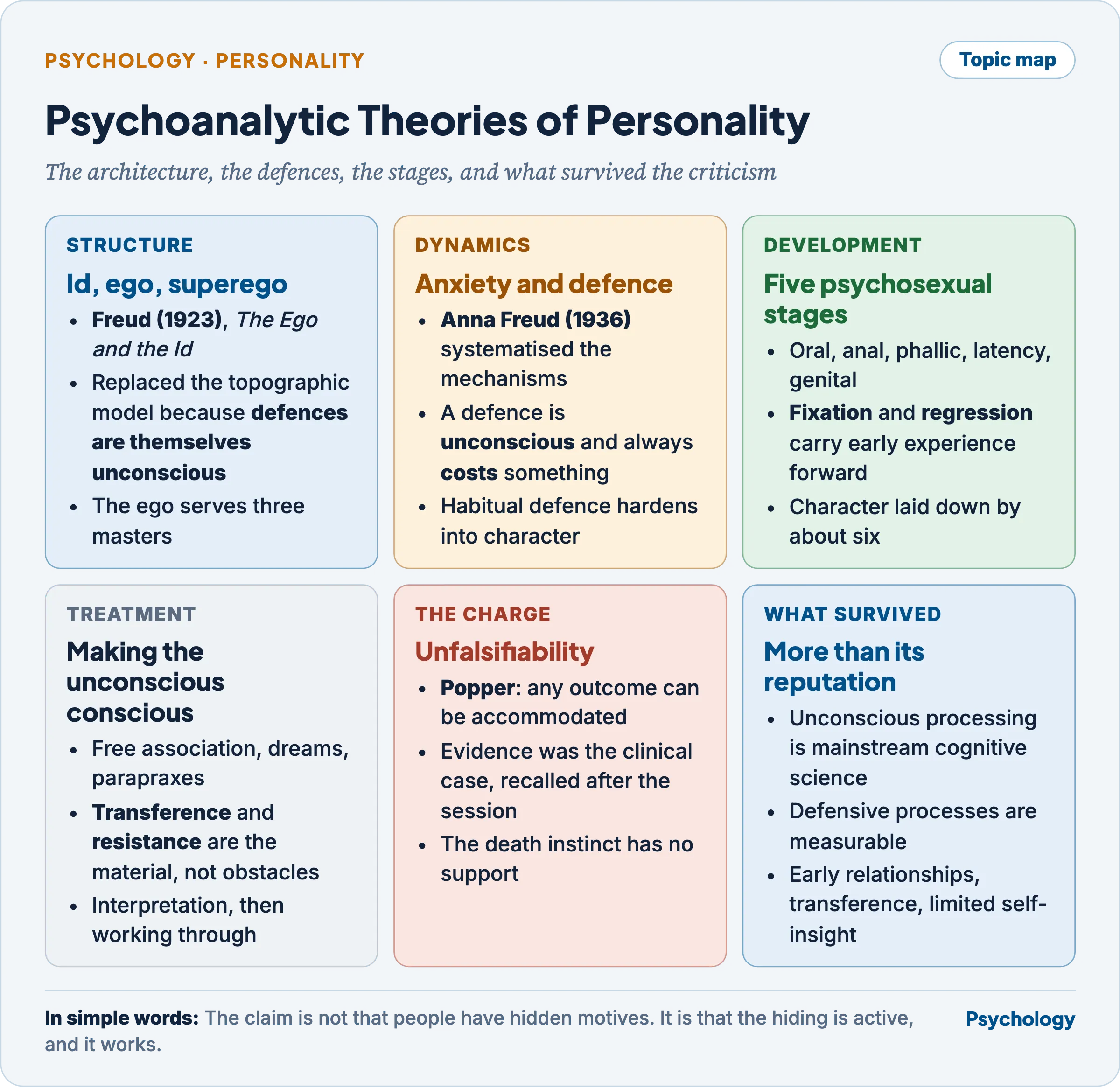
Freud’s claim is not that people have hidden motives, which nobody doubted, but something stronger and stranger: that the greater part of mental life is systematically inaccessible, that it is kept inaccessible by active force, and that it nevertheless determines what we do. Everything distinctive in the theory — the structure, the defences, the stages, the method of treatment — follows from taking that claim seriously.
The architecture of the mind
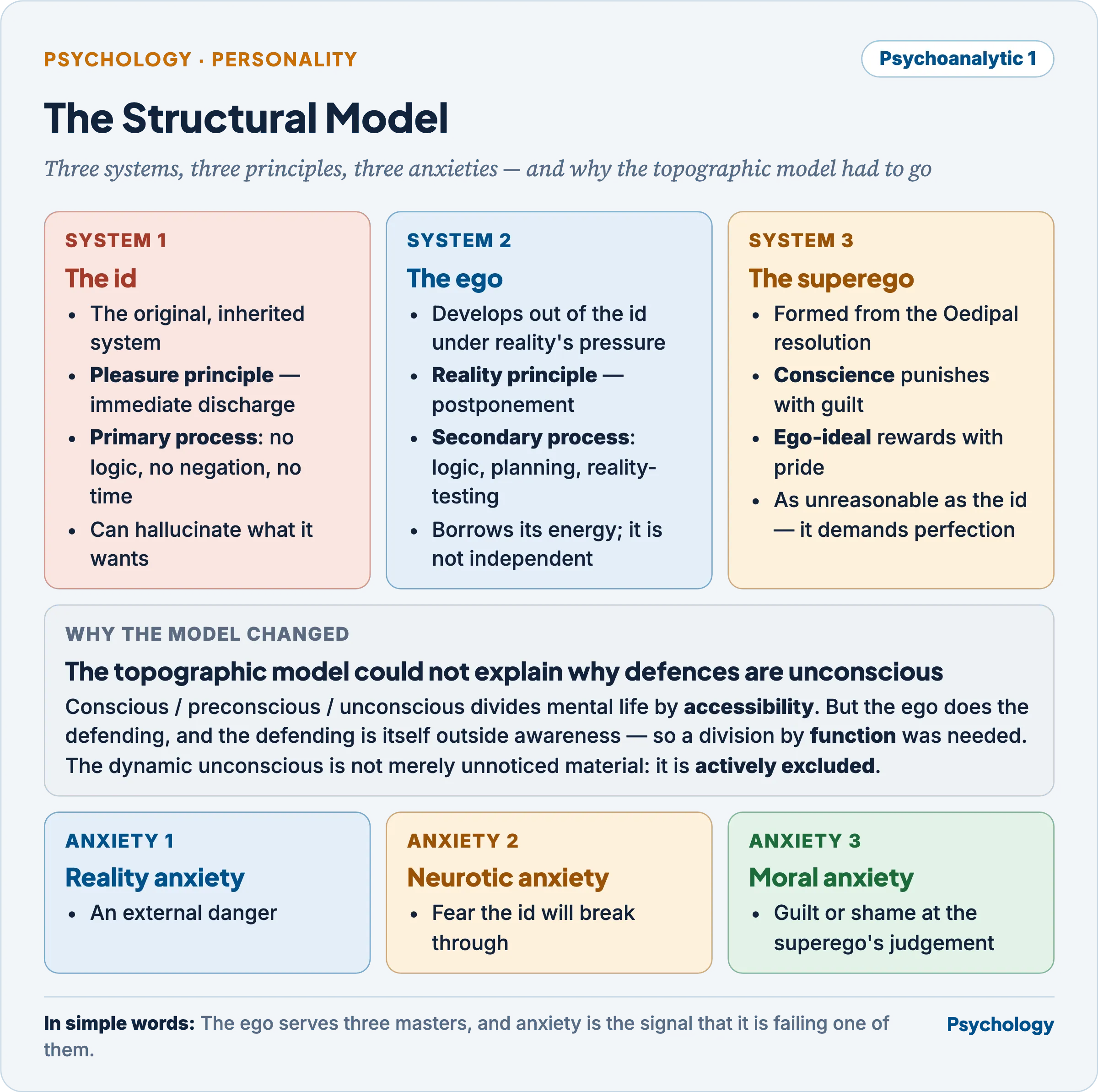
- The topographic model came first and divides mental life by accessibility.
- Conscious — what is in awareness now, a small fraction of the whole.
- Preconscious — what is not in awareness but can be summoned without resistance.
- Unconscious — what cannot be summoned, because force is being used to keep it out. This is the dynamic unconscious, and it is Freud’s distinctive contribution: not merely unnoticed material but actively excluded material.
- The structural model (Freud, 1923, The Ego and the Id) replaced it, because the topographic model could not explain why defences themselves are unconscious. The new division is by function.
- The id is the original, inherited system — the reservoir of instinctual energy. It runs on the pleasure principle, demanding immediate discharge, and on primary process thinking: no logic, no negation, no sense of time, and the capacity to form a hallucinatory image of what it wants.
- The ego develops out of the id under the pressure of reality, in Freud’s (1923) account. It runs on the reality principle, postponing discharge until a suitable object is found, and on secondary process thinking — logical, planning, reality-testing. It is the executive, and it is not a separate agent with its own energy; it borrows from the id.
- The superego forms from the resolution of the Oedipus complex, through internalising parental prohibitions and ideals. It has two parts: the conscience, which punishes with guilt, and the ego-ideal, which rewards with pride. It is as unreasonable as the id, demanding perfection rather than pleasure.
- The ego serves three masters — id, superego and external reality — and anxiety is the signal that it is failing one of them.
- The instincts supply the energy. Freud’s early dualism set the sexual instincts against the self-preservative; after 1920, in Beyond the Pleasure Principle, he proposed a deeper opposition between Eros, the life instinct whose energy is libido, and Thanatos, a death instinct expressed outwardly as aggression. The death instinct was contested from the start and is the part of the theory his own followers most often dropped.
- Three kinds of anxiety correspond to the ego’s three masters: reality anxiety at an external danger, neurotic anxiety at the fear that the id’s impulses will break through, and moral anxiety — guilt or shame — at the superego’s judgement.
Defence mechanisms
- Freud named the idea; his daughter systematised it. Anna Freud (1936), in The Ego and the Mechanisms of Defense, expanded and classified the mechanisms and made them the centre of a psychology of the ego rather than of the drives — which is why she is counted an ego psychologist.
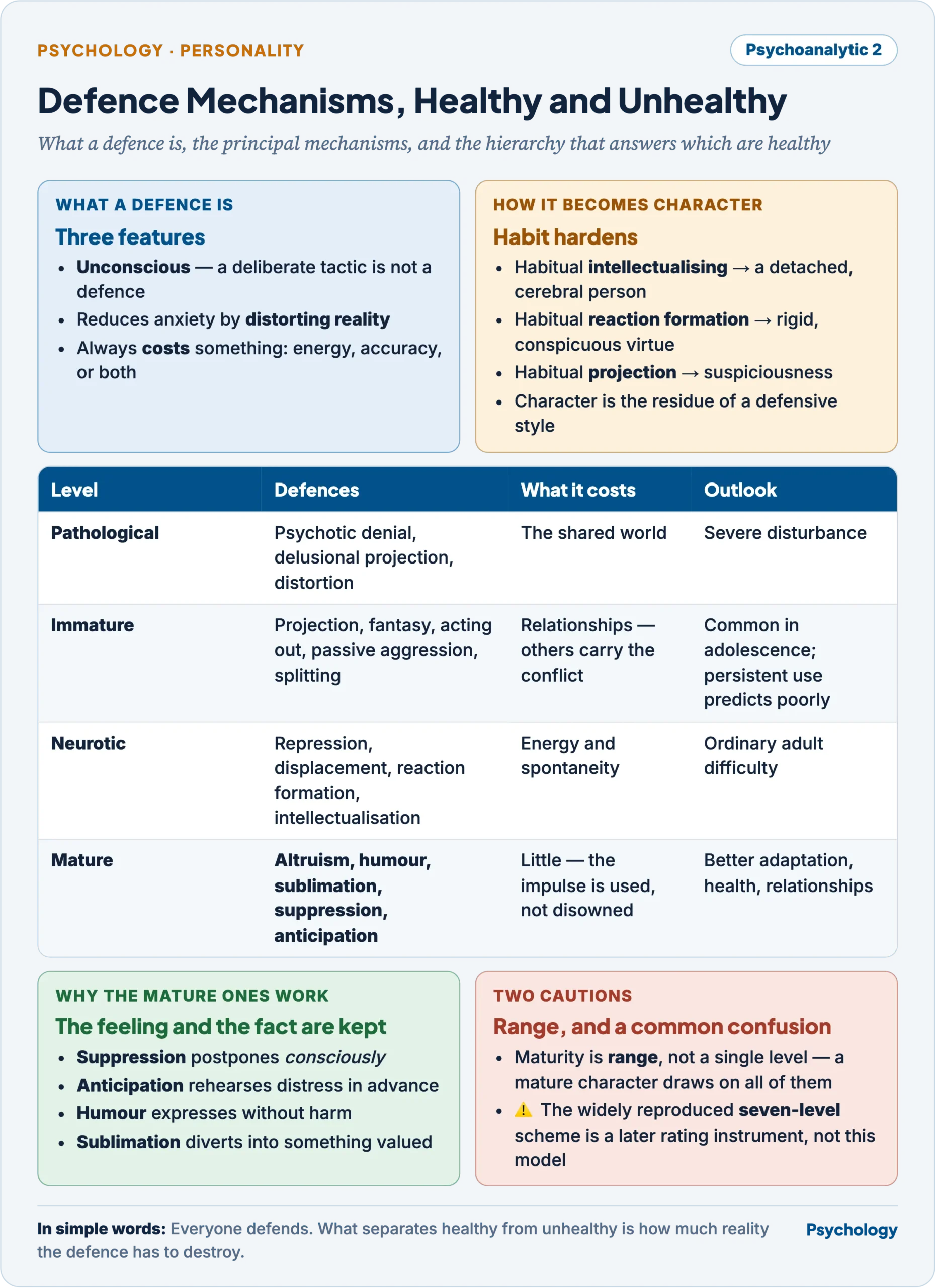
- What a defence is: an unconscious strategy by which the ego reduces anxiety by distorting reality. Two features matter. It operates outside awareness, so a deliberate tactic is not a defence. And it always costs something — energy, accuracy about the world, or both.
- The principal mechanisms, each with its distinctive manoeuvre.
- Repression — the foundational one. An unacceptable impulse or memory is pushed out of consciousness and held there. Everything else is built on it.
- Denial — refusing to register an external fact, as distinct from repression, which excludes an internal one.
- Projection — attributing one’s own unacceptable impulse to someone else. The hostile person who experiences the world as full of hostility.
- Reaction formation — converting an impulse into its opposite, usually with a conspicuous excess that gives it away. Exaggerated solicitude concealing resentment.
- Displacement — redirecting an impulse from a dangerous target to a safe one. Anger at an employer discharged at home.
- Sublimation — redirecting the impulse into a socially valued activity. Freud regarded it as the only fully successful defence, and the engine of civilisation.
- Rationalisation — supplying an acceptable reason in place of the real one, after the fact.
- Regression — retreating to the behaviour of an earlier stage under stress.
- Intellectualisation — handling a threatening matter in abstract, affectless terms, so the fact is retained and the feeling is not.
- Identification — taking on the attributes of another to reduce anxiety; the mechanism by which the superego is formed in the first place.
- Undoing — a symbolic act performed to cancel an unacceptable thought, which is the mechanism visible in obsessional rituals.
- Healthy against unhealthy: the hierarchy, and the criterion. The distinction is not between having defences and not having them — defending is normal and necessary. It is how much reality the defence sacrifices and how well it serves long-run adaptation. Vaillant, following a cohort of men across most of their adult lives in a study begun in the 1930s, ranked defences on exactly that criterion into four levels.
| Level | Defences | What it costs | Outlook |
|---|---|---|---|
| Pathological | Psychotic denial, delusional projection, distortion | The shared world; reality is rewritten | Severe disturbance |
| Immature | Projection, fantasy, acting out, passive aggression, idealisation, splitting | Relationships; others are made to carry the conflict | Common in adolescence; persistent use predicts poor outcomes |
| Neurotic | Repression, displacement, reaction formation, intellectualisation, dissociation | Energy and spontaneity; the symptom replaces the conflict | Ordinary adult difficulty |
| Mature | Altruism, humour, sublimation, suppression, anticipation | Little; the impulse is used rather than disowned | Associated with better adaptation, health and relationships |
– The mature defences are the operative answer to the question. They work because the person retains the feeling and the fact and changes only what is done with them: suppression postpones consciously rather than excluding unconsciously; anticipation rehearses a future distress in advance and so reduces it; humour expresses the impulse without harm to anyone; altruism gives others what one would wish to receive; sublimation diverts the energy into something valued.
– Maturity is a matter of range, not of a single level. A mature character can draw on defences from every level as the occasion demands; an immature one is confined to the low ones. Defensive style also shifts upward with age, which makes the hierarchy developmental rather than merely descriptive.
– A caution worth carrying: the widely reproduced seven-level scheme belongs to a later rating instrument, not to this four-level model, and the two are frequently conflated.
- How defences shape personality. A defence used habitually stops being a response and becomes a trait. The person who meets every threat by intellectualising becomes, in time, detached and cerebral; one who meets it by reaction formation becomes rigidly and conspicuously virtuous; one who projects becomes suspicious. Character, on this account, is the residue of a defensive style — which is why psychoanalytic description so often reads as a description of what a person cannot bear to know.
The psychosexual stages
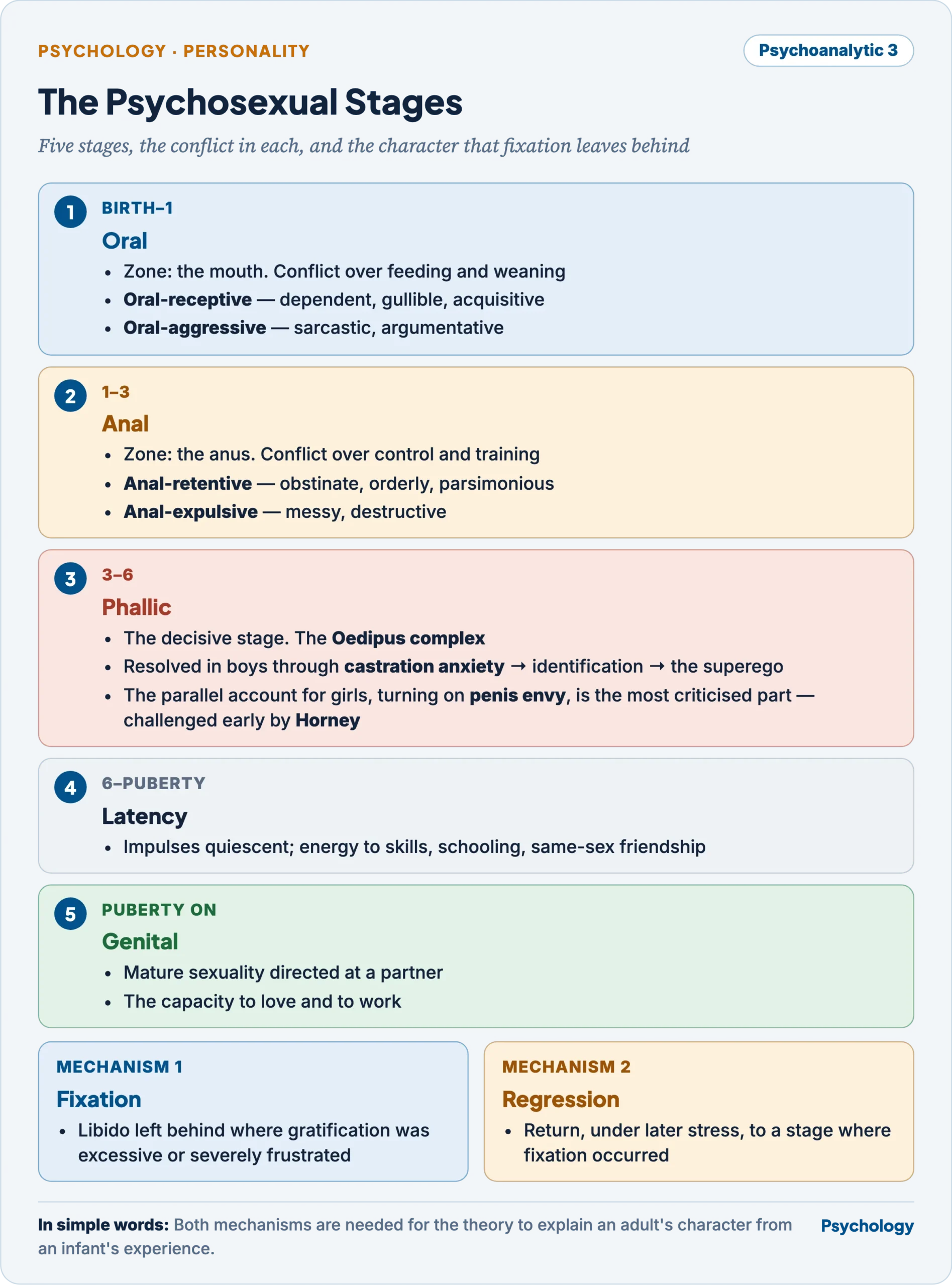
- The developmental claim is that libido is invested in a succession of bodily zones, that each stage poses a characteristic conflict, and that how the conflict is handled leaves a permanent mark on character.
- Oral (birth to about one): the mouth. Conflict over feeding and weaning. Fixation yields oral-receptive traits — dependency, gullibility, acquisitiveness — or oral-aggressive ones: sarcasm, argumentativeness.
- Anal (about one to three): the anus. Conflict over toilet training and control. Fixation yields the anal-retentive character, obstinate, orderly and parsimonious, or the anal-expulsive, messy and destructive.
- Phallic (about three to six): the genitals, and the decisive stage. The Oedipus complex — desire for the opposite-sex parent and rivalry with the same-sex parent — is resolved in boys through castration anxiety, leading to identification with the father and the formation of the superego. The parallel account for girls, turning on penis envy and a weaker motive for identification, is the most criticised part of the theory and was challenged early, by Horney among others, as a male projection rather than an observation.
- Latency (about six to puberty): sexual impulses are quiescent and energy goes into skills, schooling and same-sex friendship.
- Genital (puberty onwards): mature sexuality directed at a partner, and the capacity, in Freud’s phrase, to love and to work.
- Fixation and regression are the two mechanisms that carry early experience forward. Fixation is libido left behind at a stage where gratification was excessive or severely frustrated; regression is the return, under later stress, to a stage where fixation occurred. Both are needed for the theory to explain adult character from infant experience.
Do childhood experiences determine the rest of life?
- Freud’s answer is yes, and it is the theory’s strongest and most vulnerable claim. Character is substantially laid down by about the age of six; later life elaborates the structure rather than rebuilding it.
- What supports it. Early relationships demonstrably shape expectations of others that persist; attachment patterns formed in infancy predict later relational style with modest but real consistency; and large epidemiological studies of adverse childhood experiences find graded associations between early adversity and adult mental and physical health. The direction of the finding is Freud’s.
- What qualifies it, and the qualification is substantial.
- The associations are probabilistic and modest, not determining. Most children exposed to early adversity do not show the predicted adult outcome.
- Resilience is the norm, not the exception. Longitudinal work on children in severely disadvantaged circumstances repeatedly finds a majority reaching adequate adult adjustment, which a strong determinism cannot accommodate.
- Infant determinism has been directly challenged, notably by Kagan, on the ground that development is open and that later environments can override early ones — and that retrospective reconstruction makes the past look more formative than it was.
- The evidence is correlational and confounded. Adversity runs with poverty, with parental disorder and with genetic transmission, so the childhood-to-adult path is not cleanly identified.
- Memory does not work as the theory requires. The recovery of repressed early memories in therapy has been shown to be capable of producing confident, detailed and false recollections, which undermines reconstruction as evidence.
- The theoretically interesting answer is a middle one. Early experience matters, it matters most for the expectations we bring to relationships, and it works as a probabilistic shaping of trajectories rather than as a stamp. What the other traditions add is specific: Erikson extends development across the whole lifespan, so later stages can revise earlier failures; behavioural and social-cognitive accounts make later learning as formative as earlier; humanistic accounts hold the present capacity for choice to be decisive; and trait and biological accounts locate much of the continuity in constitution rather than in experience at all.
Implications for counselling and therapy
- The aim is insight, and the proposition is that insight relieves. Freud’s formulation — where id was, there ego shall be — means extending conscious, reality-oriented control over material that had been excluded.
- The classical techniques each follow from the architecture.
- Free association — saying whatever comes, without censorship — on the premise that the material excluded by defence will surface if the usual filtering is suspended.
- Dream analysis, the via regia to the unconscious, distinguishing the manifest content from the latent content that the dream-work has disguised through condensation, displacement and symbolisation.
- Analysis of parapraxes — slips, forgettings, accidents — read as compromise formations.
- Transference — the patient’s displacement onto the analyst of feelings belonging to earlier figures — which converts the past into something happening in the room and therefore available to examination. Its counterpart, countertransference, was first a contaminant to be eliminated and is now treated as information.
- Resistance — everything the patient does to obstruct the work — treated not as an obstacle to the treatment but as its subject matter.
- Interpretation and working through: insight is offered when the patient is close to it, and must then be applied repeatedly across contexts, because a single realisation does not dislodge a lifetime’s pattern.
- What has changed in practice. Classical analysis — several sessions a week over years, the couch, the silent analyst — is now rare. Contemporary psychodynamic work is typically once weekly, face to face, time-limited, and focused on a formulated problem.
- The evidence base is better than its reputation. A review in a leading general psychology journal assembled the meta-analytic evidence that psychodynamic therapy produces effect sizes comparable to those of other established therapies, and reported the more interesting finding that its gains tend to increase after treatment ends rather than decay — consistent with the claim that it changes underlying processes rather than symptoms alone. The qualification is that the trials are fewer and often smaller than for the cognitive-behavioural therapies.
Psychoanalytic against humanistic approaches
| Psychoanalytic | Humanistic | |
|---|---|---|
| Human nature | Driven by instinct and conflict; civilisation is a restraint | Inherently constructive, tending towards growth |
| Prime mover | Unconscious conflict, drive, defence | The actualising tendency, and present experience |
| Time focus | The past, especially the first six years | The present, oriented to becoming |
| Determinism | Thoroughgoing; the person is not master in their own house | Freedom and responsibility are constitutive |
| Role of awareness | Most of what matters is inaccessible | The person’s own perception of their world is the datum |
| The therapist | An expert who interprets what the patient cannot see | A facilitator who supplies the conditions for growth |
| Pathology | Conflict and defence; symptoms are compromise formations | Incongruence between self and experience, from conditions of worth |
| Evidence | The clinical case, the symptom, the dream | The person’s self-report, taken at face value |
- The disagreement is about human nature, and everything else follows. If instinct is dangerous and must be restrained, then therapy uncovers and the therapist knows more than the patient. If the organism is trustworthy and has been distorted by others’ conditions of worth, then therapy removes obstacles and the client knows more than the therapist.
- Recent developments have moved each towards the other’s ground.
- In the psychodynamic tradition: brief, structured and manualised treatments; mentalisation-based work, which targets the capacity to understand one’s own and others’ mental states and has been trialled for borderline personality disorder; transference-focused therapy; attachment-informed practice, which gives early relational experience a measurable form; and neuropsychoanalysis, which attempts to tie psychoanalytic constructs to brain systems. The common direction is towards testability.
- In the humanistic tradition: emotion-focused therapy, which gives Rogerian conditions a specific technology for working with emotion; motivational interviewing, which took the person-centred stance into health behaviour change and has a substantial trial base; and the absorption of the core conditions into generic counsellor training, where empathy, congruence and unconditional positive regard are now taught as common factors rather than as one school’s doctrine. Positive psychology pursues humanistic questions with nomothetic methods, though it has been reluctant to acknowledge the debt.
- The convergence is real but partial. Both now accept that the therapeutic relationship carries much of the outcome, which was a humanistic claim that psychodynamic research confirmed.
Criticisms and limitations
- Unfalsifiability is the central charge, pressed by Popper: the theory can accommodate any outcome, since a prediction’s failure can be attributed to defence, reaction formation or resistance. A system that cannot fail cannot be confirmed either.
- The evidential base was the clinical case, recorded from memory after the session, from a small, self-selected, unrepresentative group of patients, interpreted by the person whose theory was at stake.
- The treatment of women — penis envy, the weaker superego, the account of femininity as a deficit — was challenged within the movement by Horney, who argued the theory described men’s fantasies about women rather than women, and proposed womb envy as a deliberate mirror.
- The death instinct has no empirical support and was abandoned by most of his successors.
- It is culture-bound. The theory universalises a family structure — the small bourgeois household with a dominant father — that is far from universal; the Indian extended household, with multiple caretakers and a different handling of infancy, has been argued to produce a different configuration, which is a challenge to the generality of the Oedipal account rather than a detail.
- Therapy is long, costly and unavailable at scale, which is a practical objection with distributional consequences.
- But much of it survived, and the honest assessment says so. Unconscious processing is now mainstream cognitive science; defensive processes are measurable; the formative role of early relationships has independent support from attachment research; transference has been demonstrated experimentally as the carrying-over of representations of significant others onto new acquaintances; and the idea that people have limited insight into their own motives is among the better-supported claims in psychology. The disagreement with Freud is substantially about mechanism and evidence, not about whether these phenomena exist.
Previous Year Questions
- 2026What do you mean by defense mechanism? Distinguish between healthy and unhealthy defense mechanisms. Explain how it influences personality of an individual.
- 2024Distinguish between psychoanalytic and humanistic approaches to personality. Discuss in detail the recent developments in the applications of these approaches.
- 2023Do childhood experiences affect us in our entire lives? — Elaborate your answer in the light of personality theories.
- 2005What is personality? Discuss Freudian approach to personality.
- 1999Elucidate Freud’s conceptualization of human personality. Discuss its implications for counselling therapy.