

measurement of intelligence and aptitudes.
Official Syllabus: Paper I · Unit 10 Intelligence and Aptitude
“A condition or set of characteristics regarded as symptomatic of an individual’s ability to acquire with training some (usually specified) knowledge, skill or set of responses.”
— Bingham (1937), defining aptitude
Aptitude testing exists because a single ability score cannot answer the question people actually bring to a counsellor or a selector: not how able is this person, but able at what. The whole apparatus of differential batteries, special aptitude tests and interest inventories is an attempt to replace one number with a shape — and the central dispute is how much that shape really tells you beyond the number.
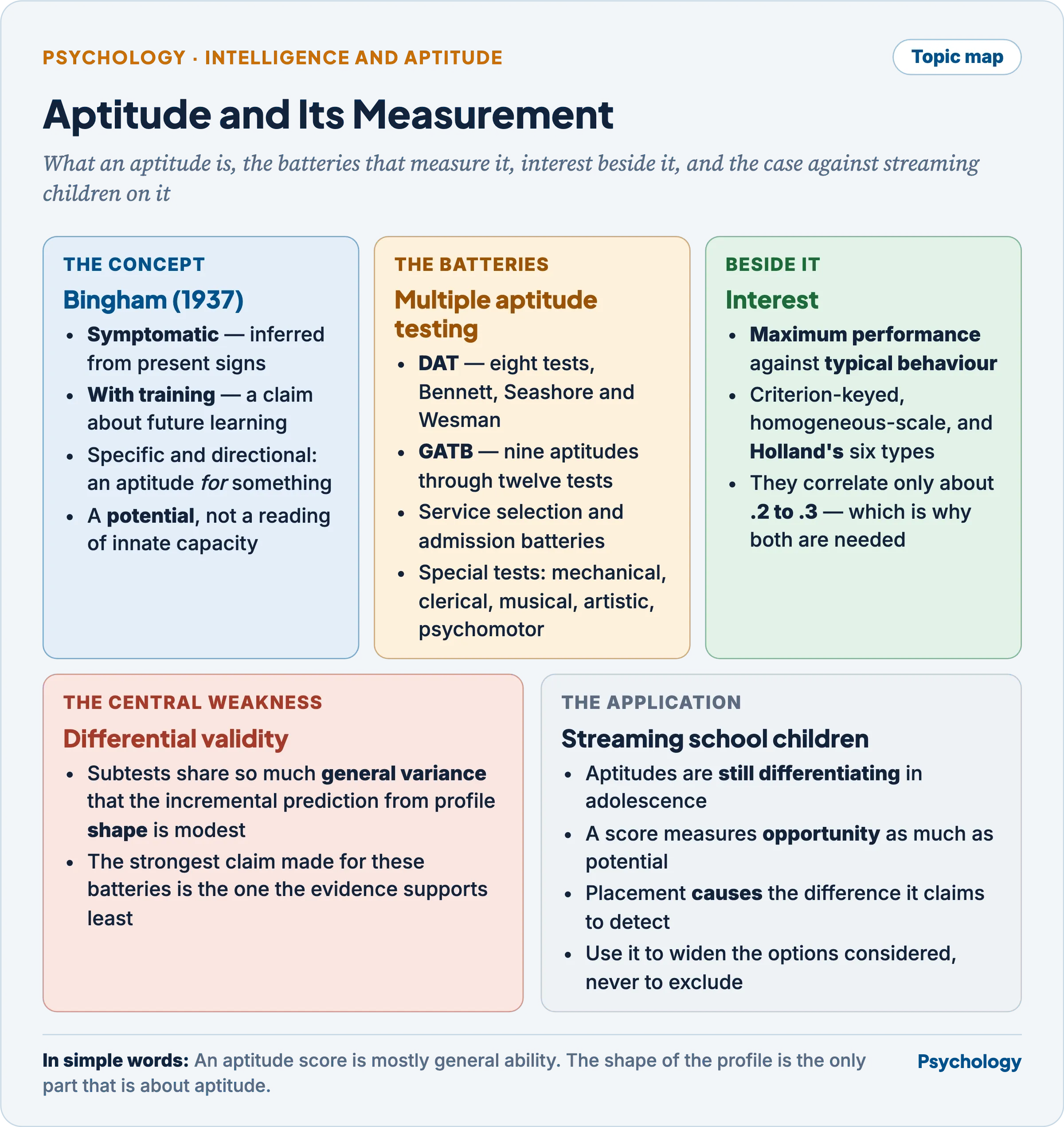
What an aptitude is
- Bingham’s definition above remains the standard one, and two of its phrases carry the whole concept. Symptomatic means an aptitude is inferred from present signs, never observed directly. With training means the claim is about future learning, not present attainment.
- An aptitude is specific and directional. One has an aptitude for something — mechanical work, music, clerical speed, surgery — and the term is unintelligible until the object is named. This is what separates it from intelligence, which is defined as general.
- It is a potential, not a capacity. As measured, every aptitude score is a joint product of whatever endowment exists and whatever learning has already occurred, and no test separates them. Treating a score as a reading of innate potential is the single commonest error in the field’s practice, and the one that does most damage when the testee is a child.
- The four neighbouring constructs are easiest to hold apart by what each is used to claim.
| Construct | What it measures | Time reference | Breadth |
|---|---|---|---|
| Intelligence | Present general cognitive functioning | Now | General |
| Aptitude | Capacity to profit from training | Future | Specific to a domain |
| Achievement | What has been learnt from instruction | Past | Specific to a course |
| Interest | Preference for an activity | Disposition | Specific to a domain |
- The distinctions are of degree, not kind. Cronbach (1949) argued that aptitude and achievement tests differ in the inference drawn rather than in content or psychology: both sample present behaviour, and the labels record whether that behaviour is being used to predict future learning or to certify past learning. Anastasi put the same point as a continuum of experiential specificity, running from items assuming only experience common to a whole culture to items assuming one course of instruction.
Intelligence tests against aptitude tests
- The difference is in construction, and it produces the difference in use. An omnibus intelligence test samples many content areas and sums, so specific variances partly cancel and the general factor dominates the composite. A differential aptitude battery samples one content area intensively in each subtest, so the specific or group variance survives.
- Hence the profile is the information. A single aptitude score carries a large dose of general ability and tells you little on its own. A mechanical reasoning score that is high relative to the same person’s verbal and clerical scores is the aptitude claim; the absolute level is mostly g.
- They overlap heavily. Aptitude subtests correlate with intelligence tests typically in the .5 to .7 range, and with each other, for exactly this reason. They are not redundant — the residual specific variance is what could predict differentially across occupations — but the overlap is the reason the differential claim is hard to demonstrate.
- What each is used for. Intelligence tests serve diagnosis, classification and broad selection and report a composite with index scores. Aptitude batteries serve guidance, placement and selection for particular training, and report a profile meant to be read for its shape.
Multiple aptitude batteries
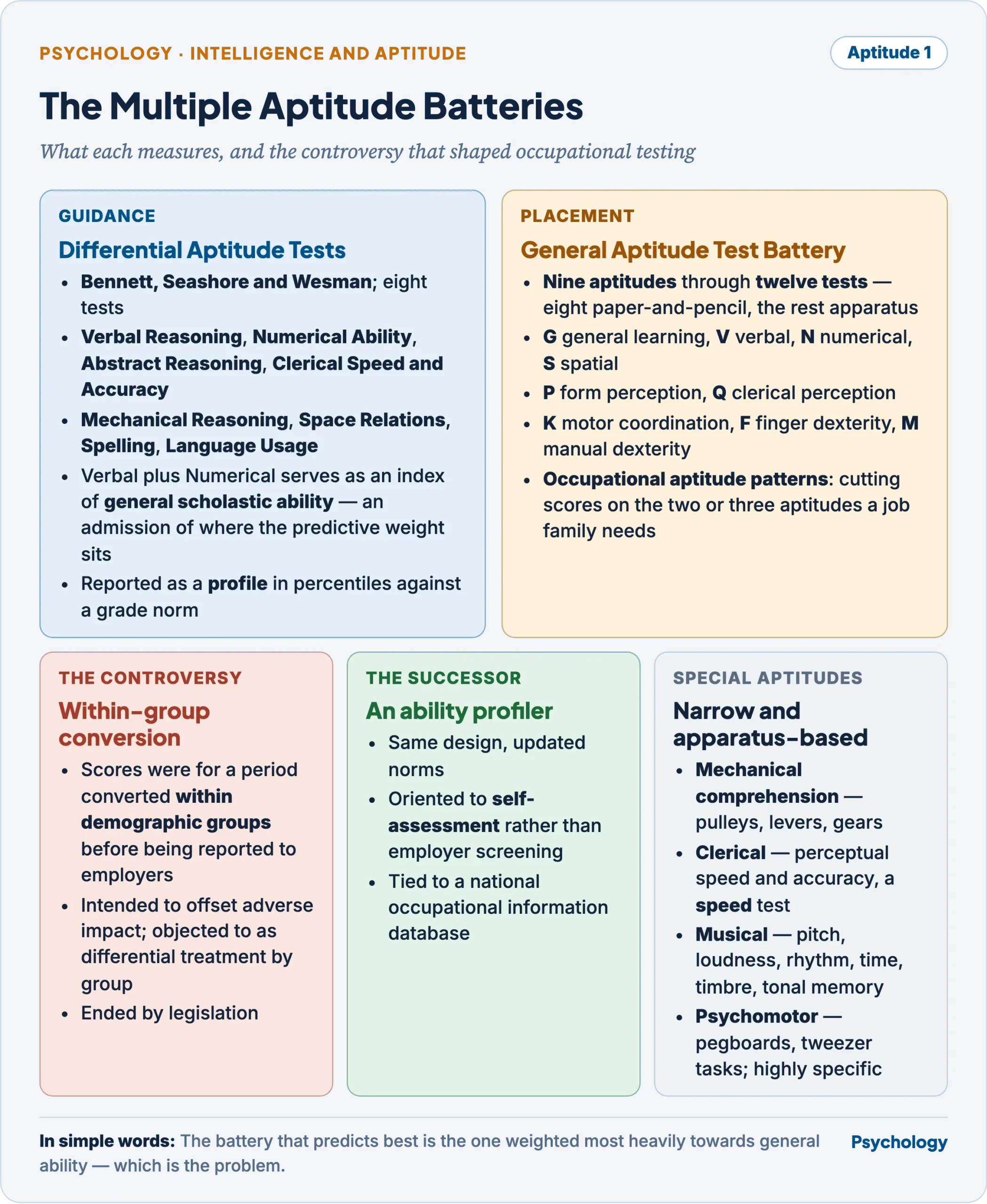
- The Differential Aptitude Tests, developed by Bennett, Seashore and Wesman, are the standard instrument of educational and vocational guidance. The battery comprises eight tests: Verbal Reasoning, Numerical Ability, Abstract Reasoning, Clerical Speed and Accuracy, Mechanical Reasoning, Space Relations, Spelling and Language Usage.
- Verbal Reasoning and Numerical Ability combined serve as an index of general scholastic ability, which is an admission that most of the battery’s predictive weight sits in its most g-loaded part.
- Results are reported as a profile across the eight, usually in percentiles against a grade-level norm group, and the counselling use is comparison of a person’s peaks and troughs rather than their overall level.
- The General Aptitude Test Battery, built by the United States employment service for occupational placement rather than schooling and is the most thoroughly researched instrument of its kind. It measures nine aptitudes through twelve tests — eight paper-and-pencil tests and the remainder apparatus tests:
- G — labelled Intelligence in the official manuals and defined as general learning ability — V verbal, N numerical, S spatial, P form perception, Q clerical perception, K motor coordination, F finger dexterity, M manual dexterity. Eight of the twelve subtests are paper-and-pencil; the remainder are apparatus tests, using a pegboard and a finger-dexterity board.
- Its distinctive feature was the occupational aptitude pattern: minimum cutting scores on the two or three aptitudes a given family of jobs required, so the battery was used as a matching device against a large occupational database.
- Its controversy is instructive. Scores were for a period converted into percentiles within the applicant’s own racial or ethnic group before being referred to employers — a practice intended to offset adverse impact, whose legality was questioned, and which the Civil Rights Act of 1991 prohibited outright. The national review committee that examined it did not simply endorse the practice: it recommended reporting two scores, a within-group percentile and an expectancy score. The episode is the clearest case of the tension between a test’s predictive accuracy and the distributional consequences of using it.
- A successor instrument, the Ability Profiler maintained with the national occupational information database, continues the design with updated norms and a self-assessment orientation rather than an employer-screening one.
- Service selection batteries such as the armed-services vocational aptitude battery are the largest-scale application: a multi-aptitude battery whose composites are mapped onto training courses, with a general composite used for entry eligibility and the specific composites for assignment.
- Scholastic aptitude and admission tests form the other large family — tests used to predict performance in a course of study rather than an occupation. These sit closest to the achievement end of Anastasi’s continuum, which is why their status as aptitude measures is persistently disputed.
Special aptitude tests
- Mechanical aptitude is assessed by tests of mechanical comprehension, which present pictured physical situations — pulleys, levers, gears, balances — and ask what will happen. The ability is not knowledge of physics but a spatial-causal intuition about how objects behave, and it predicts success in technical training. Older batteries added assembly and manipulation tasks using actual apparatus.
- Clerical aptitude is assessed by tests of perceptual speed and accuracy: checking pairs of names or numbers for identity against a tight time limit. The distinctive feature is that these are speed tests of a simple discrimination, not power tests of a difficult one, which is why they correlate only modestly with general ability and carry genuinely separate variance.
- Musical aptitude has the oldest tradition, and its history corrects a detail everyone reproduces. The familiar six measures — pitch, loudness, rhythm, time, timbre and tonal memory — belong to the 1939 revision. The 1919 original had five, and contained neither rhythm nor timbre: pitch, intensity, time, consonance and tonal memory. Seashore’s own manual listed sense of rhythm and sense of timbre among the capacities he had not measured; rhythm was added in 1925, and consonance and intensity became timbre and loudness in 1939. The design assumption — that musical ability decomposes into elementary sensory discriminations — is itself the standing criticism, since later work treats musical aptitude as more holistic and more dependent on exposure.
- Artistic aptitude is assessed either by judgement tests, which present a work alongside an altered version and ask which is better composed, or by production tests requiring the testee to make something. Judgement tests are reliable and arguably measure acquired taste; production tests measure what is wanted and are hard to score objectively.
- Psychomotor aptitude — manual dexterity, finger dexterity, steadiness, reaction time, coordination — is assessed with apparatus: pegboards, tweezer-and-pin tasks, pursuit rotors. These abilities are highly specific, correlating poorly with each other and with general ability, so “motor ability” is not one thing. They matter for surgical, dental, assembly and trade work.
- Professional admission tests in medicine, law and management are multi-aptitude batteries tailored to one profession’s demands, combining reasoning with content familiarity.
Aptitude against interest
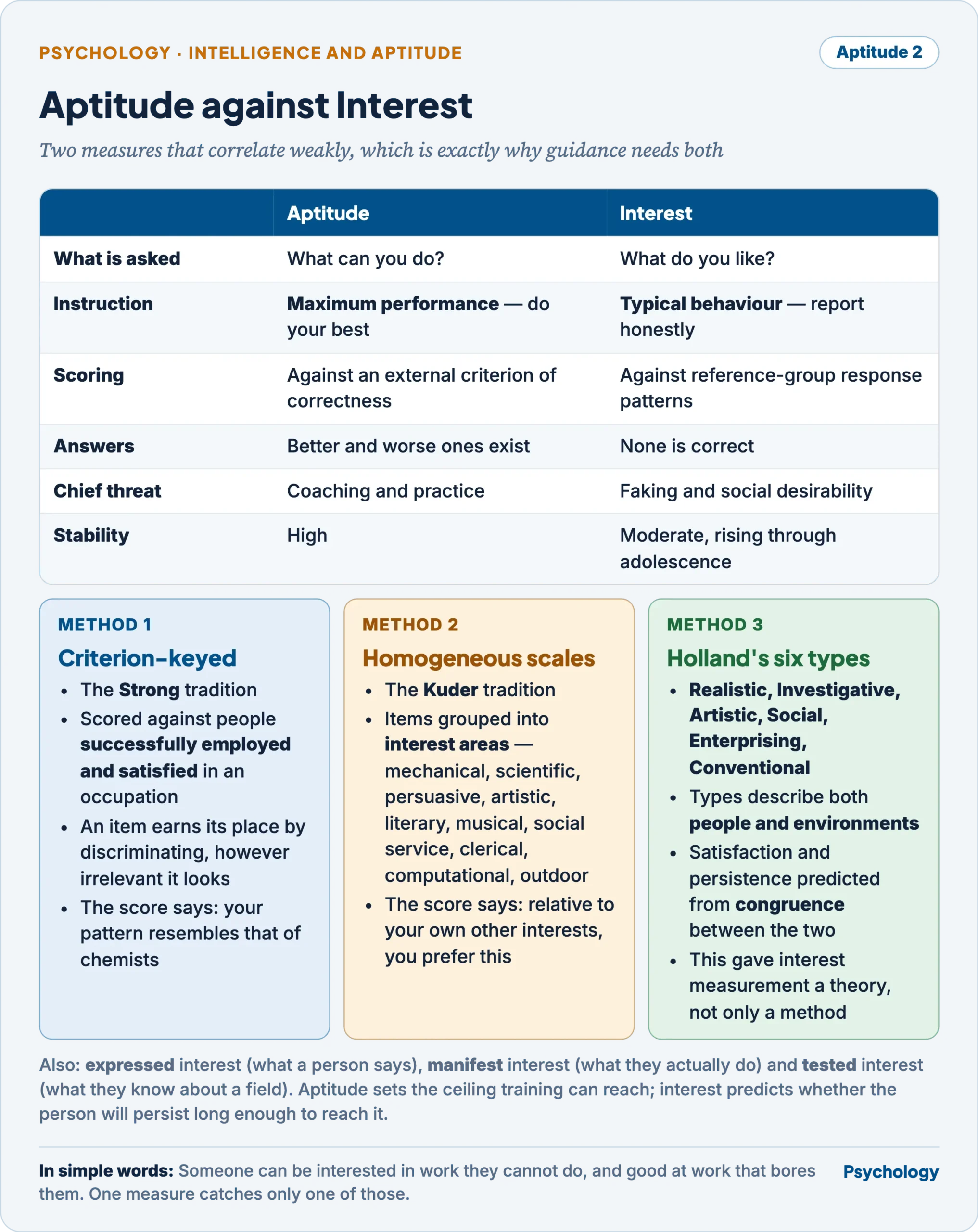
| Aptitude | Interest | |
|---|---|---|
| What is asked | What can you do? | What do you like? |
| Instruction | Maximum performance — do your best | Typical behaviour — report honestly |
| Scoring | Against an external criterion of correctness | Against reference-group response patterns |
| Answers | Better and worse ones exist | None is correct |
| Chief threat | Coaching and practice | Faking and social desirability |
| Stability | High | Moderate, rising through adolescence |
- They correlate weakly — commonly reported around .2 to .3 — which is the fact that makes both necessary. A person may be interested in work they have no aptitude for, and apt at work that bores them, and guidance that consults only one of these is predictably wrong in one of those two ways.
- What interests actually predict is modest and specific. Meta-analytic work puts the relation of interests to job performance at about .14 and to training performance at about .26, with turnover around -.15. Congruence between a person’s profile and their environment does better than interest scores alone — about .32 against .16 — but the congruence-to-satisfaction relation is itself small, around .17. So interests predict persistence and satisfaction better than proficiency, which is exactly the division of labour the comparison above implies.
- How interests are measured. The two classical approaches differ in how a score is given meaning.
- Criterion-keyed inventories, the tradition of the Strong interest inventory, score a person’s likes and dislikes against the response patterns of people successfully employed and satisfied in an occupation. An item earns its place because it discriminates that group from people in general, regardless of whether it looks relevant. The score says: your pattern resembles that of chemists.
- Homogeneous-scale inventories, the tradition of the Kuder preference record, group items into interest areas — mechanical, scientific, persuasive, artistic, literary, musical, social service, clerical, computational, outdoor — and report a profile across them. The score says: relative to your own other interests, you prefer mechanical activity.
- Holland’s typology organises both people and environments into six types — realistic, investigative, artistic, social, enterprising, conventional — and predicts satisfaction and persistence from the congruence between a person’s profile and their environment’s. This gave interest measurement a theory rather than only a method, and underlies most current instruments.
- Other methods: expressed interest, simply asking; manifest interest, inferred from what the person actually does; and tested interest, inferred from knowledge of a field, on the reasoning that people acquire information about what interests them.
- The practical rule. Aptitude sets the ceiling on what training can achieve; interest predicts whether the person will persist long enough to reach it. Neither substitutes for the other, and a competent guidance decision uses both alongside attainment and the realities of opportunity.
Aptitude testing in India
- The structural pressure is unusually strong. Streaming decisions are taken early, a single aggregate score dominates placement into stream, institution and profession, and the supply of valued places is far below demand. These conditions make formal aptitude assessment attractive — and make its misuse costlier, because the decisions it informs are hard to reverse.
- The policy direction has shifted against hard early streaming. The National Education Policy, 2020 removes the rigid separation between arts, sciences, vocational and academic streams, provides for flexible subject choice, introduces vocational exposure from the middle stage, and proposes competency-based assessment in place of rote recall. The relevant implication for testing is that it reduces the number of irreversible decisions an aptitude score would have to carry.
- Counselling capacity, not instrumentation, is the binding constraint. Indian school systems have very few trained counsellors per student, so where aptitude testing happens it is often administered and interpreted without the professional judgement the interpretation requires — which converts a profile into a verdict.
- The norms problem applies here with particular force. An aptitude battery’s percentiles are a property of the sample that produced them, and batteries developed and normed elsewhere misclassify when transplanted. Indian adaptations and indigenous batteries exist, but the pattern established in the intelligence-testing literature — where re-norming a well-known non-verbal test on a large, genuinely representative Indian school sample placed most ordinary children near the bottom of the existing distribution — is the warning that matters. That result told us about the norms, not about the children.
Using aptitude tests to predict professions for school children
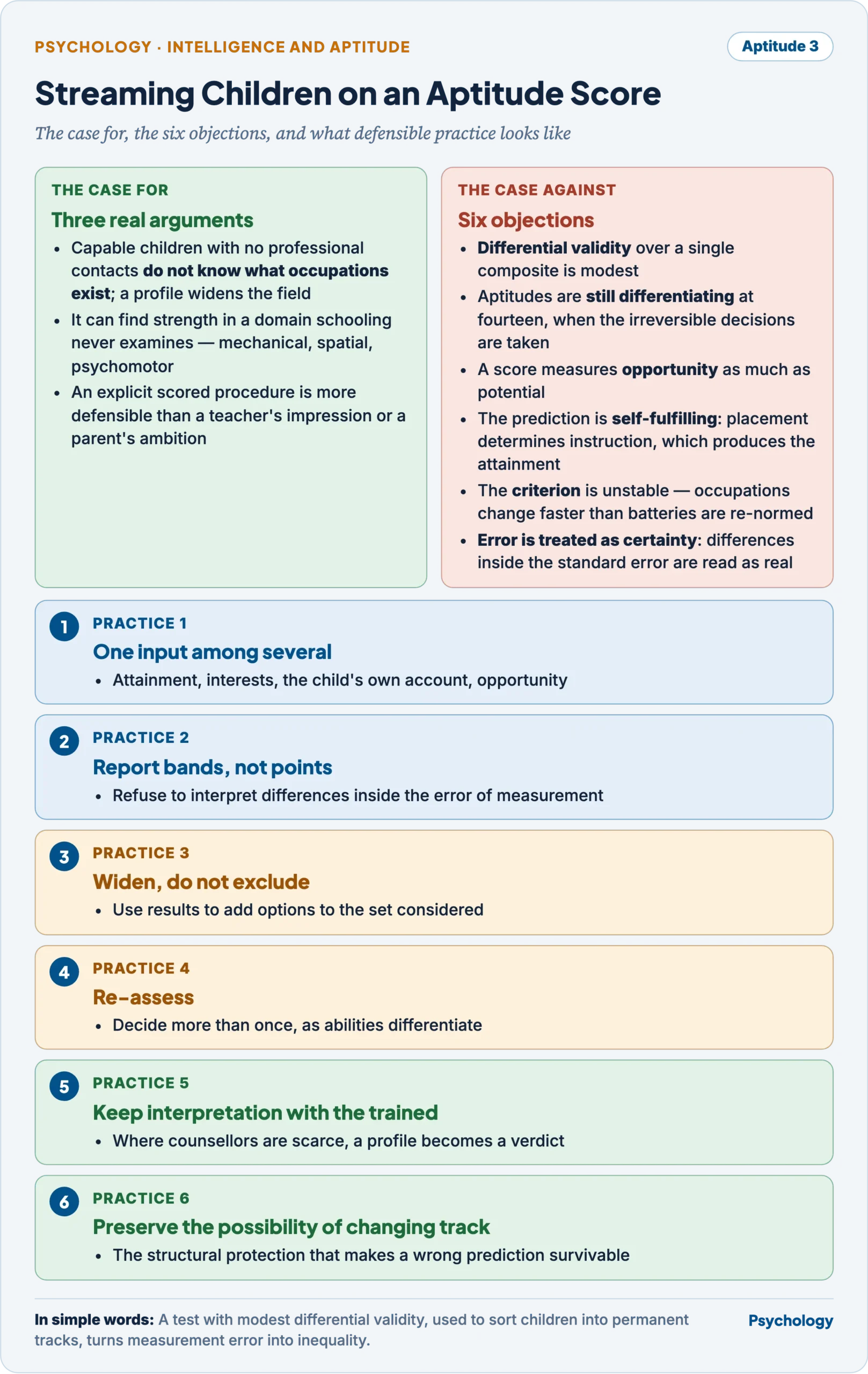
- The case for. Capable children from families with no professional contacts do not know what occupations exist or what they demand; a profile can widen the field they consider rather than narrow it. It can identify strength in a domain that schooling does not examine — mechanical, spatial, psychomotor — and so dignify paths that a marks-based system renders invisible. And an explicit, scored procedure is more defensible than allocation by a teacher’s impression or a parent’s ambition.
- The case against is stronger, in six distinct parts.
- Differential validity is weaker than the design implies. The promise of these batteries was that tailored composites would outpredict a general one. In large military data the general composite reached a validity of .61 against a tailored mechanical composite’s .60, and for clerical work the optimal composite correlated .94 with the general one — barely distinguishable from g. The hypothesis was widely accepted long before it was tested, and the gains never materialised. The review committee did keep the door open, holding that collapsing nine aptitudes into two composites was itself flawed and that better weights might improve prediction.
- Aptitudes are still differentiating in adolescence. Abilities become more distinct with age and experience, so a profile taken at fourteen is a less stable basis for a lifelong decision than the same profile at twenty — and the decisions taken at fourteen are the irreversible ones.
- A score measures opportunity as much as potential. A child who has never handled tools scores low on mechanical reasoning; one with no access to books scores low on verbal. The test then predicts a future shaped by the same deprivation, and the prediction comes true for reasons the test does not measure.
- The prediction is self-fulfilling. Placement into a stream determines subsequent instruction, which produces the attainment that appears to confirm the placement. The allocation partly causes the difference it claims to detect — and since schooling raises measured ability, this is a documented mechanism rather than a worry.
- The criterion is unstable. Occupations change faster than batteries are re-normed, and a profile matched against an occupational pattern derived decades earlier is predicting entry to a job that may no longer have those demands.
- Error is treated as certainty. Every score is a band, not a point, and profile differences within the error of measurement are routinely interpreted as real peaks and troughs.
- The empirical evidence on tracking itself is the strongest part of the case, and it is consistent across a century. A synthesis of thirteen meta-analyses found that students did not benefit from between-class grouping — the kind streaming produces — with effects of about .04 to .06, while within-class grouping (.19 to .30), cross-grade grouping by subject (.26) and special provision for the gifted (.37) did help. Crucially, the effects did not differ for high-, medium- and low-ability students, which contradicts the old belief that grouping helps the top and harms the bottom. Earlier best-evidence syntheses of secondary schooling found a median effect of about zero, with the randomised studies favouring mixed groups, and an independent estimate puts tracking’s effect at about .05.
- The international evidence points the same way. Comparative work finds that systems with more differentiated instruction show greater inequality of performance without higher average performance, and the recommendation is to defer selection to upper secondary, because students from disadvantaged backgrounds are more likely to be placed in the least academic tracks. Early sorting is also unreliable, since prior attainment is a weak guide to later potential and movement between tracks is difficult once made.
- What the low tracks actually receive is the mechanism. Where high tracks get literature, essays and research, low tracks get workbooks, fragmented tasks and practice at filling in forms — and in one classic study low-track teachers named learning to take a direct order among the most important things for the year. The sharpest finding is that placement differences by class and community appear regardless of whether test scores, teacher recommendations or family choice are used as the basis, so fairer testing alone does not fix it.
- An important precision: the critique must not rest on predictive bias. Where it has been examined, cognitive tests do not under-predict the later performance of lower-scoring groups — if anything they slightly over-predict it. Mean differences between groups are real, and their causes are not established, but the tests are not biased as predictors. The defensible critique therefore rests on three other things: the modest absolute accuracy of the prediction, the self-reinforcing instructional and expectancy consequences of placement, and the disparate impact of using a mean-different measure to allocate irreversible opportunity. Getting this distinction right is what makes the objection hold.
- What defensible practice looks like, since the honest conclusion is to constrain the use rather than abandon the tool: treat the profile as one input among several — attainment, interests, the child’s own account, opportunity; report scores as bands and refuse to interpret differences inside the error; use results to widen the set of options considered rather than to exclude; re-assess rather than decide once; keep interpretation with someone trained to do it; and preserve the possibility of changing track, which is the structural protection that makes a wrong prediction survivable.
Criticisms and limitations
- The aptitude-achievement distinction does not hold cleanly. Since both measure present behaviour, an aptitude score is depressed by poor prior opportunity and is then used to predict a future shaped by that same opportunity.
- Incremental validity over a general ability measure is modest, which undercuts the differential claim that is the whole rationale for a multi-aptitude battery.
- Profiles are over-interpreted. Peaks and troughs within the standard error are read as real, and a profile’s shape is treated as a stable property of a person rather than one estimate on one occasion.
- Psychomotor and perceptual aptitudes are extremely specific, so the tests predict narrowly and a label such as “manual dexterity” covers abilities that correlate poorly with one another.
- Interest inventories measure self-concept as much as interest, and are open to faking wherever the result affects something the respondent wants.
- Norms transplant badly, and the consequences are concentrated in exactly the populations least able to contest a classification.
- The social consequences outrun the psychometrics. A battery with modest differential validity, used to allocate children to divergent and irreversible tracks, converts measurement error into permanent educational inequality. The group-exposure history of occupational aptitude testing is the standing reminder that the question is never only whether a test predicts, but what is done with the prediction.
Previous Year Questions
- 2021Give a critical appraisal on the practice of using aptitude tests to predict professions for high school children.
- 2015What is an aptitude? Describe the various tests of aptitudes.
- 2009Distinguish between ‘intelligence’ and ‘aptitude’ tests. List commonly measured aptitudes and their tests.
- 2007Distinguish between aptitude and interest and describe methods of their measurement.