

Emotional intelligence.
Official Syllabus: Paper I · Unit 10 Intelligence and Aptitude
“The ability to monitor one’s own and others’ feelings and emotions, to discriminate among them and to use this information to guide one’s thinking and actions.”
— Salovey and Mayer (1990), defining emotional intelligence
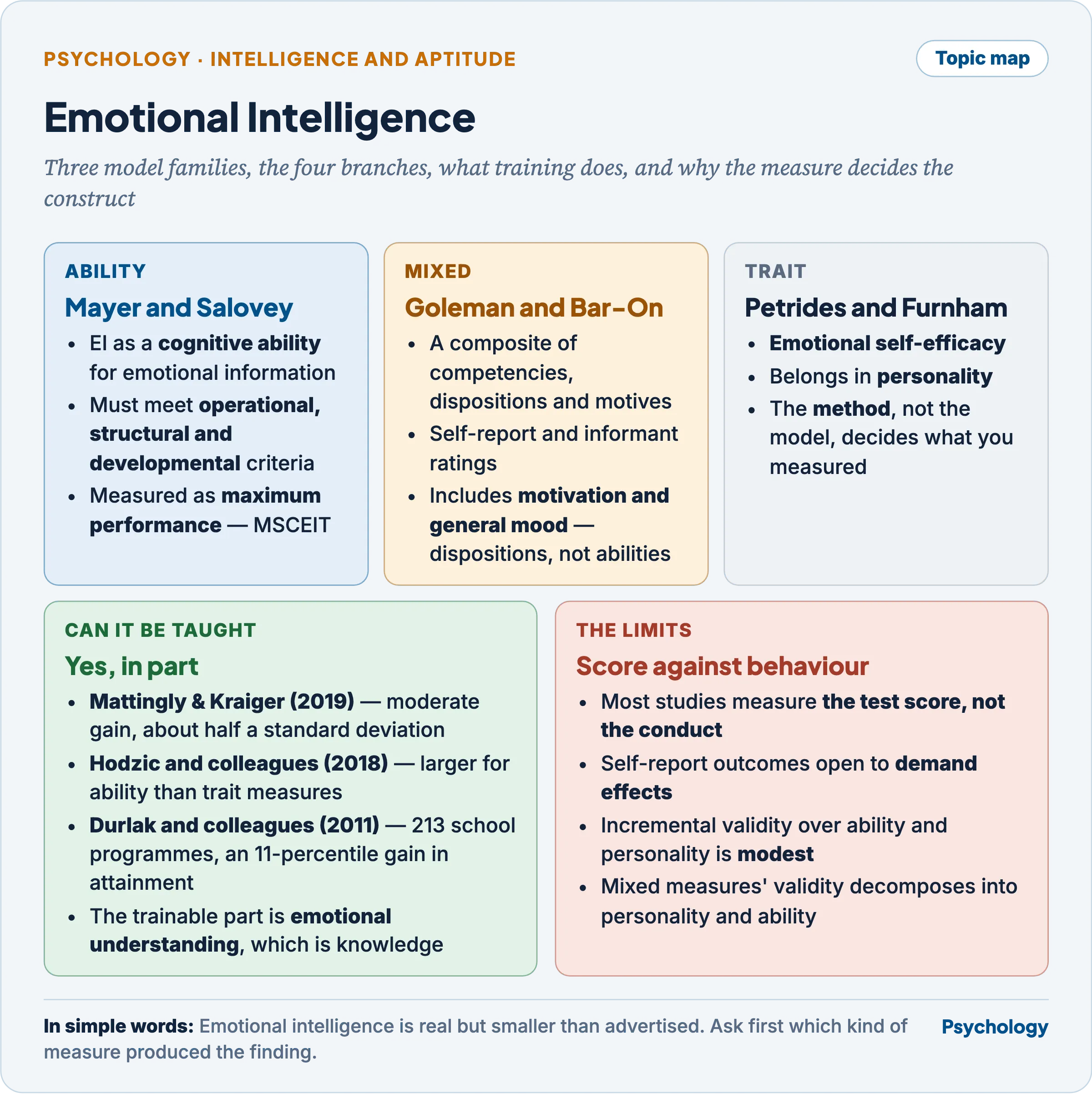
Emotional intelligence is a claim that there is an ability where the ability literature had seen only temperament. The question it raises is whether competence with emotions is a genuine intelligence — measurable as a maximum performance, structurally coherent, developing with age, and predicting outcomes beyond what general ability and personality already explain — or a cluster of traits given an upgraded name.
The answer differs sharply by how the construct is measured, which is why the measurement argument is the substance of the field rather than an appendix to it. Emotional competence as a learned capability is taken up with the emotion topics, and social intelligence, the wider construct of which this is the emotion-specific part, has its own treatment.
The three model families
- The lineage runs through Gardner. His intrapersonal and interpersonal intelligences (1983) made emotional and social competence candidate intelligences rather than traits, which is the opening Salovey and Mayer (1990) used. The term had appeared earlier in scattered work; their contribution was to define it so that it could be tested.
- Three model families now exist, and conflating them is the commonest error in this literature.
| Ability model | Mixed model | Trait model | |
|---|---|---|---|
| Chief proponents | Mayer and Salovey | Goleman; Bar-On | Petrides and Furnham |
| What EI is | A cognitive ability for processing emotional information | A composite of competencies, dispositions and motives | A constellation of emotion-related self-perceptions |
| Measurement | Maximum performance; items have better and worse answers | Self-report and informant ratings of competencies | Self-report of emotional self-efficacy |
| Where it belongs | Within the intelligences | Within applied competency frameworks | Within personality |
| Typical instrument | MSCEIT | EQ-i; ESCI | TEIQue |
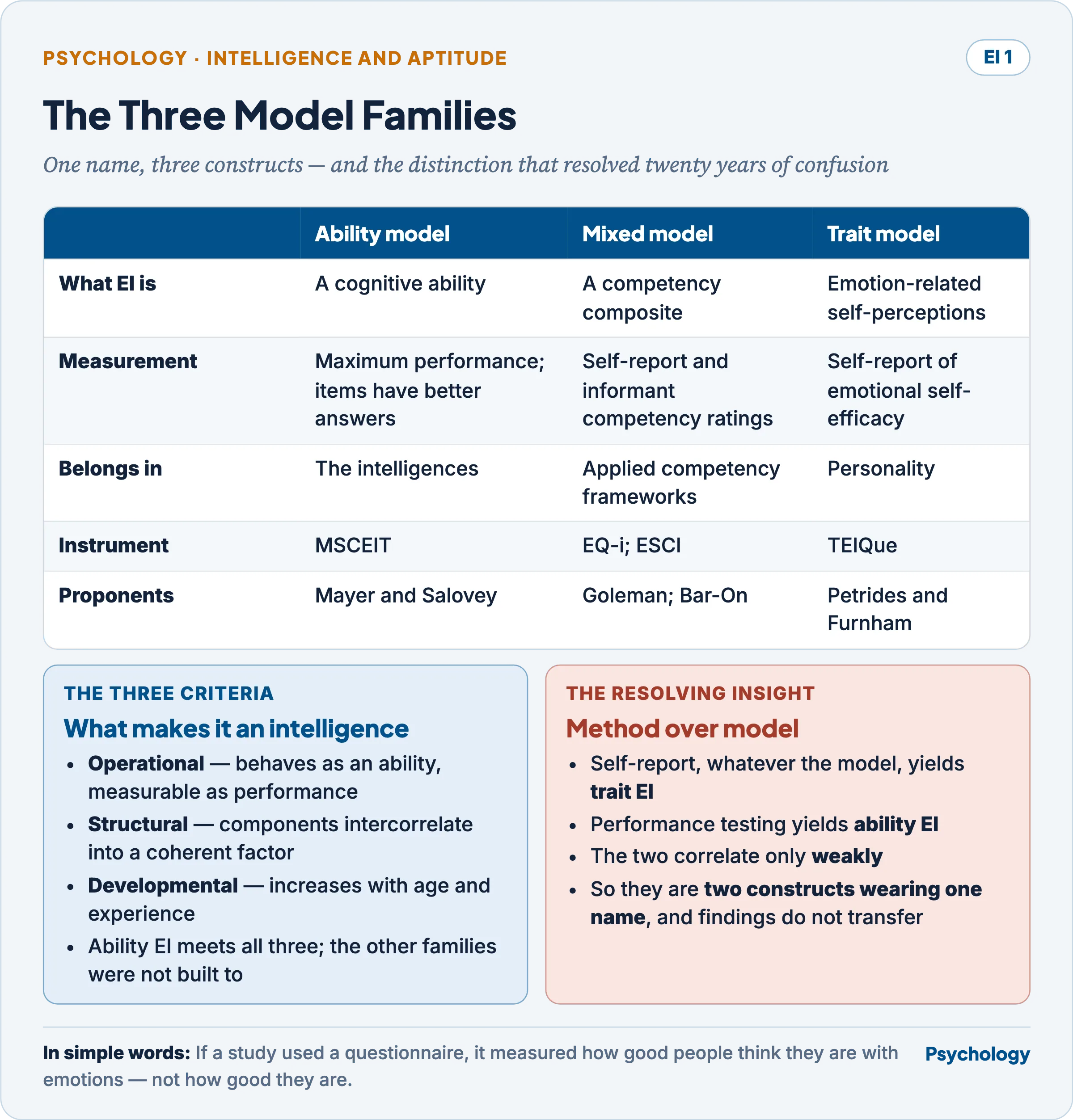
- The ability model is the only one that makes EI an intelligence in the technical sense. Mayer and Salovey argued it must meet three criteria: an operational criterion — it behaves as an ability, measurable as performance rather than self-description; a structural criterion — its components intercorrelate into a coherent factor; and a developmental criterion — it increases with age and experience.
- The four-branch model (Mayer and Salovey, 1997) is that model’s content, ordered from the basic to the reflective.
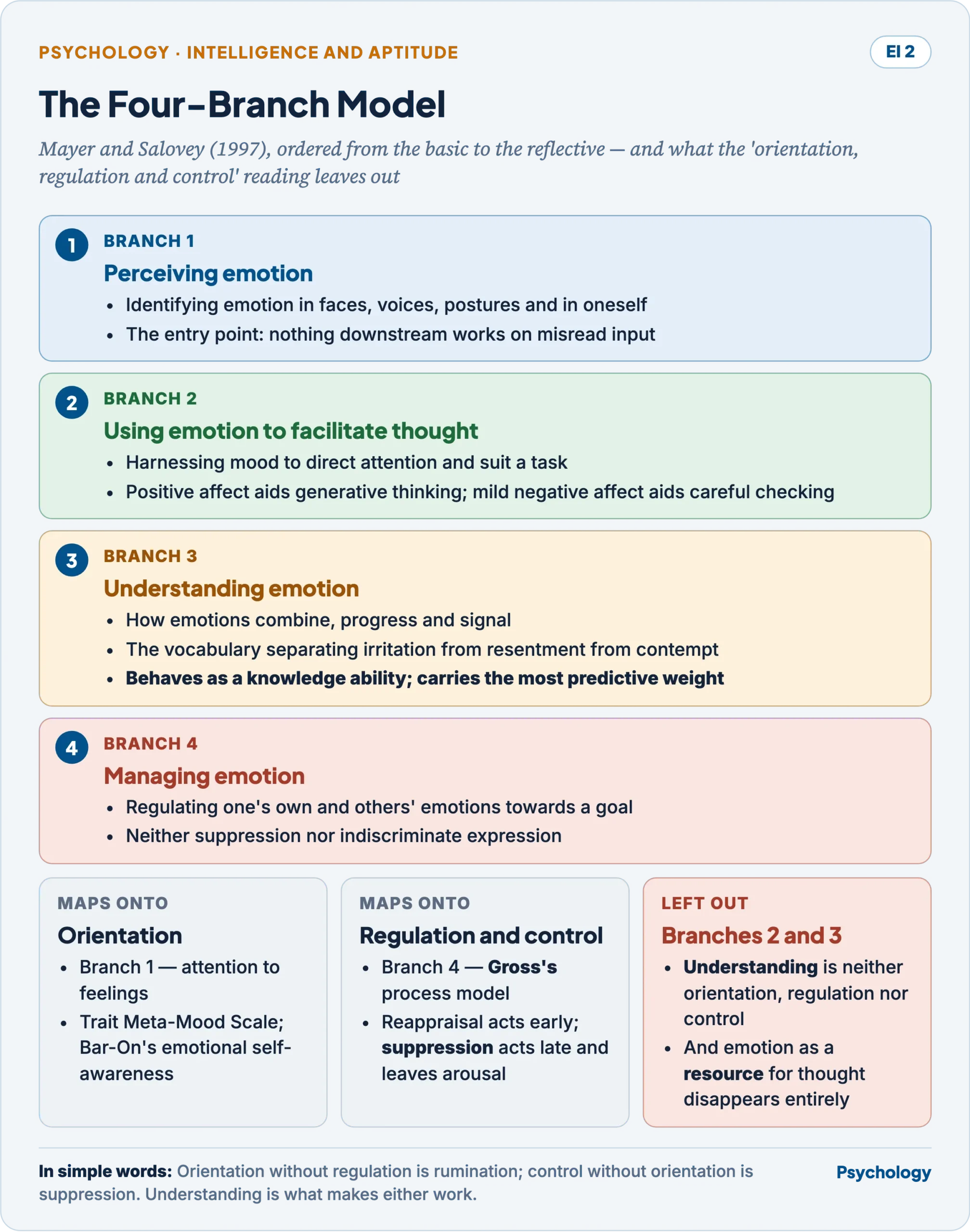
– Perceiving emotion — identifying emotion in faces, voices, postures and in oneself; nothing downstream works on misread input.
– Using emotion to facilitate thought — harnessing mood to direct attention and suit a task, as positive affect aids generative thinking and mild negative affect aids careful checking.
– Understanding emotion — knowing how emotions combine, progress and signal, and the vocabulary distinguishing irritation from resentment from contempt. This branch behaves most like a knowledge ability and carries the most predictive weight.
– Managing emotion — regulating one’s own and others’ emotions towards a goal, without either suppression or indiscriminate expression.
- The mixed models were built for application and are broader. Goleman (1995, 1998) set out five domains — self-awareness, self-regulation, motivation, empathy and social skill — later reorganised into four clusters. Bar-On (1997) introduced the emotional quotient and the EQ-i, with five composites — intrapersonal, interpersonal, stress management, adaptability and general mood — across fifteen subscales. Both include elements such as motivation and optimism that are dispositions rather than abilities, which is the objection to them.
- The trait model resolved the confusion by relocating it. Petrides and Furnham (2000, 2001) argued that the critical distinction is not the content of the model but the method of measurement: self-report, however the model is specified, yields trait EI or emotional self-efficacy, which is a personality variable; performance testing yields ability EI, which is a cognitive variable. The two correlate only weakly, so they are different constructs wearing one name, and findings from one do not transfer to the other.
What Salovey and Mayer contributed
- A scientific definition where there had been a popular notion: the 1990 formulation gave the construct testable content — monitoring, discriminating among, and using emotional information.
- A place inside the intelligences. By requiring EI to satisfy the operational, structural and developmental criteria, they subjected it to the standards of the ability literature instead of exempting it.
- The four-branch architecture, which converted a vague competence into an ordered set of separately measurable skills running from perception to reflective regulation.
- Performance measurement, through the MEIS and then the MSCEIT (Mayer, Salovey and Caruso, 2002) — eight tasks, two per branch, scored by consensus and expert criteria. However contested the scoring, this was the first serious attempt to measure emotion skills as maximum performance.
- The boundary work, which is underrated: they drew the line between ability EI and the mixed conceptions, and stated plainly what EI is not — not warmth, optimism, motivation or social effectiveness, and no guarantee of good behaviour, since the same skills enable manipulation.
- The research findings, including that ability EI increases from adolescence to adulthood, satisfying their own developmental criterion, and the Trait Meta-Mood Scale (Salovey and colleagues, 1995), which showed that attention to feelings and clarity about them separate empirically — the first evidence of internal structure.
Orientation, regulation and control — how far the amalgamation holds
- The three terms map onto real components.
- Emotional orientation is the perceptual and attentional entry — noticing emotion in oneself and others rather than screening it out. The Trait Meta-Mood Scale’s attention to feelings and Bar-On’s emotional self-awareness operationalise it.
- Emotional regulation is the fourth branch, managing emotion. Gross’s process model specifies the available mechanisms and when each acts — situation selection, situation modification, attentional deployment, cognitive change or reappraisal, and response modulation. Reappraisal, acting early, reduces both experience and expression; suppression, acting late, reduces expression while leaving or raising physiological arousal and impairing memory for the episode. Regulation is therefore a repertoire plus the judgement of which strategy fits.
- Emotional control is the narrower impulse-inhibition component — Bar-On’s impulse control, Goleman’s self-regulation cluster, the delay-of-gratification tradition. In Gross’s terms it is response modulation, the latest-acting and least efficient of the family.
- So the amalgamation reading is largely right, and incomplete in two specific ways.
- It omits understanding. The third branch — emotional knowledge, how emotions combine, succeed one another and signal — is neither orientation, regulation nor control, and it has the strongest psychometric standing and the most predictive power. Regulation without understanding is suppression applied blindly.
- It omits the use of emotion to facilitate thought, where emotion is an input to cognition rather than a disturbance to be handled. On the amalgamation reading emotion is only ever a problem; on the four-branch model it is also a resource.
- And the three do not combine into one thing. Attention to feelings and clarity about them dissociate empirically, and a person can be highly oriented to emotion and poor at regulating it, which describes much of what clinical work addresses. Orientation without regulation is rumination; control without orientation is suppression. The components are better read as separable skills whose value depends on the others being present.
Comparing intelligence, emotional intelligence and social intelligence
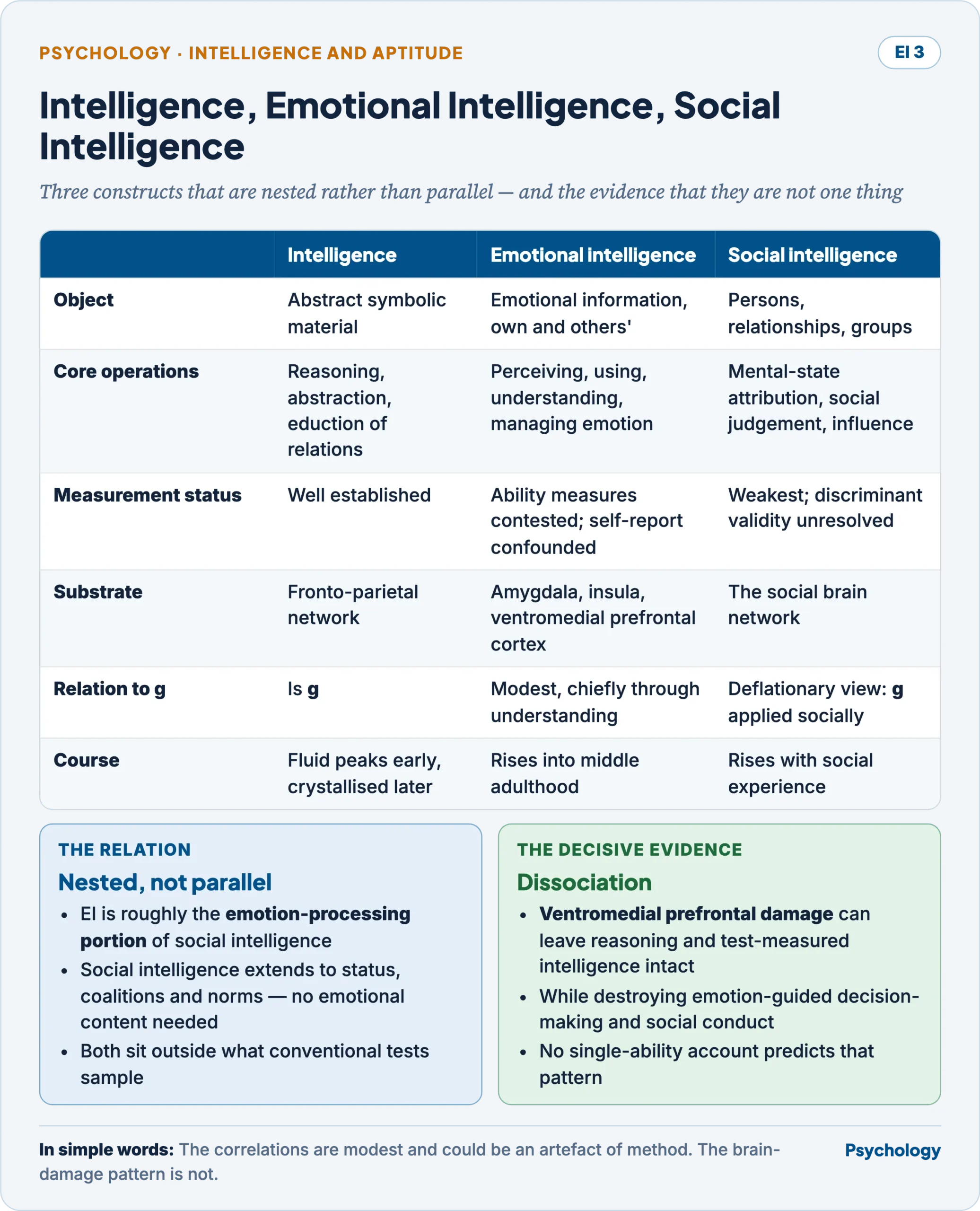
| Intelligence | Emotional intelligence | Social intelligence | |
|---|---|---|---|
| Object | Abstract symbolic material | Emotional information, own and others’ | Persons, relationships, group dynamics |
| Core operations | Reasoning, abstraction, eduction of relations | Perceiving, using, understanding, managing emotion | Mental-state attribution, social judgement, influence |
| Measurement status | Well established, high reliability | Ability measures contested; self-report measures confound with personality | Weakest; discriminant validity unresolved |
| Neural substrate | Distributed fronto-parietal network | Amygdala, insula, ventromedial prefrontal cortex | The social brain network |
| Relation to g | Is g | Ability EI correlates modestly with g, chiefly through understanding | Deflationary view treats it as g applied socially |
| Developmental course | Fluid component peaks early, crystallised later | Rises into middle adulthood | Rises with social experience |
| Overlap | — | Shares the knowledge component with g | Substantially overlaps EI; EI is the emotion-specific part |
- The constructs are nested rather than parallel. Emotional intelligence is approximately the emotion-processing portion of social intelligence, which extends further to competences with no emotional content — reading status, coalitions and norms. Both sit outside what conventional tests sample, which is why they were proposed.
- Where they genuinely differ from general ability, the discriminating evidence is not the modest correlations but the dissociations: ventromedial prefrontal damage can leave reasoning and test-measured intelligence intact while destroying emotion-guided decision-making and social conduct. No account on which these are one ability predicts that pattern.
The effective civil servant
- The three abilities answer three different parts of the work.
- General ability carries the analytical load — reading evidence, finding the error in a proposal, modelling a scheme’s consequences, drafting precisely. It remains the best single predictor of performance in complex, novel work.
- Emotional intelligence carries the self-regulatory load. Administration is high in emotional labour — sustained public dealing under provocation, where the required display diverges from the felt emotion. Joseph and Newman (2010) found EI’s validity for job performance moderated by emotional-labour demands, strongest in exactly such roles and negligible without them. That is the defensible version of the claim: not that EI predicts performance generally, but that it predicts it where the work is emotionally demanding.
- The mechanism in grievance and crisis work. Accurate perception prevents the misreading that escalates an encounter; understanding supplies the knowledge that a petitioner’s anger commonly follows repeated futility rather than the present refusal, which changes the response; reappraisal keeps the officer’s own arousal out of the exchange; and social judgement selects what to say to whom. Each step is a branch of the model doing identifiable work.
- The honest limit. Harms and Credé (2010) found the association between EI and transformational leadership substantially inflated by same-source self-report, falling considerably once leader and follower reports were kept separate. Selecting administrators on a self-report emotional intelligence score is not supported; developing the underlying skills is.
- Social intelligence carries the third load, of influence without authority — negotiating across departments, building coalitions for a reform, reading a delegation’s real objection as distinct from its stated one. Ford and Tisak (1983) found social ability predicting observed social effectiveness where academic ability did not, and the managerial detail belongs with social intelligence.
- The Indian institutional anchor. Mission Karmayogi, the national programme for civil services capacity building approved in 2020, rests on a competency framework placing behavioural competencies alongside domain and functional ones, and the Second Administrative Reforms Commission had urged that attitudinal attributes enter recruitment and training rather than knowledge alone. Behavioural competence is thereby treated as developable and assessable, which is the claim the training evidence bears on.
Development by parents and teachers, and whether training works
- The parental mechanism is emotion coaching. Gottman, Katz and Hooven (1996) distinguished parents by their meta-emotion philosophy — whether a child’s negative emotion is an occasion for teaching or something to be dismissed. Children of emotion-coaching parents showed better physiological regulation, fewer behaviour problems and better peer relations. The behaviours are specific: label the emotion, validate it before addressing the behaviour, do not punish the emotion itself, then problem-solve.
- What else the evidence supports for parents: talking about emotions and their causes in ordinary conversation, which predicts children’s emotion understanding; modelling regulation rather than describing it; inductive discipline, which explains an act’s effect on another person and so recruits perspective-taking; and a secure attachment relationship, the condition under which a child brings distress to a parent at all.
- What teachers can do beyond a curriculum: teach an emotion vocabulary explicitly, since understanding is knowledge and is teachable; run structured problem-solving at the point of a real dispute rather than in the abstract; set norms that make emotional expression safe enough to discuss; and avoid the two failure modes of suppressing all expression and of attending to emotion without teaching regulation.
- Training works, by a moderate amount, on the measures used. Mattingly and Kraiger (2019) meta-analysed emotional-intelligence training studies and found a moderate overall gain, on the order of half a standard deviation, present for both ability-based and mixed measures and in both published and unpublished studies. Hodzic and colleagues (2018) similarly found small-to-moderate effects, larger for ability measures than for trait measures, and maintained at follow-up. Controlled studies of intensive adult programmes have reported gains in emotion regulation sustained at one year.
- The qualifications are serious and belong with the finding. Most studies measure the test score, not the behaviour, and a raised score is not changed conduct under pressure; self-report outcomes are open to demand effects, since participants know what the programme intended; the trainable component is concentrated in emotional understanding, which is knowledge and behaves like any taught knowledge, while perception and regulation move less; and the school evidence is stronger in design and outcome measurement than the adult evidence, which is the reverse of where commercial training effort goes.
- So emotional intelligence can be enhanced, with the emphasis on which part. Emotion knowledge is teachable and the evidence for teaching it is good; dispositional emotional style changes slowly; and the gap between a raised score and changed behaviour is where the literature is thinnest.
Has it revolutionised our knowledge of human abilities?
- No — but the verdict has three parts, and the negative one is only the first.
- What it did not do. It did not displace general ability, still the strongest single cognitive predictor of educational and occupational outcomes; it did not produce a measure with the psychometric standing of established ability tests; and the popular claim that it matters more than IQ has no empirical support. Incremental validity over ability and personality, where found, is modest — meta-analytic work finds mixed and self-report EI adding something to the prediction of job performance beyond ability and the five factors while ability EI adds little, and decomposition attributes much of that apparent validity to the personality, self-efficacy and cognitive ability already inside those measures.
- What it did do, and this is real. It brought affect into an ability literature that had excluded it for a century; it produced the emotional-labour moderation finding, which identifies when emotion skills matter; it established emotional understanding as a measurable knowledge domain, with meta-analytic work placing emotional intelligence among the stronger correlates of academic performance after intelligence and conscientiousness; and it drove the school social-emotional learning movement, whose evidence base is the best thing to come out of the construct.
- What it did badly. It generated a commercial industry of instruments and training largely disconnected from the ability research, in which self-report measures of personality are sold as measures of an intelligence. The gap between the popular and the scientific construct is wider here than anywhere else in differential psychology, and the field’s own corrective — the ability-versus-trait distinction — is routinely ignored in practice.
Measurement
- Performance measures. The MSCEIT presents emotional problems with better and worse answers across eight tasks, scored against consensus — the modal response of a normative sample — or against expert judgement. Its difficulties are specific: consensus scoring defines correctness as agreement with the majority, which measures conformity to a cultural norm rather than skill; the branch covering the use of emotion has had the weakest reliability; and the four-factor structure is not always recovered.
- Situational judgement tests answered the scoring objection. The Situational Test of Emotional Understanding and the Situational Test of Emotion Management (MacCann and Roberts, 2008) score items against appraisal theory and expert judgement rather than against the modal answer, so correctness derives from a theory of emotion rather than from a vote. This is the methodological advance the ability tradition needed.
- Self-report measures — the EQ-i, the TEIQue, the Schutte scale, the Trait Meta-Mood Scale, the Wong and Law scale — are quick, reliable, widely used, and measure emotional self-efficacy. They correlate substantially with the five-factor dimensions, which is the evidence that they sit in personality. Informant measures such as the Emotional and Social Competency Inventory avoid self-enhancement and introduce rater bias and halo in its place.
- The practical rule follows. The measure determines the construct, so a study reporting that emotional intelligence predicts an outcome is uninterpretable until one knows whether it used a performance test or a self-report — those are two different variables.
Criticisms and limitations
- The construct is defined inconsistently across its three families, so findings do not aggregate: a single name covers a cognitive ability, a competency composite and a personality trait.
- Discriminant validity is the central unresolved problem. Self-report emotional intelligence overlaps heavily with the five-factor dimensions — enough that several reviewers treat it as a reorganisation of personality rather than a new ability.
- Incremental validity over ability and personality is modest, and where mixed measures appear to add prediction, decomposition finds the addition coming from the personality and ability variance within them.
- Consensus scoring is conceptually unsound as a criterion of emotional skill: it makes the majority response correct by definition and cannot register a person who reads a situation better than most people do.
- The ability model’s own structure is unstable. The four-branch factor solution is not always recovered, and the branch covering the use of emotion to facilitate thought has the weakest reliability — so the architecture is better supported as a description than as a measured structure.
- The constructs are culturally loaded. Display rules, the value placed on emotional expression and what counts as skilled regulation differ across societies, so items keyed to one culture’s norms measure acculturation partly as ability — and the Indian evidence base rests heavily on translated self-report instruments.
- High emotional intelligence is not a moral property. Accurate perception of others’ emotions and skilled management of them are the tools of manipulation as much as of care — a point Mayer and Salovey made themselves and popular treatments omit.
- The popular literature has outrun the research by a wide margin, and the specific claim that emotional intelligence predicts life success better than general ability is unsupported.
Previous Year Questions
- 2024Explain the main components of emotional intelligence. What does the research evidence suggest about the role of training in its enhancement? Discuss.
- 2022Compare and contrast the concepts of intelligence, emotional intelligence and social intelligence. How can they contribute in the making of an effective civil servant? Discuss.
- 2016Explain the contribution of Salovey and Mayer with regard to the concept of emotional intelligence.
- 2014What are the key components of emotional intelligence? How can parents and teachers help facilitate its development in school-going children?
- 2010Discuss the constituents of emotional intelligence.
- 2006Show how and to what extent emotional intelligence is an amalgamation of emotional orientation, regulation and control.
- 2002What is emotional intelligence? Has it revolutionized our knowledge of human abilities? Describe the method of measuring it.