

Concept of intelligence and aptitude.
Official Syllabus: Paper I · Unit 10 Intelligence and Aptitude
“Judgement, otherwise called good sense, practical sense, initiative, the faculty of adapting one’s self to circumstances — auto-critique.”
— Binet and Simon (1916), on what intelligence consists of
Intelligence and aptitude are the two oldest working constructs in differential psychology, and neither has a definition its own field agrees on. What the field does agree on is narrower and more useful: that people differ reliably in cognitive performance, that those differences are structured rather than random, and that the structure can be measured well enough to predict things that matter. The concepts are defended on that basis, not on the basis of a settled definition.
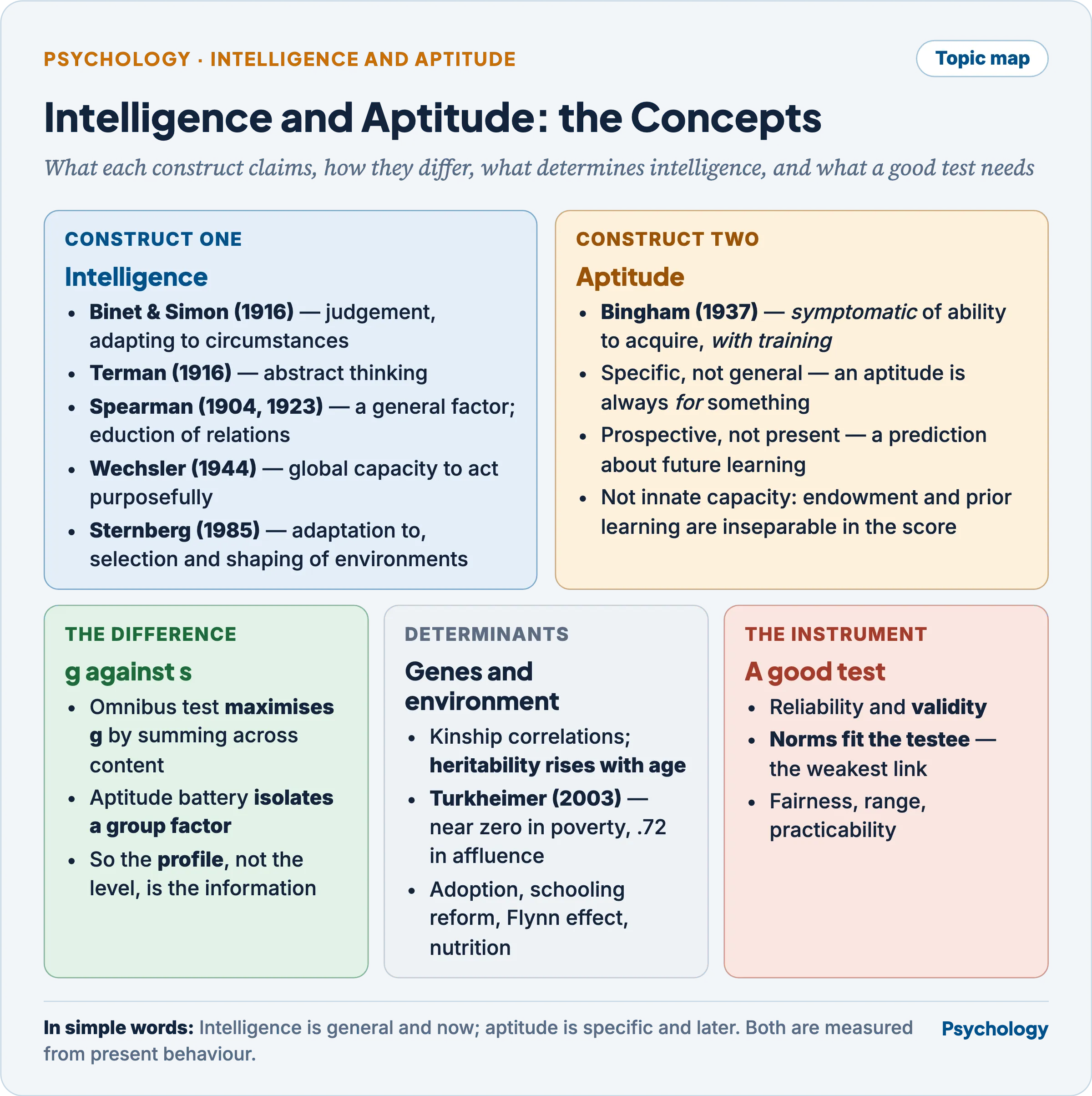
What intelligence has been taken to mean
- The definitions by named psychologists diverge in what they emphasise, and the divergence is itself the point.
- Binet and Simon (1916) located intelligence in judgement — adapting to circumstances and correcting one’s own errors. They were building an instrument to identify children needing special schooling, and wanted a definition that tracked practical competence rather than schoolroom knowledge.
- Terman (1916) defined it as the ability to carry on abstract thinking — a narrowing that suited the test he was standardising, since items of abstract reasoning are what the Stanford-Binet largely contained.
- Spearman (1904, 1923) treated intelligence as a general factor common to all intellectual activity, given psychological content in 1923 as the eduction of relations and correlates — perceiving a relation between two items, and completing a pattern from an item plus a relation.
- Stern (1912) and later Piaget both emphasised adaptation: intelligence as the general capacity to adjust thinking to new requirements, which for Piaget meant the equilibrium between assimilation and accommodation rather than a quantity one could have more or less of.
- Wechsler (1944) defined it as “the aggregate or global capacity of the individual to act purposefully, to think rationally and to deal effectively with his environment” — deliberately global, because Wechsler held that intelligence manifests in many ways and that a test must sample several of them.
- Sternberg (1985) defined it functionally as mental activity directed towards purposive adaptation to, selection of and shaping of real-world environments, which brings practical competence inside the construct rather than leaving it outside.
- The disagreement was measured, twice. When the Journal of Educational Psychology assembled a symposium of leading psychologists in 1921 to define intelligence, the replies were so various that the exercise became the standard illustration of definitional failure. Sternberg and Detterman (1986) repeated it with a new panel sixty-five years later. Attributes such as adaptation, elementary processes, metacognition and knowledge recurred in both, but no definition commanded assent in either.
- Boring (1923) cut the knot operationally: intelligence is what the tests test. This is honest about practice and circular as theory, and it is the reason the construct has always needed external validation rather than definitional agreement.
- The modern consensus statements are careful and deliberately modest.
- The APA task force report, Intelligence: Knowns and Unknowns (Neisser and colleagues, 1996), affirms that individual differences in cognitive ability exist, are substantial, are measurable and predict outcomes, while stating plainly that the causes of group differences are unknown and that no test is culture-free.
- Gottfredson (1997) published a statement signed by fifty-two researchers asserting a general ability, measurable by standard tests, which predicts occupational and educational outcomes more strongly than any other single trait — a stronger claim about which the field is genuinely divided.
What aptitude has been taken to mean
- The classic definition is Bingham’s (1937): an aptitude is a condition or set of characteristics symptomatic of a person’s ability to acquire, with training, some knowledge, skill or set of responses. Two elements of that wording do the work — symptomatic, so an aptitude is inferred from present signs; and with training, so the claim is about future learning rather than present attainment.
- Freeman described an aptitude as a combination of characteristics indicative of capacity to acquire a specific ability after training, and Warren’s dictionary as a condition or quality indicative of the potentiality for developing a skill. The agreement across definitions is that aptitude is potential for a specific acquisition.
- Aptitude is narrower and more directional than intelligence. Intelligence is defined as general and present; an aptitude is defined as specific and prospective. A person has an aptitude for something — mechanical work, music, clerical speed, surgery — and the construct is only intelligible with the object named.
- Aptitude is not the same as capacity. Aptitude as measured is always a joint product of whatever native endowment exists and whatever learning has already happened. No test separates the two, so an aptitude score is a prediction about future learning drawn from present performance, not a reading of innate potential. Treating it as the latter is the single commonest error in how aptitude testing is used.
How the two differ
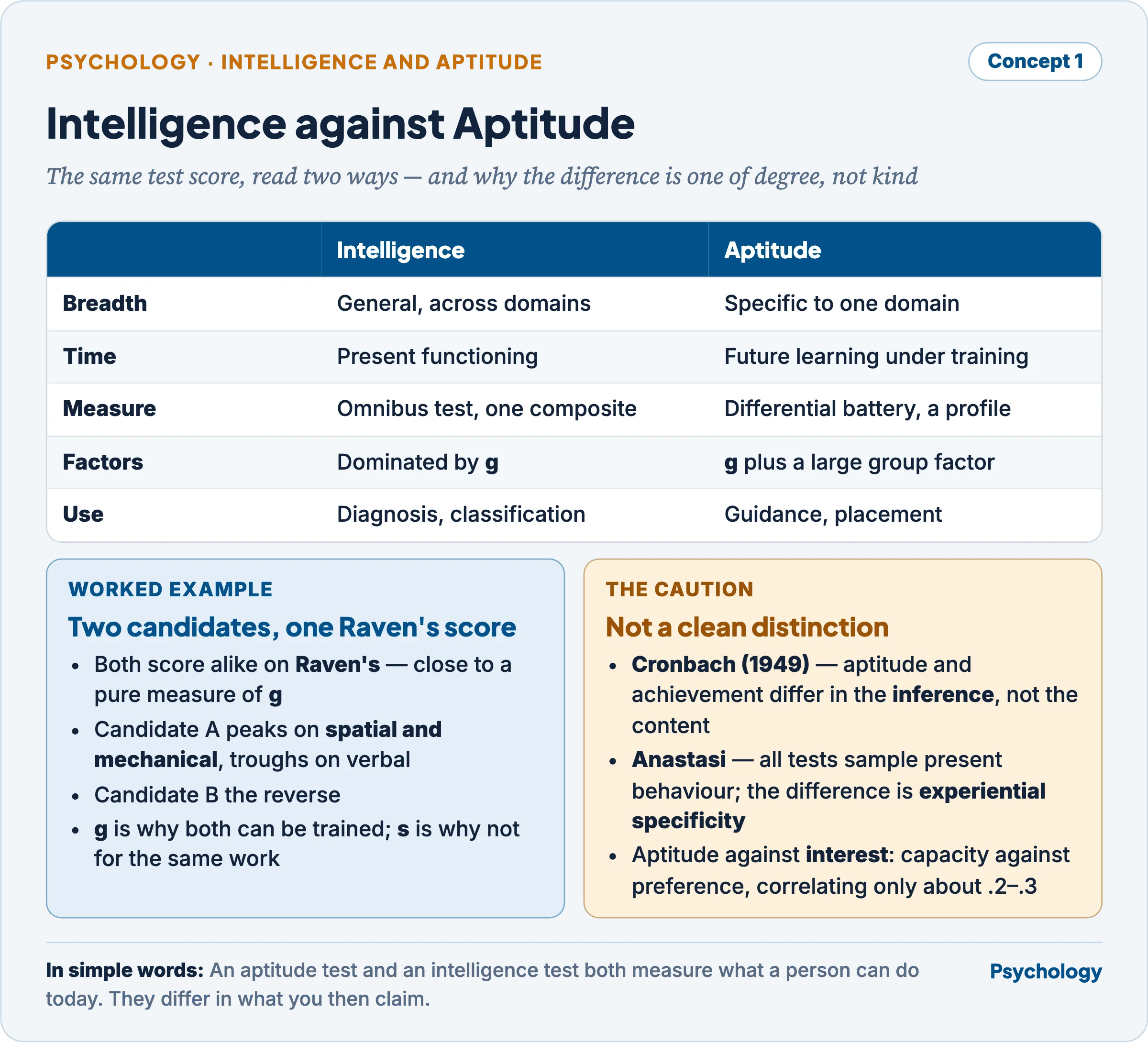
| Intelligence | Aptitude | |
|---|---|---|
| Breadth | General, cutting across domains | Specific to a domain or occupational family |
| Time orientation | Present cognitive functioning | Prediction of future learning under training |
| Typical measure | Omnibus test yielding a composite — Stanford-Binet, Wechsler scales, Raven’s | Differential battery yielding a profile of separate scores |
| What is reported | A single score plus index scores | A profile, read for the shape of the peaks |
| Use | Diagnosis, classification, broad selection | Guidance, placement, selection for particular training |
| Factor composition | Dominated by g | g plus a substantial specific or group factor |
- The difference in factor terms is the sharpest way to state it, and it is a difference of degree rather than kind. Any cognitive test score contains variance from the general factor and variance from narrower factors. An omnibus intelligence test is built to maximise the g component by sampling many content areas and summing, so the specific variances partly cancel. An aptitude test is built to isolate a group factor, by sampling one content area intensively so that its specific variance survives the summing.
- This is why aptitude subtests correlate substantially with intelligence tests, typically in the .5 to .7 range, and with each other — the shared g. It is also why they are not redundant: the residual, specific variance is what predicts differentially across occupations.
- The practical consequence: the profile is the information. A high mechanical-reasoning score tells you little on its own, because it carries g; a mechanical-reasoning score high relative to that person’s own verbal and clerical scores is the aptitude claim.
- An example. Two candidates score identically on Raven’s Progressive Matrices, which is close to a pure measure of g. On a differential battery one peaks on spatial relations and mechanical reasoning and troughs on verbal reasoning, the other the reverse. Intelligence testing cannot distinguish them; aptitude testing places one towards draughtsmanship or technical training and the other towards work built on language. The general factor they share is why both can be trained at all; the specific factors are why they should not be trained for the same thing.
- Spearman’s theory read onto the distinction. On the two-factor account every performance is g plus an s specific to that activity, with tests differing in their g saturation. Intelligence as measured is then an estimate of g, and an aptitude is an estimate of a particular s or of a group factor standing between the two. Spearman’s own later admission of group factors is what makes room for aptitudes at all: pure two-factor theory, with g and nothing but uncorrelated specifics, leaves no stable intermediate ability for an aptitude battery to measure.
- Spearman’s theory in brief, since the distinction is unintelligible without it: from the universally positive correlations among mental tests — the positive manifold — he inferred one function common to all intellectual activity, tested the inference by the tetrad-difference criterion, which predicts that tetrad differences vanish if a single common factor plus uncorrelated specifics generates the matrix, and gave g psychological content in three noegenetic principles — apprehension of experience, eduction of relations and eduction of correlates. The lettered two-factor formalisation is Spearman (1927), not the 1904 study. The fuller treatment, with Thurstone’s primaries and the hierarchical models, belongs with the factor theories.
- Aptitude against achievement. Cronbach (1949) argued that aptitude and achievement tests differ in the inference drawn, not in their content or their psychology: both measure present behaviour, and the labels record whether that behaviour is being used to predict future learning or to certify past learning. Anastasi made the same point by noting that all tests sample current performance, and that the aptitude–achievement distinction is a continuum of experiential specificity — from items assuming only experience common to a whole culture, to items assuming a particular course of instruction.
- Aptitude against interest. An aptitude is a capacity measure, taken under maximum-performance instructions, and is scored against external criteria. An interest is a preference measure, taken under typical-behaviour instructions, and is scored against reference groups. The two correlate weakly — commonly reported in the .2 to .3 range — so a person can be interested in work they have no aptitude for and apt at work that bores them. Guidance that uses only one of them is predictably wrong in one of those two ways.
The determinants of intelligence
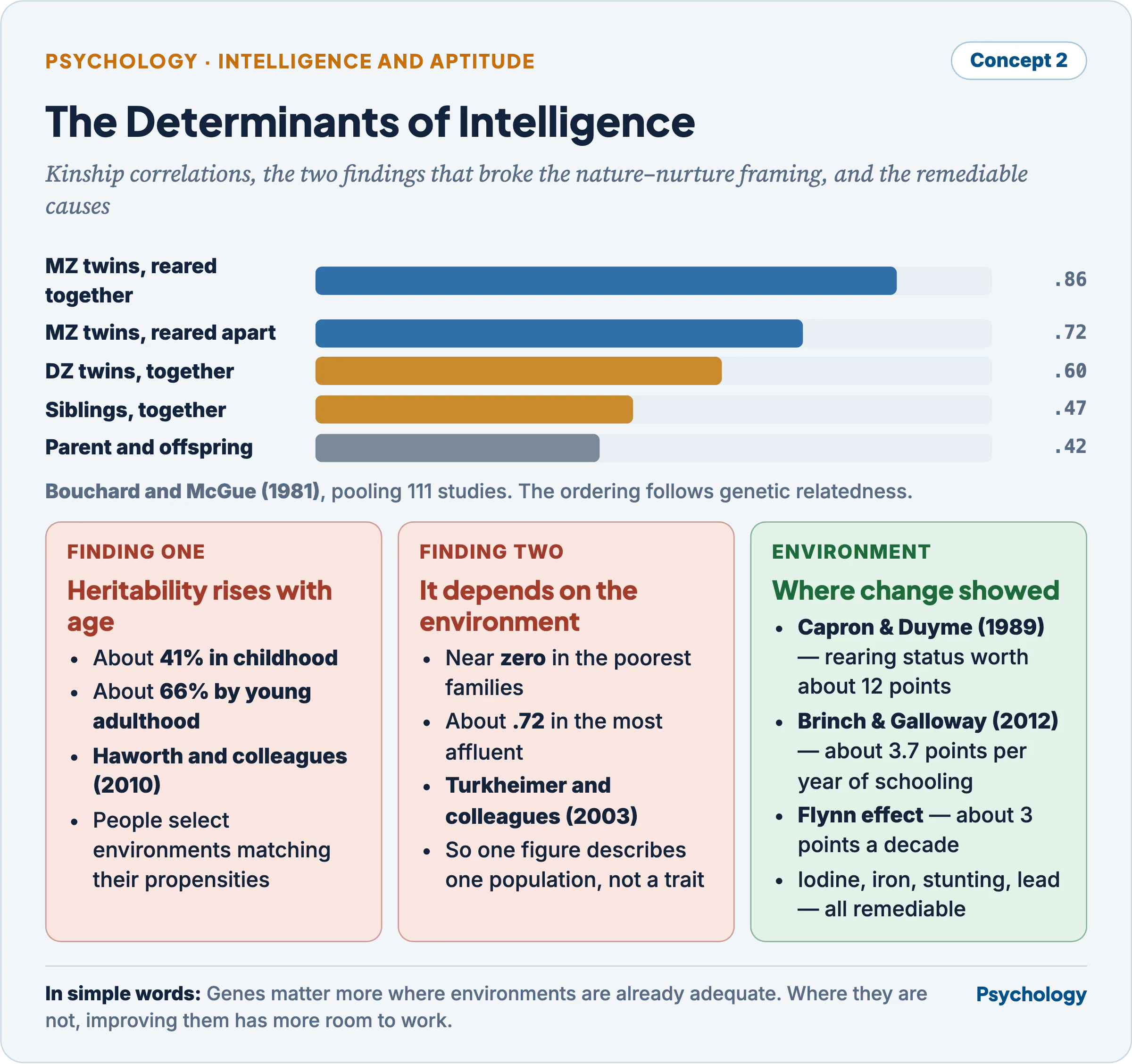
- The genetic evidence is from kinship correlations. Bouchard and McGue’s (1981) review of 111 studies set out the pattern that still frames the debate: monozygotic twins reared together correlate about .86, monozygotic twins reared apart about .72, dizygotic twins together about .60, siblings reared together about .47, and parent–offspring pairs about .42. The ordering follows genetic relatedness closely, and the Minnesota Study of Twins Reared Apart (Bouchard and colleagues, 1990) independently reported correlations near .70 for identical twins separated in infancy.
- Heritability is not a constant — the central modern finding. Two results in particular break the old nature–nurture framing.
- Heritability rises with age. Pooled twin data (Haworth and colleagues, 2010) show the heritability of general cognitive ability increasing from roughly 41% in childhood to about 66% in adolescence and young adulthood — the opposite of what a simple environmentalist account predicts, and explained by people increasingly selecting and shaping environments that match their propensities.
- Heritability depends on the environment. Turkheimer and colleagues (2003), analysing twins from impoverished American families, found heritability of IQ near zero in the poorest families and around .72 in the most affluent, with the shared-environment share moving in the opposite direction. Where environments are deprived, environmental variation dominates; where they are uniformly adequate, genetic variation shows through. A single heritability figure is therefore a statement about one population at one time, not about a trait.
- The environmental evidence is strongest where an environment changed and intelligence changed with it.
- Adoption and cross-fostering. Capron and Duyme (1989) used a four-group French design crossing the socio-economic status of biological and adoptive parents, and found rearing status worth roughly twelve IQ points independent of biological origin — a design that isolates rearing because the two influences are orthogonal by construction.
- Schooling. Brinch and Galloway (2012) exploited a Norwegian reform that lengthened compulsory schooling and estimated roughly 3.7 IQ points per additional year of schooling — causal identification from a policy change rather than a correlation between schooling and ability.
- The Flynn effect. Population test scores rose by roughly three points per decade through the twentieth century across many countries, and the environment is the only candidate cause on that timescale. Gains concentrated on fluid, abstract items rather than on vocabulary and arithmetic, which is why the effect bears on what tests measure as much as on intelligence itself.
- Nutrition and toxicants. Iodine deficiency in pregnancy, iron-deficiency anaemia, chronic undernutrition and lead exposure each depress measured ability, and each is remediable. These are the determinants with the clearest policy handles.
- The Indian evidence and the Indian handles. Iodine deficiency was endemic across the sub-Himalayan belt and is addressed through the National Iodine Deficiency Disorders Control Programme and universal salt iodisation, under which household access to iodised salt is now near-universal. Anaemia among young children remained above two-thirds in the most recent National Family Health Survey, and child stunting around a third — both operating on exactly the nutritional pathway above. The programmes aimed at it are the Integrated Child Development Services, the midday meal scheme and POSHAN Abhiyaan. The policy inference is the one Turkheimer’s result licenses: in populations where basic environmental adequacy is not yet uniform, environmental improvement has more room to raise ability than any genetic fact forecloses.
- The observational strand is distinct from the experimental one, and the two converge. Kinship, adoption and schooling-reform designs are research evidence, built to isolate a cause. Against them stand observational findings that no design produced: the secular rise in test scores across whole populations, the geographic coincidence of endemic iodine deficiency with depressed cognitive performance in sub-Himalayan districts before salt iodisation, and the association of childhood stunting and anaemia with later school attainment in large survey samples. Neither strand alone would be persuasive; together they identify determinants that are both causal and remediable.
- The interaction, stated properly. Genes and environment are not additive contributions to a fixed total. Gene–environment correlation means genotypes help select environments; gene–environment interaction means the same environment has different effects on different genotypes. Both are documented, so asking what percentage of intelligence is inherited is asking a question that has no population-free answer.
What makes a good test of intelligence
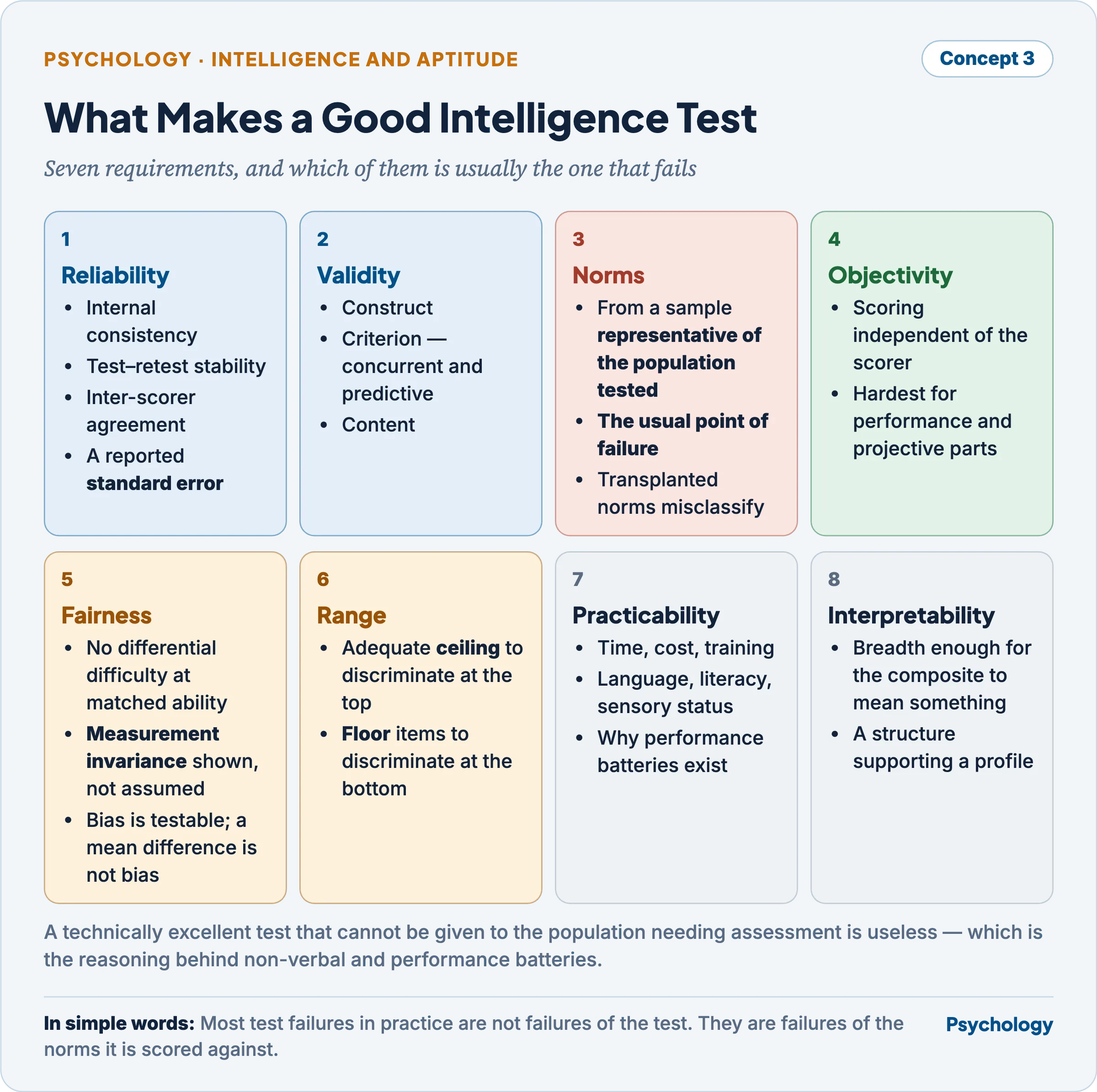
- Reliability — consistency of measurement. The forms that matter are internal consistency across items, test–retest stability over an interval, and inter-scorer agreement where judgement enters scoring. The practical requirement is a reported standard error of measurement, so that a score is read as a band rather than a point.
- Validity — whether the test measures what it claims and supports the inferences drawn. Construct validity, through the pattern of correlations with other measures; criterion-related validity, concurrent and predictive, against outcomes such as attainment or job performance; and content validity, whether the items sample the domain.
- Standardisation — fixed administration, fixed scoring, and norms from a sample representative of the population tested. Norms are the weakest link in practice: a score is meaningful only against the group that produced the norms, and transplanted norms misclassify. The Standards for Educational and Psychological Testing place the burden on the test user to show the norms fit the testee.
- Objectivity — scoring that does not depend on who scores. Performance and projective components are where this is hardest.
- Fairness and freedom from bias — items not differentially difficult for groups matched on the underlying ability, and measurement invariance demonstrated rather than assumed. Bias is a technical property that can be tested for; it is not the same as a mean difference between groups.
- Adequate range — a sufficient ceiling to discriminate at the top and floor items to discriminate at the bottom, without which the test cannot do the classification work asked of it.
- Practicability — administration time, cost, training needed, and suitability for the testee’s language, literacy and sensory status. A technically excellent test that cannot be given to the population needing assessment is useless, which is the reasoning behind performance and non-verbal batteries.
- Comprehensiveness and interpretability — enough breadth that the composite means something, and a score structure that supports a profile rather than only a single number.
The justification for the concepts — and the case against
- The theoretical justification. Individual differences in cognitive performance are real, substantial and stable: test scores correlate positively with one another, the correlation structure is orderly enough to support factor models, and rank order is moderately stable across decades of a life. A construct is justified when it organises findings that would otherwise be unconnected, and generates predictions that survive testing. Intelligence does both — the positive manifold, the ageing pattern of fluid and crystallised abilities, the Flynn effect and the heritability findings are one literature because of it.
- The utilitarian justification. Testing was created for a practical purpose and has been retained for practical purposes: identifying children needing educational support, placing people in training they can complete, allocating scarce selection opportunities by something more defensible than patronage, and screening for cognitive impairment in clinical and neurological work. Within the range of ordinary application, cognitive test scores remain among the better available predictors of training and educational outcomes.
- The case against is also historical and specific. Early intelligence testing was used to support immigration restriction and sterilisation. Brigham’s 1923 analysis of United States Army test data, which drew racial conclusions about intelligence, is the canonical instance — and his own 1930 retraction, which concluded that comparative studies of national and racial groups using those tests, including his own, were without foundation, is the equally canonical correction. The lesson is not that measurement is impossible but that the inferential leap from a score to a claim about a group’s capacity was never licensed by the data.
- The Indian objection is substantive, not only historical. The constructs, item types and norms were developed in a narrow range of societies. Where norms developed on small or socio-economically unrepresentative Indian samples have been re-examined on large government-school samples, very large proportions of ordinary children fall at the bottom of the distribution — which tells us about the norms, not the children. The concepts travel; the instruments and norms do not travel without re-standardisation.
Criticisms and limitations
- No agreed definition underlies either construct, so both remain partly operational — defined by the instruments that measure them. This leaves the field vulnerable to the charge that it has reified a test score.
- The constructs are narrower than their use. Standard tests sample abilities that formal schooling rewards. Practical competence, creativity and social skill are either outside the construct or measured poorly within it, which is the opening exploited by the multiple-intelligences and information-processing accounts.
- The aptitude–achievement distinction is not clean. Since both measure present behaviour, an aptitude score is depressed by poor prior opportunity, and then used to predict a future shaped by the same opportunity — a mechanism that converts disadvantage into a prediction of disadvantage.
- Aptitude profiles are less differentially predictive than their design implies. Because subtests share so much general variance, the incremental prediction from profile shape over a single composite is modest, which weakens the strongest claim made for differential batteries.
- Scores are routinely over-interpreted. A score is an estimate with a standard error, obtained on one occasion, against norms from one sample. It is read as a stable property of a person.
- The policy risk is irreversibility. Where test results are used to allocate children to divergent tracks, the measurement error and the environmental sensitivity documented above are converted into permanent educational differences — and the schooling effect on measured ability means the allocation partly causes the difference it claims to detect.
Previous Year Questions
- 2024Differentiate between intelligence and aptitude. Also, discuss the main features of a good intelligence test.
- 2023How do intelligence and aptitude differ? Explain the two in the light of ‘g’ and ‘s’ factors of intelligence giving suitable example.
- 2004What are the determinants of intelligence? Support your answer with research and observational evidences.
- 2003Is intelligence different from aptitude? Discuss Spearman’s theory of intelligence.
- 2000What is the theoretical and utilitarian justification of the concepts of aptitude and intelligence?