

Psychological and physiological basis of motivation and emotion.
Official Syllabus: Paper I · Unit 9 Motivation and Emotion
“Universals occur through the operation of a facial affect program which specifies the relationship between distinctive movements of the facial muscles and particular emotions.”
— Ekman (1972)
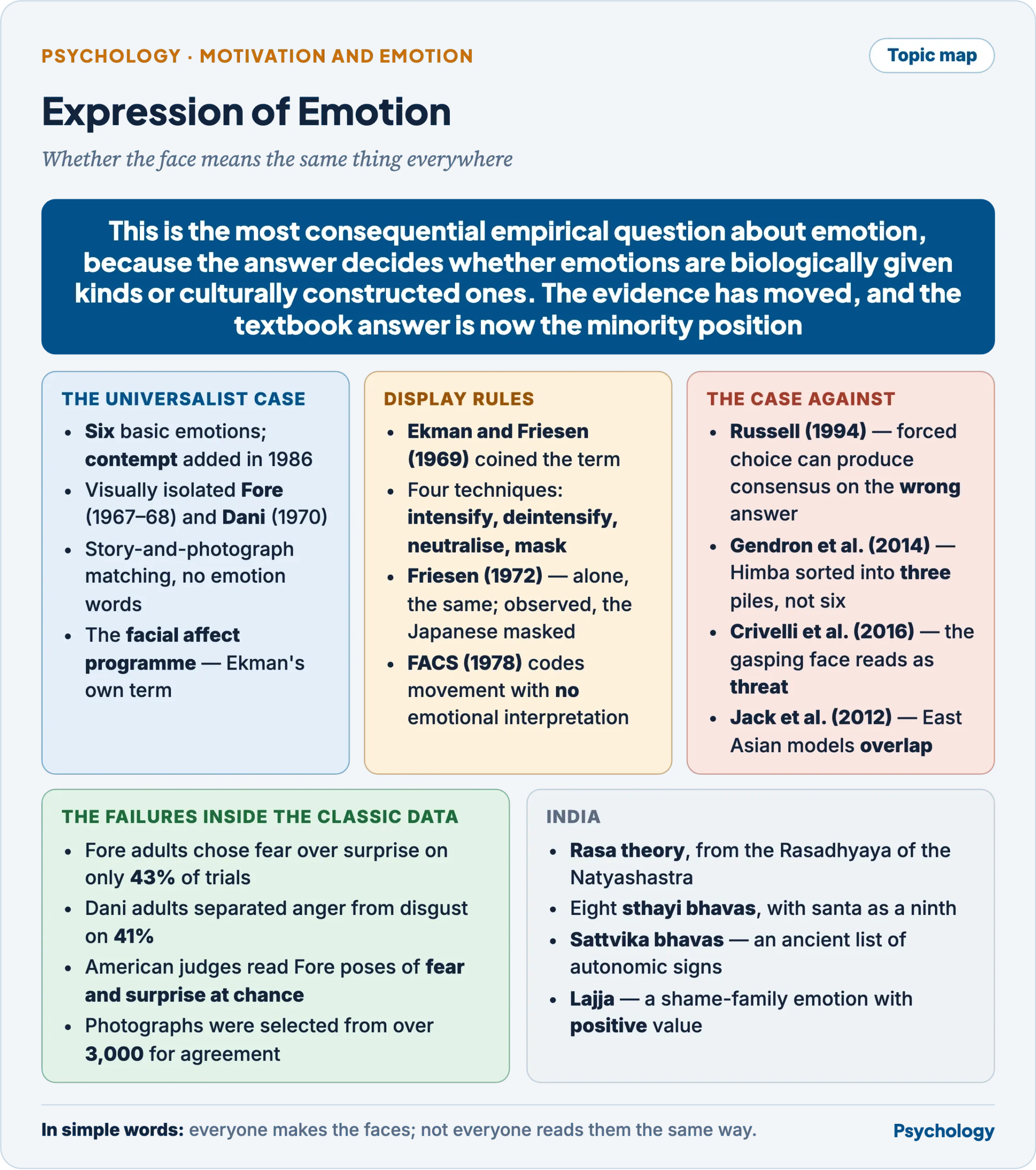
Whether the face expresses emotion in the same way everywhere is the most consequential empirical question about emotion, because the answer decides whether emotions are biologically given kinds or culturally constructed ones. The evidence has moved substantially in the last two decades, and the textbook answer is now the minority position.
Basic emotions, and what “basic” means
- Ekman’s cross-cultural programme worked with six emotions: happiness, sadness, anger, fear, surprise and disgust. Contempt was added as a seventh in Ekman and Friesen (1986), on the strength of judgements collected in ten countries, its expression being a unilateral tightening and raising of one lip corner; the claim was immediately contested by Izard and Haynes (1988) and defended in reply.
The six, one by one — the facial configuration, the typical antecedent and the function each is held to serve:
- Happiness — lip corners raised and drawn back by zygomaticus major, cheeks raised and crow’s feet formed by orbicularis oculi. Antecedent: a goal attained or a relationship affirmed. Function: signals safety and invites approach. The most reliably recognised of the six, and the only one with a single unmistakable signal.
- Sadness — inner brow corners raised and drawn together, lip corners pulled down, upper eyelids drooping. Antecedent: irrevocable loss. Function: signals need and elicits care; the slowed posture withdraws the person from activity.
- Anger — brows lowered and drawn together, eyelids tensed, lips either pressed tight or squared to show the teeth, with a direct stare. Antecedent: an obstacle to a goal, or a violation. Function: a threat display that prepares attack and may obtain compliance without it.
- Fear — brows raised and drawn together, upper eyelids raised to widen the eyes, lips stretched horizontally. Antecedent: physical or psychological danger. Function: widened eyes enlarge the visual field, and the display warns others.
- Surprise — brows raised and curved, eyes wide, jaw dropped, no horizontal lip stretch. Antecedent: an unexpected event. Function: maximises sensory intake. It is the briefest of the six and the one most often confused with fear, which shares the raised brows and widened eyes.
- Disgust — nose wrinkled by levator labii superioris, upper lip raised, cheeks raised, sometimes with the tongue protruded. Antecedent: contamination, originally of taste and smell, extended to moral violation. Function: rejection — the configuration physically restricts intake through nose and mouth.
- Three senses of “basic”, as Ekman (1999) set them out. First, that emotions differ from one another in appraisal, antecedent, physiology and probable response, against the view that all emotional processes are the same thing at different intensities. Second, that emotions evolved to deal with fundamental life tasks — encounters with predators, rivals, offspring, contamination. Third, that basic emotions combine into complex ones, as contempt is sometimes analysed into anger and disgust.
- The criteria for calling an emotion basic: a distinctive universal signal, emotion-specific physiology, automatic appraisal, distinctive universal antecedent events, presence in other primates, quick onset, brief duration and distinctive subjective experience.
- The list expanded far beyond six. In Ekman (1999) he proposed fifteen candidate emotions, including amusement, contentment, embarrassment, excitement, guilt, pride in achievement, relief, satisfaction, sensory pleasure and shame — while excluding romantic love, grief and jealousy as emotional plots rather than emotions. The “six basic emotions” is therefore his cross-cultural test set, not his theory of how many emotions there are.
- Plutchik’s alternative. Plutchik (1980) proposed eight primary emotions arranged as four pairs of opposites — joy and sadness, trust and disgust, anger and fear, surprise and anticipation — varying in intensity and combining, like primary colours, into complex emotions. His wheel is the standard representation, and the dyad of joy and trust giving love is the standard illustration.
The universality evidence
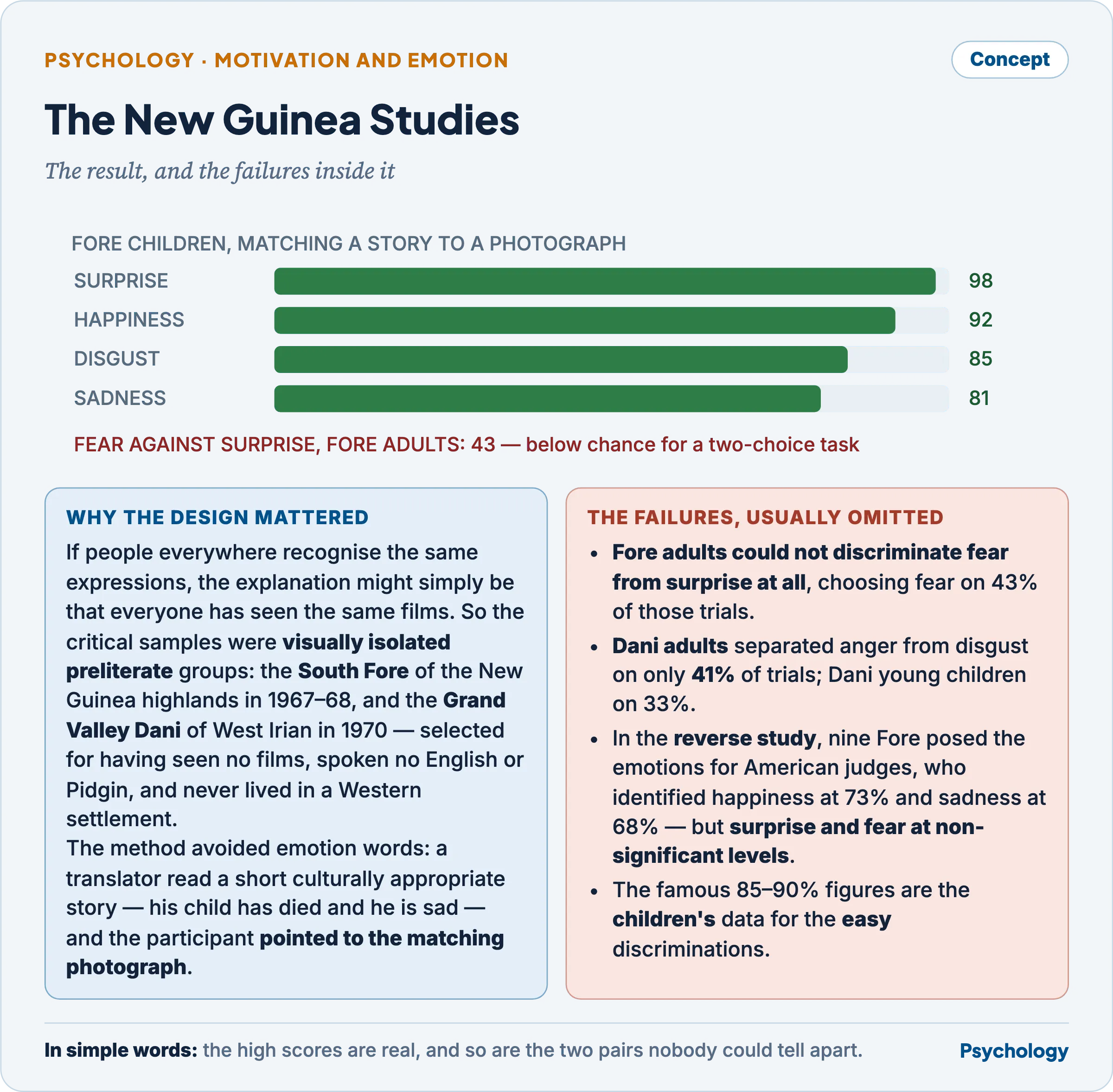
- The design problem. If people everywhere recognise the same expressions, the explanation might simply be that everybody has seen the same films. So the critical samples were visually isolated preliterate groups: the South Fore of the New Guinea highlands, studied in 1967 and 1968, and the Grand Valley Dani of West Irian in 1970, selected for having seen no films, spoken no English or Pidgin, and never lived in a Western settlement.
- The method, borrowed from an earlier procedure, avoided emotion words: a translator read a short, culturally appropriate story — his friend has come and he is happy; his child has died and he is sad — and the participant pointed to the matching photograph from a small set.
- The results (Ekman, 1972) were high for the easy discriminations. Among Fore children, happiness was matched at 92 per cent, surprise at 98, disgust at 85 and sadness at 81, with comparable figures for Dani adolescents. The reverse study had nine Fore pose the emotions for photographs judged by American students, who identified happiness at 73 per cent and sadness at 68.
- The failures are part of the finding and are usually omitted. Ekman (1972) reports that Fore adults could not discriminate fear from surprise at all — they chose fear on only 43 per cent of those trials, which is below chance for a two-option task. The Dani managed it only weakly, and Dani adults distinguished anger from disgust on only 41 per cent of trials. In the reverse study, American judges identified the Fore poses of surprise and fear at non-significant levels.
- Other supporting lines. Congenitally blind individuals produce recognisable expressions they cannot have learnt by imitation; expressions appear in a regular developmental sequence; and homologues of several displays occur in other primates. Sauter and colleagues (2010) extended the claim beyond the face, finding that Himba listeners in Namibia and English listeners matched several non-verbal vocalisations to the same emotion stories.
The facial affect programme and display rules
- The facial affect programme is Ekman’s own term for the proposed innate mechanism linking each basic emotion to a distinct pattern of neural impulses to the facial musculature. It is held to be at least partly innate and to operate with little prior cognitive evaluation, which is what would explain universal expressions.
- Display rules are the learnt, culturally specific conventions governing which emotion may be shown, by whom, to whom and in what setting. Ekman and Friesen (1969) introduced the term and specified four management techniques:
- Intensifying a felt emotion — showing more delight at a gift than one feels.
- Deintensifying it — showing muted triumph when the loser is present.
- Neutralising it — the composure expected of a professional.
- Masking it — covering a felt emotion with the expression of a different one.
- The study that established them — Friesen (1972) had Japanese and American students watch a neutral travelogue and then a stress film of surgery and accidents, with a hidden camera recording their faces. Alone, the two groups’ facial movements in response to the stress film were closely similar, with a whole-face correlation of about .88. When a scientist in a white coat entered and sat with them, the Japanese participants masked negative emotions with positive expressions markedly more than the Americans did. The programme and the rules together give the standard two-level account: a universal mechanism, culturally regulated at the point of display.
- The design has been criticised, on the ground that no particular display rule was specified in advance, no independent evidence was offered that the Japanese were subject to one and the Americans not, and the only evidence for a rule operating was the absence of the predicted expression.
- Related findings. Collectivist samples more often moderate negative displays toward a higher-status person, and also moderate positive displays, consistent with a general norm of emotional regulation for group harmony rather than a rule about negative emotion specifically.
- The Facial Action Coding System (Ekman and Friesen, 1978) was built to break the circularity of judgement studies: it codes visible facial movement into anatomically defined action units and carries no emotional interpretation of its own, so that what a configuration means becomes an empirical question rather than a definitional one.
Is facial expression of emotion innate or acquired?
The evidence supports neither pure position, and the defensible answer separates three different claims.
- Production looks substantially innate. Congenitally blind people, including children blind from birth, produce expressions resembling those of sighted relatives; expressions appear on a developmental timetable; the musculature required is common across human groups; and homologous displays occur in other primates.
- Recognition looks substantially learnt, or at least heavily shaped by the concepts and the method available. The within-culture advantage in recognising expressions, the dependence of the “universal” result on forced-choice formats, and the failure of the universal pattern to appear in free-response tasks all point that way.
- Regulation is clearly learnt. Display rules are acquired early, differ by culture, class and gender, and are the mechanism by which the same felt state produces different visible behaviour.
- The answer that fits the evidence: the capacity and the basic motor patterns are substantially innate; the contexts that elicit them, the rules that govern their display and the categories used to interpret them are learnt. Asking whether expression is innate or acquired conflates production, elicitation, regulation and recognition, which have different answers.
The case against universality
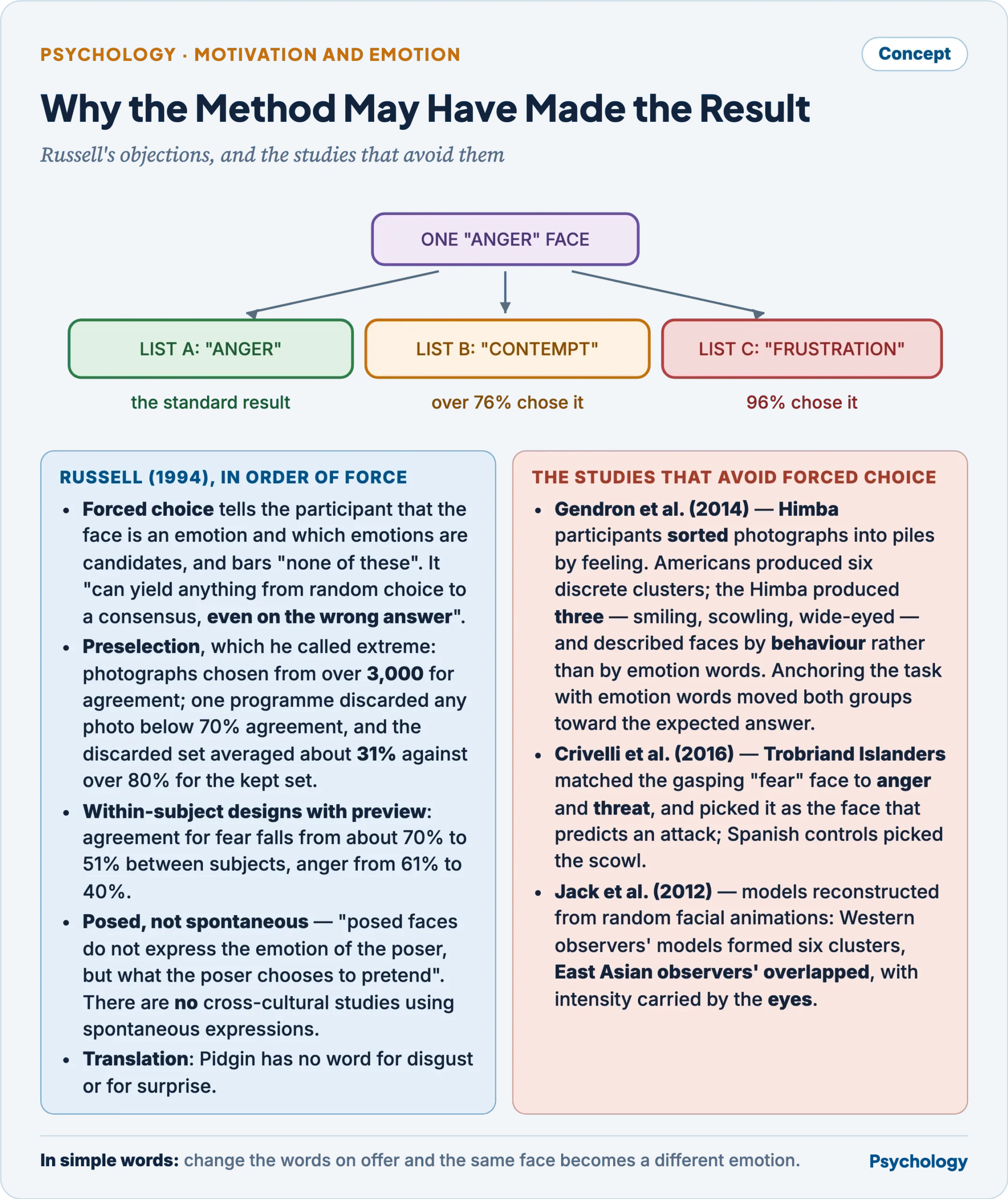
Russell (1994), reviewing the cross-cultural literature, argued that the universality result is substantially an artefact of method. His objections, in order of force:
- Forced choice (Russell, 1994). Giving participants a short list of emotion words tells them that the face is to be read as an emotion and which emotions are candidates, and prevents them answering “none of these” or describing the situation instead. His demonstration is decisive on its own terms: by changing the option list, the face designated “anger” was labelled contempt by over three-quarters of judges and frustration by 96 per cent, and the “fear” face was labelled surprise by 71 per cent. Forced choice “can yield anything from random choice to a consensus, even on the wrong answer”. Free labelling consistently gives much lower agreement.
- Preselection of stimuli, which Russell (1994) called extreme. The photographs used were chosen from a pool of over three thousand for producing high agreement; in one programme, photographs failing a 70 per cent agreement criterion were discarded, and the discarded set averaged about 31 per cent agreement against over 80 for the retained set. The stimuli are therefore selected for the result.
- Within-subject designs with preview (Russell, 1994). Participants typically saw the whole set first and judged all faces in sequence, which invites comparison between them. Agreement falls substantially in between-subjects designs — in his comparison, fear from about 70 to 51 per cent and anger from 61 to 40.
- Posed rather than spontaneous faces. “Posed faces do not express the emotion of the poser, but what the poser chooses to pretend”, and accuracy for spontaneous expressions is far lower than for posed ones. There are no cross-cultural studies of recognition from spontaneous expressions.
- Translation. The Fore fieldwork was conducted through translators by researchers who spoke neither Fore nor Pidgin, and Pidgin has no word for disgust or contempt and none for surprise, so substitutes had to be used.
- The cumulative argument — No single flaw is fatal; the point is that every one of them pushes in the same direction. Russell (1995) proposed minimal universality as what survives — people everywhere can infer something about others from facial behaviour — while holding that emotions occur without expressions and expressions without emotions. Ekman (1994) and Izard (1994) replied in the same volume, Izard arguing that the criticisms bear only on the universality of semantic attributions.
The newer evidence does not depend on Russell’s methodological argument.
- Gendron and colleagues (2014) avoided forced choice entirely, asking Himba participants in remote north-western Namibia to sort photographs into piles by the feeling of the person shown. Americans produced six largely discrete clusters; the Himba produced three — smiling, scowling and wide-eyed — and did not separate the scowling, pouting and nose-wrinkled faces. The Himba described the faces predominantly by behaviour (“laughing”, “looking at something”) rather than by emotion words. Anchoring the task with emotion words moved both groups toward the expected solution, which is the point: the method supplies the structure the result then reports.
- Gendron and colleagues (2014) also tested vocalisations with the same population and found Himba agreement below five per cent for most categories except laughter — which contradicts the earlier finding with Himba listeners and shows how much the free-response and matching formats differ.
- Crivelli and colleagues (2016) found Trobriand Islanders matching the gasping “fear” face to anger and to threat, and selecting it as the face that predicts an attack, where Spanish controls chose the scowling face. The same configuration carries opposite meanings in the two societies.
- Jack and colleagues (2012) reconstructed observers’ internal models of facial expressions from random facial animations, with no preselected photographs. Western Caucasian observers’ models formed six distinct clusters; East Asian observers’ models overlapped considerably across categories, and represented emotional intensity through the eyes, which are less voluntarily controllable than the mouth. Later work from the same group argues that the early, biologically basic signals collapse fear with surprise and anger with disgust, so that four categories describe the signal better than six.
- The behavioural ecology view — Fridlund (1994) and Crivelli and Fridlund (2018) argue that facial displays are not read-outs of internal states at all but social tools that signal the displayer’s likely course of action and what they want from the audience. On this account displays are audience-dependent rather than emotion-dependent, and their meaning is set by the interaction.
Non-verbal cues beyond the face
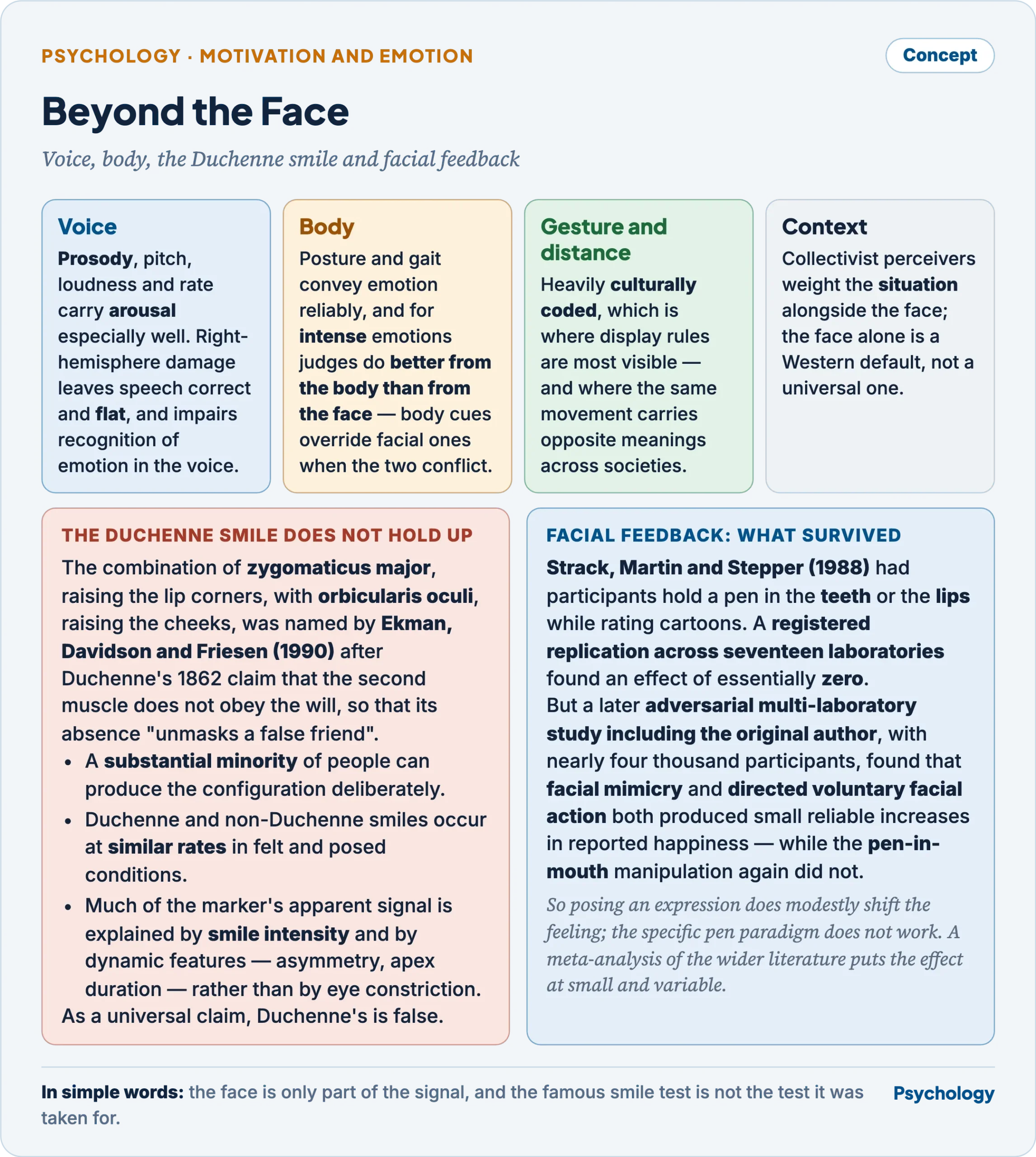
- Vocal cues — pitch, loudness, rate, pauses and prosody — carry arousal especially well, and a proportion of the emotion’s identity. Right-hemisphere damage impairs both the production and the recognition of emotional prosody, leaving speech correct and flat.
- Posture and gait convey emotion reliably, and in several studies body cues override facial cues when the two conflict — for intense emotions, judges perform better from the body than from the face.
- Gesture and interpersonal distance are heavily culturally coded, which is where display rules are most visible.
- The Duchenne smile — the combination of zygomaticus major, which raises the lip corners, with orbicularis oculi, which raises the cheeks and produces crow’s feet — was named by Ekman, Davidson and Friesen (1990) after Duchenne’s 1862 claim that the second muscle is not under voluntary control, so that its absence “unmasks a false friend”. That claim does not hold as stated: a substantial minority of people can produce the configuration deliberately, Duchenne and non-Duchenne smiles occur at similar rates in felt and posed conditions, and much of the marker’s apparent signal is explained by smile intensity and by dynamic features such as asymmetry and duration rather than by eye constriction itself.
- The facial feedback hypothesis holds that the expression feeds back into the feeling. The famous pen-in-the-teeth demonstration of Strack, Martin and Stepper (1988) did not survive: a registered replication across seventeen laboratories found an effect of essentially zero. But the broader hypothesis did survive: a large adversarial multi-laboratory study including the original author, with nearly four thousand participants, found that facial mimicry and directed voluntary facial action both produced small reliable increases in reported happiness, while the pen-in-mouth manipulation again did not. A meta-analysis of the wider literature puts the effect at small and variable. The accurate statement is that posing an expression does modestly shift the feeling, and that the specific pen paradigm does not work.
Emotion in the Indian tradition
- The rasa theory, set out in the Rasadhyaya chapter of the Natyashastra, is the classical Indian analysis of emotion, developed in relation to drama because drama is where emotional states are deliberately produced and examined.
- Eight sthayi bhavas, or stable emotions, are enumerated: rati (love or delight), hasa (amusement or mirth), soka (sorrow), krodha (anger), bhaya (fear), utsaha (energy or heroism), jugupsa (disgust) and vismaya (wonder), with santa, serenity, added as a ninth in some texts. The overlap with Ekman’s list is striking and the differences are instructive — heroism and wonder are there, and the Indian list treats serenity as an emotion rather than as its absence.
- The structural claim is different from the Western one, and this is the point worth making. An emotion is not an internal state with an expression attached; it is a complete episode composed of its causes, its manifestations and its accompanying feelings:
- Vibhava — the determinants. Alambhana vibhava is the person or object the emotion is about; uddipana vibhava is the surrounding situation that excites it.
- Anubhava — the overt manifestations, verbal (vachika) and bodily (angika).
- Sattvika bhavas — the eight involuntary responses, which are effectively an ancient list of autonomic signs: paralysis, trembling, change of colour, sweating, horripilation, change of voice, weeping and fainting.
- Vyabhichari bhavas — the thirty-odd transient feelings that colour the stable emotion.
- Rasa — what the audience experiences, arising from the union of these elements.
- Why it matters for the universality debate. The rasa analysis anticipates appraisal theory in making the determinants part of the emotion rather than its cause, and anticipates the constructionist position in treating the emotion as an assembled episode rather than a discrete internal kind.
- Lajja is the clearest case of an emotion the Western taxonomies do not hold. It covers shame, shyness, modesty and propriety, is gendered in its expectation, and carries a positive evaluation — a person who possesses it is well-mannered — where shame in the Western literature is a negative self-conscious emotion. Shame and guilt are themselves distinguished by the attribution of failure to the global self rather than to a specific act, and collectivist settings, where deviation from group standards is the salient failure, generate the first where individualist settings generate the second.
- Display rules in the Indian setting are strongly marked by age, gender and relative status: the suppression of anger toward elders, the gendered expectation that women express anger by withdrawal and men by confrontation, and the regulation of positive display in the presence of those who lack what one has.
Criticisms and limitations
- The universality evidence is method-dependent, and the dependence is large enough that the choice of task — forced choice, free labelling or sorting — effectively determines the answer.
- Posed expressions dominate the literature, and they are what a person chooses to display rather than what they feel.
- Preselected stimuli mean the faces tested are the ones that already produce agreement.
- The remote-sample studies are small. The newer critical studies work with tens of participants in one or two societies, and are no more immune to sampling criticism than the work they correct.
- Production, recognition and regulation are run together in most of this debate, although the evidence differs for each.
- The facial affect programme is not independently specified. Its existence is inferred from the universality of expressions, which is what it is invoked to explain.
- Indian material is treated as illustration rather than evidence. The rasa framework is cited in textbooks and almost never used to generate testable predictions about Indian participants, which is exactly what the constructionist debate now needs.
Previous Year Questions
- 2025Critically evaluate the role of facial-affect programme and display rules in the expression of emotions by citing relevant examples.
- 2024Explain the biological and cultural bases of emotion. Do people reveal their emotions through non-verbal cues? Discuss.
- 2020Explain six primary emotions that can be identified from facial expressions.
- 2012Is facial expression of emotion innate or acquired? Support your answer with suitable evidence.