

Creative thinking and fostering creativity.
Official Syllabus: Paper I · Unit 8 Thinking and Problem Solving
“Creativity is most likely to occur when people are primarily motivated by the interest, enjoyment and challenge of the work itself, rather than by external pressures.”
— Teresa Amabile, stating the finding on which almost every practical recommendation rests
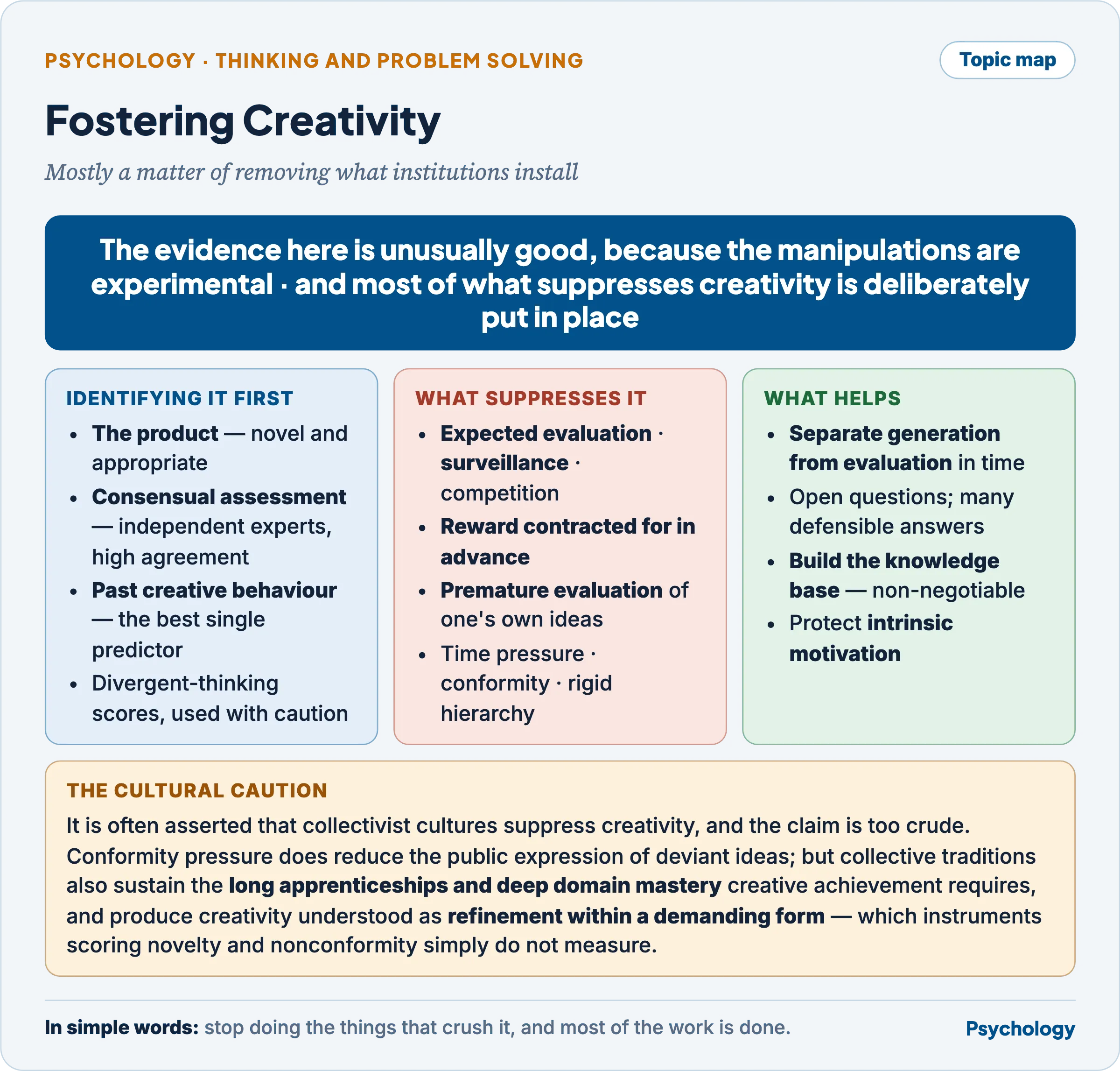
Creativity can be increased, and the evidence for how is unusually good — because the manipulations are experimental. Osborn (1953) began the applied tradition with brainstorming, and Amabile (1983) supplied its best-supported principle by showing experimentally that the conditions institutions routinely impose — evaluation, surveillance, competition and contracted-for reward — reliably reduce creative output. The central finding is uncomfortable for institutions: most of what suppresses creativity is deliberately installed, and fostering it is more a matter of removing obstacles than of adding techniques.
Identifying creativity first
Before creativity can be fostered it has to be recognised, and the criteria used determine who is found.
- The product criterion — is what the person produces novel and appropriate? The most defensible and the hardest to apply to children, whose products are rarely novel to anyone but themselves. The mini-c notion is the repair: novelty relative to the person’s own prior understanding.
- Divergent-thinking scores — fluency, flexibility, originality and elaboration, from the Torrance tests or Alternate Uses. Convenient, moderately reliable, and only modestly predictive of actual creative achievement.
- Consensual assessment. Amabile’s procedure: have independent domain experts rate products for creativity without being told what creativity is. Inter-rater agreement is consistently high, which is the strongest evidence that creativity is a recognisable property even though it resists definition.
- Behavioural checklists and biographical inventories — records of what a person has actually made, entered, published or built. Past creative behaviour is the single best predictor of future creative behaviour, better than any test.
- Teacher and peer nomination, which is cheap and biased: teachers reliably nominate the conscientious and agreeable, and Getzels and Jackson’s finding that high-creativity children were rated less favourably than high-IQ children of equal achievement is the standing warning.
- Process indicators — questions asked, approaches tried, willingness to abandon a working method for a better one.
The practical rule: use several criteria, weight what the person has produced above what a test says, and be suspicious of any single score.
What suppresses creativity
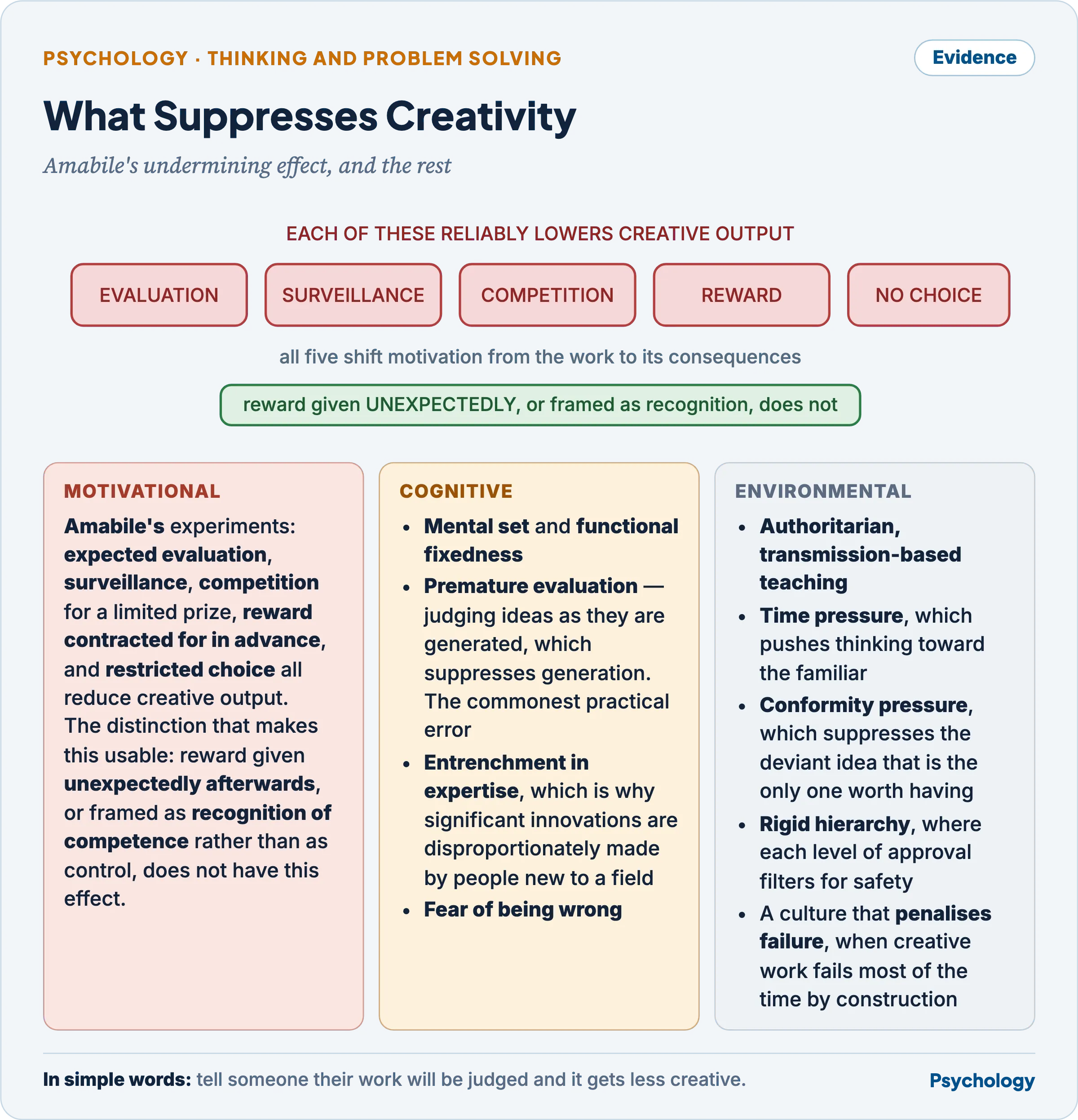
Motivational barriers, which Amabile’s experiments established and which are the best-evidenced part of this literature.
- Expected evaluation. Being told the work will be judged reduces its creativity, even when no judgement is delivered.
- Contracted-for reward. Reward promised in advance and contingent on doing the task reliably lowers creativity — the undermining effect — by shifting motivation from the work to the payment. Reward given unexpectedly afterwards, or framed as recognition of competence rather than as control, does not have this effect, and the distinction is what makes the finding usable rather than paralysing.
- Surveillance. Being watched while working reduces creativity.
- Competition for a limited prize does the same.
- Restricted choice. Removing autonomy over how a task is done lowers creative output even when the task is unchanged.
Cognitive barriers.
- Mental set and functional fixedness, carried over from problem solving: the stored solution blocks the better one.
- Premature evaluation — judging ideas as they are generated, which suppresses generation. This is the single most common practical error.
- Entrenchment in expertise. The knowledge that makes contribution possible also makes departure harder, which is why significant innovations are disproportionately made by people new to a field or arriving from an adjacent one.
- Fear of being wrong, which is a cognitive habit before it is an emotional one.
Environmental and cultural barriers.
- Authoritarian and transmission-based teaching, in which the teacher holds the answers and the pupil’s task is reproduction.
- Time pressure, which pushes thinking toward the familiar.
- Conformity pressure within a group, which suppresses the deviant idea that is the only one worth having.
- Rigid hierarchy in organisations, where an idea must survive several levels of approval, each of which filters for safety.
- Excessive specialisation, which narrows the associative range that remote combination needs.
- A culture that penalises failure, since creative work fails most of the time by construction.
The cultural caution. It is often asserted that collectivist cultures suppress creativity, and the claim is too crude. Conformity pressure does reduce the public expression of deviant ideas; but collective traditions also sustain long apprenticeships and deep domain mastery, which creative achievement requires, and they produce creativity understood as refinement and variation within a demanding form — a conception that Western instruments scoring novelty and nonconformity simply do not measure.
Fostering it in children and in the classroom
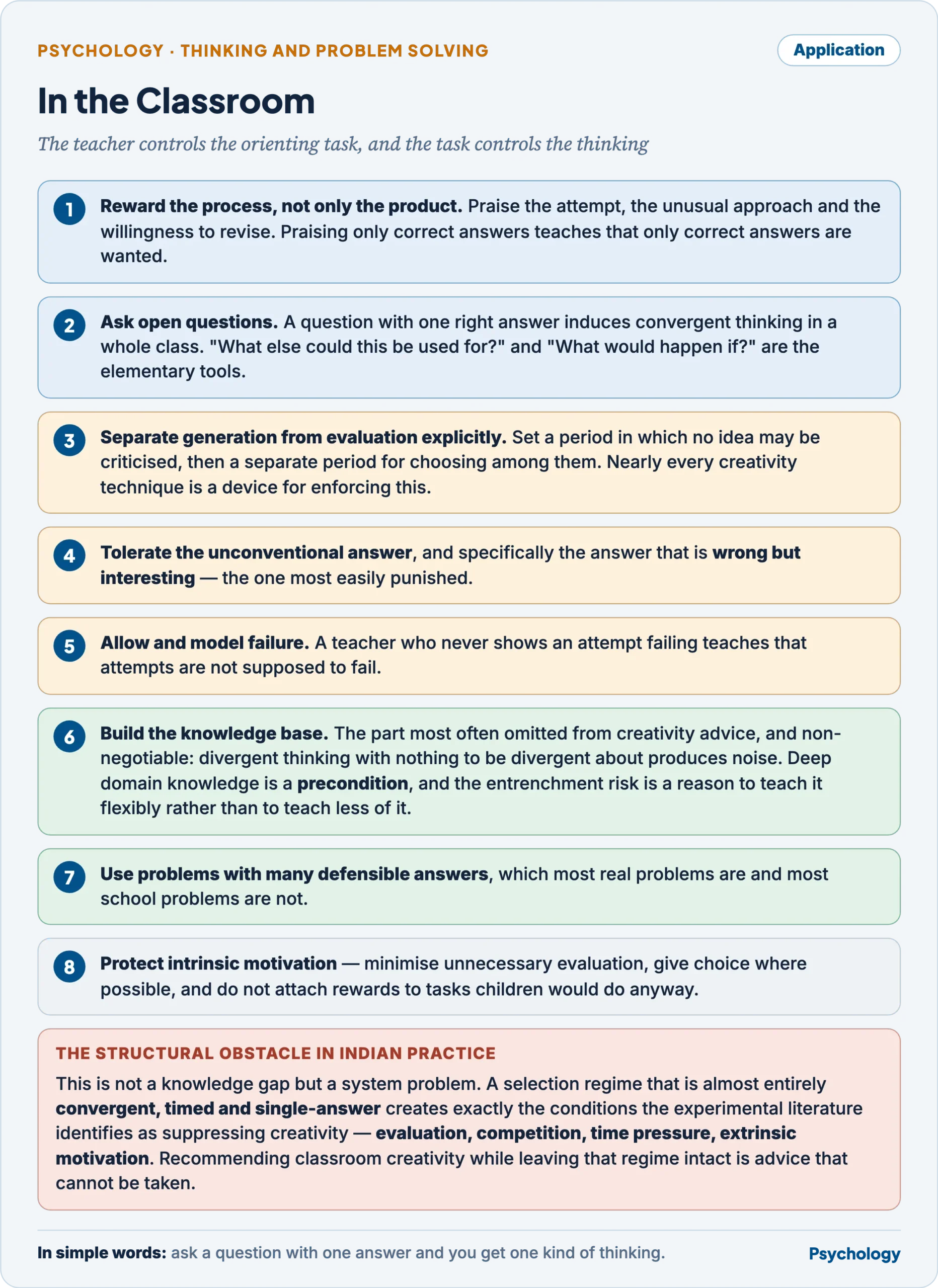
- Reward the process, not only the product. Praise the attempt, the unusual approach and the willingness to revise. Praising only correct answers teaches that only correct answers are wanted.
- Ask open questions. The teacher controls the orienting task, and a question with one right answer induces convergent thinking in a whole class. “What else could this be used for?” and “What would happen if?” are the elementary tools.
- Separate generation from evaluation explicitly. Set a period in which no idea may be criticised, then a separate period for selecting among them. Nearly every creativity technique is a device for enforcing this separation.
- Tolerate the unconventional answer, and specifically the answer that is wrong but interesting, which is the one most easily punished.
- Allow and model failure. A teacher who never shows an attempt failing teaches that attempts are not supposed to fail.
- Provide unstructured time and materials. Creativity requires slack; a fully scheduled day has none.
- Build the knowledge base. This is the part most often omitted from lists of creativity advice and is non-negotiable: divergent thinking with nothing to be divergent about produces noise. Deep domain knowledge is a precondition, not an obstacle, and the entrenchment risk is a reason to teach it flexibly rather than to teach less of it.
- Use problems with many defensible answers, which most real problems are and most school problems are not.
- Protect intrinsic motivation, which means minimising unnecessary evaluation, giving choice where possible, and not attaching rewards to tasks children would do anyway.
- Expose children to varied domains and to creative models, since remote combination needs remote material and since seeing how a creative person actually works demystifies it.
The specific techniques, and how well they work
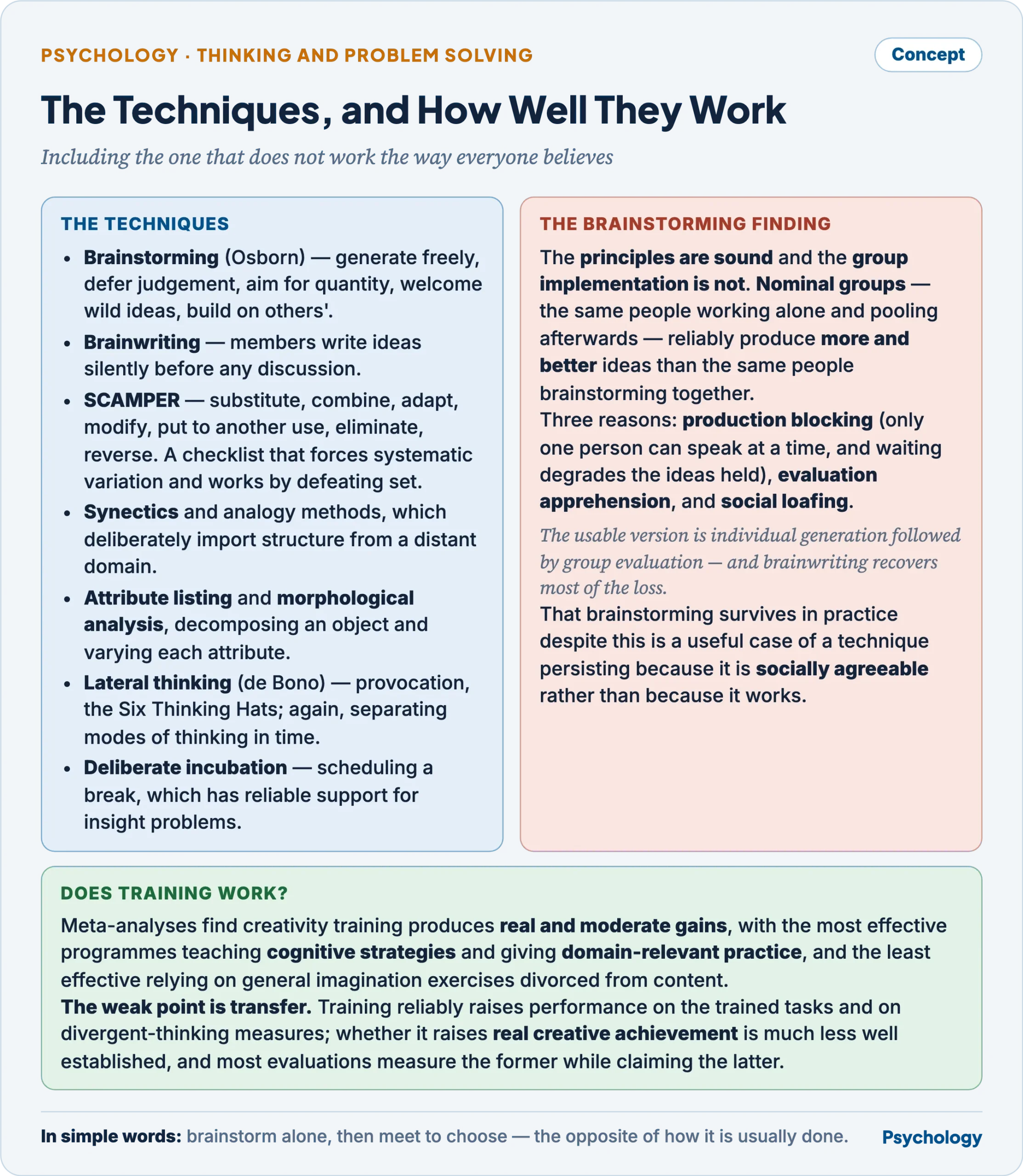
- Brainstorming (Osborn): generate freely, defer judgement, aim for quantity, welcome wild ideas, build on others’. The principles are sound and the group implementation is not: nominal groups of individuals working alone and pooling afterwards reliably produce more and better ideas than the same people brainstorming together, because of production blocking, evaluation apprehension and social loafing. The usable version is individual generation followed by group evaluation.
- Brainwriting, in which members write ideas silently before any discussion, recovers most of the loss and is the better group procedure.
- SCAMPER — substitute, combine, adapt, modify, put to another use, eliminate, reverse — a checklist that forces systematic variation and works by defeating set.
- Synectics and analogy-based methods, which deliberately import structure from a distant domain.
- Attribute listing and morphological analysis, which decompose an object into attributes and vary each systematically.
- Lateral thinking (de Bono), including deliberate provocation and the Six Thinking Hats, which again works chiefly by separating modes of thinking in time.
- Deliberate incubation — scheduling a break, which has reliable experimental support for insight problems.
- Training programmes. Meta-analyses find that creativity training produces real and moderate gains, with the most effective programmes being those that teach cognitive strategies and give domain-relevant practice, and the least effective being those relying on general imagination exercises divorced from content.
The organisational case
The same principles transfer, and the evidence is from field studies rather than laboratories.
- Autonomy over method, with clear goals — latitude about how, not about what.
- Psychological safety, so that a half-formed or unpopular idea can be voiced without cost. This is the most consistent predictor of innovative behaviour in teams.
- Diverse composition, which supplies the remote associations, at the cost of coordination difficulty.
- Tolerance of failed projects, without which nobody attempts anything uncertain.
- Slack resources — time and budget not committed to current operations.
- Recognition rather than contingent reward, following the undermining-effect distinction.
Criticisms and limitations
- Transfer is the weak point. Training raises performance on the trained tasks and on divergent-thinking measures reliably; whether it raises real creative achievement is much less well established.
- Divergent-thinking gains are not creativity gains, and most evaluations of creativity training measure the former.
- The undermining effect is real but bounded. It holds for contracted-for reward on tasks that are already interesting; it does not hold for reward framed as recognition, nor for tasks nobody would do unpaid, and the early strong claims were overstated.
- Brainstorming survives in practice despite the evidence, which is a useful case of a technique persisting because it is socially agreeable rather than because it works.
- Most studies are short-term, with outcomes measured days or weeks later and almost never years later.
- Classroom recommendations outrun the evidence. The advice above is coherent and partly evidenced, and much of it rests on extrapolation from laboratory manipulations to institutional practice.
- Indian application faces a structural obstacle rather than a knowledge gap: a selection system that is almost entirely convergent, timed and single-answer creates exactly the conditions — evaluation, competition, time pressure, extrinsic motivation — that the experimental literature identifies as suppressing creativity. Recommending classroom creativity while leaving that system intact is advice that cannot be taken.
Previous Year Questions
- 2019Explain how divergent thinking is different from convergent thinking. Discuss the methods to foster divergent thinking in children.
- 2011What are the criteria to identify creativity? How can a teacher promote creativity in the classroom setting?
- 2003Describe the meaning of creativity and discuss the ways for fostering creative talents.