

Creative thinking and fostering creativity.
Official Syllabus: Paper I · Unit 8 Thinking and Problem Solving
“Creativity is a phenomenon which the psychologist has almost totally neglected.”
— J. P. Guilford (1950), in the presidential address to the American Psychological Association that founded the field
Creativity was studied seriously only after Guilford (1950) pointed out that it was not being studied at all, and that the intelligence tests then dominating the field measured precisely the kind of thinking creativity is not. The seventy years since have produced a workable definition, a measurement tradition, and a settled conclusion that no single factor explains it.
What creativity is
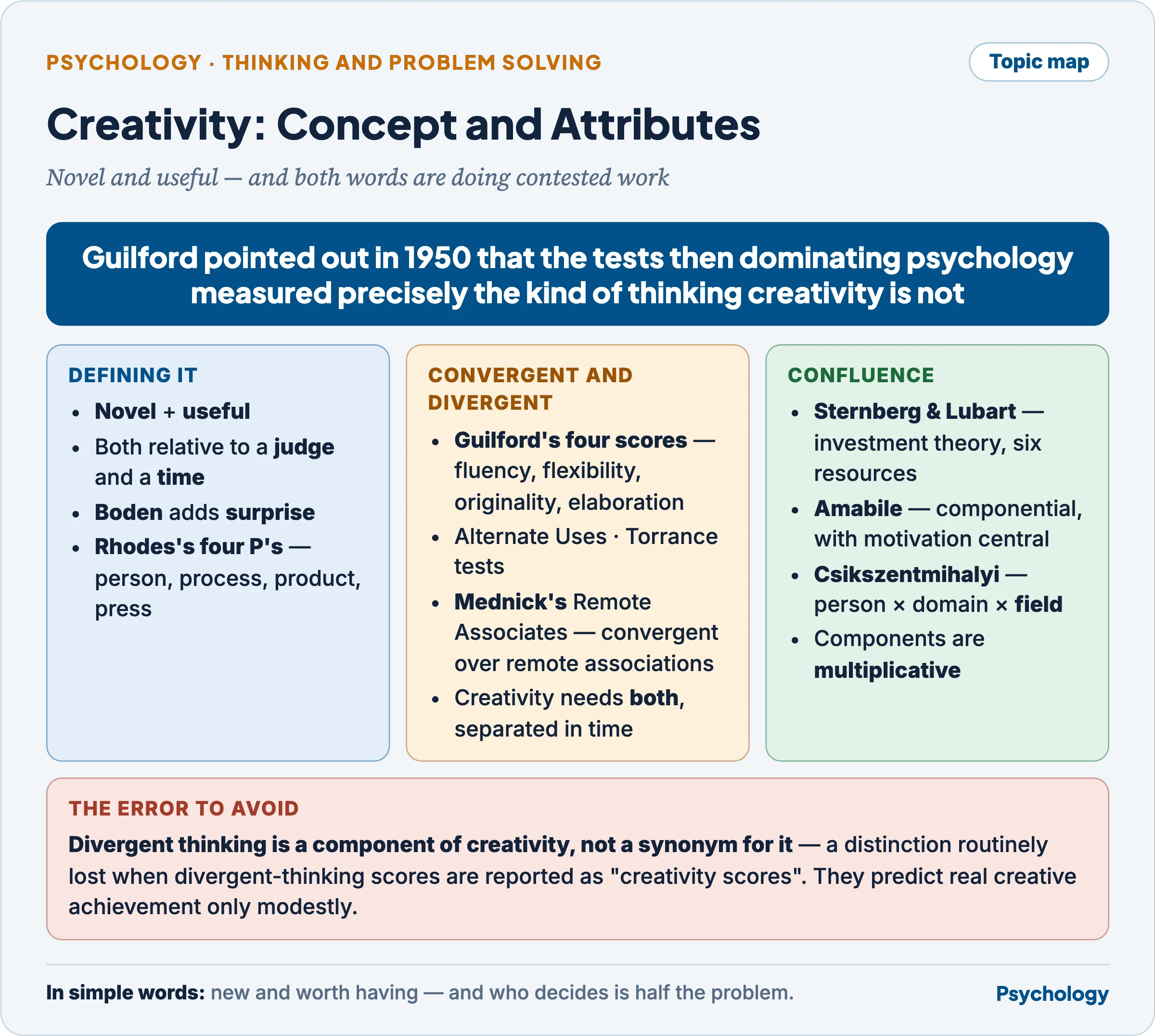
The standard definition has two criteria: creativity is the production of ideas or products that are both novel and useful — appropriate, valuable, or adaptive to the task in hand.
Why both are needed. Novelty alone admits the random and the bizarre: a sentence generated by chance is novel and worthless. Usefulness alone admits the competent and conventional. Only the conjunction picks out what is meant.
Critically examining the definition, which is where the interest lies.
- “Useful” is doing contested work. It is natural for engineering and awkward for art, where the value of a work is not its usefulness in any ordinary sense. The usual repair is to broaden the second criterion to appropriateness or value within the domain, which preserves the structure at the cost of precision.
- Both criteria are relative to a judge. Novel to whom — the person, the field, or history? Useful by whose standard? Creativity assessed this way is a social judgement, not a property of the idea, which is the point Csikszentmihalyi’s systems model makes central.
- They are relative to a time. Work rejected in its period and celebrated later was not creative and then creative; the judgement changed. This is a real difficulty for any definition locating creativity in the product.
- A third criterion is often proposed. Boden adds surprise: an idea may be novel and useful and still be the obvious next step, and what we call creative usually violates an expectation.
- The definition says nothing about process. Two people may reach the same novel and useful idea, one by insight and one by exhaustive search. A product definition counts both as creative, which may be right, and leaves the psychology untouched.
- Rhodes’s four P’s organise the alternatives: creativity can be studied as a person (traits), a process (how ideas are generated), a product (what is produced), or a press (the environment). Most disputes about defining creativity are disputes about which of the four is being defined.
Convergent and divergent thinking
| Convergent thinking | Divergent thinking | |
|---|---|---|
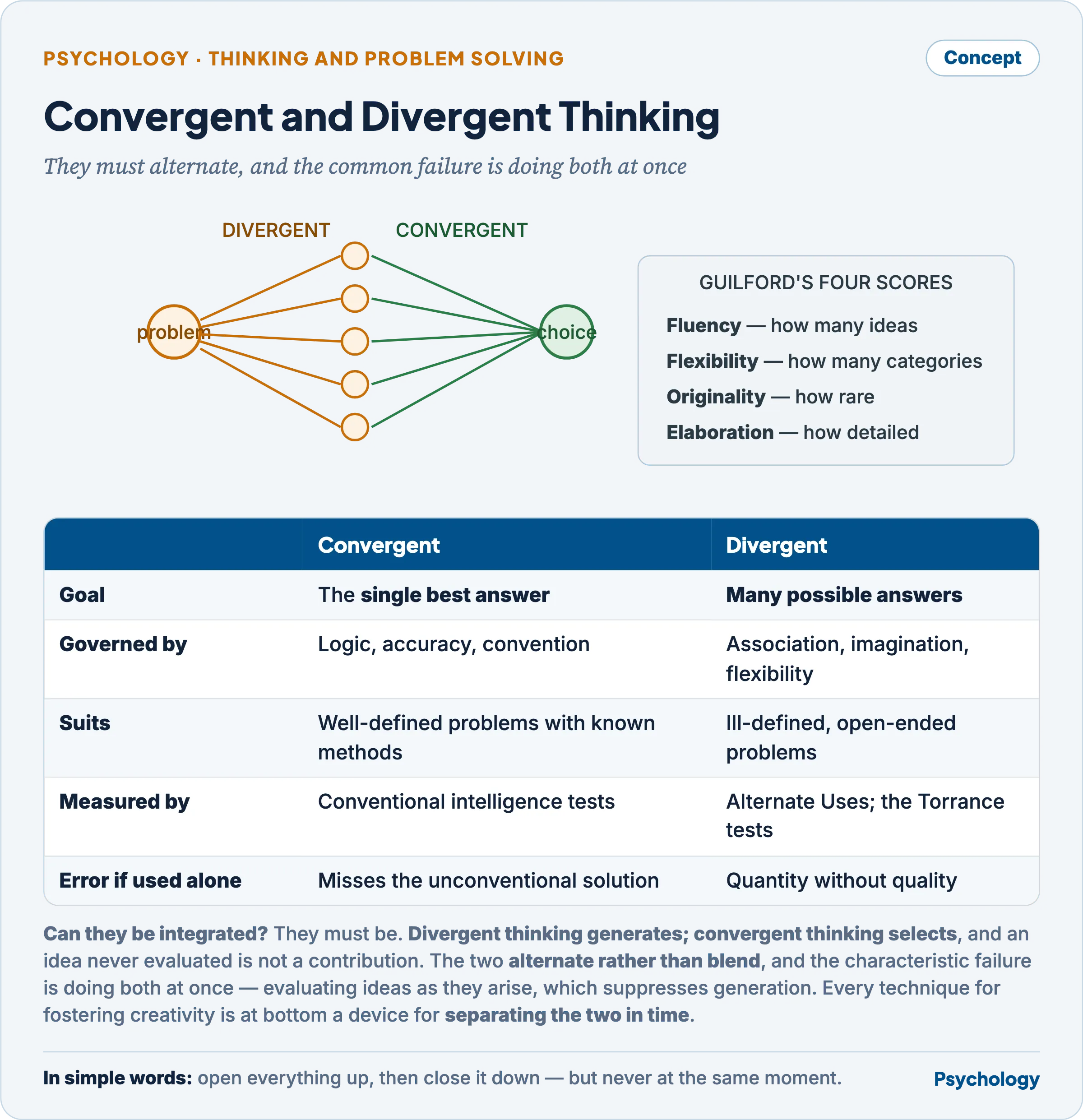
| Goal | The single best answer | Many possible answers |
| Direction | Narrowing toward one solution | Branching outward from the problem |
| Governed by | Logic, accuracy, convention | Association, imagination, flexibility |
| Suits | Well-defined problems with known methods | Ill-defined, open-ended problems |
| Measured by | Conventional intelligence tests | Alternate Uses; the Torrance Tests |
| Scored for | Correctness | Fluency, flexibility, originality, elaboration |
| Error if used alone | Misses the unconventional solution | Produces quantity without quality |
Guilford’s four scores for divergent production are the operational core of the construct: fluency, the number of ideas; flexibility, the number of different categories they fall into; originality, their statistical rarity; and elaboration, the detail with which each is developed. Flexibility and originality carry most of the meaning, since fluency alone rewards listing.
The standard measures. The Alternate Uses task asks for as many uses of a common object as possible. The Torrance Tests of Creative Thinking extend this across verbal and figural tasks and remain the most used instrument. Mednick’s Remote Associates Test approaches it from the other side, giving three words and asking for the one that links them — which requires convergent thinking over remote associations, and so measures something the divergent tests do not.
Can they be integrated?
They not only can be, they must be, and this is the central point about creative thinking.
- Divergent thinking generates; convergent thinking selects. An idea that is never evaluated is not a contribution, and evaluation is convergent work. A person with high divergent and low convergent ability produces a great deal and finishes nothing.
- The two alternate rather than blend. Creative work cycles between phases of expansive generation and phases of critical pruning, and the characteristic failure is doing both at once — evaluating ideas as they arise, which suppresses generation. Every technique for fostering creativity is, at bottom, a device for separating the two in time.
- The Geneplore model formalises this as alternating generative and exploratory phases: preinventive structures are produced without constraint, then explored for interpretation and usefulness, with the cycle repeating.
- Insight requires both. The restructuring is divergent; recognising that the restructured version solves the problem is convergent, and immediate.
- The empirical support is that divergent-thinking scores predict creative achievement only modestly on their own, and predict considerably better in combination with measures of evaluative ability, knowledge and persistence.
Divergent thinking is therefore a component of creativity and not a synonym for it — a distinction routinely lost when divergent-thinking scores are reported as “creativity scores”.
The attributes of creative people
- Openness to experience — the strongest and most consistent personality correlate, and the one Big Five trait reliably associated with creative achievement across domains.
- Tolerance of ambiguity, the willingness to remain in an unresolved problem rather than closing prematurely.
- Independence and nonconformity — a disregard for consensus that is a precondition for departing from it.
- Intrinsic motivation, which Amabile’s work makes central: creative work is sustained by interest in the task rather than by its rewards.
- Persistence, since creative products are typically preceded by long periods of unrewarded effort and by many failures.
- Risk tolerance and willingness to be wrong in public.
- Broad interests and wide associative range, which supply the remote elements that combination requires.
- Preference for complexity over simplicity and symmetry.
- Self-discipline, which is the attribute most often omitted from lists and most visible in biographies of creative achievers.
The honest qualification: these are modest correlations from predominantly Western samples, mostly cross-sectional, and the traits are neither necessary nor sufficient. Openness is the only one that approaches a reliable finding.
What impedes creativity
The attributes have their mirror image, and the barriers are better evidenced than the traits because most of them have been manipulated experimentally.
- Motivational. Amabile’s experiments established that expected evaluation, surveillance, competition and reward contracted for in advance all reliably reduce creative output, by shifting motivation from the work to its consequences. Reward given unexpectedly afterwards, or framed as recognition, does not.
- Cognitive. Mental set and functional fixedness, which make the stored solution block the better one; premature evaluation, judging ideas as they are generated and so suppressing generation; and entrenchment in expertise, which is why significant innovations are disproportionately made by people newly arrived in a field.
- Personality and affect. Conformity, low tolerance of ambiguity, rigidity, and fear of being wrong — which is a learnt habit before it is a disposition.
- Environmental. Authoritarian and transmission-based teaching; time pressure, which pushes thinking toward the familiar; conformity pressure within a group; rigid hierarchy, where an idea must pass several levels each filtering for safety; and a culture that penalises failure, when creative work fails most of the time by construction.
The removal of these is treated at length in the note on fostering creativity; the point here is that they are the conditions institutions routinely install, which is why creativity usually has to be protected rather than taught.
Mundane and exceptional creativity
| Mundane (little-c) | Exceptional (Big-C) | |
|---|---|---|
| What it is | Everyday creativity — an improvised recipe, a classroom activity, a workaround | Achievement that changes a domain |
| Who shows it | Everyone, routinely | Very few, rarely |
| Novelty is relative to | The person or the immediate group | The field and its history |
| Domain knowledge required | Modest | A decade or more |
| Social recognition | None needed | Constitutive — it is what makes it Big-C |
| Studied by | Psychometric tests, diary and experimental methods | Historiometric study of eminent figures, case studies |
The Four C model of Kaufman and Beghetto (2009) adds two intermediate categories that make the scheme usable: mini-c, the personally novel insight involved in any genuine learning; and Pro-c, the professional-level creativity of someone who makes a living by it without transforming the field.
Are they the same thing in different amounts? The dispute is real and unresolved. The continuity view holds that Big-C is little-c plus knowledge, opportunity, persistence and luck — the same processes operating with more resources, which the Four C model’s graded structure assumes. The discontinuity view holds that eminent creativity involves something qualitatively different, and points out that divergent-thinking scores, which predict everyday creativity reasonably, predict eminent achievement very poorly. The evidence is mixed, and the honest formulation is that the processes appear continuous while the determinants are not: domain mastery, access to a field, and historical timing matter for Big-C and are irrelevant to little-c.
The confluence approach
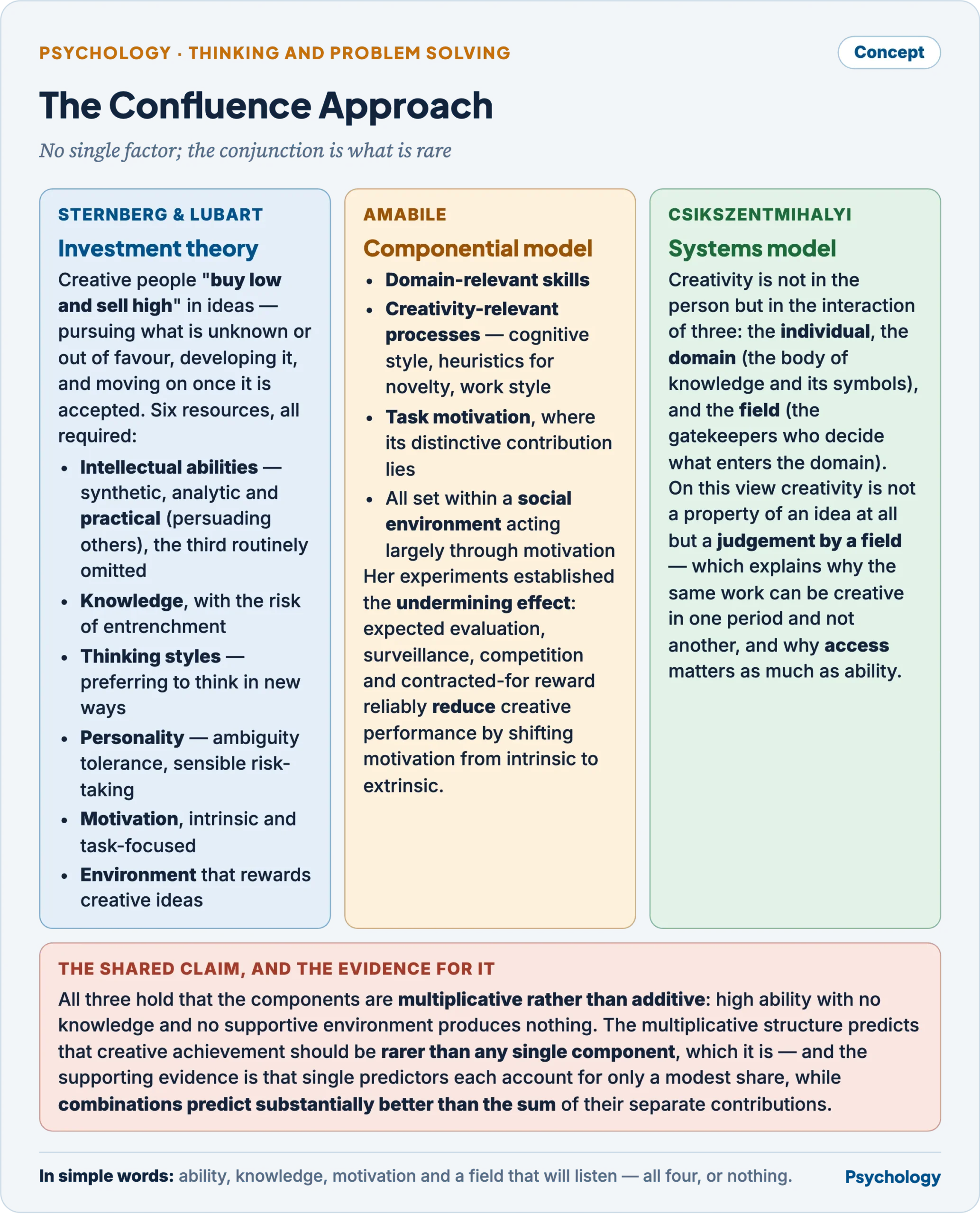
The confluence approach is the current consensus: creativity requires the convergence of multiple distinct components, no one of which is sufficient, and it is the conjunction that is rare. It replaced the search for a single creative faculty, which failed.
Investment theory — Sternberg and Lubart. Creative people “buy low and sell high” in the world of ideas: they pursue ideas that are unknown or out of favour, develop them, and move on when they become accepted. It specifies six resources, all of which must be present.
- Intellectual abilities — the synthetic ability to see problems in new ways, the analytic ability to judge which ideas are worth pursuing, and the practical ability to persuade others of their value. The third is routinely omitted and is what separates a creative idea from a creative contribution.
- Knowledge — enough to move the field forward, with the attendant risk of entrenchment.
- Thinking styles — a preference for thinking in new ways, which is distinct from the ability to do so.
- Personality — tolerance of ambiguity, willingness to take sensible risks, self-efficacy.
- Motivation — predominantly intrinsic and task-focused.
- Environment — one that supports and rewards creative ideas, without which the other five produce nothing visible.
Amabile’s componential model specifies three intrapersonal components — domain-relevant skills, creativity-relevant processes (cognitive style, heuristics for novelty, work style), and task motivation, which is where its distinctive contribution lies — set within a social environment that largely acts through motivation. Her experimental work established the undermining effect: expected evaluation, surveillance, competition and contracted-for reward reliably reduce creative performance by shifting motivation from intrinsic to extrinsic.
Csikszentmihalyi’s systems model places creativity not in the person but in the interaction of three: the individual, the domain (the body of knowledge and its symbols), and the field (the gatekeepers who decide what enters the domain). On this view creativity is not a property of an idea at all, but a judgement by a field — which explains why the same work can be creative in one period and not another, and why access to a field matters as much as ability.
The common claim, and the evidence for it. All three models hold that the components are multiplicative rather than additive: a person with high ability, no knowledge and no supportive environment produces nothing, and the multiplicative structure predicts that creative achievement should be rarer than any single component, which it is. The supporting evidence is that single predictors — divergent-thinking scores, IQ, openness — each account for only a modest share of creative achievement, while combinations predict substantially better than the sum of their separate contributions.
Explaining creative insight
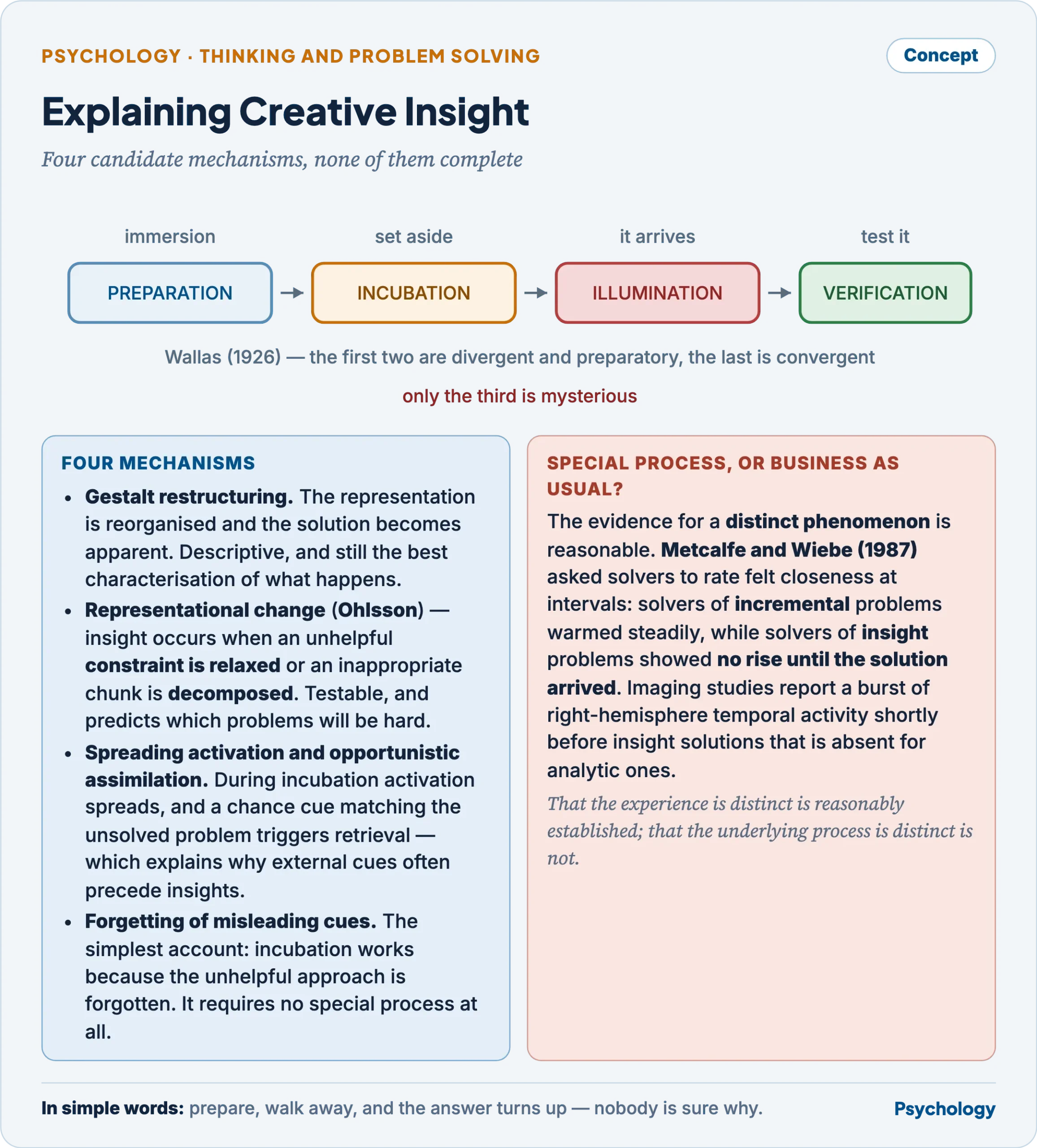
Wallas’s (1926) four stages remain the standard description: preparation, immersion in the problem and gathering of material; incubation, setting it aside while no conscious work occurs; illumination, the sudden arrival of the solution; and verification, the convergent work of testing and elaborating it.
How the illumination is explained — four candidate mechanisms, none of them complete.
- Gestalt restructuring. The problem’s representation is reorganised so that elements previously seen one way are seen another, and the solution becomes apparent. Descriptive, and still the best characterisation of what happens.
- Representational change, the modern version, associated with Ohlsson: insight occurs when an unhelpful constraint is relaxed or an inappropriate chunk is decomposed. It is testable and predicts which problems will be hard, which the Gestalt account does not.
- Spreading activation and opportunistic assimilation. During incubation, activation spreads through memory and a chance cue is encountered that matches the unsolved problem, triggering retrieval. This explains why incubation helps and why external cues often precede insights.
- Forgetting of misleading cues. The simplest account: incubation works because the unhelpful approach is forgotten, releasing the solver from their own set. It requires no special process at all.
The standing dispute is whether insight needs a special process or is business as usual — ordinary memory and search that happen to feel sudden because the search was unconscious. The evidence for a distinct phenomenon is reasonable: Metcalfe and Wiebe (1987) showed that solvers of insight problems report no rise in felt closeness until the solution arrives, while solvers of incremental problems report steady warming, and imaging studies report a burst of right-hemisphere temporal activity shortly before insight solutions that is absent for analytic ones. That the experience is distinct is reasonably established; that the underlying process is distinct is not.
Criticisms and limitations
- Divergent-thinking tests have modest predictive validity for real creative achievement, and treating their scores as “creativity” is the field’s commonest error.
- Scoring is problematic. Originality is scored by statistical rarity within the sample, so an answer’s creativity depends on who else was tested; fluency contaminates the other three scores.
- The confluence models are hard to falsify. A model requiring six interacting resources can accommodate any outcome after the fact, and specifies few risky predictions.
- Historiometric work on eminent creators relies on biographical record, which is selective, retrospective and written by people who already know the subject was important.
- Culture is treated thinly. The emphasis on individual originality and departure from convention is a particular cultural conception; traditions in which creative achievement means mastery and incremental refinement within a form — classical Indian music and dance among them — are not well served by instruments that score novelty and nonconformity.
- Little Indian work exists on creativity measurement, and the available adaptations of Torrance-type tests carry norms and content that do not transfer cleanly.
Previous Year Questions
- 2016Distinguish between mundane and exceptional creativities and citing suitable research evidences, describe the confluence approach to creativity.
- 2018“Creativity refers to novel ideas that address some problems in a useful way.” Critically examine the statement and discuss how creative insight can be explained.
- 2022How do psychologists conceptualize creativity? Explain the confluence approach to creativity.
- 2006Present an account of the attributes of the creative thinking and explain the factors that impede creativity.
- 1998How do convergent and divergent thinking differ? Can it be integrated in higher form of creative thinking?
- 1995Explain convergent and divergent thinking.