

Piaget’s theory of cognitive development.
Official Syllabus: Paper I · Unit 8 Thinking and Problem Solving
“The principal goal of education is to create men who are capable of doing new things, not simply of repeating what other generations have done.”
— Jean Piaget (1896–1980), whose theory of stages reoriented the study of children’s thinking
Before Piaget, children’s thinking was treated as adult thinking with less in it. Jean Piaget (1936 onward) argued that it is different in kind, not merely in quantity: a child at four does not know less than a child at nine so much as reason by different rules. His method was to attend to what children get wrong, on the assumption that errors are systematic and reveal the structure of the underlying thought.
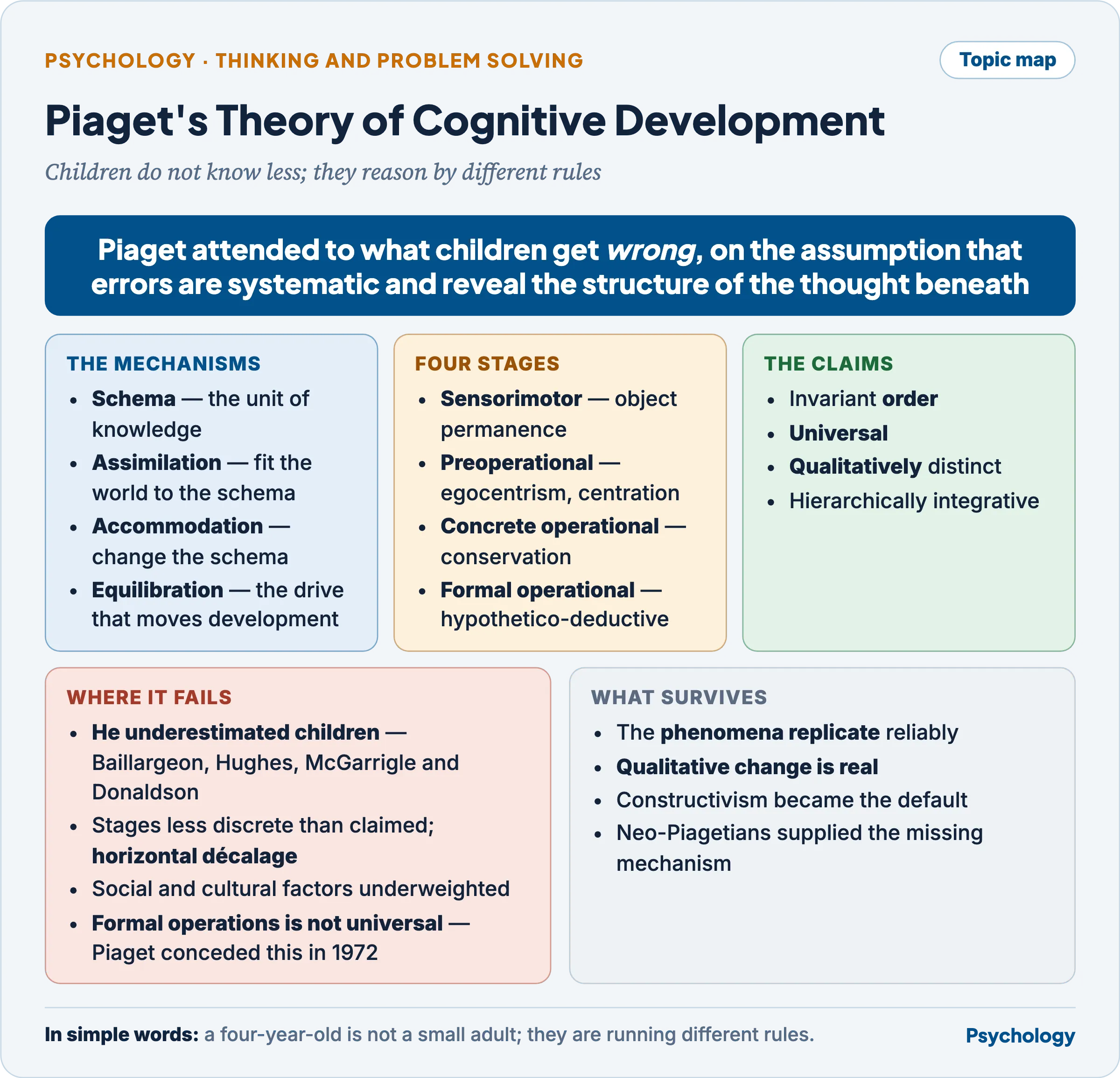
The mechanisms
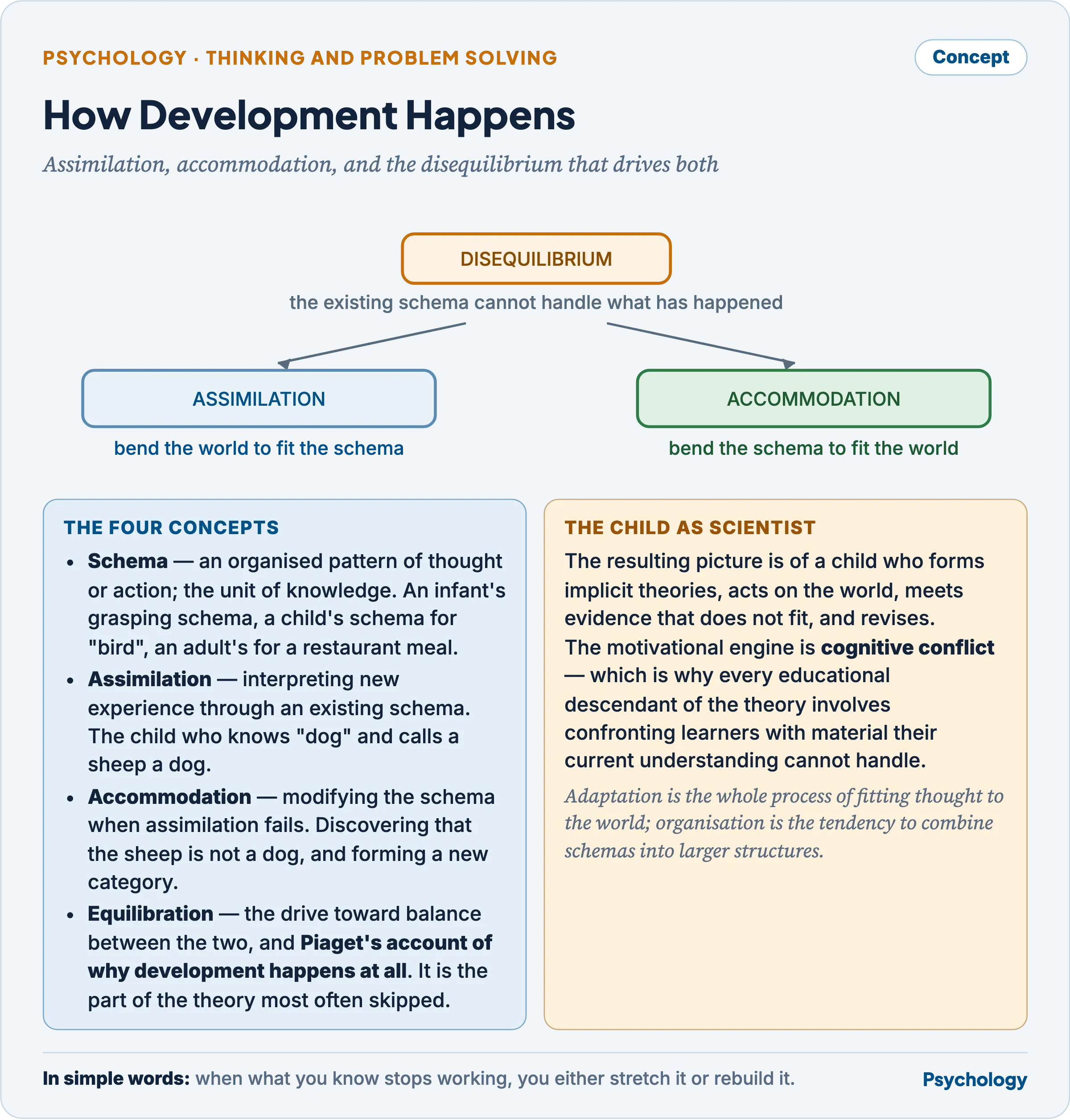
Piaget was a constructivist: knowledge is neither given by the environment nor innate, but built by the child through acting on the world. Four concepts do the work.
- Schema — an organised pattern of thought or action, the unit of knowledge. An infant’s grasping schema; a child’s schema for “bird”; an adult’s schema for a restaurant meal.
- Assimilation — interpreting new experience in terms of an existing schema. A child who knows “dog” and calls a sheep a dog is assimilating.
- Accommodation — modifying the schema when assimilation fails. Discovering that the sheep is not a dog, and forming a new category, is accommodation.
- Equilibration — the drive toward balance between the two. Disequilibrium, produced when existing schemas fail to handle experience, is what motivates cognitive change, and the resolution of it is what moves the child to a more adequate structure. This is Piaget’s account of why development happens, and it is the part of the theory most often skipped.
Two further ideas frame these. Adaptation is the overall process of fitting thought to the world, carried out by assimilation and accommodation together. Organisation is the tendency to combine schemas into more complex structures.
The child as a scientist. The resulting picture is of a child who forms implicit theories, acts on the world, meets evidence that does not fit, and revises. The theory’s motivational engine is cognitive conflict, which is why its educational descendants all involve confronting learners with material their current understanding cannot handle.
The four stages
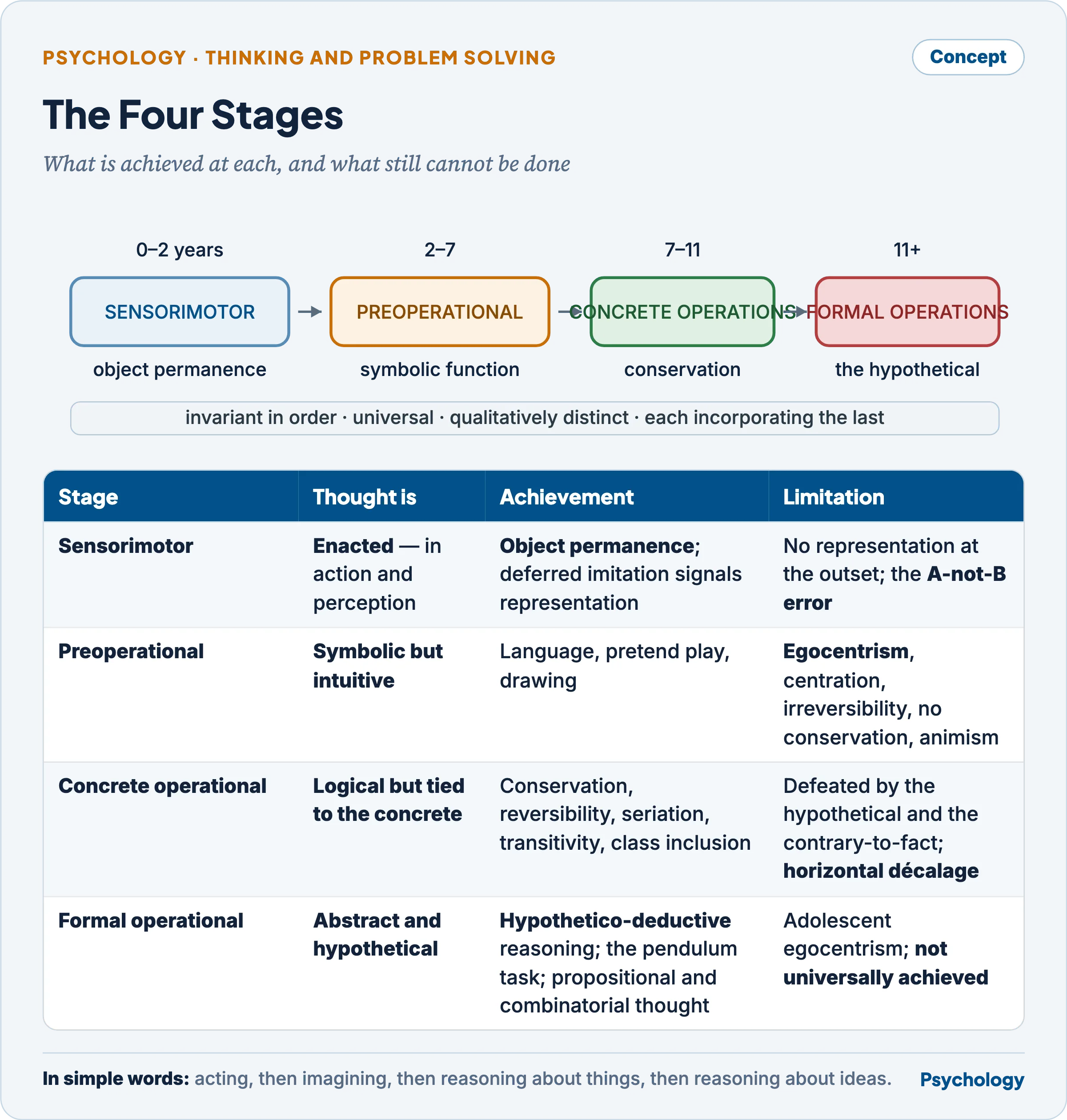
The stages are claimed to be invariant in order, universal, qualitatively distinct, and hierarchically integrative — each building on and incorporating the last.
Sensorimotor, birth to about two
Intelligence is practical: the infant knows the world through action and perception, not representation. Six substages run from reflexes, through primary circular reactions (repeating acts centred on the body), secondary circular reactions (repeating acts that produce effects in the world), their coordination into genuinely means–end behaviour, tertiary circular reactions (deliberate variation — the child as experimenter), to the beginnings of symbolic representation.
- The milestone is object permanence — understanding that an object continues to exist when it cannot be seen. Before it, out of sight is out of existence; the infant does not search for a hidden toy.
- The A-not-B error is the characteristic intermediate failure: having repeatedly found a toy at A, the infant watches it hidden at B and still searches at A.
- Deferred imitation at the end of the period — reproducing an action seen earlier — is the behavioural evidence that representation has arrived.
Preoperational, about two to seven
The symbolic function is now available: language, pretend play, drawing. But thought is not yet operational — it cannot be reversed or coordinated — and it is characterised by what it lacks.
- Egocentrism — difficulty taking another’s visual or conceptual perspective, shown in the three mountains task, where the child asked what a doll on the far side can see reports their own view.
- Centration — attending to one salient dimension and ignoring others, which is what causes conservation failure.
- Irreversibility — inability to mentally undo an action.
- Lack of conservation — a liquid poured into a taller, narrower glass is judged to be more; a row of counters spread out is judged to contain more.
- Animism, attributing life and intention to objects; artificialism, treating natural features as made for a purpose; transductive reasoning, moving from particular to particular rather than by induction or deduction.
Concrete operational, about seven to eleven
Operations — internalised, reversible mental actions — become available, and the preoperational errors drop away, provided the material is concrete.
- Conservation of number, then mass, then weight, then volume. That these are mastered at different ages within the same stage is horizontal décalage, which Piaget acknowledged and which is awkward for a theory of unified stage-wide structures.
- Reversibility and decentration — attending to several dimensions at once.
- Seriation (ordering by a dimension), transitivity (if A > B and B > C then A > C), and class inclusion (there are more flowers than roses).
- The limit is that reasoning is tied to the actual and concrete; a contrary-to-fact premise defeats it.
Formal operational, about eleven onward
Thought becomes abstract, systematic and hypothetical.
- Hypothetico-deductive reasoning — generating hypotheses and testing them systematically. The pendulum task is the standard demonstration: asked what determines the period, the formal-operational adolescent varies one factor at a time while holding the others constant, which the concrete-operational child does not.
- Propositional thought — reasoning about verbal statements without reference to concrete reality, so that the logic of an argument can be evaluated independently of whether its premises are true.
- Combinatorial reasoning — systematically generating all possible combinations.
- Adolescent egocentrism returns in a new form, described by Elkind (1967): the imaginary audience, the sense of being constantly observed and judged, and the personal fable, the belief that one’s experience is unique and that ordinary risks do not apply.
How the modes of thinking differ across the stages — the comparison the theory exists to make:
| Stage | Thought is | Characteristic achievement | Characteristic limitation |
|---|---|---|---|
| Sensorimotor | Enacted — in action and perception | Object permanence | No representation at the outset |
| Preoperational | Symbolic but intuitive | Language and pretend play | Egocentrism, centration, irreversibility |
| Concrete operational | Logical but tied to the concrete | Conservation, seriation, class inclusion | Fails on the hypothetical and contrary-to-fact |
| Formal operational | Abstract and hypothetical | Hypothetico-deductive reasoning | Adolescent egocentrism; not universally achieved |
Egocentrism properly understood
The 1918-vintage word misleads, and the misreading is common enough to be worth correcting directly: egocentrism in Piaget’s sense is not selfishness, inconsiderateness or a moral failing. It is a cognitive limitation — the child’s difficulty in representing that another person’s viewpoint differs from their own, and in some formulations the failure to recognise that there is another viewpoint at all.
- The preschooler who holds a picture facing themselves while describing it to someone else is not being rude; they have not yet constructed the distinction between what they see and what the other sees.
- The child who offers a distressed adult their own favourite toy is being generous within the limits of their perspective-taking, not thoughtless.
- The three mountains task shows the limitation at its starkest, and it is not a test of willingness to consider others.
The qualification the evidence requires. Hughes (1975) used a policeman doll task in which a child hides a doll from one or two policemen — a situation with an intelligible purpose. Children as young as three and a half succeeded at high rates. Task demands, not perspective-taking as such, carried much of the three mountains result. Children are therefore less egocentric than Piaget concluded, and become so earlier, but the developmental direction he described holds.
Is formal operational thought universally achieved?
It is not, and this is the stage claim with the least support.
- Many adults do not show it on standard tasks. A substantial proportion of adolescents and adults in literate Western samples fail formal-operational problems, and in some studies the majority do.
- Cross-cultural evidence is weaker still. Adults in non-literate and non-schooled societies frequently fail the standard tasks, while performing competently on demanding reasoning embedded in their own practices — navigation, weaving, trade, legal argument. Formal operational performance tracks schooling far more closely than age, which is the finding that most damages the universality claim.
- Task familiarity decides much of it. Performance rises sharply when the problem is set in a familiar domain, which suggests what is being measured is partly content knowledge and practice, not a general structure.
- Piaget’s own revision. In 1972 he conceded that formal operations may not be universal in the way he had claimed, and may appear only in areas of a person’s aptitude and specialisation — an engineer reasoning formally about mechanisms and not about law. This concedes the domain-specificity his theory had been built to deny.
The correct conclusion is therefore careful. The capacity for formal operational thought appears to be widely available where the relevant experience and schooling exist; its expression is domain-specific and far from universal. It is better described as an achievement that particular environments cultivate than as a stage every typical person enters.
Critique
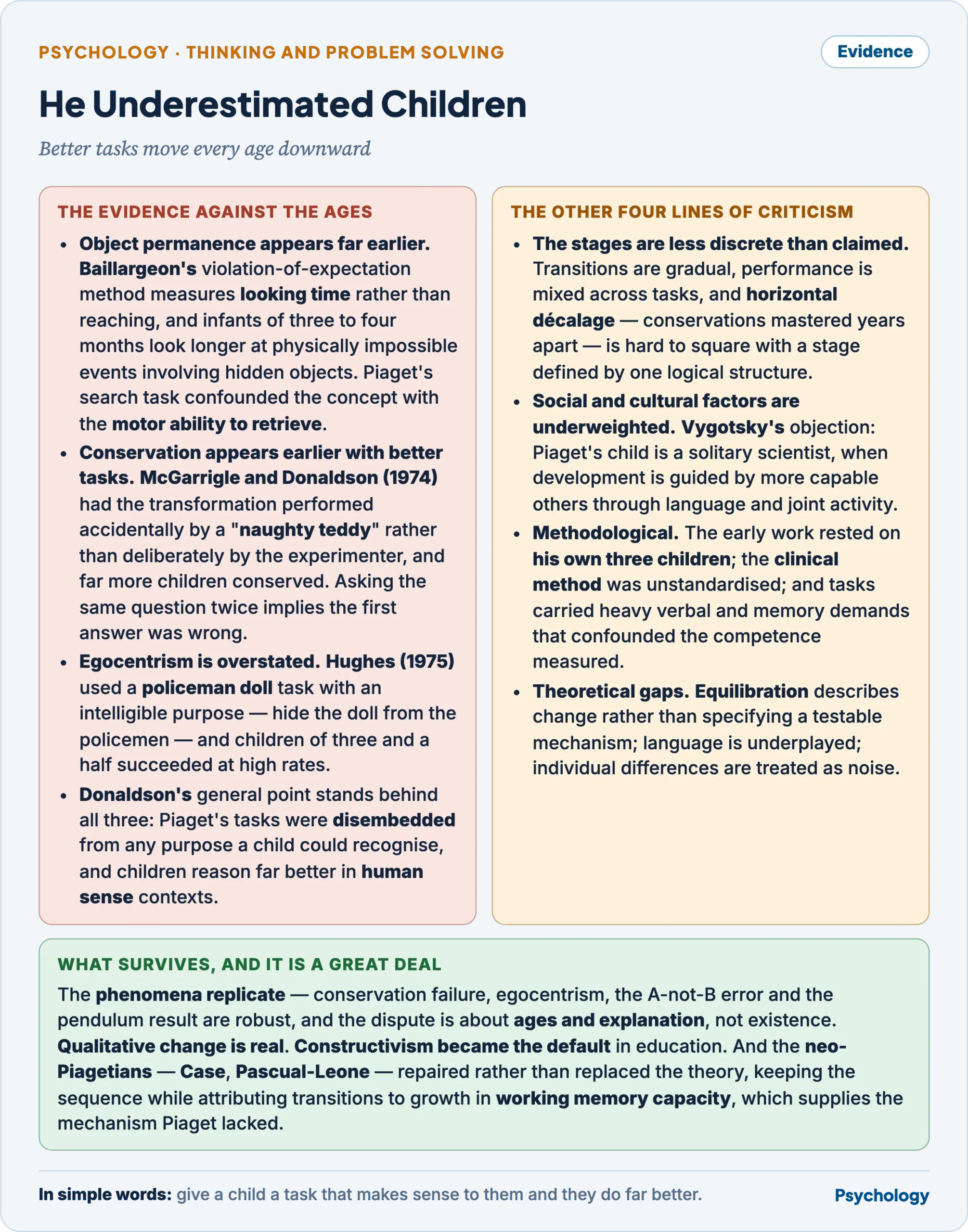
He underestimated children. This is the most substantial charge, and the evidence is strong.
- Object permanence appears far earlier than he thought. Baillargeon’s violation-of-expectation method measures looking time rather than reaching, and infants of three to four months look longer at physically impossible events involving hidden objects — which they would not do if the object had ceased to exist for them. Piaget’s search task confounded the concept with the motor ability to retrieve.
- Conservation appears earlier with better tasks. McGarrigle and Donaldson (1974) had the transformation performed accidentally by a “naughty teddy” rather than deliberately by the experimenter, and far more children conserved. Asking the same question twice implies to a child that the first answer was wrong; removing that implication removes much of the failure.
- Egocentrism is overstated, as the policeman doll task shows.
- Donaldson’s general point stands behind all three: Piaget’s tasks were “disembedded” from any purpose a child could recognise, and children reason far better in human sense contexts.
The stages are less discrete than claimed. Transitions are gradual rather than stepwise, children show mixed-stage performance across tasks, and horizontal décalage — different conservations mastered years apart — is difficult to reconcile with a stage defined by a unified logical structure.
Social and cultural factors are underweighted. Vygotsky’s objection is the standing one: Piaget’s child is a solitary scientist, when in fact cognitive development is guided by more capable others through language and joint activity. Culture determines which competences are cultivated, and schooling in particular predicts formal-operational performance.
Methodological criticisms. The early work rested on his own three children and on small samples; the clinical method of flexible questioning was unstandardised and open to the interviewer’s expectations; and tasks placed heavy verbal and memory demands that confounded the competence being measured.
Theoretical gaps. Equilibration is a description of change rather than a mechanism specified sufficiently to be tested; the role of language is underplayed, which Vygotsky reversed; and the theory says little about individual differences, treating variation as noise around a universal sequence.
What survives, and it is a great deal.
- The phenomena are robust. Conservation failure, egocentrism, the A-not-B error and the pendulum result replicate reliably; the dispute is about the ages and the explanation, not the existence.
- Qualitative change is real. Children do reason by different rules at different points, and the alternative view — development as the accumulation of more of the same — is harder to sustain after Piaget than before.
- Constructivism became the default. Active learning, discovery methods and the idea that instruction must engage what the learner already has all descend from him.
- The neo-Piagetians repaired rather than replaced. Case and Pascual-Leone retained the sequence while attributing the transitions to growth in working memory capacity and in processing efficiency, which supplies the mechanism Piaget lacked.
- Post-formal thought has been proposed as a fifth stage, marked by tolerance of contradiction, relativistic and dialectical reasoning — adult cognition being less absolute than formal operations implies.
In education
- Readiness. Instruction pitched beyond the child’s current structures will be assimilated in distorted form rather than learned — which is an argument for sequencing, not for waiting passively.
- Active discovery. Children construct understanding by acting; being told is not the same as coming to know.
- Concrete materials before abstract symbols, and the sequencing of mathematics and science curricula around conservation, seriation and classification is a direct application.
- Cognitive conflict as a teaching device — confronting a learner with evidence their current understanding cannot handle, which is equilibration used deliberately.
- Peer interaction, which Piaget valued precisely because disagreement among equals produces the conflict that adult authority suppresses.
- The Indian qualification. Replications in Indian samples broadly recover the sequence while finding the ages sensitive to schooling, literacy and the familiarity of materials. Where a conservation task uses unfamiliar objects and an unfamiliar register of language, it measures those as much as it measures conservation — which matters for a school system testing children across many languages and very uneven schooling.
Previous Year Questions
- 2023In view of Piaget, “Intellectual development takes place through stages which occur in a fixed order and which are universal regardless of social and cultural background.” Critically examine Piaget’s point of view in detail.
- 2026Highlight the developmental milestones as per the Piaget’s stages of cognitive development.
- 2015Describe Piaget’s stages of cognitive development. Critique his theory.
- 2021Formal operational thought is not universally achieved. Discuss.
- 2018According to Piaget, the egocentric preschooler is not intentionally ‘inconsiderate’ but rather has difficulty taking another’s viewpoint. Explain.
- 2010What are the stages of cognitive development according to Piaget?
- 2000Giving an account of Piaget’s theory of cognitive development bring out the difference in the modes of thinking at different stages of development.
The 2001 question pairing Erikson’s psychosocial stages with Piaget’s cognitive stages is answered in the note on Freud and Erikson, where the two stage sequences are set side by side.