

Metamemory.
Official Syllabus: Paper I · Unit 7 Memory
“Metacognition refers to one’s knowledge concerning one’s own cognitive processes, and to the active monitoring and regulation of those processes.”
— John Flavell (1979), defining the field he had named earlier in the decade
Every account of memory so far describes a system that encodes, stores and retrieves. Metamemory concerns a second system that watches the first and decides what to do about it: how well a person knows their own memory, how accurately they judge what they have learnt, and how they use those judgements to allocate study, choose strategies and decide whether to trust what comes to mind. It is what turns a memory system into a learner.
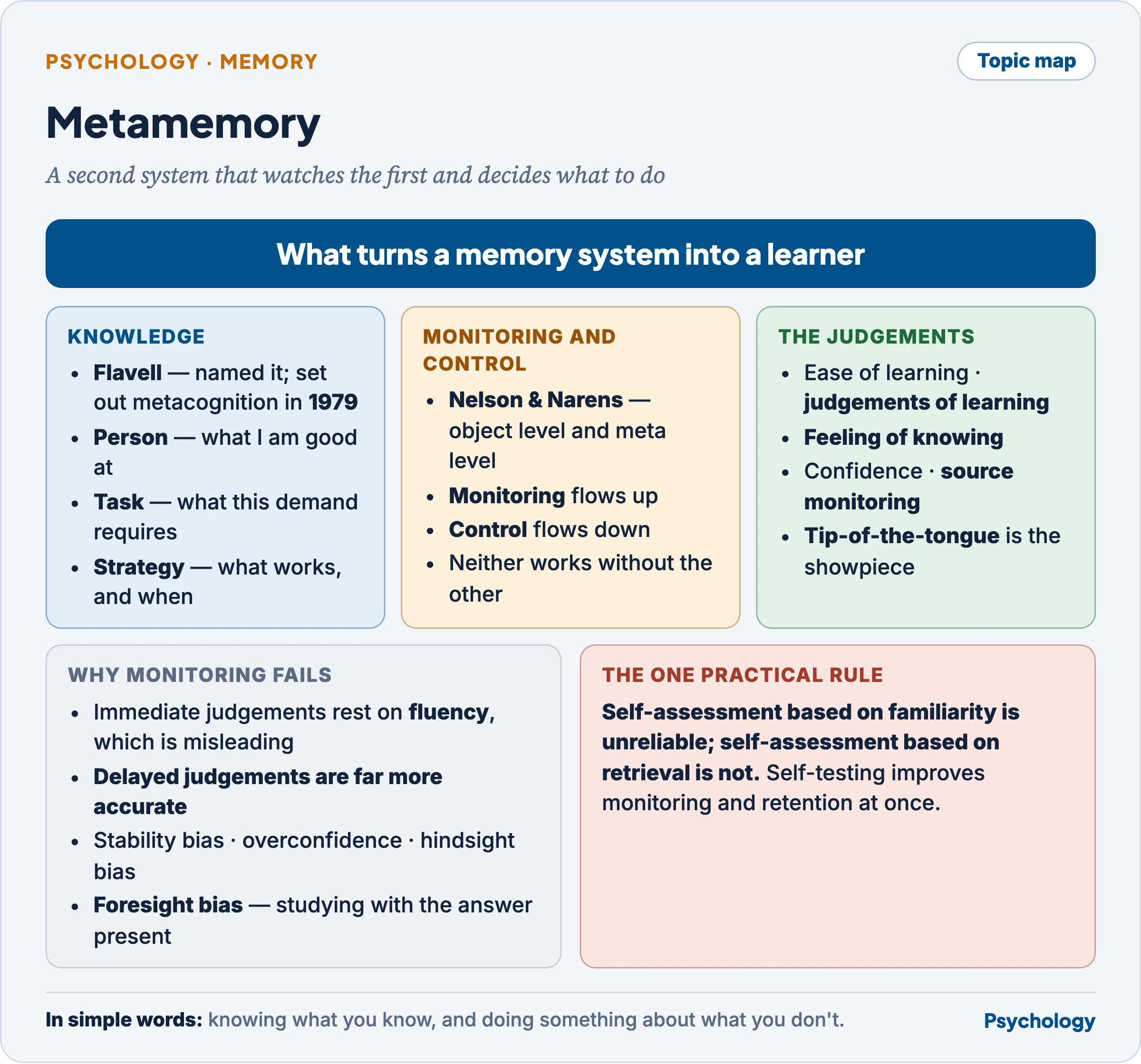
What metamemory is
Flavell introduced metamemory in the early 1970s and set out metacognition more fully in 1979. The construct has two faces, and keeping them apart is the whole of the topic.
- Metamemory knowledge — relatively stable beliefs about memory, of three kinds.
- Person knowledge: what one is good and bad at. I am better at faces than at names.
- Task knowledge: what different memory demands require. Recognition is easier than recall; a list of related words is easier than unrelated ones.
- Strategy knowledge: which techniques exist and when each applies. Testing myself works better than re-reading.
- Metamemory monitoring and control — the on-line processes operating during learning and retrieval, which is where the experimental work is.
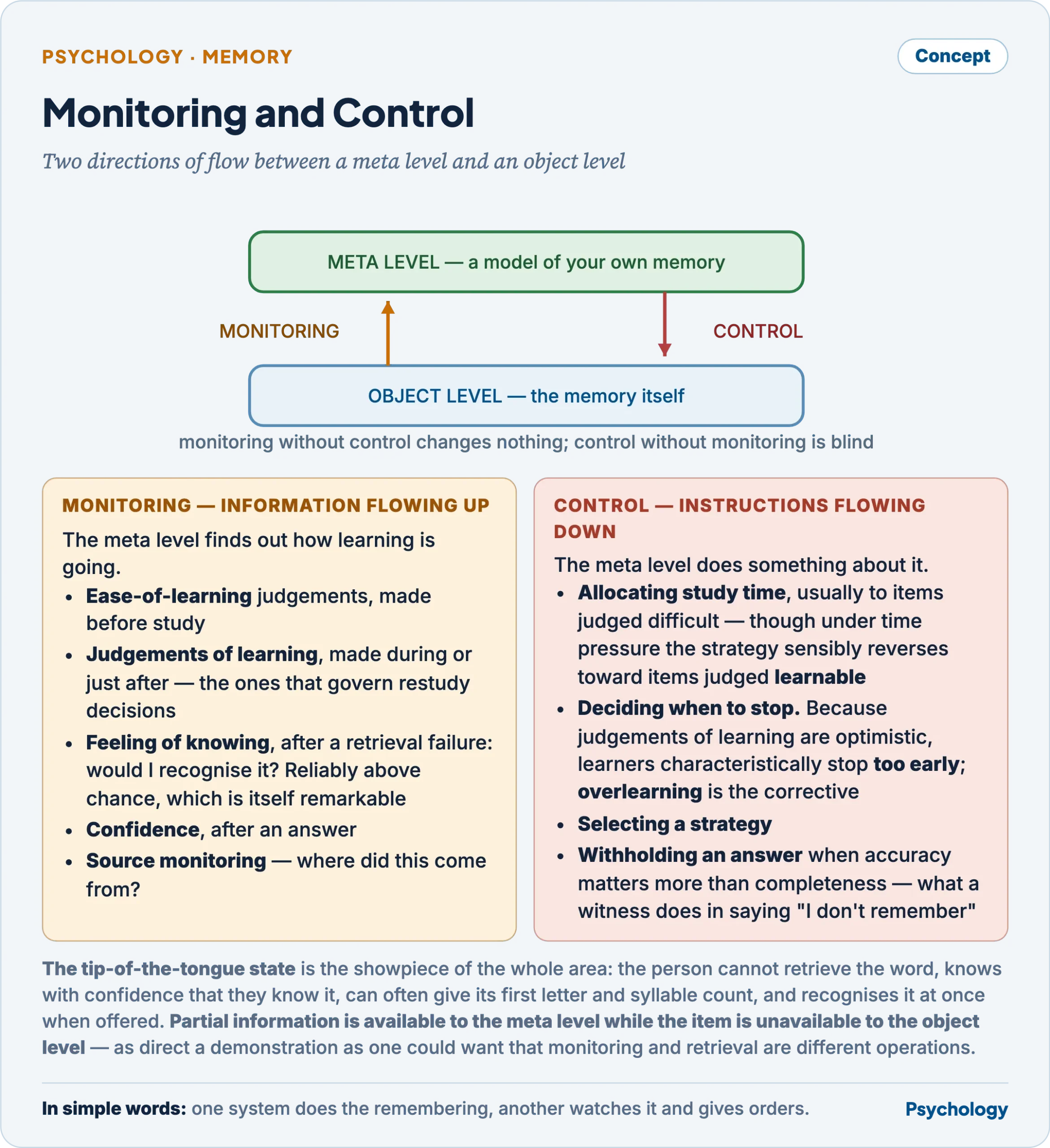
Nelson and Narens gave the standard framework, in which an object level does the remembering and a meta level holds a model of it. Two directions of flow connect them, and the distinction between them is the most useful idea in the area.
- Monitoring — information flowing upward, from memory to the model. The meta level finds out how learning is going.
- Control — instructions flowing downward, from the model to memory. The meta level does something about it: study longer, switch strategy, stop, answer, or withhold the answer.
Monitoring without control changes nothing, and control without monitoring is blind. Effective learning requires both, and failures of self-directed study are usually failures of monitoring rather than of memory.
The monitoring judgements
- Ease-of-learning judgements, made before study: how hard will this be? Moderately accurate, and used to allocate time across items.
- Judgements of learning, made during or just after study: how likely am I to recall this later? The most studied judgement, and the one that governs restudy decisions.
- Feeling of knowing, made after a retrieval failure: I cannot recall it, but would I recognise it? Reliably above chance, which is itself remarkable — the system can assess the presence of something it cannot produce.
- Confidence judgements, made after an answer: how sure am I that this is right? The judgement that matters most in applied settings, from examinations to testimony.
- Source monitoring — deciding where a remembered item came from, whether it was perceived or imagined, read or told. Its failure produces errors in which the content is right and the origin is wrong, which is the mechanism behind the misinformation effect.
The tip-of-the-tongue state is the showpiece of the whole area: the person cannot retrieve the word, knows with confidence that they know it, can often report its first letter, its number of syllables and words it resembles, and recognises it immediately when offered. Partial information is available to the meta level while the item itself is unavailable to the object level, which is as direct a demonstration as one could want that monitoring and retrieval are different operations.
How accurate is monitoring, and why it is not
Metamemory is systematically imperfect, and the pattern of its errors is practically important.
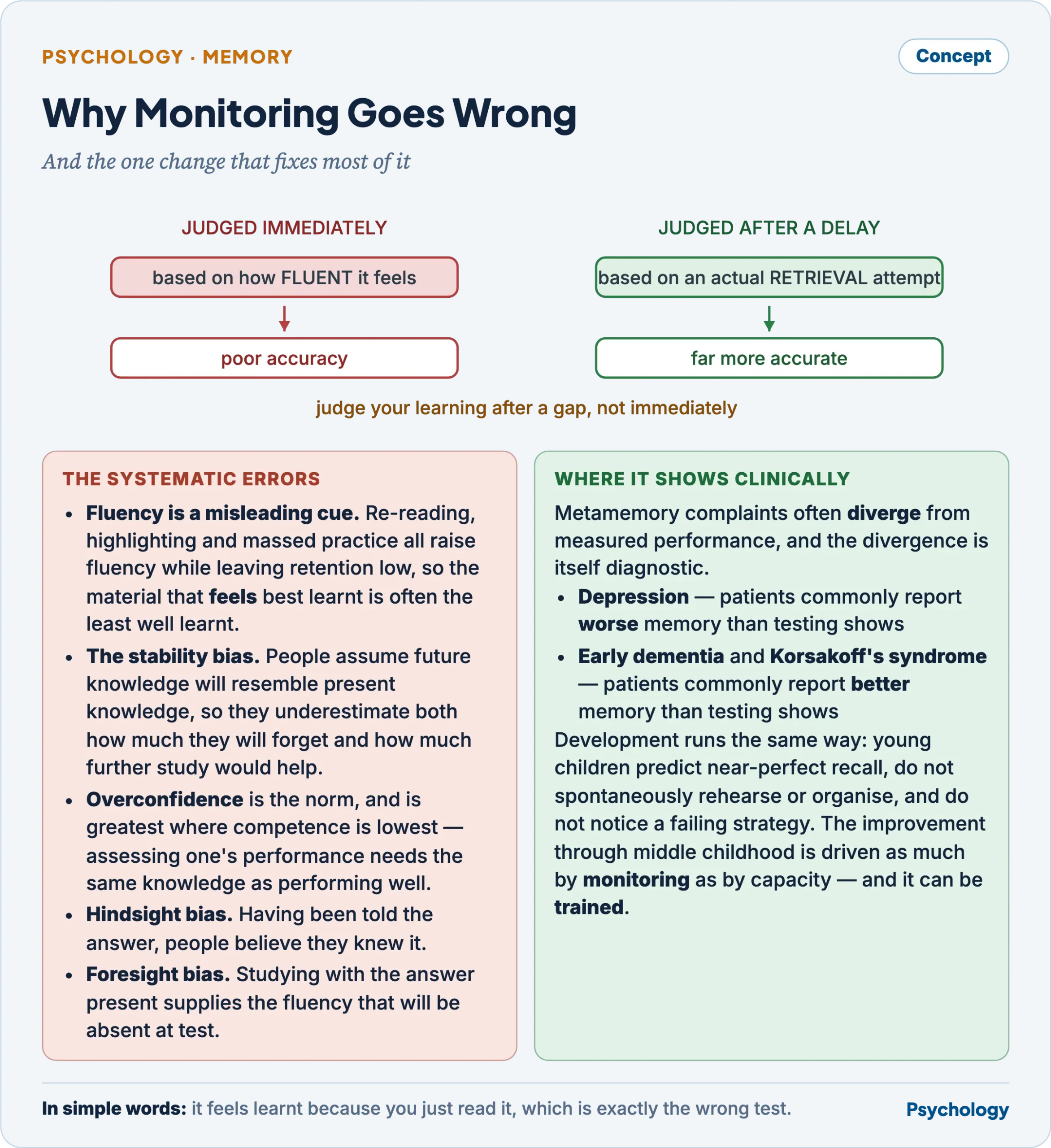
- Judgements made immediately after study are poor, because they are based on how fluently the material is being processed while it is still in mind. Fluency is a misleading cue: re-reading, highlighting and massed practice all raise fluency while leaving retention low, so the material that feels best learnt is often the least well learnt.
- Delayed judgements are far more accurate. A judgement made after a delay must be based on an actual attempt to retrieve, which is diagnostic, rather than on current availability, which is not. This is the delayed-JOL effect, and it yields the single most useful piece of study advice in the area: judge your learning after a gap, not immediately.
- The stability bias. People assume their future knowledge will resemble their present knowledge, and so underestimate both how much they will forget and how much further study would help.
- Overconfidence is the norm, and it is greatest where competence is lowest, because assessing one’s performance requires the same knowledge as performing well.
- Hindsight bias corrupts retrospective judgements: having been told the answer, people believe they knew it.
- The foresight bias. Studying material with the answer present makes it seem learnt, because the answer’s presence supplies the fluency that will be absent at test.
The practical consequence is that self-assessment based on familiarity is unreliable, and self-assessment based on retrieval is not. Self-testing improves monitoring and retention simultaneously, which is why it dominates the recommendations in this area.
Control, and how metamemory governs study
- Allocation of study time. Learners given control typically devote more time to items judged difficult — but only when time is sufficient. Under time pressure the strategy reverses toward items judged learnable, which is a rational response to a deadline rather than a failure.
- Stopping decisions. When to stop studying is a control decision driven by a judgement of learning, and because those judgements are optimistic, learners characteristically stop too early. Overlearning — continuing past the point of first correct recall — is the corrective.
- Strategy selection. Knowing that testing beats re-reading changes behaviour only if the learner also monitors accurately enough to see that re-reading is not working.
- Withholding an answer. When accuracy matters more than completeness, a person can decline to answer items they are not confident of, and people do this well enough to raise accuracy substantially. This is control applied at retrieval, and it is what a witness does in saying “I don’t remember”.
- Development. Young children show markedly poor metamemory: they predict near-perfect recall, do not spontaneously rehearse or organise, and do not notice when a strategy is failing. The improvement through middle childhood is driven as much by the growth of monitoring as by any change in capacity, and it can be trained.
Memory and forgetting as processes
Metamemory monitors both of them, and they are frequently treated as a single dimension when they are not.
| Memory | Forgetting | |
|---|---|---|
| What it is | The retention and recovery of information over time | The loss of access to information once held |
| Processes | Encoding, storage, retrieval | Decay, interference, retrieval failure, motivated suppression |
| Is it a failure? | No | Not necessarily — much of it is adaptive selection |
| Measured by | Recall, recognition, savings, priming | The complement of those, and by savings against a fresh baseline |
| Relation | Not opposites. Both are outputs of one system, and the same variable often moves both |
Two points make the distinction more than definitional.
- Forgetting is not the absence of memory but one of its operations. A system retaining everything would be unable to generalise or to find what matters, which is the lesson of Luria’s mnemonist. Retrieval-induced forgetting shows the system actively suppressing competitors in order to retrieve efficiently, so forgetting is part of how remembering works.
- Most forgetting is not loss. Savings, cued recall, priming and spontaneous recovery all show material surviving after recall has failed, so “forgotten” names a state of access, not of storage.
The theories of forgetting themselves — decay, interference, retrieval failure and motivated forgetting — are set out in full in the note on theories of forgetting.
Metamemory as an innovation in the study of memory
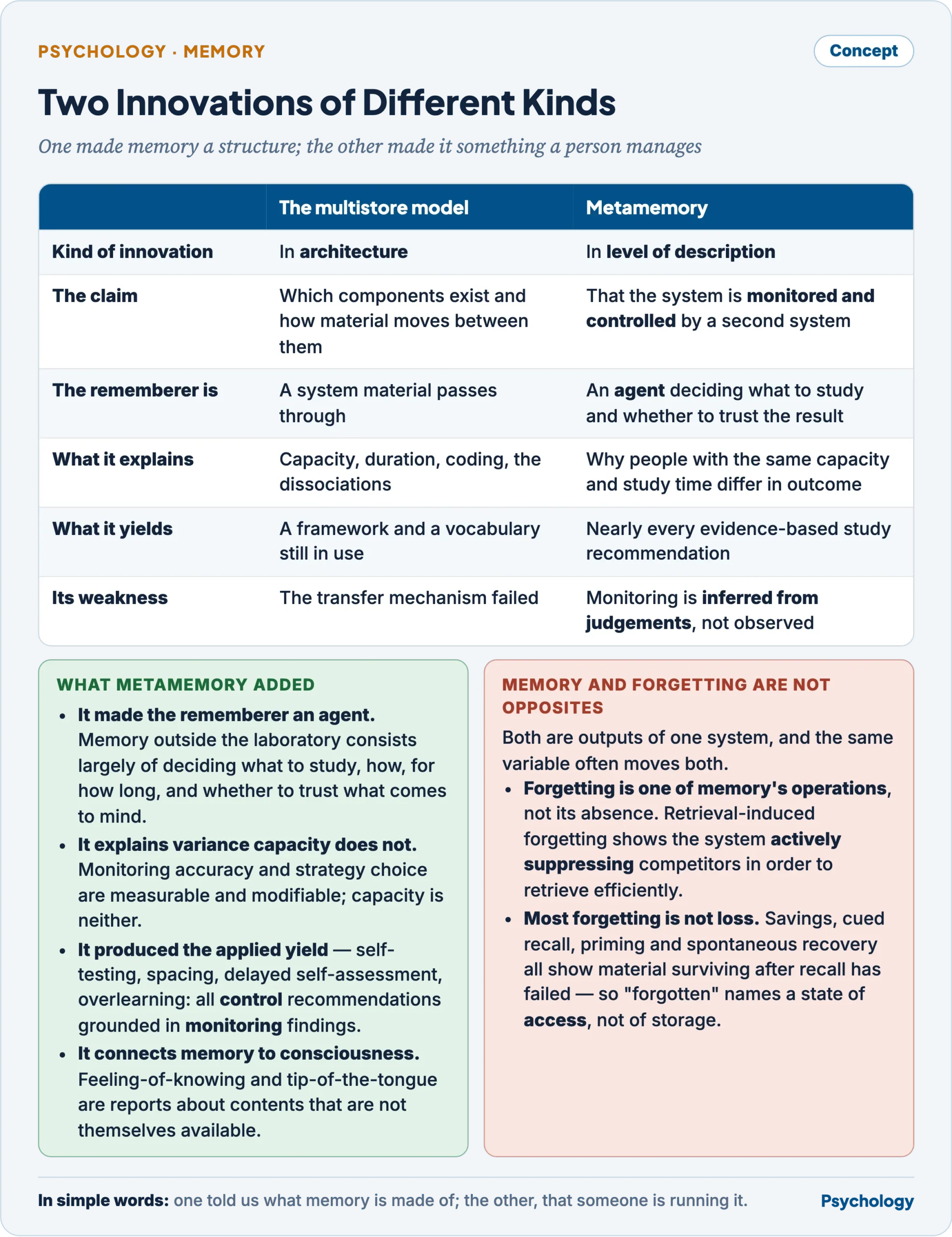
The construct changed what the field was studying, and in three specific ways.
- It made the rememberer an agent rather than a store. The multistore model and its successors describe a system material passes through. Metamemory describes a person deciding what to study, how, for how long, and whether to trust the result — which is what memory outside the laboratory consists of.
- It explains variance that capacity does not. Two people with the same span and the same study time differ in outcome largely through monitoring accuracy and strategy choice, and these are measurable and modifiable where capacity is neither.
- It produced the applied yield. Nearly every evidence-based study recommendation — self-testing, spacing, delayed self-assessment, overlearning — is a control recommendation grounded in a monitoring finding.
- It connects memory to consciousness. Feeling-of-knowing and tip-of-the-tongue states are reports about memory contents that are not themselves available, which makes metamemory one of the few tractable experimental routes into self-knowledge.
- It has clinical and forensic reach. Metamemory complaints often diverge from measured memory performance, and the divergence is itself diagnostic: patients with depression commonly report worse memory than testing shows, while patients with early dementia and with Korsakoff’s syndrome commonly report better.
Set against the multistore model, the two innovations are of different kinds and are often paired in examination questions for that reason. Multistore was an innovation in architecture — a claim about what components exist and how material moves between them, which organised the field and generated a generation of experiments. Metamemory was an innovation in level of description — a claim that the memory system is monitored and controlled by a second system, which the architecture had no place for. One made memory a structure; the other made it something a person manages.
Criticisms and limitations
- Monitoring is inferred from judgements, not observed. A judgement of learning is a verbal report, and treating it as a readout of an internal monitor assumes exactly what is at issue.
- The accuracy measures are contested. Relative accuracy — whether a learner ranks items correctly — and absolute accuracy — whether the probability estimate is calibrated — can diverge, and studies reporting “accurate metamemory” often mean only the first.
- The construct is broad to the point of looseness, covering stable beliefs, on-line judgements, strategy use and control decisions, which may have little in common beyond being about memory.
- Laboratory tasks are narrow. Word pairs studied for minutes may say little about how a student monitors a term’s work.
- Training effects are modest and often fail to transfer beyond the trained material, the recurring limitation of strategy instruction.
- Cultural variation is almost unstudied, although beliefs about memory, the value placed on verbatim retention and the acceptability of saying “I do not know” plainly differ, and all three would affect both monitoring and control.
Previous Year Questions
- 2024Differentiate between the processes of memory and forgetting. Also, discuss multistore model and meta-memory as innovations in the study of memory.
The 2020 question differentiating metamemory from self-instructional learning is answered in the note on programmed, probability and self-instructional learning, where the two are set side by side.