

Organization and Mnemonic techniques to improve memory.
Official Syllabus: Paper I · Unit 7 Memory
“There is no limit to the amount of information that can be remembered, provided it can be organised.”
— the practical claim that every finding in this area tests
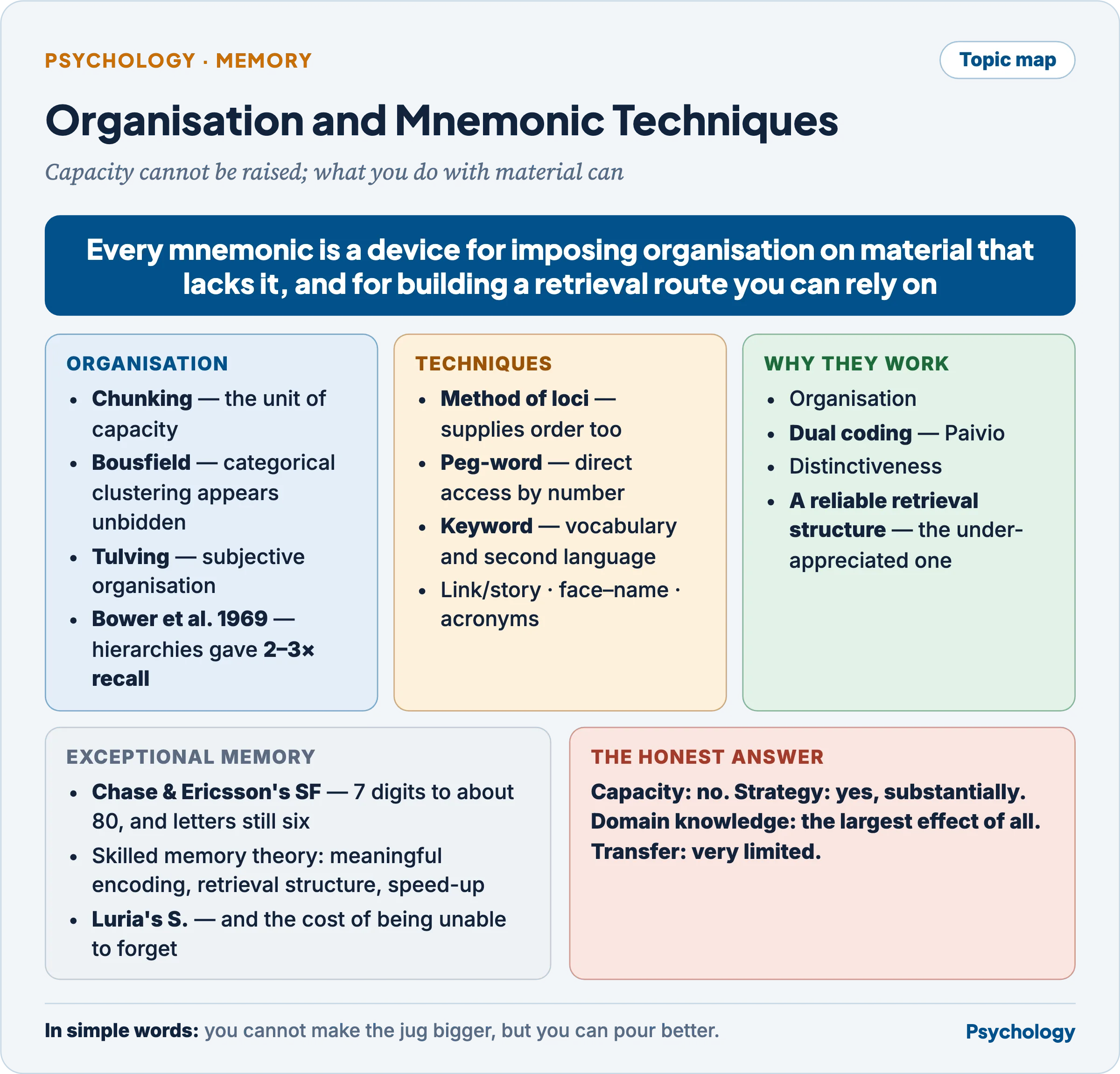
The question of whether memory can be improved has a precise answer, and the precision matters. Raw capacity cannot be raised: no technique increases the span of immediate memory or the durability of a trace as such. What can be raised, often dramatically, is what a person does with material before storing it and how they get back to it afterwards. Every mnemonic technique is a device for imposing organisation on material that lacks it, and for building a retrieval route that can be relied on.
Organisation
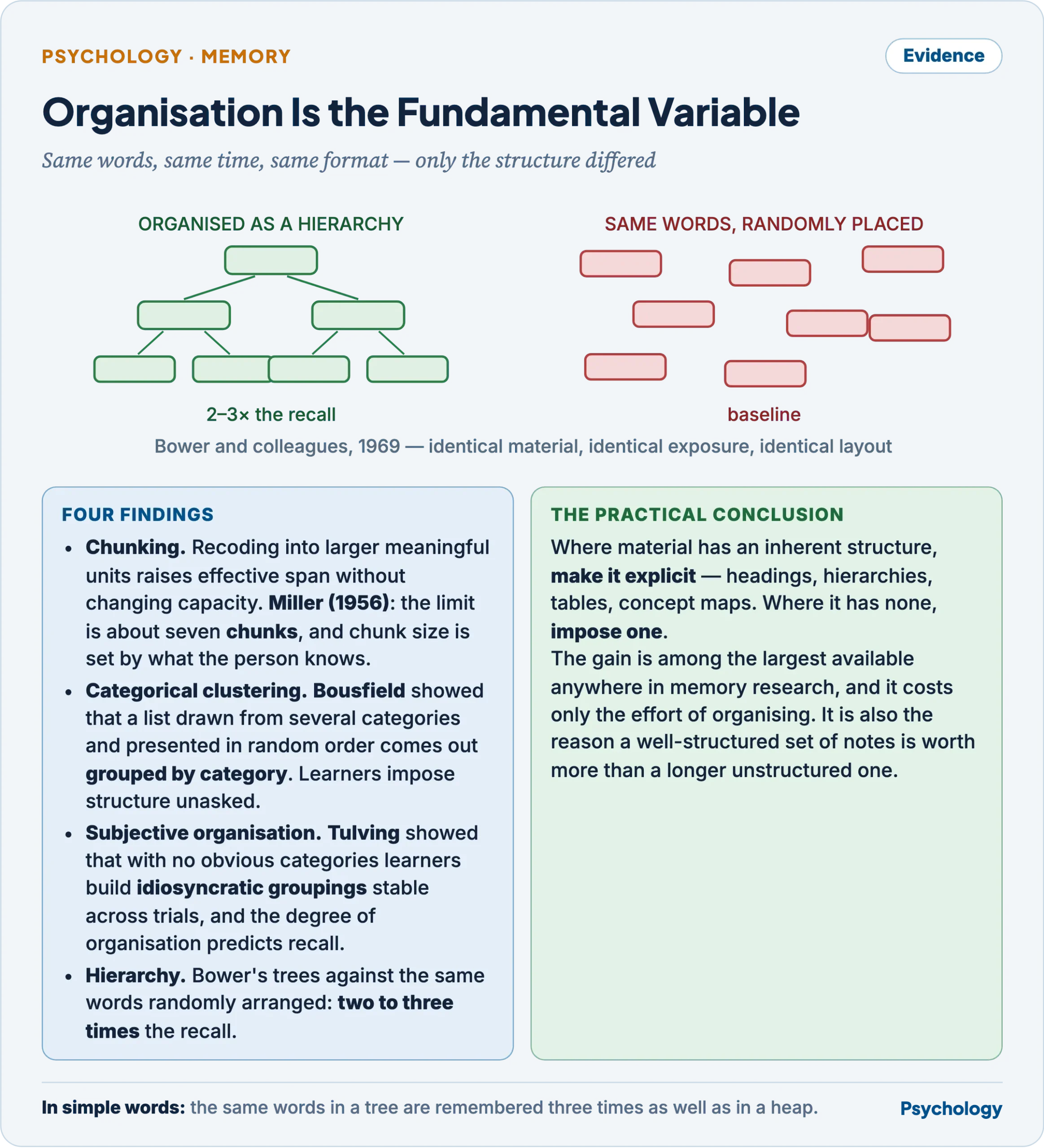
Organisation is the more fundamental of the two, because mnemonics are only particular ways of achieving it.
- Chunking. Recoding items into larger meaningful units raises effective span without changing capacity, since the unit of capacity is the chunk. Miller (1956) made this the central point of his paper: the limit is about seven chunks, and the size of a chunk is set by the person’s knowledge.
- Categorical clustering. Bousfield showed that when a list drawn from several categories is presented in random order, recall comes out grouped by category regardless of presentation order. Learners impose structure whether or not they are asked to.
- Subjective organisation. Tulving showed that with lists having no obvious categories, learners construct idiosyncratic groupings that remain stable across trials, and that the degree of such organisation predicts how much is recalled.
- Hierarchical organisation. Bower and colleagues (1969) presented words either in a hierarchical tree by category and subcategory, or the same words in the same layout randomly arranged. Recall from the organised version was two to three times that from the random one. The material, the exposure and the format were identical; only the structure differed.
- The practical conclusion. Where material has an inherent structure, make it explicit — headings, hierarchies, tables, concept maps. Where it does not, impose one. The gain is one of the largest available in the whole of memory research, and it costs only the effort of organising.
Mnemonic techniques
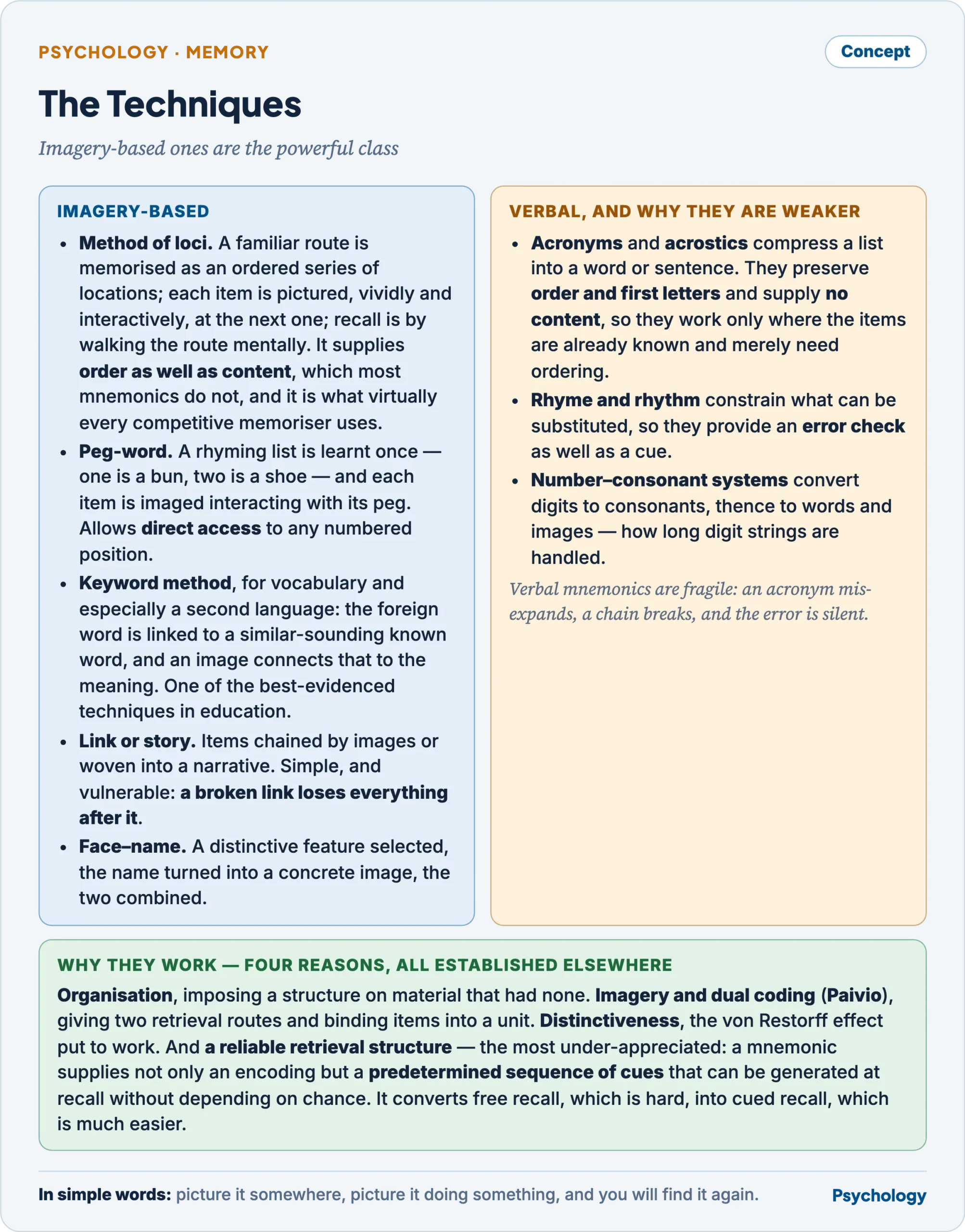
Imagery-based techniques — the most powerful class, because they exploit the dual coding of material in both verbal and visual form, which Paivio showed gives two independent routes to retrieval.
- The method of loci. A familiar route or building is memorised as an ordered series of locations; each item to be remembered is pictured, vividly and interactively, at the next location; recall is by walking the route mentally. It supplies order as well as content, which most mnemonics do not, and it is the technique used by virtually every competitive memoriser.
- The peg-word system. A rhyming list is learned once — one is a bun, two is a shoe — and each item is imaged interacting with its peg. It allows direct access to any numbered position without running through the list.
- The keyword method, for vocabulary and especially a second language. The foreign word is linked to a similar-sounding word in the known language, and an image connects that keyword to the meaning. One of the best-evidenced techniques in education.
- The link or story method. Items are chained by images, or woven into a narrative. Simple to use, but vulnerable: a broken link loses everything after it.
- The face–name technique. A distinctive facial feature is selected, the name converted into a concrete image, and the two combined.
Verbal techniques — weaker, and useful where imagery is awkward.
- Acronyms and acrostics, which compress a list into a word or sentence. They preserve order and first letters and supply no content, so they work only when the items are already known and merely need ordering.
- Rhyme and rhythm, which constrain what can be substituted and so provide an error check as well as a cue.
- Number–consonant systems, converting digits into consonants and thence into words and images, which is how long digit strings are handled.
Why they work — and all four reasons are reasons already established elsewhere in the field.
- Organisation. Each imposes a structure on material that had none.
- Imagery and dual coding. Two codes give two retrieval routes, and interactive imagery binds items into a unit.
- Distinctiveness. Bizarre and vivid images stand out from their neighbours, the von Restorff effect put to work.
- A reliable retrieval structure. This is the most under-appreciated. A mnemonic supplies not only an encoding but a predetermined sequence of cues that can be generated at recall without depending on chance. It converts free recall, which is hard, into cued recall, which is much easier.
Expertise, schemas and exceptional memory
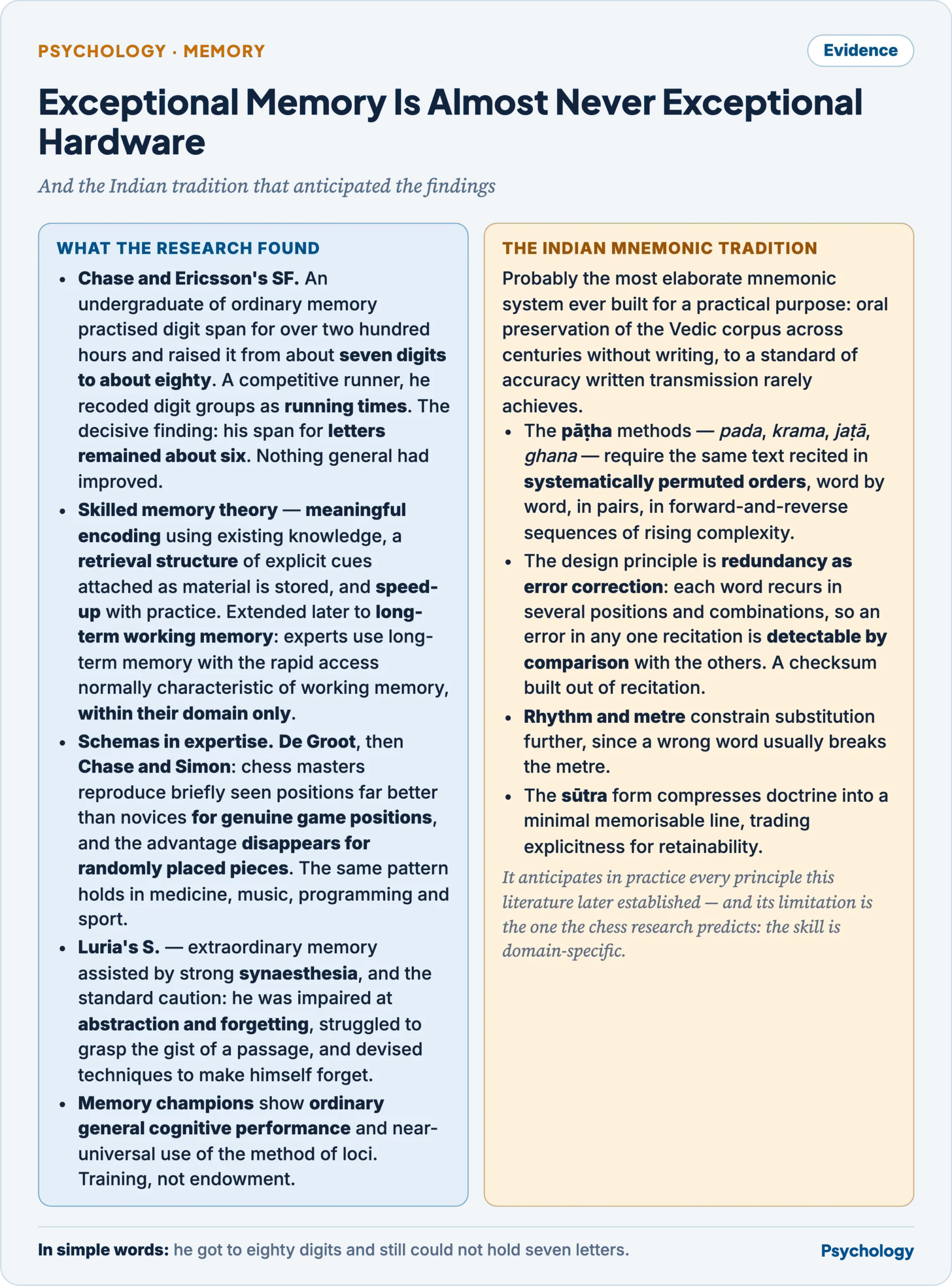
Exceptional memory is almost never exceptional hardware, and the research that established this is among the most instructive in the field.
- Chase and Ericsson’s SF. An undergraduate of ordinary memory ability practised the digit-span task for more than two hundred hours and raised his span from about seven digits to about eighty. He was a competitive runner, and he recoded digit groups into running times — 3492 as “3 minutes 49.2 seconds, near world-record time for the mile”. The decisive finding is that his span for letters remained about six. Nothing general had improved; he had built a domain-specific recoding system.
- Skilled memory theory, drawn from that work, specifies three principles: meaningful encoding using existing knowledge; a retrieval structure of explicit cues attached to the material as it is stored; and speed-up with practice. Later work extended this to long-term working memory — the claim that experts use long-term memory with the rapid access normally characteristic of working memory, within their domain only.
- Schemas in expertise. De Groot, and later Chase and Simon, found that chess masters reproduce briefly seen board positions far better than novices for genuine game positions, with the advantage disappearing for randomly placed pieces. What the master has is a very large store of meaningful configurations, each of which is a single chunk. The same pattern appears in medicine, music, programming and sport: the expert’s memory advantage is confined to structured material from the domain.
- Mnemonists. Luria’s study of S. describes a man of extraordinary and apparently limitless memory, assisted by strong synaesthesia in which sounds produced consistent colours, tastes and textures. The case is also the standard caution: S. was impaired at abstraction and forgetting, could not easily grasp the gist of a passage because of the images each word provoked, and devised techniques to make himself forget. An inability to lose detail is not an unmixed advantage.
- Memory champions. Studies of competitive memorisers find ordinary performance on general cognitive measures and the near-universal use of the method of loci. Training, not endowment.
What else actually improves memory
Mnemonics address arbitrary material. Most of what a student must retain is not arbitrary, and for that the evidence favours a different set of techniques.
- Retrieval practice. Testing oneself produces substantially better long-term retention than restudying for the same time. Among the two or three best-supported techniques available.
- Distributed practice. The same total time spread over occasions beats massed study, and the advantage grows with the retention interval.
- Interleaving. Mixing problem types within a session beats blocking them, especially where the skill is choosing the right approach.
- Elaborative interrogation and self-explanation. Asking why a fact is true, and explaining a step to oneself, force the semantic processing that durable traces require.
- Sleep, which supports consolidation, and physical exercise, which has modest but real associations with memory performance.
- Low-utility techniques, which students nonetheless prefer: highlighting, re-reading and simple summarisation. They are effortful, time-consuming and shallow, and the fluency they produce is mistaken for learning.
- Attention at encoding, which costs nothing and is the most commonly squandered advantage of all.
The Indian mnemonic tradition
India developed what is probably the most elaborate mnemonic system ever built for a practical purpose: the oral preservation of the Vedic corpus across many centuries without writing, to a standard of accuracy that written transmission rarely achieves.
- The pāṭha recitation methods — pada, krama, jaṭā, ghana and others — require the same text to be recited in systematically permuted orders, word by word, in pairs, in forward-and-reverse sequences of increasing complexity.
- The design principle is redundancy as error correction: because each word recurs in several different positions and combinations, an error in any one recitation is detectable by comparison with the others. It is a checksum built out of recitation.
- Rhythm, metre and chanting constrain substitution still further, since an incorrect word usually breaks the metre.
- The sūtra form — compressing a doctrine into a minimal, rhythmic, memorisable line — is the complementary strategy, trading explicitness for retainability and relying on commentary to unpack what was compressed.
The tradition anticipates in practice every principle this literature later established: organisation, redundancy, rhythmic constraint, overlearning and distributed rehearsal across a lifetime. Its limitation is the one the chess research predicts — the skill is domain-specific and does not make its practitioners better at remembering anything else.
Can memory be improved? The honest answer
- Capacity: no. Span and the basic durability of a trace are not raised by practice, and SF’s letter span is the proof.
- Encoding and retrieval strategy: yes, substantially. Organisation, imagery, elaboration and retrieval structures produce large and reliable gains.
- Domain knowledge: yes, and it is the largest effect of all. The more one knows about a subject, the better one remembers new material in it, because there is more to encode with. This is why reading widely in a subject improves memory for it more than any technique.
- Transfer: very limited. Gains are tied to the material and the method, which is the consistent finding from SF through to commercial brain-training.
- What a recommendation should therefore look like: use organisation and mnemonics for genuinely arbitrary material; use retrieval practice, spacing and elaboration for meaningful material; build domain knowledge; protect attention at encoding; and expect no general improvement in memory as a faculty.
Criticisms and limitations
- Mnemonics take longer to learn than they save for small amounts of material, and the method of loci requires a route to be built and maintained before anything can be stored in it.
- They aid retention, not understanding. A mnemonic for the cranial nerves does not convey what they do, and used as a substitute for comprehension it produces exam performance without competence.
- They suit arbitrary, listed, ordered material and are ill-suited to argument, principle and conceptual relations — which is most of what a serious subject consists of.
- Verbal mnemonics are fragile: an acronym mis-expands, a chain breaks, and the error is silent.
- Much of the evidence is from word lists over short intervals, and long-term retention of mnemonically encoded material is less studied than the technique’s popularity suggests.
- The memory-improvement industry overpromises, and the strongest claims — general gains, transfer to intelligence — are the ones with the weakest support.
Previous Year Questions
- 2025Describe some major strategies for memory retention and explain each one with relevant examples.
- 2023How can the memory be improved with the help of organization and mnemonic techniques?
- 2021Describe the role of schemas and mnemonic devices in expertise and exceptional memory.
- 2011How the principles of encoding help enhancing the use of mnemonic devices?
- 2002Can human memory be improved? If yes, what techniques would you recommend? Explain how each technique proposed by you can bring about improvement in memory.