

Levels of processing.
Official Syllabus: Paper I · Unit 7 Memory
“Memory is a by-product of perceptual analysis, and the durability of the trace is a function of the depth to which the stimulus has been analysed.”
— Fergus Craik and Robert Lockhart (1972), replacing structure with process
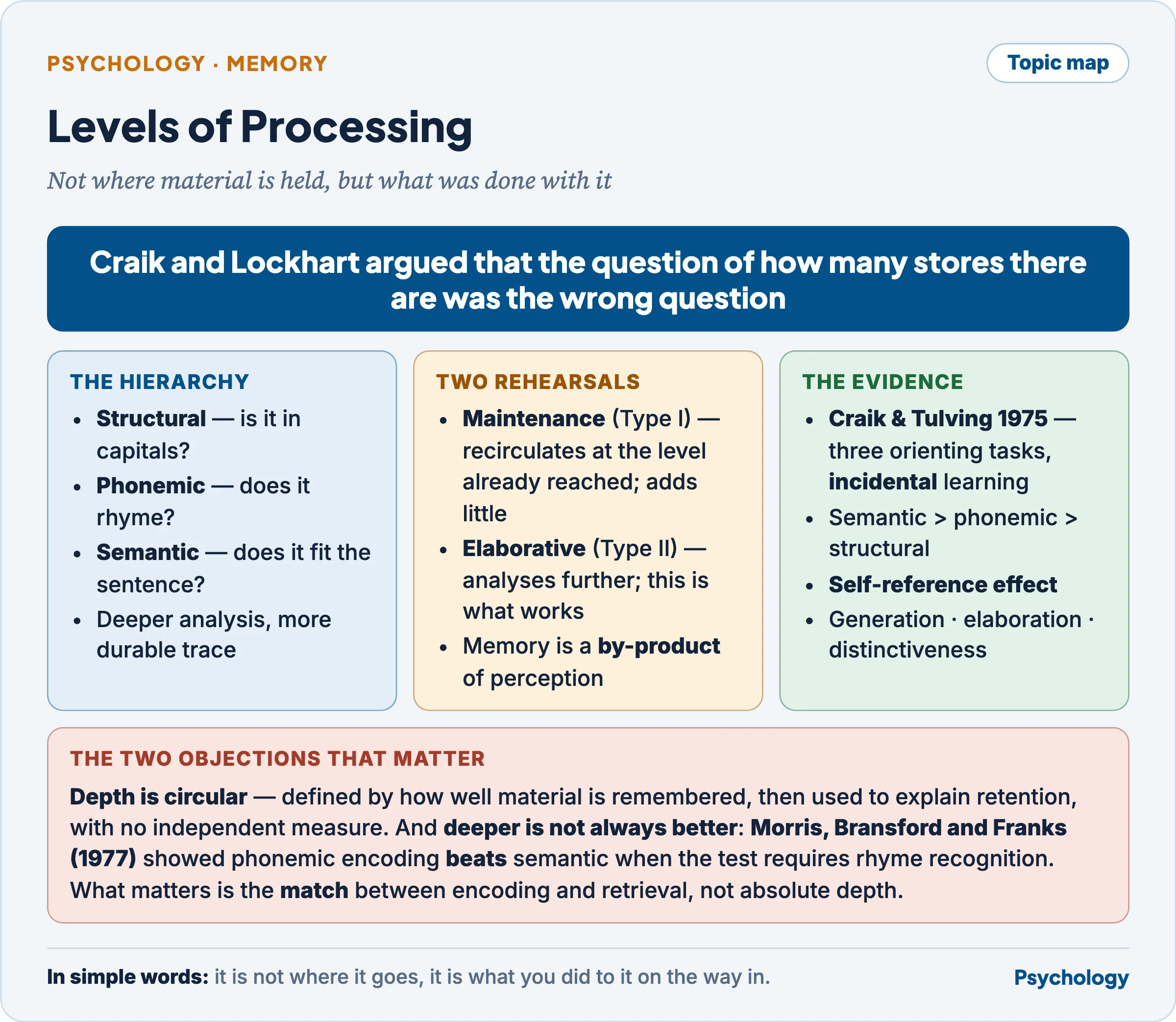
The multistore model asked where material is held and how it is transferred. Craik and Lockhart (1972) argued that this was the wrong question. On their account there are no separate stores to be moved between; there is only what the mind does with an input, and memory is the residue of that processing. A durable memory is not material that reached a particular box but material that was analysed deeply.
The framework
- Material is analysed through a hierarchy of levels, from the shallow to the deep.
- Structural — physical appearance. Is the word in capital letters?
- Phonemic — sound. Does it rhyme with “train”?
- Semantic — meaning. Does it fit the sentence “the _ pulled into the station”?
- Deeper analysis, more durable trace. Depth here means the degree of semantic and cognitive analysis, not time spent or effort expended.
- Memory is a by-product. It is not the goal of a separate storage operation but what remains after perception and comprehension have done their work — which is why incidental learning under deep processing can match or exceed intentional learning under shallow processing.
- Two kinds of rehearsal; one helps. Maintenance rehearsal — Type I — recirculates material at the level already achieved, keeps it available, and adds little to long-term retention. Elaborative rehearsal — Type II — analyses it further, and does.
The radical element is the second sentence of that list. On the multistore account, time in the short-term store determines transfer. Here, the kind of processing determines retention; time matters only as it permits deeper analysis.
The evidence
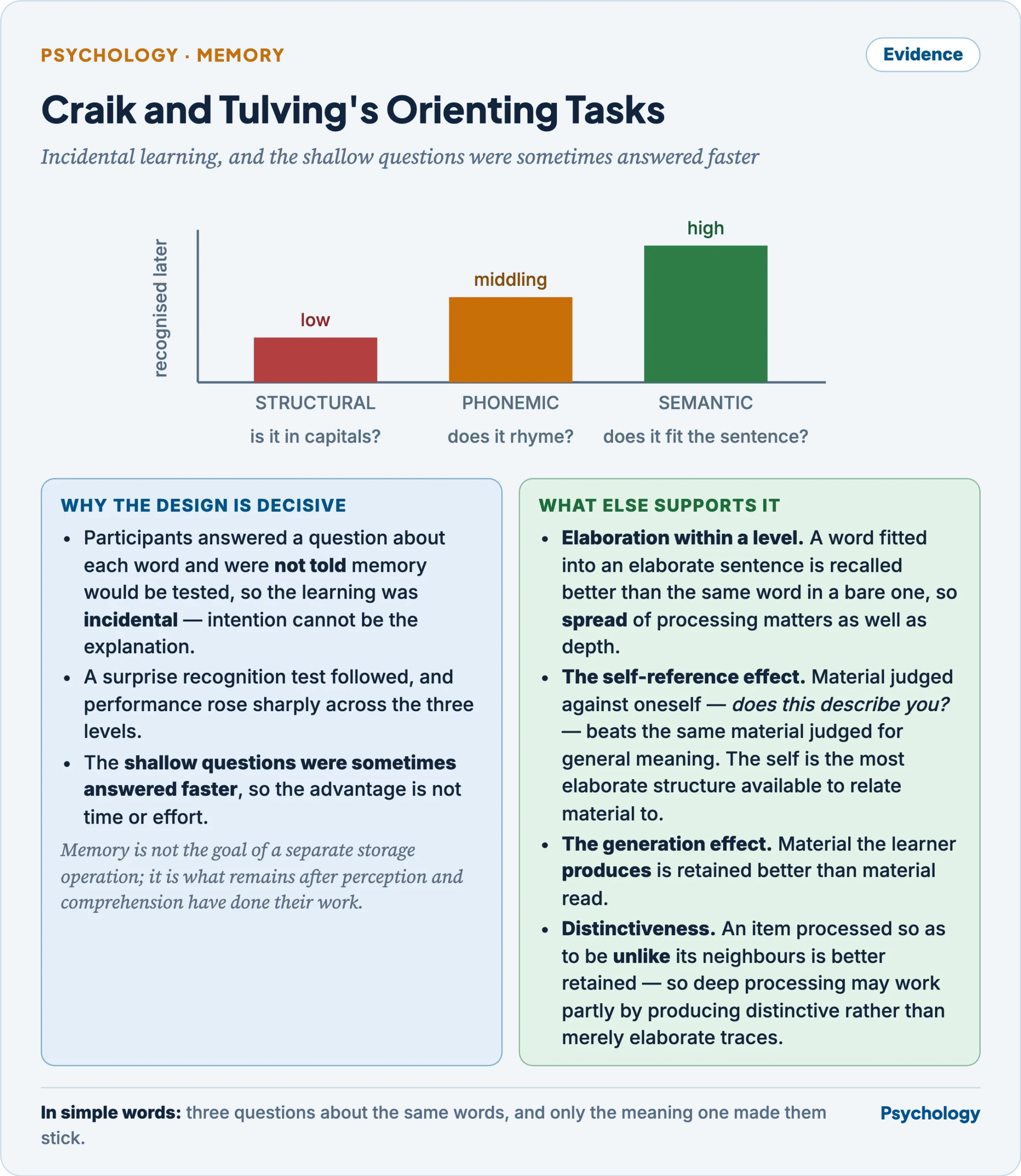
- Craik and Tulving (1975). Participants were shown words preceded by a question of one of three types — a case question (structural), a rhyme question (phonemic) or a sentence-frame question (semantic) — and answered yes or no. They were not told memory would be tested. A surprise recognition test followed.
- Recognition rose sharply across the three levels, with semantic processing far better than phonemic, and phonemic better than structural.
- The effect held although the task was incidental and although the shallow questions were sometimes answered faster — so the advantage is not effort or duration.
- Elaboration within a level. Richer semantic frames produce better memory than simple ones: a word fitted into an elaborate sentence is recalled better than the same word fitted into a bare one. Depth is therefore not the only dimension; spread of processing matters too.
- The self-reference effect. Material judged against oneself — does this adjective describe you? — is remembered better than the same material judged for general meaning. The self appears to be the most elaborate and best-organised structure available to relate material to.
- The generation effect. Material the learner produces is retained better than material read, which the framework accommodates as deeper and more elaborate engagement.
- Distinctiveness. An item processed in a way that makes it unlike its neighbours is better retained, which is why deep processing may work partly by producing distinctive rather than merely elaborate traces.
How it differs from the multistore and working memory models
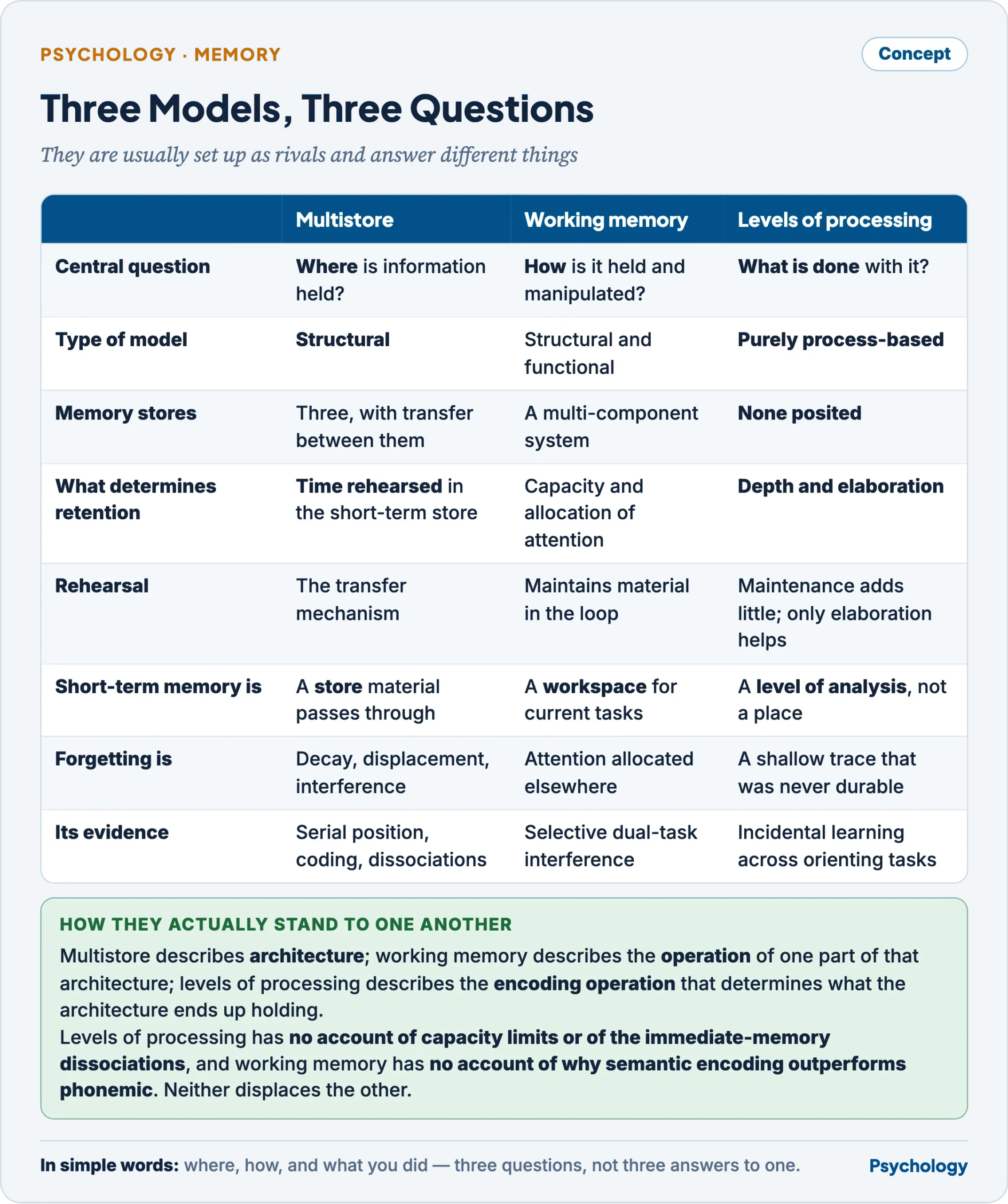
| Multistore | Working memory | Levels of processing | |
|---|---|---|---|
| Central question | Where is information held? | How is information held and manipulated? | What is done with information? |
| Type of model | Structural | Structural and functional | Purely process-based |
| Memory stores | Three, with transfer between them | A multi-component system | None posited |
| What determines retention | Time rehearsed in the short-term store | Capacity and allocation of attention | Depth and elaboration of processing |
| Rehearsal | The transfer mechanism | Maintains material in the loop | Maintenance adds little; only elaboration helps |
| Short-term memory | A store material passes through | A workspace for current tasks | A level of analysis, not a place |
| Account of forgetting | Decay, displacement, interference | Attention allocated elsewhere | A shallow trace was never durable |
| Characteristic evidence | Serial position, coding differences, dissociations | Selective dual-task interference | Incidental learning across orienting tasks |
The three are often set up as rivals and are better read as answering different questions. Multistore describes architecture; working memory describes the operation of one part of that architecture; levels of processing describes the encoding operation that determines what the architecture ends up holding. Levels of processing has no account of capacity limits or of the immediate-memory dissociations, and working memory has no account of why semantic encoding outperforms phonemic. Neither displaces the other.
Individual differences in memory
The framework explains differences between people in a way a structural model cannot, and this is one of its more useful applications.
- Differences are in processing, not in capacity. If memory were a store of fixed size, differences would be differences of size. On the processing account they are differences in what people habitually do with material — and habits can be changed, where capacity cannot.
- Expertise. The expert encodes material semantically and relates it to an elaborate existing structure; the novice is restricted to surface features. This is why the chess master’s advantage for real board positions disappears for random ones: the deep encoding has nothing to engage with.
- Age. Older adults show reduced spontaneous use of deep and organisational strategies, and the age difference narrows considerably when deep processing is induced by the task. The deficit is substantially one of strategy rather than of machinery, though not entirely.
- Children. The developmental improvement in memory is driven largely by the acquisition of elaborative and organisational strategies, and by the growth of the knowledge base that makes deep encoding possible.
- Depression and anxiety. Depression is associated with reduced elaborative encoding and with a mood-congruent bias in what is elaborated; anxiety consumes the attentional resources that elaboration requires.
- Study habits. The reliable difference between successful and unsuccessful students is not time spent but method — self-explanation, retrieval practice and organisation against highlighting and re-reading, which keep processing shallow while feeling like work.
Putting it to work
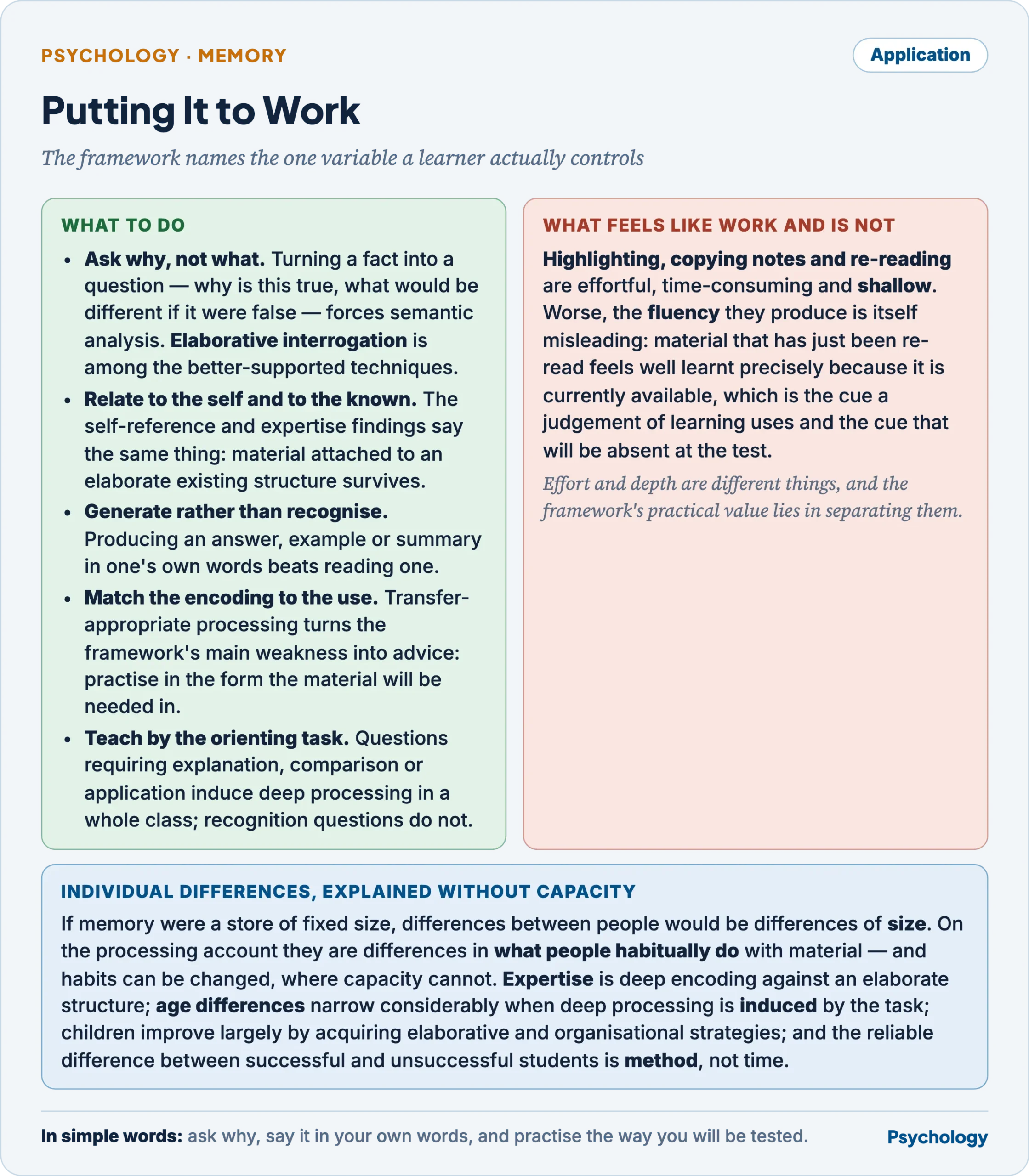
The framework’s practical yield is unusually direct, because it names the variable a learner actually controls.
- Ask why, not what. Turning a fact into a question — why is this true, how does it follow, what would be different if it were false — forces semantic analysis where re-reading does not. Elaborative interrogation is among the better-supported study techniques.
- Relate to the self and to the known. The self-reference effect and the expertise findings say the same thing: material attached to an elaborate existing structure survives. A new concept explained in terms the learner already holds is deeply encoded by construction.
- Generate rather than recognise. Producing an answer, an example or a summary in one’s own words beats reading one, which is why closing the book and writing from memory outperforms highlighting.
- Beware of processing that feels like work. Highlighting, copying notes and re-reading are effortful, time-consuming and shallow. The sense of fluency they produce is itself misleading, because fluent material feels well learnt. Effort and depth are different things, and the framework’s practical value lies precisely in separating them.
- Match the encoding to the use. Transfer-appropriate processing turns the framework’s main weakness into advice: practise in the form the material will be needed in. If the test requires written argument, the studying should involve written argument.
- Teaching follows the same rule. Questions that require explanation, comparison or application induce deep processing in a whole class; questions that require recognition do not. A teacher controls the orienting task, and the orienting task controls what is retained.
Criticisms and limitations
- Depth is circular — the central objection. Depth is defined by how well material is remembered, and retention is then explained by depth. Without an independent measure of depth the framework cannot be falsified. Attempts to supply one — processing time, task difficulty — fail, because shallow tasks are sometimes slower and harder and still produce worse memory.
- Deeper is not always better. Transfer-appropriate processing — Morris, Bransford and Franks (1977) — showed that phonemic encoding beats semantic encoding when the test requires rhyme recognition. What matters is the match between encoding and retrieval demands, not absolute depth. This is the most damaging result, since it shows the ordering of levels is not fixed.
- Elaboration and distinctiveness may be the real variables, and may be the real variables. A trace may be well retained because it is unusual rather than because it is deep.
- It is an encoding account only. Retrieval is barely addressed, and the framework cannot explain context effects, cue-dependent forgetting or the tip-of-the-tongue state.
- It cannot explain immediate-memory phenomena that the structural models handle well — span limits, acoustic confusions, the dissociations in amnesia and conduction aphasia.
- It is a framework, not a theory. Craik and Lockhart described it that way themselves, and it generates orienting-task demonstrations more readily than risky predictions.
- The craft lesson survives the theory. Whatever the status of depth, the practical implications — elaborate, relate to what you know, generate rather than re-read, and make the encoding resemble the use — are among the best-supported recommendations in education.
Previous Year Questions
- 2022Discuss the levels of processing model and highlight its relevance for explaining individual differences in memory.
- 2018Demonstrate the importance of the shallow and deep levels of processing in remembering. With the help of daily life examples, explain how retrieval cues enable us to remember.
- 2017Explain the differences in information processing at various levels of memory. In what way is recall affected by initial processing of information?
- 2011How does level of processing model differ from multistore and working memory models? Explain.
- 2010Discuss the levels of processing framework of memory and the relevant supporting research evidence.
- 2008The level at which an information is processed has a bearing on recall of that particular information. Discuss in the light of experimental studies.
- 2001Present a critical appraisal of stage versus process models of memory and citing suitable studies show how elaborative processing and self-generation improve memory.