

Programmed learning, probability learning, self-instructional learning, concepts.
Official Syllabus: Paper I · Unit 6 Learning
“The whole process of becoming competent in any field must be divided into a very large number of very small steps, and reinforcement must be contingent upon the accomplishment of each step.”
— B. F. Skinner (1954), setting out what a teaching machine would have to do
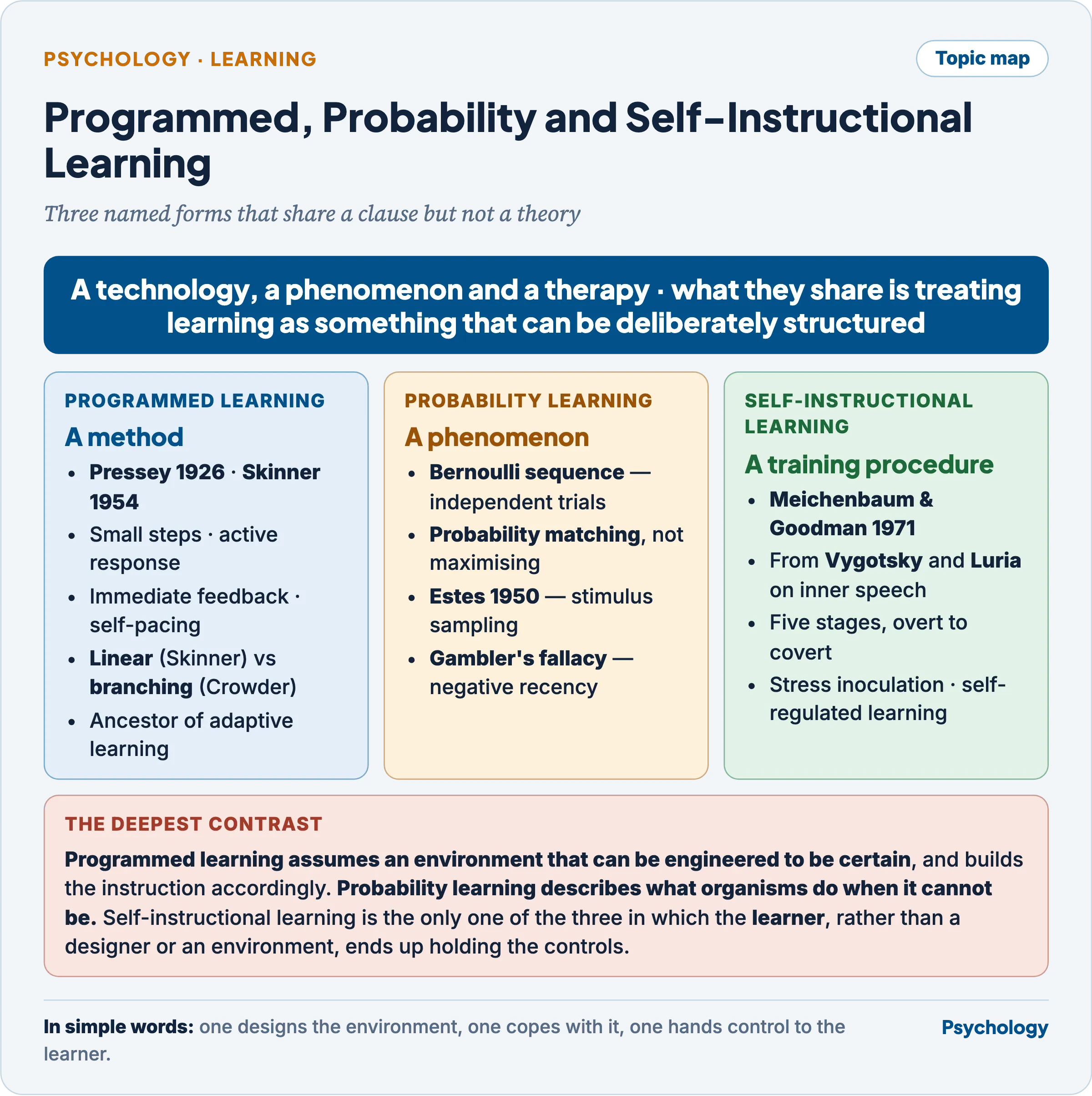
Three named forms of learning sit together in this clause without sharing a theory. Programmed learning is an engineered method of instruction derived from operant principles. Probability learning is a laboratory phenomenon about how organisms behave in uncertain environments. Self-instructional learning is a clinical training procedure for self-regulation. What they share is that each treats learning as something that can be deliberately structured rather than left to occur.
Programmed learning
Programmed learning is instruction in which material is broken into small sequenced units, the learner responds actively to each, and feedback is supplied immediately, so that learning proceeds at the learner’s own pace with minimal error.
Sidney Pressey (1926) built the first machine, intended for testing: it presented a multiple-choice item and would not advance until the correct key was pressed. B. F. Skinner (1954), in The Science of Learning and the Art of Teaching, converted the idea into a theory of instruction. His diagnosis of the ordinary classroom was that it fails on the terms his own research had established — reinforcement is delayed by days, it is infrequent, the sequence is set by the syllabus rather than by what each learner has mastered, and aversive control does much of the work.
The principles
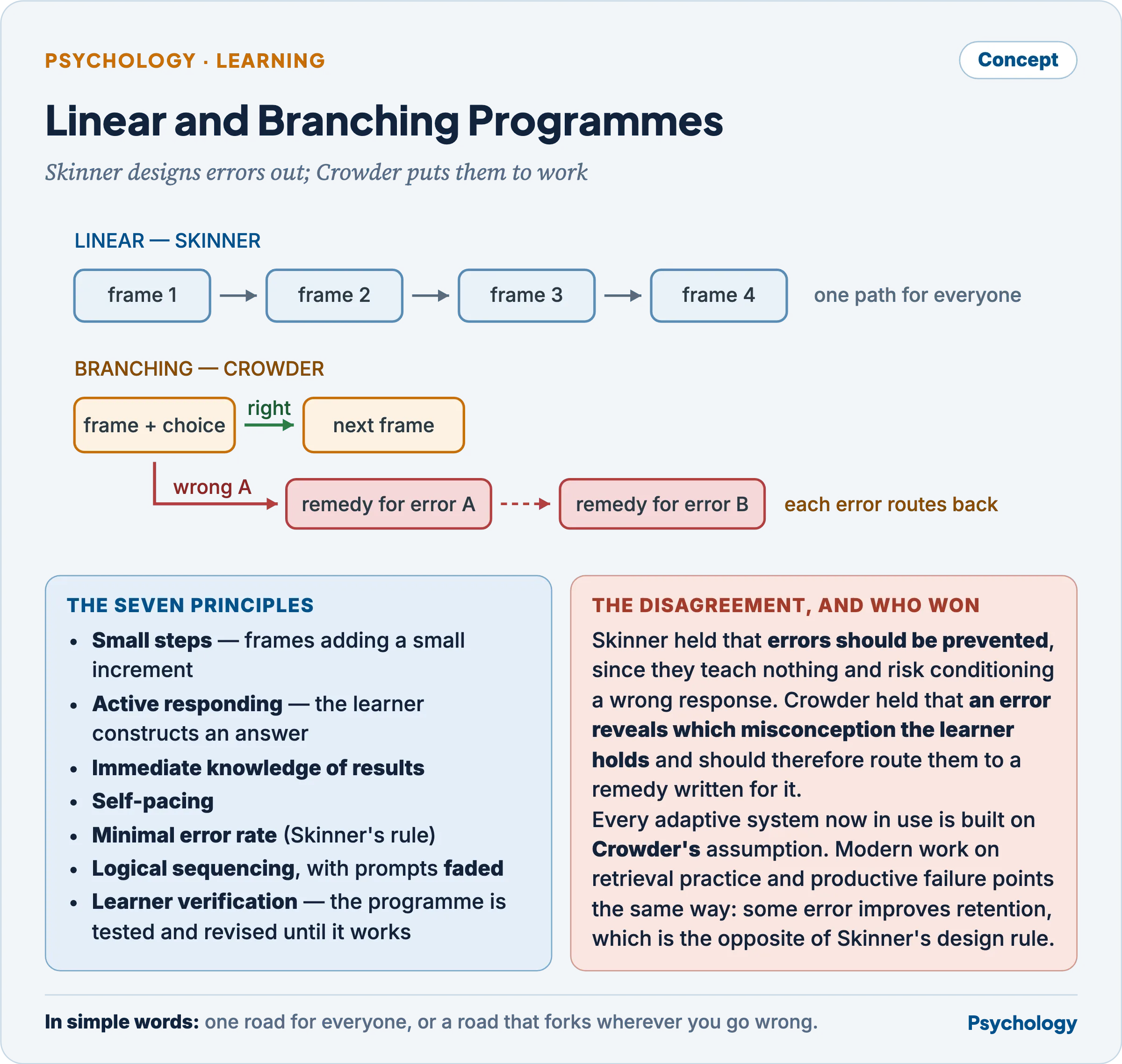
- Small steps. Content is divided into frames, each adding a small increment, so the learner is almost always right.
- Active responding. The learner constructs a response at each frame rather than reading passively; responding is what is reinforced.
- Immediate knowledge of results. The correct answer is supplied at once, which is the reinforcer and also the error-correction.
- Self-pacing. The learner sets the rate, which removes the compromise a class-paced lesson forces.
- Minimal error rate. A well-written programme aims to keep errors low, since on Skinner’s account errors are not instructive and merely risk conditioning the wrong response.
- Logical sequencing, with cueing and prompting that are gradually faded as the response comes under the control of the material itself.
- Learner verification. The programme is tested on real learners and revised until it works — instruction is treated as an empirical product, which is the most durable of these ideas.
Two architectures
- Linear programming (Skinner). One path, which every learner follows in the same order. Frames are small, the response is usually constructed, and errors are designed out. Simple to build; identical for a quick learner and a struggling one.
- Branching or intrinsic programming (Norman Crowder). Larger frames ending in a multiple-choice item, where each wrong option routes the learner to a remedial sequence written for that particular misunderstanding before returning to the main line. Errors here are diagnostic, not wasteful — the choice a learner makes reveals which misconception they hold. More expensive to write, and genuinely adaptive.
Crowder’s design is the ancestor of every adaptive system now in use, and the disagreement between the two men was substantive: Skinner held that errors should be prevented, Crowder that they should be exploited.
Strengths and weaknesses
| Advantages | Disadvantages |
|---|---|
| Self-pacing suits mixed-ability groups | Isolating — no discussion, no peer learning |
| Immediate feedback at every step | Monotonous; small steps bore able learners |
| Active responding throughout | Fragmentation — the whole may be lost in the parts |
| Mastery before progression | Expensive and slow to write and validate |
| Individual record of where each learner failed | Poorly suited to ill-structured content |
| Consistent delivery, free of the teacher’s variation | Limited transfer beyond the trained form |
| Empirically revised against learner data | Sidelines the teacher’s judgement and the learner’s questions |
Is it feasible to programme higher forms of learning?
Partly, and the limit is principled rather than technical.
- Knowledge, comprehension and application programme well. They have determinate correct answers, so a response can be scored and feedback given automatically, and this is where programmed instruction has always worked.
- Analysis can be programmed with branching and simulation, because the steps are decomposable even where the whole is complex.
- Synthesis, evaluation and creation resist programming, for a structural reason: a programme must be able to recognise a correct response in advance, and these outcomes are defined by producing something the programme’s author did not anticipate. Where there is no single right answer, there is nothing for immediate feedback to be contingent on.
- The partial exception is that sub-skills of higher-order work can be programmed even where the work itself cannot — the components of argument, statistical procedure or experimental design can be drilled, leaving the integration to be taught another way. Modern systems narrow the gap with simulations, open-response scoring and intelligent tutoring, but have not closed it.
What it became
The method as Skinner conceived it did not survive, and almost every one of its principles did. Computer-assisted instruction, mastery learning in Bloom’s sense, intelligent tutoring systems, adaptive testing, modern language and skill applications and spaced-repetition software all rest on small steps, active response, immediate feedback, self-pacing and empirical revision. Where the modern descendants depart from Skinner is in treating errors as information, which is Crowder’s position rather than his.
Designing a programme — for anger reduction, for example — follows the standard instructional-design sequence. Analyse the learner and the task, and specify the behaviour precisely enough to be measured: identify the triggers, the physiological signs, the usual response and the baseline frequency. Design behavioural objectives and sequence them from recognising arousal, through relaxation, through cognitive reappraisal, to rehearsal in progressively more provoking situations. Develop the frames, each small, each demanding a constructed response, each giving immediate feedback, with branches for the common failure modes. Implement with self-pacing and criterion-referenced progression. Evaluate against the baseline measures and revise the frames that learners fail. The point of the model is that the programme is revised until it works, rather than the learner being blamed for failing it.
Probability learning
Probability learning is learning in an environment where a response is followed by a given outcome only with some probability, so that what is acquired is the probability structure of the environment rather than a single correct response.
The standard laboratory arrangement is the two-choice guessing task. On each trial the participant predicts which of two lights will come on. Unknown to them, light A appears on a fixed proportion of trials — say 70% — and light B on the rest, in an independent random order. Such a series is a Bernoulli sequence: repeated independent trials, each with two outcomes and a fixed probability, where the outcome of one trial carries no information about the next.
Designing a probability-learning experiment
The paradigm is specified tightly enough to be written out as a design.
- Participants and allocation. Adults with no experience of the task, randomly allocated to probability conditions — for instance 50:50, 70:30 and 90:10 — so that matching can be tested across environments rather than at one value.
- Apparatus. Two response keys and two signal lights, with trials machine-timed so that presentation is identical for every participant.
- Constructing the sequence. Generate each trial independently with a fixed probability of the A event, using a random number generator. Independence is what makes it a Bernoulli sequence and must not be compromised by the common shortcut of fixing the number of A events per block and shuffling, which creates negative dependence between trials and would itself induce the behaviour under study.
- Procedure. On each trial the participant predicts A or B, the outcome is then displayed, and the next trial follows. Run several hundred trials, grouped into blocks of fifty so that acquisition can be plotted across blocks.
- Measures. The proportion of A responses per block, compared against the true probability and against the maximising benchmark; overall accuracy; and the conditional probability of switching after a run of identical outcomes, which is the direct measure of recency effects.
- Controls. No information about the probabilities beforehand; a fixed and modest payoff schedule; counterbalanced assignment of lights to keys; and a post-session report of what the participant believed the pattern was, to compare stated belief against actual behaviour.
- Predictions. Response proportions converge on the event probabilities rather than on maximising, and switching after a run exceeds the base rate — the gambler’s fallacy, appearing as a measurable behavioural signature rather than as a reported belief.
The central finding
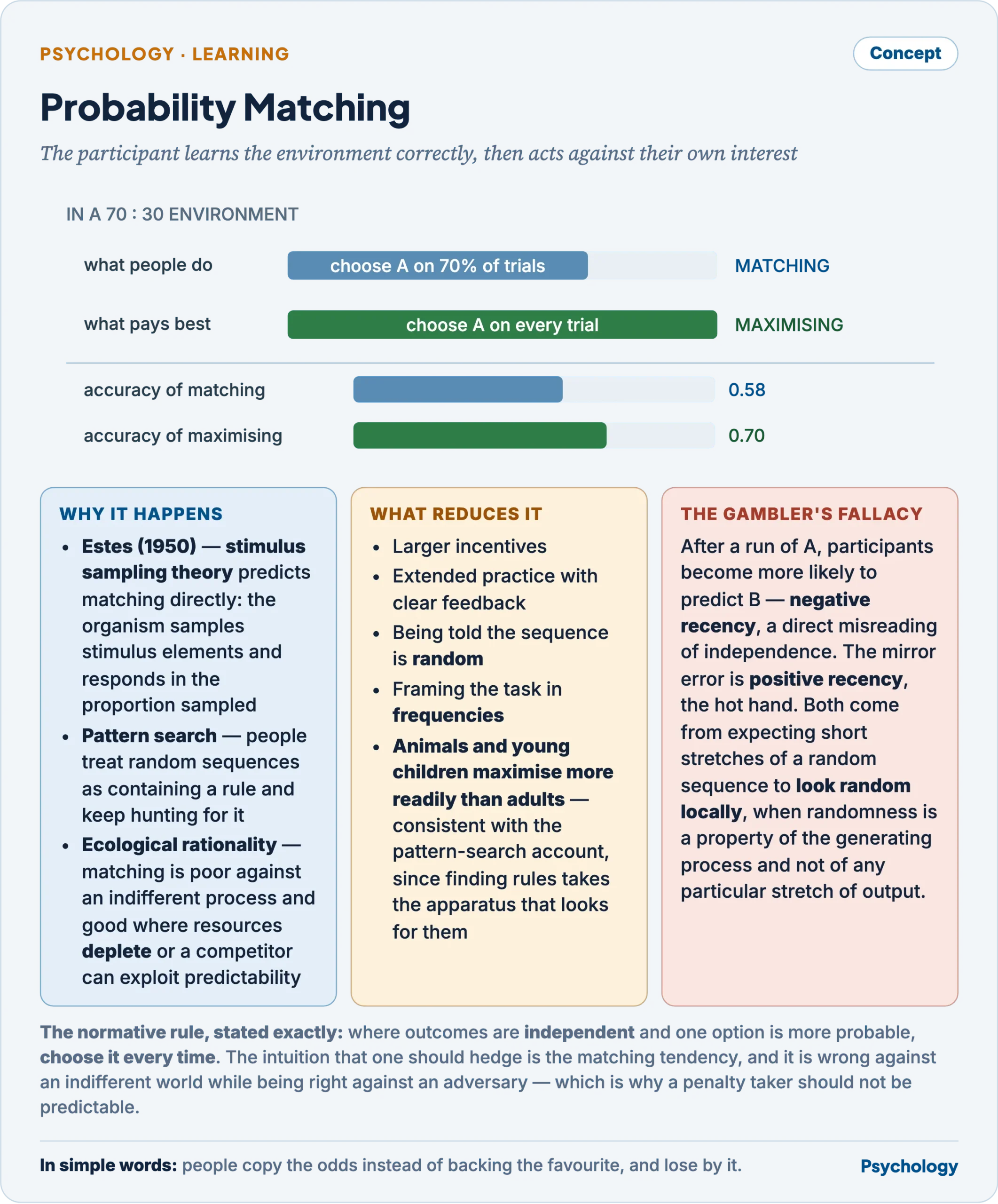
Participants converge on probability matching — they choose A on roughly 70% of trials and B on roughly 30%, reproducing the event probabilities in their own behaviour. This is the signature result of the paradigm, and it is not optimal.
| Strategy | Working | Proportion correct |
|---|---|---|
| Matching — choose A on 70% of trials | (0.7 × 0.7) + (0.3 × 0.3) | 0.58 |
| Maximising — choose A on every trial | 0.7 × 1.0 | 0.70 |
Both figures are arithmetic consequences of a 70:30 environment, not empirical results.
The participant has learned the environment’s structure accurately and then acts on it in a way that costs them. Explaining that gap is the substance of the topic.
- Estes (1950), in stimulus sampling theory, predicted matching directly: on each trial the organism samples a subset of stimulus elements, each conditioned to one response, and responds according to the proportion sampled. Matching is what such a system does.
- Pattern search. People treat random sequences as though they contain a rule, and continue to hunt for one. Matching is what a failed search looks like from outside.
- Ecological rationality. Matching is a poor strategy against a stationary independent process and a good one when the environment responds to behaviour — where resources deplete, or where a competitor can exploit a predictable choice. Foraging animals distribute choices across patches for this reason, and in competitive settings unpredictability is itself valuable.
Matching is reduced, though rarely eliminated, by larger incentives, by extended practice with clear feedback, by being told the sequence is random, and by describing the task in terms of frequencies. Animals and young children maximise more readily than adults, which is a striking reversal of the usual direction and consistent with the pattern-search account: looking for a rule requires the cognitive apparatus that finds rules.
The gambler’s fallacy
The same task produces the classic error. Observing a run of A, participants become more likely to predict B — treating the sequence as though a correction were due. This is negative recency, and it is a direct misreading of independence: in a Bernoulli sequence the probability of A on the next trial is unchanged by any number of preceding As. The complementary error, positive recency or the hot-hand belief, treats a run as evidence of a streak and predicts its continuation. Both arise from the same source — a belief that short random sequences should look random locally, when randomness is a property of the generating process and not of any particular stretch of output.
How it differs from other learning
- The relation between response and outcome is probabilistic, not deterministic — in conditioning the CS reliably precedes the UCS, here it does so only sometimes.
- There is no correct response to acquire. What is learned is a distribution, and every single trial can be wrong even for a perfect learner.
- Feedback on any one trial is partly misleading, so learning requires integration across many trials and is correspondingly slow.
- It is largely implicit: participants adjust to the probabilities while being unable to state them, and their verbal estimates often diverge from their behaviour.
- Knowing the rule does not fix it. Told explicitly that the sequence is random, many participants continue to match — which is why this is a learning phenomenon rather than a reasoning error.
Where it matters
Any judgement under uncertainty with repeated feedback is a probability-learning situation — medical diagnosis from imperfect signs, weather forecasting, agricultural decisions on sowing and irrigation, investment, insurance, strategy in sport, and the design of policy where outcomes are stochastic. The normative lesson is narrow and worth stating exactly: where outcomes are independent and one option is more probable, choose it every time. The intuition that one should hedge is the matching tendency, and it is wrong against an indifferent world — while being right against an adversary, which is why a penalty taker should not be predictable.
Self-instructional learning
Self-instructional learning is the deliberate use of verbal self-direction to guide and regulate one’s own behaviour, acquired through a training sequence in which speech moves from the trainer to the learner and from overt to covert.
Its theoretical basis is Vygotsky’s account of the regulatory function of speech, developed by Luria: speech is first the adult’s, directing the child; then the child’s own, spoken aloud; then internalised as inner speech that regulates action from within. Meichenbaum and Goodman (1971) turned this developmental sequence into a training procedure with impulsive second-grade children, and the resulting programme is the standard form.
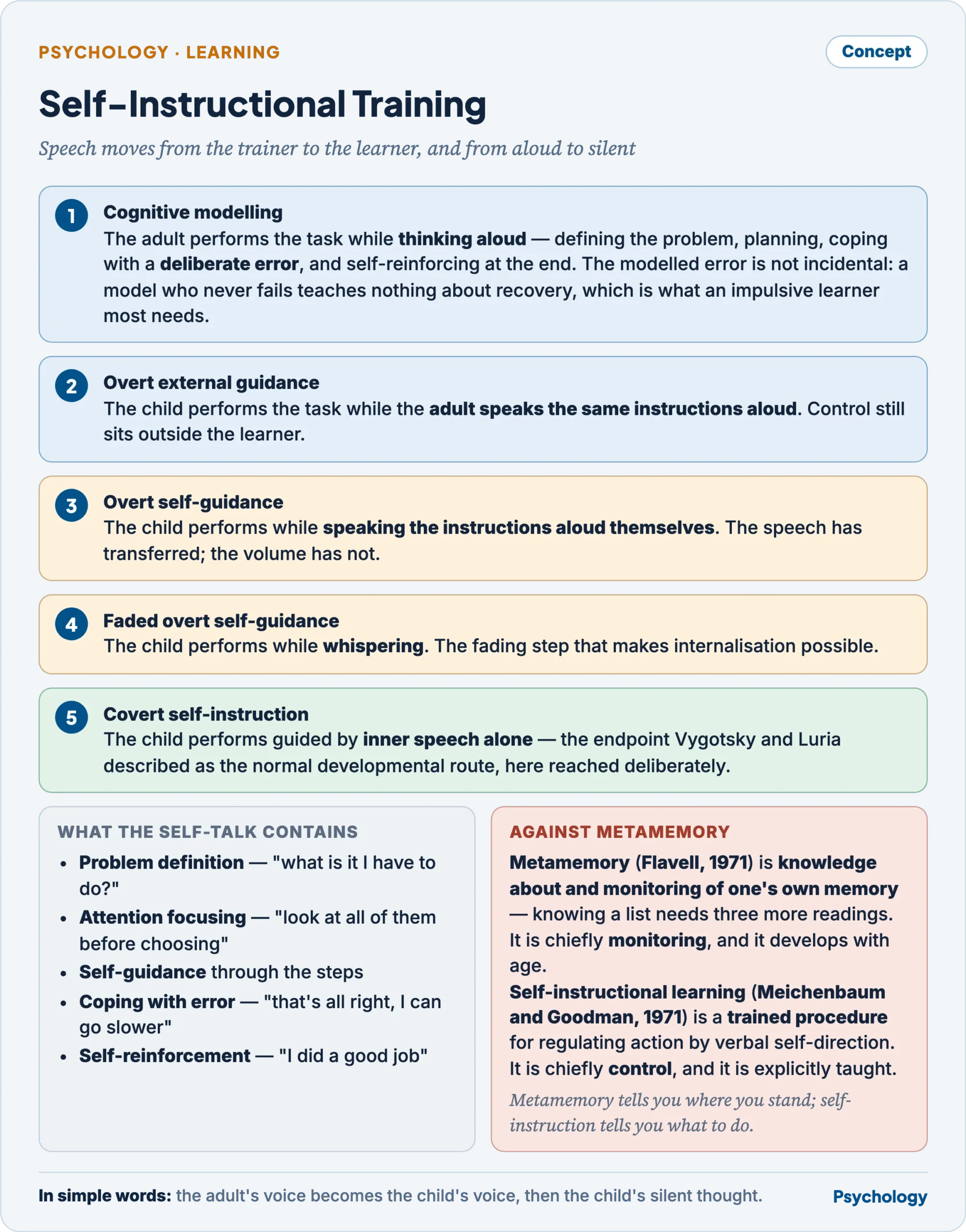
- Cognitive modelling. The adult performs the task while thinking aloud — defining the problem, planning, coping with a deliberate error, and self-reinforcing at the end.
- Overt external guidance. The child performs the task while the adult speaks the same instructions aloud.
- Overt self-guidance. The child performs while speaking the instructions aloud themselves.
- Faded overt self-guidance. The child performs while whispering.
- Covert self-instruction. The child performs while guiding themselves through inner speech alone.
The content of the self-talk is as deliberate as the sequence, and covers problem definition (“what is it I have to do?”), attention focusing, self-guidance through the steps, coping with error (“that’s all right — I can go slower”), and self-reinforcement (“I did a good job”). Including a modelled error is not incidental: a model who never fails teaches nothing about recovery, which is the part an impulsive learner most needs.
Applications run from impulsivity and attention difficulties, through anger and aggression, test and performance anxiety, academic problem-solving, pain management and sports performance. Meichenbaum’s stress inoculation training generalises the method into a three-phase treatment — conceptualisation, skills acquisition and rehearsal, then application under graded real stress — and is among the better-evidenced cognitive-behavioural procedures. The broader descendant is self-regulated learning in Zimmerman’s sense, cycling through forethought, performance monitoring and self-reflection.
Self-instructional learning and metamemory
The two are often confused because both sit inside metacognition, and they differ on every dimension that matters.
| Metamemory | Self-instructional learning | |
|---|---|---|
| What it is | Knowledge and monitoring of one’s own memory | A training procedure for regulating behaviour by verbal self-direction |
| Named by | Flavell (1971) | Meichenbaum and Goodman (1971) |
| Domain | Memory specifically | Any goal-directed action |
| Metacognitive function | Chiefly monitoring — knowing what one knows | Chiefly control — directing what one does |
| Typical measure | Judgements of learning, feeling-of-knowing, confidence accuracy | Observed task behaviour, errors, latency to respond |
| Acquired how | Develops with age and experience | Explicitly trained, through a fixed fading sequence |
| Example | Knowing a list needs three more readings, and that one is better at faces than at names | Saying “slow down, look at all four pictures, then choose” while working |
The compact statement: metamemory tells you where you stand; self-instruction tells you what to do. Monitoring without control changes nothing, and control without monitoring is undirected, which is why mature self-regulation requires both.
Comparing the three
| Programmed learning | Probability learning | Self-instructional learning | |
|---|---|---|---|
| What it is | A method of instruction | A phenomenon of behaviour under uncertainty | A training procedure for self-regulation |
| Theoretical parent | Operant conditioning, Skinner | Statistical learning theory, Estes | Vygotsky and Luria on inner speech |
| Environment | Designed, deterministic, feedback certain | Natural or simulated, probabilistic, feedback unreliable | Any; the learner supplies the structure |
| Who controls the sequence | The programme | Nobody — the environment is indifferent | The learner, progressively |
| Feedback | Immediate and correct at each step | Delayed in effect, misleading trial by trial | Self-generated |
| Learning outcome | A correct repertoire | A probability estimate | A self-regulatory skill |
| Error is | Designed out (Skinner) or diagnostic (Crowder) | Unavoidable even when learning is perfect | Explicitly modelled and coped with |
| Awareness | Explicit throughout | Largely implicit | Begins overt, ends covert |
The deepest contrast is between the first two. Programmed learning assumes an engineered, certain environment, and builds the instruction accordingly; probability learning describes what organisms do without one. The third is the only one of the three in which the learner, rather than a designer or an environment, ends up holding the controls.
Criticisms and limitations
- The evidence was always mixed. Comparisons against conventional teaching generally found it as effective and faster, rather than better, and the enthusiasm of the 1960s outran what the data supported.
- Errorless learning is now doubted. Desirable difficulty, retrieval practice and productive failure all suggest that some error improves retention, which is the opposite of Skinner’s design rule.
- Matching is robust; its explanation is not settled, with statistical-learning, pattern-search and ecological accounts each supported in part and none decisive.
- The literature rests on artificial two-choice tasks with no cost to error, and generalising from them to consequential real decisions is an assumption rather than a demonstration.
- Self-instructional training generalises weakly to untrained settings and over time — the recurring limitation of cognitive-behavioural skill training, and the reason booster sessions and training across settings are built in.
- The three do not form a coherent category, and treating them as one subject because the syllabus lists them together obscures that one is a technology, one a phenomenon and one a therapy.
- Indian work is thin, with programmed instruction having been taken up in teacher education and distance learning but with limited published evaluation, which is itself worth noting where an answer asks about relevance to Indian education.
Previous Year Questions
- 2023Compare and contrast between programmed and probability learning and also highlight their advantages and disadvantages.
- 2020Differentiate between metamemory and self-instructional learning. Elaborate your answer with suitable examples.
- 2018Examine how probability learning is different from other types of learning. Give examples.
- 2015Evaluate the notion of programmed learning and describe its relevance for modern day education with suitable examples.
- 2014What are the distinctive features of probability learning? How useful is it in real life?
- 2009Discuss various characteristics of probability learning. Prepare an experimental design of probability learning following ‘Bernoulli Sequence’. When is the behaviour of the subject labeled as ‘gambler’s fallacy’?
- 2008Using the procedure of programmed learning, how would you conduct ‘anger-reduction’ training for a group of individuals who have been assessed high on anger? The training procedure needs to be as per the instructional design model.
- 1998Delineate the principles involved in programmed learning. Is it feasible to programme higher form of learning?
- 1996Nature of and theory underlying programmed learning and its implications for teaching.