

Extrasensory perception.
Official Syllabus: Paper I · Unit 5 Sensation, Attention and Perception
“Extra-sensory perception … perception without the function of the recognised senses.”
— J. B. Rhine (1934), in Extra-Sensory Perception, naming the field he founded
Extrasensory perception is on the syllabus and it is not an established phenomenon. That combination determines how it must be treated: the honest answer describes what is claimed, describes the methods used to test it, states clearly what the evidence shows, and then explains the more interesting psychological question — why belief in it is so widespread and so resistant, which is a question about normal cognition rather than about anomalous perception.
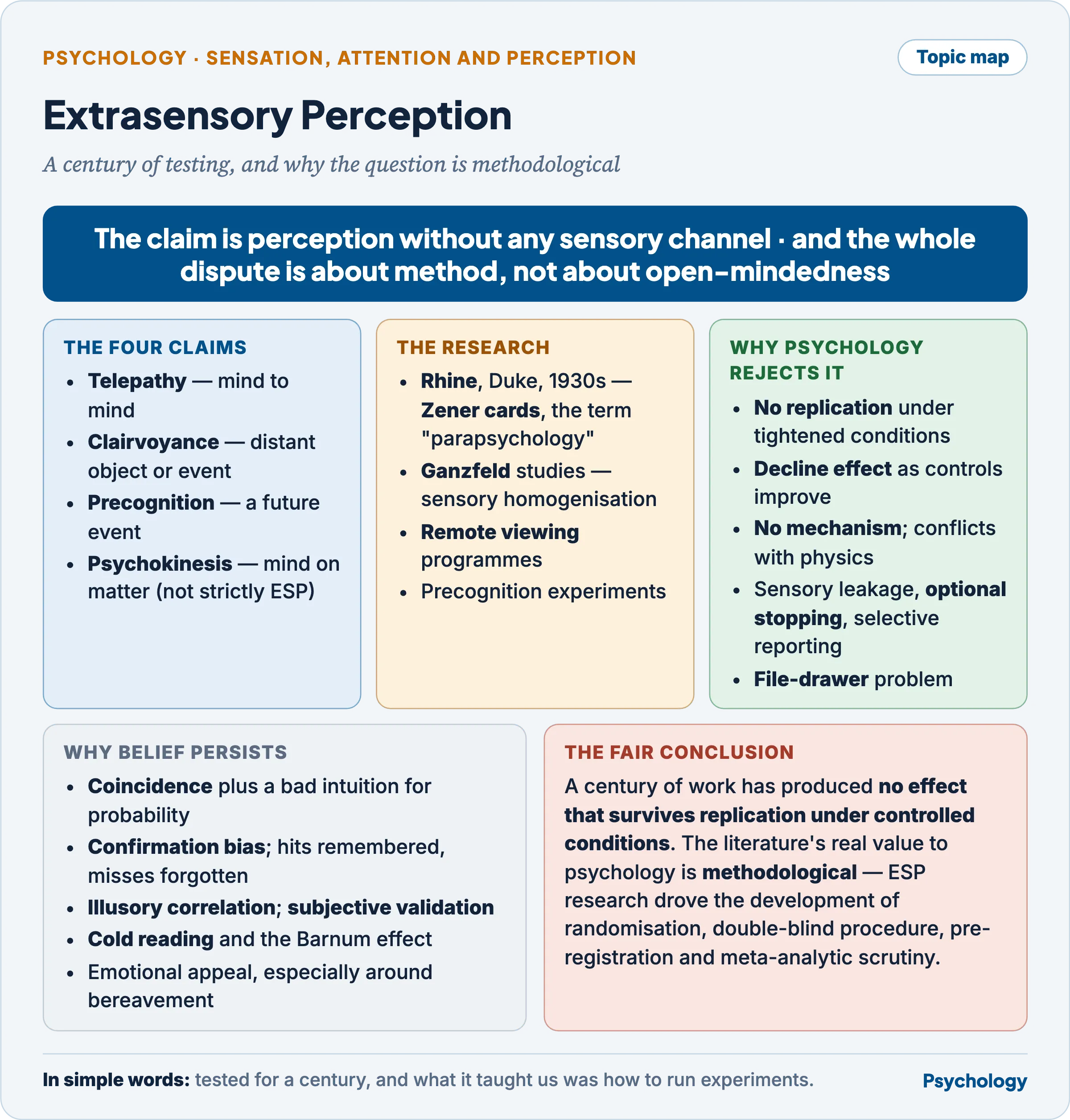
What is claimed
Extrasensory perception (ESP) is the claimed acquisition of information about the world without the use of the known sensory channels and without inference from information so acquired. With psychokinesis it makes up the field of psi, studied under the name parapsychology.
The claimed forms are conventionally four.
- Telepathy — the transfer of thoughts or feelings between people without sensory communication. The standard illustration is a person reporting the content of a distant friend’s thoughts; the everyday instance offered is thinking of someone just before they telephone.
- Clairvoyance — awareness of objects or events not accessible to the senses and not present in anyone’s mind. The standard illustration is naming a card sealed in an opaque envelope, or describing a distant location.
- Precognition — awareness of a future event that could not be inferred from present information. The standard illustration is a dream or premonition that precedes a disaster.
- Retrocognition — knowledge of a past event not learned by ordinary means, less often studied.
Psychokinesis, the influence of mind on matter without physical means, is the output counterpart — historically tested with dice and later with electronic random number generators.
How it has been tested
The field’s scientific history is a progressive tightening of method, driven each time by a demonstrated loophole, and the sequence is itself the most useful thing to know about it.
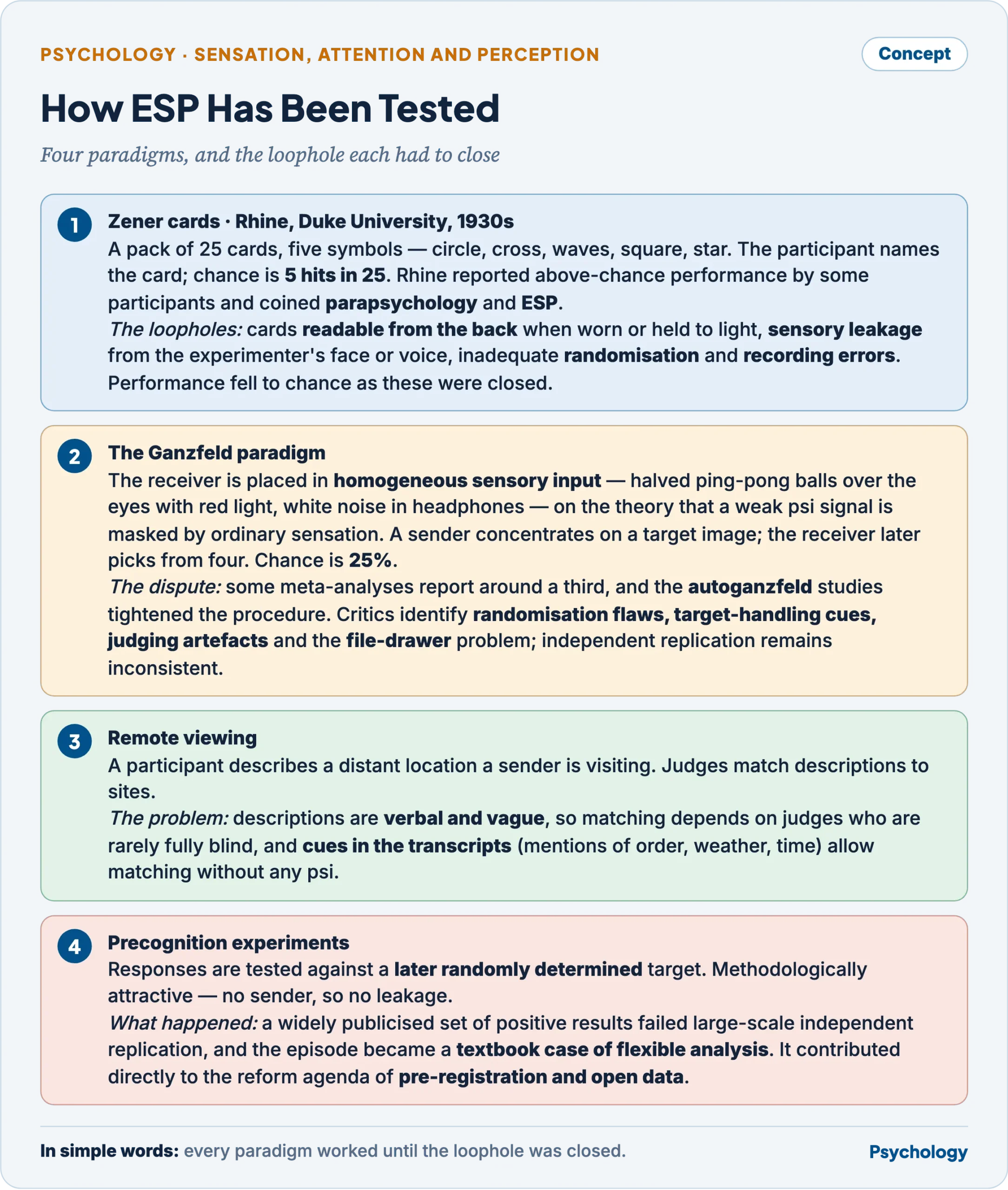
- Rhine’s card-guessing programme. J. B. Rhine at Duke University from the 1930s established the standard laboratory paradigm using Zener cards — a deck of 25 containing five each of circle, cross, wavy lines, square and star. The participant guesses the order; chance expectation is 5 hits in 25, so performance is assessed against a precisely known baseline. Rhine coined the terms extrasensory perception and parapsychology, and reported above-chance scoring.
- The critiques of the card work identified the loopholes that any guessing study must close: sensory leakage, including the possibility of reading the symbol from the back of a card or from reflections; recording errors biased toward the hypothesis; inadequate randomisation of the deck, since human shuffling leaves exploitable structure; optional stopping, ending a run when ahead; and selective reporting of successful series. Independent replication was poor, and the effects tended to shrink as controls tightened — a pattern known in the field as the decline effect.
- The ganzfeld procedure, developed by Honorton (1974), was the methodological response and is the field’s strongest paradigm. The receiver is placed in homogeneous sensory stimulation — halved ping-pong balls over the eyes under red light, white noise through headphones — on the theory that a weak psi signal is masked by ordinary sensory input and will emerge when that input is reduced. A sender in another room views a randomly selected target; the receiver describes their imagery; and an independent judge ranks the receiver’s description against four images, one target and three decoys. Chance is therefore 25 per cent.
- The meta-analytic exchange. Bem and Honorton (1994) reported a set of autoganzfeld studies, automated to eliminate experimenter handling of targets, with hit rates above chance. Milton and Wiseman then meta-analysed 30 ganzfeld studies from 7 independent laboratories following the same stringent guidelines and failed to confirm the effect: the combined result was non-significant, with a mean effect size near zero, and they concluded that the ganzfeld does not at present offer a replicable method for producing ESP in the laboratory.
- Bem’s precognition studies. Daryl Bem (2011), in the Journal of Personality and Social Psychology, reported nine experiments that reversed standard psychological paradigms — running priming and recall procedures backwards in time — and reported effects consistent with precognition. Bem, Tressoldi, Rabeyron and Duggan (2016) followed with a meta-analysis of 90 experiments from 33 laboratories in 14 countries with over 12,000 participants, reporting a small but highly significant overall effect, Hedges’ g of about 0.09.
- The counter-evidence. Wagenmakers and colleagues (2011) argued that Bem’s analyses were flawed and that a Bayesian treatment of the same data gave no support for psi. Ritchie, Wiseman and French (2012) ran three independent replications of the retroactive-recall experiments and failed to find the effect, and had difficulty publishing the null result. Galak and colleagues (2012) likewise failed to replicate across a large sample.
What the evidence shows
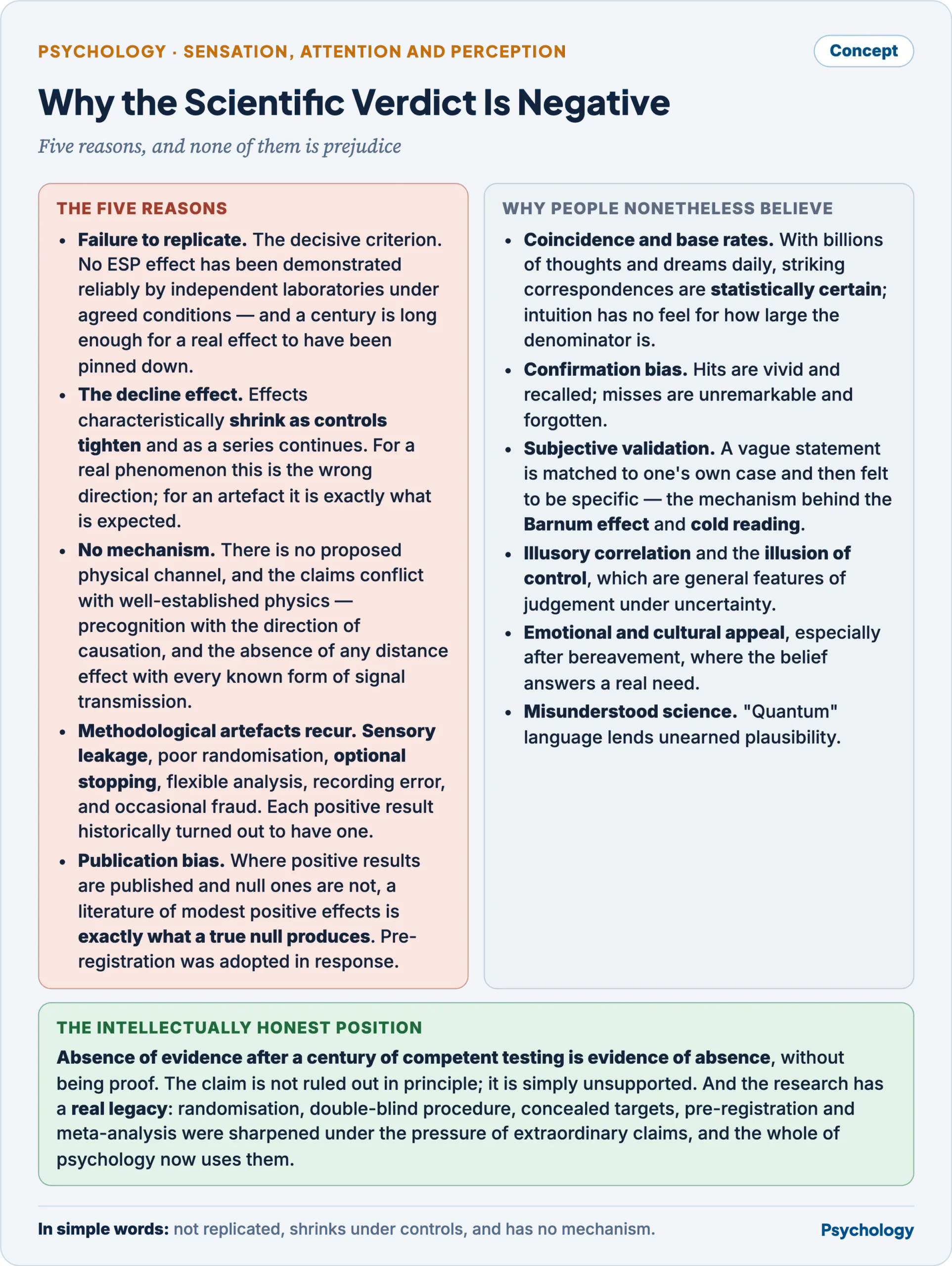
The position that the evidence supports can be stated in four propositions.
- No psi effect has been established to the satisfaction of the scientific community, after roughly ninety years of systematic laboratory work.
- The characteristic pattern is a small effect that does not survive independent replication by investigators who do not expect it. Effects shrink as controls tighten, and the most careful multi-laboratory tests have been null.
- There is no mechanism. Every proposed physical channel is excluded by what is known of physics, and the absence of any candidate mechanism raises the evidential bar — a claim incompatible with well-established theory requires stronger evidence than one that merely extends it.
- The methodological debate has been genuinely productive for psychology at large. This is the point most worth making. Bem’s paper, published in a mainstream journal with conventional methods, confronted psychology with the fact that its standard procedures could produce decisive-looking evidence for something almost certainly false. That recognition was one of the triggers of the replication crisis and of the reforms that followed — pre-registration, direct replication, adequate power, Bayesian alternatives to null-hypothesis testing, and the publication of null results. Parapsychology’s lasting contribution has been to serve as psychology’s test case for its own methods.
A fair statement of the opposing view belongs in a critical answer: proponents argue that psi effects are small, elusive and dependent on experimenter and participant factors, that the replication standard applied to them is stricter than that applied elsewhere in psychology, and that several of the failed replications departed from the original protocols. The reply is that an effect which appears only for believing investigators and vanishes under pre-registration is better explained by the known properties of flexible analysis than by a new channel of perception.
Why people believe: the cognitive determinants
The genuinely psychological question is why a belief this widespread persists without evidential support, and the answer is that normal cognition generates it reliably. No deficit needs to be invoked.
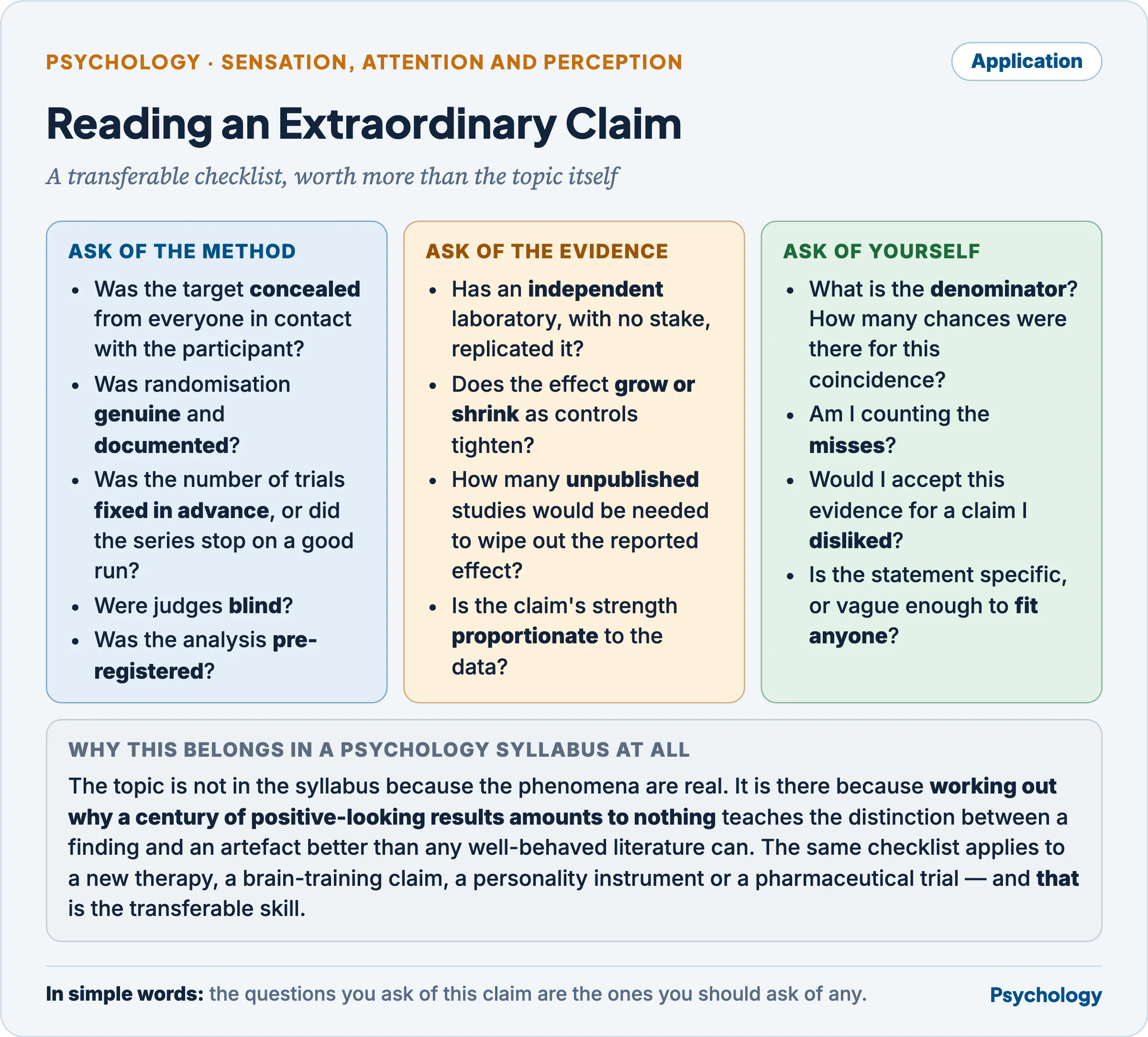
- Misjudgement of probability. People systematically underestimate how often coincidences occur by chance. In a population of a billion, events of one-in-a-million likelihood happen a thousand times a day, so a striking coincidence requires no explanation beyond the size of the sample. The birthday problem illustrates how poor the intuition is: in a group of only 23 people a shared birthday is more likely than not, a result Richard von Mises (1939) first set out and which almost nobody guesses correctly.
- The availability heuristic. A dream that preceded a death is memorable and retold; the thousands of dreams that preceded nothing are forgotten, so the base rate is unavailable and the hit rate appears high.
- Confirmation bias and selective recall. Hits are noticed, counted and recounted; misses are not. The “thinking of someone before they call” experience requires that we remember the times we thought of someone and they called, and forget the far more numerous times we thought of someone and they did not.
- Illusory correlation. People perceive a relationship between two events that is not present in the data, particularly when both are distinctive.
- Illusion of control and patternicity — the strong disposition to detect agency and pattern in randomness, which is adaptive overall and generates false positives constantly.
- The Barnum effect. Vague, general statements are accepted as specific and personal, which is why a cold reading seems uncannily accurate. This single effect accounts for a large part of belief in psychic practitioners.
- Poor understanding of randomness. People expect random sequences to look more alternating and less clustered than they are, so genuine randomness appears patterned and therefore meaningful.
- Source-monitoring failure. With time, information learned ordinarily is misremembered as having been known without a source, which converts an ordinary memory into an apparent premonition.
- The post-hoc fit. Ambiguous predictions are matched to events after the fact, which is how prophecy survives.
Why people believe: the motivational determinants
- The need for control. Belief in psi offers knowledge of, and influence over, events that are otherwise uncontrollable. Experimentally, inducing a loss of control reliably increases illusory pattern perception and superstitious belief, which is close to a direct demonstration of the mechanism.
- Anxiety and uncertainty reduction. Foreknowledge, even illusory, reduces the distress of an unpredictable future, which is why belief rises under conditions of threat and instability.
- Death anxiety. Survival of consciousness is entailed by much of the psi framework, and terror-management research finds that reminders of mortality increase supernatural belief.
- Meaning and significance. Psi beliefs make the believer part of a connected, meaningful order rather than an accident, which is a substantial psychological good.
- Bereavement. The wish to retain contact with the dead is among the strongest motives, and it is what mediumship has always addressed.
- Identity and group membership. For some, the belief is part of a community and a worldview, so evidence against it is experienced as a social threat and resisted accordingly.
- Wishful thinking and the desire for the extraordinary, together with the simple pleasure of a world containing more than the ordinary.
Individual differences complete the account: belief correlates with external locus of control, with intuitive rather than analytic thinking style, with lower probabilistic reasoning skill, with high absorption and fantasy-proneness, and with transliminality, the tendency for material to cross between conscious and unconscious. Belief is not reliably related to general intelligence, which is worth saying because the assumption that it is a mark of stupidity is both wrong and unhelpful.
The Indian context is worth a line. Belief in precognition, astrology and the supernatural is widespread and culturally embedded, with institutional and economic structures supporting it, and the scientific-temper provision of Article 51A(h) of the Constitution makes its examination a matter of public policy as well as of psychology. Legislation against exploitative practices, such as Maharashtra’s anti-superstition and black magic Act, targets the exploitation rather than the belief — which is the defensible line, since the cognitive processes generating the belief are universal and not a pathology.
Criticisms and limitations
- The field is unfalsifiable in practice. Failure is routinely attributed to experimenter attitude, participant mood, or a sceptical presence inhibiting the effect, which converts every null result into a confirmation and removes the possibility of disproof.
- There is no theory. Without a mechanism, there is no prediction of when psi should be stronger or weaker, so the research cannot be theory-driven and findings cannot be cumulative.
- The replication record is the central problem, and the decline effect — effects weakening as procedures tighten — is exactly what would be expected if the original effects were artefacts.
- Publication bias is severe and hard to assess. Null results in a contested field are less likely to be submitted and published, and the file-drawer corrections proponents apply depend on assumptions that cannot be checked.
- The sceptical position has its own weakness. Dismissing the field a priori is not science either, and some of the criticism has been as motivated as the advocacy; the proper ground is the evidence and the methods, which are sufficient on their own.
- The belief literature is largely Western, and the determinants of belief in societies where the supernatural is a normative part of the shared worldview rather than a deviation from it are much less studied — a gap that matters directly for the Indian case.
Previous Year Questions
- 2021Discuss the cognitive and motivational determinants of the belief in extra sensory perception.
- 2005Citing relevant example, describe extra-sensory perception.