

The plasticity of perception.
Official Syllabus: Paper I · Unit 5 Sensation, Attention and Perception
“The inverted position of the retinal image is not essential to upright vision, for it is not essential to a harmony between touch and sight.”
— George Stratton (1897), after living for days in a world turned upside down
Plasticity is the capacity of the perceptual system to change in response to altered input. It is the property that decides a long-standing question: whether perception is a fixed translation of stimulation determined by the structure of the nervous system, or a learned and revisable set of relations between sensation and action. The experiments that bear on it are among the most physically demanding in psychology, because the only way to test the question is to disrupt perception and live with the result.
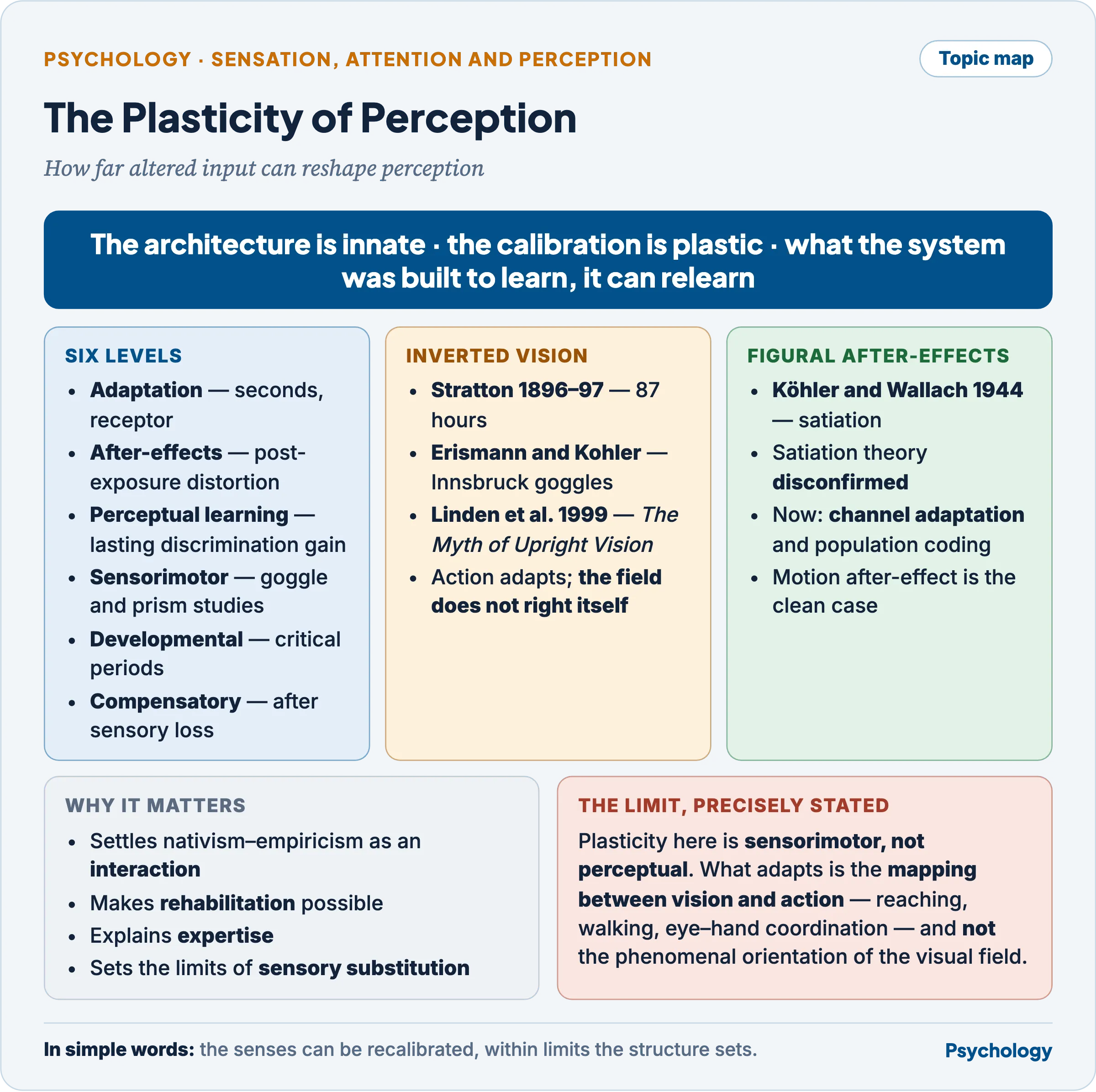
What plasticity means, and why it matters
Plasticity operates at several levels, and distinguishing them prevents the usual muddle.
- Adaptation — the short-term change in sensitivity under constant stimulation, which is receptor-level and reverses in seconds or minutes.
- After-effects — the temporary distortion of perception that follows prolonged exposure to a stimulus, which reveals that the system has recalibrated.
- Perceptual learning — the lasting improvement in discrimination with practice, which is how an expert comes to see what a novice cannot.
- Sensorimotor adaptation — the recalibration of the relation between perception and action under distorted input, which is what the goggle experiments test.
- Developmental plasticity — the shaping of the perceptual system by input during critical periods, which is irreversible once the window closes.
- Compensatory plasticity — the reorganisation that follows loss of a sense, in which cortex devoted to the lost modality is recruited by the remaining ones.
Its significance is fourfold. It settles the nativism–empiricism question in favour of an interaction rather than either extreme. It makes rehabilitation possible after sensory loss or brain injury. It explains expertise — the radiologist’s eye, the musician’s ear, the wine taster’s palate are products of perceptual learning. And it sets the limits within which sensory substitution and prosthetics can work.
The inverted-vision experiments
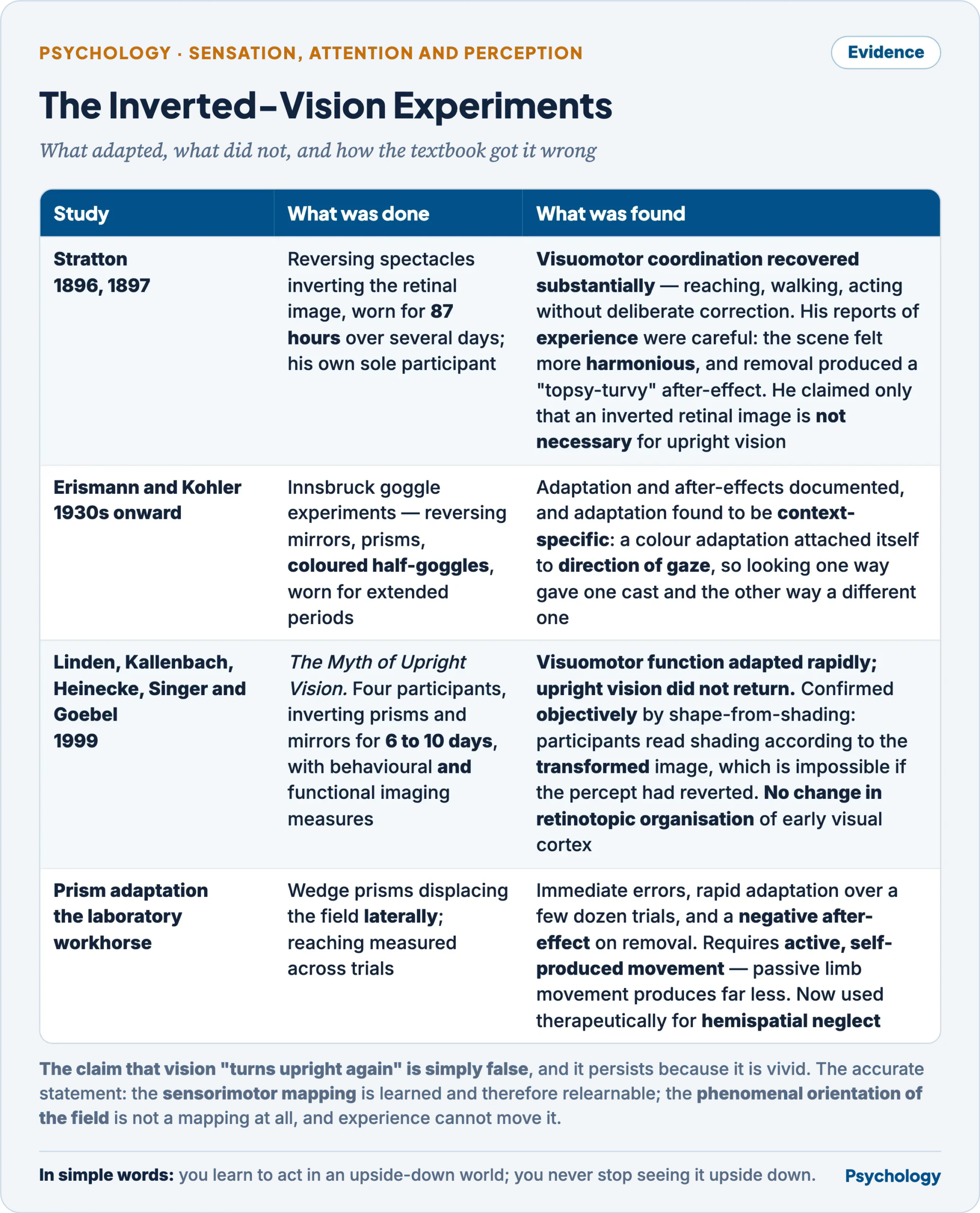
George Stratton (1896, 1897) built the first reversing spectacles: a short tube of lenses that inverted the retinal image, so that the world appeared upside down and left-right reversed. He wore the device for 87 hours over several days, patching his eyes at night.
His findings fall in two parts.
- Behaviour. Initially everything failed — he could not reach for objects, walk without stumbling, or avoid obstacles; he reported vertigo and nausea. Over the days, visuomotor coordination recovered substantially. He could move about, reach accurately, and act without constant deliberate correction.
- Experience. His reports of visual experience are more equivocal, and this is where the literature has gone wrong. He described the scene as gradually feeling more harmonious and reported moments in which things seemed normally placed, and on removing the spectacles the world again seemed “topsy-turvy” — a clear after-effect. He did not claim that the visual field had simply flipped back upright, and his own conclusion was carefully worded: an inverted retinal image is not necessary for upright vision, because what matters is the harmony between sight, touch and movement, not the absolute orientation of the image.
Erismann and Kohler, in the Innsbruck Goggle Experiments from the 1930s onward, extended the work with reversing mirrors, prismatic goggles and coloured half-goggles worn for extended periods. They documented both adaptation to the distortion and after-effects on its removal, and found adaptation to be context-specific — a colour adaptation acquired through half-coloured goggles attached itself to direction of gaze, so looking one way produced one colour cast and looking the other a different one.
The modern corrective
The textbook claim that vision “turns upright again” does not survive careful testing, and the correction is the most valuable thing an answer can contain.
Linden, Kallenbach, Heinecke, Singer and Goebel (1999), in a study pointedly titled The Myth of Upright Vision, had four participants wear inverting prisms and mirror spectacles for six to ten days with both behavioural and functional imaging measures.
- Visuomotor functions adapted rapidly — the participants learned to act effectively in the inverted world, as Stratton had.
- Upright vision did not return. No participant reported the visual field righting itself.
- The persistence of the transformed image was confirmed objectively by testing shape from shading: the participants continued to interpret shading according to the transformed image rather than the world, which they could not have done if the percept had reverted.
- No change was found in the retinotopic organisation of early visual cortex, so whatever adaptation occurred was not a remapping of the primary visual map.
The conclusion is precise and worth stating in these terms: plasticity in this domain is sensorimotor, not perceptual. What adapts is the mapping between vision and action — reaching, locomotion, eye-hand coordination — and not the phenomenal orientation of the visual field. The frequently repeated claim that the world flips back upright is an over-reading of Stratton’s cautious language.
Prism adaptation — a lateral displacement rather than an inversion — is the laboratory workhorse and shows the same structure. Wearing wedge prisms that shift the field sideways produces immediate reaching errors, rapid adaptation over a few dozen trials, and a negative after-effect in the opposite direction when the prisms are removed. The adaptation requires active, self-produced movement: passively moved limbs produce far less. This is the clearest evidence that the recalibration is of the sensorimotor map rather than of vision itself, and prism adaptation is now used therapeutically for hemispatial neglect after right-parietal stroke.
Figural after-effects
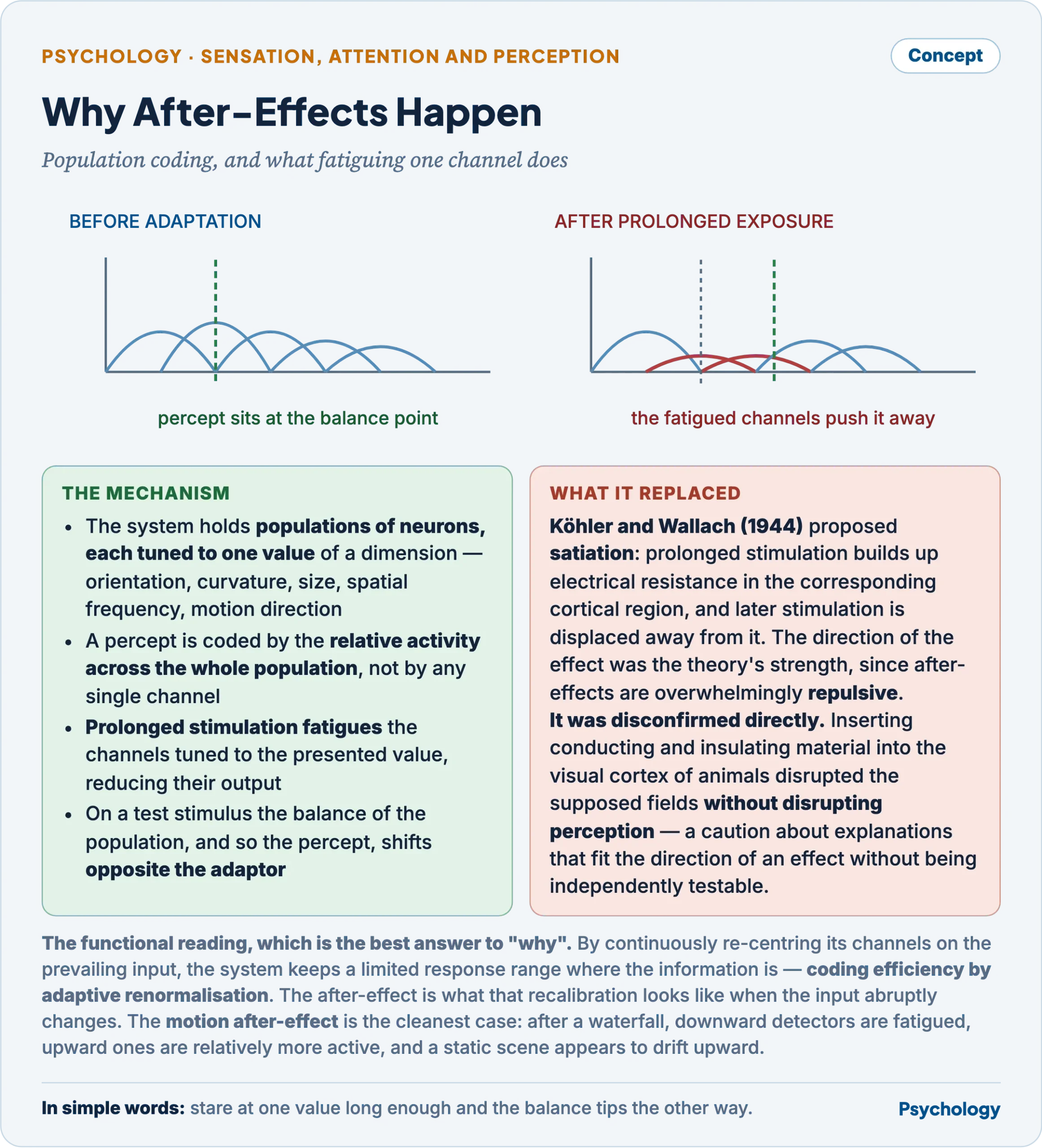
A figural after-effect is a distortion in the perceived position, size or shape of a test figure produced by prolonged inspection of an inspection figure nearby. Having fixated a curved line, a straight line in the same location appears curved the opposite way; having inspected a small circle, a medium circle appears larger.
Köhler and Wallach (1944) described these systematically and gave the classical explanation, satiation theory. On their account prolonged stimulation produces electrical satiation in the corresponding region of cortex — an accumulation of resistance in Köhler’s field-theoretical terms — and subsequent stimulation is displaced away from the satiated region, producing the characteristic repulsion away from the inspection figure.
The direction of the effect is the theory’s strength: after-effects are overwhelmingly repulsive, pushing the test percept away from the adapting stimulus, which satiation predicts naturally.
Why they take place — the modern account. Köhler’s cortical field theory has been abandoned, and for good reason: the direct test of it failed, since inserting conducting and insulating material into the visual cortex of animals disrupted the supposed fields without disrupting perception. The explanation that replaced it is neural adaptation in channels tuned to the relevant dimension.
- The visual system contains populations of neurons each tuned to a particular value of a dimension — orientation, curvature, size, spatial frequency, motion direction.
- A percept is coded by the relative activity across the whole population, not by any one channel.
- Prolonged stimulation fatigues the channels tuned to the presented value, reducing their output.
- When a test stimulus is presented, the fatigued channels respond less, so the balance of the population shifts away from the adapted value — and the percept shifts with it, in the direction opposite the adaptor.
This is why the motion after-effect — the waterfall illusion, in which a static scene appears to drift upward after watching a waterfall — is the cleanest instance: downward-motion detectors fatigue, upward detectors are relatively more active, and stationary objects are seen to rise. It is why after-effects are specific to the adapted dimension, location and often the adapted eye, which a general fatigue account could not explain.
The functional interpretation, which is the best answer to why they occur, is that after-effects are the visible side-effect of a useful recalibration. By continuously re-centring its channels on the prevailing input, the system keeps its limited response range centred where the information is — coding efficiency achieved by adaptive renormalisation. The after-effect is what that recalibration looks like when the input abruptly changes.
Other evidence for plasticity
- Perceptual learning. Discrimination improves with practice in ways that are often highly specific to the trained orientation, location and even eye, which indicates change at relatively early cortical stages rather than a general improvement in judgement. The expert radiologist, the chick-sexer and the wine taster are the everyday instances.
- Sensory substitution. Tactile-visual substitution devices convert a camera image into a pattern of stimulation on the skin or tongue. After training, blind users come to experience the information as externally located objects rather than as sensations on the skin, which is a striking demonstration that the modality of input does not fix the character of experience. Imaging shows visual cortex activation in such users.
- Cross-modal reorganisation. In the congenitally blind, visual cortex is recruited for Braille reading and auditory tasks; in the deaf, auditory cortex responds to visual motion. The cortex is substantially shaped by the input it receives rather than being irrevocably committed.
- Cochlear implants and restored sight show both plasticity and its limits: the earlier the intervention, the better the outcome, and adults receiving sight after lifelong blindness achieve far less than children do.
Plasticity against innate tendencies
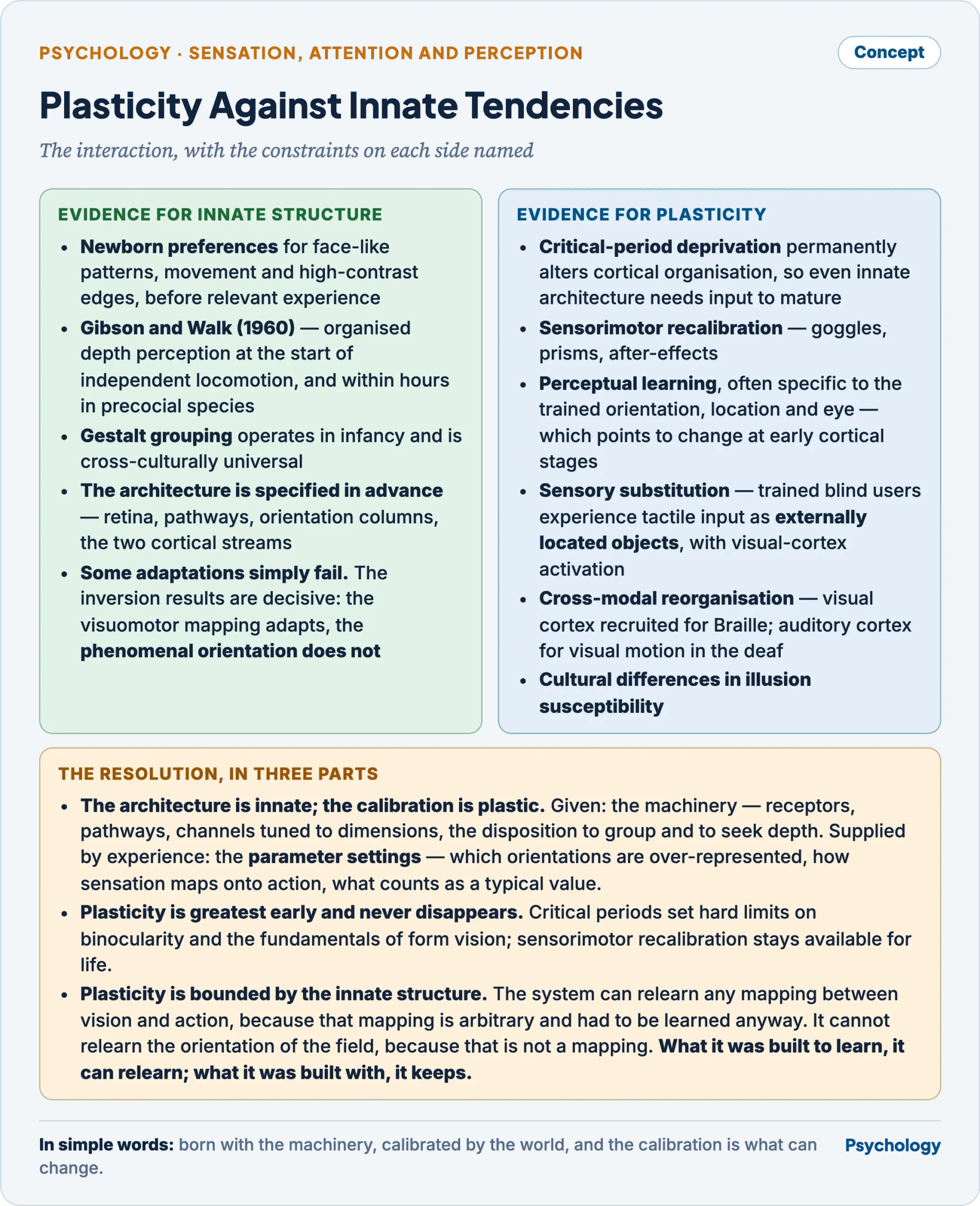
The critical question is how far plasticity goes, and the answer is a genuine interaction, with specifiable constraints on each side.
Evidence for innate structure.
- Newborn preferences for face-like patterns, for moving stimuli and for high-contrast edges appear before relevant experience.
- The visual cliff of Gibson and Walk (1960) shows organised depth perception at the start of independent locomotion, and in precocial species within hours of birth.
- Gestalt grouping principles operate in infancy and are cross-culturally universal.
- The architecture is specified in advance: the retina, the pathways, the orientation columns and the two cortical streams develop in a genetically determined pattern.
- Some adaptations fail. The inverted-vision results are the decisive case: the visuomotor mapping adapts and the phenomenal orientation of the field does not, which indicates a limit that experience cannot move.
Evidence for plasticity.
- Critical-period deprivation permanently alters cortical organisation, so even the innate architecture requires input to mature.
- The goggle, prism, after-effect, sensory-substitution and cross-modal findings above.
- Cultural differences in illusion susceptibility, which show the visual environment installing lasting interpretive habits.
The resolution has three parts, and stating them in this form is what the critical evaluation requires.
- The architecture is innate; the calibration is plastic. What is given is the machinery — receptors, pathways, channels tuned to dimensions, the disposition to group and to seek depth. What experience supplies is the setting of the parameters: which orientations are over-represented, how sensation maps onto action, what counts as a typical value on each dimension.
- Plasticity is greatest early and never disappears. Critical periods set hard limits on some functions, chiefly binocularity and the fundamentals of form vision. Sensorimotor recalibration and adaptation remain available throughout life.
- Plasticity is bounded by the innate structure, and this is the point the inversion experiments make. The system can relearn any mapping between vision and action, because that mapping is arbitrary and must be learned anyway. It cannot relearn the phenomenal orientation of the visual field, because that is not a mapping but a property of how the field is constructed. What the system was built to learn, it can relearn; what it was built with, it keeps.
Criticisms and limitations
- The classic studies are self-experiments with one participant. Stratton was his own sole subject, and the Innsbruck work used very small numbers, so the introspective reports that founded the field are unreplicated and unblinded.
- Introspective report is the wrong measure for the central question. Asking whether the world “looks upright” is a question participants cannot answer reliably, which is exactly why Linden and colleagues’ objective shape-from-shading test was needed, and why it reached the opposite conclusion.
- The textbook claim is simply wrong and persists anyway. That vision inverts and then rights itself is still widely repeated, and it is a good example of a vivid finding outliving its evidence.
- Köhler’s satiation theory was disconfirmed, and figural after-effects were for decades explained by a mechanism now known not to exist — a caution about explanations that fit the direction of an effect without being independently testable.
- Adaptation after-effects are often very brief and highly specific, so inferring large-scale plasticity from them over-reads the evidence.
- Sensory substitution results are promising and limited. Trained users extract information well; whether their experience is genuinely visual, or an efficient tactile code they have learned to interpret, is not settled and may not be answerable.
- Most of the literature is visual. Plasticity in olfaction, taste and the body senses is comparatively unstudied, so the generality of the conclusions is assumed.
Previous Year Questions
- 2023What is the meaning and significance of plasticity of perception? Discuss.
- 2018Perception is plastic. However, it may also be affected by innate tendencies. Critically evaluate.
- 1997Why do Figural-After-Effects take place?